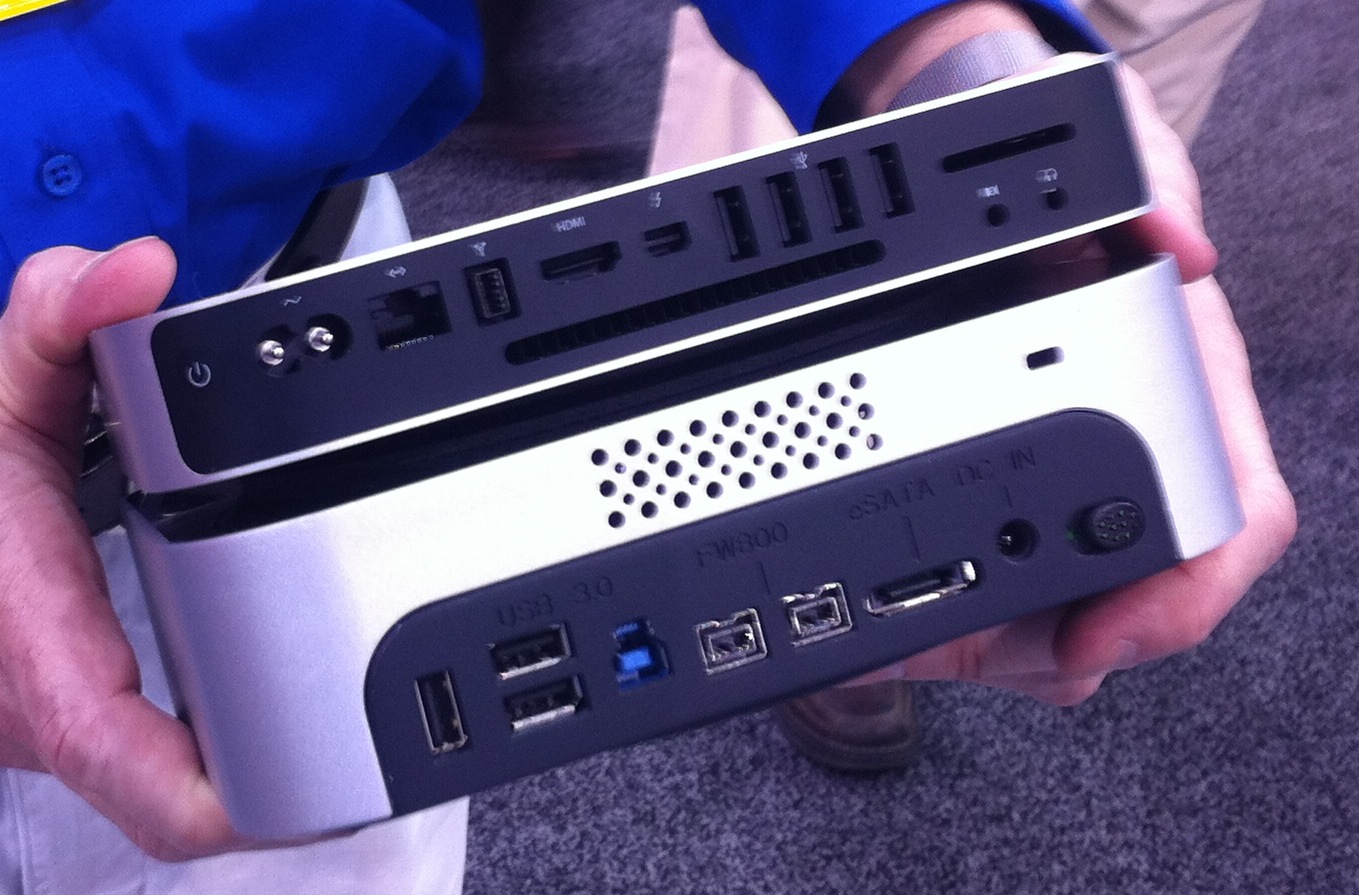
We love this add-on to the Mac Mini that turns it into more of a pro-device (and a cube!). The business up front is a DVD-R drive (not sure about BluRay) and an SDXC card reader that complements the one on the back of the mini. On the rear, you get a high power USB source for quick-charging an iPad as well as a few USB 3.0 ports that require separate drivers. Also on the back is an eSATA port for fast external peripheral support as well as two Firewire 800 ports. Inside, there is room for up to a 4TB 3.5 inch hard drive which you can order with the Mini Stack Max or you can bring your own.
This is interesting because it is moving the Mini more toward a pro-like setup.
.
OWC has not put a price on the Mac Mini Stack Max but expects them to be available in March. Expand Expanding Close
Inside Applewriter Adam Lashinky at Fortune and Steve Jobs Biography writer Walter Isaacson recently discusseda great story of how Steve Jobs got Corning to (re)invent Gorilla Glass:
..a really great CEO in this country, Wendell Weeks, who runs Corning Glass. Steve Jobs when he does the iPhone decides he doesn’t want plastic, he wants really tough glass on it, and they don’t make a glass that can be tough like they want. And finally somebody says to him, because they were making all of the glass in China for the fronts of the stores, says, “You ought to check with the people at Corning. They’re kind of smart there.” So, he flies to Corning, New York, sits there in front of the CEO, Wendell Weeks, and says, “This is what I want, a glass that can do this.” So, Wendell Weeks says, “We once created a type of process that created something called Gorilla Glass.” And Steve said, “No, no, no. Here’s how you make really strong glass.” And Wendell says, “Wait a minute, I know how to make glass. Shut up and listen to me.” And Steve, to his credit, shuts up and listens, and Wendell Weeks describes a process that makes Gorilla Glass. And Steve then says, “Fine. In six months I want enough of it to make–whatever it is–a million iPhones.” And Wendell says, “I’m sorry, we’ve actually never made it. We don’t have a factory to make it. This was a process we developed, but we never had a manufacturing plant to do it.” And Steve looks at him and says what he said to Woz, 20, 30 years earlier: “Don’t be afraid, you can do it.” Wendell Weeks tells me… Because I flew to Corning, because I just wanted to hear this story. Wendell Weeks tells me, “I just sat there and looked at the guy. He kept saying, ‘Don’t be afraid. You can do this.'”
[audience laughter]
WI: Wendell Weeks said he called his plant in Kentucky that was making glass for LCD screens, and said, “Start the process now, and make Gorilla Glass.” That’s why every iPhone in your pocket and iPad has Gorilla Glass made by Corning. This is the reality distortion field that is, I submit, part and parcel of a guy who doesn’t believe the rules apply to him, even the rule about never cut in line.
AL: And of course Corning uses this in their marketing now, they market Gorilla Glass for other customers.
Fast-forward to today where Corning introduced its Gorilla Glass 2 that is the same strength as the original but at 20 percent thinner to allow for better colors and touch that is more responsive. Alternatively, it is much stronger at the current thickness….
A new report today claimed Apple is gearing up to release a next-generation “iPad 3” with a “full HD display” in March, followed by an “iPad 4” in October. The report came from Asian supply chain watcher DigiTimes who cited Taiwanese industry sources again. Digitimes’ record has been more than a little shaky, especially of late, so approach with caution…
According to the report, iPad 3 will sport a QXGA display (1,536 x 2,048 pixel) and improved battery life, but otherwise hardware specifications will remain largely unchanged. The launch of iPad 3 in March will apparently see the current generation iPad 2 receive a price cut to $399:
The iPad 3 will come with a QXGA (1,536×2,048 pixels) display and longer battery life although its other hardware specifications may not be so amazing as expected, said the sources. But Apple will take the advantage of the iPad 3 launch to slash the price of its iPad 2 to US$399, the sources claimed.
DigiTimes claimed that Apple will drop another 9.7-inch iPad dubbed “iPad 4” by October. The device is expected to have “killer applications,” all-around upgraded hardware specifications, and “integrated applications so as to compete with an array of Android-, Wintel- or WoA (Windows on ARM)-based tablet PCs.” Previously the publication claimed Apple had a 7.85-inch iPad in the works for a late 2012 launch, which their sources later claimed would no longer be happening… Expand Expanding Close
Corning Inc., announced today its plan to unveil Gorilla Glass 2 at the 2012 International Consumer Electronics Show in Las Vegas next week, and the company said more product details would be made available Jan. 9.
The Corning, N.Y.-based company plans to “showcase the critical role of highly engineered specialty glass in addressing emerging trends” at CES 2012. Some of the highlights include increased functionality from smaller form factors; connected devices in new applications; touch technology; and, large-format design aesthetics.
However, the main attraction to the Corning booth will be the introduction of Gorilla Glass 2, which is the next generation of the damage-resistant cover glass found on practically every consumer electronic today. CES attendees will have access to Corning experts and products featuring the latest Gorilla Glass applications.
The timely debut of Gorilla Glass 2 comes just before the rumored early-2012 launch of the iPad 3, as well as the rumored summer-to-fall launch of the iPhone 5, leaving room for Apple to include the latest technology on its upcoming devices.
Although not confirmed, it is worth speculating whether Corning supplied Apple, before today’s announcement, with Gorilla Glass 2 for iOS device production. The idea does not seem far-fetched considering the nature of both companies’ relationship…
Broadcom Corporation is a global innovator for wired and wireless communications, and today the company announced its first family of 802.11ac chips designed for a broad range of product segments.
The chips, also called “5G Wi-Fi” by Broadcom, do not correlate with 3G and 4G cellphone networks. The BCM4360, BCM4352, BCM43526 and BCM43516 chips improve Wi-Fi’s range and are significantly more efficient. Perhaps, the most tantalizing aspect is that the 5GHz-based technology has speeds beyond 1Gbps and is currently in the high-end range of consumer Ethernet.
Apple currently uses Broadcom Wi-Fi Chips in its Mac line and in its iOS devices, including iPad and iPods. The latest MacBook Airs have the Broadcom BCM4322 Intensi-fi® Single-Chip 802.11n Wi-Fi Transceiver. Maybe we will see something a little faster later this year…
A series of patents published by the United States Patent and Trademark Office today (via PatentlyApple) suggested Apple is attempting to own as many Thunderbolt related trademarks and patents as possible. This is despite most being under the impression the technology is an open collaboration between Intel and Apple.
Perhaps the most noteworthy aspect of today’s patents is the possibility Apple might bring Thunderbolt to iOS devices. According to one of the patents published today, “a connection may be provided between a portable media player and a display, a computer and a portable media player, or between other types of devices.”
The benefit of supporting Thunderbolt connections on iOS devices, at least initially, would be to provide faster recharging and data transfer. It is unclear from the patents whether an iOS device would act as a Thunderbolt host machine, like a MacBook, or simply as a supported peripheral. As PatentlyApple pointed out, Apple would have to reengineer the Thunderbolt “connector to be flat enough to fit a USB-type of device slot.”
Apple is already experimenting with next-generation 30-pin connectors that would potentially support high-speed Thunderbolt-like connections. A patent originally filed in 2009, and reported byPatentlyApple in April 2011, showed that Apple is working on a new hybrid connector for iOS devices to support dual-lane Display Port technology (same as Thunderbolt).
UPDATE: The Guardianreported tonight, Jan. 4, that Apple is “believed to have ruled itself out of the running” for the rights to stream Premier League football content.
Despite much speculation from media outlets, such as The Daily Mail, it seems Apple has not even discussed the idea of bidding, and the company is unlikely to make an offer after the conclusion of this season.
Furthermore, The Guardian said Apple’s primary competitor in the streaming device market, Google, is “considered a more likely bidder.”
Reports surfaced late Jan. 3 claiming Apple wants to stream Premier League football content to its Apple TV service.
The Premier League will consider bids for next season after the rights to screen football games expires at the end of the 2011 to 2012 season.
The Daily Mailreported Jan. 3 that both Apple and Google are interested in purchasing rights to Premier League content for their respective Apple TV and Google TV services. Such streaming content is considered premium and could help solidify Apple TV in the United Kingdom while boosting iPad sales.
Apple’s U.K. iTunes subscription infrastructure is secure, but Apple TV is struggling due to a lack of streaming apps offered within the country. Apple TV in the U.K. presently offers a subscription package to Major League Baseball. Therefore, a Premier League app would compliment the available selection considerably.
The Mail did not quote sources but said the involvement of Apple and Google would “give the [Premier League] a hugely competitive market at a time when the price of other TV sports rights are in decline.”
Various reports throughout the year claimed LG is providing the television behind the Apple HDTV. However, nothing conclusive has surfaced.
As far as the big display makers are concerned, Apple’s relationship with LG is probably the strongest. LG makes iPod Touch and iPhone Retina Displays, some iPad displays, and Apple secured a $500 million dollar investment in LG displays in 2009. The net investment was a temporary exclusive on panels for the 27-inch display that Apple’s iMacs and Thunderbolt Displays now use. Sony also makes OLEDs, but it does not have a strong relationship with Apple – at least as far as displays are concerned. The other big OLED maker is Samsung, and it is currently tangled with Apple in patent disputes.
With that said, look at the things that will be shown at the Consumer Electronic show. They have a 4 mm bezel -that is half the thickness of an iPhone 4S- and weighs in at a paltry 16.5-pounds. In addition, things like “1,000 times faster than LED/LCD displays” and “infinite contrast ratio” makes this sound like one of the best displays of 2012.
(Full sized images and the press release are below.):
Much like the somewhat controversial face unlock feature built-in to Google’s Galaxy Nexus smartphone, a new patent application reveals Apple too is working on similar, but more advanced user detection solutions. As PatentlyApplepointed out, Apple noted these recognition systems could land in a future iPhone, iPad, iPod touch, or MacBook.
The basics of the patent entitled “Low Threshold Face Recognition,” is to allow a user to unlock a device—such an iPhone or iPad—using facial recognition. Apple’s solution could allow the device’s camera to recognize the user even when the device is in sleep mode. In other words, the device’s camera would remain active when sleeping, detect the user, and unlock the device without having to press the sleep/wake button. This could, in theory, allow a user to bypass the current Slide to Unlock feature.
Perhaps the most interesting aspect of the system would be the ability for the device’s settings to be customized depending on the user. For example, when detecting a specific user, iOS could set personalized wallpapers, notification settings, and custom configurations for apps. This would provide multiple user logins, allowing iOS users to easily share a device among family or coworkers.
Apple’s system would differ from other face recognition systems by ignoring face biometrics. As PatentlyApple explained, “The face recognition techniques are based on a simple, weighted difference map, rather than traditional (and computationally expensive) correlation matching.” Apple’s system could detect “high information portions” of a face such as the eyes, mouth, or the tip of a nose. In addition, an “orange-distance filter” could be applied to determine variations in skin tone and detect the “likely presence” of a user. This could detect the distance between the device and the user’s face, as well as the user’s “level of attentiveness.”
In 2010, before the iPad launch, The Wall Street Journal reported Apple was experimenting with the ability to recognize individual users with the device’s camera. Today’s patent was originally filed in 2009.
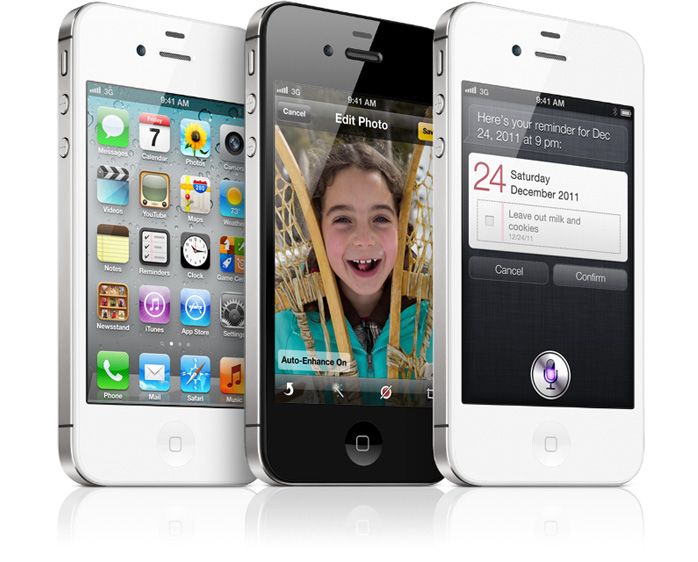
People Daily reported that Apple received the certification it needs by the China Compulsory Certification to launch the iPhone 4S in mainland China. The certification was awarded on Dec. 22, shortly after Apple also received certification from the Ministry of Industry and Information Technology of China. With the necessary certifications, Apple has now met all of its requirements to launch the iPhone 4S in China. People Daily said the iPhone 4S-model number A1431- will hit in early January.
To model how well the iPhone 4S could potentially do in China, in this year’s June quarter earnings, Apple’s sales in China topped $3.8 billion. Thus, obviously, the launch of the iPhone 4S in China would boost sales.
China Unicom is the third-largest carrier in China, and it remains the sole carrier for the iPhone. While Apple is able to reach a large market, only being available on one carrier leaves about 1.33 billion people in the market untapped. If Apple were to also sell the iPhone 4S on China Mobile, sales could grow substantially. At any rate, the iPhone 4S is at least on its way to China Unicom by January.
Mercury News reported that Apple is set to begin construction “any day now” on a new prototype retail store in downtown Palo Alto, according to a building permit issued by the city. The new Store will be located on 340 University Ave, about a block from the already thriving downtown store. It is a place where Steve Jobs made many appearances. Apple’s new store will reportedly see structural changes that will allow natural light to brighten the store completely, and the rest of the store will be mostly made of stone and steel.
Plans filed with the city call for a glass roof and facade that will allow natural light to flood much of the 15,030-square-foot store. Stone and steel also factor heavily into the design. A basement and rear mezzanine will provide office space and storage, according to the plans.
Before construction begins, crews have already completed a pedestrian bypass. Apple is spending$3.15 million on the new prototype Store, according to documents filed with the city. Palo Alto’s planning manager made comment to The Daily Beast:
Local government authorities are investigating last weekend’s explosion that injured 61 people at the Shanghai factory of an Apple iPad 2 back-panel supplier after much outcry from China Labor Watch.
CLW was founded in 2000, according to their website, and it is an independent not-for-profit organization that has collaborated with unions and labor organizations to assess factories in China.
The Dec. 17 blast at Ri Teng Computer Accessory Co., owned by Taipei-based Pegatron Corp., was similar to the explosion at a Foxconn Technology Group facility in May, according to a Dec. 19 statement from CLW.
“The blast in Riteng is a result of aluminum dust in the workshop where ipad cases are polished,” said CLW in its press release. “A similar blast happened in the same workshop of a Foxconn’s factory in Chengdu, killing 3 workers and hurting another 15.”
CLW said there was “a lot of aluminum dust in the workshop,” but apparently, the workers were not aware of the “potential danger before the blast.”
The U.S. Occupational Health and Safety Administration said aluminum dust is highly combustible, according to its online health guidelines. The administration stressed the need to take special precautions in handling the substance in occupational settings.
Samsung dropped its lawsuit in Germany seeking to ban the sale of Apple’s iPhone 4S.
The South Korea-based company had focused its complaint against a patent covering 3G communications tech. According to patent expert Florian Mueller of FOSS Patents, Samsung recently discovered a Qualcomm licensing agreement protects the technology.
“Other news from Mannheim: Samsung has formally given up attacking the iPhone 4S with 3G patents. Recognizes Apple is licensed thru Qualcomm,” tweeted Mueller on Dec. 16.
Samsung recently lost a preliminary bid to ban iPhone 4S sales in France; although, the case can progress as a patent trial:
According to Winrumors, you can take out a Windows Phone 7 device (they say various Windows Phone 7s on any carrier) with a single, solitary SMS message with a [redacted at request of Winrumors]. Worse (or better?) yet, it doesn’t have to be a text, it can be a Facebook message or Windows Live chat.
The flaw works simply by sending an SMS to a Windows Phone user. If the SMS contains a particular string of text then Windows Phone 7.5 devices will reboot and the messaging hub will not open despite repeat attempts. We have tested the attack on a range of Windows Phone devices, including HTC’s TITAN and Samsung’s Focus Flash. The attack is not device specific and appears to be an issue with the way the Windows Phone messaging hub handles particular characters. The bug is also triggered if a user sends a Facebook chat message or Windows Live Messenger message to a recipient.
And you don’t just get a reboot. When your phone comes hobbling back to life, the Messaging hub no longer works. And other parts of the OS are wonky.
If a user has pinned a friend as a live tile on their device and the friend posts a particular string of text on Facebook then the live tile will update and causes the device to lock up.
As we reported over on the sister blog, Google just launched Currents, their Flipboard/Pulse style reader for iPhone and iPad (and I guess Android too). Head over for the details. (Yes, 9to5Mac is a launch partner so look for us on the App!)
Conventional wisdom once was that as Apple expanded its retail footprint, Apple resellers would fall by the wayside. And that has happened to a certain extent, plus stores like CompUSA and Circuit City have folded.
Fortunately, other retailers have been able to succeed alongside Apple by offering differentiated services.
One of our favorite Apple resellers, MacMall, is expanding their retail stores to Huntington Beach, California this Saturday and Chicago, Illinois in the coming months. Currently, the retailer has a booming online store coupled with two retail stores in Santa Monica and Torrance that are also seeing success, the company said in a press release sent out today. The Huntington Beach store opens this Saturday, December 10th with some pretty killer deals (seen after the break). MacMall’s Chicago store, located 321 West Grand Avenue, will be seeing a later January/February opening.
We hear that MacMall is even shopping for some space in Manhattan, alongside one of our other favorite resellers, Tekserve.
MacMall, naturally can offer more to customers than Apple Stores with their unscheduled technical support, broader range of accessories (even a few PCs and Android tablets), and most importantly “online prices in a retail store”. We often tip you guys on MacMall’s awesome deals, so we’re certainly familiar with some of the deals they carry. As you can see below, they offer so many more accessories than an Apple Store (iPhone Alarm Clocks, standalone GPS, Photoframes, Cameras, etc, etc).
MacMall says Apple has encouraged them to keep expanding to more stores and with over $100 million in Apple product sales this year, that isn’t hard to believe.
At the Huntington Beach store’s grand-opening on Saturday, the first 300 people to visit the store will be entered to win free Apple TVs, MacBook Airs, iPod touchs, and iPod Nanos. Early shoppers will have a 1 in 22 chance of taking home some free holiday gifts.
With Apple deciding not to include support for T-Mobile’s bands in the US, T-Mobile has turned into an Android wasteland with over 90% of the smartphones sold on the network running on Google’s OS. Looking for some diversification (besides the over million legacy iPhones), T-Mobile looks to be one of the first in the US to roll out one of the new Nokia Windows Phone 7 devices which they plan to announce on Dec 14th, a little late for the holidays.
There has been no shortage of analyst reports regarding an Apple branded HDTV that the company is rumored to have already started work on. Some are calling for a late 2012 launch, but up until now, all have imagined the device as a standalone HDTV. Wedge Partners analyst Brian Blair offers up another concept, claiming Apple will introduce a next-gen iMac with TV capabilities that will act as a transitional device before jumping head first into the TV business. The device would essentially integrate iCloud and Apple TV features, in addition to traditional TV hardware, into the larger 27-inch iMac design. Blair explains (via Forbes):
We think this makes sense because while we typically think about the newest TV’s hanging on the wall in large form factors, Apple could effectively start with what they already have on the manufacturing line and slowly push their offering from 27 inches and scale up from there to 32 inches and then move on to the 42, 50 and 55 inch market. In short, we believe the initial Apple TV is their iMac computer that can function as a TV, over the iCloud platform.
While this appears to be entirely speculation at this point, he makes much of his case based on the fact Apple already has the 27-inch iMac in production. We know Apple killed Front Row in Lion, while at the same time introducing iOS-like functionality like Launchpad. The 27-inch iMac is already an excellent display for consuming video content, but how conventional TV features might be baked into Lion is yet to be seen.
We’re pretty sure the Apple HDTV, if it comes to pass, will be based in iOS. It will also be a living room experience unlike the up-close experience of an iMac. Also, Apple seems to be going away from using its Mac Hardware as a TV device killing both Front Row and the included remote on many of its products. Therefore we think this speculation is off. Expand Expanding Close
Yesterday we told you that Apple’s lawsuit against Proview regarding the “iPad” trademark was rejected by a court in Shenzhen, which would make Proview the rightful owner until Apple decides to appeal the decision or settle with the company outside of court.
At the time we weren’t sure what exactly would be the next course of action for either company, but according to a new report from Financial Times, it appears Proview is attempting to block iPad sales by suing resellers in Southern China. Starting with the cities of Huizhou and Shenzhen, if the company is successful at blocking sales of the iPad there, they will then go after other Apple resellers throughout China.
Xie Xianghui, a lawyer presenting Proview, discussed the company’s new course of action:
We are starting with these two cities, and if we are successful in getting iPad sales stopped, we will consider going after Apple resellers elsewhere in China.
The Shenzhen Futian District Court will begin hearing one case on December 30, with another slated for January 7. There’s always the possibility that Apple will settle outside of the courts before then, as Proview’s financial troubles are clearly a motivating factor. Expand Expanding Close
We already know what Intel has in store for their new Ivy Bridge desktop lineup, but now we’re getting a look into exactly what they have planned for their mobile CPU lineup as well. Documents leaked byVR-Zone indicate that Intel will do away with the Low Voltage processors rated at 25W and instead adopt Ultra Low Voltage processors rated at 17W known as as Ultra or U-series CPUs. The new standard voltage processors, known as the “M-series”, will be introduced as well and rated at 35, 45, and 55W variants.
The new M-Series or standard voltage processors will range from 2.6GHz dual-core i5 to a 2.9Ghz quad-core i7. Most of these processors mark a significant jump over current Sandy Bridge models, and the 3820QM and 3720QM i7 CPUs a 400MHz increase in comparison to the original Sandy Bridge CPUs. These are also the processors which will most likely find their way into a MacBook Pro, opposed to the U-Series lineup (detailed below), which could replace current Sandy Bridge low voltage CPUs in devices like the MacBook Air. Before we break down the U-Series models, here’s the full M-Series lineup:
2.9GHz Core i7-3920XM “Extreme” (200MHz faster than current Core i7-2960XM)
2.7GHz Quad-Core i7-3820QM
2.6GHz Quad-Core i7-3720QM
2.9GH Dual-Core i7-3520M
2.8 GHz Core i5 3360M
2.6 GHz Core i5 3320M
As for the Ultra or U-Series product line, which will more than likely debut in MacBook Air-like devices, at launch Intel plans on making a 2GHz core i7 and a 1.8GHz core i5. The i7 will be able to turbo to 3GHz in dual core mode, while single core mode will get you 3.2GHz. The i5, on the other hand, will provide 2.6GHz in dual core mode, and 2.8GHz in single core mode. Here’s what we know about release dates, DDR3 memory support, multiple external displays, and supported graphics… Expand Expanding Close
In October, Taiwanese company Proview Electronics accused Apple of trademark infringement regarding the “iPad” moniker, with the company’s chairman promising to sue Apple for damages in both the US and China. Apple quietly purchased the global rights to the trademark, but also launched a lawsuit to gain the rights in China, which weren’t included in the agreement. Shenzhen-based Intermediate People’s Court today rejected Apple’s lawsuit to gain ownership over the Chinese trademark, according to a report from Reuters.
According to Financial Times, Proview apparently had the iPad trademark registered in several regions including the EU, South Korea, Singapore, China, Vietnam, Thailand, and Indonesia. The report claims the company unsuccessfully tried to market a tablet computer known as I-PAD roughly ten years ago. Although courts are said to have not yet reached a final decision on ownership, Apple has reportedly already won preliminary injunctions for the trademark in Shenzhen and Hong Kong.
In 2006 Proview agreed to sell the global iPad trademark to US-based IP Application Development (IPAD) for£35,000 ($55,104), at which time Proview didn’t know had connections to Apple. The Chinese trademarks, filed as far back as 2000, were apparently not included in that agreement, leading Apple and IP Application Development to sue Proview.
In October, Proview chairman Yang Rongshan had this to say about the case: Expand Expanding Close
“We’re never going to say never about the iPhone. The iPhone for us would need to be at the cutting edge of where we’re going, and then there might be an opportunity to consider it.” U.S. Cellular revealed last month that it had the opportunity to sell the current, non-LTE iteration of the iPhone but decided against it because it was not the right economic fit for the regional carrier.
In context, US Cellular is in a drive to migrate its 26-state customer base to LTE. Previously, it was revealed that the terms of the agreement for the iPhone were reportedly “unacceptable”.
The Chicago, Illinois-headquartered company is the nation’s sixth-largest wireless carrier, serving about 6.1 million customers in half the country’s states. Competitor C-spire, another regional carrier, was able to get the iPhone and is currently selling it. Expand Expanding Close
Apple has been no stranger to patenting innovative methods and implementations of ID verification and recognition technologies, most recently highlighting a system for advanced 3D object recognition. Perhaps the most interesting patent to emerge is one for digital handshakes using advanced camera systems and invisible ink published by the US Patent & Trademark Office earlier today (via PatentlyApple). The patent essentially details a system in which advanced, next-generation cameras could read invisible inks and optical coatings, which contain unique identifiers, integrated into another device or object. In its most basic embodiment, this would allow one device (or person) to identify and establish a connection with another quickly and securely. PatentlyApple explains:
The devices could share the keys using any suitable approach, including for example providing the keys in a manner that an image captured by each device could include the other device’s key. For example, devices could be placed opposite each other (e.g., face-to-face, face-to-back, or back-to-back) such that a camera of the device includes the other device in its field of view… In one implementation, one or more cameras of the first device could capture images of the device environment. The first device could process the captured images to detect a second device in the field of view, and to identify one or more cameras of the second device.
When it comes to potential applications, Apple outlines sharing data– videos, photos, contacts, etc.– as well as determining network information, bandwidth, and security levels. The patent specifically mentions social networking aspects. For example, Twitter sharing could be integrated, while multiplayer gaming could benefit from connecting multiple devices available for a specific game and sharing data like in-game stats. However, the patent also details a number of other notable potential applications as well including logging into a secondary device and using the tech as identification at retailers… Expand Expanding Close
The bad news is that yes, Carrier IQ is running on iPhones right now, as we speak. Carrier IQ, you’ll recall is the rootkit that Carriers put on many of their phones to monitor customer usage. As a security researcher found out, Carrier IQ monitors keystrokes and sends that back to its own servers. On Apple’s devices, it appears to have been cut off from such activities. Developer chpwn breaks it down:
Carrier IQ, the now infamous “rootkit” or “keylogger”, is not just for Android, Symbian,BlackBerry, and even webOS. In fact, up through and including iOS 5, Apple has included a copy of Carrier IQ on the iPhone. However, it does appears to be disabled along with diagnostics enabled on iOS 5; older versions may send back information in more cases. Because of that, if you want to disable Carrier IQ on your iOS 5 device, turning off “Diagnostics and Usage” in Settings appears to be enough.
So it appears that on iOS it stores less information, and it doesn’t seem to be sending anything as long as ‘Diagnostics and Usage’ (iOS 5) is turned off – which is the default (you are asked to enable it during the iOS5 setup). On older versions of iOS, especially v3, it appears to be sending data without a toggle.
Verizon representatives have said that they do not run Carrier IQ on their devices which include iPhones, iPads, and Android, Blackberry and other devices. Other carriers have yet to make a statement on the matter but Carrier IQ brags on its homepage that it tracks information on 141 million devices (and counting) which is about half of the US population.
On iPhones where Carrier IQ is activated, it appears to send the following information back to the servers: Expand Expanding Close


 .
.