Reuters is reporting that the displays for the next-generation iPhone could go into mass production as soon as May, with Japan Display, LG, and Sharp all said to be working on them. Previous reports indicated that the iPhone 6 would be available in two different sizes: 4.7 inches and 5.5 inches. According to today’s new report, however, the larger model could see delays of several months due to manufacturing difficulties.
Apple is expected to announce the iPhone 6 later this year.
According to a DisplaySearch analyst report published in the Nikkei, via CNET, both LG and Sharp are having trouble ramping production of the iPad mini’s 7.9inch Retina display.
The report states that Sharp is struggling to produce any level of output at all. This corroborates with a Digitimes report from earlier this week. Apparently, Sharp’s Oxide TFT process is to blame for the low yield rates.
Following several reports this month and hints from Tim Cook that Retina iPad mini stock could be in short supply when the device launches next month, the hit and miss DigiTimes reports today that the shortages are due to limited supply of displays from Apple’s supplier Sharp. Specifically, the report claims that Sharp’s “Oxide TFT process is seeing low yield rates” leading to a less than ideal supply of 7.9-inch Retina panels. Sharp accounts for around 40% of the displays for iPad mini with Retina display production, while LG Display is providing the other approximately 60%, according to the report: Expand Expanding Close
It looks like Sharp is planning full support for OS X in its upcoming 32-inch 4K IGZO touchscreen LCD LED monitor (PN-K322B) expected to launch in the US this fall. Sharp previously announced the 36 mm thin 4K panel with pen support in July, but Macotakara.jp snapped the photo above of Sharp demoing the display running OS X from a connected MacBook at the Ceatec Japan 2013 show over the weekend.
From the translated report, it sounds like Sharp plans compatible OS X drivers as a download in 1-2 months.
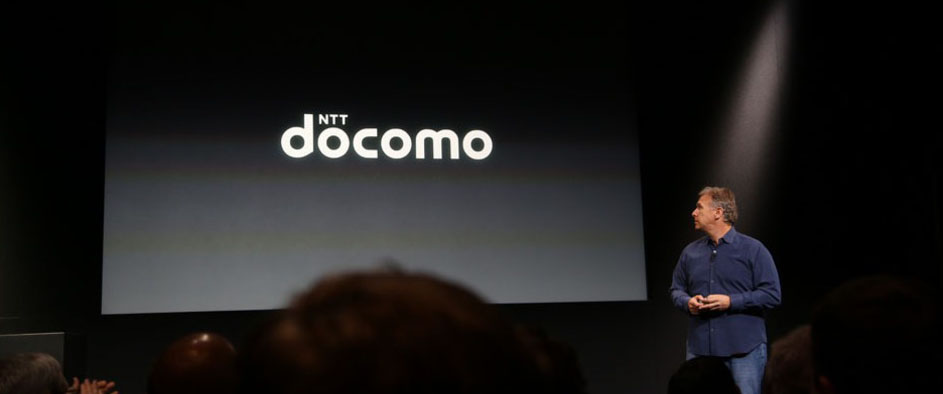
Apple is expected to become the market leader in Japan, with the iPhone 5s and 5c forecast to make up 40 percent of all new contracts on Japan’s DoCoMo carrier, reports Nikkei (via CNET).
The 40 percent figure is believed to be the quota that Apple and DoCoMo agreed on, the report said […] This development marks a tectonic shift in DoCoMo’s strategy and the Japanese phone market in general. Domestic phone suppliers like Sharp and Fujitsu are expected to suffer as a result … Expand Expanding Close
There are a few snippets of AppleTV related news popping up today. The first we take with the usual grain of salt as it comes to us from the often unreliable DigiTimes. The publication has been reporting some more believable stories as of late, but today’s rumor of Apple purchasing 55 and 65-inch Ultra HD TV panels from LG seems to be more rumor than anything else.
Apple has of course been rumored several times to be building a full fledged HDTV to go along with the much expected revamped AppleTV service coming in the the near future. The latest from the usual lineup of analysts points to a launch as early as the end of this year or early 2014. LG and Sharp– two of Apple’s regular display suppliers– would be obvious choices to source panels, but there’s no proof at this point that Apple is beyond the experimenting stage and we’ve heard rumors from more reliable sources ranging from 40-inch to 60-inch in the past.
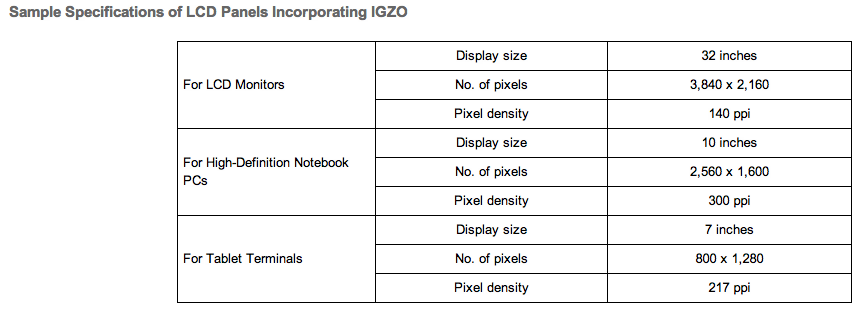
Sharp, one of Apple’s display suppliers that is rumored to have just begun production on next-gen iPhone displays, this week announced it will soon begin producing notebook displays with the highest pixel density in the biz. With displays ranging from 11.6 inches to 15.6 inches, it’s entirely a possibility that one could end up in a next generation MacBook with Retina display.
IGZO technology enables smaller thin-film transistors and increased light transmittance. As a result, fine text can be rendered crisply and clearly, and images can be displayed with impressive realism. For example, the 14-inch panel boasts a pixel density of 262 ppi, which represents 1.67 times the number of pixels of full high definition*3. Increased light transmittance also means lower rates of energy consumption, with IGZO technology reducing the amount of power required to drive liquid crystals during the display of still images. These factors lead to greater energy efficiency and longer battery life on notebook PCs. IGZO technology is also compatible with stylus-input touchscreen functionality.
Sharp will start producing the displays, which boast a resolution up to 3,200 x 1,800 and pixel density of 262 ppi, in June and already has a 13.3-inch model being mass produced. Expand Expanding Close
According to a report from Nikkan, production of displays for Apple’s next iPhone will begin in June. The new screens will be sourced from Sharp, LG, and Japan Display, the same trio that have supplied screens for the iPhone 5.
Sharp also begin in June the mass production of the next model for the liquid crystal panel of the (multi-function mobile phone) smartphone that Apple is planning on. Appears to have embarked on production readiness of consecutive holidays from May Kameyama Plant No. 1 of Apple smartphones LCD dedicated plagued by sluggish occupancy rate since the beginning of the year in (Kameyama, Mie Prefecture).
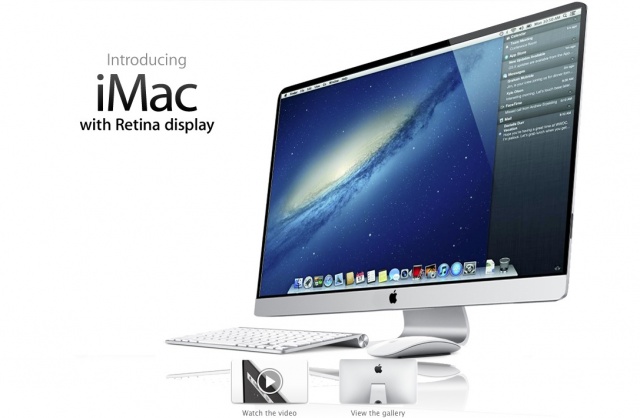
Retina iMac mockup via <a href="http://macspoilers.com/665/a-slimmed-down-retina-imac-rumored-to-launch-with-the-ipad-min/"><em>MacSpoilers</em></a>
Today, Intel announced a new version of its Thunderbolt technology that will ship with devices in 2014. The new Thunderbolt technology supports up to 20Gbps throughput, which is up from the 10 Gbps supported by the current version of Thunderbolt.
Notably, the new technology supports 4K resolutions, which could open the door for even higher-resolution Mac displays. Perhaps, this is the technology that Apple needs to work with in order to begin a Retina display rollout for its all-in-one desktop computer, the iMac, or even Mac Pro compatible Thunderbolt displays.
Last week, a report from The Wall Street Journal claimed Apple’s much rumored HDTV set is now in the “early stages of testing” with partners Hon Hai Precision and Sharp. Today, we get more details surrounding the rumored product from the Taiwan national news agency’s English language Focus Taiwan. According to the report, citing sources close to Hon Hai Precision Industry Co., the supplier is testing Apple television designs, but the possibility of the product shipping in 2013 is “unlikely”:
Nevertheless, the source said it is unlikely that shipments of the appliances will begin as soon as the end of next year.
While the report from WSJ claimed Sharp was involved in the initial testing of the product with Hon Hai, Focus Taiwan’s source claimed the possibility of Sharp displaying panels for the product is “not high”:
Asked whether the new Apple TV will use display panels produced by Japan’s Sharp Corp., the source said the possibility is not high.
The source also claimed that Apple is looking at displays ranging from 46 inches to 55 inches, meaning the company likely wouldn’t rely on Sharp’s plants best suited for production of 60+ inch panels: Expand Expanding Close
Sharp is announcing a 32-inch 4K monitor today that uses its LGZO LCD tech expected to hit the Japanese market in February 2013. The roughly $5,500 PN-K321 monitor sports a 3,840-by-2,160 resolution and HDMI and DisplayPort inputs. According to Sharp, it will also be the thinnest monitor frame on the market at just 35mm. Even if analysts were wrong about a full-fledged TV set from Apple next year, these new Sharp displays would certainly make a pretty Thunderbolt display.
Sharp will put its IGZO displays in the hands of consumers in the near future, as it recently announced its first 7-inch tablet to take advantage of the technology’s low-power consumption features. Apple decided to not go with Sharps’ IGZO displays for its latest round of iPad launches. It instead sourced display components from AU Optronics, LG Display, and Samsung, but several reports in the past indicated Apple is interested in the technology. Apple was even recently rumored to be potentially making an investment in the failing company—much like Apple partner Foxconn previously agreed to.
According to a report from IDG, Sharp has not so surprisingly announced in its recent earnings report there is “‘material doubt’ about its ability to continue operating.” While Apple’s manufacturing partner Foxconn previously agreed to buy an 11-percent stake in the company, today’s report noted those negotiations continue to drag on and risk falling through as Sharp’s stock price continues dropping. To turn the company around, rumor has it Sharp will focus on its IGZO technology and displays for smartphones and tablets, while possibly seeking investments from Apple in the process:
Sharp added, however, that it still believes it can cut costs and secure enough credit to survive. Its IGZO technology for mobile displays is likely to be a key element of its business strategy…The company, whose stock has been downgraded to junk status by ratings agencies, continues to seek investments from outside companies, with media reports in Japan linking it to companies including Apple and Intel.
As far back as November 2011, Apple was rumored to invest in Sharp’s display factories in Japan. Earlier reports indicated Sharp’s IGZO displays could possibly be used in Apple’s new 7.8-inch iPad mini, but recent teardowns of the device confirm Apple is using display components from Samsung, LG, Display, and AU Optronics. Sharp, however, remains a key Apple component supplier, and it recently confirmed it is back to producing “adequate volumes” of iPhone 5 displays after facing weeks of delays leading up to the device’s launch. In August, a report from Reuters suggested Apple could provide Sharp with financial incentives to speed up production and help with high costs cutting into the company’s margins on displays.
Sharp recently announced its first tablet to use the IGZO display technology. The displays are expected to go into mass production by the end of the year, so it’s certainly possible next generation iPads could take advantage.
We heard reports in the past that Apple passed on Sharp’s IGZO display tech for the third-generation iPad due to Sharp not having the tech ready in time. Going with Sharp’s IGZO tech would have allowed for a thinner display assembly, a brighter display with less LEDs, and the ability to use a smaller battery or extend battery life specs as a result. It could have also helped shave off some of the increased weight and depth of the new iPad. These are all things we witnessed first hand when we got up close and personal with a few IGZO demos at IFA this year. Sharp is announcing today its first 7-inch tablet to use the display technology, claiming the 1,280-by-800 IGZO display allows for 2.5 times the battery life from the tablet’s 2,040mAh battery (via ComputerWorld).
With the iPad mini launch coming later this month, it is a possibility the tech is finally ready for Apple to take advantage. Sharp also has 10-inch and 13-inch variants of the IGZO displays, but the 7-inch would of course make a lot of sense for iPad mini given what we already know about the device. Apple’s ability to increase battery life, or simply have the ability to use a smaller battery (in a smaller form factor) while maintaining battery life specs, is just one benefit. Another big benefit for Apple would be narrow borders: rumor has it—which is something we also talked about a lot in the past—the iPad mini will have a much narrower border than previous-generation iPads. Sharp told us its IGZO LCDs can be built with a bezel under 2mm, and it was showing off a demo display with a 1.75mm border at IFA. That would definitely fit the bill for the narrow-border, one-handed experience we expect from iPad mini. Expand Expanding Close
Mass production of the screens for the iPhone 5, which Apple unveiled Wednesday, began earlier this week at Sharp’s factory in central Japan, the person said…That Sharp has started delivering screens could ease concerns about whether Apple will have enough components to meet global demand for the new iPhone. Sharp is one of the three suppliers of the screens, the others being Japan Display Inc. and South Korea’s LG Display Co…
We had the opportunity to spend a lot of time with Sharp today at its IGZO display booth. While they would not say which Apple products would incorporate their new displays, they did seem to insinuate these were the best displays on the market, and Apple is the type of company that uses the best displays.
A few reports have floated around today that we are filing under rumor. The first comes from a Digitimesreport that claimed Apple suppliers are prepping for mass production of a new Retina iMac scheduled for July with a possible October unveiling. We told you in May that Retina iMacs were likely on the way when higher-resolution iMac display panels were spotted in Apple’s supply chain before the unveiling of the new Retina MacBook Pro at WWDC in June. Apple quietly updated the Mac Pro lineup after the event, and then it confirmed a redesigned Mac Pro was in the works for 2013, but we have heard nothing official from Apple on future iMacs.
We heard a lot about a possible 7-inch or 7.85-inch iPad, and today there are more roughly translated reports, coming from Chinese publication MyDrivers.com (via UnwiredView), that claim Apple has a 7.85-inch iPad using a Sharp IGZO panel. There have been several reports in recent months claiming Apple is working on the device, and the The Wall Street Journalreported in February that Apple was testing displays roughly 8-inches in size. Apple looks to be at least testing these screen sizes, but we have no solid proof that anything is planned as of yet. Previous reports indicated a possible October launch for a 7-inch iPad under $250. Expand Expanding Close
Reutersreported today, while citing Japanese business daily Nikkei, that Sharp will supply its technology to Hon Hai for a new Foxconn plant that will produce panels for devices like Apple’s iPhone. The move follows an investment from Foxconn’s parent company Hon Hai Precision in March, which agreed to buy 46.48-percent of Sharp’s LCD plant in Japan and $844 million in new shares for an 11 percent stake of the company.
TOKYO (Reuters) – Japan’s Sharp Corp will supply technological know-how to Taiwan’s Hon Hai Precision Industry Co for a plant in China that will produce panels for Apple Inc’s iPhone and other consumer electronics products, the Nikkei business daily said on Thursday.
As for what technology Sharp will provide, the report only specified it will be “aimed at improving quality management” at a future plant in Chengdu. Sharp will reportedly receive “tens of billions of yen in fees” through the partnership, and it announced plans today to buy back Sony Corp’s 7.04-percent stake in its Sakai, Japan-based plant.
Sharp revealed today that it began assembling high-performance LCDs last month with increased production in April to meet market demand.
Jefferies & Co.’s Peter Misek is a very outspoken analyst regarding Apple’s rumored HDTV. He first claimed in November that Sharp is preparing production lines for the “iTV,” but he later said the company plans to build roughly 5 million units beginning this spring with a product launch slated for Q4 2012.
According to Sharp, the LCDs will help the company contribute to “creating markets for attractive new products”:
Sharp will encourage the application of its new high-resolution LCD panels to high-definition notebook PCs and LCD monitors—which are both expected to grow in demand—as well as to mobile devices. Sharp will also contribute to creating markets for attractive new products.
Twice the LEDs: That means more heat coming from more LEDs. This is especially a problem at full brightness.
2.5X the power needed: The brightness efficiency is lower, because the new iPad has more pixels (which means more transistors) compared to the iPad 2. More pixels and transistors take up more space, meaning less opportunity for light to pass. “So they basically have to blast light through the LCD to make it come out.” Soneira adds: “I measured the LED power at maximum brightness–it’s two and a half times greater than on the iPad 2.”
Battery generates more juice: The battery has to push out more power. This makes the battery warmer.
Traditional LCD technology: Sharp’s power-efficient IGZO technology was not ready for the new iPad, which forced Apple to use traditional —and less power efficient— amorphous silicon tech. [To be fair, the older iPads also used this tech. Perhaps Apple was hoping to go 100-percent IGZO to offset the above].
The biggest heater in the new iPad is the new processor that has four graphics cores. If you look at the heat maps Consumer Reports and Tweakers did, the center of the heat is right where that A5X sits on the left side of the device.
As a bonus, do not forget those hot and schweaty Qualcomm LTE chips that bring the “faster than home broadband” goodness directly to your 4G iPads.
With all the above said, it is a minor miracle Apple managed to keep temperatures within 10 degrees to 15 degrees of the earlier versions.
Apple just posted its 2012 Supplier Responsibility Report highlighting its efforts to audit and improve working conditions within its supply chain. As part of the report, Apple also posted a list of 156 companies currently supplying components for Apple products that make up over 97 percent of all “procurement expenditures for materials, manufacturing, and assembly” of its entire product line globally.
The list includes Toshiba Mobile display, which is —as far as we know—currently not supplying displays for Apple. There were rumors in May that claimed Toshiba was working on a 4-inch retina display and rumors last month that Apple and Toshiba are building a plant for display production, which were later debunked by the increasingly unreliable DigiTimes. It also includes Sharp, who was recently rumored to be ruled out of iPad 3-panel production due to quality concerns but also supplies other components to Apple. The full list is available after the break.
In 2011, we conducted 229 audits throughout our supply chain — an 80 percent increase over 2010 — including more than 100 first-time audits. We continue to expand our program to reach deeper into our supply base, and this year we added more detailed and specialized audits that focus on safety and the environment.
Every year Apple audits suppliers in eight areas including: Anti-discrimination, Fair treatment, Prevention of involuntary labor, Prevention of underage labor, Juvenile worker protections, Working hours, Wages and benefits, and Freedom of association. The overall results can be seen in the graphic below. We also learned than Apple found 42 facilities delayed wages, 68 facilities did not provide proper benefits, and 67 facilities held back payments as punishment.
There were also 108 facilities failing to pay legal requirements for overtime and holiday pay, and 5 facilities with 6 active cases of underage labor, to which Apple is requiring the suppliers “support the young workers’ return to school and to improve its management systems.”
In the audits, Apple found 93 facilities currently have more than 50 percent of its staff exceeding the maximum 60 hour workweek (with one day of rest per 7 days) set by Apple’s Code of Conduct for suppliers: Expand Expanding Close
Following reports this morning from Macotakara that claimed Sharp would be supplying display panels for a next-generation iPad, a conflicting report from Korean publication Electronic Times Internet News (via PatentlyApple) claimed Sharp “failed to pass Apple’s approval process for mass production.” The report also claimed Samsung and LG already kicked production for iPad 3 panels into full capacity as of the beginning of this year:
It has been confirmed that Samsung Electronics and LG Display will supply LCD panels for Apple’s iPad 3, which is scheduled to be unveiled as early as in Q1 this year. Sharp was originally known to be developing display panels, but reportedly failed in initial supply.
According to the report, Apple is planning on placing orders for 65 million LCD panels for iPad 3 during 2012. It also claimed Samsung and LG would be supplying 5 million displays in the first quarter to meet demand for the device’s launch. Although there is obviously no way to verify this, and the publication does not exactly have a track record for breaking Apple news, the report does mention the same XQGA (2048×1536) display as Macotakara’s. The report cited only an “industry source.” Expand Expanding Close
More news concerning a rumored television set by Apple that several analysts and some media outlets have been calling for feverishly. According to a blog post published by The Tokyo Times news site, Apple has commissioned Sharp to begin manufacturing large displays for an Apple-branded television set. Sharp should ramp up production in January:
American technology giant Apple is shifting partnerships in Japan towards Sharp, eyeing the production of a brand-new TV range which may be called iTV.
The product should hit the market by the summer 2012, the story goes. And according toNew York Post, which referenced the original Tokyo Times report:
Apple has taken over the entire plant — pulling out of South Korea and its former partner Samsung — to insure the quality of the new set and to protect its secrecy.
The Tokyo Times story quotes Jefferies analyst Peter Misek as saying that Apple’s rivals have already begun “a scrambling search to identify what iTV will be and do”. The analyst wrote in a note to clients, based on his visit to Japan and talk with manufacturing executives:
It’s a huge deal for Sharp because they spent significant amounts of capital to try and expand capacity and upgrade their facilities. It gives Apple a partner that they can control manufacturing and secure supply at a lower price.
Please be advised that our confidence in The Tokyo Times isn’t very high… Expand Expanding Close