Tech Industry

See All Stories

Apple patent details new persistent overlay UI for iOS, “IDME” social networking app, and more

Site default logo image

The US Patent & Trademark Office has published an Apple patent application today (via PatentlyApple) revealing a brand new method of interacting with content on your iOS devices. Referred to as a “Persistent Overlay”, the concept essentially aims to provide users with single tap access to photos, songs, files,etc. from an always accessible, persistent UI. The patent also introduces us to a new social networking app, and Trackpad and Magic Mouse support for iPad.

The “Persistent Overlay” feature would act as a customizable dashboard, allowing you to add snippets or links to web content, individual songs or albums from iTunes, photos, etc. It’s unclear exactly how this “Persistent Overlay” would be incorporated into the current iOS UI. However, from the information in the patent, it appears to be completely separate from the iOS homepage. PatentlyApple says in some embodiments Apple’s description sounds like the UI could actually be part of the current multitasking feature, potentially allowing you to place items such as a photo or song next to recent apps or the iPod controls in a portion of the multitasking tray. We can also imagine the UI fitting in nicely in the empty space right above the multitasking tray.

Read about Apple’s new IDME social networking feature after the break.

Expand
Expanding
Close

AT&T- T-Mobile Merger looks to be over, companies pursuing a tactical workaround

Site default logo image

Image via ARS

Big news today (surprisingly on a 4 day US weekend).  The AT&T and T-Mobile merger was withdrawn from the FCC today.

 On November 23, 2011, AT&T Inc. and Deutsche Telekom AG electronically withdrew without prejudice, as of that date, the pending applications listed in the Public Notice released by the Federal Communications Commission on April 28, 2011 in that proceeding. Associated manual notification of withdrawal filings also are being made.

The two companies look to be pursuing an alternative plan…
Expand
Expanding
Close

Peter Misek rumor roundup: Sharp developing iTV display, along with sharper iPad 3 display

Site default logo image

A few months ago Analyst Peter Misek reported that iOS and OSX would become one in 2012.  That kind of flies in the face of Mac OS 10.8 that’s been hitting everyone’s Web logs. He’s also talked about Apple opening up super data centers all over the world for a confusing Netflix service that mostly already exists.

With that boulder of salt consumed, AllThingsD quotes Misek as saying that Apple has selected Sharp specifically to manufacture new TFT LCD panels for the upcoming iTV, an Apple-branded television set rumored to boast Siri as the flagship feature (here and here).

The analyst speculates the iTV could ship mid-2012:

Over at Jeffries, analyst Peter Misek suggests that Sharp is retooling a production line at its factory in Sakai specifically to manufacture modified amorphous TFT LCD panels that will be used in the so-called iTV. If all goes well, the line should be ready for commercial production by February of 2012, which means we could see Apple’s take on the TV by midyear.

The report also mentions some manufacturers of current televisions are becoming nervous of what exactly iTV might be (we know Sony is one of them) and hope to adapt quickly so they don’t suffer the same fate vendors in other  industries face, such as the smartphone folks. It should be noted that Misek has been wrong one too many times, so you’re cautioned to apply skepticism to his thinking. The iTV reportedly isn’t the only thing Sharp will be supplying displays for…


Expand
Expanding
Close

Apple reportedly begins recruiting senior-level executives to work on the cloud

Site default logo image

Wall Street Journal is reporting that Apple has begun a search to find senior-level executives for their cloud services. According to the report, Apple already has one Internet entrepreneur in their sights, but it hasn’t been disclosed who. To assist with their search, Apple is also reportedly looking into hiring out a recruiting firm to find solid talent.

The hopes in finding new leadership for their cloud products is undoubtedly to strengthen Apple’s already existent iCloud, but to also build new web-based applications. The report mentions that Apple is working towards building these web-based applications to limit the amount of hardware a single person needs on them at one time. The details aren’t final, though lower-level positions have already been filled to begin work. Arguably, Apple has already begun this push with iCloud.

Apple is also considering building new apps that leverage the Web to reduce people’s need to carry around numerous devices at once, according to one of the people familiar with the matter.

To assist with their movement to the cloud, Steve Jobs announced the new data center was operational in North Carolina during this year’s WWDC. The data center is home to powering all of Apple’s current cloud services, like iCloud, and presumably will power what’s coming up next.

It’s obvious that Apple will need to begin an aggressive attack on the cloud if they want to be on terms with where Google’s currently headed. It will be interesting to see how Apple will attack making web-based applications, and what else they plan to do in the cloud — but it seems they’re already off to a pretty solid start.


Expand
Expanding
Close

Samsung ad bashes those who would wait in a line for an iPhone

Site default logo image

[youtube=http://www.youtube.com/watch?feature=player_embedded&v=6h5JSojJN3Y]

via TMO

Additional variations of the concept are available on Samsung’s YouTube channel. The version included right below challenges a notion that only iPhone has the best apps. A third clip is right after the break.

[youtube=http://www.youtube.com/watch?v=kO5Il_rvZj8]


Expand
Expanding
Close

Apple patent details advanced 3D object recognition and verification technology

Site default logo image

PatentlyApple point us to a few recently obtained Apple patents published by the US Patent and Trademark Office. Perhaps the most interesting of all is a patent covering 3D object recognition technology that could potentially be implemented in future iPads. While unsophisticated facial recognition tech is already present in consumer mobile devices, Apple’s patent details a method of automated biometric identification to identify or verify an object or face based on a 3D representation compiled by analyzing the curves, points, contours, etc., of a 2D projection. In other words, a three-dimensional “statistical shape model” could be pulled from a 2D image, allowing more accurate detection and verification of 3D objects, such as a face or objects from “airport security X-ray images”, for example. The report explains:

The recovered 3D shape is the most probable shape consistent with the 2D projections, i.e. the images. The statistical model needs a bank of data, denoted training data, where the 3D positions of the image features are known, in order to learn the parameters of the model. Such data sampling could be done using e.g. binocular or multi-view stereo or range scanners. Once the model parameters are learned, the 3D shape can be computed using one or several images. The 3D shape is then used, by means of the presented invention together with the 2D image data, to identify or verify the object as a particular instance of the object class, e.g. the face belonging to a certain individual. A positive (or negative) identification initiate proper action by means of the presented innovation.

It’s unclear when exactly Apple obtained the patent, which lists Professor Kahl Fredrik as the main inventor and dates back to 2005. However, PatentlyApple points out Jan Eric Solem, who owned Polar Rose before they were acquired by Apple in 2010, is also listed as an inventor. Polar Rose technology is currently being used in facial recognition and detection features in the iOS 5 Camera app. The report speculates the next-gen PowerVR GPU from Imagination Technologies will play a role in providing Apple with the juice necessary for advanced 3D rendering, despite the company not yet being confirmed as a licensee:

Expand
Expanding
Close

The competition: Galaxy Nexus brings the heat, beating iOS 5 in browser speed tests, but falling in OpenGL Benchmarks

Site default logo image

The first Ice Cream Sandwich handset, the Galaxy Nexus, hit the UK this week (US launch coming soon) and AnandTech has benchmarked the ICS/Galaxy Nexus combo vs. the iPhone 4S/iOS 5 combo.  The Galaxy Nexus processor/GPU isn’t groundbreaking by any means, but the new software inside is certainly packing a punch beating iOS in a few key areas. As seen in the graph to the right, the Galaxy Nexus has a slightly faster tested browser than the iPhone 4S — a crucial day-to-day necessity for users.

The Galaxy Nexus also comes up with the win in JavaScript loading, bringing faster load times than the Droid RAZR and iPhone 4S. Don’t think the Galaxy Nexus is going to come away with everything, however. Both Apple’s iPhone 4S and iPad 2 outperform the Galaxy Nexus in GPU loading — which is limited by its slower SGX 540 underneath.  That’s an important consideration for gaming.

The Galaxy Nexus’s hardware has been dubbed very smooth compared to older versions of Android. Google is activating 550,000 Android devices a day and is still behind iOS in total Activations at 200 million total.   Head after the break for more graphs.


Expand
Expanding
Close

Apple experimenting with inflatable shock mounts to drop-proof cover glass

Site default logo image

In January we told you about a class action lawsuit filed by a Los Angeles man who describes the iPhone 4’s glass back panel as a “design flaw” and claims Apple “refuses to warn consumers” about its susceptibility to cracked glass under normal usage . We already know the iPhone 4S hasn’t made many improvements in terms of the durability of its glass casing, but a new patent application shows exactly what Apple has been working on to better implement a drop-resistant all glass design.

Our friends over at PatentlyApple detail the patent which describes different embodiments of including a shock mount made of polymer, foam, gel, or similar material in a future iPhone or iPad’s cover glass (as usual Apple also mentions the majority of their other products including iMacs, MacBooks, iPods, displays, and televisions). In one solution, Apple describes a “mechanically actuated retractable”, which would essnetially allow the cover glass to withdraw “at least partially into the housing in response to sensing the drop event, thereby protecting for the cover glass.”  The report explains:

Expand
Expanding
Close

Does the new Google Music match iTunes?

Site default logo image

[youtube=http://www.youtube.com/watch?v=DLPFI5YsIks&start=1770]

At an event in L.A. this afternoon, Google revealed their revamped music streaming service called Google Music. Music was previously in beta for the last three months, but today has launched to everyone (in the U.S.) and includes a set of new features. Music will continue using the Music Manager application, that was available in the beta, to let users upload music to the web locker for streaming on Android devices and through the web. Users are able to upload up to 20,000 songs for free and can have them available offline on their Android devices.

The big news regarding Music is its huge integration into the Android Market and new Music Store. Millions of songs are now available for purchase from both Android and the Music webpage. Songs range from 99-cents to a $1.29, and every song has a 90 second preview and will be downloaded as a 320k MP3 — available on Android devices and in the web locker. Music can also be shared with friends over Google Plus, and friends will receive a full free play of the song (or album) once you share it.

Google said today an iOS app will also be on its way. While users can play music from their locker with the mobile web app (check out our hands on) on iOS devices right now, a native app will definitely be a bonus.

When it comes to what songs are available, Google has locked in Sony, EMI, and Universal for music licensing (What? No Warner?), and also has close to 1,000 smaller labels. 13 million tracks will be available over time, but 8 million are available today. Users can upload any song to the locker, however, regardless of label.

Another new feature announced in Music today is Artist Hub, a place that allows artists to share music to fans. Artists can build their own unique artist page to upload content and sell their songs for $25 a year.

So how will Google Music compete with iTunes?


Expand
Expanding
Close

Apple addresses environmental concerns with audits of 15 suppliers, could impact future components and contracts

Site default logo image

Apple has been no stranger to environmental concerns regarding their manufacturing and supply chain abroad, most recently a report from five independent environmental organizations in China in August accused the company of taking “advantage of the loopholes in developing countries environmental management systems” and awarding contracts to known polluters. Yesterday Apple responded to the accusations in a three-hour meeting with five Chinese environmental NGOs, admitting fifteen of their current manufacturing partners are contributing to pollution in surrounding areas by agreeing to perform audits of the companies. This followed several meetings with Apple following the group’s report in August, including one with Apple execs in Cupertino.

According to a report from WSJ, Ma Jun, of the Institute of Public & Environmental Affairs in Beijing, had this to say following the meeting:

“This is a major step forward… They asked these companies to take corrective plans and give a timeline, and Apple will verify whether all these issues have been resolved.”

As a result of the meeting, Apple is apparently vowing to improve its environmental standards within its supply chain, a move that could not only alter the manufacturing process of components, but also impact contracts awarded to manufacturers and suppliers in the future. According to the report, to avoid issues like massive amounts of waste water, Apple will encourage alternative manufacturing processes for components such as printed circuit boards. Apple also confirmed that this and other environmental concerns will play a role when awarding future contracts to suppliers.

Expand
Expanding
Close

Qualcomm’s 4G LTE Gobi 4000 chips shipping to OEMs, likely to land in next-gen iPad

Site default logo image

Qualcomm has just issued a press release announcing the commercial availability of their Gobi 4000 chips for 4G LTE and HSPA+ capable devices, a variant of which could very well ship in a next-generation LTE-capable iPad. In August we discovered Apple had possibly begun field testing a next-gen LTE iPads with LTE code floating around the iOS builds, and it’s likely Apple would go with Qualcomm’s chip, as almost every 3G iOS device since the Verizon iPhone has used their Gobi platform, the exception being the the AT&T iPad which uses an older Infineon chip.

“The Gobi 4000 platform allows customers to offer both LTE/HSPA+ and LTE/EV-DO designs to meet the growing demand for embedded 3G/4G connectivity in mobile devices worldwide… System designers now have the flexibility to choose an embedded Gobi 4000 platform for high-speed 4G LTE support, or an embedded Gobi 3000 platform for worldwide 3G connectivity.”

The new chips, now shipping to OEMs with modules available through Novatel Wireless and Sierra Wireless, are based on Qualcomm’s MDM9600 and MDM 9200 3G/4G wireless modems, and as the company notes, have been specially designed for deployment in devices utilizing Snapdragon dual-core and quad-core processors. In addition to HSPA+, dual-carrier HSPA+, and LTE support, the Gobi 4000 platform is also backwards compatible with HSPA and EV-DO. On top of a possible variant of the chip coming to a future 4G LTE iPad, the Gobi 4000 platform will also be included in Lenovo’s ThinkPad laptops, and Dell’s Latitude E6420 laptops, in addition to other Windows and Android powered mobile devices.

Qualcomm’s senior vice president of produdct management for CDMA Technologies, Cristiano Amon, had this to say about the announcement:

Expand
Expanding
Close

Apple patent roundup: Dual OLED backlit iPad 3, speakers for iPod nano, and swipe and hold iOS gestures

Site default logo image

There has been no shortage of Apple patent applications published by the US Patent & Trademark Office today (via PatentlyApple). Three of the most interesting with potential to be implemented in upcoming products include a dual OLED backlighting system for future iPads, integrated speaker clip for iPod nano, and new hold and swipe gestures for iOS devices.

First up we have a patent application that backs up a report from DigiTimes claiming Apple is considering alternative backlighting systems with a dual-LED light bar design for iPad 3. PatentlyApple outlines the application which details use of multiple OLED backlights not only in a future iPad, but also potentially in a next-gen iPhone, Cinema Display, MacBook, and iMac.

The report also claims Apple mentions “television in passing” within the application, while quoting an announcement from DuPont regarding new AMOLED processing technology, PatentlyApple says that tech is already being supplied to Asian AMOLED manufacturers. Apple’s alternative backlight solutions could also lead to an overall thinner design:

“The bonding of the OLED backlight in the LCD may also increase the mechanical rigidity of the LCD, which may enable the use of thinner glass substrates and possibly reduce the thickness of the overall device. Further, an OLED backlight may generally be thinner than a typical LED backlight, and may also provide improved light uniformity without the use of light guides or additional brightness enhancing films.”

Details on iPod nano speaker patent and swipe and hold iOS gestures below the fold.


Expand
Expanding
Close

Flurry: iOS + Android destroy Nintendo + Sony in U.S. portable gaming revenues

Site default logo image

Nintendo president Satoru Iwata declared Apple and iOS as the “enemy of the future” back in 2010. Not only was he right, according to new estimates for the U.S. portable game software by revenue from Flurry Analytics, 2011 seen Nintendo’s grip on the market slide even further as iOS and Android games triple their marketshare from 20% in 2009 to 60% during 2011.

The graphic above shows U.S. revenue for Flurry’s portable gaming category- a category that now includes Nintendo DS, Sony PSP, iOS, and Android. As you can see, iOS and Android have together taken the lead from Nintendo with 58% of revenues in comparison to last year’s 34%. In comparison, Nintendo DS held 57% during 2010, while dropping to just 36% in 2011. Total US revenue jumped from $2.7 billion in 2009 to $3.3 billion in 2011.

When comparing combined game revenues of the two veterans– Sony and Nintendo– with the combined revenues of the two new guys– Apple and Google– 2011 will be the first year where the emerging platforms dominate with iOS and Android estimated to take in $1.9 billion in comparison to the DS and PSP’s $1.4 billion. That accounts for a $200 million drop for Sony and Nintendo and $1.1 billion increase for iOS and Android from 2010. Perhaps investors were right to urge Nintendo to begin developing iOS titles.

As for Nintendo, the company who captured approximately two-thirds of the market in 2009 has seen their “enemy of the future” demote them to just a third of the market. Sony clearly has some catching up to do, but is hard at work on highly anticipated new handheld devices for 2012.

Expand
Expanding
Close

AT&T still commands a (shrinking) majority of U.S. iPhone base, says Localytics

Site default logo image

.

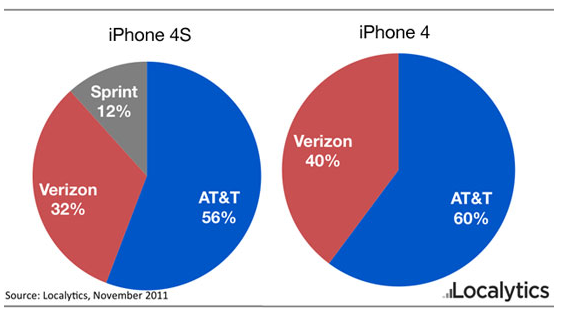
According to Localytics, AT&T continues to be the dominant iPhone carrier in the US, even with the Verizon entering the market strongly last year, grabbing 40% of the users in half the time.

As the 4S was launched on Sprint as well with truly unlimited data plans, one would have thought more of AT&T’s marketshare would have been diminished.  However, it appears that sprint is taking more away from Verizon.

Sprint’s share of the 4S market now stands at 12% according to the figures.  AT&T, though coverage is spotty in urban areas like New York and San Francisco, does have a significant speed advantage over Sprint and Verizon’s 3G as well as the ability to talk and use data at the same time.

Looking at iPhone 4 distribution as a comparison, Sprint seems to have eroded more of Verizon’s market share than AT&T’s – of the previous-generation handset, 60% are on AT&T versus 40% on Verizon.

A likely driver for these differences is the fact that AT&T can mine its existing base of iPhone users. Because all Verizon iPhone users are in the first year of their wireless contract, the cost of upgrading will be high. However, many longer-term AT&T users, especially those holding iPhone 3GS and earlier devices, are off-contract or nearing the end of their contract. AT&T has been aggressively leveraging the iPhone 4S to sign these customers to new two-year contracts, and the data in this study suggests that tactic may be working.

That data strongly lines up with our poll which we’ve been tracking since before the iPhone 4S launch…


Expand
Expanding
Close

Apple training retail managers on union awareness tomorrow; biannually

Site default logo image

Apple is holding a training session with new managers to address unionizing tomorrow, reports CNet. The session will be held to address unions in the workplace and take any legal questions they might have. The internal document obtained by CNet said the following:

“This course is intended to provide managers with a practical understanding of how unions affect the workplace, how and why employees organize, and the legal do’s and don’ts of dealing with unions. This is a mandatory class for all new managers, and is required biannually for all managers.”

The course will then become a biannual occasion for all of Apple’s retail managers. The push for this course by Apple’s executive team most likely comes after early this year when Apple employees began pushing for the “Apple Retail Workers Union” that would address issues of part-time employees being underpaid. Other issues also included training opportunities and break schedules.


Expand
Expanding
Close

Barnes and Noble release Nook Tablet iPod touch competitor

Site default logo image

[youtube=http://www.youtube.com/watch?feature=player_embedded&v=fR7ZtiHoTEE]

Barnes and Noble announced their Nook Tablet today, a successor to their now $199 Nook Color.  The $249 dual core tablet is aimed squarely at the $199 Kindle Fire but has 10GB more (16GB total) storage and the ability to add up to 32GB via micro SD card.  It also has a superior screen to the Kindle and the popular Hulu Plus and of course Neflix for watching videos.  The app library is a much smaller  subset of the Android market, however it is curated much better so only quality apps are allowed in.

Although we hear it a lot, the Nook Tablet or the Kindle Fire aren’t really competitors to the iPad.  Realistically, if you have a budget for a $500-$830 iPad, you aren’t considering a $200 alternative … and vice versa.  Sure all are “tablets” but it is like comparing a netbook to a MacBook Pro.

If anything, these cheap 7-inch tablets are competition for the $188 iPod touch (though with increased portability, superior app and content ecosystem and cameras -that too is a stretch).  Price, being one of the biggest purchase considerations, puts these things more in line with the lower priced iPods.  For people who want a bigger screen and don’t consider the many other advantages to being in the Apple ecosystem a plus, these might make sense.

If you had a choice between the two, would you choose a $199/$249 Nook or a $199 Kindle Fire?


Expand
Expanding
Close

Apple patent details virtual SIM Card with NFC router, could lead to thinner next-gen iPhone

Site default logo image

The US Patent & Trademark Office published a patent application from Apple today (via PatentlyApple) detailing how a future iPhone could potentially utilize a virtual SIM card that integrates NFC technology. We reported back in October 2010 rumors of Apple experimenting with virtual SIM cards that would essentially allow consumers to bypass carriers when purchasing an iPhone and utilize a carrier-chooser App Store app to select the network of their choosing. Not long after, reports claimed Apple ditched plans due to concerns raised by European carriers who threatened to no longer subsidize the iPhone.

Today’s patent, which was originally filed in Q4 2010, gives us a much better look into Apple’s possible plans to integrate a custom SIM into a future iOS device. Of course, as reported before, the tech would potentially allow Apple to offer the device through their retail locations and cut the carriers out of iPhone sales. However, according to PatentlyApple, Apple claims another benefit the technology would provide is the ability to produce an even “thinner, astoundingly beautiful, next generation iPhone”, thanks to the lack of a SIM card slot and associated costs. PatentlyApple walk us through the patent:

Expand
Expanding
Close

Complete overhauls tipped for next year’s iPhone, iMac, and MacBook Air

Site default logo image

According to sources for Digitimes within upstream supply chains, Apple is planning complete overhauls for much of their product lineup for 2012. This seems likely seeing that Apple did not re-design any of their hardware products for a 2011 launch. The publication is calling for an all new iPhone, iMac, MacBook Air and iPad. This all new iPad is likely the one Digitimes spotted for a Q3 launch in the supply chain. This completely new iPhone could be the teardrop-shaped device we’ve heard so much about and rumors of an iMac redesign have yet to become specific.

Apple last overhauled the iMac in 2009 with larger, brighter LED displays, thinner unibody casings, and faster processors. The most recent update came in May with an HD FaceTime camera, improved graphics performance, and faster, quad-core processors across the lineup. In addition, the publication is calling for a MacBook Air overhaul, which seems unlikely given that brand new MacBook Air designs were launched in late 2010. If Digitimes is correct about a MacBook Air overhaul, we think 15 inch addition is what they are discussing. The report says that the new iPhone and iMac are scheduled for launch during the second half of 2012, but offers no launch details for the new MacBook Air line. (Image: The Verge)


Expand
Expanding
Close

Apple engineers contact iPhone 4S user to diagnose battery issues

Site default logo image

Apple engineers are in the process of contacting iPhone 4S owners in order to determine the cause of alleged battery life issues. One iPhone owner told the Guardian that Apple engineers “installed a monitoring program” on his iPhone to diagnose the source of the problem:

“I then got a call from a senior [Apple] engineer who said he had read my post and was ‘reaching out’ to users for data and admitted this was an issue (and that they aren’t close to finding a fix!) and asked lots of questions about my usage and then asked if he could install the file below and that he would call back the day after to retrieve the info. I extracted the file from my Mac after a sync and emailed it to him. He was incredibly helpful and apologetic in the typical Apple way!”

The unnamed iPhone user was apparently experiencing a “10% drop in standby every hour”, he turned off location services and Siri in an attempt to troubleshoot which new features exclusive to the iPhone 4S might be causing the battery loss to no avail. We first reported about users complaining about the iPhone 4S’s battery draining unexplainably fast a couple weeks ago. The issue seems to only be affecting a small number of users, although the Apple discussion boards are still full of people experiencing similar problems. If this account with an Apple engineer is to be believed, it looks like Apple is at least acknowledging the issue even if they “aren’t close to finding a fix”. We’ll keep you posted as we learn more.

China Mobile is the T-Mobile of the East with 10 million iPhone users, an incompatible high speed network and no contract

Site default logo image

China Mobile doesn’t officially offer the iPhone yet. But it is carrying 10 Million iPhones on its network according to Reuters.

“We have not yet got agreement with Apple,” Wang said on the fringes of the ITU World telecoms fair in Geneva. “Apple promised to provide, when they develop the iPhone for LTE, that it will include TD-LTE. We are discussing the details.”

There had been rumors that Apple would offer a TL-LTE version of the iPhone 4S earlier this year with China Mobile going as far as saying:

China Mobile and Apple hope to find a solution for close collaboration. We discussed this issue with Apple. We hope Apple will produce a new iPhone with TD-LTE. We have already got a positive answer from Apple.

It appears that positive answer wasn’t for this round of devices, though the CDMA Verizon iPhone arrived off schedule in January. TD-LTE will require some separate chips which could be hard to fit inside the iPhone 4S’s enclosure. Apple however has to look longingly at that 600 million+ subscriber base, however.

While T-Mobile USA is on the opposite end of the subscriber spectrum (China Mobile has around the same amount of subscribers as the populations of Europe and the US combined), T-Mobile is the #4 carrier in the US in the midst of AT&T attempting to swallow it.

But they both don’t officially offer the iPhone, yet have a significant number of iPhones floating around on their network. Both offer a different type of high speed 4G network that stock iPhone 4Ses can’t take advantage of. Both networks do offer EDGE/GSM speeds however which some may find valuable tied with reduced fees or better coverage. T-Mobile told us earlier this year that they had over a million iPhones on their network, a figure that is likely to go up with Apple sneakily offering iPhones 4S unlocked at launch.


Expand
Expanding
Close

iSuppli: Teardown reveals 16GB iPhone 4S carries $188 BOM

Site default logo image

As always, the guys over at IHS iSuppli have just published analysis of their iPhone 4S teardown showing a BOM of $188 for the 16GB and in the process revealing some previously undisclosed suppliers.

The $188 BOM is of course for the entry-level 16GB model, which would also inflate to $196 if factoring in an $8 manufacturing cost. BOM for the 32GB model comes in at $207 (again, before manufacturing), and $245 for the 64GB variant.

The report describes the 4S’s insides as including a “wealth of innovation”, in contrast to the device’s feature set which was received as an incremental upgrade by most. Among the suprises revealed during the teardown– NAND flash memory supplied by Hynix Semiconductor (a first for iPhone) and a “unique custom” wireless module from Avago Technologies Ltd.  The device torn down by iSuppli carried the same sony Sensor as the device X-Rayed by Chipworks but they postulate that Omnivision may also provide an 8-megapixel sensor as well for some of the devices.

Senior director of teardown services for IHS, Andrew Rassweiler, explains:
Expand
Expanding
Close