A new job listing on Apple.com could add fire to the rumors that Apple is considering including fingerprint technology in upcoming devices.
The job posting seeking a software engineer to write “low-level code to configure and control hardware” is the only listing on Apple’s site located at the “Melbourne Design Center” in Melbourne, Florida. Not only is the position looking for someone familiar with testing various sensors with LabTool and FA software, but Melbourne is also the home base of Authentec, the company Apple acquired fingerprint technology from last year for around $365 million.Read more
There have been many rumors this year about what upgrades Apple will include in its anticipated annual iPhone refresh. Most agree Apple will move to release two iPhones, but there is some debate about what those phones will be.
In July, a 10K filing showed that Apple acquired security company AuthenTec for $356 million. At the time, we noted Apple was presumably after the company’s various fingerprint-related technologies, while companies such as Samsung, Motorola, and others entered in deals with AuthenTec for its secure VPNs, encryption algorithms, and security-related products. Today, NFCWorld (via TechCrunch) reported Authentec has now sold its embedded security solutions division to NFC company Inside Secure. The sale would seem to indicate that Apple was indeed specifically after the company’s fingerprint and NFC solutions:
The sale suggests that Apple’s interest in acquiring Authentec lies with the company’s innovative combined fingerprint and NFC solution, which is not part of the division being acquired by Inside Secure, and will lead to renewed speculation that Apple will include NFC in future iPhones and other devices…. NFC and contactless chip provider Inside Secure is to acquire the embedded security systems division of Authentec, the fingerprint and secure solutions specialist which Apple agreed to buy for US$356m in July 2012. The transaction is valued at up to US$48m.
To get a hold of AuthenTec’s Embedded Security Solutions Division, Inside Secure will reportedly pay $38 million in cash and another $10 million “subject to completion of certain post-closing transactions.” Products the division is responsible for are currently used in hundreds of millions of mobile and networking devices worldwide, with customers ranging from Samsung, Nokia, LG, and Motorola to HBO, Cisco, and Texas Instruments. Last year, the division brought in sales of $25.3 million. Read more
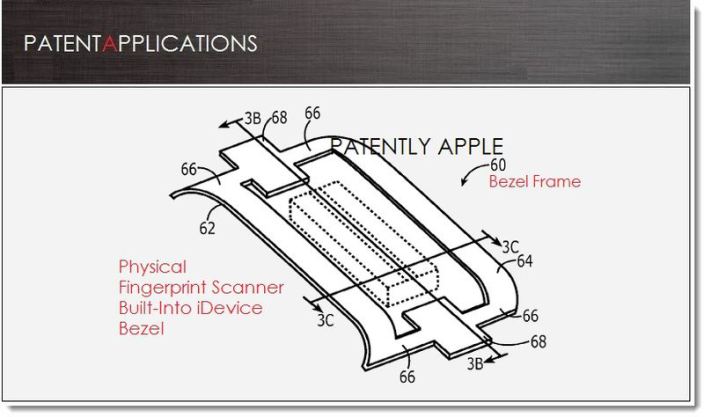
With Apple’s $356 million purchase of mobile security firm AuthenTec, for its nearly 200 patents covering fingerprint and sensor technologies, there has been a lot of talk about how Apple might integrate the technology into future devices. Adding to the rumors are recent reports that Apple signed a deal with Sydney, Australia-based Microlatch to develop NFC apps using its fingerprint authentication tech. Today, we get a look at some possible areas Apple might be exploring with the technology thanks to a patent application published by the U.S. Patent and Trademark Office and detailed by Patently Apple.
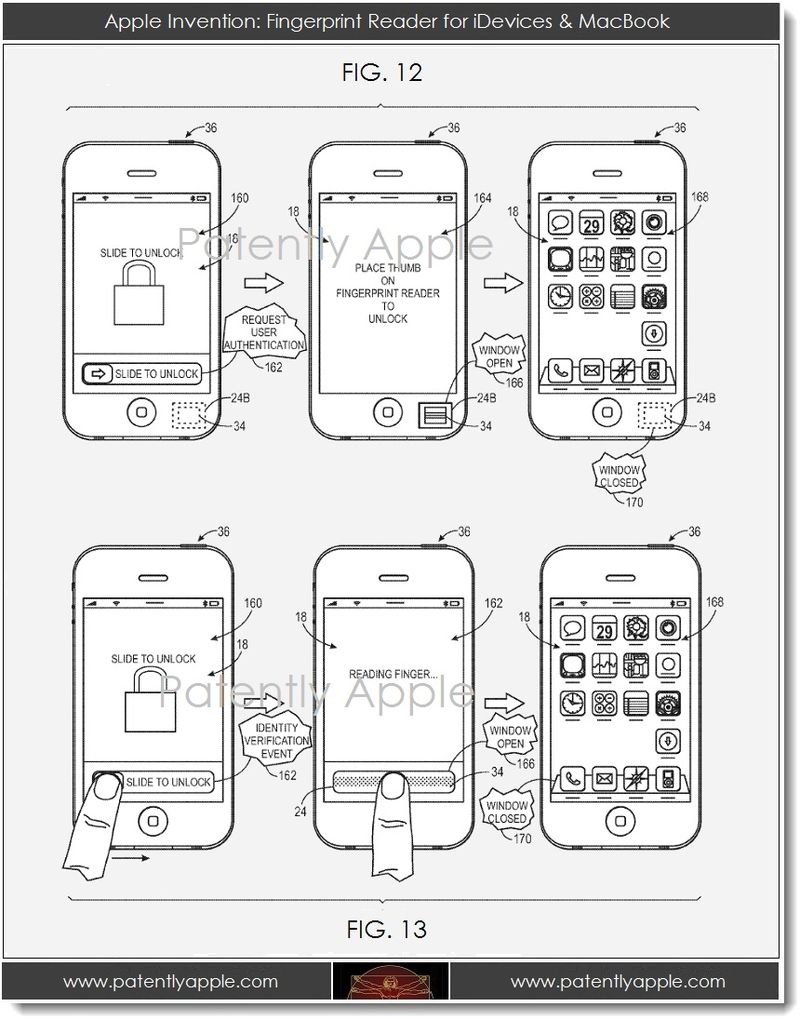
As highlighted in the image above, Apple’s patent covers a hidden color-matched or transparent “window”—next to the iPhone’s home button in this case—that could reveal “components by causing the electronic window to change opacity, allowing the components to suddenly appear as from out of nowhere.” In other words, Apple could build a biometric sensor or camera into a device’s bezel but have it remain invisible to the user—at least when not in use. One embodiment of the invention described using fingerprint tech during the unlocking process (pictured right):
In Apple’s patent FIGS. 12 and 13 shown below we see a biometric sensor in context with a fingerprint reader which is initially concealed behind a closed window on an iPhone. Upon the iPhone’s activation in a locked state, a lock screen 160 may be displayed requesting a user to slide a finger across the display to unlock the device. The electronic device may request user authentication to access the handheld device. The device may then display an instruction screen requesting that a user provide biometric data via their fingerprint which will be read by the fingerprint reader.
The patent also covers similar methods using face recognition and eye recognition rather than fingerprint sensors; the invention would also not be limited to unlocking devices. The patent continued by describing e-commerce and wallet applications, which would line up with the earlier reports regarding Microlatch: Read more