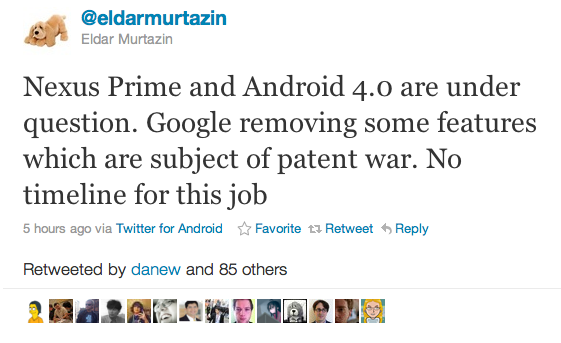
Update: He’s wrong. We’ve heard from an impeccable source that Google plans to have invites out “in the next day or so” and there is no patent delay.
We reported earlier that Google and Samsung were delaying the release of the new Nexus Prime phone and Android 4.0 “Ice cream Sandwich” out of respect for the passing of Steve Jobs.
“We believe this is not the right time to announce a new product as the world expresses tribute to Steve Jobs’s passing,” the companies said.
But according to often (but not always) correct blogger Eldar Murtazin, there are patent issues at hand which need to be addressed before the devices and OS ship. Specifically, Google is slicing out features which may be subject to Apple’s Patents…
See Steve Jobs introducing multi-touch in 2007 below, saying “Boy have we patented it!”. More coverage at 9to5google.com Expand Expanding Close
Here’s the official statement from Google and Samsung:
“We believe this is not the right time to announce a new product as the world expresses tribute to Steve Jobs’s passing,” the companies said.
They are likely to make an announcement on the launch late next week. The new Google phone is built by Samsung and is rumored to have a 4.65-inch, 720P display with dual core 1.5GHz Samsung processor, NFC, 1GB of RAM and other speeds and feeds. It will likely be one of the stronger competitors the iPhone 4S faces this holiday season.
Funny, because it is true? SNL’s Seth Meyers tackles the Fire vs. iPad debate at 48 secs in (YouTube).
[vodpod id=Video.15495947&w=650&h=420&fv=]
You know, no one is really talking about this, but at a smaller 7 inches and priced at $199, the Kindle Fire is more of an iPod touch competitor than a iPad competitor…at least as far as budgets and capabilities are concerned.
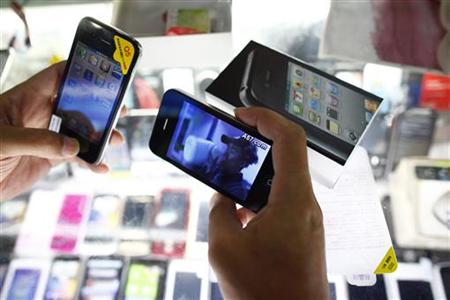
What’s most interesting about these fake iPhones is that they were made from real iPhone parts. The assumption is that the companies that made supplies for Apple would make additional parts and sell them to third parties who would somehow assemble a Frankenstein of iPhone and non-iPhone parts together and sell them at double the cost.
The cost to make one fake iPhone, which used some genuine parts, was around 2,000 yuan ($313). It was sold on unauthorized markets and on the Internet for around 4,000 yuan, only a few hundred yuan cheaper than the real iPhone, the newspaper said.
The fake iPhones had the same functions as the genuine ones but had a shorter battery life, it quoted the police as saying.
It would be interesting and surprising if they got iOS working on these. I’m guessing a flavor of Android with a iOS-like skin was used. Apple would have a big problem on their hands if iOS was being pirated.
Having a look at the otherwise impressive Galaxy S II phones from Samsung, I noticed that the USB AC power adapter had a ‘familiar’ feel to it. Turns out, it is almost an exact replica, within a millimeter in every direction. Compare to their previous USB power adapter.
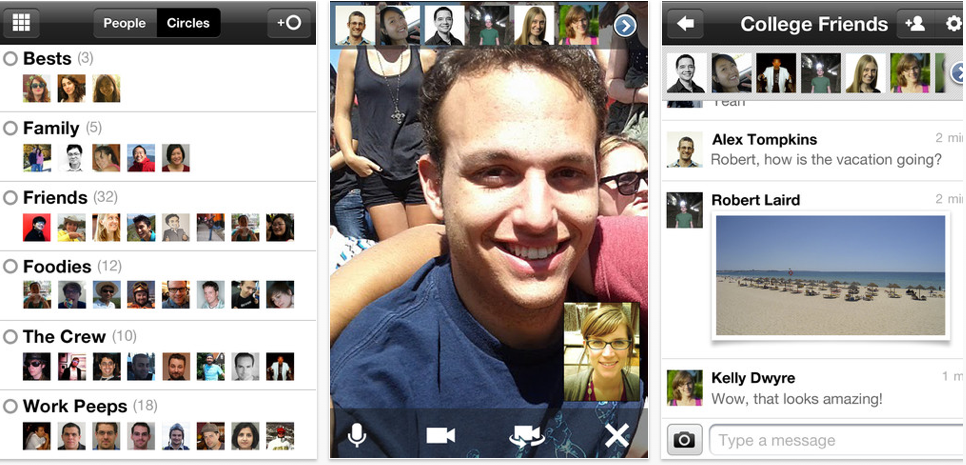
Google Plus (iTunes) iOS users will see a big update in their App Store today with lots of new features and improvements that were detailed earlier this week. Most notable is the ability to start and join video hangouts from a mobile device. In brief testing on both an iPhone 4 and an Android device on Wi-Fi, the Video conferencing worked great. It should work over 3 or 4G but the results obviously won’t be as good. Also, this version changes Huddles to Messenger and you can now send picture files through the messenger application.
If all of the rumors are true, Amazon has a 7-inch “media tablet” that runs a forked version of Android and will connect to all of Amazon’s services, including its Appstore, Movies, TV, Music and of course eBooks. It won’t be true multi-touch but the rumored price is half of the iPad’s (just like the screen) at $250. Who is making this for Amazon? Foxconn of course.
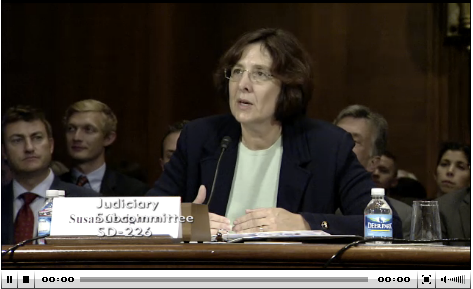
As part of the Senate Judiciary hearings today, former FTC official (and new Google employee) Susan Creighton, testified under oath today that Google, Microsoft and Yahoo! all bid to become the default search engine on iOS’s Mobile Safari Web Browser. As we know, Google won, and as we can infer, Apple gets some revenue from Google for making it its default search engine. As we know from Apple being Apple, the quality of the search results was probably as big a part of the decision as the relatively small bits of revenue.
But as part of the testimony, Creighton said briefly (before she was cut off) that 2/3rds of mobile search comes from Apple iOS devices. That’s pretty interesting considering the share of Android devices in the market. But not altogether surprising considering the web browser market share which includes those millions and millions of iPads.
Video at 2:24.00 (during very interesting testimony around Apple picking Google as default search)
Remember that cool iHub USB device that was briefly selling on M.I.C. Gadget, but then was pulled by Apple’s lawyers? It is back, and at a place you’ll probably feel a bit more familiar with: Amazon. Amazon has a few sellers selling that iHub again for prices (white, black) as low as $12.40. Interestingly, Amazon is fulfilling these orders (free shipping) which indicates that they might be complicit.
“Is 2011 going to be the year of copycats?”, Apple’s then chief executive rhetorically asked at the March iPad 2 introduction in San Francisco. Really, the title of this article couldn’t be more true. iPad is now stealing market share from Android, climbing from 65.7 percent share to 68.3 percent globally as Android slipped from 34.0 percent to 26.8 percent. HP exited the game, having retired its TouchPad and today lackluster sales of RIM’s PlayBook tablet made the news.
Apple decimated competition so thoroughly that analysts are saying the company can take its time releasing a third-generation iPad. According to J.P. Morgan analyst Mark Moskowitz, Apple should be in “no rush” with iPad 3:
Our latest research continues to indicate that there is no such device slated for production this year. In our view, Apple should be in no rush. The other tablet entrants have stumbled so far, and that trend-line could persist deep into 2012.
He also wasn’t impressed by Sony’s tablet which “lacks the refined, sleek feel of the iPad and its bezel-like back is not user-friendly”. And Research In Motion’s BlackBerry PlayBook tablet? On a downward spiral and probably due for life support. Per RIM’s quarterly filing, they shipped only 200,000 PlayBooks in the quarter, a paltry number compared to Wall Street expectations of 700,000 units. RIM refused to reveal actual sell-through as it is no doubt significantly lower than the sell-in. Ticonderoga analyst Brian White weighs in:
We believe the PlayBook is poised to follow HP’s TouchPad as the next casualty of iPad’s tablet dominance
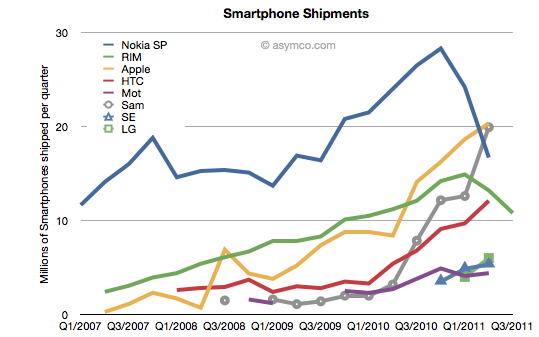
To put PlayBook sales into perspective, RIM shipped one PlayBook to every 46 iPads. With just 200,000 units, PlayBook may very well be heading to the technology graveyard. BlackBerry phones are also shrinking due to “lower than expected sales for older models”. One fifth of RIM’s stock valuation was wiped out today as a result of poor tablet and smartphone performance. By the way, RIM’s global market share is now dropping to single digits. Did the Waterloo, Ontario company learn a valuable lesson?
Many watchers have written off the PlayBook, but RIM has bigger worries on its mind: Its smartphone business is declining and global market share dropping to single digits. Chart courtesy of Asymco.
However, fan noise is very noticeable, as is the heat coming out of the top vent, and a fast boot doesn’t excuse the slow wake-up times compared to ARM-based cellphones and tablets.
Tablet devices running Windows 8 should be showing up next year and look to take on Apple’s dominance in tablets with its iPad (which should be on version 3 by then).
Martin Fichter, the acting president of HTC America, has a daughter down at Steve Jobs’ alma mater, Reed College, where he conducted the very scientific focus group:
On the iPhone 5 hype: “Apple is innovating. Samsung is innovating. We are innovating. Everybody is innovating. And everybody is doing different things for the end consumers. I brought my daughter back to college — she’s down in Portland at Reed — and I talked to a few of the kids on her floor. And none of them has an iPhone because they told me: ‘My dad has an iPhone.’ There’s an interesting thing that’s going on in the market. The iPhone becomes a little less cool than it was. They were carrying HTCs. They were carrying Samsungs. They were even carrying some Chinese manufacture’s devices. If you look at a college campus, Mac Book Airs are cool. iPhones are not that cool anymore. We here are using iPhones, but our kids don’t find them that cool anymore.”
But another peculiarity of the ITC is that its rulings can be waived by the president. Verizon thinks it would be great if President Obama, in a blanket statement, made clear he would not let stand any decision blocking importation of consumer wireless devices. The parties then would have to recur to normal patent litigation, and whatever rights and wrongs are discovered could be settled by exchanges of cash. Mobile is a rare industry exhibiting growth, job creation and animal spirits. Who needs a paralyzing meltdown?
It will be interesting to see if the President will override if Apple wins any of the blockades it is seeking against Android devices in the ITC. IF he does, Apple/Google/Microsoft/whoever will have to go through the longer patent dispute process.
Both iPhones and Android devices could be blocked by pending ITC rulings.
France-based Hardmacreports that Apple is readying a remote iOS device testing tool for deployment to its service personell. It is web based and will send the diagnostic information, relatively anonymously, to Apple technicians. A tool of this sort is already in use by Apple technicians but Hardmac claims that this once can be used remotely.
Apple announced (internally) that they have put the final touch to the tools that will facilitate a diagnostic. It will be simple to use and can be used remotely. In effect, this systems operates entirely online. An email is sent to the device containing a URL (this can also be entered by hand) and the device will connect via Mobile Safari and the telephone to start internal checks and sends the result of it to the Apple servers to which the service centres are connected.
This would be a pretty clever and powerful tool to do basic diagnostics on iOS devices which could help technicians diagnose and fix device problems over the phone, saving both the customers and Apple time and effort. Obviously, the diagnostics would only work on devices that were booting up and running Mobile Safari -which isn’t the case in most device repair situations. The test can only identify the following information:
Health, level of load of the battery, duration passed since the last complete charge,
Minimum level to which the battery was discharged,
iOS version installed,
To know if the mobile was turned off normally the preceding time.
The tools should be available in the coming months and Hardmac doesn’t speculate whether the test will be able to detect if a device is jailbroken. Expand Expanding Close
comScore has just released their ‘U.S. Mobile Subscriber Market Share’ report for the three month period ending in July. The report once again sees Apple’s market share increasing, this time up 1 percentage point to capture 27% of the market. This is in comparison to Google, who came in at an impressive 15% increase to top the chart at 41.8% market share. They are of course followed by the usual suspects, RIM in third at 21.7% (down 5%), and Microsoft at 5.7% (down 1%).
Apple’s market share among mobile OEMs is also on the increase, growing 1.2% to capture 9.5% of the market. Of course, Samsung (who also increased 1%), still dominates among OEMs with 25.5% of the market. LG comes in at second with 20.9%, followed by Motorola, and Apple. Expand Expanding Close
UPDATE [Monday, September 12, 2011 at 3:30pm ET]: Dolphin Browser HD for iPad just went live on the App Store.
Most Android users are quite familiar with the third-party Dolphin Browser app, which has been downloaded over 9 million times and according to TechCrunch just raised $10 million from Sequoia Capital. It appears some of that investment will go towards the company’s efforts on iOS devices as well, as an official iOS version of the browser has just popped up in the App Store.
The iOS version brings over the majority of features that have made Dolphin so popular among Android users. Among them is highly customizable gestures, built-in translations, dock-like sidebar for accessing bookmarks, speed dial, tabbed browsing, and more. Don’t be fooled, however, Dolphin is still based on Apple’s own WebKit, much the same as the default Safari app, all other third-party browsers on the App Store, and the majority of browsers in the smartphone industry. It does have some competitors such as Opera and a handful of smaller players like SkyFire who are starting to gain traction and steadily improving their iOS offerings. Expand Expanding Close
Ever wished you could run your favorite iOS app on your Mac? What about your Windows machine or Android device? If creators of new Kickstarter project iEmu reach their funding goals, it may be possible sooner than you think.
iEmu is a new project based on the open-source QEMU emulator, currently accepting donations through Kickstarter, that aims to emulate the S5L8930 chipset used in iPhone 4 and first-gen iPads. It will support a number of platforms including “Linux, Windows, Mac, mobile platforms such as Android, and even on iOS itself”.
The goals of iEmu? Well the end goal is an emulator capable of running “most iPad/iPhone apps” that even supports peripherals like the compass, accelerometer, and GPS. It would also “be extended with plugins for custom iOS exploration” and able to be reflashed in iTunes. Expand Expanding Close
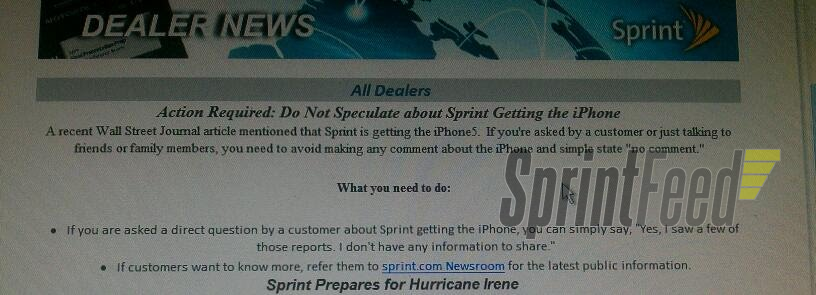
While it may seem obvious, Sprint is telling its dealers not to discuss the possibility of an upcoming iPhone 5 according to SprintFeed.
If the nation’s third largest carrier wasn’t getting the iPhone, would they put in such harsh lockdown measures? Why not instruct employees to tell customers to look at a nice Blackberry or Android instead? Color us skeptical.
According to the New York Post (viaBGR), Amazon is getting ready to launch their rumored Android-powered tablets with a price tag “hundreds less” than Apple’s current $499 base model iPad 2. “Hundreds less” sounds a lot like $299.
The devices, expected to launch sometime in October, will more than likely be the result of the entry-level tablet codenamed “Coyote” and it’s pro-model counterpart the NVIDIA T30 Kal-El powered “Hollywood”. We told you about these devices back in May, which will most likely be powered by a highly customized Amazon version of Android (bringing with it Amazon services like the Appstore, Kindle eBook store, Amazon Videos, music and possibly brought together by the Cloud Drive).
Amazon is clearly prepping a huge move into the tablet market. We reported this week that the company signed up a third touch panel supplier, and that was after recently becoming the second largest buyer of tablet-related parts – without yet having released a tablet. Expand Expanding Close
Assuming Android goes proprietary to Motorola, it falls behind Apple in market share by 2012 and Windows Phone (the Other category) gulps up nearly half the mobile phone market.
There’s a good reason why Apple’s products “just work”. But it’s been a bumpy road for the Cupertino, California company because right from the onset competitors were ridiculing its vertically integrated approach to business. Apple’s supposedly ‘closed’ ecosystem is a major weakness, critics cry. The past decade, however, saw the marketplace validate the strategy through booming sales of Apple gear. But what if GOOG actually tried the AAPL model with Motorola, which today makes about one in ten Android smartphones?
That’s the dilemma Piper Jaffray resident Apple analyst Gene Munster set out to explore in his Friday note to clients. In short, making Android proprietary and exclusive to Motorola would add about 35 percent to operating income for Google, the accidental hardware company. By 2015, the phone biz would add $10.5 billion in operating profit and $56 billion in revenue, resulting in a per-share earnings of $25.16 by 2015. There’s just one problem with this hypothetical strategy: Expand Expanding Close
LinkedIn has announced a new HTML 5 optimized page for mobile browsers and updated iPhone and Android apps with 2-10X speed increases.
The new app is now focused around four key areas: Updates, Inbox, You, and Groups & More.
The Inbox will allow you to view your messages and invitations in one centralized location. The You area presents your profile, connections, and to share updates. Lastly, LinkedIn is now introducing their most requested feature Groups, into the app.
Interestingly, LinkedIn also announced their mobile platform is growing 400 percent year-over-year. Check it out in your mobile browser, or hit the download links below:
If you’ve ever been *ahem* channel surfing late at night and stumbled upon HBO subsidiary Cinemax programming you know that there isn’t much differentiation between what you see there and all out pornography.
The news this weekend is that Apple just gave the go-ahead to Cinemax’s MaxGo App(free) for both iPhone and iPad. Yes, it includes “Late Night” content.
Far be it from us to judge what should and shouldn’t be on the App Store, but it seems that Apple is continuing to create controversy with its “no porn” stance.
In an email exchange with Gawker’s Ryan Tate last year, Jobs said that the iPad would offer users “freedom from porn.” And in a Q&A session after the launch of iOS 4, Jobs told reporters that porn was one reason Apple wouldn’t allow unsigned or unapproved apps onto iOS devices like the iPhone and iPad.
“You know, there’s a porn store for Android. You can download nothing but porn. You can download porn, your kids can download porn. That’s a place we don’t want to go – so we’re not going to go there.”
Playboy,which is at least as “soft-core” as SCinemax, was denied access to the App Store for its nude pictorials. For what it is worth, access to the Max Go app is parental controlled to users 17 or older.
If this story picks up, Apple will probably force HBO to curtail its mature content retroactively, not that there aren’t plenty of other outlets via Safari for such material. Expand Expanding Close