iOS devices refer to any of Apple’s hardware that runs the iOS mobile operating system which include iPhones, iPads, and iPods. Historically, Apple releases a new iOS version once a year, the current version is iOS 10. Here is the complete list of iOS 10 compatible devices.
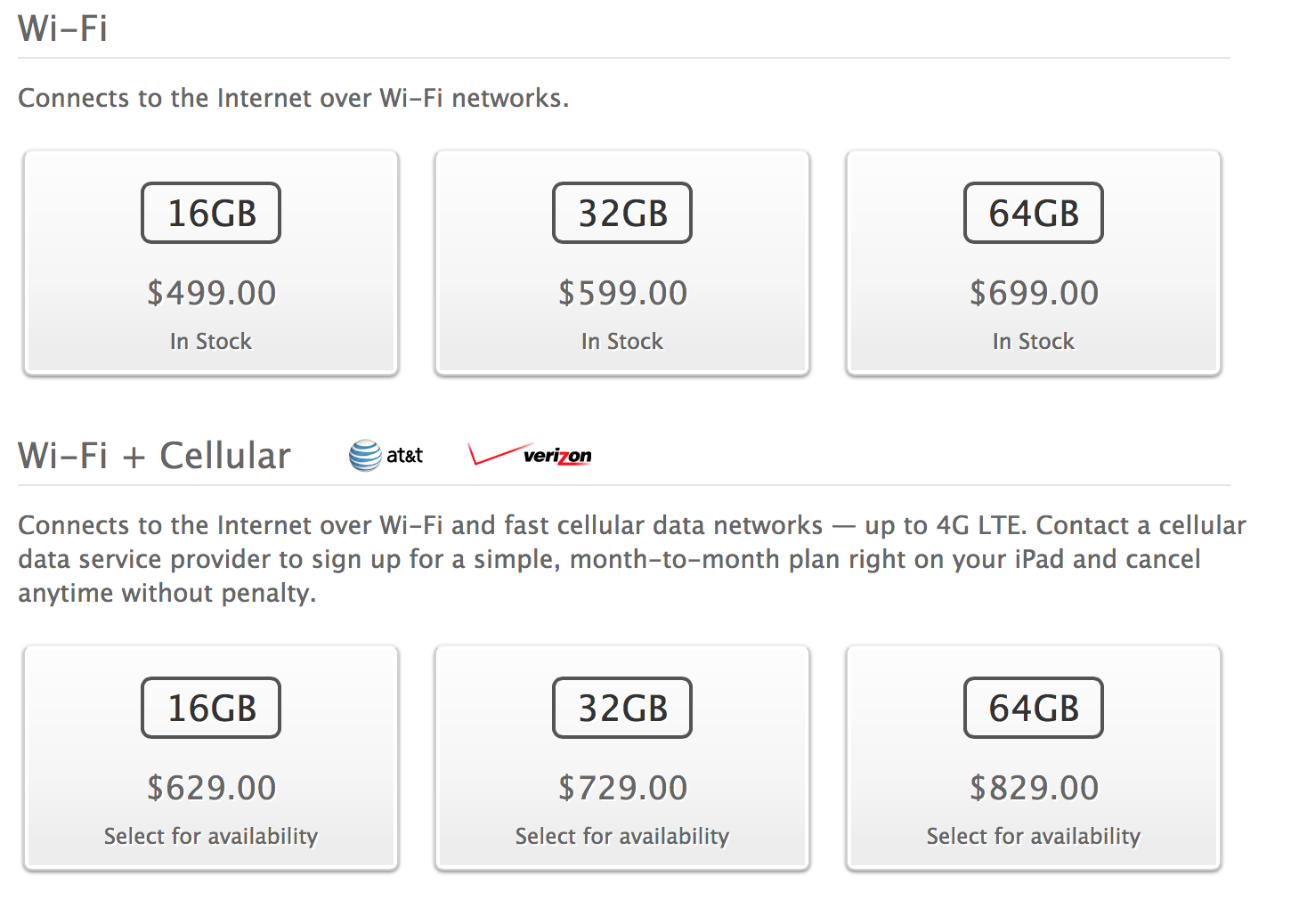
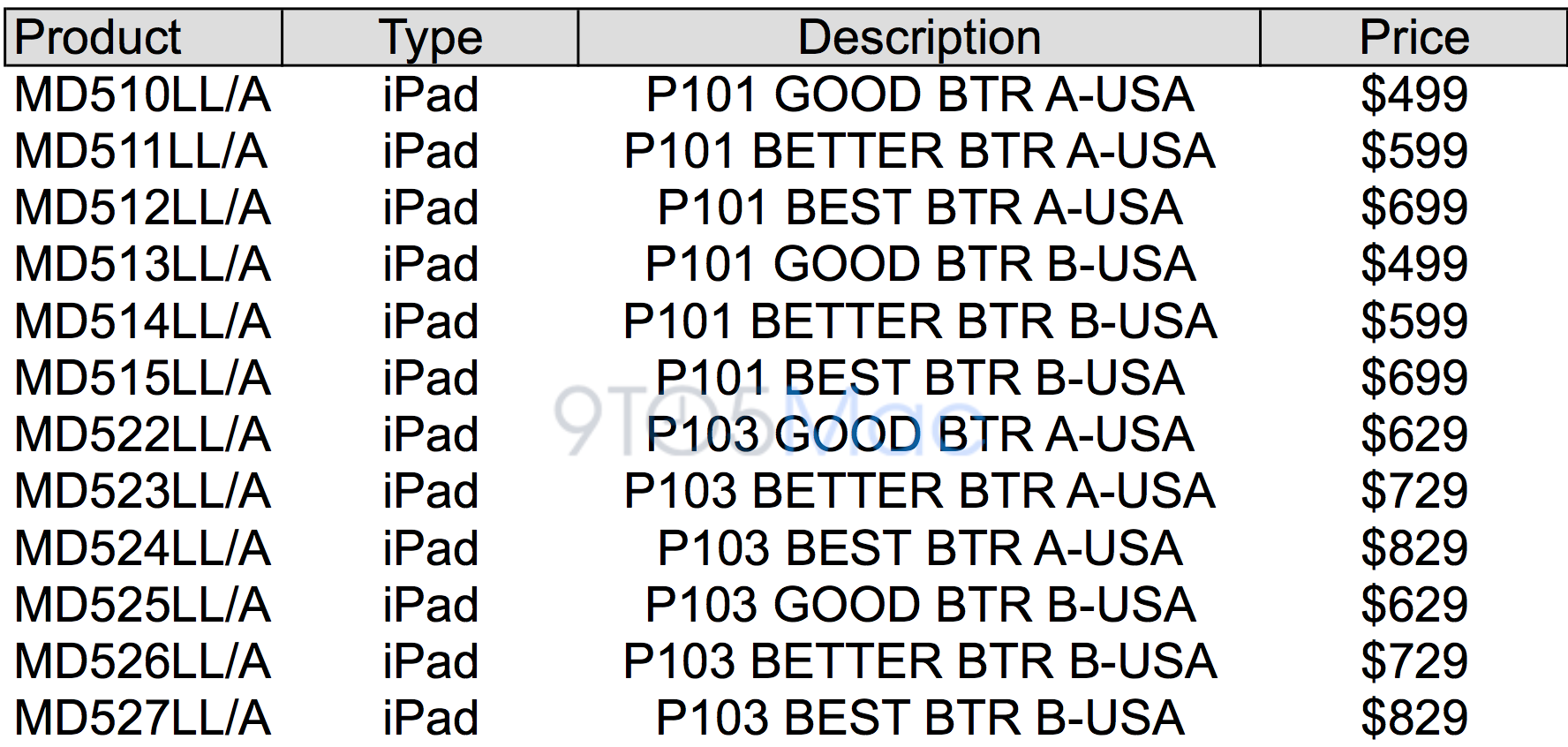
Apple will announce a refreshed version of its full-sized, 9.7-inch Retina display iPad at its media event October 23rd, according to our sources. These people say that the new version of the iPad will retain the same $499, $599, and $699 WiFi-only price points, and the LTE line will retain the current $629, $729, and $829 pricing. With no price changes or additional storage capacities, we believe that the storage options of 16GB, 32GB, and 64GB will also be retained.
Launching roughly half a year after the current third-generation iPad, this new iPad is said to be a tweaked model and not a complete revamp. As iMore and iLounge previously reported, we expect this new iPad to gain the smaller Lightning connector from the iPhone 5, fifth-generation iPod touch, and seventh-generation iPod nano. Also likely in the mix for this tweaked iPad is global LTE support, just like in the iPhone 5, according to a recent report from The Guardian. Apple could also use this opportunity to upgrade other internals like the processor, screen, battery, etc. but we don’t yet have specifics on this.
.
Out of the many new iPad models coming at this event, these new full-sized iPads make up half of the SKUs. The other half belong to the smaller ‘mini’ iPad.
We still cannot confirm, but we heard whispers of a Nov. 2 iPad mini release date. This is based on several retail scheduling anomalies. As the announcement of the iPad mini approaches, TechCrunch, iMore, iFun, and Geeky Gadgets additionally claim Nov. 2 is when the 7.85-inch device will hit stores and ship to customers who pre-ordered. Geeky Gadgets reported:
Our source, who is someone close to a major UK retailer, and has been reliable in the past, has told us that Apple will start selling the new iPad Mini on Friday the 2nd of November, the device will be available in the US And UK on this date, possibly some other countries as well.
That would mean just a week and a half passing, if released on Nov. 2, after the announcement. Since it is close to the holiday season, a quick release may make sense.
Famed iOS hacker Comex tweeted today that his internship at Apple has ceased. “So… no point in delaying,” he said to 195,000 followers. “As of last week, after about a year, I’m no longer associated with Apple.” Comex, whose real name Nicholas Allegra, explained to Forbes that his employment at Apple was terminated for not responding to an email. Forbes Andy Greenberg wrote:
When I followed up with Allegra in a phone call, he explained that the email he forgot to answer was an offer to continue his employment at Apple as a remote intern. At Apple, apparently, offer letters are taken rather seriously, and Allegra soon learned that his had been rescinded. “I wasn’t too happy about it, but it didn’t seem like I was able to fix it,” he says. “So that’s what it is.”
Before joining Apple as an intern over a year ago, Comex’s hacking work most notably included JailbreakMe. It is a popular tool to jailbreak iOS devices through an exploit within Safari. He also developed another popular jailbreak tool called “Spirit”. Expand Expanding Close
Verizon has reported its Q3 2012 earnings this morning with “a third consecutive quarter of double-digit percentage growth.” The nation’s second-largest carrier claims it experienced $29 billion in total operating revenue (3.9-percent gain over last year) and sold 6.8 million smartphones in total for the third quarter. Of the 6.8 million, Verizon reported selling 3.1 million iPhones. Just over one-fifth (or roughly 651,000) of those were the iPhone 5 that saw supply constraints. To compare, during Q2, Verizon sold 2.7 million iPhones.
The carrier also shed more light on its aggressive LTE rollout across the country. Its LTE service is now available to 250 million people in 419 markets across the United States. Furthermore, on the company’s earnings call, CFO Fran Shammo reiterated that its new Share Everything data plan has been “successful and well-received.”
According to The Next Web, Apple is in negotiations to acquire criticized photo/video-sharing company Color. The deal is reportedly “done,” though final papers are apparently yet to be signed. Color Founder Bill Nguyen, who happened to found a company Apple previously acquired (Lala), reportedly has been building new versions of the Color app to demo to Apple SVP Eddy Cue. The Next Web claims the deal is in the double-digit millions of dollars. With Color’s recent pivots in product along with surrounding criticism, we are naturally somewhat skeptical that Apple would move to acquire them. Apple and Color have yet to respond to The Next Web‘s report. Yesterday, news broke out that Apple has acquired an HTML-focused company called Particle.
The 32 GB Surface tablet costs the same as the 16GB iPad, but it also comes with twice the storage capacity—or at least that’s what everyone thought until Microsoft’s AMA on Reddit yesterday.
Daring Fireball just linked to one of the Surface Team’s responses that regarded how much free space the tablet actually has available:
So, the entry-level Surface delivers 20 GB of free space with Office and a few apps, eh?
In case you did not know, the iPad’s OS consumes around 1 GB of space. But that’s not all: Microsoft’s Steven Bathiche handled more questions as to whether the Surface’s display stands up to the new iPad’s Retina display.
After giving a long-winded description of Microsoft’s ClearType display technology, Bathiche concluded, “[sic] Doing a side by side with the new iPad in a consistently lit room, we have had many people see more detail on Surface RT than on the Ipad with more resolution.”
Again, in case you did not know, the current iPad offers a 2,048-by-1,536-pixel resolution. Surface for Windows RT has a 1,366-by-768-pixel resolution.
Apple has been selling iPhone 5’s as fast as they can make them since its mid-September launch. However, pre-order delays and retail shortages related to manufacturing troubles meant Apple was a little shy of the 10 million units predicted by analysts for opening weekend. We know Apple sold at least 5 million iPhone 5 units during the first three days of its retail launch starting Sept. 21. With a slow start and strong finish to the quarter ending on Sept. 29, today we get estimates from 59 analysts predicting iPhone sales for Q4 courtesy of Fortune. Apple is set to announce earnings for Q4 later this month on Oct. 25.
The average of the group is 26.3 million units, just slightly over the 26 million Apple sold in Q3 2012 (pros in blue, amateurs in green):
Smartphone parts supplier ETrade Supply just posted alleged leaked OEM parts of the iPad mini’s nearly 8-inch LCD screen and 4490mAh battery.
Apple’s much-discussed iPad mini is set to unveil at the company’s media event next Tuesday, and today’s parts pictures possibly confirm earlier reports and give a sneak peak as to what to expect from the folks in Cupertino.
The device’s display is “about 162mm in length and 124mm in width,” according to ETrade Supply, with a ratio of 4:3. Labeling on the back also indicates LG Display manufactures the part.
The Wall Street Journal spoke with an unnamed Hon Hai executive today about why the iPhone 5 is experiencing supply shortages, and the Taiwanese manufacturer, also known as Foxconn, apparently blamed it on the smartphone’s complicated design and its subsequent assembly process.
“The iPhone 5 is the most difficult device that Foxconn has ever assembled. To make it light and thin, the design is very complicated,” said the executive to the Wall Street Journal. “It takes time to learn how to make this new device. Practice makes perfect. Our productivity has been improving day by day.”
The official did not wish to be named, but he admitted Hon Hai is attempting to better production capacity while apply more procedures to alleviate the reports of damages such as scratches to the iPhone 5’s metal casing.
GigaOmfound yesterday that the new fifth-generation iPod touch is without a light sensor, prohibiting the device from auto-setting the brightness. Raghid Harake, a curious customer turned concerned, emailed Apple Senior Vice President of Worldwide Marketing Phil Schiller (viaiDownloadBlog) to find out why. Schiller, known for responding to emails, allegedly said the device is “too thin” at .24-inches. Just how thin:
Image via <a href="http://reviews.cnet.com/mp3-players/apple-ipod-touch-5th/4505-6490_7-35453100.html" target="_blank">Cnet</a>
The thickest point on the fifth-generation iPod touch is 6.13mm, while the fourh-generation is 7.12mm at its thickest point.
Apple officially announced a media event for the much-rumored iPad mini scheduled for Oct. 23. Apple sent out invitations to the press today, as noted by The Loop. The event will kick off at 10 a.m. PST in San Jose’s California Theatre, as opposed to one of Apple’s usual venues. An Oct. 23 unveiling of the new 7.85-inch iPad would likely signal an early-November launch and international rollout leading up to the holidays. Earlier this month, The Wall Street Journalreported Apple’s supply chain in Asia has kicked mass production of the iPad mini into full swing.
Pricing for the iPad mini has been the biggest source of debate, with some analysts claiming Apple is not “cutting corners” on the iPad mini’s design despite trying to compete with pricing of 7-inch competitors from Amazon and Google. Yesterday, Bloomberg reiterated earlier reports that Apple is having production issues with the iPhone 5 related to scratching on the device’s aluminum back. With delays and shortages still making an impact on supplies of the iPhone 5, analysts have also suggested initial supplies of the new iPad will likely be constrained.
Logitech just announced its 720p HD Wi-Fi Broadcaster webcam that wirelessly transmits to any Mac, iPhone, or iPad from 50 feet away.
The webcam is specifically aimed toward “video professionals, bloggers and hobbyists,” as it allows instant live streaming with Ustream and gives users the ability to toggle between the device and their computer’s built-in camera for second-angle POV shooting.
Logitech further noted the webcam is compatible with most popular Mac video applications like QuickTime, PhotoBooth, iMovie, FinalCut Pro, FaceTime, iChat, Skype, etc. Oh, and it comes with a plastic carrying case that doubles as a stand.
Additional specs:
HD 720p video capture
3x digital zoom and digital pan and tilt
Built-in mono mic / External mic jack
2-hour battery life, depending on use and usage of illumination lamp.
Tripod ready H.264 video compression
Built-in illumination lamp
Broadcaster is now available for pre-order at just $199.99 in the United States and Europe.
There has been a lot of controversy over Apple’s new Lightning connector introduced with the iPhone 5 and refreshed iPod lineups. Perhaps the biggest source of frustration for users and accessory manufacturers alike is the inability, so far, to produce official third-party products using the new standard. Apple has yet to update accessory makers with changes to its ‘Made For iPad/iPhone/iPod (MFi)’ policies. This will apparently require approval of facilities manufacturing Lightning products, but according to reports, it will not come until at least next month.
For accessory makers wishing to produce unofficial Lightning products, that process has proven difficult thanks to chips Apple has built into the connector thought to include security features. Despite reports that the security features have already been reverse engineered, and one or two third-party products on the market using the original Lightning cables from Apple’s suppliers, we have yet to experience a flood of Lightning products available to consumers. We also did not know exactly what tech Apple is including in these chips, something that we get a better look at today courtesy of a detailed teardown from Chipworks.
Once inside, Chipworks found a TI chip labeled “BQ2025” (alongside a handful of others) that could possibly include security features. The chip isn’t listed on TI’s website, but four similar chips are:
However, TI does have published datasheets on the BQ2022, BQ2023, BQ2024, and BQ2026. These four chips are cataloged on TI’s website as battery fuel gauges, but they are not identical, with three of them being serial EPROMs and one of them being a battery monitor IC… All use a single wire SDQ interface (TI’s proprietary serial communications protocol), and all have some basic security features such as CRC generation. So, it is certainly likely that the BQ2025 does have some security implemented on it. It would also seem likely that it includes an SDQ
Another possibility is that the chip is being used to better conserve electricity. For example, the cable could stop drawing electricity once the connected iOS device is fully charged to provide the obvious benefit of saving power. According to research from Opower, the iPhone 5 costs a mere 41 cents annually to charge once per day. However, the focus might simply be a greener, more energy efficient product.
In terms of the security features, Chipworks noted this is “the first secure cable” it has seen with this type of security device. It also speculated that, in terms of Lightning connectors, “piracy is not a concern” for Apple:
We got a look inside the new fifth-generation iPod touch last week thanks to our friends over at iFixit. Today, they are taking apart the seventh-generation iPod nano that Apple recently unveiled alongside the new iPod touch and iPhone 5 lineups. While it did not perform quite as poorly as the iPod touch in terms of repairability, it was still unable to outperform the 7 out of 10 repairability score given to iPhone 5. We see the usual suspects inside including flash memory from Toshiba and a TI touchscreen controller. However, a quick look at the Nano’s internals shows a few anonymous, Apple-branded chips as well:
* Toshiba THGBX2G7D2JLA01 128 Gb (16 GB) NAND flash
* Texas Instruments 343S0538 touchscreen controller
* Broadcom BCM2078KUBG Bluetooth + FM radio
* NXP Semiconductors 1609A1
* 75203 23017
* 75292 98820
* 339S0193
* Apple 338S1099
* Apple 338S1146
Thanks to many components being soldered to the logic board (battery, lightning connector, headphone jack, etc.), and a battery attached to the assembly, iFixit is giving the new Nano a 5 out of 10 for repairability. Here are some of the highlights:
Despite rumors that T-Mobile is no longer using Apple or the iPhone in its “Unlimited & Unlocked” campaign, T-Mobile later confirmed its plans for unlocked iPhone customers would continue as planned. Today, the carrier announced improved coverage and speeds for customers using its iPhone-compatible 4G network in and around Kansas City. It also promised future announcements for Las Vegas and other markets later this year:
T-Mobile’s $4 billion plan to strengthen our already competitive 4G network is well underway. Today, I’m thrilled to announce that Kansas City is the latest market where T-Mobile customers will be able to benefit from enhanced voice and data coverage, as well as faster speeds on unlocked devices, including the iPhone… As T-Mobile network advancements continue in other cities, customers in some parts of Seattle, Los Angeles, Washington D.C. and the New York metro area are already experiencing improved coverage and iPhone “speed sightings” on T-Mobile’s 4G network. Stay tuned – in addition to Kansas City and Las Vegas, T-Mobile will be announcing many other markets this year where we have strengthened our network.
Just before we heard Apple was not using an ARM-designed processor and instead its first custom CPU design for the new iPhone’s A6, we also heard reports that Apple was reducing component orders from Samsung due to the two companies’ ongoing patent disputes. While we knew Samsung was still—at the very least—manufacturing the new chip, a report from KoreaTimes gives more insight into the company’s involvement directly from a Samsung official. According to the report, the A6 is the first of Apple’s iPhone chips where Samsung did not contribute to development of the technology:
According to industry sources, Apple has not collaborated with Samsung in the process to develop its A6 microprocessor used in its latest iPhone 5. Samsung has handled the manufacturing of the processors used in previous iPhones and believed to have contributed in their design to some degree… It now appears that the structure of the deal has been dramatically adjusted…Apple is still relying on the Korean firm to manufacture its chips but has made it clear it will no longer use its rival’s technology.
We heard conflicting reports in September regarding Apple’s decision to reduce component orders from its biggest supplier, Samsung. Reuters claimed the reduction in orders was an attempt to simply “widen its supply chain,” while others reported Apple is actively reducing orders of displays, memory chips, and batteries specifically due to increasing tension between the companies. According to the report’s source, an unnamed senior Samsung official, Samsung is now only manufacturing the A6 chips on a “foundry basis”:
“There are three kinds of chip clients. Some want us to handle everything from chip design, architecture and manufacturing. Some want us to just design and manufacture. Some want us to just make the chips. Apple is now the third type,’’
Related to today’s report: Apple’s recent hiring of Samsung chip designer Jim Mergard. The report claimed the hiring of Mergard, who was working specifically on ARM chip designs at Samsung and prior, increases the “mutual tension”… Expand Expanding Close
Microsoft announced this evening its new music service, called “Xbox Music”, that aims to compete with iTunes, Spotify and RDIO. The service is set to launch tomorrow for the Xbox 360 and Oct. 26 for Windows 8 (coming pre-installed) and Windows Phone 8 devices. The service will also launch as an iOS app shortly after, GigaOm noted:
But the biggest story to me is that Xbox Music will embrace Android and iOS. Jerry Johnson, general manager of Xbox Music, wasn’t able to tell me exactly when the apps for those two platforms are going to come out, but the sense that I took away from the briefing was that his team is working on making it happen sooner rather than later. Xbox Music on Android and iOS will look very much like Xbox Music on Windows Phone 8, which itself in many ways follows the style formerly known as Metro.
Microsoft’s service will be for limited hours of free streaming after six months, so Spotify might not need to worry just yet.
There is no word on what pricing iOS users will see, but Microsoft said it will offer a free ad-support version for Windows 8 device owners and a $10 ad-free plan for those wanting an ad-free experience.
Developer Ben Guild posted alleged screenshots of Google’s upcoming Maps for iOS app. He claimed the photos show the alpha version of the app that is “speedy” and supports the iPhone 5. Further details in the report assert that Maps for iOS is vector-based and supports two-finger rotation.
The photos do not show anything too mind-boggling. However, if real, they show Google is actively working on the app which many hope is coming. Last month, we reported that Google has a Maps for iOS coming—and others agree.
The hope for Google to release a standalone app came after the flop of Maps that Apple introduced in iOS 6. Users have complained, while Apple CEO Tim Cook promised Maps would get better over time. Google chairperson Eric Schmidt voiced last week in Tokyo that Apple should have kept Google Maps: “We think it would have been better if they had kept ours. But what do I know?” He would neither confirm nor deny working on a Maps app for iOS, but he mentioned Apple would “have to approve it. It’s their choice.”
If it is released, I think it is safe to say that a Google Maps for iOS would quickly reach top of the charts in the App Store.
Update: A Twitterer shows how easy these are to fake:
Baseball ticket in Passbook being scanned in (CNET)
Nearly a month after launching its virtual wallet iPhone app, Passbook, Apple is preparing to put the feature to good use in its physical retail stores.
Later this month, Apple will be seeding an updated version of its mobile point-of-sale (EasyPay) system software to Apple Store employees. This update, numbered version 12.3, will allow retail employees with EasyPays to capture Apple Store payment card codes from customer iPhones and iPod touches running Passbook.
While Apple’s EasyPay software should be ready for Passbook this month, some sources noted that the current EasyPay hardware, at least at some retail stores, may not be capable of scanning iOS device displays. Presumably, Apple has a solution for this in the works.
Also, Apple’s plans for rolling out the consumer-facing Apple Store app update to support Passbook-based Apple Store cards is currently unclear. But with Apple preparing to seed software to its stores that interacts with Passbook on customer iPhones and iPod touches, we believe that the feature is close to being a rolled out.
If the 16.7Whr/4490 mAh iPad Mini battery images that MacRumors reported last night are authentic, it would place the power at almost exactly three times more than the iPhone 5’s 5.45Whr and one-third of the massive 42.5Whr battery of the third-generation iPad. Seems pretty logical.
The battery runs at 3.72 volts, and it shows a model number of A1445 and an Apple part number of 616-0641.
Not the best looking pie chart—especially for Samsung.
Apple’s iPhone 5, at just three weeks old, is apparently experiencing more Web traffic than its three-month-old arch nemesis Samsung Galaxy S III.
The latest report from research firm Chitika depicts the iPhone 5 as gobbling up 56 percent of Web traffic volume, compared to the S III’s 44 percent, in just 18 days since it officially released. Chitika attributed the sudden growth to record-breaking sales numbers and 4G speeds:
Record-breaking sales numbers, along with new 4G browsing speeds which encourage data usage, are the most likely explanation for this tremendous growth. This latest shift in the mobile ecosystem is not welcome news for Samsung, which has positioned its device as a direct competitor to the iPhone 5.
Chitika has notably come under fire recently for publishing incorrect information on Google’s local search queries. The firm realized its errors after reading an article by SearchEngineLand. While today’s Web traffic report is significant—yet sudden— for Apple, lets hope Chitika has straightened out its metrics for analyzing Web data.
Apperian just launched “Remote Control for iOS”, a feature for its Enterprise App Services Environment that it called “the first and only solution that empowers IT departments to remotely view and interact with employee’s iOS devices as if the device was directly in front of them.” The solution works from anywhere, even over cellular networks, provides per-app privacy settings for end users, and it allows admins to control iOS devices through a web browser with no additional coding or software necessary:
Mobile devices go anywhere and everywhere – so there’s no need to be on the same local network or use a VPN to use Remote Control. An administrator can remotely control a device that is behind a home router, firewall or captive network with no additional configuration. It even works over cellular network, so you can provide support to a user no matter where they are.
A video demo of the feature is above, while the company’s full press release is below: Expand Expanding Close