Sprint, the third-biggest U.S. mobile service provider, failed to bill customers for more than $100 million of taxes for its wireless services over seven years, according to New York Attorney General Eric Schneiderman.
Sprint’s problems continue, as it seems the company might have been giving its customers an unfair break over the past seven years.
Update: Sprint has a response:
“This complaint is without merit and Sprint categorically denies the complaint’s allegations. We have collected and paid over to New York every penny of sales taxes on mobile wireless services that we believe our customers owe under New York state law. With this lawsuit, the Attorney General’s office is claiming New York consumers, who already pay some of the highest wireless taxes in the country, should pay even more. We intend to stand up for New York consumers’ rights and fight this suit.”
Verizon announced its earnings today coupled with some interesting new information. Verizon’s Chief Financial Officer Andrew Davies told investors that a data-sharing plan would be available this summer. Family Data sharing has been in the cards for a while, but this is another indication of an imminent launch.
During the call, Verizon announced that it activated an additional 3.2 million iPhones for the quarter, which is 1.1 million units down (or 24 percent) from the blowout Holiday quarter when the carrier activated 4.3 million iPhones.
Verizon activated 6.3 million smartphones overall, and 9.1-percent of those were on LTE. Data revenues were $6.6 billion, which is up $1.1 billion (or 21.1-percent) year-over-year and represents 42.9-percent of all service revenues. Total revenues were $18.3 billion, up 8.2-percent year-over-year.
Verizon is now at 47 percent smartphones overall. It is near the tipping point where smartphone customers outnumber dumbphone counterparts.
Verizon put out dozens of press releases today announcing expansions and additions to its 4G LTE network. The majority of the additions and expansions will kick-in April 19.
Update: a commenter with legit accents in his name, indicating superior knowledge of Swedish to mine (yet inferior sense of humor), says “Uppleva” is actually “Experience”, as in “Experience a cable-free solution”.
Although Nokia may or may not be having some success in the United States with its heavy Lumia 900 marketing campaign under AT&T, it does not appear to have made any headway on its home turf in Europe. AT&T will give you $50 to take one of its Lumia 900 phones in the United States, but it has already fallen off the Best Selling list at Amazon.
Yesterday, the credit rating agency Moody’s downgraded Nokia’s debt to near junk level citing a “sharp decline in first-quarter cell phone sales that led to a 35 percent fall in revenue.” Standard & Poor’s announced a similar downgrade in March. Nokia’s share prices plunged another 20 percent in recent days on news that it would not come close to its forecasts.
Things do not seem to be looking up, either. Reuters talked to four European carriers that said Nokia phones simply could not compete with Apple’s iPhone and the Android devices already available.
“No one comes into the store and asks for a Windows phone,” said an executive in charge of mobile devices at a European operator, which has sold the Lumia 800 and 710 since December
When the Nokia 900 launched, we asked: “What question does the Lumia 900 answer? Why would you buy a Lumia over an iPhone or Android device?” Expand Expanding Close
Microsoft revealed its full Windows 8 suite this evening, which includes Windows 8, Windows 8 Pro, and Windows 8 Enterprise. However, most notably, there is another version named “Windows RT” that will run on ARM-based machines. This version is primarily aimed at tablets, according to Nilay Patel at The Verge:
Specifically, Windows RT will not be sold separately, but only available pre-installed on new machines with ARM processors. That’s a major change in the way Microsoft has traditionally sold Windows, and it underscores a more integrated approach to ARM-powered devices like tablets. Windows RT will also include the Office suite as we previously reported, but no other desktop apps can be installed on ARM machines. Windows RT will also lack the traditional Windows Media Player and most of the enterprise features found in Windows 8 Pro and Enterprise.
[…]he was most concerned by the efforts of countries such as China, Saudi Arabia and Iran to censor and restrict use of the internet, but warned that the rise of Facebook and Apple, which have their own proprietary platforms and control access to their users, risked stifling innovation and balkanizing the web.” There’s a lot to be lost,” he said. “For example, all the information in apps – that data is not crawlable by web crawlers. You can’t search it.”
It is interesting that “lost” is defined above as “not crawlable by Google’s search engine.” Framing the argument—as “what is in the best interests of users” versus what Google wants—would probably have helped his case. We are supposed to think that it is just a coincidence the two biggest corporate threats to Google are also the two biggest threats to humanity/the Internet. (via Slashdot)
Today, we have two pieces of Intel-related news with reports claiming a solid April 23 launch date for the Ivy Bridge introduction, while others report Intel has begun shipping its next-generation Thunderbolt technology.
Late last month, we heard reports from CPU World, which claimed Ivy Bridge CPUs most-likely to land in future Macs would launch between April 22 and April 28 with availability by April 29. Today, we get a solid launch date with Cnetand various other sourcesreporting Intel will start its initial rollout April 23. As we detailed previously, many of the Ivy Bridge models included in the initial launch would be suitable for MacBook Pro-like devices and desktop offerings. However, Intel’s Ultra low-voltage U-Series Ivy Bridge processors most likely headed for MacBook Air-like designs are expected to launch in June.
Intel today said there would be over 100 Thunderbolt devices by year-end and another report coming fromVR-Zone today claimed Intel started shipping its second-generation Thunderbolt controllers codenamed “Cactus Ridge,” which would align nicely if both these updates are headed to future Macs… Expand Expanding Close
Yesterday, the U.S. Department of Justice filed a lawsuit against Apple and five other publishers over eBook price-fixing. The Department of Justice reached a settlement with three of the publishers in the suit, but Apple, MacMillan, and Penguin are standing strong (the U.S. is also after Simon and Shuster). Yesterday, MacMillan’s CEO released a letter on the matter and explained why the publisher chose not to settle. In the note, he said the Department of Justice’s settlement demands “could have allowed Amazon to recover the monopoly position it had built before our switch to the agency model.” He also said it is “hard to settle a lawsuit when you know you have done no wrong” and called the agency model the future of an “open and competitive market.”
As CNETnoted, the Department of Justice may have a more difficult case against Apple. For one, Apple does not have a strong-hold in the eBook market, because Amazon has the commanding lead with its Kindle sales. The Department of Justice has a case against the publishers rather—and that is most likely why three of them have already chosen to settle. Apple only holds open the store, while publishers are the ones who choose the prices to set.
The settlement reached with three of the publishers yesterday is said to give them “freedom to reduce the prices of their e-book titles,” which allows Amazon to go back to its previous wholesale model.
A key point that the Department of Justice is using in its lawsuit is when all five of the publishers met together at a hotel in London to talk over eBook prices. Apple was not present at the meeting, so this may give the Department of Justice a harder time to press the Cupertino-based Company. Of course, the Department of Justice could still come out victorious, but it may have to dig a little deeper against Apple than it did with publishers. We are sure there will be more out of this case as time goes on.
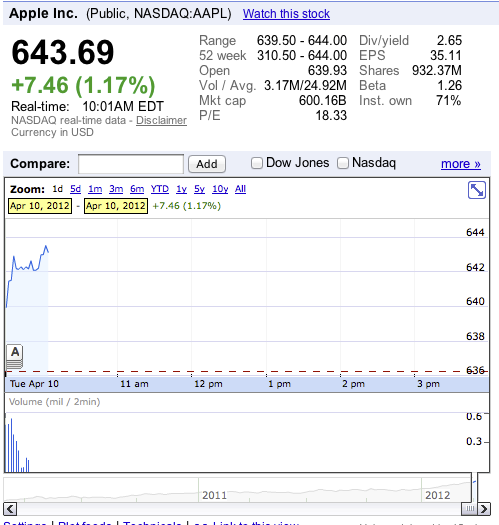
As the market just begins to open today, Apple’s market cap crossed the $600 billion threshold. Today’s accomplishment comes just a month after the company hit the $500 billion threshold. The market overall is down.
To compare, Microsoft holds the record for the highest market cap ever of $619 billion in 2000 (over $800 billion in today’s dollars). At the time of this writing, Microsoft is sitting at a $250 billion market cap. If some analysts are to be believed, the AAPL train will keep rolling to a $1 trillion market cap in the coming years.
Apple now dwarfs the No. 2 company, Exxon, by a comfortable $200 billion. We are looking forward to April 24 when Apple will talk Q2 2012 numbers.
Apple hired a new leader for its tax department, according to an SEC filing this morning. Phillip Bullock, formerly Symantec’s Chief Accounting Officer, chose to leave the company he joined in 2006 to join the winning team in Cupertino.
Phillip A. Bullock, who was appointed as Symantec’s Chief Accounting Officer in September 2009, announced he will be leaving the Company to lead the tax department at Apple, Inc., and not due to any disagreement with the Company on any matters relating to the Company’s operations, policies or practices.
Bullok has years of experience in the industry, serving as Vice President of Tax and Trade Compliance starting in 2006. He took responsibility for Symantec’s corporate risk assurance function in March 2007, and then he became Chief Accounting Officer in 2009. Before Symantec, he worked for a small tax practice.
This looks to be Apple’s third major hire this year after it hired John Browett from Dixons Retail to head its retail department. Apple also hired Robin Burrowes from Xbox to head App Store marketing in February.
Apple is known for finding the best in the industry, so we suspect it is no different here. Just in time to submit those taxes.
We reported this morning that Apple has now begun internally seeding a prototype next-gen iPhone with the A5X chip that debuted in the new iPad and 1GB of RAM. Based on his recent trips to China and Taiwan, Topeka Capital Market analyst Brian White, who has Apple’s price target at $1,001 as of this morning, shared some new details of what he described as “the buzz around the new iPhone 5.” According to White (via Barron’s), he expects a “sleek” new iPhone to launch in the December quarter. He also expects the device to sport a new 4-inch display and include 4G LTE capabilities.
White set his price target based on an expected August or September unveiling of the product. He also claimed the launch “could be extraordinary” by dwarfing previous launches and driving the stock closer to our $1,001 price target.” According to the report, Apple is expected to start component production for the “iPhone 5” in June.
White also claimed sales of the new iPad could have been higher if not for a production issue with panel makers related to the new Retina display. Last month, Apple announced its “strongest iPad launch yet” with sales of three million new iPads on its debut weekend… Expand Expanding Close
According to an Apple patent application published by the United States Patent & Trademark Office and detailed byPatentlyApple, Apple is working to implement audio transducers in combination with multiple speakers to enable surround sound configurations on MacBook-like devices. Apple’s focus of the patent appears to be improving audio in mobile devices as speakers decrease in size to accommodate smaller and thinner form factors.
As detailed in the image to the right, one embodiment of the invention shows the use of several speakers and an audio transducer integrated into the bezel and enclosure of a MacBook. These configurations would allow, for example, the speakers embedded next to the display to handle high range frequencies, while the lower speakers would handle mid-range and the audio transducer the low-range. Additional speaker enclosures could be added to enable 3.1 or 4.1 surround sound configurations. Apple also stated the audio transducer could provide both low and mid-range frequencies, “essentially performing as a “subtweeter” for frequency ranges from 20-500 Hz and 500-1500 Hz. The report explained:
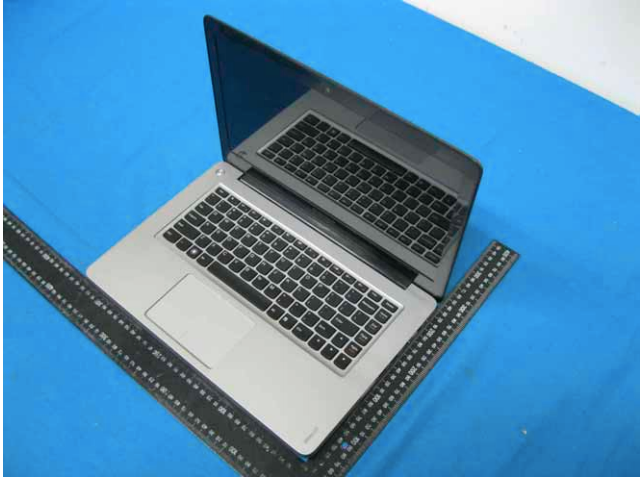
This is the new Lenovo IdeaPad U310 (and U410) as it appears in the Federal Communication Commission database. I always wonder if Lenovo during its design meetings pretends like it came up with this look, or if the boss just says, “Make me something that looks exactly like this MacBook Pro.”
There is no way to sugarcoat today’s announcement from the once-great Blackberry-maker RIM. The company is, after years of putting its head in the sand, finally taking drastic measures to change course, including getting rid of former Co-CEO and current board member Jim Balsillie and its CTO and COO (loooong overdue). Revenues are way down—and so are unit sales and prospects.
So, where is the way out of this mess? RIM says it is looking for “strategic business-model alternatives.” It is also considering a sale. Where is there any value in the company?
This is not the first time an Apple patent has surfaced relating to three-dimensional camera technologies. A previous patent highlighted advanced 3D object recognition and verification. A new patent—published today by the United States Patent & Trademark Office and detailed by PatentlyApple—shows Apple is continuing to work on 3D camera technologies that could land in future iOS devices. Apple’s patent described a 3D imagining camera that uses advanced microlenses, depth-detection, chrominance, and luminance sensors. The camera could recognize facial expressions and gestures while creating 3D models of scanned objects. PatentlyApple explained:
With iOS gaining roughly 30 percent United States marketshare as of Q4 2011 at the expense of RIM, Nokia and Microsoft, new numbers from Nielsen’s latest study show just how much of a duopoly the U.S. market has become. While noting about 50 percent of mobile subscribers in the U.S. are now smartphone owners, Nielsen gave a breakdown of how the two leading platforms continue to dominate as of February 2012: Expand Expanding Close
We have heard reports in recent months that the launch of Intel’s Ivy Bridge processor lineup, which will likely find its way into next-generation Apple products, has been delayed. While an April/May launch was expected for some of the lineup initially, Intel confirmed in February that the launch would likely be pushed to June. Today, a report fromCPU World that cited various sources claimed the Ivy Bridge CPUs, including both desktop and mobile chips, will launch between April 22 and April 28.
A ton of recent rumors all but confirm Apple plans to enter the TV market with a full-fledged Apple-branded HDTV, but today a patent published by the U.S. Patent and Trademark Office details an advancement of high refresh rate LCD technology known as “fringe field switching.” As described byPatentlyApple, Apple’s patent offers advancements in the technology that would allow FFS for use with large screen HDTVs. The report noted, “Previous versions of FSS couldn’t accommodate such large displays.” PatentlyApple explained:
Update: Nokia has responded to reports that Apple is offering to license its nano-SIM patents royalty-free by claiming Apple does not have patents “essential to its nano-SIM proposal” (via ITworld):
“We are not aware of any Apple Intellectual Property which it considers essential to its nano-SIM proposal. In light of this, Apple’s proposal for royalty-free licensing seems no more than an attempt to devalue the intellectual property of others.”
In recent weeks, reports popped up that suggest Apple is attempting to push a new standard for miniaturized SIM cards. In May 2011, Reuters reported Apple “submitted a new requirement to (European telecoms standards body) ETSI for a smaller SIM form factor.” More recent reports from the Financial Timesconfirmed other companies, including Motorola and Nokia, were attempting to push their own “nano-SIM” design. At the time, FT said Apple had support from “most of the European operators.” Ahead of the Smart Card Platform Plenary meeting with the European Telecommunications Standards Institute this Thursday and Friday, Foss Patents reports Apple is promising the ETSI it will license any Apple-owned patents related to nano-SIM free of charge to its competitors: Expand Expanding Close
Square updated its “Card Case” app with a new design, new name, and a shiny new icon (literally) less than a week after PayPal announced its triangular Square competitor.
Unlike the previous version of the app, which used a credit card metaphor for each store you had an account with, version 2.0, now called “Pay with Square,” uses a list of businesses nearby that accept Square payments and allow you to quickly open a tab at any of them. You can also search a map for nearby Square-compatible businesses and add your favorites to a list for quick and easy access on future visits.
This is not the first time we have received hints that Apple is working on an innovative universal remote control for controlling TV and video content. In January, we told you that Apple was researching a touchscreen remote with adaptable user interfaces. The invention would essentially allow button layouts stored in the cloud or in a device (such as a TV) to be wirelessly and seamlessly beamed to the controller’s UI. The concept would alleviate the “table full of remotes” scenario Steve Jobs described at D8.
Today, a new patent application published by the United States Patent & Trademark Office and detailed by PatentlyApplegives us even more insight into what Apple’s universal remote concept could become. In the newly discovered patent application, Apple details a remote that is capable of displaying customized controls for various devices by simply taking a picture of the device. Apple would send the picture to iCloud, analyze it, and beam a UI or button layout to the remote that works for your TV. PatentlyAppleexplained:
Reports from the Wall Street Journal last Octoberrevealed Sprint’s Chief Executive Officer Dan Hesse convinced the company’s board to take on a staggering commitment of approximately $20 billion to purchase 30.5 million iPhones over four years. At the time, Hesse said Sprint “would likely lose money on the deal until 2014. ″ He also claimed not having the iPhone was “the No. 1 reason customers leave or switch.” In an interview with Mobile World Live (via BGR), Hesse defended the decision and claimed, among other things, that iPhone users are “more profitable than the average smartphone customer.”
“ Subsidies are heavy for the iPhone. This is the reason why a high percentage of new customers is important… But iPhone customers have a lower level of churn and they actually use less data on average than a high-end 4G Android device. So from a cost point of view and a customer lifetime value perspective. They’re more profitable than the average smartphone customer.”
Hesse went on to claim that Sprint was “pulling a lot of customers” from AT&T and Verizon during the fourth quarter by noting four out of every 10 iPhones the carrier sold were new customers. According to Hesse, that is around double the rate of the other carriers. Expand Expanding Close
This year we have an awesome speaker line-up, including cool dudes like Loren Brichter (Tweetie/ex-Twitter), Neven Mrgan (Panic), Karl von Randow (Camera+), Raphael Schaad (Flipboard), Matt Rix (Trainyard), Shaun Inman (Last Rocket) and many more.The full line-up and other details like the date and location can be found on our website, www.onemorething.com.au – videos from the 2011 event can be found on Vimeo:http://vimeopro.com/omtconf/2011 and we even have a podcast where we interview all the 2012 speakers up on iTunes: http://itunes.apple.com/au/podcast/one-more-thing-ios-conference/id511706732