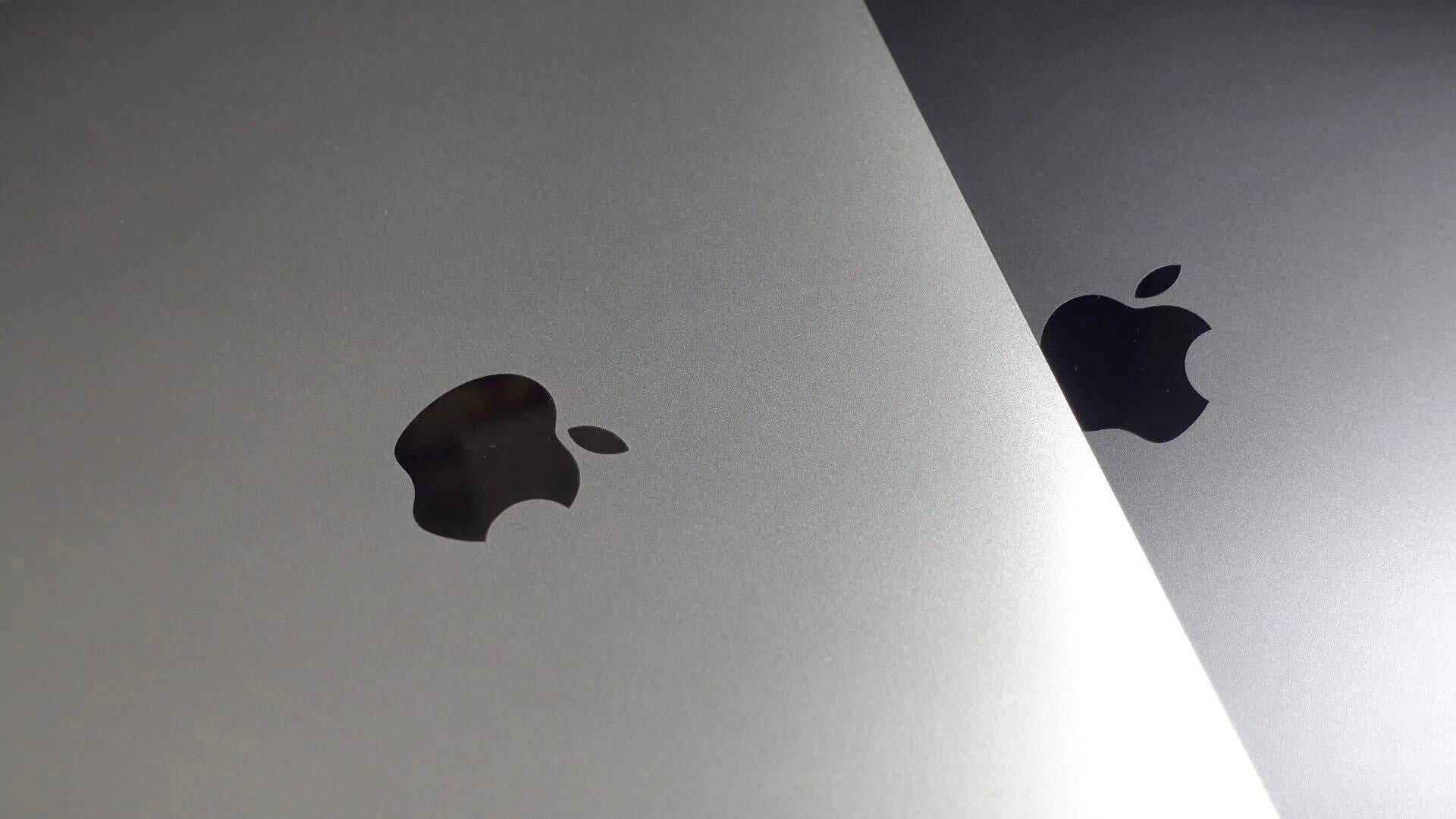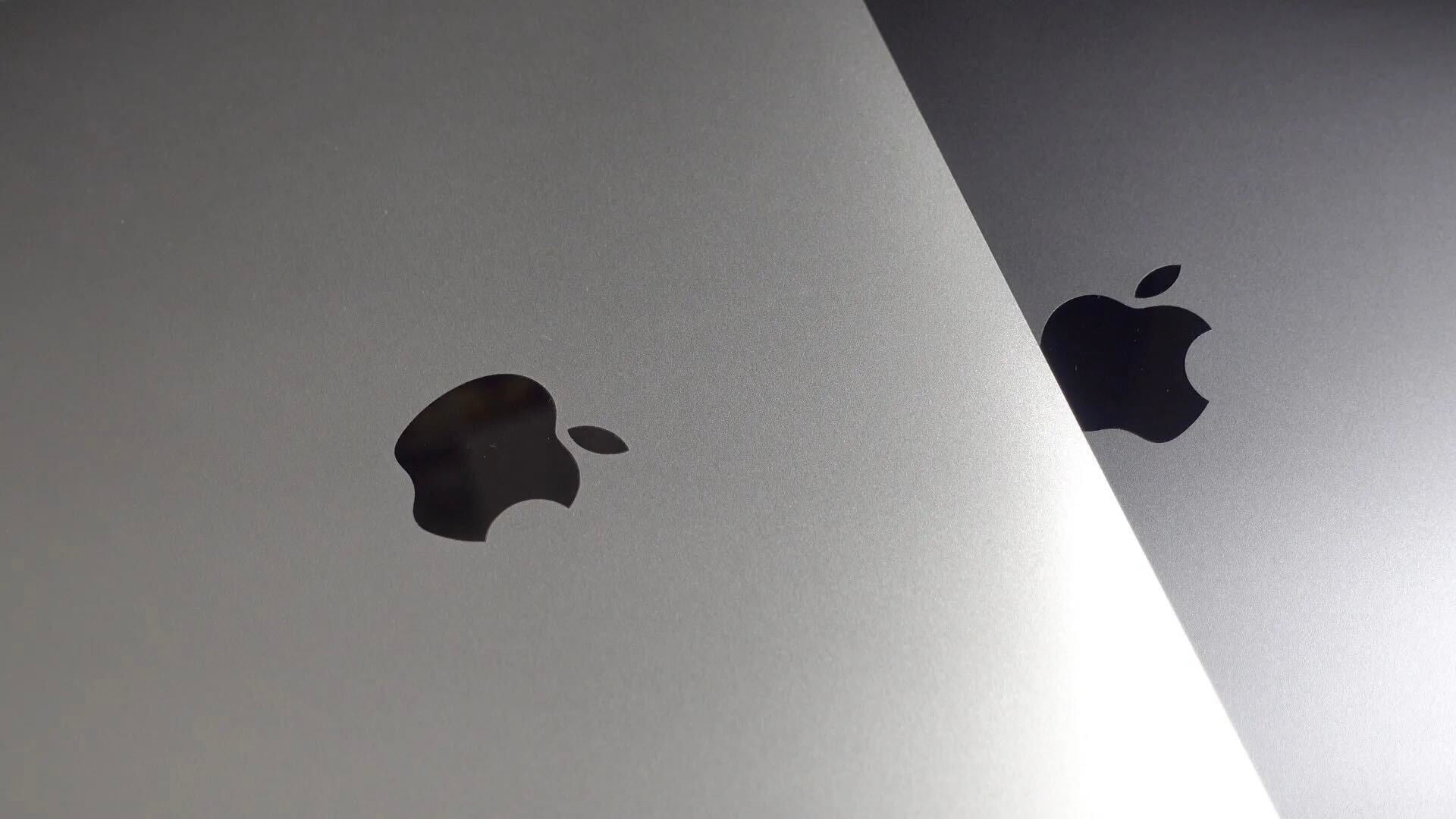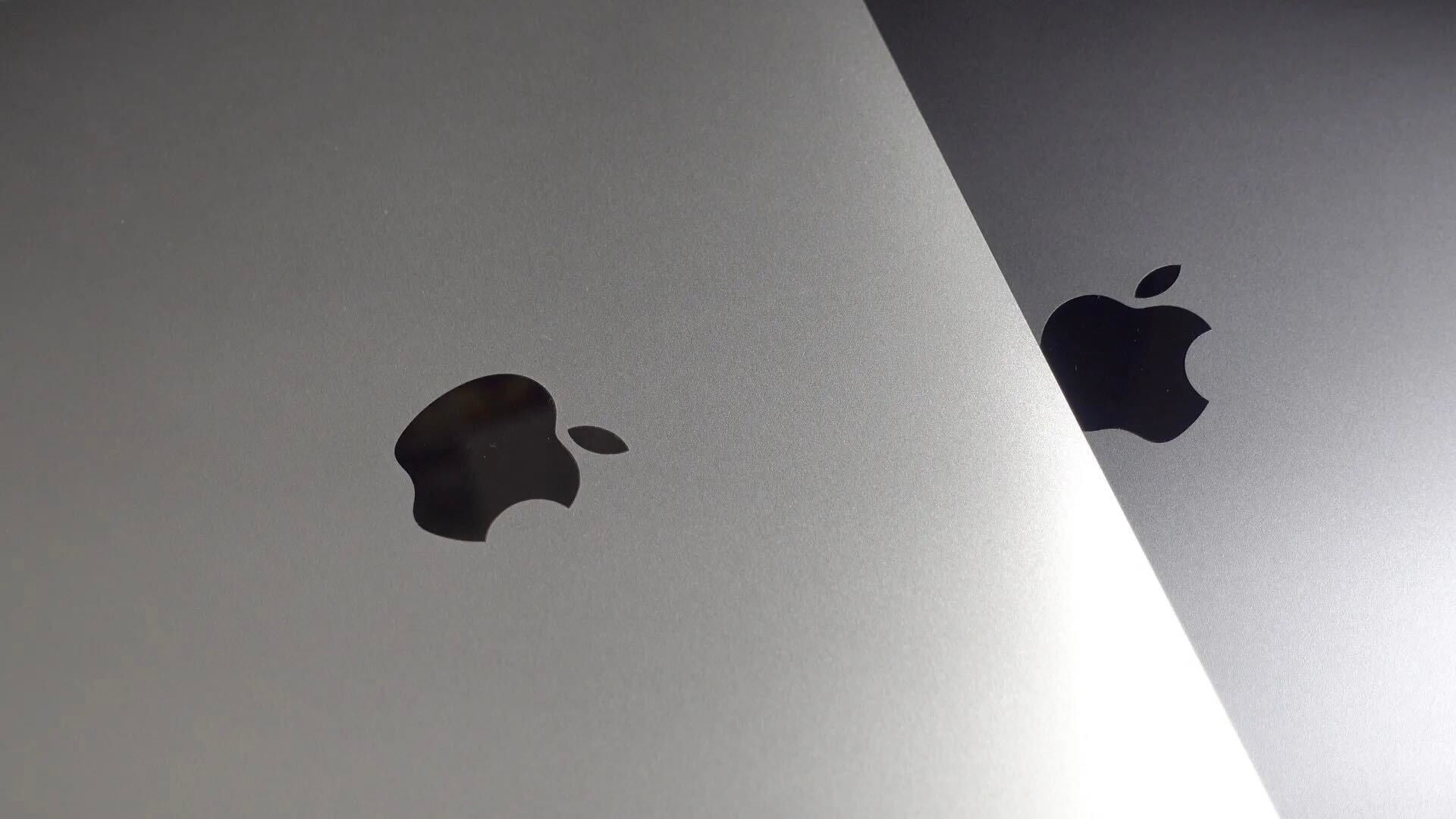
Apple got its hands on a new U.S. patent this week that loosely covers the entire form of its thinnest notebook.
According to The Verge, the patent [D661,296] is “clearly intended to broadly cover the distinctive wedge or teardrop profile” of the MacBook Air that is found in more and more “UltraBooks that Intel is pushing:
With design patents it’s all about the drawings. There isn’t much in terms of a written description to go by, so the nuances of the drawings define the enforceable protection of the patent. And as always, the coverage centers around the details of the solid lines in those drawings. The dashed lines provide context, but do not at all define what is patented. In determining infringement, courts look at whether the allegedly infringing device and the design patent are substantially similar in overall appearance to an “ordinary observer,” excluding minor differences. You can see […] how Apple has dashed out the unimportant details of the notebook, like the rear contour, hinge, side ports and feet, and instead focuses on the overall wedge shape and look of the device with solid lines. That’s the aesthetic Apple has patented here and a notebook with hinges, feet or a shaped back different than the MacBook Air could still be infringing as long as the rest — primarily the claimed wedge profile — is substantially similar. On the other hand, competitors can still rely on meaningful tweaks to the angles, shapes and proportions of their notebook designs to avoid the patent — that’s how patent design-arounds work.
Apple tends to uphold its design rights and go after competitors in the mobile space that infringe upon its patents. With this new notebook patent, which issued on Tuesday, rivals with contending unibody, aluminum-shaped laptops, such as Ultrabooks, may now be in the Cupertino, Calif.-based Company’s legal sights.
Analytics firm Flurry has dissected developer ratios for Apple and Google’s mobile platforms as their respective annual conferences are on the horizon, and research findings show the two companies boast a joint market cap of about $750 billion.
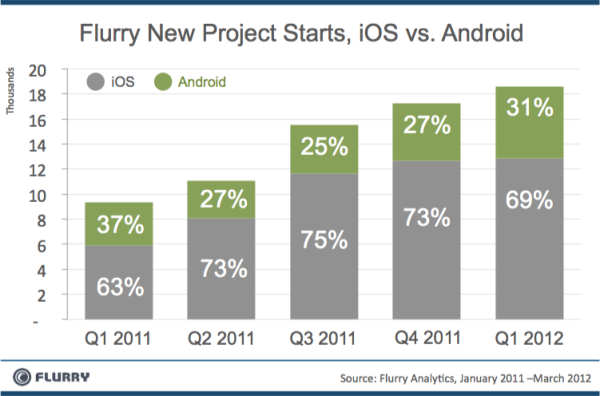
The study compared developer support for iOS versus Android by examining data collected from more than 70,000 companies across more than 185,000 mobile apps. The bar graph below illustrates developers’ loyalty to Apple: For every 10 apps that developers build, seven are for the iOS operating system.
“While Google made some gains in Q1 2012, edging up to over 30% for the first time in a year, we believe this is largely due to seasonality, as Apple traditionally experiences a spike in developer support leading up to the holiday season. Apple’s business has more observable seasonality,” explained Flurry in a blog post.
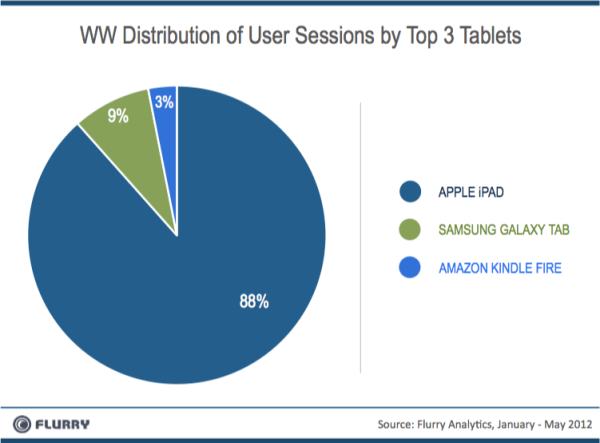
Flurry further cited iOS as the more attractive platform to developers due to its stronghold on the tablet market share. The pie chart below represents a sample size exceeding 5 billion total user sessions. It reveals the Galaxy Tab and Amazon Kindle Fire “hold very distant second and third places in terms of consumer usage.”
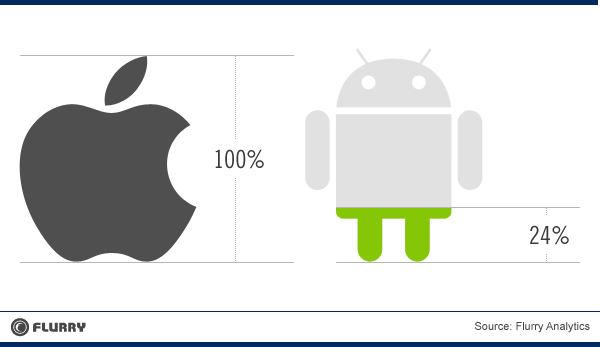
Another comparison on revenue generated by top apps for both Android and iOS uncovered the difference in revenue generated per active user is four times greater on iOS than Android. Flurry noted that for every $1 earned on iOS, a developer could expect to earn about 24-cents on Android.
Apple’s Worldwide Developer Conference is June 11 to June 15 in San Francisco, while Google’s I/O conference is June 27 to June 29 in the same California tech-hub city.
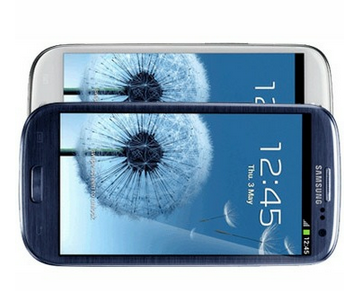
Apple put forward a second California litigation against South Korea-based Samsung earlier this week when it sought the court’s consent to add the Android-powered Galaxy S III smartphone to its motion for a preliminary injunction against the Galaxy Nexus.
Apple made this move approximately 20 hours after I wrote about the Galaxy S III being “the obvious next target”. In my blog post I speculated that Apple might bring a preliminary injunction motion against it, possibly after awaiting tomorrow’s preliminary injunction hearing. Apple decided to forge ahead now. Apple is on the offensive against Android. Earlier this week it filed an ITC complaint requesting an immediate import ban of 29 allegedly-infringing HTC devices. There’s an important overlap: the “data tapping” patent that Apple is seeking to enforce against HTC’s current generation of products is one of two patents Apple is using against the S III.
Apple purchased the S III in the United Kingdom, where Samsung launched it on May 29. The U.S. launch date is June 21 — precisely two weeks after the preliminary injunction hearing.
Apple’s motion notes that “[a]ccording to press reports, Samsung has already sold over nine million preorders of the Galaxy S III; indeed, the Galaxy S III has been reported to be the most extensively preordered piece of consumer electronics in history.”
Apple filed the first preliminary injunction motion against the Galaxy Nexus in February over four disputed patents. The Cupertino, Calif.-based Company’s requested in its latest motion that Samsung withhold the launch of the device’s successor in the United States until the court rules on the preliminary injunction request.
Samsung replied to the motion this afternoon, contending Apple cannot continue to add to its record for the Galaxy Nexus:
“If Apple wishes to seek an injunction against the Galaxy S III, the Court should require Apple to file a new motion and allow the parties to develop a full factual record on all four factors. Accordingly, the Court should reject Apple’s motion to amend its current notice of motion for a preliminary injunction.”
The blogosphere is abuzz this morning regarding a few key developments—some good, some bad—within notable iOS apps, including: Linkedin, Angry Birds Space, and Sparrow.
Linkedin
UPDATE at 1:02 p.m. PST.: According to LinkedIn’s Director Vicente Silveira: “We can confirm that some of the passwords that were compromised correspond to LinkedIn accounts.” More information about what LinkedIn is doing to remedy the situation is detailed in a blog post by the company’s director.
UPDATE at 10:01 a.m. PST.: LinkedIn just updated its iOS app to version 5.0.3 to bring “miscellaneous bug fixes” and “improvements in calendar.” The company promised earlier that it would no longer send sensitive data from the meeting notes section of calendar events and that it would provide a “learn more” link to offer more information on how it crops data. These improvements are also live on the Android counterpart.
LinkedIn’s free iOS app is in the middle of a scandal after reports from last night indicated the professional network scrubs calendar entries filled with business and personal data, and then transmits the sensitive particulars to the company’s servers without users’ knowledge. LinkedIn promptly took to its official blog and tried to reassure users that all is well. Unfortunately, the website’s troubles do not stop there: According to a report from The Verge today, a Russian forum member [translated] claimed to have hacked and uploaded nearly 6.5-million LinkedIn passwords. The company posted a tweet this morning notifying users that it is “currently looking into reports of stolen passwords.” A later tweet from the company revealed it could not confirm the existence of a security breach, but asked users to “stay tuned.”
Rovio, the gurus behind the popular iOS app Angry Birds Space, announced in a tweet this morning that its latest offering in the popular Angry Birds series hit 100 million downloads across all platforms. The game passed 50 million downloads within 35 days of its launch, and the company revealed last month that all Angry Birds titles cumulatively hit 1 billion downloads across all platforms. Those are some astonishing stats for a 99-cent app.
Sparrow launched a landing page today on its website with the message: “We are preparing something bigger.” The URL, sprw.me/ipad, is an indication that the popular email client for Mac and iPhone is now coming to the iPad. A contact field to sign up for updates is centered on the page. Once an email is submitted, an image of the iPad immediately springs from below.
Corning Inc., the manufacturer behind Gorilla Glass, Gorilla Glass 2, and other display products, just announced a new ultra-slim, flexible glass called “Willow Glass“.
The Corning, N.Y.-based Company introduced its technology at the Society for Information Display’s Display Week tradeshow in Boston this morning. The main highlight is its ability to “wrap” around a device or structure. Willow Glass is specifically formulated to couple with touch sensors, and Corning is exploring further use in “lighting and flexible solar cells.” The company’s fusion process helps to make the product just 100 microns thick, which is akin to a sheet of printer paper. Willow Glass samples are shipping to customers now, but The Verge expects full production to begin later this year.
Apple released a report in March on U.S. jobs that revealed Corning employees in Kentucky and New York create “the majority of the glass for iPhone.”
Corning’s Gorilla Glass 2 is a much stronger, resilient version of the Gorilla Glass featured on Apple’s current iPhones. It’s possible that the next-generation iPhone will sport this new glass, so take a look at the video above.
ChipWorks and iFixit are hardcore when it comes to breaking open our favorite devices to see what is inside. The two websites decided to take it up a notch today by joining forces to publish a live teardown of the non-LTE Samsung Galaxy SIII. ChipWorks looked at the—you guessed—chips, while iFixit focused on repair aspects.
Yep, that is Samsung’s Exynos 4412, 32 nm CMOS, 1.4 GHz quad core ARM processor.
“The Exynos is in a standard PoP (Package-on-Package) assembly with a Samsung LP DDR2 Green Memory K3PE7E700M-XGC2,” explained ChipWorks. “It is notable that this is the same process generation as we documented in the Apple A5 rev 2, APL2498, also fabricated by Samsung and for which you can see the general structure.”
The device also features the Sony IMX145 is an 8-megapixel, 1.4 um pixel pitch, back illuminated CMOS image sensor. Sony designs and manufactures this image sensor, which the Apple iPhone 4S also boasts. Samsung provides its own storage, however, with the KMVTU000LM. According to ChipWorks, it is a multi-chip Samsung MOVI N and memory module.
Ken Segall, a former Apple consultant and subsequent author, recently revealed a couple of anecdotes on the late CEO Steve Jobs while speaking at an event for his tell-all book.
Segall remembered a quarrel between Jobs and Apple’s design guru Jonathan Ive. He said the pair was “inseparable” and as “close as lovers,” but he also noted they had their disagreements: According to PC Advisor:
Segall was shocked at one of these rare arguments between Steve and Jony – he even worried that Ive might quit Apple over the row.
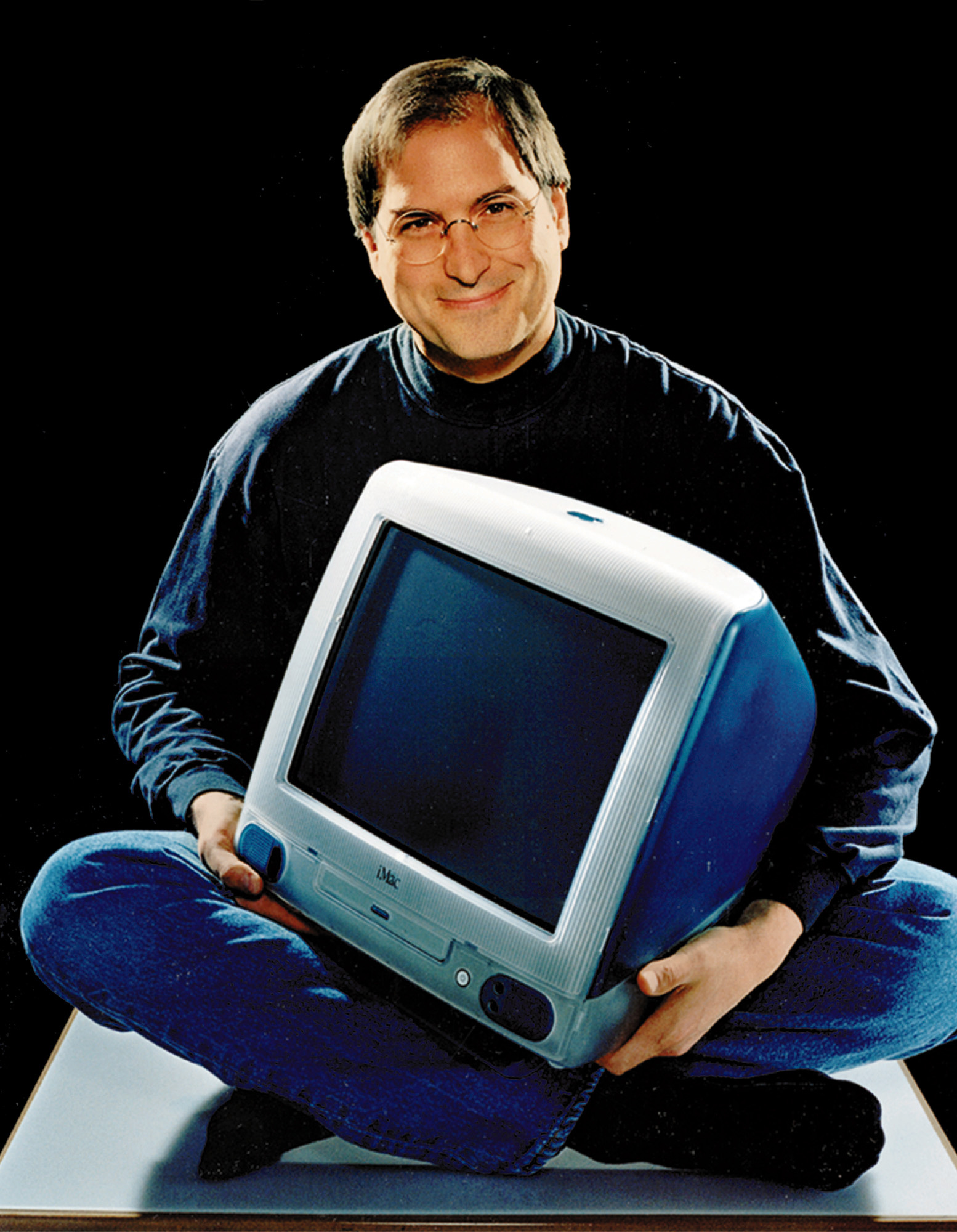
After 1998’s Bondi Blue iMac Apple decided to push the boat out and release a whole rainbow of the coloured computers the next year. Many models in various hues were collected together for Jobs, Ive, Segall and a few others to select from.
But Ive was “driven crazy” by Steve’s choices, and eventually stormed out of the room to his holiday, shouting that Steve could choose any of the colours he liked but he was taking no more part in the discussion.
Walter Issacson’s “Steve Jobs” biography provides a little more background information on the iMac feud:
Ive soon came up with four new juicy-looking colors, in addition to bondi blue, for the iMacs. Offering the same computer in five colors would of course create huge challenges for manufacturing, inventory, and distribution. At most companies, including even the old Apple, there would have been studies and meetings to look at the costs and benefits. But when Jobs looked at the new colors, he got totally psyched and summoned other executives over to the design studio. “We’re going to do all sorts of colors!” he told them excitedly. When they left,Ive looked at his team in amazement. “In most places that decision would have taken months,” Ive recalled. “Steve did it in a half hour.”
The author of “Insanely Simple: The Obsession That Drives Apple’s Success” further remembered one of the first names considered for the iPhone. So, what is the ingenious smartphone name that fell to the wayside in lieu of the “iPhone” moniker?
A few of the most noteworthy apps in the iOS ecosystem either landed on the App Store recently or received much-welcomed updates, such as the launch of Little Things Forever—the long-awaited sequel to the “iPad App of the Week” Little Things. Performance enhancements and new feature additions also arrived to Little Things, as well as Diet Coda, Sparrow for iPhone, Netflix, Etsy, Pinterest, Angry Birds Space and Angry Birds Space HD, Flixster with Rotten Tomatoes, Google Shopper, and Djay and Djay Free.
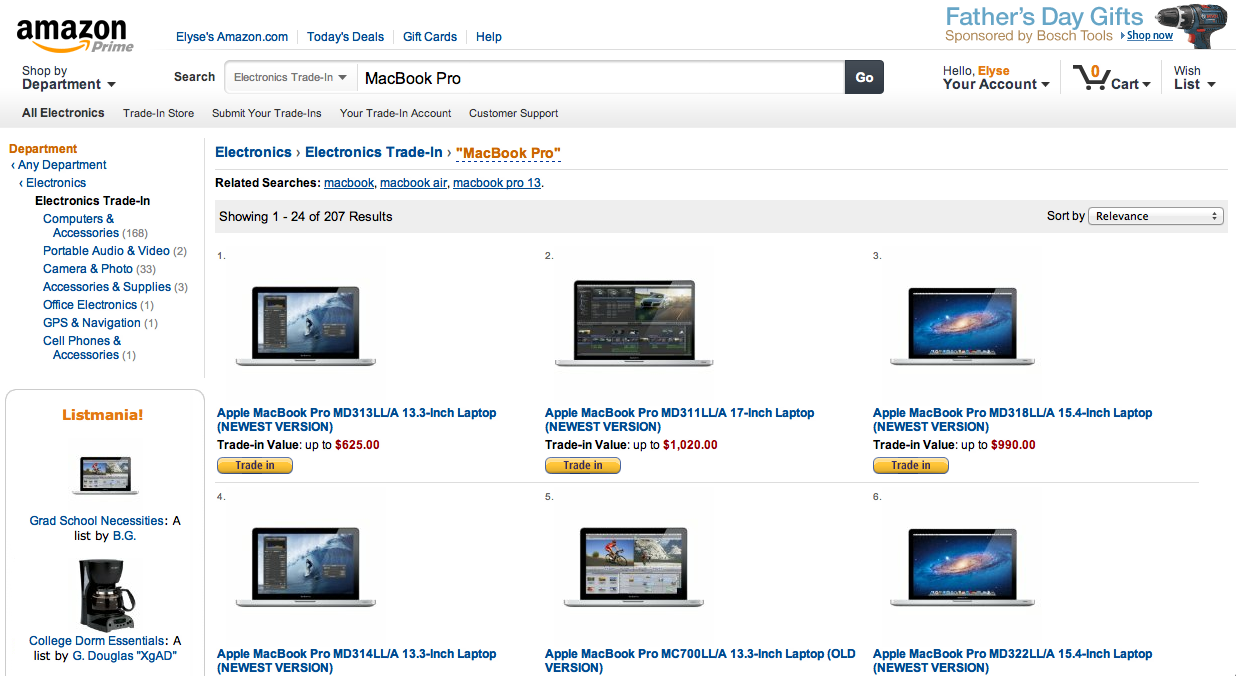
Starting today, those who are interested can visit www.amazon.com/tradein to search for electronics worth trading-in. After finding the item, click the Trade in button. After the trade-in submission is accepted, Amazon offers free shipping through UPS Ground or U.S. Postal Service to eliminate the headache and cost of the trade-in process. All items have to ship within seven days of submitting the transaction.
The online retailer deposits a Gift Card into the seller’s account after the deal finalizes. Unaccepted trade-ins either will receive a lower Gift Card amount or simply be returned. The return method adheres to the seller’s preference, which is selected upon completing the initial transaction online.
9to5Mac first reported earlier this month that Apple is prepping a new 15-inch MacBook Pro for this summer that features an ultra-thin design, a “jaw-dropping” Retina Display, and super-fast USB 3. Our sources also indicated the MacBook Retina Display will début at the Worldwide Developers Conference next month, but it will not stay exclusive to Apple’s Pro notebook. The first-class, high-resolution display is also coming to the MacBook Air family. Expand Expanding Close
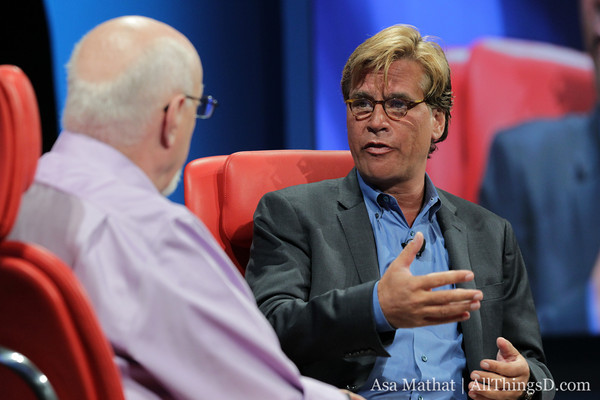
Aaron Sorkin, the screenwriter behind the Sony-backed biopic based on Walter Isaacson’s Steve Jobs biography, just sat down with Walt Mossberg at the D10 Conference to discuss everything from the late CEO and upcoming blockbuster to writing techniques and…The Beatles.
Sorkin is a Hollywood mogul thanks to his numerous successes, including “The Social Network,” “Moneyball,” and “The West Wing,” but the Big Shot warned that his silver-screen version of the best-selling biography is still in its early stages. Expand Expanding Close
Apple’s medium-length, white docking cable is widely known for its, how would one say, cumbersome functionality when attached to iDevices.
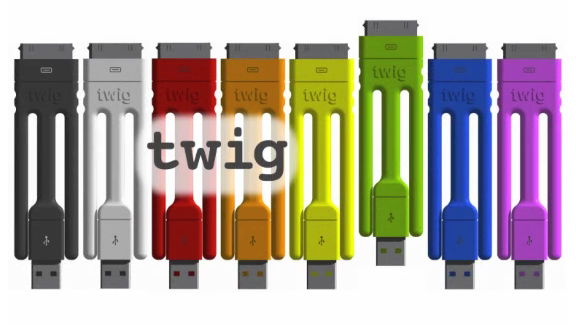
It comes in every iPhone, iPad, iWhatever box, and it is in desperate need of an update. Sure, reports show the next iPhone will sport a mini-dock connector, so maybe a new charging solution is already around the corner. But, in the meantime, third-party firms are thankfully developing interesting alternatives. Twig, for instance, is a newly launched Kickstarter project that certainly caught our eye.
Jason Hilbourne created a docking cable—err thing—that lacks a cord, can fit into a pocket, bends like Gumby, and sports a variety of color options. No tangle, no mess, and no headache. Oh, and the best part is that this little doohickey also doubles as a tripod. Go watch the video on the Kickstarter page to see how Hilbourne developed the product before deciding upon the last iteration. Those who are interested can get Twig at the $18 contribution level.
In related Kickstarter/docking cable news, Dave Hakkens has developed the Plugbook. Yes, it is in the shape of a book, so it can hide between other books. However, 10 feet of cable hides inside. Interesting, eh?
Their “trusted source” released these screenshots, which give subsequent validity to the claims that Apple has worked on an in-house mapping solution for years now. Apple is reportedly testing its 3D technology in build 10A314 of iOS 6. The renderings are largely accurate, from what we heard, but the bookmarks icon does not show the border that we saw. Also, the 3D icon only exists on the iPad version (it is actually below the curl on the iPhone, because it is too easy to accidentally press.) We hope to have our own screenshots shortly.
Our sources were the first to indicate Apple will drop Google Maps in iOS for a new Maps app with an Apple backend. 9to5Mac further said the app’s design would be very similar to Google Maps on the iPhone, iPad, and iPod touch, but a “much cleaner, faster, and more reliable experience.” Today’s report adds validity to our initial reporting, while speculating the app’s color scheme will be more silver than blue.
Many versions of iOS 6 have floated around Apple’s campus recently, which suggest the company is on track for a mid-June unveiling at this year’s World Wide Developers Conference. The new Maps app and its 3D mode is likely a major feature of iOS 6, but we previously noted that anyone anticipating major home screen changes or Android-style widgets will find disappointment. However, Apple is set to unveil an upgraded iCloud service at WWDC with new sharing and commenting features for photos and video syncing capabilities that resemble the Video Stream feature we told you about last year.
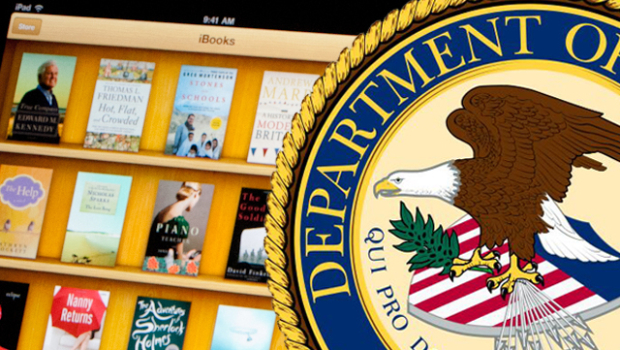
Ars Technica posted Apple’s legal response (PDF) to the U.S. Department of Justice’s lawsuit against the Cupertino, Calif.-based Company, and six publishers, for allegedly conspiring to fix eBook prices. In the document, Apple condemned the federal government for siding with “monopoly, rather than competition,” and then called the Department of Justice’s complaint “fundamentally flawed as a matter of fact and law.”
Phrases like “false” and “absurd” appear throughout Apple’s response to the accusations, which parallels the company’s statement from April, in regards to the suit’s filing, where Apple essentially said it is breaking monopolies, rather than starting them. Daring Fireball cropped this little nugget from the legal response that summarizes the entire 31-page document:
The Government sides with monopoly, rather than competition, in bringing this case. The Government starts from the false premise that an eBooks “market” was characterized by “robust price competition” prior to Apple’s entry. This ignores a simple and incontrovertible fact: before 2010, there was no real competition, there was only Amazon. At the time Apple entered the market, Amazon sold nearly nine out of every ten eBooks, and its power over price and product selection was nearly absolute. Apple’s entry spurred tremendous growth in eBook titles, range and variety of offerings, sales, and improved quality of the eBook reading experience. This is evidence of a dynamic, competitive market. These inconvenient facts are ignored in the Complaint. Instead, the Government focuses on increased prices for a handful of titles. The Complaint does not allege that all eBook prices, or even most eBook prices, increased after Apple entered the market.
The iOS 5.1.1 untethered Absinthe 2.0 jailbreak unveiled in Amsterdam this morning and is available for download. For those who want to run Absinthe 2.0 on OS X 10.8 Mountain Lion, or for those having trouble with the jailbreak, just browse the slideshow and steps above. It is literally as easy as 1, 2, and 3.
Note: A jailbroken iPhone simply means it is freed from the limitations imposed by Apple for safety measures.
Oh, Siri. Apple’s little voice-activated personal assistant in iOS can handle questions, give recommendations, and delegate requests, but does it really live up to expectations?
The folks in Cupertino like to roll out advertisements that show Siri capable of compiling individual preferences with personalized results, and even completing basic tasks like finding a nearby restaurant, but the software met very mixed reactions after it Beta-débuted on the iPhone 4S in October. Those who felt misled by Siri’s functionality depicted in commercials eventually sought reimbursement by filing a class action lawsuit against Apple earlier this year.
Fortune’s Adam Lashinsky wrote about how chief executive Tim Cook is changing Apple in an interesting piece this morning, but he also touched upon the contention surrounding Siri. He noted Apple’s future relies on the quality of its products, which holds true for any company, but then he pointed to the iOS-maker’s knowledge navigator:
“Those looking for deficiencies have found them in Siri, a less-than-perfect product that Apple released with the rare beta label in late 2011, a signal that the service shouldn’t be viewed as fully baked. Siri’s response time has been slow, meaning the servers and software powering it are inadequate. ‘People are embarrassed by Siri,’ says one former insider. ‘Steve would have lost his mind over Siri.'”
It is interesting that an unnamed insider claimed Jobs would “lose his mind” over Siri, especially because it is well-known the late CEO worked with former Siri founder and subsequent Apple Engineering Director Dag Kittlaus on the project. Kittlaus admitted last March at Network World that Jobs felt they “cracked it” in regards to Siri, which alludes to the chief’s satisfaction with the voice assistant and contrasts with the insider’s opinion.
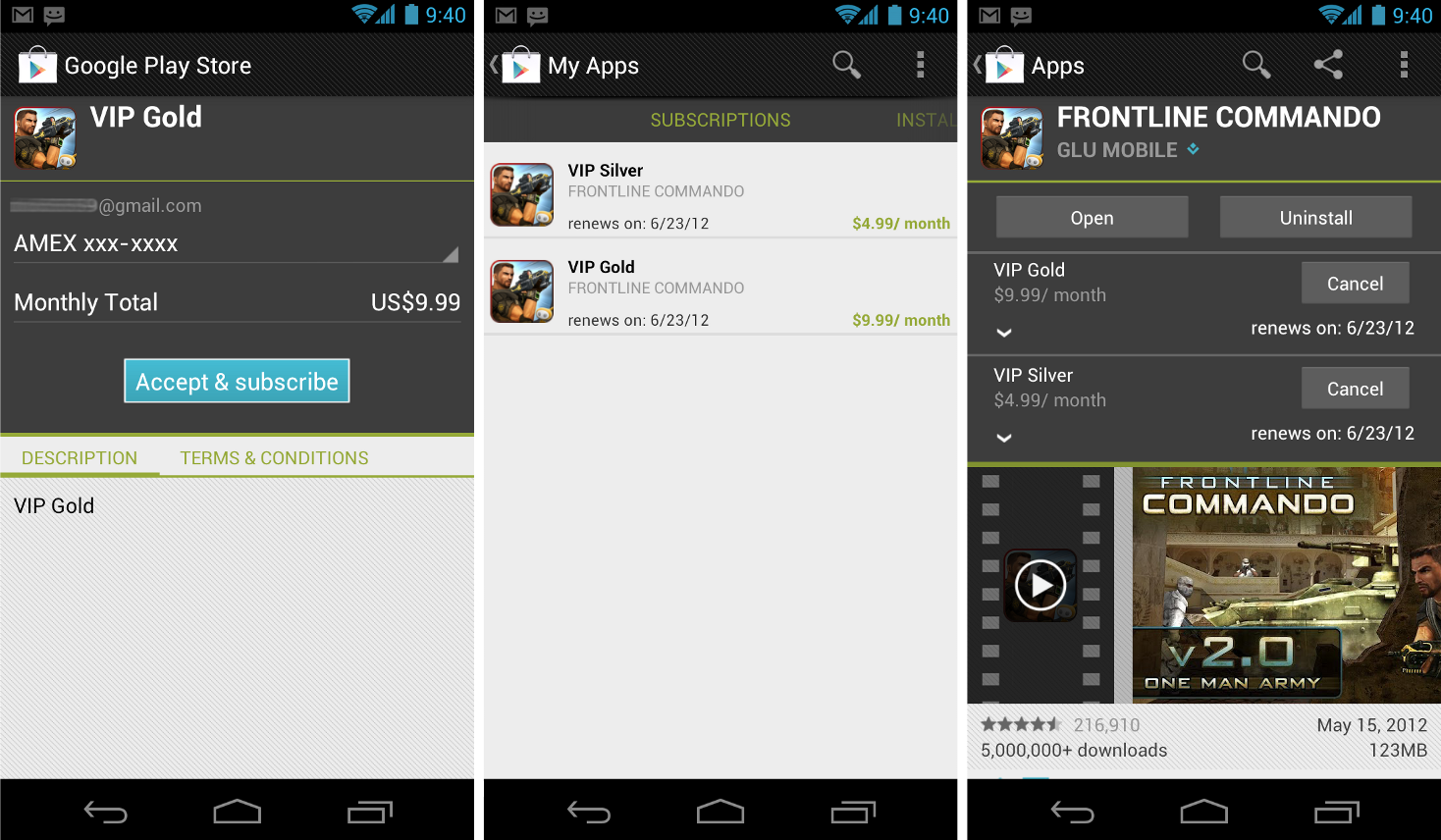
Apple unveiled in-app subscriptions for all App Store apps over a year ago, and now Google has announced the same feature today for Google Play apps. The feature is available immediately to users and developers alike for all content-based apps like magazines, newspapers, video, music, and any other type of recurring service that a developer could monetize.
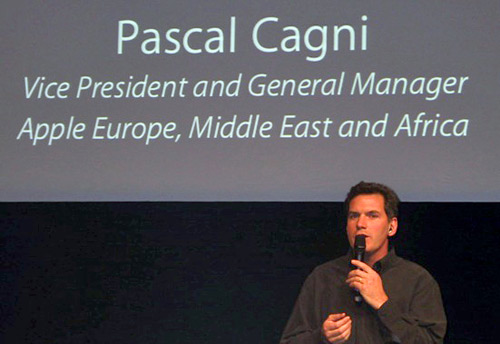
Le Figaro, a well-respected 186-year-old French daily newspaper, just reported that Apple’s Vice President and General Manager for Europe, Middle East, and Africa Pascal Cagni resigned yesterday.
During his 12 years at Apple, according to Le Figaro, the French executive stimulated Apple’s sales in hundreds of countries. He also engaged in the development of the iPod, iPhone, and the AppStore platform, while helping to expand Apple Stores.
Cagni joined Apple as the Vice President of Europe in 2000, according to Apple’s website, and before that he worked at NEC/Packard Bell Europe as the Vice President of Consumer Products. He previously held sales management posts at Software Publishing Corporation and Compaq Computer. Cagni obtained an M.A. in Law at Institut d’Etudes Politiques in Paris and an M.B.A. from Institut Superieur des Affaires. Le Figaro noted that Cagni is a graduate of HEC and Sciences Po He and a former member of the Ernst & Young Europe advisory board and the Council of Foreign Trade of France in the United Kingdom, but he now serves as a non-executive director for Kingfisher.
A Goldman Sachs executive apparently dabbled in a bit of insider trading when he allegedly discussed non-public information about Apple Inc., to a prominent hedge fund manager during a federal wiretap investigation.
David Loeb, who is head of Asia equity sales for Goldman Sachs Group Inc., in New York, was supposedly caught on a U.S. wiretap providing inside information on Apple Inc., Intel Corp., and Hewlett-Packard Co., to Raj Rajaratnam, the founder of Galleon Group, a New York-based hedge fund management firm. Rajaratnam is now serving an 11-year prison sentence for insider trading.
Today’s wiretap tidbit emerged after Gary Naftalis, a lawyer for Rajat Kumar Gupta, told a judge about the tapes’ existence. Gupta is an ex-Goldman Sachs director arrested in late 2011 by the FBI on insider trading charges derived from the Raj Rajaratnam Galleon Group case, and he is currently embroiled in an ongoing criminal trial. Gupta adamantly denies any misconduct.
‘He’s on a tape giving out information’ about those companies, Mr. Naftalis told U.S. District Judge Jed Rakoff outside the presence of the jury.
Mr. Naftalis told the judge that prosecutors were withholding exculpatory evidence he said could help his client.
[…] Assistant U.S. Attorney Reed Brodsky told Judge Rakoff that Mr. Loeb “provided Intel, Apple and Hewlett Packard information to Mr. Rajaratnam.” It’s the first time the government has publicly named Mr. Loeb and confirmed that the U.S. has evidence that he gave information about Apple, Intel and Hewlett-Packard to Mr. Rajaratnam.
“There’s none that Mr. Loeb had access to material, nonpublic information about Goldman’s earnings,” Mr. Brodsky said.
Bob Apfel, the founder of Bondholder Communications Group, told Fortune this morning that he completed the debt restructuring of Greece a couple of weeks ago with the help of an iPad. Well, 100 of them—to be exact.
Greece looked at bankruptcy head-on just a few months ago, but it found mercy through a round of restructuring transactions where the country settled for a smaller percentage of the its bonds’ paper value. Thousands of bondholders needed to first give the go-ahead, but such an endeavor, as Fortune coined it, was a “logistical nightmare.”
At that point, Apfel said he bought 100 iPads equipped with a customized app for debt-restructuring. His team of financial wizards received the tablets and immediately met with investors and other money gurus across the European Union. Of course, the iOS tablet successfully helped Apfel and his firm to close the deal that shrunk Greece’s debt to a more manageable sum.
‘I watched hundreds of millions of bonds being ‘slam dunked’ as these guys were running down the halls,’ says Apfel. ‘Split-second decisions were made that couldn’t have been made without the data platform.’
When last deal finally closed on April 25, $270 billion of Greek debt had been reduced to $130 billion.
‘It was the largest financial transaction in the history of the world,’ says Apfel. ‘And we couldn’t have done it without the iPad.’
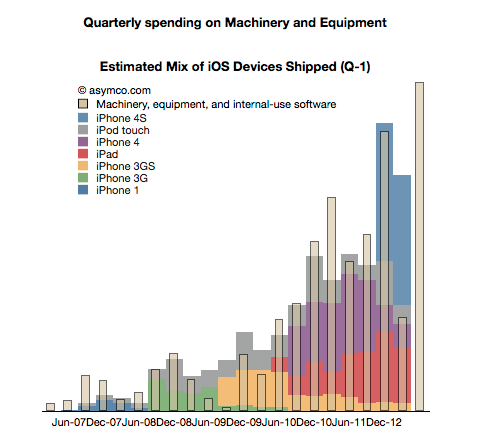
A new report this morning detailed Apple’s investment in equipment and machinery during the most recent quarter as record-breaking, which indicates the company is certainly up to something.
According to Asymco, Apple’s financial reports hint at even more future investments. The Cupertino, Calif.-based Company spent $1.3 billion in the last quarter, with another $2.5 billion needed over the next two quarters.
“Such numbers are hard to grasp. They are unprecedented not only for Apple but for almost any comparable company,” explained Asymco’s Horace Dediu.
The graph above illustrates the increase in quarterly spending for “machinery, equipment, and internal-use software.” So, what does Apple have in the works that requires so much machine-powered investments?
9to5Macrevealed today that the sixth-generation iPhone will have a 3.95-inch display at a 1,136-by-640-pixel resolution, and it will have a new dock connector. Of course, simply upgrading the iPhone does not explain Apple’s deep investment into production equipment.
Bloomberg, which cited two people familiar with the matter, claimed Apple’s CEO Tim Cook contacted Woodside and tried to lure him away with a flashy proposal to become head of sales at the Cupertino, Calif.-based Company.
Meanwhile, Google’s CEO Larry Page had to guarantee Woodside a better gig to keep him from jumping ship, which poised the executive to take the reigns as Motorola’s new top-dog.
According to Bloomberg:
Last August, Google (GOOG) Chief Executive Officer Larry Page fulfilled a pledge made to one of his senior executives, a square-jawed former attorney named Dennis Woodside. Apple (AAPL) CEO Tim Cook had been trying to poach Woodside to make him Apple’s head of sales, but Google had convinced Woodside to stay, in part by promising him greater responsibility at the search company, according to two people with knowledge of the matter, who asked not to be named because the discussions were private. Now it was time to make good. Woodside says he was speaking with board member Ram Shriram when Page asked him to run Motorola Mobility, the company Google had just acquired for $12.5 billion. ‘He said, ‘I know you’ve been looking for a challenge,’’ Woodside recalls. ‘I want you to run Motorola. I think you’d be great at it. Can you let me know by tonight?’’
The folks behind the upcoming Steve Jobs biopic, now dubbed “jOBS,” which stars Ashton Kutcher as the late CEO, released a presser this evening to announce the production’s June start date for filming. They also confirmed shooting will begin in the “historic garage” where Jobs and Steve Wozniak founded Apple. The film’s early scenes will even feature Jobs’ Los Altos home where he grew up to maintain “accuracy and authenticity” during the movie-making process. Expand Expanding Close
A few of the most noteworthy apps in the iOS ecosystem either landed on the App Store recently or received much-welcomed updates, such as the launch of Mule Radio, CNNMoney, Sonic the Hedgehog 4 Episode II, and LA Clippers, or performance enhancements for Official UEFA EURO 2012 and The Daily.