Before you can properly understand Apple News, it’s important to know its history. Apple was founded by Steve Jobs and Steve Wozniak in 1976. In 1977, Apple’s sales were growing with the success of its early computers. Within a few years, Jobs and Wozniak hired designers and a production line crew. Apple went public in 1980 and was an instant success. Over the next few years, Apple shipped new computers featuring new graphical user interfaces, such as the original Macintosh in 1984. As the market for personal computers expanded through the 1990s, Apple lost market share to the cheaper Microsoft Windows on PC clones. Eventually, Wozniak and Jobs both left Apple. Jobs would go on to found NeXT and would return to Apple when NeXT was acquired in the late 90s. Apple then began a journey to the great second act in the history of the business world.
Since the release of the iPod in 2001, Apple has become a major player once again in the technology industry. After releasing the iPhone in 2007, the iPad in 2010, and the Apple Watch in 2015, Apple is now one of the largest companies in the world. Apple’s worldwide annual revenue totaled $274.5 billion for its 2020 fiscal year.
Today, Apple operates retail stores all across the world, has a growing services division, and an ever-expanding hardware lineup. The technology industry follows Apple news to see where the company is headed in the future.
Last year, we noted Apple’s Vice President of Mobile Advertising Andy Miller left his role on Apple’s iAd team to become a partner at venture firm Highland Capital. Apple hired Todd Teresi from Adobe to replace Miller, but TechCrunch reported today that another iAd executive, former Senior Manager Mike Owen, will leave to take a job as the CRO of video ad network AdColony:
In his role at Apple, Owen had overseen the company’s New York office — arguably the most important, given many of the main players in the ad industry are so heavily concentrated there. His new job as CRO at AdColony is based in Los Angeles, where he will be responsible for overall company revenue
Owen provided a statement:
“AdColony is delivering rich, fast mobile video experiences to consumers in a mobile video ecosystem that is riddled with speed and quality issues… Video is incredibly powerful for consumers and brands and AdColony’s technology is allowing premium publishers to deliver the highest quality video experience to their consumers, which is translating into unprecedented results for advertisers. The post-PC era has just begun and we have a clear opportunity to change the way consumers think about, and experience advertising on their mobile devices.”
Barack Obama’s current Campaign Manager Jim Messina revealed recently that Apple’s CEO Steve Jobs encouraged him to capitalize on technology in ways that are boosting the president’s re-election efforts.
According to Businessweek, Messina quit his gig as the White House deputy chief of staff in January to become Obama’s 2012 campaign manager. He immediately met with executives at Apple, Google, Facebook, Microsoft, DreamWorks, and more to commence a forward thinking stand for office.
“I went around the country for literally a month of my life interviewing these companies and just talking about organizational growth, emerging technologies, marketing,” said Messina to Businessweek.
He further described two conversations that he had with Jobs while still acting as deputy chief. The Apple co-founder told Messina last year that mobile technology—coupled with social—had to be the primary focus in the re-election effort.
“Last time you were programming to only a couple of channels,” said Jobs, while referring to the Web and email. “This time, you have to program content to a much wider variety of channels—Facebook, Tumblr, Twitter, YouTube, Google—because people are segmented in a very different way than they were four years ago.”
According to an Apple patent application published by the U.S. Patent and Trademark Office and detailed by PatentlyApple, Apple is at the very least conceptualizing a device that sports a removable back panel for easily replaceable components such as lenses or optical solutions.
While it is unclear whether the invention would be used in a standalone camera, next-generation iPod or iPhone, or a different device entirely, the patent detailed several methods of upgrading a device with supplementary optics:
The digital imaging subsystem is typically enclosed within the case of the device to protect the digital imaging subsystem. The enclosure generally prevents direct access to the lens of the digital imaging subsystem for the purpose of providing any sort of supplementary optics, especially if the supplementary optics must be precisely aligned with the image sensor… It would be desirable to provide a structure for a compact device that allows the end user to reconfigure the optical arrangement of the device while retaining the benefits of assembling the device using a pre-assembled digital imaging subsystem.
Apple detailed several features that could be added through the easily swappable supplementary optics, including: improved zoom capabilities, better shutter control, removable close-up lenses, and the addition of motion sensors, flashes, or a lens baffle. As an example, the report explained a removable IR cut-off filter that would allow “capturing black and white images at very low light levels. Without the IR-cut filter the camera’s light sensitivity may extend to 0.001 lux or lower.” The report also broke down how the removable back panels could be implemented:
The new 15.4-inch MacBook Pro with Retina display is either out of stock, coming soon, on pre-order, or experiencing delayed shipping on almost every retail website, but it appears one seller is offering the latest Cupertino notebook on eBay—for roughly $1,700 more than Apple’s asking price.
The above eBay deal comes with same day, free shipping and includes insurance (if this is even considered a deal). Another eBay listing offers the base model MacBook Pro for $3,199 USD, but another $95.80 USD is required for USPS priority shipping from Canada.
It is probably safe to say these puppies are in high demand, as evident by the exorbitant price markups. Expand Expanding Close
Apple updated its iTunes Connect Mobile app today that allows developers to keep an eye on their app sales stats and related data from iTunes Connect. Among the new features are “enhanced product detail views for your entire catalog,” the ability to view app ratings and reviews from customers, a new advanced search feature, and user-interface refinements on the iPad. Developers will also now be able to reject apps submitted for review and release approved updates from within the app. The updated iTunes Connect Mobile app is available on the App Store now.
Steve Wozniak traveled to upstate New York recently to visit a farm of rescued horses, and the local paper managed to snag a brief interview with the co-founder of Apple, where he discussed the criticism surrounding Siri.
Apple’s little personal assistant in iOS can handle questions, give recommendations, and delegate requests, but many wonder if it really lives up to expectations. The folks in Cupertino like to roll out commercials that show Siri capable of compiling individual preferences with personalized results, and even completing basic tasks like finding a nearby restaurant, but the software met very mixed reactions after it débuted on the iPhone 4S in October. Those who felt misled by Siri’s beta functionality depicted in ads eventually sought reimbursement by filing a class action lawsuit against the company earlier this year.
While in Patersonville, N.Y., Wozniak described his strong opinions on the voice-recognition application.
“A lot of people say Siri. I say poo-poo,” Wozniak said. “I was using it to make reservations long before Apple bought it.”
“I would say, ‘Siri, what are the five largest lakes in California?’ and it would come up, one, two, three, four, five. And I would ask ‘What are the prime numbers greater than 87?’ and they would come up all in a row. That was pretty incredible,” Wozniak said.
He said he told family and friends about Siri and how “This was the future: speaking things in normal ways, feeling like you’re talking to a human and how Siri was the greatest program,” Wozniak said.
“Then Apple bought Siri,” he said. He then paused, lifted his right hand and gave it a big thumbs down.
“‘What are the largest lakes in California?’ I’d get all these lakefront properties. And I’d say ‘What are the prime numbers greater than 87?’ And I’d get prime rib,” Wozniak said.
“I’m really disappointed, but it’s still a market for the future,” Wozniak said. “I think voice recognition for all the platforms is going to get better and better and better at putting together complete sentences and phrases. What did a human really mean? Like, if you said ‘Five, I mean six.’ It will understand a backup, the little faults in our speech that humans understand. It will understand that eventually.”
Wozniak iterated similar rumblings to a developer at FourSquare earlier this year. He even used the same lake/prime rib example. The reporter in this interview should have asked him, “Perhaps Siri knows you like prime rib?”
Despite Wozniak’s criticism of Siri, the quirky businessman seemed enthusiastic about Apple’s latest developments revealed at the Worldwide Developers Conference. He specifically said he is excited about Apple’s new computer lineup and app called “Passbook,” which essentially turns a user’s iPhone into a digital wallet.
“People are always going to be disappointed,” he added, when asked if Apple let down consumers at WWDC. “I really like the new MacBook.”
Skype updated its Mac client today to version 5.8 to add full support for 10.8 Mountain Lion and a number of features that aim to bring the app up to par with the current Windows version. Perhaps the most notable new feature included in the update is a refined contact list that replaces the old floating menu. Accessible from the “Window” menu, the new Contacts Monitor (pictured right) provides a simplified view of your contacts in a window that can be repositioned and resized. Skype said it is meant to be much like older versions, such as Skype 2.8, that users seemed to prefer. The new contact list also has filters such as “Friends” and “Family,” and the ability to right-click to start a call or new message.
Another new feature for Skype 5.8 on Mac previously only available to Windows users is access to group screen sharing. The feature is for premium subscribers, but it supports up to groups of 10 with only one member of the group required to have a premium subscription. You will also now be able to share your video feed simultaneously while screen-sharing with multiple users.
A few other updates we noticed in the latest release:
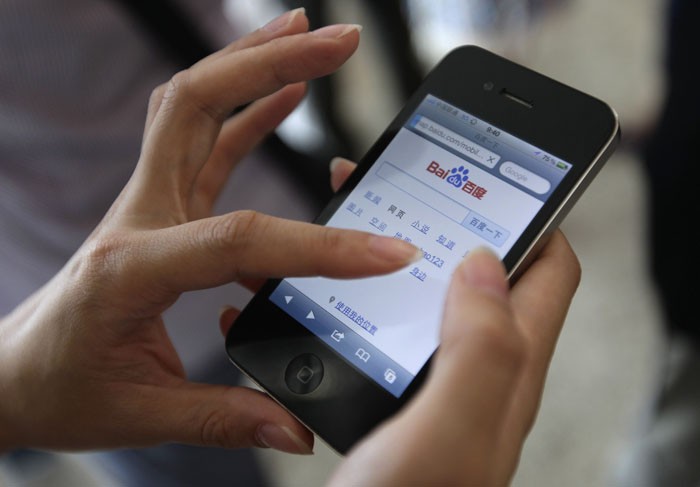
Apple announced earlier this week at the Worldwide Developers Conference that Baidu will come to the iPhone in the iOS 6 software update, but it just came to light that the Cupertino, Calif.-based Company plans to seize a portion of the China-based search engine’s advertising sales as part of the deal.
The revenue-sharing agreement with Apple follows similar accords between Baidu and manufacturers of handsets that use Google Inc. (GOOG)’s Android operating system, Wang Jing, vice president at Beijing-based Baidu, said in a phone interview today. He declined to disclose the commercial terms.
Apple said this week it will offer Baidu’s search-engine as an option for iPhone and iPad customers, and add Chinese- language support for its Siri voice technology, as the world’s most valuable company tailors its products for Chinese consumers. Baidu, which fields about 80 percent of China’s Web searches, is prepared to incur costs to add smartphone users by offering services such as music streaming for free, Wang said.
Eric Wen, who rates Baidu buy at Mirae Asset Securities, told Bloomberg that Baidu previously shared revenue with websites to encourage traffic for the search engine, while it now has a focus on sharing with smartphone manufacturers. He further estimated that Baidu distributed less than 10 percent of its generated smartphone revenue to those manufacturers.
The deal reflects Baidu’s need to invest in the mobile industry instead of computers, because more people in China are accessing the Internet through smartphones. It is worth noting that Baidu is already baked into 80 percent of Android devices.
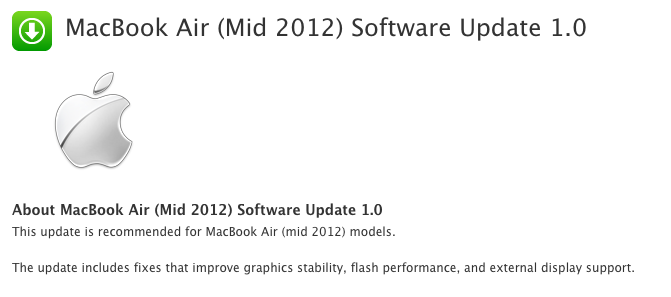
Apple just released an update (link) for the newly launched MacBook Air.
Software update 1.0 weighs 1.06GB and fixes several issues, including: graphics stability, flash performance, and external display support. The tweak accompanies more recent updates for the new MacBook Pro and MacBook Pro with Retina display, which unveiled earlier this week at Apple’s Worldwide Developers Conference.
Japan-based DeNA announced that its “Rage of Bahamut” app became the No. 1 grossing game on both iOS and Android yesterday, while earning roughly the same revenue per day from each mobile platform.
The game’s success pokes holes in recent findings from Flurry, which claimed revenue generated per active user is four times greater on iOS than Android. The analytics firm noted that for every $1 earned on iOS, a developer could expect to earn about 24-cents on Android.
“Contrary to what we read, we’ve been very happy with Android monetization. There is not a big discrepancy between the two now,” said DeNa Director Neil Young to TechCrunch.
Rage of Bahamut is a free trading card game that lets users battle either through a live single or multiplayer action mode against a “database of battle hungry foes.” It is on Apple’s App Store and boasts a 4.5-star rating on nearly 4,000 reviews as of press time.
TechCrunch further elaborated:
The game had the top slot on both platforms yesterday, but Kabam’s Kingdoms of Camelot took back the #1 iOS slot in the U.S. this morning. […]Young says Rage of Bahamut is seeing some impressive revenue numbers per day per user. In casual games, you usually see an average revenue per daily active user of a couple cents to 10 cents per day on mobile. The better games can get to 15 to 25 cents per day per daily active user. But Young says Rage of Bahamut has been able to do 4 or 5 times that. He didn’t say how much revenue overall the title is earning, but we’ve seen dual platform hits like Draw Something earn anywhere between $5 and 10 million per month through in-app purchases and advertising.
Those numbers are welcomed news for developers with growing concerns about mobile platforms lacking solid business models that encourage monetization.
In a recent story about growing concerns among app developers who want better ways to promote their apps in the App Store, The Wall Street Journal published quotes from an interview with Apple’s Vice President for Worldwide Marketing Phil Schiller about the “tremendous amount” of work Apple does to help new apps get discovered. Schiller also talked about how things will improve with the redesigned App Store, Facebook integration, and new user tracking tools for developers in iOS 6: Expand Expanding Close
A developer, called “Businesscat2000,” posted videos on the CrackBerry forums last weekend that depict iPad-based apps running on the RIM tablet. According to The Verge, CrackBerry’s Kevin Michaluk subsequently confirmed the developer’s efforts after conducting some tests:
Michaluk had the developer write out “Hi CrackBerry” on the SketchBook Mobile iOS app, as well as run the iPhone app for the site iMore. By successfully completing those tests, the developer proved that he wasn’t just playing videos of iOS apps on the PlayBook — the hack is the real deal.
Businesscat2000 also detailed his feat in the forums:
The CPU isn’t emulated on Playbook (though it is on Windows). It works very similarly to how WINE works to run Windows applications on Linux. The app binary is mapped into memory and imports are resolved to point to my own implementation of the various APIs needed. iOS actually uses a few open APIs already, which Playbook supports just as well (GL ES, and OpenAL). The bulk of the work has been in implementing all of the objective C classes that are required. The ARM code of the applications run as-is – the armv6/v7 support on PB/iDevices are pretty much identical, and the code is designed to run in USR mode. No SWIs, GPIO accesses or any of that kind of shenanigans.
More videos by the dev are below, including iOS apps running on Windows.
When we checked in last Friday on the ongoing Apple vs. Samsung cases in the United States, Apple’s lawyers were threatening Samsung with a temporary restraining order on the Galaxy S III to stop sales of the device before its June 21 release date. Apple was hoping Judge Lucy Koh would add the Galaxy S III to existing preliminary injunction requests that Apple previously made on other Galaxy products. However, according to a report from Reuters, Judge Koh ruled this week that Apple’s requests would “overload her calendar” given a July 30 trial date in the previous Galaxy cases is already set.
Apple can still request a ban on the Galaxy S III with a separate hearing date, but it likely will not be able to do so in enough time to block the device from launching later this month:
U.S. District Judge Lucy Koh in San Jose, California, effectively dashed Apple’s hopes of stopping the launch of Samsung Electronics Co Ltd’s new Galaxy S III smartphone, which also runs on Android. Koh had said Apple’s push to get a court order blocking the June 21 launch would overload her calendar… Koh last week said Apple could ask for a temporary restraining order against the Galaxy S III phone, but that would likely delay the trial over a Galaxy tablet and other smartphones. In her order on Monday, the judge said Apple would have to request a new hearing date if it wanted to stop sales of the Galaxy S III phone. That likely would not take place before the phone’s scheduled launch. Apple has not said what its next move will be.
Google confirmed in May that it applied for domains, such as .google, .youtube, and .lol, as part of ICANN’s program to increase the amount of generic top-level domains. Today, ICANN officially published its list of the 1,409 applied-for domains. Among the other companies requesting domains, AssociatedPress reported Apple is after the “.apple” domain name:
Apple Inc., Sony Corp. and American Express Co. are among companies that are seeking names with their brands… If approved, the new suffixes would rival “.com” and about 300 others now in use. Companies would be able to create separate websites and separate addresses for each of their products and brands, even as they keep their existing “.com” name. Businesses that joined the Internet late, and found desirable “.com” names taken, would have alternatives.
While several companies—such as Google— have applied for various domains that cover different products and more common words like .app, Apple appears to have only applied for the “.apple” domain.
Apple has created oversized window displays in the past following its latest product launches, including the iPhone 4S, and we snapped some photos today of the new Retina MacBook Pro signage.
The 3D renders above, which were posted by Flickr user Martin uit Utrecht, are modeled in Rhinoceros 3D. They were deemed good enough that numerous websites published them, assuming they were real shots of the next-generation iPhone. As noted by the poster, the renderings are based on leaked photos and video of what most believe to be the next-generation iPhone’s metal back. The models also have other elements present in the leaked casings, including: a smaller dock connector, redesigned speaker grills, and a repositioned headphone jack.
As iOS 6 officially unveiled yesterday, we noted a few of the features—such as Siri and FaceTime—would only be available on certain iOS devices. Ars Technica noticed the 3D flyover feature of Apple’s new Maps app would only be available to A5-powered iOS devices. In case you were wondering exactly which iOS 6 features will be compatible with your iOS device, Apple published a list (below) on its iOS 6 preview page that details all of the limitations for specific features:
-Flyover and turn-by-turn navigation will be available only on iPhone 4S and iPad 2 or later. Cellular data charges may apply.
-Siri will be available only on iPhone 4S and iPad (3rd generation) and requires Internet access. Siri may not be available in all languages or all areas, and features may vary by area. Cellular data charges may apply.
-Shared Photo Streams requires iOS 6 on iPhone 4 or later or iPad 2 or later, or a Mac computer with OS X Mountain Lion. An up-to-date browser is required for accessing shared photo streams on the web.
-FaceTime over a cellular network requires iPhone 4S or iPad (3rd generation) with cellular data capability. Carrier data charges may apply. FaceTime is not available in all countries.
-VIP list and VIP and Flagged smart mailboxes will be available on iPhone 4 or later and iPad 2 or later.
-Offline Reading List will be available on iPhone 4 or later and iPad 2 or later.
-Made for iPhone hearing aids require iPhone 4S.
-Find My Friends and Find My iPhone enable you to locate iOS devices only when they are on and connected to a registered Wi-Fi network or have an active data plan. Not available in all areas.
Apple released Thunderbolt Software Update 1.2 yesterday, but recent reports indicate the update is causing a host of issues for some users.
The Cupertino, Calif.-based Company said the update “adds support for the Apple Thunderbolt to Gigabit Ethernet Adapter,” but many have apparently discovered boot failures and other related problems like kernel panics, stalled boot screens, or “unexpected error” notices following installation.
According to threads in a few Apple discussions, the differentiating results all seem to leave Macs unusable. Fortunately, TidBits heard that reinstalling Lion fixes the complication. The website also claimed reinstalling the Mac OS X 10.7.4 Combo Update will remedy the situation.
Go to TidBits for more information on correcting this allegedly faulty software update.
Former Apple engineer and current Google employee Andy Hertzfeld expressed his disappointment in the new Mac Pro through a Google+ post this morning. He said the high-end desktop “seems like it’s stuck in time in 2010” and only received an “inconsequential processor clock bump.”
Apple unveiled an all-new MacBook Air and Pro lineup during its keynote, but the company did not announce any updates to its Mac Pro. The blogosphere jumped online to gobble up the notebooks, where they finally discovered the Mac Pro’s minor spec-bump listed under the familiar “new” notation. Since then, the Cupertino, Calif.-based Company has been under-fire for displaying the machinery as new when it only boasts a few slight changes.
Apple just revealed to developers via email that pop-rock band Neon Trees will put on a show at its Worldwide Developers Conference on June 14:
An amazing week just got better. Neon Trees will perform at Thursday night’s WWDC Bash. The party starts at 6:00 p.m. at Yerba Buena Gardens.
The WWDC Bash is intended to give developers’ coding skills a break. Apple told attendees on its website: “We’ll bring the food, the drinks, and the tunes. Just bring yourself and get ready to rock the night away.”
After posting initial benchmark data yesterday for the new Retina MacBook Pro’s SSD and USB 3.0, AnandTech published a longer analysis today about the notebook’s display. The report first took a closer look at the new resolution preferences for Retina MBP users and described the advantages of the different scaling options displayed in the gallery above:
Retina Display MBP owners now get a slider under OS X’s Display Preferences that allow you to specify desktop resolutions other than 1440 x 900. At 1440 x 900 you don’t get any increase in usable desktop resolution compared to a standard 15-inch MacBook Pro, but everything is ridiculously crisp… Even at the non-integer scaled 1680 x 1050 setting, the Retina Display looks a lot better than last year’s high-res panel. It looks like Apple actually renders the screen at twice the selected resolution before scaling it to fit the 2880 x 1800 panel (in other words, at 1920 x 1200 Apple is rendering everything at 3840 x 2400 (!) before scaling… Everything just looks better.
As illustrated in the images above showing benchmark data, the review found greatly improved viewing angles, black levels, and contrast when compared to the previous generation high-res MacBook Pro model. AnandTech then looked at Apple’s claims that the new MacBook Pro display reduces glare by 75 percent from previous generations:
Update: A reader just sent the images above that show Apple’s maps are identical to Microsoft’s for certain locations.
Evidence surfaced yesterday that showed Apple was crediting TomTom, in addition to OpenStreetMap, for at least some of the data used in its new in-house Maps app. Today, a report from TechPP (via TheNextWeb) pointed to proof that Apple’s Maps data appears to come from Microsoft too:
our friend, Cody Cooper, a New Zealand based developer, found something more interesting. While playing with Apple Maps on iOS 6 beta, Cody found that some of the Maps images had Microsoft attribution. Check out the image below showing the response headers with attributions to Microsoft Corp 2012. Click on the image for a better view.
We have not been able to confirm the evidence, so we are marking this as unconfirmed for now. Apple’s full list of acknowledgments for its Maps app can be viewed here, while the full-sized image of the evidence is below:
Update: MacRumors received a tip from a reader who claimed Apple’s CEO Tim Cook responded to his email to confirm new Mac Pros are coming next year. We received a tip last year detailing a similar email exchange between a Pro customer and the late chief Steve Jobs. Cook’s response to the reader is below:
Our pro customers are really important to us…don’t worry as we’re working on something really great for later next year.
We were not too shocked when Apple quietly updated its Mac Pro lineup following its WWDC keynote yesterday. We had previously revealed the spec-bumped Mac Pros, but many were skeptical Apple would release such a minor refresh for the product that otherwise had not received an update in two years.
Was it really an upgrade, or did Intel simply run out of the older CPUs? USB 2 and no Thunderbolt seem like a bad joke to high-end Mac Pro users.
Not surprisingly, many are calling out Apple for its decision to not release a major refresh to the Mac Pros. Perhaps most notably is former Apple engineer and current Google employee Andy Hertzfeld. In a Google+ post, Hertzfeld congratulated Apple on its new Retina MacBook, while expressing disappointment in the new Mac Pros:
The next generation MacBook Pro announced today at WWDC looks fantastic. I ordered one immediately and can’t wait to start using it. Unfortunately, the euphoria was negated by my deep disappointment with the meagre, lame update that was silently bequeathed to the Mac Pro today… The specs for the “new” Mac Pro had hardly changed, except for a tiny, inconsequential processor clock bump. Still no Thunderbolt, still no USB 3.0, no SATA III or RAM speed improvements – it seems like it’s stuck in time in 2010. The only thing that’s still high-end about it is the bloated price… Even though I’m well aware that Apple’s future lies increasingly with mobile iOS-based devices, it still makes no sense to drop the ball on your high end desktop Mac so thoroughly, and to utterly disappoint your most loyal customers like yours truly.
As for complete refreshes for the iMac and Mac Pro lineups, David Pogue for the New York Times claimed an Apple executive confirmed they are in development and likely set for a 2013 release:
Many Apple observers also wonder if Apple thinks that desktop computers are dead, since not a word was said about the iMac and Mac Pro. An executive did assure me, however, that new models and new designs are under way, probably for release in 2013
Apple’s updated MacBook Pro with Retina display made a huge splash at yesterday’s opening keynote for the Worldwide Developers Conference, but droves of Mac-lovers will have to wait a few weeks before they can get their eager paws on one of these divine notebooks.
Senior Vice President of Worldwide Marketing Phil Schiller noted the super-high resolution MacBook Pro would ship immediately while on stage at WWDC, but those taking a peak at Apple’s online store today will find a “2-3 weeks” shipping notice listed under the 15-inch Retina-optimized computers
The delay in shipping is likely due to high demand, but CNET pondered the alternative reasons:
It’s not immediately clear if the delay is due to miscommunication, a shipping snag, or simply that the first batch has sold out. In previous Apple launches, the company has promised a particular shipping time, only to find that the first group of units sell out, forcing it to modify the timetable for future orders.