Apple

See All Stories

Apple News and Brief History

Before you can properly understand Apple News, it’s important to know its history. Apple was founded by Steve Jobs and Steve Wozniak in 1976. In 1977, Apple’s sales were growing with the success of its early computers. Within a few years, Jobs and Wozniak hired designers and a production line crew. Apple went public in 1980 and was an instant success. Over the next few years, Apple shipped new computers featuring new graphical user interfaces, such as the original Macintosh in 1984. As the market for personal computers expanded through the 1990s, Apple lost market share to the cheaper Microsoft Windows on PC clones. Eventually, Wozniak and Jobs both left Apple. Jobs would go on to found NeXT and would return to Apple when NeXT was acquired in the late 90s. Apple then began a journey to the great second act in the history of the business world.

Since the release of the iPod in 2001, Apple has become a major player once again in the technology industry. After releasing the iPhone in 2007, the iPad in 2010, and the Apple Watch in 2015, Apple is now one of the largest companies in the world. Apple’s worldwide annual revenue totaled $274.5 billion for its 2020 fiscal year.

Today, Apple operates retail stores all across the world, has a growing services division, and an ever-expanding hardware lineup. The technology industry follows Apple news to see where the company is headed in the future.

Keep reading for the latest Apple news

President Obama says America should support aspirations to become the next Steve Jobs

Site default logo image

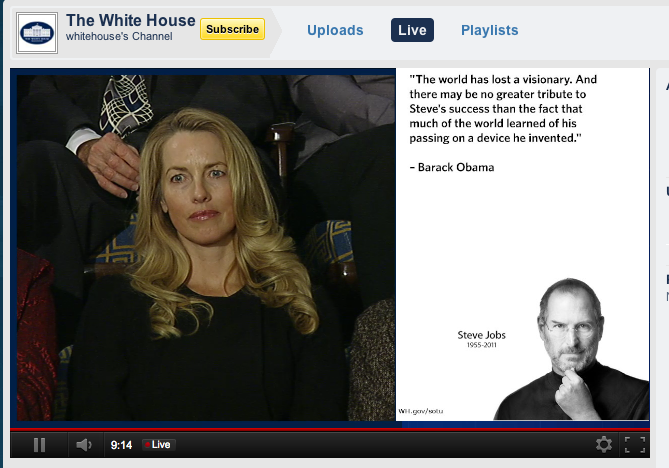
President Obama is wrapping up his State of the Union Address right now. During the event, President Obama made many references to technology as a way to help with economic times. More specifically, President Obama had a pleasant mention for Apple’s late cofounder and CEO Steve Jobs with his widow Laurene Powell Jobs in attendance.

 “That means women should earn equal pay for equal work. It means we should support everyone who’s willing to work; and every risk-tasker and entrepreneur who aspires to become the next Steve Jobs.”

You may remember when Jobs had dinner with President Obama and other successful technology entrepreneurs in February of last year. The discussion revolved around getting people to collaborate and invest in American innovation to promote private sector job growth.


Expand
Expanding
Close

More on Apple’s Anobit acquisition: Team remains in Israel (for now), headed by notable chip VP

Site default logo image

During the question-and-answer section of Apple’s blowout Q1 2012 earnings call, Apple CEO Tim Cook let out a widely known fact from within the company: Apple Senior Vice President of Hardware Engineering Bob Mansfield is now in charge of the team that comes from Anobit, an Israel-based SSD company that Apple acquired earlier this month. Cook also said Apple is integrating Anobit’s talent into Apple’s current workflow. Cook did, however, leave out some crucial details about Anobit’s integration into Apple.

We have some of the missing details, below:


Expand
Expanding
Close

Tim Cook sends congratulatory email, plans to ‘discuss some exciting new things going on at Apple’ at Town Hall tomorrow

Site default logo image

Following today’s blowout numbers, we just received word that Apple CEO Tim Cook sent a short email to Apple employees congratulating them both on a record setting holiday quarter and starting 2012 with the launch of a groundbreaking initiative for education with iBooks 2 and iPad textbooks.

Perhaps most enticing, Cook told everyone to report to Town Hall tomorrow either in person or through their AppleWeb online portal at 10 a.m. PT to discuss “some exciting new things going on at Apple.” Former Apple CEO Steve Jobs typically held such meetings following major product launches like the iPad and iPhone.

Cook’s last all hands email was sent just one week ago and discussed Apple’s supplier responsibility report.

Today’s email from Cook is pasted below:


Expand
Expanding
Close

Apple is likely the No. 1 smartphone maker, retaking spot from Samsung with 37M iPhones sold

Site default logo image

Apple just announced its Q1 2012 earnings in a press release a few minutes ago, which revealed very impressive numbers from the company. Apple revealed it sold a whopping 37 million iPhones during the holiday quarter, which now gives the company the No. 1 smartphone manufacturer spot —back from Samsung, who previously held the title. Earlier this month, Samsung gave estimates of 35 million phones sold during the holiday quarter. This means Apple beat the company by 2 million.

Check out the full announcement and the live blog coming up in a few minutes for more record setting figures from Apple.


Expand
Expanding
Close

Apple posts record results for holiday quarter: 37.04M iPhones, 15.43M iPads, 5.2M Macs and 15.4M iPods

Site default logo image

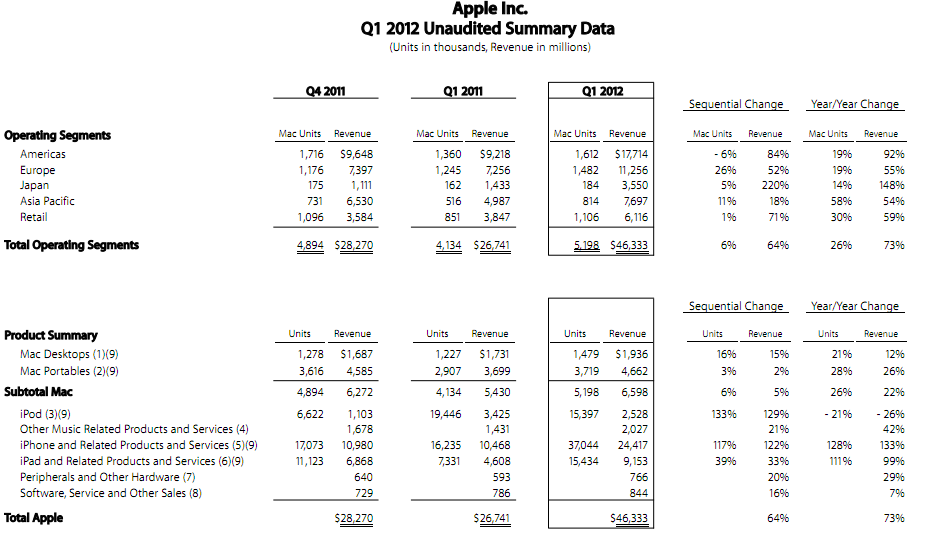
Chart via

Apple had another blowout quarter this holiday and set records across the board.  iPhones, which many estimated optimistically at 30 million, leapt to over 37 million to create the biggest quarter ever.  iPads crossed 15 million for the first time, and even Apple’s venerable Mac line crossed 5 million units for the first time (likely helped by the popular MacBook Air lineup). iPods, if you needed a downside, were off by 20-percent —which is not terrible, because Apple did not upgrade most of the iPods available last Christmas.

Apple recorded revenues of $46.33 billion and record quarterly net profit of $13.06 billion, or $13.87 per diluted share.

(Click to enlarge)

“We’re thrilled with our outstanding results and record-breaking sales of iPhones, iPads and Macs,” said Tim Cook, Apple’s CEO. “Apple’s momentum is incredibly strong, and we have some amazing new products in the pipeline.”

“We are very happy to have generated over $17.5 billion in cash flow from operations during the December quarter,” said Peter Oppenheimer, Apple’s CFO. “Looking ahead to the second fiscal quarter of 2012, which will span 13 weeks, we expect revenue of about $32.5 billion and we expect diluted earnings per share of about $8.50.”

The full press release follows, and do not forget the live blog coming shortly.


Expand
Expanding
Close

Live blog: Apple Q1 earnings call

Site default logo image

Apple’s live call to discuss Q1 2012 earnings is underway. We’re live blogging the call, where Apple is discussing their record breaking figures they just announced. You can follow along below, or listen to the call on Apple’s Investor Relations page.

Update: that’s a wrap. Thanks for joining us! You can read the highlights from today’s call after the break:


Expand
Expanding
Close

State of the Union guestlist likely indicates that Steve Jobs will be discussed

Site default logo image

Laurene Powell Jobs, widow of Apple cofounder and former CEO Steve Jobs, is among the attendees of the State of the Union address scheduled for 9 p.m. tonight (live stream here). According to the official guest list, the White House invited Powell Jobs, along with other distinguished individuals, to attend the State of the Union address, including billionaire Warren Buffett’s secretary Debbie Bosanek, cancer survivor Adam Rapp, and Mark Kelly, former astronaut and husband of outgoing Arizona Rep. Gabrielle Giffords. The news becomes interesting knowing the White House usually invites people that have something to do with a proposal or initiative the President will outline in the address. Powell Jobs may have been invited for her focus on education, the arts and women’s human rights.

Vanguard has it that Obama will welcome Powell Jobs to his State of the Union address out of respect for her late husband. According to the White House, Powell Jobs will watch Obama’s speech from First Lady Michelle Obama’s box in the House of Representatives. In December of last year, Obama gave Jobs’ widow a seat on the White House Council for Community Solutions. Chaired by former Gates Foundation CEO Patty Stonesifer, the body advises the President on job creation and social issues. eBay CEO John Donahoe and singer Jon Bon Jovi are also among the members.

Powell Jobs’ ties in education could also prove key, as education is allegedly one of key focus areas of tonight’s State of the Union address. Let’s not forget that Apple held an education-focused media event last week, debuting digital textbooks on the iPad priced at $14.99 or less and a free tool that lets anyone create and publish digital textbooks to iBookstore. In just three days, more than 350,000 copies of digital textbooks were downloaded from the store. Oh, and Obama is an avid fan of Apple’s tablet.


Expand
Expanding
Close

Gartner: No one in the world uses more semiconductors than Apple

Site default logo image

With the growing sales of Apple’s mobile devices and the ever-increasing popularity of smartphones (analysts projected 30+ million iPhones for today’s holiday quarter earnings call), it is no surprise that the Mac-maker is rising up the chip-purchasing ladder. According to research firm Gartner, Apple is now the world’s largest buyer of silicon parts, spending an astounding $17 billion on semiconductors in 2011 and accounting for a 5.7 percent share of total silicon buying.

That’s a 34.6 percent increase over 2010— enough to jump two spots ahead of rivals Samsung and the world’s leading computer maker Hewlett-Packard (soon to be displaced by Apple). Apple’s rise stems of strong sales of iPads, iPhones and its popular MacBook Air ultra-portable notebook family. Samsung ranked second with $16.7 billion worth of semiconductors in 2011, a 5.5 percent share. Computer makers Hewlett-Packard and Dell and cell phone giant Nokia round up the list of top five chip buyers with $16.7 billion, $9.8 billion and $9 billion worth of silicon parts, respectively.


Expand
Expanding
Close

Here’s a rare prototype translucent Apple hard drive circa 1985

Site default logo image

Apple and its cofounder Steve Jobs certainly helped design and popularize storage devices throughout computing history. For example, the Mac mainstreamed Sony’s 3.5-inch floppy drive in the 1980s, but Apple was working on its own storage devices even before the Mac debuted. One of our buddies discovered this eBay listing advertising for what appears to be a prototype of a previously unknown NISHA hard drive adorned with the colorful Apple logo. It comes in a translucent case, and it could easily be the first Apple product we have seen like this, even though it never shipped. It is neither a Hard Disk 20 drive Apple introduced on Sept. 17, 1985 specifically for use with the Macintosh 512K nor is it a Hard Disk 20SC.

The latter product was the first SCSI drive Apple manufactured and deployed on the Macintosh Plus in 1986, effectively obsolescing the Hard Disk 20 unit. It is a safe bet that this unit represents an early prototype of one of Apple’s hard drives, but it could also be a new hard drive design that never saw the light of day. The seller could not tell either, as the drive did not power up. Eagle-eyed readers are aware that Apple of the past had been designing its own storage devices and the aforementioned Hard Disk 20 serves as an illustrious example of the company’s closed approach to hard drives.


Expand
Expanding
Close

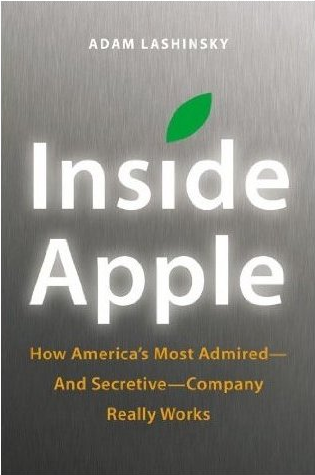
‘Inside Apple’ offers a glimpse into Apple’s secret unboxing room

Site default logo image

Apple pays utmost attention to the unforgettable experiences customers get from interacting with their thoughtfully designed product packaging, as evident in countless unboxing videos on the web. It is little surprise, then, that the company goes to great lengths to create lasting unboxing experiences.

With that said, of course the company has a dedicated “secret” room to test various packaging designs. It is somewhat akin to Jony Ive’s design bunker in that it is a place where many prototypes are being iterated exhaustively, per Apple’s famous penchant for perfection. Apple even has a number of patents, such as this filing outlining an active packaging for products that will allow Apple to change what is inside on the fly.

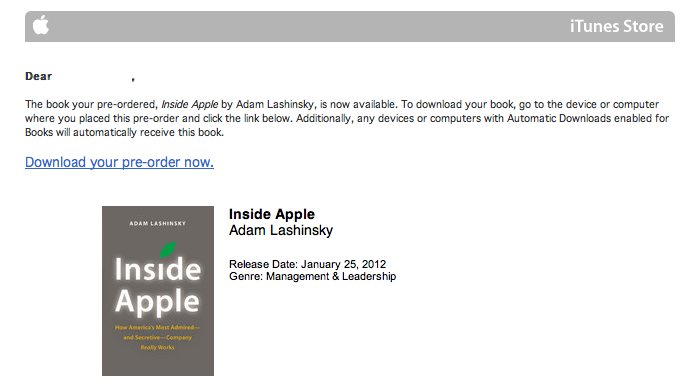
According to an excerpt from Adam Lashinsky’s upcoming book titled “Inside Apple: How America’s Most Admired – and Secretive – Company Really Works,” Apple agonizes over how its products are packaged as much as the hardware inside:

To fully grasp how seriously Apple executives sweat the small stuff, consider this: For months, a packaging designer was holed up in this room performing the most mundane of tasks – opening boxes.

According to the author, Apple once stuffed the room with hundreds of iPod box prototypes, testing each one of them until the company settled with the final design:

Expand
Expanding
Close

Apple appoints Sony Ericsson Americas President Anderson Teixeira to Head of Apple Latin America

Site default logo image

Apple plucked a high-ranking executive from the folding Sony Ericsson Joint Venture, 9to5Mac has learned.  President of Sony Ericsson U.S. and Head of Region North America Anderson Teixeira will be heading Apple’s Latin America region.  He is leaving Sony Ericsson after a decade at the JV.

Sony is buying out Ericsson’s piece of the venture and the group is folding into Sony Electronics.

Teixeira started at Apple this month.

Internally at Apple, he is “Latin America General Manager,” but to the greater world he’s “Head of Latin America.”  He will be operating out of Apple’s small Coral Gables Florida office at 1 Alhambra Plaza Suite 700.  He has nine reports at that office.

A mid-2009 profile listed some background on his appointment at Sony:

Anderson Teixeira was based at the company’s US operations in Raleigh, North Carolina. A native of Brazil, Teixeira has been part of Sony Ericsson since the formation of the joint venture in 2001. He has led the company’s operations in Latin America, as Head of Region Latin America, based in Miami, Florida, and subsequently in Western Europe, based in Munich. As President of Sony Ericsson US, Teixeira will report to Sony Ericsson President Dick Komiyama. In his role as Head of Region North America, Teixeira will have overall responsibility for Sony Ericsson’s sales and marketing operations in the US and Canada.

It is not immediately clear who Teixeira will report to but we will update that information as it becomes available.

Apple’s Latin America presence has been growing with the iPhone spreading across carriers like wildfire and even a Foxconn iPhone production line opening in Teixeira’s native Brazil.

Videos of Teixeira discussing Sony operations are embedded below:
Expand
Expanding
Close

Virgin America honors Steve Jobs with the ‘Stay Hungry, Stay Foolish’ Airbus A320

Site default logo image


Image: Virgin America

Steve Jobs’ recent passing on Oct.5 sparked intense reactions all over the world, ranging from musical tributes to moving gestures by competitors to tributes from fans and late night talk shows. More than two and a half months later, it is still heartwarming to see big brands pay respect to the values Jobs stood for and to his achievements.

Virgin America adorned the side of their Airbus A320 jet with the now famous “Stay Hungry, Stay Foolish” quote famously used in Steve’s 2005 Stanford University commencement address (from earlier quote from Stewart Brand, who used it in the farewell edition of the Whole Earth catalog in 1974 – thanks Josh). A spokesperson for the Silicon Valley-based airliner owned by British tycoon (and fellow entrepreneur) Richard Branson told MacRumors that it chose the quote “as part of an internal plane naming competition.” 

There are clearly legions of Steve Jobs fans at Virgin America, too.  Or at least one big fan.

The tail N845VA has been seen on the Orlando to SFO route, and it seems to be based in San Francisco.


Expand
Expanding
Close

Apple spends hundreds of millions to sue Android makers, is it working?

Site default logo image

Newsweek‘s Dan Lyons reported today that Apple’s “thermonuclear war” on Android smartphone manufacturers is fading fast, while a new rumor surfaced among the suits’ lawyers claiming the company spent $100 million on its initial set of claims against HTC.

Imagine how much Apple spent on other Android makers, such as Motorola (who is near locking Apple products out of Germany in retaliation) or Samsung (the biggest Mobile Communications patent holder in the world), if it spent so much on just HTC.

“Who knows if it’s true, but if so, Apple didn’t get a lot for its money,” wrote Lyons on his RealDanLyons’ blog Jan. 23.

Apple’s legal claims are abruptly junked left and right, and its only minor victories to date are so inconsequential that Android device makers can dance around the momentary obstacles with just a few minor tweaks to products, explained the Newsweek reporter.

The technology giant’s case against HTC with the International Trade Commission began in February 2010, when the Cupertino, Calif.-based company wanted the ITC to block HTC from importing products into the United States. The case originally had 84 claims based on 10 patents, but it was dwindled down to only four claims by the time a judge became involved, according to Lyons.

The rulings —for the most part— were a wash for Apple. One patent was invalid as Apple did not have a rightful claim to it, and HTC did not infringe upon two of the other patents due to Apple apparently not implementing them into its products. In other words, Apple did not have a right to seek an injunction, because ITC injunctions can only occur if it is provable that both parties are “practicing” the patent in question, which Apple could not demonstrate against HTC…


Expand
Expanding
Close

Apple’s Q1 FY12 preview: Analysts expect iPhone 4S sales to boost earnings

Site default logo image

Apple will report its fiscal first quarter results tomorrow for the October to December 2011 period during which the Cupertino, Calif.-based company saw the death of its cofounder and the record-breaking sales of its latest iPhone.

Apple passed the $400 billion market cap briefly last week, and it is the world’s second most valuable company after Exxon Mobil Corp. Its 2007-debut of the iPhone effectively piloted the touchscreen smartphone market, meanwhile the iPad carved a new consumer electronics category for the industry, as well.

Analysts expect earnings of $10.04 per share and revenue of $38.92 billion, according to FactSet, compared to Q1 FY11 where Apple earned $6.43 per share on $26.74 billion in revenue. Apple said it reckons earnings of $9.30 per share and revenue of $37 billion for Q1 FY12, but the technology giant usually underestimates its forecasts, and analysts generally ignore such predictions…


Expand
Expanding
Close

The MS Surface table re-imagined with an amazing Apple aesthetic

Site default logo image

Forget Microsoft Surface, this is what the perfect Apple worktable would look like. You would simply place an iOS device upon the desk to sync with iTunes and it would wirelessly sync data with iCloud. Its multi-touch surface would allow for a range of possibilities like operating your computer the Magic Trackpad style. Imagine being able to schedule appointments or make phone calls using its entire touch-sensitive surface, also doubling as a huge secondary display.

The eye-catching Apple-friendly desk of the future —affectionately called iDesk— was conceived by designer Adam Benton and posted at MacLife. Too bad Apple will never make this, but the artist rendition really has me hooked.  Go past the break for another image.


Expand
Expanding
Close

Apple posts new iTunes U help resources

Site default logo image

Apple created a new section on its website dedicated to the enhanced iTunes U service that was updated during last week’s education announcement. The new web-based resources available at www.apple.com/support/itunes-u contain a wealth of information and how-to topics for educators to implement the new iTunes U digital features into their workflow. Specifically, training course are available for iTunes U Public Site Manager and iTunes U Course Manager, as well as various guides on publishing on iTunes U. Educators and students can also learn about creating different types of educational content, such as audio recordings, video clips, and interactive presentations.


Expand
Expanding
Close

Sony unveils tiny 13-megapixel CMOS image sensor with HDR Video, a fit for ultra-thin iPhone 5

Site default logo image


The iPhone 4S camera system has a fifth lens and larger aperture to let more light in.

It is widely assumed that Apple’s next iPhone is going to be thinner and lighter than its predecessor —the 9.3mm thick iPhone 4S. However, camera modules for smartphones are not shrinking as fast as other tiny components are, and it is becoming a growing limitation when designing ultra-thin gadgets. If Apple is to engineer a thinner iPhone, the company is likely going to redesign the camera system all over again. Conveniently, Sony has a brand-new back-illuminated CMOS image sensor in the works that could be a natural fit for a next-generation iPhone.

Unveiled Monday, it separates the CMOS sensors from imaging circuitry:

This image sensor layers the pixel section containing formations of back-illuminated structure pixels onto chips containing the circuit section for signal processing, which is in place of supporting substrates for conventional back-illuminated CMOS image sensors. This structure achieves further enhancement in image quality, superior functionalities and a more compact size that will lead to enhanced camera evolution. 

Of course, there is no way of telling whether Apple will put the new CMOS sensor inside the next iPhone as the company famously refuses to comment on speculation. Nevertheless, Sony’s chip also benefits from the new white-light image sensors (RGBW Coding) to produce clearer images with reduced picture distortion in dark scenes and sharper videos with a wider range of light.

It also sports the HDR Movie feature that lets the camera combine two different exposures simultaneously – during video capture, one for the foreground and the other for the background. It makes a big difference in bright light situations, as seen in the below clip.

So, what’s in it for Apple?

[youtube=http://www.youtube.com/watch?v=fM2xYCcbV5U]

Expand
Expanding
Close

Global Equities Research: iBooks Textbooks downloaded 350,000 times in three days

Site default logo image

According to Global Equities Research (via AllThingsD), the new inexpensive digital textbooks Apple launched last Thursday at the Guggenheim Museum in New York City was downloaded over 350,000 times in just three days. iBooks Author, a new free of charge Mac tool to author iBooks Textbooks, saw 90,000 downloads in the same period. This data is not official and is derived from the investment firm’s proprietary tracking system that monitors Apple’s iBook sales.

Global Equities Research’s Trip Chowdhry said the numbers could be deciphered as “a recipe for Apple’s success in the textbook industry.” Apple’s new digital textbooks are priced at $14.99 or less and are available from several launch partners, including Pearson, McGraw Hill, Houghton Mifflin Harcourt and DK Publishing.


Expand
Expanding
Close

NYTimes: Why Apple builds its products in China

Site default logo image

The NY Times just published an absolutely fascinating piece on Apple and why it builds almost all of its stuff in China. Go read it.  Clearly some of our politicians could learn a lot from it.

The short of it is that companies like Apple simply cannot manufacture products in the United States.  The cost (though it is cheaper in China) is not the reason, however.  Years ago, the Chinese government subsidized building cities of factories that can hire 3,000 workers to live in a dorm per day —or 8,700 Industrial Engineers in two weeks (it would take 9 months to do this in the U.S.).  Today’s gadgets require thousands of little parts that are all made in the same areas.  This whole global supply chain cannot be moved to the U.S.

The most interesting tale might have been the last minute decision to make the iPhone’s display glass:

In 2007, a little over a month before the iPhone was scheduled to appear in stores, Mr. Jobs beckoned a handful of lieutenants into an office. For weeks, he had been carrying a prototype of the device in his pocket.

Mr. Jobs angrily held up his iPhone, angling it so everyone could see the dozens of tiny scratches marring its plastic screen, according to someone who attended the meeting. He then pulled his keys from his jeans.

People will carry this phone in their pocket, he said. People also carry their keys in their pocket. “I won’t sell a product that gets scratched,” he said tensely. The only solution was using unscratchable glass instead. “I want a glass screen, and I want it perfect in six weeks.”

After one executive left that meeting, he booked a flight to Shenzhen, China. If Mr. Jobs wanted perfect, there was nowhere else to go.

 New screens began arriving at the plant near midnight.

A foreman immediately roused 8,000 workers inside the company’s dormitories, according to the executive. Each employee was given a biscuit and a cup of tea, guided to a workstation and within half an hour started a 12-hour shift fitting glass screens into beveled frames. Within 96 hours, the plant was producing over 10,000 iPhones a day.

For over two years, the company had been working on a project — code-named Purple 2 — that presented the same questions at every turn: how do you completely reimagine the cellphone? And how do you design it at the highest quality — with an unscratchable screen, for instance — while also ensuring that millions can be manufactured quickly and inexpensively enough to earn a significant profit?

Other notable tidbits:
Expand
Expanding
Close

Republican Presidential candidates ponder Apple outsourcing gadget-making to China

Site default logo image

[youtube=http://www.youtube.com/watch?v=8-fU-knxT0U&t=1h1m55s&start=3720]

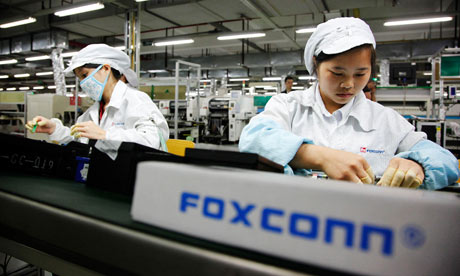
Apple received a mention in a big way during CNN’s Southern Republican Presidential Debate held yesterday at the North Charleston Coliseum in South Carolina. The debate featured Republican Presidential candidates Mitt Romney, Newt Gingrich, Ron Paul, and Rick Santorum. At one point (mark 1:01:55), CNN host John King asked the candidates in the light of the ongoing Foxconn controversy to lay out their plans to bring back manufacturing jobs to the United States.

More precisely, King zeroed in on the fact that Apple is “a breathtakingly important American company” that employs most of its workforce in retail stores, but hires half a million low-paid workers through its Far East suppliers and contract manufacturers that actually assemble its products (just like any other technology company does, mind you). Santorum has “a plan in place” to put this strategy to an end (quote right below the fold), as do other candidates. They also talked SOPA and discussed other burning issues. Just watch the clip…


Expand
Expanding
Close

Samsunged: TV advert slams Apple’s iPhone over lack of stock turn-by-turn navigation software

Site default logo image

[youtube=http://www.youtube.com/watch?v=vOSgfvTC35A]

Samsung is continuing its anti-Apple rant with a new television commercial titled “Samsunged.” Once more, the South Korean conglomerate laughs off those who would wait in line for a new iPhone. The commercial opens with the familiar scene as line waiters get a visit from their Galaxy SII-toting friend, and they promptly feel envious over his phone’s turn-by-turn navigation capabilities.

When asked by a girl waiting in the line how much he had paid for the navigation app, the Android person responded: “I didn’t, Galaxy S II just has it – it just comes with it.”  To that, one of the Apple fans remarked angrily: “Ooooh, we just got Samsunged!”

It is also worth noting that the advertisement subtly pokes fun at the iPhone 4S’s same design as the iPhone 4, as well as its widely reported battery issues. The commercial starts out with the line’s awaiting customers eagerly watching a streaming video of the device they are hoping to buy being unveiled online, and upon seeing the device, one customer sighed: “Awe, that looks like last year’s phone.” The scene immediately transitions into the Galaxy S II user bringing his friends a white smartphone charger, presumably because their device’s battery is almost dead.

Apple fans are obviously going to be seeing more of these advertisements as the Super Bowl approaches. It is certainly interesting, though, that these commercials paint Samsung customers as hipsters.


Expand
Expanding
Close

China Telecom launch imminent as iPhone gets crucial CDMA-2000 network access license?

Site default logo image

Fans in China eager to get their hands on Apple’s iPhone through wireless operators other than China Unicom, the country’s exclusive iPhone partner, are in for a surprise as the device is really close to launching on the China Telecom network. According to the Wall Street Journal, it received a much-needed CDMA-2000 network access license from Telecommunication Equipment Certification Center, the country’s certification body. This means China Telecom could now be just weeks away from officially selling the iPhone:

An iPhone compatible with the mobile network of China’ third-largest mobile carrier, China Telecom, has received a network access license, a regulatory website shows, marking a key step toward Apple being able to sell the phone to a broader audience in China.

Last week, Apple’s iPhone got an approval from China Radio Management agency for use on China Telecom’s network. That agency certified an iPhone version with a model number A1387a that supports “WCDMA,” indicating Apple could release a phone that supports both China Unicom’s and China Telecom’s networks. Nevertheless, China Telecom, which expressed interest to offer the iPhone on numerous occasions in the past, looks like it will finally land the sought-after device.

Widening the iPhone’s distribution footprint in China, a key growth market for Apple at a time when the company is increasing sales of its mobile devices around the world, is bound to positively affect the bottom line. China is now the world’s leading smartphone market. Revenue from the country contributed with 12 percent in the more than $108 billion of Apple’s fiscal 2011 revenue, up from just $3 billion in 2009.


Expand
Expanding
Close

Evidence looks bad for Apple, Google and others in anti-poaching class action suit

Site default logo image

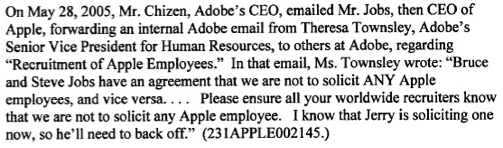
It appears the U.S. Justice Department has some solid evidence against companies including Apple, Google, Adobe, Intuit, Pixar, Lucasfilm and Intel.  TechCrunch obtained a document from the DOJ that is now posted to Scribd.  Among the pieces of evidence, include:

The DOJ settled with the six companies, but a class action lawsuit is pending.  The complaint regards entering into non-poach and no bidding war agreements. The above mentioned companies allegedly lowered employee compensation artificially while hindering mobility.

The plaintiffs seek damages for any salaried employee who worked for one of the defendants during a 4-year period in the late 2000s. That means a lot of Silicon Valley tech workers could receive a payout if the defendants lose or settle the case. The civil case will be heard by Judge Koh in San Jose starting January 26th, 2011

The defendants, including Apple, asked the case to be dismissed, stating that the DOJ found “no overarching conspiracy” and that these bilateral agreements were separate.

Expand
Expanding
Close

Apple passed $400B market cap briefly today, set all-time company high of $431 a share

Site default logo image

Hot off the heels of Apple’s iBook Textbooks and iBooks Author announcement, the Cupertino, Calif.-based Company passed a $400 billion market cap briefly today, AllThingsD pointed out. Apple also saw a new company record of $431 a share this afternoon —up $2 from yesterday’s record. As the afternoon continued on, Apple’s market cap went down to $398 billion again, but it is still close to coming back. For comparison, the world’s most valuable company, Exxon, has a market cap of $417 billion. Apple was at one time the most valuable company in 2011.

As CNN Money pointed out, Apple with a market cap of $400 billion is worth more than the countries Greece, Austria, Argentina, and South Africa.

Apple dominated financially in 2011, and it continues in 2012. Next Tuesday, the company will report what is expected to be record earnings from Q4. Apple is also expected to break past the sales of 5 million Macs and up to 30 million iPhones, some analysts claimed. We will be covering Apple’s financial announcement next Tuesday. Stay tuned!


Expand
Expanding
Close