China

See All Stories
China

China has been fundamental to Apple’s historical success, but is also arguably the greatest risk to the company’s future.

Why are most Apple products made in China?

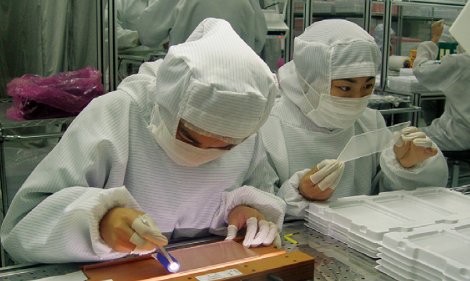
Although everyone assumes Apple products are made in China because labor is cheap there, that’s only part of the story – and an increasingly small part, as the company’s assembly partners move toward more and more automated operations.

Steve Jobs originally transferred most Apple manufacturing to China because it was the only country in the world with a huge ready-made supply-chain network, and the ability to scale up production almost overnight. There are three main reasons China – and specifically the Shenzhen area – is such a powerful manufacturing center.

First, the city is strategically placed, serving as the gateway between mainland China and Hong Kong. It is one of the largest shipping centers in the world, with a massive container port.

Second, the Chinese government established Shenzhen as the first Special Economic Zone (SEZ) in the country. SEZs are designed to encourage enterprise through relaxed planning regulations and generous tax incentives – and crucially, to facilitate foreign investment in local companies. It is this, as much as its geographical advantages, which has enabled it to grow at such a pace.

Third, that SEZ was established way back in 1980, meaning that the city has had over 40 years to grow into the manufacturing center of the tech world. Apple relies on a huge network of suppliers and sub-contractors, some of which may make just a single tiny component. The majority of them are based in Shenzhen and its immediate surrounds, so the logistics of bringing everything together in one place for assembly are straightforward.

What are the risk factors with China?

Being over-dependent on China carries a number of risks.

First, there is the generic one: Being overly dependent on any one country is a strategic risk. For example, the COVID-19 pandemic originated there, and had a massive impact on manufacturing capacity. Anything from a natural disaster to political upheaval could disrupt operations within a single country, so it is always wise to have a diverse range of manufacturing centers around the world.

Second, the relationship between the US and China has often been fraught. The trade war started by the previous US administration was a particularly low point, but continued tensions mean that there is always a risk of disruptions to trade between the two countries.

Third, it is increasingly damaging to Apple’s reputation to be so closely associated with a country that has a worsening human rights record – especially when the iPhone maker has no choice but to comply with local laws, however much they may conflict with the company’s own values. Apple has been required to remove VPN and a variety of other apps from the Chinese App Store, allow the iCloud data of Chinese customers to be stored on government-controlled servers, and more. Additionally, there have been growing reports of forced labor in China, including within many different areas of Apple’s supply chain.

What is Apple doing about it?

Apple has been working for a long time on diversifying its manufacturing operations, and has in recent years accelerated the pace at which it is doing so.

As explained above, this is far from an easy undertaking, but Apple now has major manufacturing operations in India, Thailand, Malaysia, and the Philippines, among other countries.

In India in particular, we are seeing the very early stages of a complete supply-chain infrastructure as the government uses a mix of carrot and stick to encourage companies to manufacture more of their components within the country – namely, tariffs on imports of components and tax breaks for local production. COVID-19 lockdowns in China also saw Apple move some iPad production to Vietnam for the first time, but it’s clear that the risks of over-dependence on China have never been greater.


Foxconn reportedly hid teenage workers from inspectors, Daisey’s monologue available as royalty-free download

Site default logo image

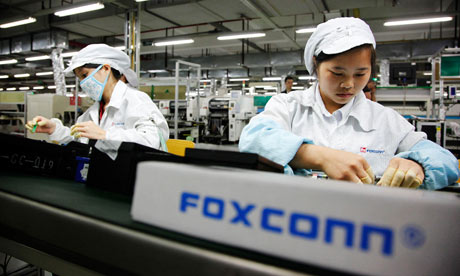
As the Fair Labor Association inspectors interview Foxconn employees about working conditions at iPad plants, early reports coming our way are a bit ambiguous and a tad confusing. First FLA president told Reuters that plant floors are spotless, then Bloomberg published an article claiming the organization found “tons of issues,” and finally those two video teasers (here and here) from ABC Nightline’s ‘iFactory’ documentary added ambiguity as the producers apparently “didn’t find any egregious violations.”

Knowing ABC’s parent company Disney has the Steve Jobs Trust as its largest shareholder, and considering that FLA is funded by the biggest players in the industry, including Apple who commissioned the Foxconn inspection that began last week, some watchers are speculating there must be more to this than meets the eye. Read on…

Expand
Expanding
Close

Fighting Proview in Shanghai Showdown, Apple highlights iPad’s benefits to China’s economy

Site default logo image

An important update as a Shanghai court hearing this morning confronted Shenzhen, China-based LCD display maker Proview and Apple of California, the maker of the widely popular iPad tablet. The high-profile hearing drew more than a hundred reporters. As you know, Proview is dreaming of a multi-billion dollar settlement for rights to the iPad name in China where Apple pushes aggressively with claims it acquired the iPad trademark in 2009 from Proview’s Taiwanese affiliate for about $55,000. Associated Press this morning described a heated exchange between cash-strapped Proview, which recently filed for bankruptcy, and the Silicon Valley giant. At stake: A countrywide import and export ban on the iPad that enjoys a 76 percent share in China.

If enforced, the ban could easily disrupt worldwide iPad availability, because the world’s largest contract manufacturer Foxconn at its plants in the Chinese province of Shenzhen manufactures the tablet. Worse, it could disrupt a future iPad 3 launch allegedly scheduled for March 7 unveiling. So yeah, it is all about money.

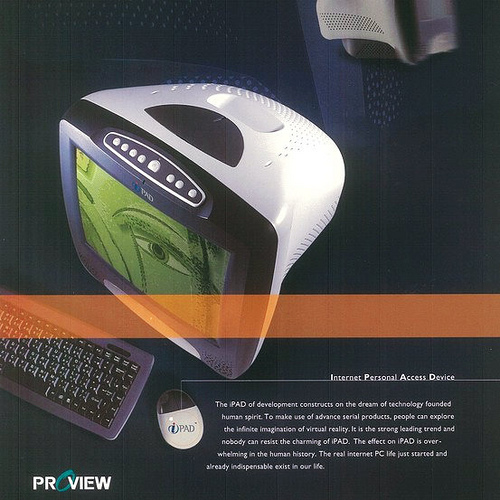
Proview representatives presented as court evidence the company’s 2000 iMac-lookalike named IPAD (pictured on the right). The lawyers came down with all guns blazing on Apple, and said: “Apple has no right to sell iPads under that name.” The company’s CEO told reporters “both sides have willingness to negotiate,” and asserted, “both sides will submit their plans before the talks,” because an out-of-court settlement “is quite possible.”

To this, Apple responded:

They have no market, no sales, no customers. They have nothing. The iPad is so popular that it is in short supply. We have to consider the public good.

Reuters followed up with another quote attributed to Apple’s legal team:

Apple has huge sales in China. Its fans line up to buy Apple products. The ban, if executed, would not only hurt Apple sales but it would also hurt China’s national interest.

Explaining Proview has not sold or marketed its IPAD computer system in years while Apple only began selling the iPad tablet in 2010, the company said the fact essentially invalidates Proview’s trademark. Lawyers for Proview cried foul, and claimed any public good achieved through the creation of iPad manufacturing jobs in China and tax revenues should not be confused with trademark infringement:


Expand
Expanding
Close

Proview: ‘We are now preparing for negotiations with Apple’

Site default logo image

Cash-strapped display maker Proview that sued Apple over the iPad moniker in China feels it has the Cupertino, Calif.-headquartered gadget giant right where it wants them, cornered against the wall. Just as the Intermediate People’s Court in Huizhou ruled last Friday that local distributors should stop selling iPads in China, Proview now told The Times of India it us ready to sit at the negotiating table, apparently telling Apple it has “peaceful intentions.”

The company wants money, is hoping for an out of court settlement, and it is shooting for as high as $2 billion for the I-PAD trademark in China. Legal representatives for the debt-laden company told the paper Tuesday:

We are now preparing for negotiations. The court cases will continue until we reach an agreement.

A court in Shanghai will begin hearings tomorrow on whether Proview’s claims have any merit and the ruling could take months, Reuters reported. Whether or not Proview’s strategy works, that is anyone’s guess at this point. Apple is even threatening to sue Proview over “defamatory statements.” This highlights Apple’s unwillingness to engage in trademark licensing talks with the Chinese firm that recently filed for bankruptcy…


Expand
Expanding
Close

Chinese Court: Stores should stop selling iPads; Apple: Proview hurt our reputation, we’ll sue over ‘defamatory statements’

Site default logo image


Pictured above: Proview’s iMac-like computer named iPAD, released 12 years ago.

The latest in an ongoing iPad trademark dispute in China comes as Shenzhen-based Proview claims a small victory in its pursue of a $2 billion compensation from Apple over the iPad moniker in China. According to a report filed by The Associated Press, Proview’s lawyer Xie Xianghui told the media Monday that the Intermediate People’s Court in Huizhou ruled last Friday that local distributors should stop selling iPads in the country.

Previous reports declared that commercial authorities in more than 40 Chinese cities were removing the device from store shelves. Apple appealed to Guangdong’s High Court against an earlier ruling in Proview’s favor, stressing in today’s statement its case is still pending in mainland China. It should be noted that Hong Kong’s and Mainland China’s legal systems are not very much alike.

PCWorld followed up with an update and said Apple will sue Proview’s lawyers and bosses for  “defamatory statements.” Folks familiar with Apple’s letter to Proview claim it reads: “It is inappropriate to release information contrary to the facts to the media, especially when such disclosures have the effect of wrongfully causing damage to Apple’s reputation.” The document is embedded below.

So, who is the biggest beneficiary of this brouhaha? Samsung— its Galaxy Tab family of tablets is after the same high-end of the market. Per IDC, Apple in the third quarter of 2011 moved 1.3 million iPads in China versus 58,000 Galaxy Tabs.

Once a well-known display maker, Proview is now strapped for cash and recently filed for bankruptcy. The company maintains it first used the iPAD moniker, which stands for “Internet Personal Access Device,” for its iMac-like computer dated back to 2000.


Expand
Expanding
Close

ABC teases the upcoming ‘iFactory: Inside Apple’ documentary [Video]

Site default logo image

[vodpod id=Video.16115602&w=650&h=420&fv=allowFullScreen%3Dtrue%26bgcolor%3D%23000000%26autoPlay%3Dfalse%26screensLayer.startScreenOverId%3DstartScreen%26screensLayer.startScreenId%3DstartScreen%26]
Note: A YouTube version should be up soon

As promised, ABC aired its documentary about Foxconn factories producing Apple products. In an unprecedented move, Apple decided to grant the network’s “Nightline” program full access to its Chinese supply chain, so correspondent Bill Weir traveled to Shenzhen, China to look at “iFactories,” as ABC dubbed them.

Full disclosure: Disney Corporation owns the ABC News network. The fact that the Steve Jobs Trust is Disney’s largest individual shareholder, coupled with Disney CEO Bob Iger now having a seat on Apple’s board of directors, certainly helped win the official approval from Apple. It also raises questions on a possible conflict of interest with this report.

The full “iFactory: Inside Apple” report is scheduled to air on a special edition of “Nightline” due tomorrow, Feb. 21, at 11:35pm ET/PT. A preview will air on “Good Morning America” and “World News with Diane Sawyer.” A long article that accompanies a video teaser, included above for your convenience, offers a grim description of working conditions inside Foxconn plants:


Expand
Expanding
Close

The price of the iPad name in China has gone up to $2B

Site default logo image

Chinese vendor Proview apparently owns rights to the iPad trademark in China, and it has two billion reasons not to honor its prior agreement with Apple as the Wall Street Journal cited a representative of Proview creditors who suggested compensation from Apple “could range as high as $2 billion,” which is up from the previous sum of $1.5 billion. Cash-strapped Proview recently filed for bankruptcy, so courts could interpret this as banks’ last-ditch effort to recoup their loans to Proview.

A Hong Kong court ruled last year that Apple’s agreement with Proview was valid, but that case is still pending on the Chinese mainland. Court documents uncovered by Dow Jones suggest on Dec. 23, 2009, Apple of California bought the rights to the iPad trademark from Proview in South Korea, Thailand, Singapore, and China for a paltry sum of about $55,494 in today’s dollars. Proview waived its right to sue for past infringements and passing off.

Proview said it still owns the trademark and maintains the deal did n0t include the China market. Another court in Mainland China sided with Proview, thus paving the way for a potential injunction on both the import and export of iPads. The world’s largest contract manufacturer, Foxconn, is exclusively manufacturing Apple’s tablet in China.

Proview chairperson Yang Rongshan said today: “If we are not compensated properly, then Apple doesn’t use the iPad trademark in mainland China.” Shenzhen-based Proview, once a well-known monitor vendor, claimed it started developing a product called the iPAD in 2000. iPAD stands for “Internet Personal Access Device.” So, what does Proview’s iPAD look like? Images are right after the break.


Expand
Expanding
Close

Apple hooks up exploding Mac userbase in China with local services in OS X Mountain Lion

Site default logo image

Mountain Lion will cater to Chinese users more than any other OS X version. CEO Tim Cook once more underscored the importance of China by highlighting Mac sales in today’s interview with the Wall Street Journal. Sales doubled in the 1.33 billion-people market during 2011 to the tune of $13 billion in revenue.

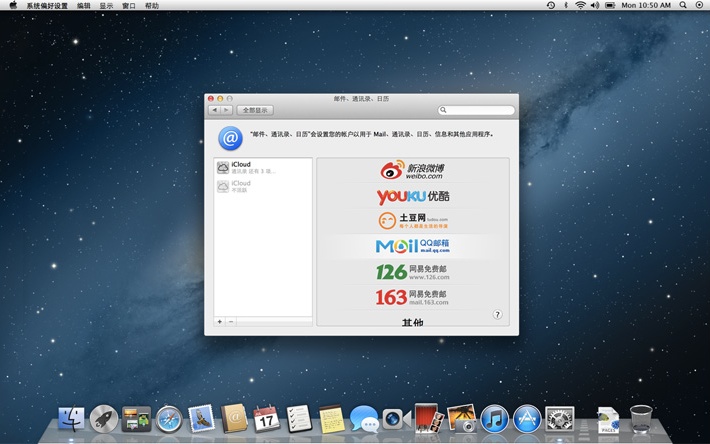
“They know about Apple and what Apple stands for. Then they search out and look for the Mac”, he told the paper. Apple’s promotional material said Mountain Lion makes it easy to “set up Mail, Contacts, Calendar, video sharing, web searching, and blogging on your Mac using many popular services in China.”

For starters, Chinese input method in Mountain Lion has “significant enhancements.” Secondly, Apple worked hard to make sure customers in China get a localized experience by providing the ability to select Baidu search in Safari. Baidu is the dominant search engine in China, ranked No. 6 in Alexa’s global rankings and No. 1 in China with an estimated 56.6-percent share of the country’s 4.02 billion search queries as of June 2011…


Expand
Expanding
Close

Apple finally talks, says Proview refuses to honor agreement to transfer iPad trademark

Site default logo image

Numerous online stores in China took the iPad off their shelves after Proview said Apple was breaking its trademark on the term “iPad.” The fight continues in court, but Apple released a statement today to China Daily about Proview’s allegations on Apple allegedly breaking the trademark.

“We bought Proview’s worldwide rights to the iPad trademark in 10 different countries several years ago. Proview refuses to honor their agreement with Apple, and a Hong Kong court has sided with Apple in this matter,” according to the statement, which also said the case is still pending on the Chinese mainland.”

Apple said it purchased Proview’s iPad trademark over several years ago in 10 different countries. Proview is refusing to transfer the trademark, but Hong Kong courts have already sided with Apple, according to the statement.

Many accuse the Mainland Chinese government of favoring local companies in these types of matters, so it may not be easy to clear this hurdle for Apple. Chinese customs already said the iPad is too powerful to be banned; although, Proview tried to block iPads from coming in or going out of China earlier this week.

Proview countered the Hong Kong situation:


Expand
Expanding
Close

Apple posts audio of Tim Cook presentation from Goldman Sachs Conference

Site default logo image

Yesterday we brought you some of the highlights from Apple CEO Tim Cook’s presentation at the Goldman Sachs Technology and Internet Conference, and now Apple made the conference’s audio available on its website. While Apple usually uses the conference to discuss numbers and trends, Cook gave us some hints at what’s next for Apple TV, and he also discussed worker safety following media attention over its supply chain abroad.

Expand
Expanding
Close

Apple tells Amazon China to pull iPads over Proview trademark dispute, customs say it’s too popular to be banned

Site default logo image

A country-wide import and export ban on Apple’s iPad that ProView is pushing for over an ongoing litigation with the iPad moniker will not be easy to implement, or at least that is what Chinese customs officials told Reuters this morning. Chinese company ProView owns the “iPad” trademark and is petitioning Chinese customs to stop shipments of iPads in and out of the country.

Foxconn manufactures the iPads in Shenzhen, China, and such a ban would disrupt global iPad supply. Another result of the legal battle over the iPad name: At Apple’s request, online shopping websites Amazon China and Suning reportedly removed the iPad until the trademark dispute is resolved. Proview is hoping to extract an estimated $1.5 billion from Apple for the rights to use the iPad moniker in China.

The plan reportedly is not working as expected, because local customs think implementing a country-wide ban on such a successful and globally popular product would be impractical, to say the least. Moreover, customs authorities are unlikely to intervene in the trademark battle, or so the story has it. For its part, Proview insists it started developing a tablet called the iPad in 2000. The company’s boss Yang Long-san confirmed the latest development to the news gathering organization:


Expand
Expanding
Close

Proview tries to block iPads from coming in or going out of China

Site default logo image

Not content with officials yesterday confiscating iPads in Shijiazhuang over an ongoing litigation on the iPad moniker, Taiwanese company Proview Electronics is now looking to put a ban on both iPad imports and exports, according to Reuters. The company is already petitioning Chinese customs to stop shipments of iPads. Proview sued Apple last year over its “I-PAD” trademark and could seek up to $1.5 billion for the name from the Cupertino, Calif.-headquartered gadget powerhouse.

Apple is in an increasingly difficult place here. Considering every iPad is built in China (until Brazil plants go online), a full-blown export ban could disrupt the iPad business on a global scale. Proview’s legal position stems from Chinese laws that seek to prevent the sale of counterfeit goods in the country. The news gathering organization confirmed the development this morning:

A Chinese tech firm claiming to own the “iPad” trademark plans to seek a ban on shipments of Apple Inc’s computer tablets into and out of China, a lawyer for the company, Proview Technology (Shenzhen), said on Tuesday.

Proview also asked the country’s Administration Industry and Commerce to put in effect iPad confiscations in as much as 30 cities. Apple’s position in this dispute remains unchanged as a spokesperson re-iterated the official line:

We bought Proview’s worldwide rights to the iPad trademark in 10 different countries several years ago. Proview refuses to honor their agreement with Apple in China and a Hong Kong court has sided with Apple in this matter.


Expand
Expanding
Close

Chinese Authorities in Shijiazhuang snatch iPads from retailer over ‘iPad’ name trademark dispute

Site default logo image

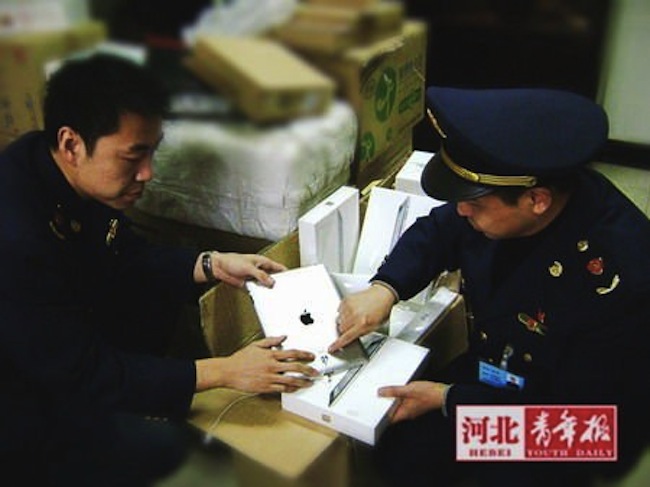
The Economic Times of India, Penn Olson, Ifeng.com, DigiCha and China.com.cn are all reporting that Chinese authorities in Shijiazhuang are confiscating iPads because of an ongoing Proview trademark litigation. Proview, you will recall, is suing Apple over its I-PAD trademark and hopes to receive up to $1.5 billion for the name.

As Penn Olson pointed out, the confiscations are in one city and so far just on third-party retailers. However, the action forced other retailers to take iPads off the shelves, though they can still be purchased if asked for. However, this latest action might be a sign of things to come…


Expand
Expanding
Close

Purported iPad 3 shells floating around China, here’s a very high-resolution image of the inside, and photos of the outside

Site default logo image
Full-sized, below.

Since a purported iPad 3 back-shell image leaked earlier today, we have dug into the story to uncover where it originally came from and some of the intricate details behind the part. For one, there are not only a few of these back-shells floated to repair shops, but there are sizable amounts of these parts built-in China. This gives credence to reports about the iPad 3 is in production, and it likely means things are moving full steam ahead of the rumored-March launch.

Next, the original image comes from a Chinese supplier who provides parts to iPad repair shops across the globe.

Perhaps the best news of the night is that we have a very high-resolution version of the image. Click the image below to view the full super high-res version. The iPad 3 rumors include the device to have a Retina Display, faster processor, improved graphics, and better cameras. As hinted by these back-shells and earlier rumors, the iPad 3 will likely sport a design that closely mirrors the iPad 2 design.

Update: Our friends at Apple.pro also obtained photos of the iPad 3 back shell, and they have a photo of the outer back portion. It appears that the camera lens is larger than the iPad 2 camera lens, and they confirmed the iPad 3 would feature magnets to support the Smart Cover. You can catch that photo after the break as well.


Expand
Expanding
Close

Group plans disruptive protest tomorrow at Apple’s Grand Central Store over Foxconn conditions

Site default logo image

Consumer groups SumOfUs and Change.org are waging a war over the working conditions at Apple’s (and the rest of the electronics industry’s) main outsourced manufacturer Foxconn. The groups said that over 35,000 people signed their “Stop Worker Abuse” online petition in just 24 hours. Today, the groups announced they would deliver a quarter million petition signatures to Apple.

Furthermore, a protest will be staged tomorrow at 10 a.m. outside Apple’s new Grand Central Terminal retail store and representatives from both SumOfUs and Change.org promised to join the protesters. Change.org’s Mark Shields called abusive working conditions at Foxconn factories “appalling,” adding he was shocked to learn about them.

The two consumer groups are demanding that the iPhone maker release a worker protection strategy for new product releases because these are the instances “when injuries and suicides typically spike because of the incredible pressure to meet quotas timed to releases.” They are also pressuring Apple to publish the results of Fair Labor Association’s audit (to which the company willfully agreed): “Including the NAMES of the suppliers found to have violations and WHAT those violations are, so that there is transparency around the monitoring effort.” The petition (found here) opens with an interesting paragraph:


Expand
Expanding
Close

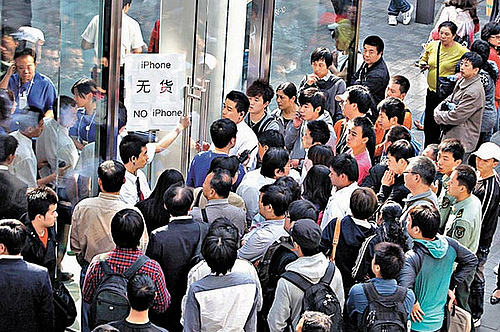
iPhone scalpers in China on the decrease as Apple resumes online sales of iPhone 4S, shipping by March 2

Site default logo image

Last week we told you about a new online lottery system for reservations that Apple setup for iPhone 4S sales through its Hong Kong stores to combat scalpers after it was forced to suspend sales of the device in various locations throughout Mainland China. Unfortunately, until this week, Apple’s online store for China has been out of stock since the overwhelming launch.

After implementing the new reservation policies on Tuesday, and in Beijing on Wednesday, Apple has now resumed online sales of the device with shipments arriving to customers no later than March 2, reported ChinaDaily. Apple’s online store for Mainland China now lists the iPhone 4S with an expected delivery time of “February.” Customers are limited to two devices with all three models currently available in both black and white. An Apple employee confirmed the March 2 date to ChinaDaily:


Expand
Expanding
Close

China Telecom says it will sell the iPhone 4S in a month

Site default logo image

Earlier this month, we reported that China Telecom earned the necessary approvals to launch the iPhone 4S on China’s third-largest carrier. Today, the China Telecom subsidiary Beijing Telecom issued a press release (via China Daily) and said the Beijing-based company will launch the iPhone 4S as early as the end of February or beginning of March.

A CDMA version of the iPhone 4S will launch on the network. The press release gave no word on pricing for the device, but it will likely fall in line with the other networks.

China Telecom currently boasts 36.3 million 3G subscribers, while in comparison the nation’s largest carrier China Mobile Ltd., boasts 51.2 million 3G subscribers. Obviously, the launch of the iPhone 4S brings a lot of excitement in China, and it gives Apple the chance to add new customers. Moreover, launching on China Mobile would add an abundance of new customers, but that does not look to be happening anytime soon.


Expand
Expanding
Close

Apple combats scalpers with new lottery system for iPhone reservations in Hong Kong

Site default logo image

Apple has implemented an interested system to fight those pesky scalpers who spoiled a recent iPhone 4S launch in Mainland China. A newly set up page on the Hong Kong Apple online store has a lottery system of sorts for iPhone reservations that appears to target scalpers employing bots from snatching up all the iPhones everyday. Rather than reserve their iPhone on a first-come-first-serve basis, customers are now required to provide full details, including a government-issued photo ID matching the name and ID number.

In addition, this lottery seems to be valid during a three-hour window each day. Those who “won” a reservation spot will be informed by email before 9 p.m. Interestingly, Apple specifically said it will not be selling iPhone 4 or iPhone 4S to walk-in customers. Previously, the reservation system would open at a random time and it would often fail as bots kept pinging the server all day, meaning reservations would be gone in less than a minute.

Perhaps Apple is keen on implementing this system in Mainland China and possibly elsewhere? Apple’s full message is included after the break…


Expand
Expanding
Close

CBS probes Apple’s relationship with Foxconn

Site default logo image

[vodpod id=Video.16019270&w=650&h=420&fv=si%3D254%26amp%3BcontentValue%3D50119105%26amp%3BshareUrl%3Dhttp%3A%2F%2Fwww.cbsnews.com%2F8301-3445_162-57367950%2Fthe-dark-side-of-shiny-apple-products%2F]
Flashless

After the NYTimes exposé and Tim Cook’s response, the question remains: Why is the media focusing on Apple and not questioning any of the other electronics companies that manufacture with Foxconn in China?

Obviously, Apple has the money, the brand, the prestige, and it grabs attention. However, it is not like Apple can make gold from straw. Apple simply cannot build its products anywhere other than China.

On the flip side, @NicePaul takes recent Forbes numbers and creates the following infographic that illustrates the opposite point:


Expand
Expanding
Close

Poll: Would you like the next iPhone to have a bigger screen?

Site default logo image

We heard earlier today that the next iPhone may have a bigger screen which could make the chassis slightly bigger.  How do you feel about this?  What size would you prefer?

Unsure? Check here (via Tim Bray).
Expand
Expanding
Close

NYTimes: Why Apple builds its products in China

Site default logo image

The NY Times just published an absolutely fascinating piece on Apple and why it builds almost all of its stuff in China. Go read it.  Clearly some of our politicians could learn a lot from it.

The short of it is that companies like Apple simply cannot manufacture products in the United States.  The cost (though it is cheaper in China) is not the reason, however.  Years ago, the Chinese government subsidized building cities of factories that can hire 3,000 workers to live in a dorm per day —or 8,700 Industrial Engineers in two weeks (it would take 9 months to do this in the U.S.).  Today’s gadgets require thousands of little parts that are all made in the same areas.  This whole global supply chain cannot be moved to the U.S.

The most interesting tale might have been the last minute decision to make the iPhone’s display glass:

In 2007, a little over a month before the iPhone was scheduled to appear in stores, Mr. Jobs beckoned a handful of lieutenants into an office. For weeks, he had been carrying a prototype of the device in his pocket.

Mr. Jobs angrily held up his iPhone, angling it so everyone could see the dozens of tiny scratches marring its plastic screen, according to someone who attended the meeting. He then pulled his keys from his jeans.

People will carry this phone in their pocket, he said. People also carry their keys in their pocket. “I won’t sell a product that gets scratched,” he said tensely. The only solution was using unscratchable glass instead. “I want a glass screen, and I want it perfect in six weeks.”

After one executive left that meeting, he booked a flight to Shenzhen, China. If Mr. Jobs wanted perfect, there was nowhere else to go.

 New screens began arriving at the plant near midnight.

A foreman immediately roused 8,000 workers inside the company’s dormitories, according to the executive. Each employee was given a biscuit and a cup of tea, guided to a workstation and within half an hour started a 12-hour shift fitting glass screens into beveled frames. Within 96 hours, the plant was producing over 10,000 iPhones a day.

For over two years, the company had been working on a project — code-named Purple 2 — that presented the same questions at every turn: how do you completely reimagine the cellphone? And how do you design it at the highest quality — with an unscratchable screen, for instance — while also ensuring that millions can be manufactured quickly and inexpensively enough to earn a significant profit?

Other notable tidbits:
Expand
Expanding
Close

Republican Presidential candidates ponder Apple outsourcing gadget-making to China

Site default logo image

[youtube=http://www.youtube.com/watch?v=8-fU-knxT0U&t=1h1m55s&start=3720]

Apple received a mention in a big way during CNN’s Southern Republican Presidential Debate held yesterday at the North Charleston Coliseum in South Carolina. The debate featured Republican Presidential candidates Mitt Romney, Newt Gingrich, Ron Paul, and Rick Santorum. At one point (mark 1:01:55), CNN host John King asked the candidates in the light of the ongoing Foxconn controversy to lay out their plans to bring back manufacturing jobs to the United States.

More precisely, King zeroed in on the fact that Apple is “a breathtakingly important American company” that employs most of its workforce in retail stores, but hires half a million low-paid workers through its Far East suppliers and contract manufacturers that actually assemble its products (just like any other technology company does, mind you). Santorum has “a plan in place” to put this strategy to an end (quote right below the fold), as do other candidates. They also talked SOPA and discussed other burning issues. Just watch the clip…


Expand
Expanding
Close

China Telecom launch imminent as iPhone gets crucial CDMA-2000 network access license?

Site default logo image

Fans in China eager to get their hands on Apple’s iPhone through wireless operators other than China Unicom, the country’s exclusive iPhone partner, are in for a surprise as the device is really close to launching on the China Telecom network. According to the Wall Street Journal, it received a much-needed CDMA-2000 network access license from Telecommunication Equipment Certification Center, the country’s certification body. This means China Telecom could now be just weeks away from officially selling the iPhone:

An iPhone compatible with the mobile network of China’ third-largest mobile carrier, China Telecom, has received a network access license, a regulatory website shows, marking a key step toward Apple being able to sell the phone to a broader audience in China.

Last week, Apple’s iPhone got an approval from China Radio Management agency for use on China Telecom’s network. That agency certified an iPhone version with a model number A1387a that supports “WCDMA,” indicating Apple could release a phone that supports both China Unicom’s and China Telecom’s networks. Nevertheless, China Telecom, which expressed interest to offer the iPhone on numerous occasions in the past, looks like it will finally land the sought-after device.

Widening the iPhone’s distribution footprint in China, a key growth market for Apple at a time when the company is increasing sales of its mobile devices around the world, is bound to positively affect the bottom line. China is now the world’s leading smartphone market. Revenue from the country contributed with 12 percent in the more than $108 billion of Apple’s fiscal 2011 revenue, up from just $3 billion in 2009.


Expand
Expanding
Close

Foxconn issues go mainstream thanks to This American Life and The Daily Show

Site default logo image

[vodpod id=Video.15968071&w=650&h=420&fv=autoPlay%3Dfalse]

Earlier this week, Apple pledged to let the Fair Labor Association access its suppliers’ facilities to monitor working conditions. Even though Apple is the first technology company admitted to the FLA, the snowballing issue of harsh conditions at Far East plants will not go away with the announcement. Quite the contrary, the problem has escalated and gone mainstream, with both The Daily Show and This American Life focusing on the grim reality of earning a living at Foxconn-operated sweatshops in China.

Jon Stewart, The Daily Show host and chief satirist, remarked in an episode yesterday:

By creating a convenient ecosystem, China’s Foxconn draws in employees who earn 31 cents an hour working for 35 hours straight, thereby saving American companies money.

As you know, Foxconn (also known as Hon Hai Precision Industry) is Apple’s favorite contract manufacturer, it but also produces gadgets for Amazon, Microsoft, HP, Dell and a variety of other brands. With that said, both shows tackle larger issues that affect just about every electronics manufacturer. The last week’s episode of This American Life, the popular radio program, weighed in as well. You can listen to their free audio stream here.


Expand
Expanding
Close

Toshiba Mobile Displays outed on Apple’s production suppliers list, factories open doors to labor group inspectors

Site default logo image


Apple just posted its 2012 Supplier Responsibility Report highlighting its efforts to audit and improve working conditions within its supply chain. As part of the report, Apple also posted a list of 156 companies currently supplying components for Apple products that make up over 97 percent of all “procurement expenditures for materials, manufacturing, and assembly” of its entire product line globally.

The list includes Toshiba Mobile display, which is —as far as we know—currently not supplying displays for Apple. There were rumors in May that claimed Toshiba was working on a 4-inch retina display and rumors last month that Apple and Toshiba are building a plant for display production, which were later debunked by the increasingly unreliable DigiTimes. It also includes Sharp, who was recently rumored to be ruled out of iPad 3-panel production due to quality concerns but also supplies other components to Apple. The full list is available after the break.

In 2011, we conducted 229 audits throughout our supply chain — an 80 percent increase over 2010 — including more than 100 first-time audits. We continue to expand our program to reach deeper into our supply base, and this year we added more detailed and specialized audits that focus on safety and the environment.

Every year Apple audits suppliers in eight areas including: Anti-discrimination, Fair treatment, Prevention of involuntary labor, Prevention of underage labor, Juvenile worker protections, Working hours, Wages and benefits, and Freedom of association. The overall results can be seen in the graphic below. We also learned than Apple found 42 facilities delayed wages, 68 facilities did not provide proper benefits, and 67 facilities held back payments as punishment.

There were also 108 facilities failing to pay legal requirements for overtime and holiday pay, and 5 facilities with 6 active cases of underage labor, to which Apple is requiring the suppliers “support the young workers’ return to school and to improve its management systems.”

In the audits, Apple found 93 facilities currently have more than 50 percent of its staff exceeding the maximum 60 hour workweek (with one day of rest per 7 days) set by Apple’s Code of Conduct for suppliers:

Expand
Expanding
Close