There are fewer options for speech recognition these days, and now there are even fewer with Nuance announcing they acquired Vlingo for an undisclosed figure. Following multiple lawsuits related to patent infringement, the two companies apparently came to what CEO of Vlingo Dave Grannan called “a good outcome.” Grannan elaborated in a prepared statement (via AllThingsD):
Vlingo and Nuance have long shared a similar vision for the power and global proliferation of mobile voice and language understanding. As a result of our complementary research and development efforts, our companies are stronger together than alone. Our combined resources afford us the opportunity to better compete, and offer a powerful proposition to customers, partners and developers.
Vlingo is notably used in various voice-controlled Android apps, and it is viewed as competitors to Apple’s Siri built into the iPhone 4S. However, Siri, also used it prior to it being used by Apple, before switching to Nuance…
In an interview with 9to5Mac, Siri co-founder Norman Winarsky said Vlingo was originally used as the speech recognition component of Siri before switching to Nuance. He noted: “Theoretically, if a better speech recognition comes along (or Apple buys one), they could likely replace Nuance without too much trouble. ” The full quote is below.
9to5Mac: How important is Nuance speech recognition to the Siri technology? Expand Expanding Close
Analytics firm Millennial Media, the second-largest mobile advertising platform behind Google, on Tuesday, released its monthly Mobile Mix report for November. Similar to their October survey that saw Android’s growth slowing (and iOS gaining). Compared to the summer period for November, both Apple’s and Research in Motion’s respective platform grew at the expense of Google. Specifically, Android went from 56 percent ad requests in October to 50 percent in November.
Meanwhile, iOS went from 28 percent ad requests in October to 30 percent in November. The BlackBerry platform recorded the biggest gain of all mobile platforms, increasing its share of ad requests from 13 percent in October to 17 percent in November. Because both iOS and BlackBerry grew their combined ad impressions by six percentage points, the same amount Android lost in the period, it is safe to assume that Apple and Research In Motion gained traction at the expense of Google’s mobile platform.
The findings are in stark contrast to the seemingly unstoppable Android growth that appears to have slowed down during the crucial holiday sales period. Android in November doubled iOS in ad impressions, but last month – its respective share changed to 50 percent for Android versus 30 percent for iOS. The Kindle Fire vs. iPad adoption figures and more info graphic charts are available below.
UPDATE [Wednesday, December 21, 2011 at 7:46am ET]: The article has been updated with a paragraph added to the bottom with a statement from HTC CEO Peter Chou saying his company is “testing” new devices meant to avoid the sales ban.
The International Trade Commission just ruled in favor of Apple in the Apple vs. HTC patent lawsuit regarding mobile devices [PDF document]. HTC was found guilty of violating Apple patent 5946647 that is described by Google Patent Search:
A system and method causes a computer to detect and perform actions on structures identified in computer data. The system provides an analyzer server, an application program interface, a user interface and an action processor. The analyzer server receives from an application running concurrently data having recognizable structures, uses a pattern analysis unit, such as a parser or fast string search function, to detect structures in the data, and links relevant actions to the detected structures. The application program interface communicates with the application running concurrently, and transmits relevant information to the user interface. Thus, the user interface can present and enable selection of the detected structures, and upon selection of a detected structure, present the linked candidate actions. Upon selection of an action, the action processor performs the action on the detected structure.
HTC has violated products. The ruling involved the phone’s software, and it is subject to an import ban on April 19, 2012. The ITC said HTC could continue to ship replacement devices for currently shipped products. Obviously, a ban on certain HTC products is a major blow to the company, and because this is software-based, other Android device manufactures should not be too pleased. You can read the ITC’s full ruling through the The Verge.
Last time we checked with research firm IDC, they listed Apple at 68.3-percent of the worldwide tablet market with approximately 9.3 million units of the iPad 2 shipped in quarter two of 2011. While the firm’s estimates for Q3 saw a drop to 61.5-percent of the market, Apple still leads the market and increased shipments from the 9.3 million in Q2 to approximately 11.1 million units in Q3.
To put that in perspective, Apple’s closest competitor, Samsung, is over 10 times behind with just 5.6-percent of the market. The overall tablet market increased 23.9-percent to approximately 18.1 million units, representing a 264.5-percent increase from the year-ago quarter.
As for where Apple stands in comparison to the overall Android tablet market, IDC expects Android tablet market share to increase rapidly in Q4 from just 33.2-percent in Q3 to 40.3-percent. It’s important to note that IDC recently included “media tablets,” such as Amazon’s Kindle Fire and Barnes & Noble’s Nook Tablet, in their worldwide tablet market estimates. These additions will more than likely account for much of the increase.
This morning, Morgan Stanley significantly raised its forecasts for 2012, predicting Apple could possibly sell 90 million iPads during the year (in addition to 190 million iPhones). The analysts apparently have high hopes for Android 4.0’s ability to offer a competitive alternative to iPad going forward:
Google’s Vic Gundotra just announced on his Google+ page a host of new Hangouts features meant to “go beyond the status update”. In short, you can now hangout on any post (an invitation will be added to the comments), call any phone number in the world and conference in anyone (free calling to US and Canada, international calling rates are “super, super low”), plus initiate a hangout session from the official Google+ iOS app by tapping the new hangout icon.
The executive also shared an interesting milestone for Hangouts on Air, saying “hundreds of people” whitelisted as part of their trial now have the ability to broadcast their hangouts to the world. “Our goal is to enable this for everyone on the planet”, Gundotra noted. You will also be able to automatically record a Hangouts on Air session and upload it to a private YouTube account for later viewing. These features require a new Google+ app, “coming soon” to the App Store. The official Google blog has more information.
As we reported over on the sister blog, Google just launched Currents, their Flipboard/Pulse style reader for iPhone and iPad (and I guess Android too). Head over for the details. (Yes, 9to5Mac is a launch partner so look for us on the App!)
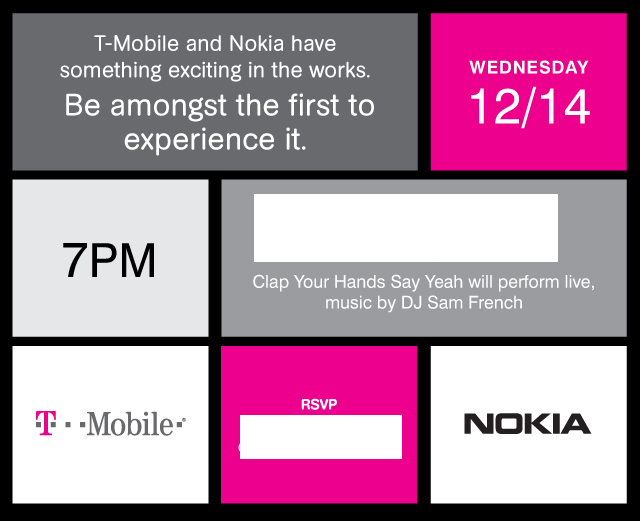
With Apple deciding not to include support for T-Mobile’s bands in the US, T-Mobile has turned into an Android wasteland with over 90% of the smartphones sold on the network running on Google’s OS. Looking for some diversification (besides the over million legacy iPhones), T-Mobile looks to be one of the first in the US to roll out one of the new Nokia Windows Phone 7 devices which they plan to announce on Dec 14th, a little late for the holidays.
Curious to see how Windows Phone feels, but don’t have a device around to do so? Us neither. But Microsoft has just released a new HTML 5 website that allows iPhone and Android users to get a taste of the Windows Phone 7 (Mango 7.5) operating system. The trial requires no downloads or registration, and you can try it out by just going to the webpage http://aka.ms/wpdemo on your mobile device.
While it doesn’t use any of the data on your phone like your contacts, the demo does give you a pretty comprehensive look at all of Windows Phone’s features. Microsoft uses a blue dot to guide you around the operating system, and obviously some features like voice recognition just don’t work in the browser. Drat, that’s something we really wanted to try.
Will this draw users over to the Windows Phone platform? Probably not, but it’s always cool to see what the competition is up to.
A recent survey conducted by GoodMobilePhones.co.uk of 1,694 Brits aged 18 and over made waves with claims that as much as 22 percent of U.K. owners regret the purchase of iPhone 4S over battery life and jealousy of rival smartphones. What happened instead, research firm Kantar Worldpanel ComTech claims, was that the device went on to steal Android market share in the United Kingdom.
According to the findings of the research note, Apple’s U.K. handset market share in the quarter leading up to the end of October climbed to 27.8 percent, a 2.8 percentage point increase, while Android dropped from 49.9 percent to 46 percent. Looking only at October sales, Apple won a cool 42.8 percent of all handset sales during the month versus 35 percent of October sales for Android phones… Expand Expanding Close
Update: Ooops. Originally thought this was an Apple patent.
.
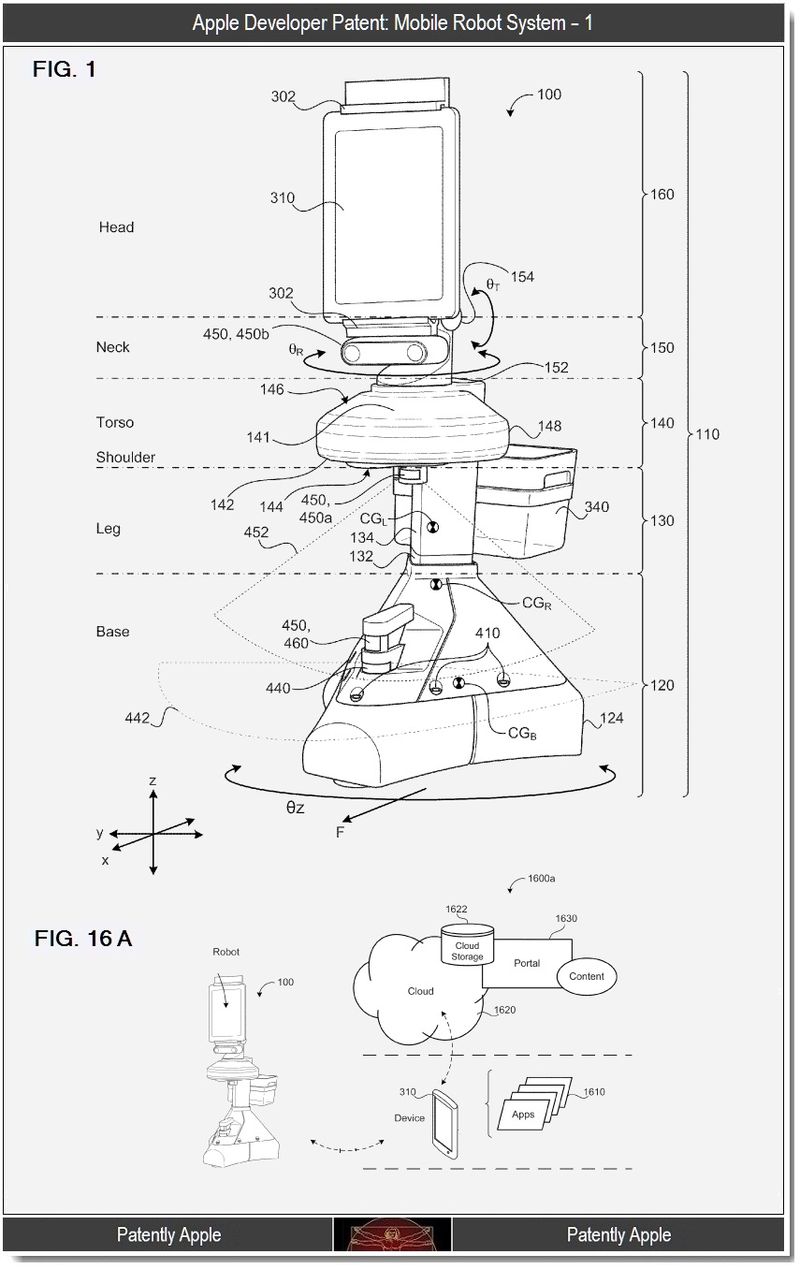
Patently Appletoday publishes some interesting new patents from developers including what appears to be an “iRobot” (oops, name taken) built around an iPad head.
iRobot’s introductory abstract describes the invention this way: “A robot system includes a mobile robot having a controller executing a control system for controlling operation of the robot, a cloud computing service in communication with the controller of the robot, and a remote computing device in communication with the cloud computing service. The remote computing device communicates with the robot through the cloud computing service.”
Subsequent drawings include navigation and obstacle avoidance (below) which seems to indicate that this is a “mobile” device in every sense of the word. Most of the perceived applications appear to be in the medical setting… Expand Expanding Close
Additional variations of the concept are available on Samsung’s YouTube channel. The version included right below challenges a notion that only iPhone has the best apps. A third clip is right after the break.
The first Ice Cream Sandwich handset, the Galaxy Nexus, hit the UK this week (US launch coming soon) and AnandTechhas benchmarked the ICS/Galaxy Nexus combo vs. the iPhone 4S/iOS 5 combo. The Galaxy Nexus processor/GPU isn’t groundbreaking by any means, but the new software inside is certainly packing a punch beating iOS in a few key areas. As seen in the graph to the right, the Galaxy Nexus has a slightly faster tested browser than the iPhone 4S — a crucial day-to-day necessity for users.
The Galaxy Nexus also comes up with the win in JavaScript loading, bringing faster load times than the Droid RAZR and iPhone 4S. Don’t think the Galaxy Nexus is going to come away with everything, however. Both Apple’s iPhone 4S and iPad 2 outperform the Galaxy Nexus in GPU loading — which is limited by its slower SGX 540 underneath. That’s an important consideration for gaming.
The Galaxy Nexus’s hardware has been dubbed very smooth compared to older versions of Android. Google is activating 550,000 Android devices a day and is still behind iOS in total Activations at 200 million total. Head after the break for more graphs.
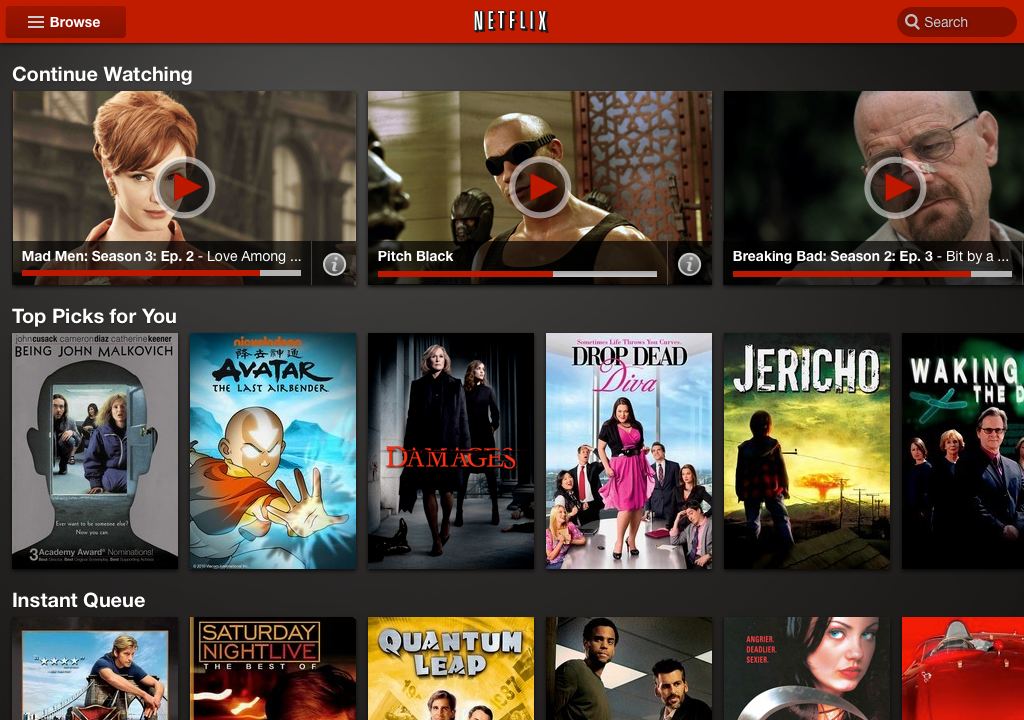
In addition to a revamped Android version, Netflix said today that a “new tablet experience should be available for members with iPads in a few weeks”. What’s the new tablet experience like? According to a press release and a blog post, Netflix aims to consolidate the app’s user interface across iOS and Android tablets with a “much more immersive” design that manages to cram up twice as many movies and television shows as before without looking cluttered. Neil Hunt, chief product officer at Netflix, says:
In the last 12 months we have seen a threefold increase in how long Netflix members are watching on their tablets. We’re happy to debut a new user experience coinciding with the release of the next generation of devices from industry leaders. The new Netflix interface offers a significant improvement in browsing and searching for TV shows and movies to instantly watch.
Each item in the new interface sports a larger artwork than before and you can swipe between the individual rows of titles. If this sounds familiar, you’re right – a similar experience is built into supported set-top boxes, gaming consoles and other Netflix-ready devices.
Interestingly, the new Netflix software is also available for the Kindle Fire and Nook Tablet. Netflix also offers a free trail, here.
The delayed iPhone launch gave Android vendors additional three months to gain market share whilst negatively affecting Apple, sending shares down ten percent over the past month. Worry not, though – strong iPhone 4S launch and price reductions for both the iPhone 4 and 3GS models are seen as catalyst enabling Apple to regain lost share from Android manufacturers during the current quarter. Also, remember Apple is still taking more than half of all smartphone profits.
The gist of today’s report from Gartner pegged Apple’s share of the global smartphone market at 15 percent on sales of 17.29 million units, a 21 percent annual increase. But the smartphone market grew at an even faster clip so Apple actually recorded a decline from the 16.6 percent in Q3 2010 on sales of 13.48 million units. Android, meanwhile, has gone from 25.3 percent in Q3 2010 to 52.5 percent in Q3 2011, more than doubling its market share. Together, iOS and Android accounted for more than two-thirds of all smartphones sold (talk about duopoly).
Apple is also under pressure as quarterly iPhone sales decreased compared to the 20.34 million iPhones shipped during the June quarter. Principal research analyst Roberta Cozza said some consumers “were waiting for a rumored new iPhone and associated price cuts on older iPhone models; this affected U.S. sales particularly”.
Gartner believes Apple will bounce back in the fourth quarter because of its strongest ever preorders for the iPhone 4S in the first weekend after its announcement. Markets such as Brazil, Mexico, Russia and China are becoming more important to Apple, representing 16 percent of overall sales and showing that the iPhone has a place in emerging markets.
iPhone 4S launches in India, the world’s second-largest market, on November 25. Pre-orders sold out in Hong Kong in 10 minutes and the online Apple Store is now offering unlocked iPhone 4S units. The company pledged to roll out the handset to a hundred carriers in 70 countries by the year’s end, the fastest iPhone roll out yet. Supply chain sources claimed Apple cut holiday quarter iPhone 4S orders, but analysts rushed to dispute that report. How does Apple fare in the whole handset market? Read on…
Nintendo president Satoru Iwata declared Apple and iOS as the “enemy of the future” back in 2010. Not only was he right, according to new estimates for the U.S. portable game software by revenue from Flurry Analytics, 2011 seen Nintendo’s grip on the market slide even further as iOS and Android games triple their marketshare from 20% in 2009 to 60% during 2011.
The graphic above shows U.S. revenue for Flurry’s portable gaming category- a category that now includes Nintendo DS, Sony PSP, iOS, and Android. As you can see, iOS and Android have together taken the lead from Nintendo with 58% of revenues in comparison to last year’s 34%. In comparison, Nintendo DS held 57% during 2010, while dropping to just 36% in 2011. Total US revenue jumped from $2.7 billion in 2009 to $3.3 billion in 2011.
When comparing combined game revenues of the two veterans– Sony and Nintendo– with the combined revenues of the two new guys– Apple and Google– 2011 will be the first year where the emerging platforms dominate with iOS and Android estimated to take in $1.9 billion in comparison to the DS and PSP’s $1.4 billion. That accounts for a $200 million drop for Sony and Nintendo and $1.1 billion increase for iOS and Android from 2010. Perhaps investors were right to urge Nintendo to begin developing iOS titles.
As for Nintendo, the company who captured approximately two-thirds of the market in 2009 has seen their “enemy of the future” demote them to just a third of the market. Sony clearly has some catching up to do, but is hard at work on highly anticipated new handheld devices for 2012. Expand Expanding Close
Apple issues its 10-K report with the SEC at the end of every fiscal year and this year’s (via MacRumors, TNW) is full of growth. Numbers grew across the board from the end of fiscal 2010 to 2011:
Full time employees went from 49,400 to 60,400. Retail was the bulk of that which went from 25.6K to 36K.
Retail Stores up 40: 317 to 357.
Ad spending up 35% from $691 million to $933 million.
R&D spending up 36% to $2.4B.
Leases 7 million square feet of building space 3 million of those are for retail.
According to research firm Strategy Analytics (via Bloomberg), Google’s Android-based tablets gained market share in the iPad dominated tablet market during the third quarter, specifically led by new models from Samsung (presumably referring to the same Galaxy Tab family that is currently the focus of patent related litigation between Apple and Samsung).
The report claims Android was up from just 2.3 percent from the same three month period last year, to a 27 percent share of worldwide sales during the third quarter in 2011. The iPad’s market share during the same period reportedly fell from 96 percent to 67 percent. The research firm notes that Samsung’s Galaxy tablets currently account for 9 percent of the total tablet market.
There is also reason to believe Android’s growth on tablets will continue to grow into 2012, as the introduction of Android 4.0 Ice Cream Sandwich (the first Android OS specifically designed for both phones and tablets) could help tablet adoption among Android smartphone users. Strategy Analytics believes that Amazon’s Kindle Fire will also drive Android tablet sales, estimating the company will sell more than 15 million units by 2013.
In contrast to this obvious good news for the Android tablet market, which the WSJ’s Walt Mossberg recently described as having “flopped” in an interview with Google mobile chief Andy Rubin, there are conflicting stats for Android tabs in the enterprise. Rubin’s answer? “There’s a little over 6 million Android tablets that we know about”, a figure which of course includes pre-Honeycomb devices but not the Nook and those that don’t use Google services. The recently released Good Technology Device Activations Report for Q3 2011 shows that when it comes to tablets in business, enterprise users are clearly choosing iPad over the alternatives, noting “iOS tablets represent over 96 percent of total tablet activations”. Their graphic (above) also speaks volumes. Expand Expanding Close
I have a feeling the next couple days are going to be busy as the Steve Jobs bio comes out in bits and pieces. Next up, according to the AP, which bought a copy Thursday (where can I get one?), Jobs had extremely harsh words for Eric Schmidt and Google after Android started looking more and more like iOS.
Isaacson wrote that Jobs was livid in January 2010 when HTC introduced an Android phone that boasted many of the touch and other popular features of the iPhone. Apple sued, and Jobs told Isaacson in an expletive-laced rant that Google’s actions amounted to “grand theft.”
“I will spend my last dying breath if I need to, and I will spend every penny of Apple’s $40 billion in the bank, to right this wrong,” Jobs said. “I’m going to destroy Android, because it’s a stolen product. I’m willing to go thermonuclear war on this.”
Jobs used an expletive to describe Android and Google Docs, Google’s Internet-based word processing program. In a subsequent meeting with Schmidt at a Palo Alto, Calif., cafe, Jobs told Schmidt that he wasn’t interested in settling the lawsuit, the book says.
“I don’t want your money. If you offer me $5 billion, I won’t want it. I’ve got plenty of money. I want you to stop using our ideas in Android, that’s all I want.” The meeting, Isaacson wrote, resolved nothing.
So it is fair to say Jobs is not a fan of Android. While I can see why he’s upset about Android, the jab at Docs doesn’t seem to be as obvious.
[youtube=http://www.youtube.com/watch?v=wPuYWwBDHHQ]
AT&T just issued a press release saying they activated one million iPhone 4S units, or one-quarter of the four million devices Apple sold during the launch weekend. It’s the most successful launch in AT&T’s history, the company wrote in the release:
AT&T today announced it activated more than 1 million iPhone 4S’ as of Tuesday, making it the most successful iPhone launch in the company’s history. AT&T was the first carrier in the world to launch iPhone in 2007 and is the only U.S. carrier to support iPhone 4S with 4G speeds. “It’s no surprise that customers are clamoring for iPhone 4S and they want it to run on a network that lets them download twice as fast as competitors’,” said Ralph de la Vega, President and CEO, AT&T Mobility & Consumer Markets. AT&T’s speed advantage, and the unique ability to talk and surf at the same time, has been roundly praised by industry pundits.
About those “4G speeds”…
AT&T is reportedly pushing Apple to put a “4G” cellular icon on iPhone 4S to represent its faster Internet connection, which theoretically hits 3G HSPA 14.4 Mbps speeds (lawmakers wouldn’t approve of that). The carrier also released a customer testimonial video, included above, with people explaining why they opted for an iPhone 4S on the AT&T network (hint: because it’s “super-fast”).
Taking into account September quarter earnings, iPhone 4S sales in just a few days since last Friday’s launch hit nearly one-third of the 2.7 million iPhones activated in the last quarter which was down from the 3.2 million iPhones from the year ago September 2010 quarter (which included the iPhone 4 launch).
Note that this is one million iPhone 4Ss only, excluding the newly price-reduced iPhone 4 and iPhone 3GS units.
AT&T just released its earnings and showed strong iPhone sales despite having a 16-month old device on hand with updates looming. The carrier reported activating 2.7 million iPhones in the quarter out of a total of 4.8 million total devices. Android device sales doubled year over year.
Non-iPhone Smartphone Sales Increase.AT&T continues to deliver robust smartphone sales. (Smartphones are voice and data devices with an advanced operating system to better manage data and Internet access.) In the third quarter, the company sold 4.8 million smartphones, representing nearly two-thirds of postpaid device sales. Sales of Android devices more than doubled year over year, and almost half of all smartphone sales were non-iPhone devices. During the quarter, 2.7 million iPhones were activated.
Our polls show that significantly more than half of all US iPhone users go with AT&T, due mostly to the higher data rates and ability to talk and use data at the same time.
The keynote went a little bad over in Hong Kong with both the Facial Recognition and the Quick Response features not working or crashing the device. Overall though, there are some interesting new features that certainly differentiate Android from iOS and Windows Phone 7.
As for the Samsung Galaxy Nexus Phone, it has a 5-megapixel camera which has to be a letdown when compared to 8 megapixel cameras that are standardizing on the high end across the industry. Its most impressive feature (unless you are trying to squeeze it into your pocket) has to be the 4.65-inch 720P display. Although Pentile, which means not every pixel gets RGB dots, it does get close to Apple’s 326 PPI Retina display with a 316 PPI density. Like the as yet unpopular Honeycomb tablets, it doesn’t have any front facing buttons but has screen buttons that shift around as well as all of those new Android 4.0 features.
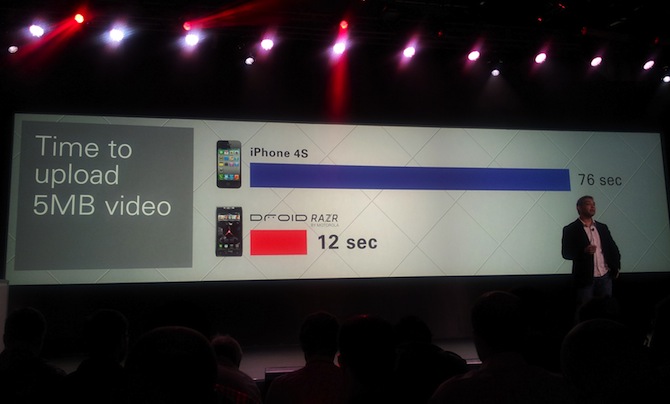
Motorola teaches us the difference between the 3.5-inch iPhone 4S and 4.3-inch RAZR.
Motorola has just unveiled the DROID RAZR and it looks like it beat the iPhone in the thinness department (except the upper part housing the camera that isn’t). Motorola’s device is, according to the blurb, “impossibly thin”, measuring just 7.1mm versus 9.3mm for the iPhone 4S. This 4G LTE handset driven by Android 2.3.5 features a 4.3-inch Super AMOLED display with an qHD resolution, a 1.2GHz dual-core processor with 1GB of RAM plus an eight-megapixel camera with 1080p video recording, 32 gigabytes of storage and Bluetooth 4.0. It weights a slight 121 grams compared to the iPhone 4S’s 140 grams.
But 7.1mm thin? Sure, except the part that is 10mm thin housing the camera.
They also have an optional lapdock that looks a lot like a MacBook Pro. The physical design boasts an interesting combination of Gorilla Glass and KEVLAR. Motorola is claiming up to 8.9 hours of video playback and 12.5 hours of talk time. The device is available for pre-order beginning October 27 on the Verizon Wireless network, starting at $299, with an expected launch sometime in November. Our own Seth Weintraub is live-blogging the announcement over at 9to5Google so feel free to hop over if you’re eager to find out more or check out the official RAZR mini-site. More juicy press shots, a nice teaser video and full press release after the break…
They also compare 4G LTE RAZR to 3G iPhone 4S. BTW Moto, thanks for free advertising!
The first SunSpider and BrowserMark benchmarks 9to5Mactold you about yesterday confirmed the iPhone 4S as being “twice as fast”, per Apple’s tagline. Today, AnandTechpublished a more thorough analysis based on Javascript, CPU and GPU benchmarks of Apple’s latest handset. Thanks to the dual-core A5 chip first outed with iPad 2 this Spring, Javascript performance on iPhone 4S “finally catches up to Tegra 2 based Honeycomb devices, while general CPU performance is significantly higher than the iPhone 4” – about 68 percent, to be precise.
More importantly, Geekbench results (seen below) tell us that iPad 2 is clocked around “25 percent higher than the iPhone 4S”. Overall, the Apple-designed dual-core A5 chip inside iPhone 4S is estimated to run at 800MHz versus iPad 2’s 1GHz A5 processor. This isn’t entirely unexpected due to the battery concerns and the handset’s much smaller 5.25 Whr battery. Furthermore, Apple says iPhone 4S has “up to seven times faster graphics” versus the advertised “nine times faster graphics” on the iPad 2 – another proof that the two device’s graphics processing units are not clocked equally.
As we predicted, Imagination Technologies’ PowerVR SGX543 graphics units ticking inside the iPhone 4S is also significantly speedier compared to the ARM-based Mali-400 GPU found in the Samsung-designed 1.2GHz Exynos 4210 processor (they recently announced the improved 4212 chip) used in the Galaxy S II smartphone. By all accounts, the iPhone 4S has the fastest graphics in a smartphone yet. Anand Lal Shimpi and Brian Klug explain: