Apple

See All Stories

Apple News and Brief History

Before you can properly understand Apple News, it’s important to know its history. Apple was founded by Steve Jobs and Steve Wozniak in 1976. In 1977, Apple’s sales were growing with the success of its early computers. Within a few years, Jobs and Wozniak hired designers and a production line crew. Apple went public in 1980 and was an instant success. Over the next few years, Apple shipped new computers featuring new graphical user interfaces, such as the original Macintosh in 1984. As the market for personal computers expanded through the 1990s, Apple lost market share to the cheaper Microsoft Windows on PC clones. Eventually, Wozniak and Jobs both left Apple. Jobs would go on to found NeXT and would return to Apple when NeXT was acquired in the late 90s. Apple then began a journey to the great second act in the history of the business world.

Since the release of the iPod in 2001, Apple has become a major player once again in the technology industry. After releasing the iPhone in 2007, the iPad in 2010, and the Apple Watch in 2015, Apple is now one of the largest companies in the world. Apple’s worldwide annual revenue totaled $274.5 billion for its 2020 fiscal year.

Today, Apple operates retail stores all across the world, has a growing services division, and an ever-expanding hardware lineup. The technology industry follows Apple news to see where the company is headed in the future.

Keep reading for the latest Apple news

ABC teases the upcoming ‘iFactory: Inside Apple’ documentary [Video]

Site default logo image

[vodpod id=Video.16115602&w=650&h=420&fv=allowFullScreen%3Dtrue%26bgcolor%3D%23000000%26autoPlay%3Dfalse%26screensLayer.startScreenOverId%3DstartScreen%26screensLayer.startScreenId%3DstartScreen%26]
Note: A YouTube version should be up soon

As promised, ABC aired its documentary about Foxconn factories producing Apple products. In an unprecedented move, Apple decided to grant the network’s “Nightline” program full access to its Chinese supply chain, so correspondent Bill Weir traveled to Shenzhen, China to look at “iFactories,” as ABC dubbed them.

Full disclosure: Disney Corporation owns the ABC News network. The fact that the Steve Jobs Trust is Disney’s largest individual shareholder, coupled with Disney CEO Bob Iger now having a seat on Apple’s board of directors, certainly helped win the official approval from Apple. It also raises questions on a possible conflict of interest with this report.

The full “iFactory: Inside Apple” report is scheduled to air on a special edition of “Nightline” due tomorrow, Feb. 21, at 11:35pm ET/PT. A preview will air on “Good Morning America” and “World News with Diane Sawyer.” A long article that accompanies a video teaser, included above for your convenience, offers a grim description of working conditions inside Foxconn plants:


Expand
Expanding
Close

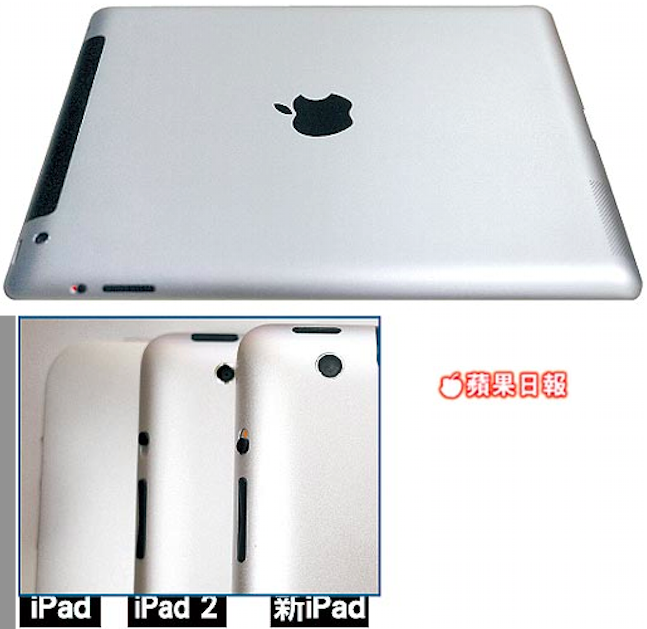
iPad 3 w/8 Megapixel camera pictured by Apple Daily publication

Site default logo image

Apple Daily today has images of what it claimed is the next iPad compared to an iPad 1 and an iPad 2. You will notice increased tapering and a bigger camera lens. The publication said the camera is a whopping 8-megapixels, which would likely mean it is the same Sony camera found in the iPhone 4S that CEO Howard Stinger first leaked in April of last year. Apple will likely bring some of its optics over, as well.

We first heard reports of 5- to 8-megapixel cameras in the next iPad at the end of last year in a wide-ranging set of reports.

Apple.pro grabbed some images of the print version that seem to show the tapering better.

The iPad 3 picture seems to be coming together but that does not mean there are not going to be some surprises.

Apple Daily also noted new cabling (pictured below):
Expand
Expanding
Close

9to5Toys: 20% off iTunes gift cards, Minis starting at $551, iMacs at $1086

Site default logo image

From 9to5Toys:


Staples has 2x$25 iTunes gift cards for $40 with free shipping.  At 20% off, that matches the lowest price we’ve seen.  The promo lasts until Feb. 25th.  iTunes gift cards can be used on Music, Videos, iBooks, iOS Apps  and Mac Apps (including Mountain Lion).

Also, remember we’re partnering with MacMall until the end of the month to bring you the lowest prices on new Mac desktops including Minis starting at $551.88 and iMacs starting at $1086.82

All discounts, including higher end models listed below:


Expand
Expanding
Close

Analyst arrested for leaking iPhone sales numbers, charged with insider trading

Site default logo image

[youtube=http://www.youtube.com/watch?v=Vb6zrVLaL6c]

Analyst John Kinnucan is charged with two counts of securities fraud, two counts of conspiracy, and insider trading for leaking sales numbers from Apple, reported Reuters. The lawsuits against the analyst were filed in a U.S. District Court in Manhattan, and he was arrested on Thursday.

Kinnucan received tips from Apple’s suppliers SanDisk and Flextronics so he could leak sales numbers and forecasts to hedge funds. One SanDisk executive, Don Barnetson, is also in court on counts for insider trading. Kinnucan leaked the secret information about the iPhone’s sales between 2008 and 2010, and he would get the information by bribing suppliers. He is rumored to have earned $1.58 million for leaking Apple’s trade secrets.

Between 2008 and 2010, investigators said, Kinnucan paid insiders with cash, trips and other benefits to get secret information, including sales trends for Apple Inc’s iPhone. Kinnucan then funneled the information to hedge fund traders in California and New York in exchange for hundreds of thousands of dollars, investigators said.

Kinnucan’s arrest is part of a bigger crack down on insider trading within hedge funds. Over 60 people were already arrested during the operation, dubbed “Operation Perfect Hedge,” including a Flextronics executive for leaking iPhone sales numbers.


Expand
Expanding
Close

iPhone 4 ‘Antenna-gate’ settlement reached, puts problem to bed for $15/owner

Site default logo image

[youtube=http://www.youtube.com/watch?feature=player_embedded&v=tNmXrVNeGzs&start=75]

CNET reported that Apple settled 18 suits bundled as a Class-action lawsuit over the “Antennagate” “scandal.”  Each iPhone 4 owner (it is not clear if Verizon iPhone 4 users who had different radios/Antenna are exempt) is entitled to a $15 cash settlement or a bumper. Apple began offering bumpers to users shortly after the release and the subsequent press conference to address the issue (as well as returns, no restocking fee or questions asked).

The settlement found:

Apple was “misrepresenting and concealing material information in the marketing, advertising, sale, and servicing of its iPhone 4–particularly as it relates to the quality of the mobile phone antenna and reception and related software.”

The settlement has its own Web site, www.iPhone4Settlement.com, which will be up in the coming weeks (the site doesn’t go anywhere right now). There, customers will be able to get information about the settlement and how to make a claim. As part of the arrangement, e-mails will also be sent alerting original buyers to the settlement before April 30, 2012. The claims period is then open for 120 days.

“We believe that the Apple iPhone 4 settlement is fair, adequate, and reasonable,” said co-lead counsel Ira Rothken, who represents the class, to CNET. “We believe that it allows members of the class to choose, and they can get $15 of cash or a bumper, so we believe that type of choice is proportional to the circumstances.”

Consumer Reports, who could not recommend the iPhone 4 based on the problem, demonstrated above, said the iPhone 4S was free of this issue.

Apple still sells the iPhone 4 with what we believe is the same design as the one used above, so it is not certain how this settlement will affect those sales.

Update: Statement from Apple via the Loop:

“This settlement relates to a small number of customers who indicated that they experienced antenna or reception issues with their iPhone 4 and didn’t want to take advantage of a free case from Apple while it was being offered in 2010,”


Expand
Expanding
Close

Actual iPad 3 production display placed under microscope, Retina Display confirmed

Site default logo image

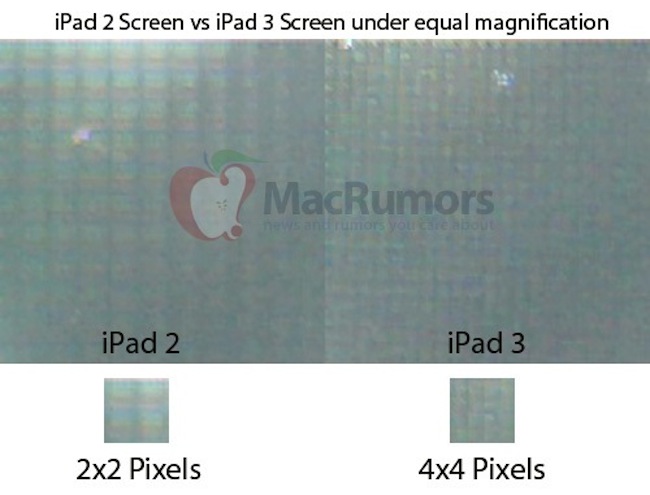
Macrumors claimed to have obtained one of the screens floating around on the Internet from iPad 3 production. Putting it under a microscope, the publication indeed discovered it has 4 times the pixels as an iPad 2 or double the horizontal and double the vertical, which yields 2,048-by-1,536 pixels.

Physically, the purported iPad 3 display is the same size as the current iPad 1 and iPad 2 display at 9.7″ in diagonal, and looks quite similar to the naked eye.

However, when comparing the iPad 3 display to one from an iPad 2 under a microscope, the difference in resolutions becomes readily apparent, with the iPad 3 display’s pixels appearing to be one-quarter the size of those on the iPad 2.

We are just a few weeks away from the anticipated March 7 announcement. While the Retina display was expected for some time, there might still be some surprises.


Expand
Expanding
Close

Apple starts the countdown to 25 billionth app

Site default logo image

Apple started a countdown to its 25 billionth app download on the App Store. A promotional page at the company’s website reads:

As of today, nearly 25 billion apps have been downloaded worldwide. Which is almost as amazing as the apps themselves. So we want to say thanks. Download the 25 billionth app, and you could win a US$10,000 App Store Gift Card. Just visit the App Store and download your best app yet.

A special section on the App Store, and the official rules, state that a person lucky enough to download the 25 billionth app will take home a $10,000 App Store Gift Card. You can also fill out an entry form here to take part in the contest.

Hat tip to @Crossingman.


Expand
Expanding
Close

The price of the iPad name in China has gone up to $2B

Site default logo image

Chinese vendor Proview apparently owns rights to the iPad trademark in China, and it has two billion reasons not to honor its prior agreement with Apple as the Wall Street Journal cited a representative of Proview creditors who suggested compensation from Apple “could range as high as $2 billion,” which is up from the previous sum of $1.5 billion. Cash-strapped Proview recently filed for bankruptcy, so courts could interpret this as banks’ last-ditch effort to recoup their loans to Proview.

A Hong Kong court ruled last year that Apple’s agreement with Proview was valid, but that case is still pending on the Chinese mainland. Court documents uncovered by Dow Jones suggest on Dec. 23, 2009, Apple of California bought the rights to the iPad trademark from Proview in South Korea, Thailand, Singapore, and China for a paltry sum of about $55,494 in today’s dollars. Proview waived its right to sue for past infringements and passing off.

Proview said it still owns the trademark and maintains the deal did n0t include the China market. Another court in Mainland China sided with Proview, thus paving the way for a potential injunction on both the import and export of iPads. The world’s largest contract manufacturer, Foxconn, is exclusively manufacturing Apple’s tablet in China.

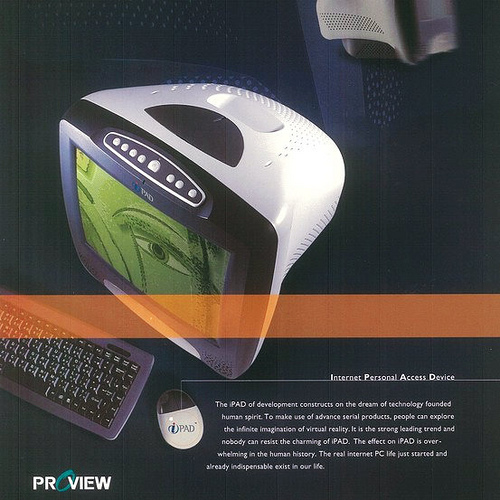
Proview chairperson Yang Rongshan said today: “If we are not compensated properly, then Apple doesn’t use the iPad trademark in mainland China.” Shenzhen-based Proview, once a well-known monitor vendor, claimed it started developing a product called the iPAD in 2000. iPAD stands for “Internet Personal Access Device.” So, what does Proview’s iPAD look like? Images are right after the break.


Expand
Expanding
Close

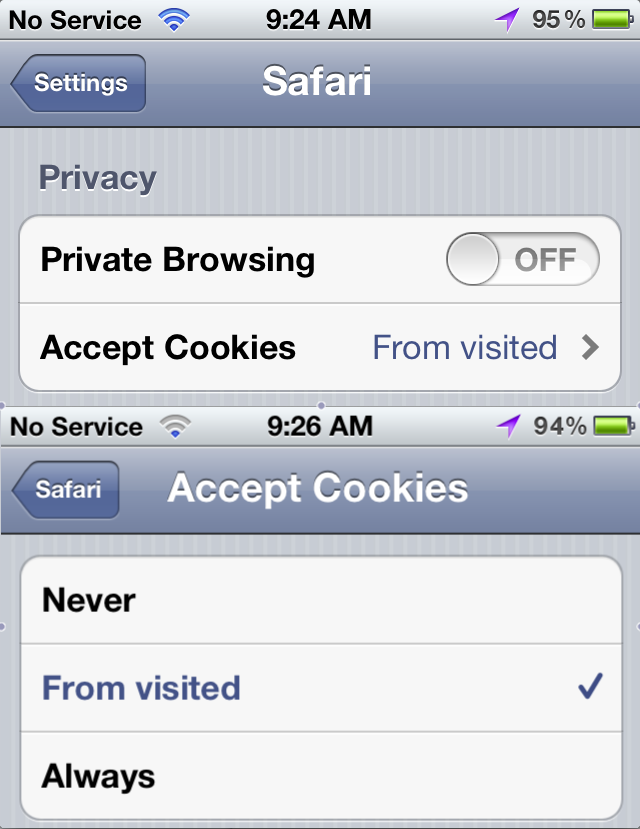
Google and other ad companies have been tricking iOS Safari into accepting ad cookies, regardless of security settings

Site default logo image

Internet giant Google found itself in a middle of a potential public relations nightmare following a Wall Street Journal article this morning. Tentatively titled “Google’s iPhone Tracking,” the article asserts that “Google Inc. and other advertising companies have been bypassing the privacy settings of millions of people using Apple Inc.’s Web browser on their iPhones and computers” to follow iPhone users even after they explicitly set Safari’s privacy controls to disable such tracking. According to authors Julia Angwin and Jennifer Valentino-Devries, Google used “special computer code that tricks Apple’s Safari Web-browsing software into letting them monitor many users.” Google apparently disabled the problematic code after the newspaper contacted the Mountain View, Calif.-based Company.

Stanford researcher Jonathan Mayer discovered that although mobile Safari’s default setting blocks cookies from third parties and advertisers, Google and advertising companies Media Innovation Group, Vibrant Media, and Gannett PointRoll fooled mobile Safari into thinking “a person was submitting an invisible form to Google,” letting them in turn install a tracking cookie on users’ iPhones and PCs without consent.

Once a cookie installed, a Safari glitch allowed subsequent cookies to attach. Both Google and Apple issued statements following this morning’s report…


Expand
Expanding
Close

Google and Apple team up to save diabetic

Site default logo image

The iPhone is great in many ways, but perhaps one of the best cases is in a medical emergency. KVAL reported a 57-year-old Oregon man was suffering from a diabetic reaction while driving down a local highway. (Video link here.)

When two medical responders came to the scene and tried to assist the man, they ran into quite a language barrier. The man only spoke Chinese, but luckily, one of the responders knew to reach for his iPhone. He fired up Google Translate and was able to speak Chinese with the man to figure out his condition and give him the help he needed.

Cross posted on 9to5Google.com


Expand
Expanding
Close

Apple seeds devs with Safari 5.2 for Lion, Xcode 4.4 with new LLVM compiler

Site default logo image

As part of today’s Mountain Lion Preview roll out, Apple seeded its registered developers with new versions of the Xcode development environment and the Safari browser. Safari 5.2 for Lion, now available for download through the Dev Center, welcomes new features that cannot be found in the most recent Safari 5.1.3 version for end-users or the recently seeded Safari 5.1.4 for developers.

Apple took a page from Google’s book by integrating the search bar into the address bar (finally, some would say) in Safari 5.2. Other enhancements include visual tweaks that highlight the domain section of the URL in the address bar and a rehashed Reader icon. Features from both Safari 5.1.4 and 5.2 are likely to be included in this summer’s release of Mountain Lion.

A developer preview version of Xcode 4.4 is required to code and test applications for Mountain Lion that will become available to the public this summer. Among the new features:


Expand
Expanding
Close

Did your Mac make the Mountain Lion obsolescence list?

Site default logo image

If you plan to install Mountain Lion on an older Mac, you might be out of luck. The new operating system release raises the ladder in terms of graphics performance required for its new features like AirPlay Mirroring. As a result, a couple years old Mac might not cut it anymore. According to French-language website MacGeneration, any Mac sporting Intel’s sluggish GMA x3100 or 950 chip will not be able to run Mountain Lion. While we have come a long way since the GMA graphics, you probably have somewhere under your table or in the basement a legacy Mac that does not have enough oomph for Mountain Lion. Anything older than the mid-2007 iMacs, early-2008 Mac Pros, early-2009 Mac minis and Xserves are left behind. The same goes for MacBooks based on any Intel Core 2 Duo processor and the original 2008 MacBook Air. Sorry folks, that is the price of progression. In addition, the following platform changes may interest you…


Expand
Expanding
Close

AirPlay Mirroring in OS X Mountain Lion: From the board room to the living room (and beyond)

Site default logo image

Apple released OS X Mountain Lion preview today ahead of the planned summer release and we briefly touched upon some of the more important features like the all-new Messages app, Gatekeeper anti-malware capabilities, enhanced local services for the Chinese, system-wide Twitter integration and brand new iOS-like Notification Center. Tucked away as a side-note in Apple’s press release is AirPlay Mirroring, another welcome addition to Mountain Lion’s arsenal of over a hundred new features (so claims Apple).

Yes, there are a few apps for that, though, I have yet to find one that works as seamlessly and effortlessly as AirPlay implementation on iOS devices. Eagle-eyed readers could point out that AirPlay support was long-planned for Lion until it was abruptly pulled last-minute without an explanation. Sure enough, it took longer than expected, so we are excited with full AirPlay Mirroring now a possibility on Macs running Mountain Lion.

Just as you would expect, AirPlay Mirroring in Mountain Lion lets you tunnel whatever is on your Mac wirelessly to your television through the Apple TV set-top box. Think web pages in Safari, kitten clips on YouTube, movies from iMovies, Keynote presentations or any other content displayed on your Mac, including your desktop. Yes, just like on the iPad.

Better yet, using AirPlay Mirroring on 2011 Mac notebooks does not need a local wireless network, because the machine can create an ad hoc wireless network to pair with the Apple TV. This is gold for road warriors and educators who only need a MacBook and an Apple TV to present their portfolio or teaching material on the big screen.

There are some caveats, though.


Expand
Expanding
Close

New book ‘Insanely Simple’ focuses on Apple’s simplicity, releases in April

Site default logo image

There are people—yours truly included—who felt genuinely dumbfounded having read both the authorized “Steve Jobs” biography by Walter Isaacson and Adam Lashinsky’s “Inside Apple.” Do not get me wrong, Isaacson and Lashinsky are among the best contemporary wordsmiths, and their work enlightened us with some previously unknown details about the inner-workings of Apple and the man who cofounded it. Nonetheless, the authors dedicated way too many pages to the stuff we already knew, and their writing style may not appeal to the Technorati accustomed to fast-paced news reporting and sensationalist headlines. Hoping to fill this gap and tell the untold story about Apple of California from a different angle, writer Ken Segall committed to a project tentatively named “Insanely Simple – The Obsession That Drives Apple’s Success” (via Daring Fireball).

Few would dare argue that Apple’s agonizing over the tiniest and seemingly unimportant details is what makes the products so pleasurable to use. Segall should know what makes Apple tick: He coined the iMac moniker during his 12-year tenure at TBWA\Chiat\Day, Apple’s and NeXT’s advertising agency, and he now runs an Apple parody website you are probably familiar with called Scoopertino. The author explained the reasoning behind his ambitious undertaking on his personal blog:


Expand
Expanding
Close

Apple hooks up exploding Mac userbase in China with local services in OS X Mountain Lion

Site default logo image

Mountain Lion will cater to Chinese users more than any other OS X version. CEO Tim Cook once more underscored the importance of China by highlighting Mac sales in today’s interview with the Wall Street Journal. Sales doubled in the 1.33 billion-people market during 2011 to the tune of $13 billion in revenue.

“They know about Apple and what Apple stands for. Then they search out and look for the Mac”, he told the paper. Apple’s promotional material said Mountain Lion makes it easy to “set up Mail, Contacts, Calendar, video sharing, web searching, and blogging on your Mac using many popular services in China.”

For starters, Chinese input method in Mountain Lion has “significant enhancements.” Secondly, Apple worked hard to make sure customers in China get a localized experience by providing the ability to select Baidu search in Safari. Baidu is the dominant search engine in China, ranked No. 6 in Alexa’s global rankings and No. 1 in China with an estimated 56.6-percent share of the country’s 4.02 billion search queries as of June 2011…


Expand
Expanding
Close

Poll: How long until Apple buys Twitter?

Site default logo image

As of today, Twitter is baked into both iOS and MacOS X on a relatively low-level. Apple’s own social network Ping has yet to gather any steam in the marketplace. Facebook and Google are both growing their social networks like crazy while they are increasing in value.

Apple has $100 billion in its pocket, and CEO Tim Cook said at a recent Goldman Sachs event that he is looking for innovative ways to spend the money.

Do you think Apple will buy Twitter? If so, when?


Expand
Expanding
Close

Here, Apple’s demo video for Mountain Lion

Site default logo image

[youtube=http://www.youtube.com/watch?v=DoR08T26IPU]

If you are still feeling overwhelmed with today’s news of OS X Mountain Lion Preview and the first public beta of Messages for the Mac, do not be: Apple just published a nice video demonstration of key new features on the new OS X Mountain Lion Sneak Peek page. It will take some time before the clip goes live on Apple’s official YouTube channel. Until then, enjoy the above Newsit Tech’s conversion of the Mountain Lion showcase that is likely to be pulled soon.


Expand
Expanding
Close

Apple posts Messages Beta for the Mac on the heels of Mountain Lion announcement

Site default logo image

Just as we are chewing on the news that Apple is working on Mountain Lion, a major new Mac OS X release, the company published Messages Beta for the Mac, an early taste of what is coming in Mountain Lion. Certain code leaks indicated such an application could be in the works and now it is coming. The Messages application lets you send unlimited iMessages to any Mac, iPad, iPhone, or iPod touch user.

You can start an iMessage conversation on your Mac and continue it on your iOS device, and even start a FaceTime video call and bring the conversation. Messages also supports sending photos, videos, attachments, contacts, locations and more and it comes with built-in support for iMessage, AIM, Yahoo!, Google Talk and Jabber accounts. Apple noted that when you install Messages, it replaces iChat—even though iChat services will continue to work.

You can download your copy of iMessges Beta for the Mac here.


Expand
Expanding
Close

Apple unveils Mountain Lion Preview: iOS-ification of OS X continues with Messages, AirPlay Mirroring, Notification Center, Game Center, Twitter and more

Site default logo image

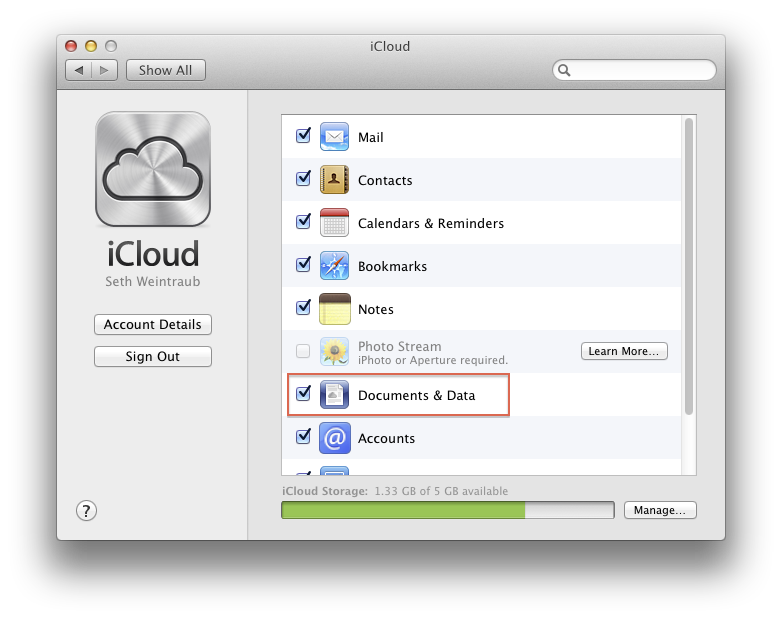
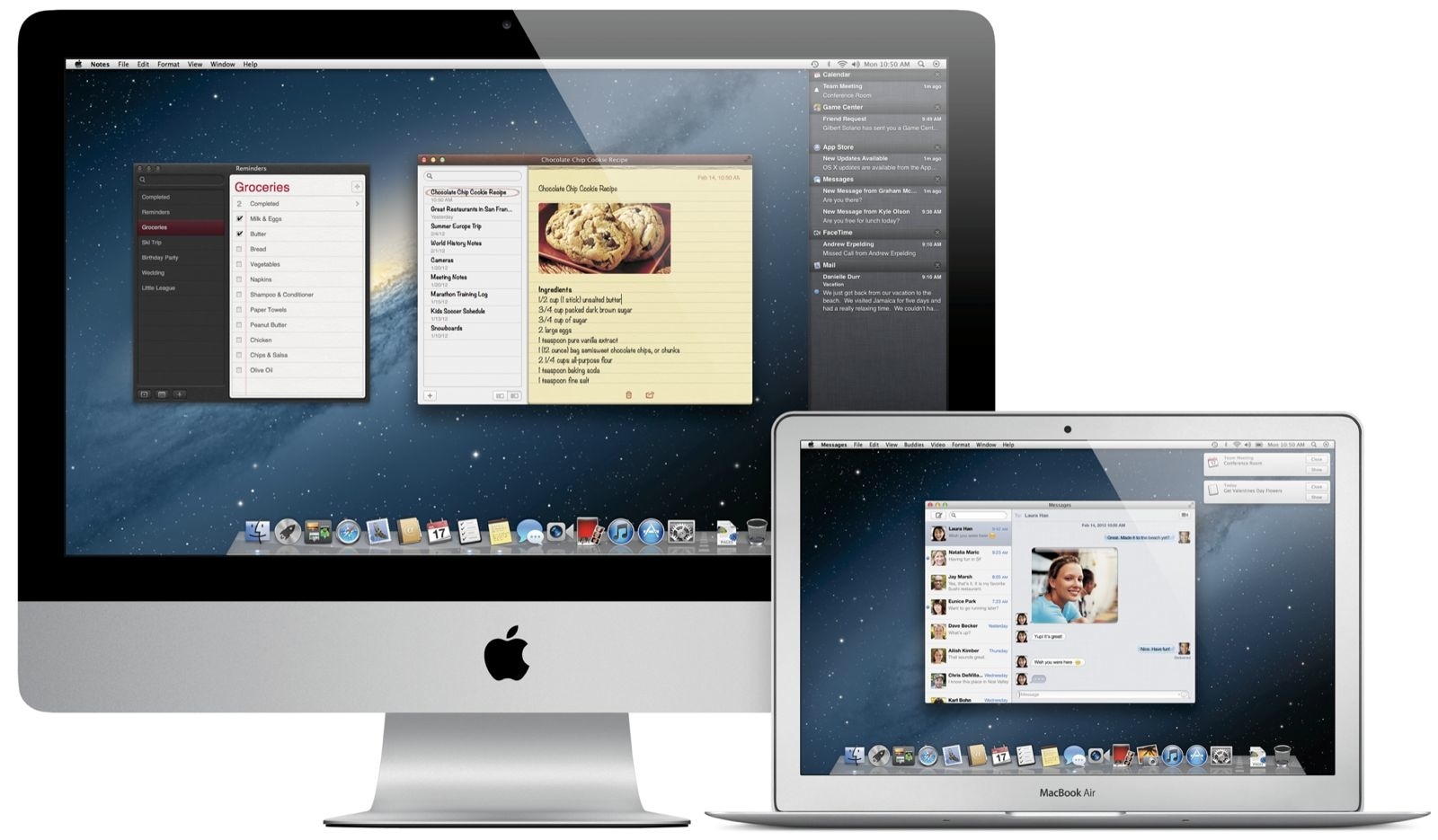
It has been only seven months since Apple released Mac OS X 10.6.7 Lion and today the company announced Mountain Lion—the next major update to its desktop operating system. As 9to5Mac first learned in October, Mountain Lion brings even more popular iOS features to the Mac platform. The notion is shared by those Apple invited to a private briefing a few day ago: Mountain Lion is all about putting even more of iOS into the bowels of OS X. Meanwhile, iOS-ification of OS X continues with Twitter integration in Mountain Lion and new iOS-esque apps, such as Messages, Notification Center, AirPlay Mirroring, Notes, Reminder, Game Center, and deep iCloud integration.

With over a hundred million iCloud accounts now in use, Mountain Lion’s setup assistant will now ask you to set up an iCloud account for the Documents in the Cloud and Find My Mac features, as well as to sync contacts, email and chat messages and calendar entries. You can also access your iCloud storage in Finder and drag and drop documents for manual syncing between iOS apps that support Documents in the Cloud and their desktop counterparts.

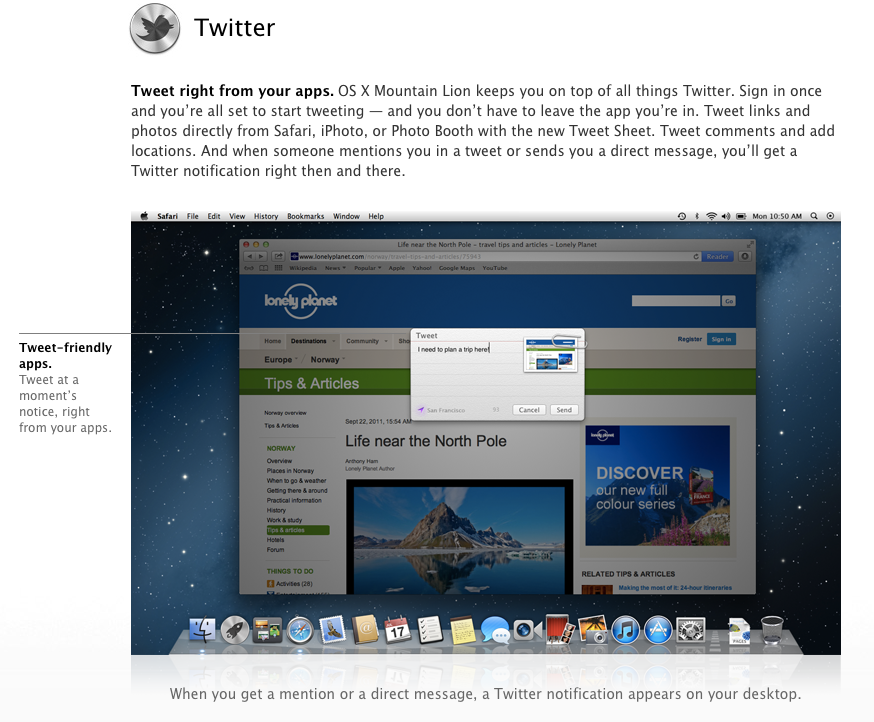
AirPlay Mirroring is another welcome addition for those wishing to securely beam a 720p video stream of what is on your Mac to a HDTV through the Apple TV. Share Sheets, a new system-wide feature, is accessible from Apple’s and third-party apps for sharing links, photos, and videos. Like in iOS, Twitter integration means you give your Twitter credentials once and tweet directly from Safari, Quick Look, Photo Booth, Preview and supported third-party apps.

Mountain Lion Beta is available to Mac Developer Program members starting today whilst end-users can upgrade to Mountain Lion from the Mac App Store in late summer 2012. The company also pledged to update OS X once a year from now on. For more information, check out Apple’s new OS X Mountain Lion Sneak Peek page.

The full release, more features and two press shots are after the break.


Expand
Expanding
Close

Apple finally talks, says Proview refuses to honor agreement to transfer iPad trademark

Site default logo image

Numerous online stores in China took the iPad off their shelves after Proview said Apple was breaking its trademark on the term “iPad.” The fight continues in court, but Apple released a statement today to China Daily about Proview’s allegations on Apple allegedly breaking the trademark.

“We bought Proview’s worldwide rights to the iPad trademark in 10 different countries several years ago. Proview refuses to honor their agreement with Apple, and a Hong Kong court has sided with Apple in this matter,” according to the statement, which also said the case is still pending on the Chinese mainland.”

Apple said it purchased Proview’s iPad trademark over several years ago in 10 different countries. Proview is refusing to transfer the trademark, but Hong Kong courts have already sided with Apple, according to the statement.

Many accuse the Mainland Chinese government of favoring local companies in these types of matters, so it may not be easy to clear this hurdle for Apple. Chinese customs already said the iPad is too powerful to be banned; although, Proview tried to block iPads from coming in or going out of China earlier this week.

Proview countered the Hong Kong situation:


Expand
Expanding
Close

Apple’s iOS problem: Contacts uploading is just the tip of the iceberg. Apps can upload all your photos, calendars or record conversations

Site default logo image

Apple responded today to the contacts-sharing issue with a statement indicating it plans to put some form of a setting on contact data that would allow users to control who views the data, similar to the way Apple locks down location data.

“Apps that collect or transmit a user’s contact data without their prior permission are in violation of our guidelines. We’re working to make this even better for our customers, and as we have done with location services, any app wishing to access contact data will require explicit user approval in a future software release.”

Congress became involved and probably motivated the move, but the legislative body is not going to like what it hears.

The problem is that iOS apps not only have access to a user’s contacts database (including addresses and notes), but apps also have full and unencumbered access to everything in the iOS app sandbox, such as pictures, music, movies, calendars, and a host of other data. Any of this content is literally open for developers to freely transmit to their own servers while apps are open.

(note that pictures with geotags will pop up a Location dialog which can be averted in code with some well known tricks)

Moreover, approved apps also have access to the iPhone’s camera and microphone, so apps can also take pictures and make recordings without permission (although, this would be easy to detect by the user with the light from the front camera or red bar during audio). Photos, videos, and audio are transmittable securely or insecurely up to servers that you and Apple do not know about.

To developers, this is no big secret. It is not trivial, but putting that kind of functionality into an app is straightforward and only uses Apple’s publicly available and blessed developer APIs (which means this stuff will not likely be detected by Apple’s App Store approval process).

Obviously, shady developers and even government entities are probably already using such apps to gather information. Therefore, these are some scenarios:


Expand
Expanding
Close

Apple responds to iOS contact data sharing: ‘It’s a violation’

Site default logo image

Apple officially responded to the mounting privacy concerns related to how third-party iOS apps access address book data on users’ devices. Tom Neumayr, a spokesperson for the Cupertino, Calif.-headquartered gadget giant told AllThingsD’s John Paczkowski:

Apps that collect or transmit a user’s contact data without their prior permission are in violation of our guidelines. We’re working to make this even better for our customers, and as we have done with location services, any app wishing to access contact data will require explicit user approval in a future software release.

So, there you have it. A forthcoming iOS software update will make sure no app can get access to iPhone contacts without your explicit approval. We are inclined to think Apple should not limit user approvals to just location data and contacts. While we are at it: Why not implement toggles for accessing the camera roll, photo library, and even your music library for that matter? This stuff is just waiting to be uploaded by rogue apps. By the time Apple discovers those violations and pulls misbehaving software from the App Store, it will already be too late and the damage will have been done. Any thoughts?


Expand
Expanding
Close

Lawmakers grill Apple’s Cook on iOS developer data access following Path address book privacy debacle

Site default logo image

The Path debacle just took another turn for the worse with House Energy & Commerce Committee Ranking Member Henry Waxman and Commerce Manufacturing and Trade Subcommittee Chair G.K. Butterfield issuing a letter to Apple CEO Tim Cook (via The Next Web). In it, the legislators seek to find out whether Apple is doing enough to protect personal data on users’ iPhones, including their contacts. Specifically, the letter asserts there have been claims that the practice of collecting address book data without users’ consent is “common and accepted among iOS app developers.”

As a consequence, the legislators argue, “This raises questions of whether Apple’s iOS app developer policies and practices adequately protect consumer privacy.” They want Apple to respond to questions by Feb. 29. Apple is asked to detail its App Store review practices in respect to protecting users’ information. Whichever way you look at it, it is hard to escape the notion that everything on your iPhone is waiting to be uploaded.

As you know, with the exception of location services, iOS does not prompt users when apps tap APIs to access personal data stored in an iPhone’s address book, camera roll, music library and other places. This also includes little things such as geolocation information embedded in image files taken on the device. This is bothering the legislators and now they want to know why Apple has not implemented a simple toggle that lets users control access to their data other than location.

You have built into your devices the ability to turn off in one place the transmission of location information entirely or on an app-by-app basis. Please explain why you have not done the same for address book information.

We included the letter in its entirety below the fold.


Expand
Expanding
Close