Apple

See All Stories

Apple News and Brief History

Before you can properly understand Apple News, it’s important to know its history. Apple was founded by Steve Jobs and Steve Wozniak in 1976. In 1977, Apple’s sales were growing with the success of its early computers. Within a few years, Jobs and Wozniak hired designers and a production line crew. Apple went public in 1980 and was an instant success. Over the next few years, Apple shipped new computers featuring new graphical user interfaces, such as the original Macintosh in 1984. As the market for personal computers expanded through the 1990s, Apple lost market share to the cheaper Microsoft Windows on PC clones. Eventually, Wozniak and Jobs both left Apple. Jobs would go on to found NeXT and would return to Apple when NeXT was acquired in the late 90s. Apple then began a journey to the great second act in the history of the business world.

Since the release of the iPod in 2001, Apple has become a major player once again in the technology industry. After releasing the iPhone in 2007, the iPad in 2010, and the Apple Watch in 2015, Apple is now one of the largest companies in the world. Apple’s worldwide annual revenue totaled $274.5 billion for its 2020 fiscal year.

Today, Apple operates retail stores all across the world, has a growing services division, and an ever-expanding hardware lineup. The technology industry follows Apple news to see where the company is headed in the future.

Keep reading for the latest Apple news

Apple pressures EU regulators to set FRAND licensing rules

Site default logo image

After taking a beating by Motorola over FRAND patents this month, Apple issued a letter to the European Telecommunications Standards Institute asking the body to establish consistent royalty fees for patents deemed essential to wireless standards, reported the Wall Street Journal. The body has a role in setting the standards related to GSM, 3G UMTS, and 4G LTE radio technologies.

Apple is involved in nasty patent disputes with Motorola, HTC and Samsung in courtrooms around the world, and it previously asserted in court documents that handset maker Motorola refused to license its essential patents on “Fair, Reasonable, and Nondiscriminatory” (FRAND) nature at rates offered to Nokia, Samsung and other vendors. According to the Journal:

Many mobile technology companies, such as Motorola Mobility Holdings Inc. and Samsung Electronics Co. Ltd., hold patents that became part of industry-wide standards. Standards bodies often require the patent holders to offer to license their patents to any company on a basis known as Frand, or fair, reasonable and nondiscriminatory. Questions about such commitments have arisen amid a flurry of patent suits between rivals in the mobile-device market.

Apple’s lawyer wrote in the letter: “It is apparent that our industry suffers from a lack of consistent adherence to FRAND principles in the cellular standards arena.” A copy of Apple’s letter was posted online by the FOSS Patents blog. Motorola recently likened its enforcement of FRAND patents to bank robbery: “It only takes one bullet to kill.” Samsung and Motorola reportedly demanded that Apple pay a 2.4 percent and 2.25 percent royalty, respectively, illustrating what the iPhone maker called are unreasonable FRAND licensing terms.


Expand
Expanding
Close

Apple is the only PC brand making progress in Europe (and that’s without iPad)

Site default logo image

Research firm Gartner just released its estimates for PC shipments in the Western Europe region during the holiday quarter, and only Apple and Asus made any meaningful progress, with Apple recording the strongest gains in France and the United Kingdom.

While the Mac maker remained absent from the Top 5 rankings in Western Europe and Germany, it was a sole first-tier PC brand to grow sales in the United Kingdom during the holiday quarter. Specifically, Apple’s Mac business in the country grew 17.2 percent, enough to rank fourth with a 9.1 percent market share.

Everyone else’s business shrunk: Hewlett-Packard (No. 1) was down 27 percent, Dell (No. 4) declined by a whopping 32.2-percent, Toshiba (No. 3) fell 5.4-percent and Acer (No. 5) was by far the biggest loser with a 62.4-percent year-over-year decline. The same story is in France where Apple placed No. 5 by growing 15.3-percent for an 8.2-percent market share. Only Asus (No. 2) grew slightly faster than Apple at 17.4-percent, while shipments of PC desktops and notebooks from HP, Acer, and Dell plummeted.

If you include the iPad, Apple easily beats its rivals to the PC punch across the board.

More notes and charts are after the break.


Shipments of notebook and desktop PCs in the United Kingdom. Source: Gartner, February 2012


Expand
Expanding
Close

Attention politicians: For every low-wage job shipped to Shenzhen, the App Economy creates a quality job in the US

Site default logo image

[youtube=http://www.youtube.com/watch?v=8-fU-knxT0U&t=1h1m55s&start=3720]

American politicians are in a hullabaloo over the 500,000 Foxconn low-wage jobs in China that they claim could be stationed in the United States, but no one seems to pay attention to the booming “App Economy” that created roughly the same amount of decent jobs stateside. Both sides of the aisle have made public statements on how the Cupertino, Calif.-based Company should bring its grueling $0.31-an-hour factory occupations home.

President Barack Obama reportedly once asked the late Apple CEO Steve Jobs, “What would it take to make iPhones in the United States?” at the Silicon Valley Summit last year, and Jobs allegedly responded: “Those jobs aren’t coming back.” The New York Times described why those positions are not returning last month. You can watch the Republicans, perhaps besides Ron Paul, be just as dumbfounded about the labor issue in the video above.

Bureaucrats can toy with the idea of stimulating employment, but innovation —the creation of new goods and services— is already boosting industries and small businesses capable of employing hundreds of thousands of workers at respectable wages. For example: According to Indeed.com, the average app developer salary in Palo Alto, Calif., is $119,000 a year.

“Nothing illustrates the job-creating power of innovation better than the App Economy,” contended a new NetTech sponsored study (PDF) released today. “The incredibly rapid rise of smartphones, tablets, and social media, and [apps] that run on them, is perhaps the biggest economic and technological phenomenon today.”

The Bureau of Labor Statistics is currently unable to track App Economy employment numbers. TechNet is a “bipartisan policy and political network of technology CEOs that promotes the growth of the innovation economy,” and it enlisted Dr. Michael Mandel of South Mountain Economics to conduct analysis from The Conference Board Help-Wanted OnLine database and track accurate employment statistics.

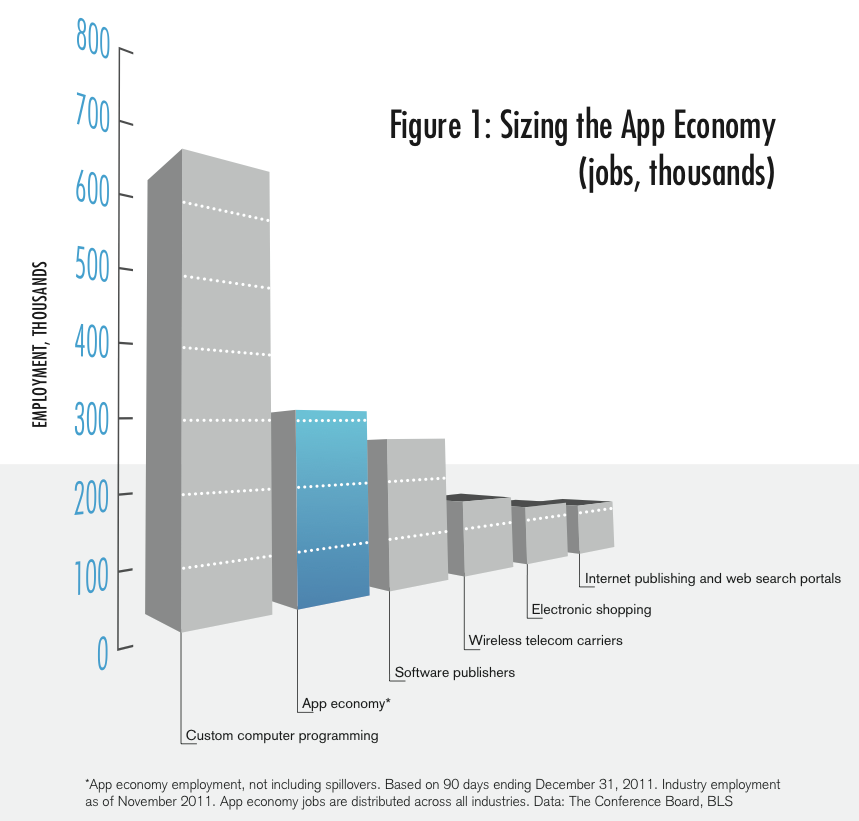
Dr. Mandel’s conclusions illustrated that the industries housed under the App Economy’s wide umbrella are responsible for an estimated 466,000 jobs (including spillovers not depicted in the above graph) across the states…


Expand
Expanding
Close

Siri represents nearly 25 percent of Wolfram Alpha queries after four months

Site default logo image

Apple’s digital secretary named Siri, an iPhone 4S exclusive, is now responsible for nearly 25 percent of all searches conducted on Wolfram Alpha, an answer-engine developed by Wolfram Research.

As you know, Apple collaborated with Wolfram Alpha on Siri (Microsoft is another licensee), and took advantage of algorithms powering Mathematica, another Wolfram Research product. It lets users type in complex factual queries, and then Wolfram Alpha computes accurate answers from its structured data containing hundreds of datasets.

The Cupertino, Calif.-based Company fancies Wolfram Alpha’s curated knowledge database, which is a nice fit for the iPhone 4S’s factual question answering feature. According to the New York Times’ Steve Lohr, Siri accounts for a quarter of all Wolfram Alpha queries after four months:

Siri accounts for about a quarter of the queries fielded by Wolfram Alpha, whose staff has grown to 200.

Google should be worried, as this could be another sign of Siri users becoming accustomed to retrieving factual answers from Wolfram Alpha and not Google. For example: Telling Siri to “Google the iPhone” launches Safari with Google search results accompanied by text-based adverts, but just asking “How many days are there until Easter” produces a formatted answer from Wolfram Alpha with no advertising whatsoever. This is also important knowing that a quarter of all searches on mobile devices are conducted through voice commands.


Expand
Expanding
Close

Apple in early discussions to open stores inside of Sam’s Club locations

Site default logo image

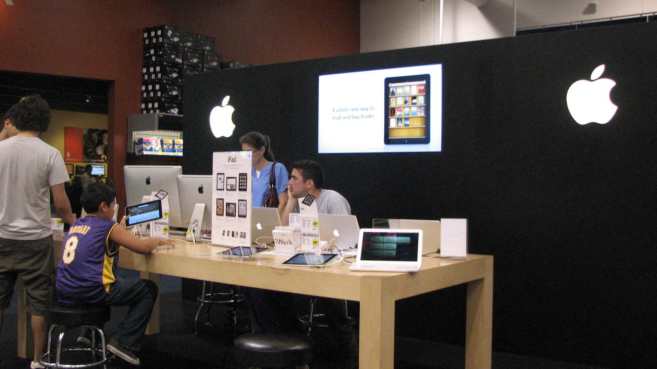
Apple Store inside of a Best Buy

Apple and Walmart subsidiary Sam’s Club are in early discussions to widen their already existing partnership. Sam’s Club currently sells Apple’s iPhone, iPad, and iPod lines within its large retail chain, but the two corporate giants are looking to take their business relationship to the next level. According to sources, Apple is considering an expansion of its Apple Store-in-store program to the 47 United States retail warehouse chain.

Sources said Apple is looking to expand its program beyond Best Buy and Target in the United States, and Sam’s Club is one of the retail chains that Apple is in early discussions with. An Apple-store-in-store typically consists of a mini-Apple Store type setup within a larger store. For example, the store-in-stores in Best Buy consist of Apple-like displays and a large table with all of Apple’s products as typically seen in standalone Apple Stores.

Sam’s Club and Apple are not only in early discussions for the Apple store-in-store program, but a backup plan is also being discussed. This plan consists of Sam’s Club simply selling Apple’s Macs, but without the Apple Store features. Since the discussions are still early, sources could not comment on a timeframe for such partnerships, but we know the store-in-stores will likely not be coming soon—or at all if the discussions fall flat. While Sam’s Club is said to be considered, it is unknown if its parent company Walmart is, too.


Expand
Expanding
Close

Microsoft promises native Dynamics CRM client for iPad, iPhone in 2012

Site default logo image

Software giant Microsoft will release in the second quarter a high-profile productivity tool for Android-toting business professionals. Accompanying Microsoft’s CRM Dynamics 2012 platform update is a preview guide that specifically mentions Android support, as noted by ZDnet. The document also includes a screenshot depicting Dynamics CRM mobile client for iPad (as seen on the right). In addition to native clients for Android devices and iPads/iPhones running iOS 5.x, Dynamics CRM will also be available on devices powered by Microsoft’s Windows Phone software.

As opposed to a web client that comes with significant limitations, the mobile client comes with all the bells and whistles so it should be Godsend for road warriors. Many businesses rely upon Dynamics CRM to manage their interactions with customers, clients, and sales prospects. Dynamics CRM mobile client will be priced at $30 a month per seat versus rival Salesforce’s mobile client which starts at $65 a month per seat.

Expand
Expanding
Close

Apple becomes the top smartphone vendor in US as Siri helps iPhone 4S outsell iPhone 4 by 75 percent

Site default logo image

We saw the Android-iOS duopoly coming last summer. Now, the effects of this incredibly tight chokehold are becoming painfully evident to virtually every handset maker sans Apple and Samsung. According to a fresh NPD survey from this morning, during the fourth quarter of 2011 Android and Apple together accounted for over 90 percent of smartphone sales in the United States. No wonder RIM is sliding fast. The remaining 10 percent is up for grabs.

Apple, which seized the No. 1 crown from Samsung last quarter, and leapt past Samsung and LG to become the best-selling U.S. handset brand, according to NPD. The iPhone maker grabbed 43 percent of all U.S. smartphone sales, while Android devices accounted for 48 percent of devices. First-time buyers prefer Android (57 percent) to iPhone (34 percent). Smartphones in Q4 represented 68 percent of all cell phones in the U.S., up from 50 percent in the year-ago quarter.

Some perspective: HTC today reported fourth-quarter results and blamed Samsung and Apple for a 26 percent income drop. What’s more, HTC devices are nowhere to be seen on NPD’s list of the top five best-selling devices in the U.S.

Read below for more highlights…


Expand
Expanding
Close

Another publication investigates Foxconn: CNN interviews an iPad assembler, Apple responds

Site default logo image

[vodpod id=Video.16054122&w=650&h=420&fv=]

After The New York Times published a lengthy two-part piece covering the controversial working conditions of Apple’s supply chain within Foxconn factories in China, other publications are doing their own investigative work to find out more informtion. The NYT’s second installment brought us the backstory of Foxconn worker Lai Xiaodong leading up to his death at a factory explosion in Chengdu. Today, CNN published a video of journalist Stan Grant who recently sat down for an interview with a current Foxconn employee and iPad display assembler:

“I can’t bear it anymore. Everyday was like, I get off from work and I go to bed. I get up in the morning, and I go to work. It became my daily routine and I almost felt like I was some kind of animal.”

The video starts off with Grant showing “Miss Chen,” who requested her name be changed for the interview, and the finished iPad she helps assemble on a daily basis but has never used. Miss Chen told CNN her Foxconn bosses informed her not to talk with media or “criminal liability shall be investigated according to law.” Chen, a poor Chongqing university student, said she took the one-month job with no experience on promises of “great benefits and little overtime.” Chen described her experience upon arriving at Foxconn:

Expand
Expanding
Close

Latest Snow Leopard security update breaks popular PowerPC apps like Quicken

Site default logo image

As part of the Mac OS X 10.7.3 update released earlier this week, Security Update 2012-001 [release notes] for Snow Leopard broke compatibility with several Rosetta Power PC programs. The issue, as described on Tidbits, MacInTouch and on Apple Support Communities threads (here, here and here), causes some third-party programs to crash unexpectedly under Snow Leopard. This includes popular applications such as Quicken, Filemaker 7, Adobe Photoshop and Microsoft Office 2004 and X. There is a workaround solution that helps alleviate the issue, at least until Apple addresses it with another update, explained right after the break.


Expand
Expanding
Close

That was fast: German ban on Apple 3G products lifted due to FRAND status of patents

Site default logo image

Update: 8PM ET: Apple has updated the store and all 3G devices are again available.

Just this morning Apple was dealt a patent blow by a German court that ruled Apple’s 3G products outside of the iPhone 4S were in violation of Motorola patents. The “Fair, Reasonable, and Non-Discriminatory” (FRAND) nature of the patents means Apple should be able to purchase licensing rights to those patents at market rates (i.e. what Nokia, Samsung, and others pay). According to Apple, Motorola has not offered those types of terms.

Fast forward to a few minutes ago: Apple stated the 3G devices in question would be back on sale “shortly”…

Slashgear reported:

Apple has been granted a suspension of the German injunction against 3G-enabled iOS devices, with the iPad WiFi + 3G, iPhone 4 and other gadgets back on sale through the company’s online store. ”All iPad and iPhone models will be back on sale through Apple’s online store in Germany shortly” the company told us in a statement. “Apple appealed this ruling because Motorola repeatedly refuses to license this patent to Apple on reasonable terms, despite having declared it an industry standard patent seven years ago.”


Expand
Expanding
Close

Mac desktop lowest price special from MacMall: New Minis start at $551, iMacs at $1086

Site default logo image

From 9to5Toys.com:

MacMall is offering 9to5 readers an additional 3% off of their already lowest prices on Mac Minis and iMacs this month yielding the lowest prices you’ll find anywhere (by as much as $50) with free shipping via this link.  The 3% is deducted at checkout and MacMall doesn’t charge tax in most states.

All discounts, including higher end models listed below:


Expand
Expanding
Close

Former Apple exec Bob Borchers talks Apple marketing, packaging, and his time at Apple

Site default logo image

[youtube:http://www.youtube.com/watch?feature=player_embedded&v=3H8v5XEkVAk]

Update: Apple had these videos taken offline.  We will make an effort to see if they exist somewhere else. Help us out in the comments if you find them.

Former Apple marketing executive Bob Borchers, who was part of the original iPhone team and helped lead the Nike+iPod partnership and third-party iPod integration with car manufacturers, recently gave a talk at a school in California to discuss his experiences at Apple (part 2 below). In case you are unfamiliar, you might remember Borchers from several “guided tour” videos for iPhone and other Apple products a few years back. He has also been a source for many of the interesting stories coming from Adam Lashinsky’s new book “Inside Apple.”

At the starting of his talk to students, Borchers surveys the crowd to find out the ratio of Android users to iPhone users, leading him to joke: “Alright that’s good. I’ll keep my Apple stock.” As a former marketing executive, Borchers showed and talked about a few ads, but also discussed the AT&T partnership, as he noted, “We broke rules in terms of how we worked with folks like AT&T”:

“AT&T as a company… they buy the cellphones and then they sell them to you and I… we said, ‘no we don’t want to do that’. We want to be able to sell the iPhone. We want to be able to talk directly to the customer. That was a big, big change for the industry.” 

Other than telling some recent stories that have debuted in “Inside Apple,” Borchers also talked about Steve Jobs’ initial mission to create the iPhone, describing the late CEO as wanting to create “the first phone people would fall in love with.” He also discussed how important the multitouch display and having the full “Internet in your pocket” was to the original concept. Before wrapping up his speech, Borchers talked about how the iPhone was developed from his point of view on the product marketing/product management team and the importance of Apple packaging:


Expand
Expanding
Close

Apple researching social fitness tech sporting real-time sharing of performance data for competitive workouts

Site default logo image

In the future, hitting the gym along with your iPhone-toting pals could spur competitiveness in ways unlike ever before. Apple’s mobile devices run a variety of fitness apps and third parties provide useful accessories ranging from casual jogging to some serious working out. Not content with resting on its laurels, Apple is looking to ratchet it up a notch with a new patent filing titled “Interfacing Portable Media Devices And Sports Equipment” that surfaced Thursday in the United States Trademark and Patent Office database.

It outlines new fitness technology letting you share performance data with your friends in real-time, as you are working out. Mentioning that traditional sharing through a third-party website is so last century, the filing goes on to describe immediate data sync between friends exercising on a similar equipment. Moreover, unlike Apple’s fitness center app patent or this fitness freak filing, it does not even pretend to mention Nike+. This suggests Apple could be developing its own solution that might some day augment or even replace Nike’s technology with numerous bells and whistles.

Fancy yourself working out on a treadmill next to your boss and being able to brag about your lower heart rate and blood pressure all the while covering greater distances. Heck, you could be even working out at your local gym while boss is running on a treadmill at his office in Tanzania.

Speaking of competitiveness…


Expand
Expanding
Close

comScore: iPhone at 30 percent US smartphone market share, 12 percent total US market share

Site default logo image

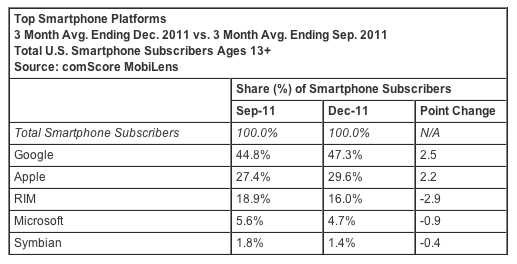
Research firm comScore is out with its latest numbers for the month of December, giving us a glimpse at the current United States mobile market. The report indicates that mobile sales are up-and-rising for the holiday month. comScore found that Google’s Android is leading with a 47.3-percent OS market share (rising 2.5 points) and Apple’s iOS is in second with a 29.6-percent market share (rising 2.2 points).

When it comes to device market share for both smartphones and non-smartphones on the OEM side, Samsung tops the charts with a 25.3-percent market share, which did not change from the previous month. LG and Motorola place second and third, both losing a small amount of market share during December. Apple comes in fourth in market share, and now boasts 12.4-percent of total mobile subscribers (rising 2.2 points).

The U.S. still ranks in as one of the world’s most important places for smartphones, with 97.9 million people owning smartphones during Q4 2011. When it comes to worldwide sales, Research Firm IDC  yesterday released its estimates for December. They found that Apple passed LG to become the third-largest smartphone manufacturer worldwide, with an 8.7-percent market share in Q4 2011, and a 6 percent market share in 2011 as a whole. Nokia remains in the top spot with 26.6-percent, followed by Samsung who has 22.8-percent. You can check out the graphs after the break for the full run-down:


Expand
Expanding
Close

CEO Tim Cook breaks down $150M in charitable contributions by Apple

Site default logo image

Among the various topics, like the new employee discount program, discussed at a recent all-hands Town Hall session with Apple employees was something seemingly very important to CEO Tim Cook: Charity. Unlike cofounder Steve Jobs who thought his company should focus on maximizing shareholders’ value so they can donate their own wealth, the new boss is adamant that Apple must do more on this front.

According to The Verge, the Town Hall meeting saw Cook shed more light on Apple’s charitable contributions that totaled $150 million (versus a cool $97.6 billion they had in the bank last quarter):

According to our sources, Cook said that Apple has donated a total of $50 million to Standford’s hospitals, split into $25 million for a new main building and $25 million for a new children’s hospital. Cook also spent quite a bit of time talking about Apple’s status as the leading contributor to Project RED, and expressed pride that Apple’s given over $50 million to the effort since it started.

According to Apple’s website, the Product Red initiative generated more than $180 million for the Global Fund since its inception. As 9to5Mac first reported back in September, one of the first important moves (anti-Jobsian, perhaps?) of then newly appointed CEO was a company-wide charity matching program for donations made by Apple employees up to $10,000 a year.


Expand
Expanding
Close

Here’s the fix for intermittent CUI errors following the 10.7.3 update

Site default logo image

A number of users flooded Apple Support Communities forums following yesterday’s release of the Mac OS X Lion 10.7.3 update to complain about dreaded CUI errors. In addition to a bunch of minor issues, some people reported being greeted with unexpected app crashes after rebooting into 10.7.3. For them, attempting to launch any application would produce the above  (and below) prompt saying:

The application unexpectedly quit after trying to restore its windows. Do you want to try to restore its windows again?

Log files reveal that the affected users are often unable to use their computer normally as a large number of crashes are being logged. Luckily, there are several easy workarounds to fix this annoying bug…

Expand
Expanding
Close

Apple hires Xbox Live veteran for App Store marketing

Site default logo image

Robin Burrowes, the person in charge of Xbox Live marketing in the EMEA region, left Microsoft for Apple and is now charged with heading the App Store marketing initiatives for iTunes Europe. Burrowes led Xbox Live marketing for seven years and were responsible for product, business and marketing management as well as planning, strategy and leadership of Xbox Live across regions, according to his LinkedIn profile. Prior to joining Apple, the executive was involved with Microsoft’s MSN online operation as events/B2B marketing manager, British retail chain HMV (promotions manager) and Tennent Caledonian Breweries (brand marketing manager).

Burrowes graduated from University of Strathclyde in 1991. Apple fashionably would not comment on its new hire. Hiring yet another games veteran indicates Apple’s desire to expand on iTunes gaming initiatives in Europe. Apple’s business in the region and around the world is booming on strong iPhone sales. Interestingly, a recent job listing on Microsoft’s website for a software development engineer possibly hinted at Xbox Live games for iOS devices. A spokesperson for the Windows maker told Forbes they are “working to extend a few of our Xbox experiences and titles to other platforms.”


Expand
Expanding
Close

Rumor: iPad 3 launching in March, ‘strange’ Apple event due February (UPDATED)

Site default logo image

Japanese blog Macotakara has a satisfying accuracy score in the Apple rumor business, and it was widely quoted earlier this month on a claim that Apple’s contract manufacturers Foxconn Electronics and Pegatron Technology issued orders to begin assembly of next-generation iPads for an early-March launch. Today, Macotakara reported that Apple would announce the iPad 3 in a media event due in March— ahead of the launch.

Previously, the blog claimed that a special Apple event to announce a new iPad was due in February and that the device was meant to go on sale the following month. Weirdly enough, Macotakara also said it heard from sources from Apple’s supply chain that the company will indeed hold an event this month, which was described as “strange.”

According to MacRumors’ Arnold Kim who contacted the author of the Macotakara report, “The February event would not be a product event.”

UPDATE: The Loop’s Jim Dalrymple disputed the story, saying Apple will not hold an event in February (he’s been right on these things before):

This is not going to happen, according to my sources. Apple will not hold an event in February, unusual or otherwise. That’s it.


Expand
Expanding
Close

Passware: Filevault can be brute force cracked during the span of a lunchbreak

Site default logo image

FileVault has been included in Macs by Apple since the release of Panther many years ago. In Apple’s most recent release, OS X Lion, the company included FileVault that brought new ways of encryption. FileVault lets you encrypt your entire drive with a master password to protect key-chain passwords, files, and more. FileVault 2 uses a separate partition to store the FileVault login information.

Cnet pointed us to a new report from password recovery company PassWare, who claimed it can decrypt Apple’s FileVault 2 in under 40 minutes. Obviously, this is a big concern because FileVault contains so much of users’ information.

PassWare decrypts FileVault by going in through the system’s firewire connection and using live-memory analysis to extract the encryption key from the FileVault partition (so the machine must assumedly be running?). From there, a user can uncover keychain files and login passwords that can be used to unlock the whole HDD/SSD.

PassWare conveniently makes PassWare 11.3 available to do this, but you will have to throw down a lofty $995 to get the software. PassWare makes this software primarily available for law enforcement.


Expand
Expanding
Close

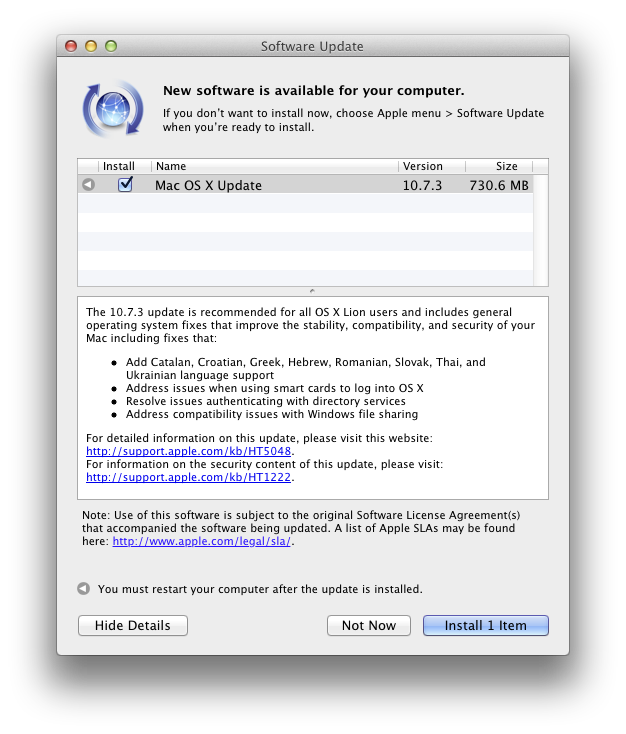
Mac OS 10.7.3 released, includes Safari 5.1.3

Site default logo image

.

Apple just released Mac OS 10.7.3 via Software update and manual download.  Apple released some peripheral downloads today as well:

Release notes are as follows:
Expand
Expanding
Close

Debug tool shows quad-core A6 and LTE capabilities on iPad 3

Site default logo image

[slideshow]

Following reports earlier this month from Bloomberg that iPad 3 production kicked off in anticipation of a March launch, BGR today claimed a source is in possession of an iPad 3 prototype that has provided more information on the device.

A source claiming to be in possession of an iPad 3 prototype provided BGR with images containing details about Apple’s highly anticipated third-generation tablet. From the data in the photos, which contain the output from an iPad 3 using a development and debug tool called iBoot, we can infer plenty of information about the upcoming iPad 3.

BGR claimed the debug reports from the iPad 3 prototype in question have model numbers J1 and J2 (iPad3,1 and iPad3,2), with one being the only Wi-Fi model and the other an LTE/CDMA/GSM combo “for all carriers.” This echoes 9to5Mac‘s findings from last year.

The reports also provided confirmation of an A6 processor (model number S5L8945X) that most have expected Apple to include in the device.  We first broke news of a Quad-core chip in the iPad 3 via code snippets in iOS 5.1B software.

According to the BGR report, the processor will be a quad-core variant, “making the upcoming iPad 3 the fastest iOS device ever.”

We’ve seen previous mentions of the Samsung S5L8945X in iOS 5 dumps from the iPhone 4S:

So, while nothing in the report is new, the means by which these were found, reportedly from a prototype iPad 3, seem to confirm previous findings.

Expand
Expanding
Close

The next iPod nano is going to have a camera if these new spyshots are real (Update: March-April release?)

Site default logo image

Update: MIC Gadget says that there is a shutter/overexposure problem with the 1.3 Megapixel camera shutter that Apple is working on and they expect a April-ish type of time frame. We typically put less weight in piggybacking-type reports

Here is more evidence that Apple was (is?) prototyping an iPod nano with a camera on the back and the accompanying hole on the clip. Leaked by the Japanese blog Apple.pro, which leaked a similar set of images in April of last year, the new shots further indicate that Apple could be working (or at least was researching at some point), a next-generation iPod nano with an alleged 1.3-megapixel camera on its back, while still keeping the current model’s size and display.

The hole on the clip looks like it could house camera lens. Such a solution would theoretically separate the camera hardware and electronics inside the diminutive main casing from the optics and sensor hardware integrated on the clip. The clip hole looks very similar to an Apple patent filing published in May 2011, with one of the drawings depicting a belt clip with a hole in the exactly same place as on these spy shots. Two more shots are available after the break.


Expand
Expanding
Close

Munster offers three content scenarios for iTV, says Apple tapping ‘major TV component supplier’ for late 2012 launch

Site default logo image


Apple television mockup by Guilherme M. Schasiepen

Piper Jaffray’s resident Apple analyst Gene Munster is arguably the most vocal proponent of an integrated high-definition television set from Apple, the mythical iTV. His old predictions were picked up by the press lately thanks to that vague Apple HD TV hint in Walter Isaacson’s authorized Steve Jobs biography, gaining more credence with both Sony and Samsung dissing the idea as old news.

Now, last we heard from Munster was in November of last year when he predicted an Apple television set within a year, costing double a comparable set. In a note to clients issued Tuesday, the analyst warned that his original timing “remains uncertain” but underscored he is still targeting “a late 2012 launch.”

More interesting is Munster’s claim that a “major TV component supplier” told him last month Apple was inquiring about “various capabilities of their television display components,” which sounds a lot like this skeptical New York Times report from October 2011. However, “Without a revamped TV content solution, we do not think Apple enters the TV market,” Munster wrote. Remaking the user interface is easy, but getting Hollywood on board will be tricky, as the Wall Street Journal warned in December.

With that in mind, Munster offers three content scenarios for the Apple television, as quoted by Fortune’s Philip Elmer-Dewitt…


Expand
Expanding
Close

Best Buy and Taiwanese tablet vendor borrow marketing cues from Apple ahead of Super Bowl advertising craze

Site default logo image

[youtube=http://www.youtube.com/watch?v=pS9sUm5Y0sg]
last year’s 

The iPhone maker is many things to many people and it is easy to overlook Apple’s powerful marketing amidst the popularity of its gadgets. Yet, the two are inseparably intertwined. No wonder well-known names in business are (again) taking cues from Apple’s marketing cookbook, including United States specialty retailer of consumer electronics Best Buy that uncharacteristically decided to break away from the usual Super Bowl advertising featuring celebrities, which seems to be norm these days.

Instead, its new approach calls for celebrating technology innovators, a concept Apple popularized back in 1997 with the “Think Different” campaign. According to Bloomberg, the retailer opted to feature Silicon Valley inventors, such as Instagram cofounder Kevin Systrom and camera phone pioneer Philippe Kahn who will help bring home the message at Sunday’s big game. From the mouth of Best Buy’s Marketing Chief Drew Panayiotou:

Big brands like to hire celebrities. We looked at everyone from George Clooney to Stephen Colbert. We believe the inventors are more than enough. I give those 125 million viewers a lot of credit. I think they’ll appreciate the story. […] They may not be at the same level as Steve Jobs, but they created some amazing stuff.

Eagle-eyed readers could point out that the retailer last holiday season aired Apple-focused adverts promoting its store-within-a-store displays, seen below. However, Best Buy’s latest creative concept marks a departure from its past Super Bowl campaigns that tapped celebrities, such as heavy metal rocker Ozzy Osbourne and teen heartthrob Justin Bieber. Meanwhile, a Taiwanese vendor is treading the fine line between originality and a display of disrespectfulness by featuring a Steve Jobs imitator to drum up excitement for its upcoming Android slab. Check it out that commercial in a clip included right after the break.


Expand
Expanding
Close