China

See All Stories
China

China has been fundamental to Apple’s historical success, but is also arguably the greatest risk to the company’s future.

Why are most Apple products made in China?

Although everyone assumes Apple products are made in China because labor is cheap there, that’s only part of the story – and an increasingly small part, as the company’s assembly partners move toward more and more automated operations.

Steve Jobs originally transferred most Apple manufacturing to China because it was the only country in the world with a huge ready-made supply-chain network, and the ability to scale up production almost overnight. There are three main reasons China – and specifically the Shenzhen area – is such a powerful manufacturing center.

First, the city is strategically placed, serving as the gateway between mainland China and Hong Kong. It is one of the largest shipping centers in the world, with a massive container port.

Second, the Chinese government established Shenzhen as the first Special Economic Zone (SEZ) in the country. SEZs are designed to encourage enterprise through relaxed planning regulations and generous tax incentives – and crucially, to facilitate foreign investment in local companies. It is this, as much as its geographical advantages, which has enabled it to grow at such a pace.

Third, that SEZ was established way back in 1980, meaning that the city has had over 40 years to grow into the manufacturing center of the tech world. Apple relies on a huge network of suppliers and sub-contractors, some of which may make just a single tiny component. The majority of them are based in Shenzhen and its immediate surrounds, so the logistics of bringing everything together in one place for assembly are straightforward.

What are the risk factors with China?

Being over-dependent on China carries a number of risks.

First, there is the generic one: Being overly dependent on any one country is a strategic risk. For example, the COVID-19 pandemic originated there, and had a massive impact on manufacturing capacity. Anything from a natural disaster to political upheaval could disrupt operations within a single country, so it is always wise to have a diverse range of manufacturing centers around the world.

Second, the relationship between the US and China has often been fraught. The trade war started by the previous US administration was a particularly low point, but continued tensions mean that there is always a risk of disruptions to trade between the two countries.

Third, it is increasingly damaging to Apple’s reputation to be so closely associated with a country that has a worsening human rights record – especially when the iPhone maker has no choice but to comply with local laws, however much they may conflict with the company’s own values. Apple has been required to remove VPN and a variety of other apps from the Chinese App Store, allow the iCloud data of Chinese customers to be stored on government-controlled servers, and more. Additionally, there have been growing reports of forced labor in China, including within many different areas of Apple’s supply chain.

What is Apple doing about it?

Apple has been working for a long time on diversifying its manufacturing operations, and has in recent years accelerated the pace at which it is doing so.

As explained above, this is far from an easy undertaking, but Apple now has major manufacturing operations in India, Thailand, Malaysia, and the Philippines, among other countries.

In India in particular, we are seeing the very early stages of a complete supply-chain infrastructure as the government uses a mix of carrot and stick to encourage companies to manufacture more of their components within the country – namely, tariffs on imports of components and tax breaks for local production. COVID-19 lockdowns in China also saw Apple move some iPad production to Vietnam for the first time, but it’s clear that the risks of over-dependence on China have never been greater.

Site default logo image

Desperate Chinese housewives on trial for iPad and iPhone-smuggling

The grey market for iPhones in China is no secret, with thousands of the devices smuggled from places like Hong Kong and the U.S. back into Mainland China for sale by scalpers. Today, Reuters reported that 26 suppliers of one of China’s largest online grey market iPhone dealers, Lanyou Shuma.com, are currently on trial in a Shenzhen court. According to local reports, many of the suppliers accused in the case are “described as housewives who frequently travel to Hong Kong.” Citing various local newspapers, Reuters said the housewives were usually paid 20 Yuan to 30 Yuan for each phone smuggled back to China, with 25 of the defendants accused of smuggling both iPads and iPhones:

On Wednesday, 26 suppliers of Lanyou Shuma.com were tried in a Shenzhen court as part of five rings that smuggled more than 162,000 mobile phones worth over 500 million yuan ($80 million) from Hong Kong over the past two years, the Beijing News said.

Half of the suspects are described as housewives who frequently travel to Hong Kong, according to another newspaper, the Southern Metropolis Daily, adding that they were paid 20 to 30 yuan in commission for each phone they brought back to the mainland

The Lanyou Shuma.com digital store, once one of the largest on China’s Taobao Marketplace, was forced to close in April by Taobao after Hong Kong authorities launched an investigation on possible smuggling of the iPhone 4S, the Beijing News said.

Site default logo image

New Shenzen, China Apple Store scheduled for grand opening this Saturday

Cupertino-based Apple is set to open its first Apple Store in Shenzhen, China on Nov. 3 at 9 a.m., as confirmed on its website earlier this morning. The store is located in Yitian Holiday Plaza at Nanshan district of Shenzhen, and it marks the seventh store in China. Apple CEO Tim Cook and company are moving aggressively into the country to keep up with their 2010 goal of 25 stores by the end of 2012.

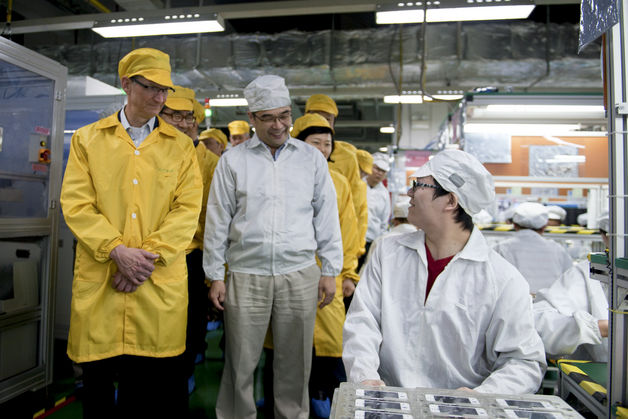
If Shenzhen sounds like a familiar city in China, it is because the city serves as one of the biggest hubs for the manufacturing of parts for Apple products. Shenzhen is home to Foxconn—a factory where the brute of Apple devices are being produced daily.

When touring Apple’s biggest retail store in China last month, Apple Senior Vice President of Retail John Browett confirmed the Shenzhen storeMIC Gadget noted many “rich people live in this part of the city so the demographics are very good for high end retailers.”

According to several local media, Apple is also set to open a new store in Chengdu, China where the iPad is manufactured. Apple has yet to confirm, but it has ramped up employee hiring.

The company has reiterated the importance of China to Apple several times. During its Q4 earnings call last Thursday, CFO Peter Oppenheimer announced Apple gained $5.7 billion in revenue during Q4 and $23.8 billion FY2012 from China.

In other Apple retail news: Apple opened a gorgeous store in Palo Alto, Calif., this weekend


Expand
Expanding
Close

Fix dings/dents/scratches on your iPhone 5 with this $99 original rear panel replacement

Site default logo image

One of the biggest controversies surrounding the launch of the iPhone 5 has been the light scratching and chipping that some users have reported witnessing on the device’s coated aluminium backside. Apple’s Marketing Senior Vice President Phil Schiller called the scratching “normal” for aluminium products, as scratching on the coated surface reveals the natural silver color underneath making it more noticeable to users than an all-glass design. There have even been reports that quality control issues related to the scratching have lead to shortages and troubles in Apple’s supply chain.

While Apple is standing behind the design for the most part (they will swap your iPhone 5 for a new one if it’s scratched out of the box), there is another solution on the market for your scratched iPhone 5. iPhone5mod, the same people behind one of the first Lightning connector docks on the market, is today releasing rear panel replacements that it claimed are 100 percent original.

The standalone rear case is apparently “the same thing you are seeing and touching in your iPhone 5 right now.” It would not be all that shocking considering China-based iPhone5mod also claimed to have “original Lightning controller chips from Apple’s supplier” for its iPhone 5 dock.

The replacement part is available for $99 now in both black and white from iPhone5mod.com. Apple has been quick to issue takedown notices for the company’s products in the past, so there is a possibility these won’t last long.

Enhanced by Zemanta

Apple holding MFi conference November 7 -9 to discuss Lightning guidelines, here’s the event’s program

Site default logo image

Earlier this month, iLounge and Macotakara reported that Apple made several changes to its MFi (Made for iPhone/iPad/iPod) policy that tightens control over manufacturers producing accessories. In its report, iLounge included word about a seminar in China where Apple plans discuss its policy change with manufacturers—talking specifically about Apple’s new Lightning technology. Today, thanks to a report by TechCrunch and a picture of the seminar’s program provided to us by a tipster (as seen above), we have learned more about the seminar. The conference will be held in Shenzhen, China from Nov. 7 to Nov. 9 to talk about the new standards.

With the new standards, Apple will have a strict control over the supply of Lightning pins that help power the Lightning connectors that MFi partners could build. Apple will only supply the pins to partners that the company has vetted to make sure its standards are met. Previous teardowns have already shown that what Apple has with its Lightning cables is not ordinary dumb cable technology.

As you can see in the program, Apple has a lot on the docket for those who attend. It will give manufacturers an insight into Apple Retail, how to design Lightning accessories, and the changes within the MFi program. Apple’s engineers will also assist with Wi-Fi, AirPlay, and Bluetooth. Once Apple has approved a company, it will sell them the Lightning pins in volume. According to TechCrunch, the pricing is “very fair when you consider the advance technology.”

Last year, at its MFi program that took place Dec. 7 to Dec. 9, Apple told developers to get busy building next-generation iOS accessories compatible with Airplay and support Bluetooth 4.0. As we now know, Apple has rolled out Bluetooth 4.0 to most of its devices and wants to make Airplay a standard for audio and video consumption.


Expand
Expanding
Close

Foxconn official says iPhone 5 supply shortages caused by complicated design, productivity improving

Site default logo image

The Wall Street Journal spoke with an unnamed Hon Hai executive today about why the iPhone 5 is experiencing supply shortages, and the Taiwanese manufacturer, also known as Foxconn, apparently blamed it on the smartphone’s complicated design and its subsequent assembly process.

“The iPhone 5 is the most difficult device that Foxconn has ever assembled. To make it light and thin, the design is very complicated,” said the executive to the Wall Street Journal. “It takes time to learn how to make this new device. Practice makes perfect. Our productivity has been improving day by day.”

The official did not wish to be named, but he admitted Hon Hai is attempting to better production capacity while apply more procedures to alleviate the reports of damages such as scratches to the iPhone 5’s metal casing.


Expand
Expanding
Close

Apple’s manufacturing jobs in China comes up in US presidential debates, both candidates give their opinion [Video]

Site default logo image

[youtube=http://www.youtube.com/watch?v=QEpCrcMF5Ps&start=5400]

One of the last questions in the debate concerned how to bring Apple’s manufacturing jobs ‘back’ to the United States.

Mitt Romney went first and said China is stealing intellectual property, designs, cheating on currency, hacking into computers, and isn’t playing fair to U.S. workers: “We can compete with anyone in the world as long as the playing field is level.”

Obama went second and said the U.S. doesn’t necessarily want the low-skill, low-wage jobs and education and skills will bring higher-paying jobs home: “There are some jobs that are not going to come back. […] I want high-wage, high-skill jobs. That’s why we have to invest in advanced manufacturing […] make sure that we have the best science and research in the world.”

And the President should know: Steve Jobs told Obama in February 2011, according to Walter Isaacson, “If you could educate these [30,000] engineers, we could move more manufacturing plants here.”

The New York Times dived deep on this and probably has better answers than either politician.

[UPDATED with full transcript below]


Expand
Expanding
Close

Third-party Lightning connector products surface as manufacturers report cracking Apple’s authentication chip

Site default logo image

[youtube=http://www.youtube.com/watch?feature=player_embedded&v=QxqlcyVPm5M]

A new iPhone 5 dock being sold through China-based iPhone5mod.com could be the first third-party product to ship with Apple’s new Lightning connector. Earlier reports indicated that accessory manufacturers would have trouble producing Lightning-compatible products due to a unique authentication chip Apple is using in the new standard. According to reports from M.I.C Gadget and MacRumors, which spoke with representatives of the company, the dock and cable from iPhone5mod are actually using chips obtained from Apple’s suppliers. They also provide all the same functionality. However, the company hinted cracked authentication chips are available and working:

We spoke with representatives of iPhone5mod, who informed us that they are currently using original Lightning controller chips from Apple’s supplier, ensuring proper functionality… iPhone5mod did, however, inform us that they have also obtained cracked chips that bypass Apple’s authentication functions and that the cracked chips are working just as well as the original chips

[tweet https://twitter.com/iphone5mod/status/255725839440818176]

The company is currently selling the product in two pieces: the iPhone 5 dock and Lightning cable for $19,90 each, or you can buy both as a package for $39.90:
Expand
Expanding
Close

Taiwan asks Apple to blur imagery of early-warning radar facility in Maps app

Site default logo image

Turkish website Sosyalmedya reported last month that Apple was putting the country’s national security at risk by releasing high-resolution imagery of sensitive locations in its new Maps app. In that case, the issue was a clear view of a maximum-security prison. A quick comparison to Google’s Maps showed the location was obscured, something Google has been known to do upon request. There were other controversial locations discovered in the Maps app (locations that Google currently blurs), and today a report from The Associated Press noted Apple is being asked by Taiwan to obscure imagery of an early-warning radar station in the country.

Taiwan is asking Apple Inc. to blur a map image of its new $1.4 billion early warning radar station… The 10-storey high radar installation built with U.S. technology is expected to go online later this year. It’s near the Hsinchu Airbase in northern Taiwan.

According to the report, Taiwan Defense Ministry spokesperson David Lo said, “Apple should follow its rival Google in using only low-resolution satellite pictures.” The Associated Press said the facility is located near Hsinchu Airbase in northern Taiwan and will be used for monitoring aircrafts, missiles, and determining speed for targets “coming from as far as western China.”


Expand
Expanding
Close

Site default logo image

Some iPhones coming off the assembly line with backward volume keys (iPhone 5 version)

Remember this?

Although it isn’t going to change your life, it looks like a few iPhone 4s are coming off the assembly line with reversed volume buttons.  Reader Eric sends us his which he says works like it should if the buttons were reversed.

Fast-forward a year:

.

Thanks Donut Bandit!

Those fine folks at Foxconn might have missed this one.

Apple’s next huge data center will be in Hong Kong, groundbreaking Q1 2013

Site default logo image

Map of Hong Kong post handover

We’ve received word that Apple is building another enormous data center—this time in Hong Kong SAR, China.

Apple recently finalized a location in the New Territories region of Hong Kong near the Shenzhen China border for the data center. We spoke to a bidding contractor employee who, on the condition of anonymity, told us the planned data center’s scale is unprecedented for his business: “There is simply nothing to compare it to and therefore it is hard to make estimates on size based on the materials required.” We were told that construction is to begin in Q1 2013, and it will likely take over a year for operations to start in the data center. The aim is to have it operational by 2015, which is the same time that Apple’s Spaceship Campus 2 is scheduled to go online.


Expand
Expanding
Close

Site default logo image

Iconic Shanghai Apple Store floods, temporarily closes

Reader Dan just sent us some pictures of the iconic Shanghai Apple Store that is currently being cleaned up due to a pretty significant flood.

Big flood in their flagship Shanghai, China store located in the Pudong district of Shanghai.…unfortunately, they were not allowing the public to take pictures so i wasn’t able “sneak in” too many pictures but i’ve attached a short video and couple pics.
When i arrived they had already blocked off the area where it was flooding and tried to control it by putting bins underneath to catch the water.  They covered surrounding iPads/Macs with plastic cover.  Unclear as to how much damage occurred.

It is not the kind of damage that comes from a drive through smash-and-grab, but it will take some time to clean up this mess. Thanks Dan!

Report: iOS and Android make tech history with worldwide, fast-growing adoption

Site default logo image


Mobile analytics firm Flurry published a new report today asserting iOS and Android handsets have experienced adoption at such a supersonic speed that their growth rate has now eclipsed all consumer technology in history.

According to Flurry:

The rate of iOS and Android device adoption has surpassed that of any consumer technology in history.  Compared to recent technologies, smart device adoption is being adopted 10X faster than that of the 80s PC revolution, 2X faster than that of 90s Internet Boom and 3X faster than that of recent social network adoption.  Five years into the smart device growth curve, expansion of this new technology is rapidly expanding beyond early adopter markets such as such as North America and Western Europe, creating a true worldwide addressable market.  Overall, Flurry estimates that there were over 640 million iOS and Android devices in use during the month of July 2012.

Smartphones making headway as they spread worldwide is nothing new, but their history-making adoption rate is certainly notable. The report illustrated countries with the greatest number of device activations as well as the fasting growing markets. The results indicated the United States sits at No. 1 with 165 million iOS and Android handset activations for July, but China experienced a leading 401 percent activation growth during the same period.


Expand
Expanding
Close

More alleged iPhone 5 parts leak out of China, shows new nano-SIM card once again

Site default logo image

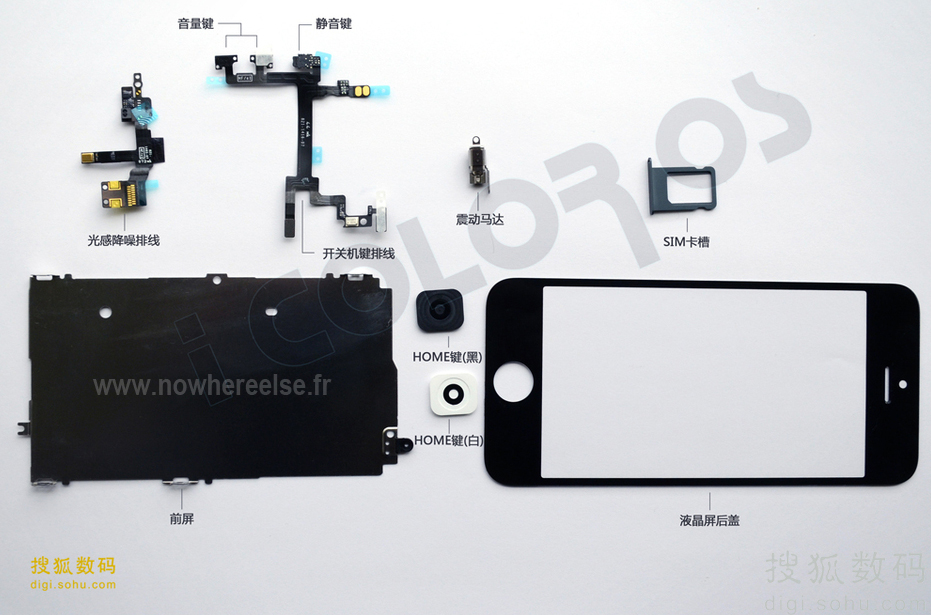
According to a new report from French publication Nowhereelse.fe and Chinese forum iColorOS, more sixth-generation iPhone parts have surfaced from China. As you can see above, we now have a look at the alleged glass front, home button, sensors, volume control buttons, and the protection element placed on the back of the phone screen that may appear in the next iPhone. The leak also adds a bit more validity to a report earlier this week that showed a new nano-SIM card and smaller home buttons for the device.


Expand
Expanding
Close

This is what the new iPhone’s Nano SIM tray looks like

Site default logo image

According to a translated report from Nowhereelse.fr, images of the tray for Apple’s new nano-SIM design started surfacing from China. In June, the ESTI was thought to have selected Apple’s new SIM card design for its 4FF standard, and reports from just last month claimed European carriers are stockpiling the new SIMs in anticipation of a next-gen iPhone launch. A smaller home button appears to also be present in some of the images, which of course lines up with previous leaks.

Presented as being designed to slip into the SIM card slot of the iPhone 5, this element seems in turn confirm that the next iPhone indeed adopt this new standard imposed by Apple. I take this article to drag other photos with us in passing a Home button which should equip the iPhone 5 and which is also slightly smaller than previous generations, details of which we heard last Friday.


Expand
Expanding
Close

Site default logo image

Apple gets paid for its products, on average, before it has to pay for their manufacturing

A fun fact from The Wall Street Journal just in time for Apple earnings:

Cash comes in before it goes out in part because Apple has incredible negotiating leverage vis-à-vis its suppliers. On average, in fiscal 2011 it didn’t pay suppliers for 83 days after being invoiced, according to Sanford C. Bernstein analyst Toni Sacconaghi. Yet Apple collected on its customer invoices much faster, 18 days on average. Meanwhile, it paid to keep just four days of inventory on hand in 2011, versus an already impressive 10 days in 2010.

While the scenario above oversimplifies (it takes many months to set up device assembly lines including testing and fault tolerance for instance), capital investments in manufacturing are heading toward null game for Apple.

‘iPhone 5’ is already for sale in China

Site default logo image

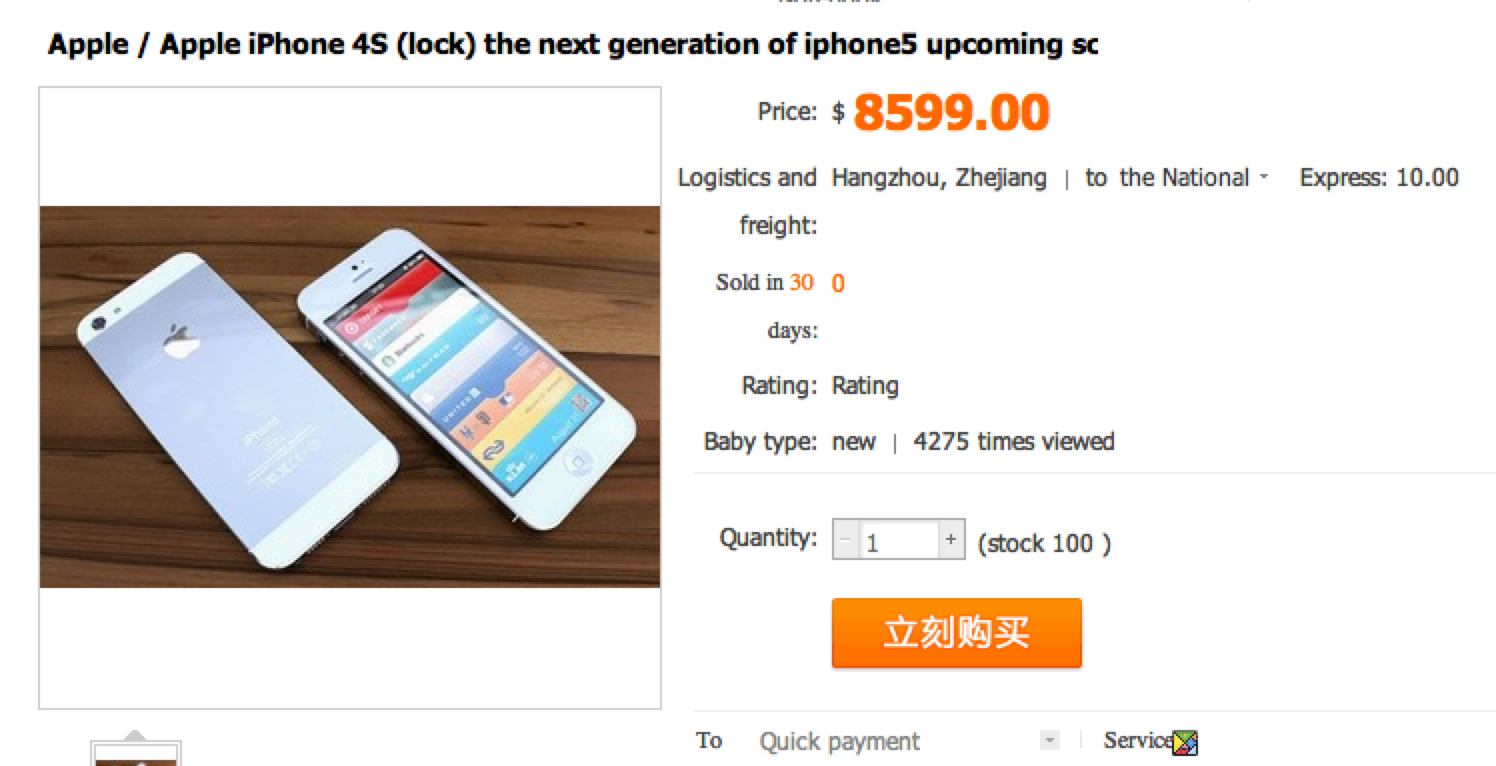
Those in China looking to get a head start on their Fall iPhone shopping are given the opportunity by sites like TaoBao, which, according to Reuters, (and the link we dug up) are already for sale.

Apple Inc’s next-generation iPhone has not even been released yet, but opportunistic sellers on China’s largest e-commerce platform, Taobao, are already accepting pre-orders, complete with mock-up pictures and purported technical specifications.

The hotly anticipated iPhone 5 is widely expected to be released sometime between August and October this year, although Apple itself has been tight-lipped about it. Sources have said the iPhone 5 would have a bigger screen than previous models, while Taiwanese media reported the phone’s voice recognition software, Siri, would have more powerful functions.

Buying Apple devices unseen shows what kind of confidence consumers have in the products that Apple makes. Would you put money down on Apple’s next iPhone without knowing anything about it?
Expand
Expanding
Close

Site default logo image

Tim Cook makes surprise appearance at Allen & Co retreat this morning (Update: Spotted with Dorsey)

Tim Cook with Twitter creator Jack Dorsey

[tweet https://twitter.com/markgurman/status/223099203377836032]

Apple Chief Executive Tim Cook made a low-profile, surprise appearance at the Allen & Company annual retreat in Sun Valley earlier today.

According to The New York Post, the CEO attended the event for the first time to observe The New Yorker’s Evan Osnos’ session on China:

  • While his name was on the list of possible attendees, no one knew if the low-key CEO would put in an appearance.
  • Apple’s late co-founder Steve Jobs hadn’t traveled to the annual gathering in recent years.
  • Cook slipped out of the session at the Sun Valley Inn largely unnoticed. While other business titans gathered at the Duck Pond for lunch, he headed in the direction of the lodge.
  • The session was hosted by The New Yorker’s China correspondent, Evan Osnos. Apple is getting ready to unleash the latest version of the iPad in China, the world’s largest consumer market.

The Allen & Company Sun Valley Conference is a 29-year-old annual conference hosted by private investment firm Allen & Company. It takes place in Sun Valley, Idaho for one week in July, where moguls, executives and philanthropists flock to rub shoulders. Previous conference guests have included Steve Jobs, Bill and Melinda Gates, Warren and Susan Buffett, Larry Page and Sergey Brin, Mark Zuckerberg, and more.

(Cook and Sagan pictures via BusinessInsider; Cook and Dorsey picture via mcatwellons—Thanks, @wiserjoe727!)

Site default logo image

TIME cover story asks ‘How long will China allow Apple to profit so handsomely on its shores?’

As you can see from the image above, TIME magazine’s cover story that hits newsstands tomorrow for both the U.S. and international editions is titled, “Made in China: Why Apple’s future depends on the world’s biggest market”. While noting increasing iPhone sales in China, Taiwan, and Hong Kong greatly contributed to Apple’s record earnings of $39.2 billion and ($7.9 billion for Greater China) reported in April, TIME’s Hannah Beech questions, “How much longer will an increasingly nationalistic government allow foreign companies like Apple to profit so handsomely on its shores?” The full story titled “The Cult of Apple in China” is available to TIME subscribers here. An excerpt is below:

The vast majority of Chinese aren’t up in arms about labor conditions at Apple’s supplier factories. A cluster of suicides by Foxconn workers a couple of years ago elicited much more coverage in the West than in China…. Yet Foxconn keeps signing on new workers, even though many other companies complain of labor shortages as Chinese youth increasingly eschew factory work. (Apple runs educational programs for workers in supplier factories.)… Even after all the criticism of Foxconn—the suicides, the industrial accidents, the punishing hours—young Chinese still want a job making Apple devices…

…Apple’s relationship with the People’s Republic embodies some of the global economy’s brightest opportunities but also its thorniest dilemmas. An American tech giant must decide how much to adapt its practices in a faraway land. Should Apple represent the best of the West in the Middle Kingdom, or must it conform to the less salubrious way China Inc. operates? From China’s side, how much longer will an increasingly nationalistic government allow foreign companies like Apple to profit so handsomely on its shores? Caught in the middle are 1.3 billion Chinese whose toil in factories and taste for luxury products will dictate the future of the world’s marketplace.

Site default logo image

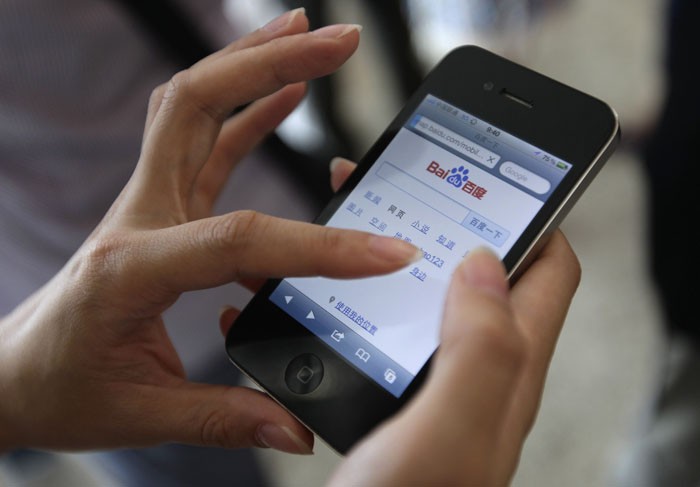
Apple to grab portion of Baidu ad sales in iPhone

Apple announced earlier this week at the Worldwide Developers Conference that Baidu will come to the iPhone in the iOS 6 software update, but it just came to light that the Cupertino, Calif.-based Company plans to seize a portion of the China-based search engine’s advertising sales as part of the deal.

According to Bloomberg:

The revenue-sharing agreement with Apple follows similar accords between Baidu and manufacturers of handsets that use Google Inc. (GOOG)’s Android operating system, Wang Jing, vice president at Beijing-based Baidu, said in a phone interview today. He declined to disclose the commercial terms.

Apple said this week it will offer Baidu’s search-engine as an option for iPhone and iPad customers, and add Chinese- language support for its Siri voice technology, as the world’s most valuable company tailors its products for Chinese consumers. Baidu, which fields about 80 percent of China’s Web searches, is prepared to incur costs to add smartphone users by offering services such as music streaming for free, Wang said.

Eric Wen, who rates Baidu buy at Mirae Asset Securities, told Bloomberg that Baidu previously shared revenue with websites to encourage traffic for the search engine, while it now has a focus on sharing with smartphone manufacturers. He further estimated that Baidu distributed less than 10 percent of its generated smartphone revenue to those manufacturers.

The deal reflects Baidu’s need to invest in the mobile industry instead of computers, because more people in China are accessing the Internet through smartphones. It is worth noting that Baidu is already baked into 80 percent of Android devices.


Expand
Expanding
Close

Site default logo image

Apple caters to China with crop of targeted features

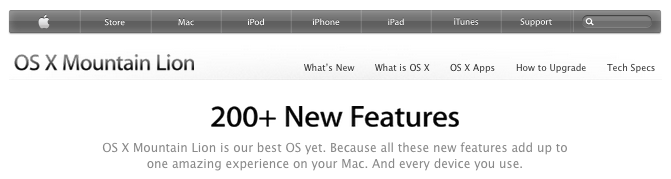
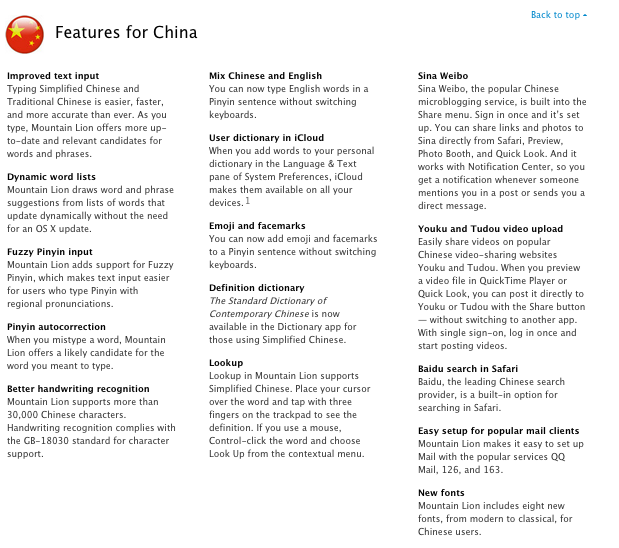
Apple unveiled a host of China-targeted features for its operating systems during the opening keynote of the Worldwide Developers Conference yesterday, but the full suite of additions are now spotlighted on Apple’s website.

A few of the earmarks include integration with China’s Twitter-alternative Sina Weibo, Google-competitor Baidu, and YouTube-like Youku and Tudou. Communicating also got easier with improved input for emoticons and Chinese pinyin, and even Siri can now fully communicate in Chinese.

According to The Wall Street Journal:

Some of the new features are now outlined on Apple’s website as part of the new Mountain Lion operating system. They address a number of long-standing issues for Chinese users, who can’t easily take advantage of Apple products’ existing integration with Facebook, Twitter, Youtube and Google search because of government Web filtering and who previously had to use third-party apps or browsers to access Chinese Internet services. […]

Apple’s announcement of the new features shows how the Cupertino-based maker of iPads and iPhones is rushing to embrace China, now the company’s largest market outside of the U.S., after previously neglecting it.

The world’s largest mobile market by subscribers and second-largest PC market by unit shipments, China had to wait almost two and a half years, until 2009, before getting its first official iPhone launch. Apple didn’t start accepting payments in Chinese yuan for the App Store until last November.

Chief Executive Tim Cook noted Apple’s tremendous growth in China during April’s quarterly earnings call. The Cupertino, Calif.-based Company is continuing to expand its presence in the country with the addition of Apple Stores in Shenzhen and Chengdu.


Expand
Expanding
Close

Site default logo image

Foxconn workers, activists claim no change at Apple plants following FLA audits

We reported earlier this month that Foxconn announced it would share the initial costs of improving iPhone and iPad assembly plants with Apple following an agreement to improve working conditions based on recommendations from the Fair Labor Association. Today, according to a report from Reuters, labor watchdog Student & Scholars Against Corporate Misbehaviour released a report claiming Foxconn factories have not changed much since the FLA’s audits:

A fresh report released on Thursday by labor watchdog Student & Scholars Against Corporate Misbehaviour (SACOM), based on visits to several Foxconn factories and 170 worker interviews, found rights violations “remain the norm” including high production targets, inhumane treatment and signs of overall salary cuts.

“The frontline management continue to impose humiliating disciplinary measures on workers,” it said.

“The above findings demonstrate that Apple and Foxconn have not turned over a new leaf,” the report added.

Even after recently raising wages of some workers by 16 to 25 percent, Reuters’ report claimed average overall salaries decreased and some “had to work unpaid overtime after pay hikes.” A Foxconn worker in Guanlan told Reuters: “The work pressure is still great… There hasn’t been much change. We are still being pushed very hard.”

Foxconn responded to the SACOM report in a statement to Reuters:

“The welfare of our employees is without a doubt our top priority and we are working hard to give our more than one million employees in China a safe and positive working environment,”

Site default logo image

Apple, Foxconn to share costs of improving factories

Apple plans to improve work conditions at its iPhone and iPad-assembling Chinese factories, and Foxconn executives announced today that it would share the initial price of that venture with the Cupertino, Calif.-based Company. According to Reuters:

  • Foxconn chief Terry Gou did not give a figure for the costs, but the group has been spending heavily to fight a perception its vast plants in China are sweatshops with poor conditions for its million-strong labor force. It regards the criticism as unfair.
  • ‘We’ve discovered that this (improving factory conditions) is not a cost. It is a competitive strength,’ Gou told reporters on Thursday after the ground-breaking ceremony for a new China headquarters in Shanghai.
  • ‘I believe Apple sees this as a competitive strength along with us, and so we will split the initial costs.’
  • It was unclear if the split would be 50/50 or in some other ratio.

Apple and Foxconn began bettering conditions for workers earlier this year by raising wages in mid-February from 16 percent to 25 percent, and then they hired thousands of new laborers the next month to reduce overtime in the factories.


Expand
Expanding
Close

Site default logo image

Apple reportedly offers Proview $16M for Chinese iPad trademark

A judge in the United States dismissed Proview’s suit two days ago against Apple in the U.S., and it seems the dispute may be wrapping up soon, because the companies have been discussing a settlement amount.

A report by Sina (via the Beijing Times/TNW) claims that Apple offered $16 million as a settlement for the iPad trademark in China, which Apple was duped out of prior to the product’s 2010 launch. Apple bought the Chinese trademark using secret subsidiary IPAD, but the Taiwanese arm of Proview had no right to sell it, because it was a separate entity from the Chinese company that owned rights to “IPAD” in China.

Proview China is now in bankruptcy to the tune of $63 million to Chinese banks and others; so $16 million is a long way from bringing it back from the dead. However, the creditors may choose to take what they can get.

By the way, the new iPad is conspicuously late to China—with some even wondering if it is because of the trademark dispute.


Expand
Expanding
Close