Tech Industry

See All Stories
Site default logo image

Google accelerating development of Siri competitor for Android

The Wall Street Journal reported that Google is accelerating its plans to launch a competitor to Siri. 9to5Google has the full story:

We have heard several reports in the past that Google was working on various evolutions of its Voice Actions platform for Android. Back in December we heard of “Project Majel”, which according to reports is the codename for a new voice-controlled assistant app similar to Siri. In March TechCrunch reported on a similar project dubbed Google Assistant. According to a new report from the Wall Street Journal, Google is accelerating its plans to launch a competitor to Apple’s Siri…

Site default logo image

Verizon announces ultra-high speed FiOS ‘Quantum’ service, up to 300 Mbps for $210 a month

Verizon announced tiers for its new high-speed Internet FiOS “Quantum” service today. It ranges from $65 to $210 a month, and it is available in double or triple-play bundles and stand-alone plans. Verizon will continue offering its entry-level $65 15/5 Mbps service, but it will introduce new plans including: 50/25 Mbps, 75/35 Mbps, 150/65 Mbps, and 300/65 Mbps. The company noted they are “by a wide margin the nation’s fastest, mass scale residential Internet speeds.”

Three of those speeds ¬¬ 75/35, 150/65 and 300/65 — are twice as fast as those previously offered.1 In addition, Verizon will continue to offer its entry-level speed of 15/5 Mbps… The two highest downstream speed offers – 150 and 300 Mbps – and the new 65 Mbps upstream speed are by a wide margin the nation’s fastest, mass scale residential Internet speeds available. By contrast, the fastest Internet speeds offered by cable-company challengers top out at 105 Mbps downstream and 20 Mbps upstream. (This FiOS Internet speed grid shows specific examples of the benefits of faster downstream and upstream speeds.)

Verizon noted existing customers can upgrade free, but they will on-average pay $10 to $15 more per month. The company also outlined the different pricing options for new customers:

For new customers, prices of triple-play bundles of 15/5 Mbps FiOS Internet, FiOS TV and FiOS Digital Voice unlimited calling will range from $99.99 to $144.99 per month, depending upon which FiOS TV package is ordered. The packages are: Prime, with more than 200 channels and more than 50 HD channels; Extreme, with more than 290 channels and more than 70 HD channels; and Ultimate, with more than 380 channels plus premium movie channels, and more than 110 HD channels).

Double-play bundles of the 15/5 Mbps FiOS Internet and FiOS TV range from $84.99 to $129.99 per month. Stand-alone 15/5 Mbps service costs $69.99 per month on a month-to-month basis, and $64.99 per month with a two-year contract.

Triple-play bundles of the 50/25 Mbps speed range from $109.99 to $149.99 per month for new customers. Double-play bundles with FiOS TV range from $94.99 to $134.99 per month. The stand-alone version costs $79.99 per month on a month-to-month basis, and $74.99 with a two-year contract.

Triple-play bundles of the new 75/35 Mbps speed range from $114.99 to $154.99 per month for new subscribers. Double-play bundles with FiOS TV range from $99.99 to $139.99 per month. The stand-alone costs $89.99 per month on a month-to-month basis, and $84.99 with a two-year contract.

Triple-play bundles of 150/65 Mbps speed range from $169.99 to $174.99 per month for new FiOS customers. Double-play bundles with FiOS TV range from $154.99 to $159.99 per month. The stand-alone costs $99.99 per month on a month-to-month basis, and $94.99 with a two-year contract.

The new 300/65 Mbps tier, offered as a stand-alone only, costs $209.99 per month on a month-to-month basis, and $204.99 with a two-year contract.3

Will Microsoft try to take on Apple by manufacturing its own tablet?

Site default logo image

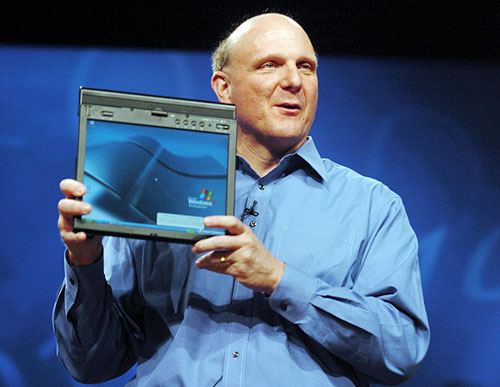
Microsoft is allegedly prepping to directly compete with Apple in the tablet market

The Redmond, Wash.-based Company scheduled an event in Los Angeles on Monday to make a “major announcement.” AllThingsD reported earlier this week that the event would unveil Microsoft’s tablet plans:

  • After signaling for months that it would attack the market only through its traditional hardware partners, Microsoft has decided to enter the tablet business more directly. […]
  • Sources say that Microsoft concluded that it needs its own tablet, with the company designing both the hardware and software in an effort to better compete against Apple’s strengths. Microsoft’s tablets may include machines running ARM-based processors as well as models running on traditional PC processors, sources said.

Perhaps more interesting: The Wrap claimed Microsoft will self-manufacture the device, which is an assertion that AllThingsD supports. The move is certainly plausible, because Microsoft snatched a 17.6-percent stake in Barnes and Noble’s Nook eReader business last month for $300 million. One could speculate that Apple and Amazon’s dominating presence in the market causes companies like Microsoft and Barnes and Noble to join forces.

[tweet https://twitter.com/harrymccracken/status/213653354117738497]


Expand
Expanding
Close

Apple patent details replaceable back panels for adding lenses and advanced camera features

Site default logo image

According to an Apple patent application published by the U.S. Patent and Trademark Office and detailed by PatentlyApple, Apple is at the very least conceptualizing a device that sports a removable back panel for easily replaceable components such as lenses or optical solutions.

While it is unclear whether the invention would be used in a standalone camera, next-generation iPod or iPhone, or a different device entirely, the patent detailed several methods of upgrading a device with supplementary optics:

The digital imaging subsystem is typically enclosed within the case of the device to protect the digital imaging subsystem. The enclosure generally prevents direct access to the lens of the digital imaging subsystem for the purpose of providing any sort of supplementary optics, especially if the supplementary optics must be precisely aligned with the image sensor… It would be desirable to provide a structure for a compact device that allows the end user to reconfigure the optical arrangement of the device while retaining the benefits of assembling the device using a pre-assembled digital imaging subsystem.

Apple detailed several features that could be added through the easily swappable supplementary optics, including: improved zoom capabilities, better shutter control, removable close-up lenses, and the addition of motion sensors, flashes, or a lens baffle. As an example, the report explained a removable IR cut-off filter that would allow “capturing black and white images at very low light levels. Without the IR-cut filter the camera’s light sensitivity may extend to 0.001 lux or lower.” The report also broke down how the removable back panels could be implemented:


Expand
Expanding
Close

Site default logo image

T-Mobile details progress of 4G network rollout, continues testing iPhone compatible 1900MHz HSPA+

Following a keynote from T-Mobile’s Chief Technology Officer Neville Ray at the NGMN conference this morning, Senior Vice President of Technology Dave Mayo provided an update today regarding the company’s $4 billion 4G-network plan.

We already knew T-Mobile would be make its 4G HSPA+ in the 1900 MHz band available to iPhone users later this year as its new network equipment gets installed. It recently confirmed that it began testing the network on a small scale. Today, we get an update on the progress of the carrier’s 4G rollout with Mayo confirming installations of new equipment at the first 400 modernized GSM / HSPA+ sites, which will be complete by the end of June, with the number growing to 2,500 sites a month after. He also noted the carrier was approved for 19,500 additional sites. This indicates the LTE network is on track for its 2013 rollout.

Expand
Expanding
Close

Verizon to introduce shared data plans June 28, reflects reality of multiple device users

Site default logo image

According to a report from AllThingsD, Verizon Wireless will soon change the way it charges customers for cellular/data plans in a major way. Rather than charging customers for phones calls or messages sent, the report claimed Verizon would charge “almost exclusively based on how much data” is consumed. The new “Share Everything” plans will also be the first in the United States that allows users to share their data with up to 10 devices through a single account:

The plans, known as “Share Everything,” allow users an unlimited number of calls and texts and also allow data usage to be pooled among up to 10 devices on one account. With the move, Verizon becomes the first U.S. carrier to offer the ability for customers to share a bucket of data across multiple devices.

AllThingsD noted that AT&T also has plans for shared data options, but it did not provide more details. As for Verizon’s new plans, which will apparently kick-in June 28, the report explained the cost of the data plan and pricing metrics based on a per-device fee. In other words, you will have to pay roughly $40 per smartphone ($10 per tablet), and then opt for either a $50 1GB data plan or a $100 10GB plan. While the report claimed the new pricing should not impact the cost of plans for users who continue consuming the same amount of data, it is clear that those signing a new plan for a single smartphone are getting a bit less for their money:


Expand
Expanding
Close

Site default logo image

Photos allegedly show logic board of new MacBook Pro, sporting NVIDIA GT 650M graphics

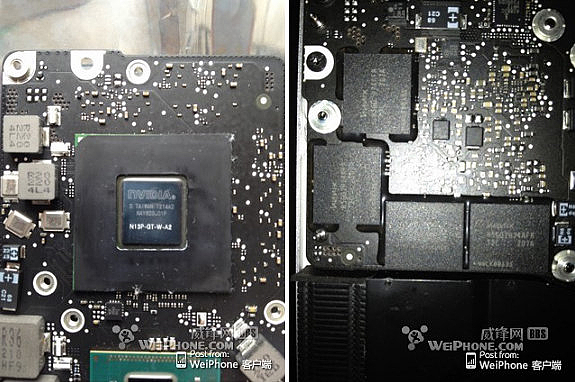
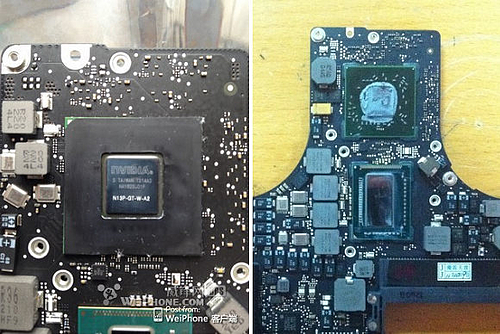
A user on Chinese forum WeiPhone posted (via MacRumors) photos that allegedly show off the logic board placed in the new MacBook Pro, which is to be announced tomorrow during Apple’s keynote opening at this year’s Worldwide Developers Conference. According to the leak, the MacBook Pro is set to feature a NVIDIA GT 650M graphics chip with 1GB GDDR5 graphics memory.

Another forum user analyzed the new logic board and put it side-by-side with the logic board on the current 15-inch MacBook Pro. As you can see, both logic boards have very similar layouts. The position of the GPU is also the same on both units.

We were the first to report last week that Apple is set to announce a refresh to most of the Mac line tomorrow, including the Mac Pro. Our sources indicated that Apple will release two configurations of the redesigned 15-inch MacBook Pro; although, what Apple plans to do with the other screen sizes is unclear. The new MacBook Pro will sport Retina graphics, an ultra-slim design, and USB 3.0. Our source said the Retina display is “jaw dropping.”

Tonight’s leak does not indicate what type of processor speed the new MacBook Pro will have, but it is somewhere in the neighborhood of 2.3 GHz, 2.5 GHz, or 2.7 GHz chip variants. You can bank on the processor being Intel’s new Ivy Bridge chip that supports Retina graphics, but pricing is still up in the air.

All of our questions will be answered tomorrow when Apple’s CEO Tim Cook and his company take the stage to make things official. You can read our full wrap-up of what we expect to be announced and follow our liveblog kicking off at 1 p.m. EST/10 a.m. PST tomorrow!

Update: this morning we reported Apple will be announcing both next-generation MacBook Pros with a thinner design and Retina Display AND spec-bumped MacBook Pros with the current design.


Expand
Expanding
Close

Site default logo image

Project Magenta is Linux-based mobile OS that aims to replicate iOS on generic hardware

.

Without getting into too many details, here is what little is known about this Open Source Magenta Project:

Magenta is an implementation of Darwin/BSD on top of the Linux kernel. It is made up of a number of kernel and userland components that work together. It is fully binary compatible with iPhone OS 5.0 (as in, it uses the same binary format).

It runs on ARM 7 Hardware currently, but what is the goal?

The final goal is probably recreating the iPhone OS 1.0 stack. I think this is a pretty feasible goal, considering the fact that there are so many open source libs that can be used to replace the proprietary libs used by Apple. Just as an example:
* CoreGraphics -> Cairo
-> FreeType
-> libpng/jpg
* Celestial -> Various open source media decoding libs.
* UIKit -> Chamelleon

The project does not wish to build a platform that can run Apple’s App Store apps; it appears to just aim at running iOS.

It will be interesting to see where this goes.

[tweet https://twitter.com/chronic/status/211315542026493953]
Expand
Expanding
Close

Site default logo image

UN’s ITU wants to tax biggest US websites including Google and Apple

The United Nations is considering a new Internet tax for U.S. websites and content providers including Google and Apple, according to leaked proposals from the European Telecommunications Network Operators Association:

The United Nations is considering a new Internet tax targeting the largest Web content providers, including Google, Facebook, Apple, and Netflix, that could cripple their ability to reach users in developing nations…The European proposal, offered for debate at a December meeting of a U.N. agency called the International Telecommunication Union, would amend an existing telecommunications treaty by imposing heavy costs on popular Web sites and their network providers for the privilege of serving non-U.S. users, according to newly leaked documents.

Site default logo image

Oracle sues Lodsys, attempts to invalidate patents

Texas-based shell company Lodsys has often been accused of being a patent troll for its various attempts to take legal action against app developers and companies that it claims uses its technologies. Most notably, the company last year attempted to get iOS and Android developers to pay royalties over in-app purchasing before Apple’s legal team eventually intervened on behalf of developers. Now, after recent threats from Lodsys to Oracle customers such as Walgreens over a web-chat technology, Oracle is suing Lodsys in an attempt to invalidate its patents. GigaOM reported:

Oracle has decided to weigh in because Lodsys “has repeatedly threatened numerous Oracle customers” such as Walgreens over the use of a web-chat feature Lodsys claims to own. Oracle is asking the court to declare that the four patents Lodsys is using to bully its customers are not new inventions. The patents, including US Patent  5,999,908 (“customer based design module”), came to prominence last year when Lodsys used them to sue Best Buy, Adidas and others.

Site default logo image

Brightcove CEO: Apple’s cable TV strategy will focus on AirPlay, not an HDTV

While the media is quick to jump on any hint that Apple might be working on an HDTV—and many analysts even pinpoint a late 2012 launch—CEO of video cloud company Brightcove Jeremy Allaire said Apple’s approach to cable TV will not focus on a traditional TV monitor product (via AllThingsD). Instead, he makes the case for beaming content from iOS devices through dedicated cable TV apps using AirPlay. This follows reports late last month that claimed Apple is set to introduce a new Apple TV OS at WWDC this month. Allaire explained:

I believe Apple will seek partnerships with the top cable companies for them to open up their APIs for their EPG, VOD libraries and Network DVR infrastructure so that Apple can offer a superior user experience on top of those services… In such a model, you’d purchase and use an Apple TV device (more on what the devices will actually be below) and use it in concert with an existing subscription from a TV operator, and access the TV functionality as an App. Yes, cable TV will just be an app among what will be tens and then hundreds of thousands of apps on your Apple TV.

As for new devices and software, Allaire claimed Apple’s main focus would be to enhance its current TV platform and integration with iOS devices, while possibly entering the TV monitor business. He further claimed Apple will release a completely redesigned Apple TV set-top box as a “thin black bar,” a “TV monitor” device that includes the same features as the set-top box, and updates to iOS APIs and AirPlay to include “new camera and microphone, motion detection and speech recognition” capabilities:

First, Apple will release a new Apple TV add-on product, though I expect that rather than using the current “puck” design it will instead be a thin black bar, perhaps 1 inch tall and 3 inches wide, that can easily mount to the top of almost any existing HD capable TV set. Like the existing Apple TV, it will have HDMI and power jacks on the back, but it will also include a high-def camera built into it’s face, as well as an embedded iOS environment that provides motion-sensing and speech processing.

Second, Apple will also release a TV monitor product as well with identical capabilities as the updated Apple TV add-on device, but in a design and form factor that presents the Apple brand effectively. Why would they do this when it is such an established market with such long replacement cycles? In short, because they can, and it will be gorgeous and include the latest innovations in display technology, and will sell at a premium price that ensures a reasonable gross margin for Apple.

Third, Apple will provide updates to iOS that include significantly enhanced and improved AirPlay functionality, and where AirPlay capabilities become a more front and center aspect of the iOS experience. Additionally, they will release new iOS APIs for dealing with second screen device capabilities such as the new camera and microphone, motion detection and speech recognition. Developers will be encouraged to build iOS apps that are Apple TV ready, using dual-screen features and motion user interaction, among other things.

Site default logo image

Judge rules Steve Jobs’ thermonuclear comments can be used in Motorola trial

Apple’s CEO Steve Jobs was known for being vocal when it came to talking about Google’s Android. Comments from Jobs referring to Android as a stolen product and vowing to destroy it even made it into Walter Isaacson’s official biography about the chief. Now, a judge presiding in a patent case with Motorola ruled that he would allow the comments to be referenced in trial, which goes against requests from Apple’s lawyers. Reuters reported (via GigaOM):

Steve Jobs gave a lot of juicy quotes before he died, and Apple Inc has failed to keep some of them out of an upcoming patent trial against Google’s Motorola Mobility unit, according to a court ruling.

A couple of examples:

  • “I will spend my last dying breath if I need to, and I will spend every penny of Apple’s $40 billion in the bank, to right this wrong.”
  • “I’m going to destroy Android, because it’s a stolen product. I’m willing to go thermonuclear war on this.”
Site default logo image

Source: No iPhone 4S on Boost Mobile in September

There is a rumor floating around today that surfaced conspicuously/immediately after the Cricket pre-paid phone was announced. If Cricket got the iPhone, it would make sense that Boost could also get the iPhone. Even we said:

Sprint, which carries the iPhone, and owns two big prepaid networks in Virgin and Boost Mobile, will likely have an iPhone prepaid offering in the coming months too.

Both Boost and Virgin use the same CDMA as Cricket, so it is not a technology barrier by any means.

However, according to our sources, Boost getting the iPhone this September is purely fiction.

We’re not sure if Boost isn’t getting it at all, or perhaps the timing is off, or perhaps Sprint’s more premium Pre-Paid service, Virgin, is getting the iPhone.

Update: Looks like it is Virgin.
Expand
Expanding
Close

Site default logo image

Hackintosh Ivy Bridge vs. Sandy Bridge benchmarked, small speed gains but significant power efficiency detailed [Video]

[youtube=http://www.youtube.com/watch?feature=player_embedded&v=oHzLPrXB8Wg#!]

With Apple’s upcoming Mac lineup to include the much-rumored Ivy Bridge upgrade, we get a look today at what the new CPUs might be cable of, courtesy of a comparison to Sandy Bridge, running on a Hackintosh. According to Insanely Great Mac:

How the new Ivy Bridge CPUs look to match up to Intel’s previous generation Sandy Bridge platform. Benchmarks include both stock and over clocked Core i7 3770K and Core i7 2600K. Plus a look at how the new chips may affect the next round of Mac upgrades.

ETSI selects Apple’s nano-SIM design for new 4FF standard?

Site default logo image

We already knew that Apple is pushing hard to have the European Telecommunications Standards Institute select its nano-SIM card design over competitors like Nokia and Motorola, who proposed their own alternative design with RIM. While it was rumored that Apple had support from the majority of European operators, the ETSI confirmed today that it has selected a form factor for the new 4FF SIM Card:

The fourth form factor (4FF) card will be 40% smaller than the current smallest SIM card design, at 12.3mm wide by 8.8mm high, and 0.67mm thick. It can be packaged and distributed in a way that is backwards compatible with existing SIM card designs. The new design will offer the same functionality as all current SIM cards.

The announcement from the ESTI does not flat-out confirm Apple’s design was chosen, but we are able to confirm that the new form factor does match up nicely with measurements of Apple’s proposed design thanks to a little bit of investigative work courtesy of The Verge. Unfortunately, Nokia and Motorola’s proposed design had almost identical dimensions. We will have to wait for more official information on the new standard from ESTI before we know for sure that Apple’s design was selected.

The ESTI explained the standard would be published in its TS 102 221 specification:


Expand
Expanding
Close

Rumor: Apple working on standalone iSight camera?

Site default logo image

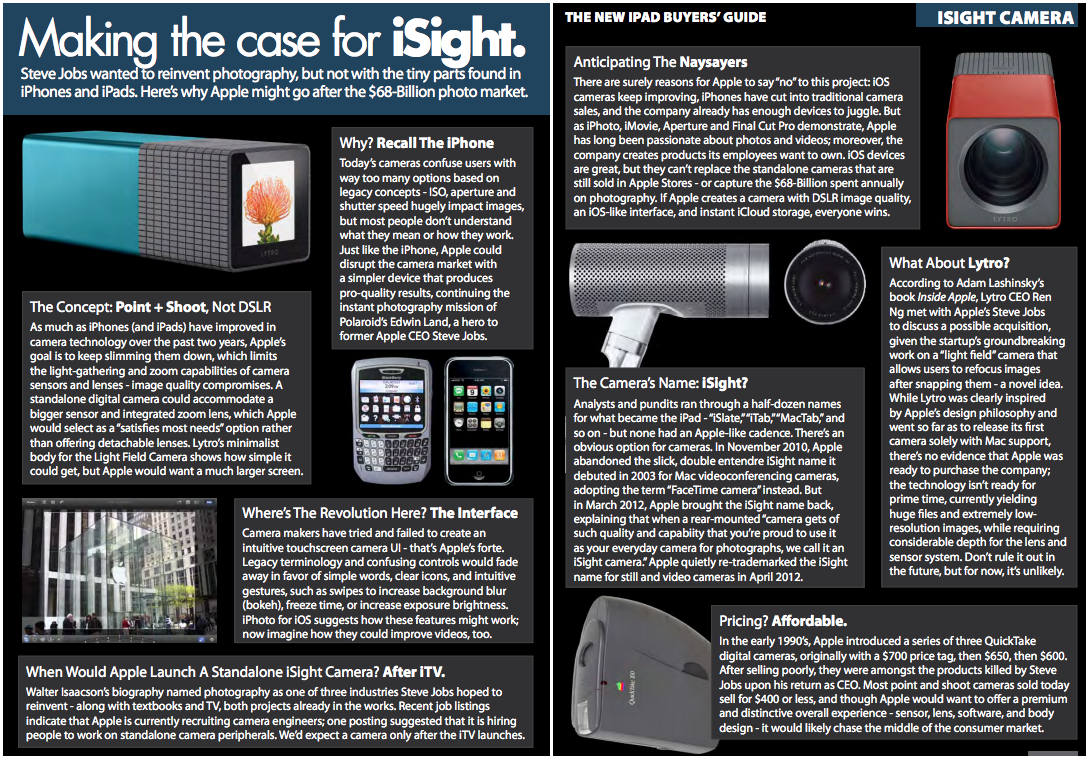
The New iPad Buyers’ Guide published by iLounge this week included a piece that speculated Apple might be working on a standalone camera product. While the story discussed the possibility of Apple working on a point-and-shoot iSight camera, iLounge clearly labeled it as speculation and simultaneously noted it received a tip claiming Apple is working on the project.

Take special note of pages 152 and 153—“Making the case for a standalone iSight Camera.” I’ll share more on this topic shortly, but for now, I’ll say that this two-page spread very nearly had a different title. We were tipped that this project is actually happening at Apple right now, but we didn’t feel confident enough in our source to call it a certainty; it’s therefore billed as speculation. Still, there’s enough smoke to make us think there’s a fire.

It did not feel strongly enough in the source to run the story, but Jeremy Horwitz of iLounge sent out a tweet today noting once again that Apple is working on a standalone camera:

[tweet https://twitter.com/horwitz/status/208273241540792320]

Expand
Expanding
Close

Next-gen iPhone schematic shows 4-inch display, repositioned FaceTime camera

Site default logo image

We posted high-resolution images of both the black and white versions of the next-generation iPhone back plate yesterday. Although we could determine many new features of the device, such as the redesigned speaker grills, repositioned earphone jack, and FaceTime camera, the exact display dimensions are still unknown. We noted one of our images depicted what appears to be the next-generation iPhone front glass with enough room for the much-rumored, roughly 4-inch display, but new schematics surfaced today (via Cydia Blog) that show a diagonal opening of just slightly over 4-inches. The designs also shows the repositioned FaceTime camera above the earpiece.

Although calculations of the display show an opening less than 0.1-inch over 4-inches, the display could likely measure a flat 4-inches diagonally as the front panel is typically slightly larger than the display. We noted yesterday that our sources informed us that the next-generation iPhone front glass images we posted feature the same width of the current iPhones, which would comfortably allow for an approximate 16:9 aspect ratio. We cannot confirm the schematic is 100 percent legit, or not just a past prototype, but also all the recent evidence points to a 4-inch next-generation iPhone that we expect to see this October.


Expand
Expanding
Close

Report: Apple to unveil new Apple TV OS at WWDC, will run on future HDTV

Site default logo image

According to a report from BGR, which cited a “trusted source,” Apple is preparing to demo a refreshed version of its Apple TV OS at WWDC next week. The report also claimed it is the same OS that runs on the much-rumored Apple HDTV that many reports indicate the company is working on. BGR also said Apple is testing a new “control out” API. The report explained:


Expand
Expanding
Close

Site default logo image

Tim Cook met with lawmakers in Washington last week to strengthen relationship and ‘open up a line of communication’

Tim Cook with U.S. Speaker of the House John Boehner—taken on May 15.

According to CNN Money, Apple’s CEO Tim Cook met with a number of U.S. Congressional leaders last Tuesday to strengthen Apple’s relationship with the government and develop an open line of communication between the two parties. The meetings were not exactly on legal issues, such as Apple’s current eBook battle with the U.S. Department of Justice, but rather a brief and “low key” introduction. One aide told CNN Money: “It was an act of opening up a line of communication, but it was a first step in what hopefully will be a growing relationship. They didn’t become best buds in one meeting.

Apple’s late co-founder and once-CEO Steve Jobs did not really have an open relationship with the U.S. government and chose to stay away from political and law issues. However, there was one time he actually had dinner with President Obama and other key figures. The President supposedly looked to Jobs for economical advice, and he even said the U.S. should support peoples’ aspirations to become like Jobs.

Last week’s meetings may indicate Cook is looking to change a few things at Apple when it comes to dealing with the government. Of course, Cook will not be quick to change pressing issues as rapidly as he and others at Apple might like, but things could change soon with a new relationship.
Expand
Expanding
Close

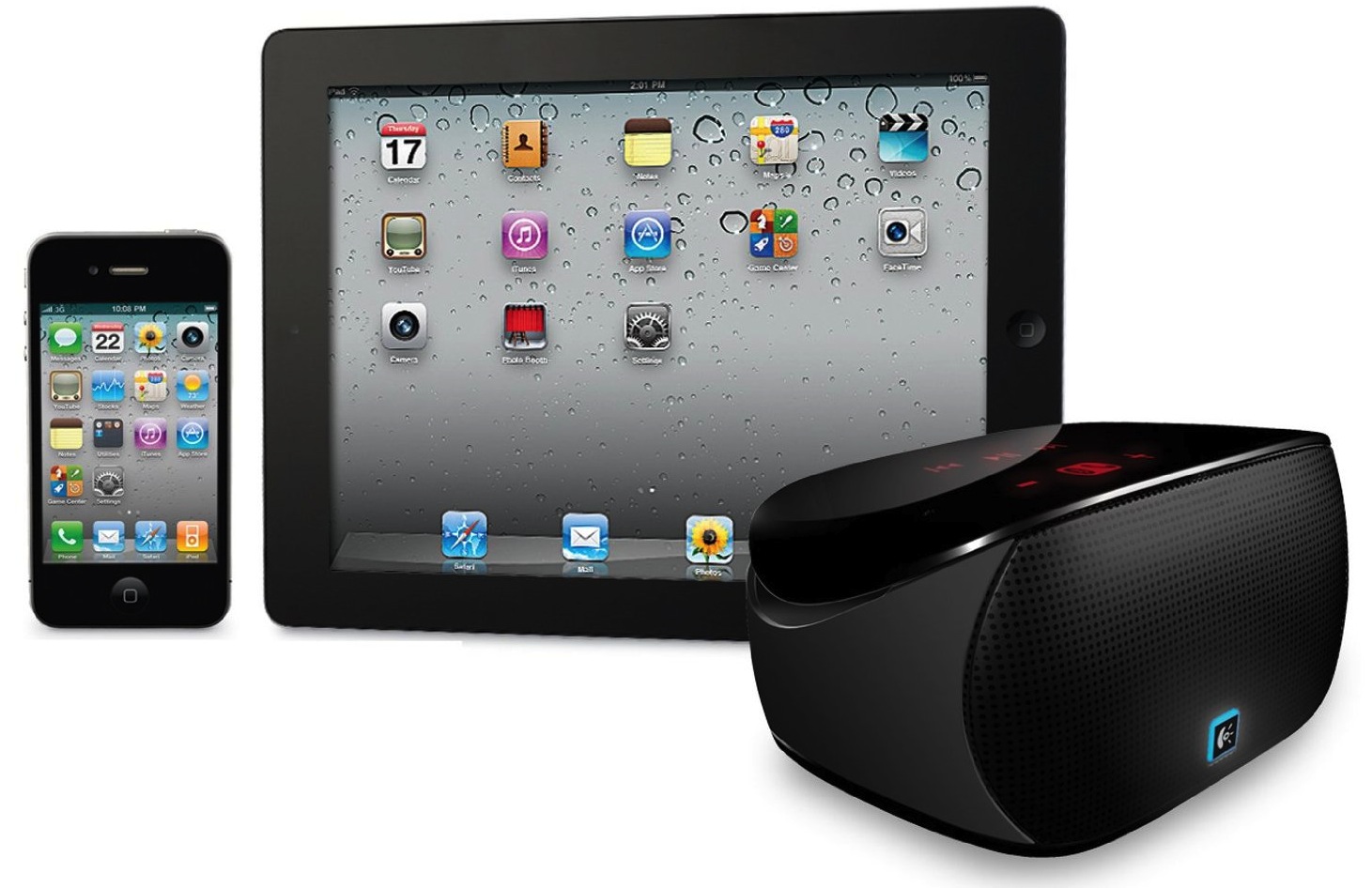
Review: $80 Logitech Mini Boombox—the diminutive wireless speaker with huge sound and battery

Site default logo image

Last month, I put the full-sized Logitech Boombox up against the Jawbone Jambox in a $150 Bluetooth speaker battle. I liked both devices, but they had separate strengths and weaknesses and were best suited to different tasks. For instance, I liked the portability of the Jambox, its speakerphone capability, and charging via USB. I liked the sound and simplicity of the Logitech Boombox, but I did not like the proprietary AC adapter.

After the review, Logitech got ahold of me and said if I liked the Jambox and the Boombox, they made another product that I would love called the “Mini Boombox.” Unlike Logitech’s full-size Bluetooth speakers, the Mini charges via Mini-USB, can fit in the palm of your hand (or cargo pant pockets), and it acts as a speakerphone for an iPhone. This one retails for $100, but it can be found for $79.99 at both Amazon (with $30 of MP3s) and Best Buy.

How did it stack up against the two $150 Bluetooth speakers mentioned earlier?


Expand
Expanding
Close

Site default logo image

iPad claims another victim: Cisco kills Cius Android tablet due to BYOD (read: i-P-a-d)

From 9to5Google: Cisco is killing off its Android-based Cius business tablet less than a year after launching due to the “BYOD trend.” Translation: iPad:

There’s no denying iOS devices and cheaper Android solutions are taking the place of Cius. Recent studies show Apple with 97 percent of tablets in the enterprise, while 94 percent of the Fortune 500 arecurrently testing or deploying iPad. The result is no further investment in the Cius tablet line and only limited support for what is currently available. The company will instead “double down” on Jabber and WebEx


Expand
Expanding
Close

Site default logo image

WSJ: Analysts now agree we’re going to see new Retina Macs in June

A newly redesigned 15-inch MacBook Pro was all but rumor until we reported earlier this month that Apple indeed has a slimmed down, all-new MacBook Pro sporting a Retina display, Ivy Bridge, and speedy USB 3. We followed that up with a report revealing Apple’s new MacBook Airs and iMacs will both likely include super-high resolution Retina displays. At the time, we reported Apple’s WWDC in June would be expected for at least the unveiling of the new slim MacBook Pro; although, a gradual roll out of Retina iMacs and Airs following the Pros would not be much of a surprise. Apple typically rolls out new Mac features such as higher-res displays gradually.

Following those reports, The Wall Street Journal published a story today quoting analysts who now all seem to agree that we will see upgraded Macs this summer. Ben Reitzes of Barclays Capital claimed the new Retina Mac lineup would debut at WWDC in June:

Reitzes said it is likely the Mac line will feature the retina-display technology used in the iPad, as well as the new Ivy Bridge quad-core processors from Intel Corp. (INTC) He also estimates that Apple’s new operating-system upgrade, called Mountain Lion, and the new MacBook Airs should be on the market before the first Ultrabook laptops with Microsoft Corp.’s (MSFT) Windows 8 operating system hit the shelves in the fall… “We believe recent data reflect a pause ahead of new products, which we believe will be released this quarter in June,” according to Reitzes, who has an overweight rating and $750 target price on Apple’s stock.