Before you can properly understand Apple News, it’s important to know its history. Apple was founded by Steve Jobs and Steve Wozniak in 1976. In 1977, Apple’s sales were growing with the success of its early computers. Within a few years, Jobs and Wozniak hired designers and a production line crew. Apple went public in 1980 and was an instant success. Over the next few years, Apple shipped new computers featuring new graphical user interfaces, such as the original Macintosh in 1984. As the market for personal computers expanded through the 1990s, Apple lost market share to the cheaper Microsoft Windows on PC clones. Eventually, Wozniak and Jobs both left Apple. Jobs would go on to found NeXT and would return to Apple when NeXT was acquired in the late 90s. Apple then began a journey to the great second act in the history of the business world.
Since the release of the iPod in 2001, Apple has become a major player once again in the technology industry. After releasing the iPhone in 2007, the iPad in 2010, and the Apple Watch in 2015, Apple is now one of the largest companies in the world. Apple’s worldwide annual revenue totaled $274.5 billion for its 2020 fiscal year.
Today, Apple operates retail stores all across the world, has a growing services division, and an ever-expanding hardware lineup. The technology industry follows Apple news to see where the company is headed in the future.
Below is our usual list of newly released apps and updates that landed in the App Store today. Some of the more notable apps on the list include updates to iOS apps Adobe Photoshop Express, and SketchBook Express, and Mac App Store apps Growl and Angry Birds Space. We will keep the list updated as more apps and updates are released throughout the day.
Adobe Photoshop Express Version 2.5: The free universal iPhone and iPad app was updated to include the Adobe Effects Pack of “45- eye-catching effects” and the Enhanced Adobe Border Pack with 18 new borders as in-app purchases. The update also includes improvements to borders, effects, and editing, as well as Tumblr and Twitter sharing options, improvements to Facebook and Flickr sharing, and support for the iPad’s Retina display.
SketchBook Express Version 2.5:The free version of Autodesk’s SketchBook Pro app was updated today with a few new features including palm rest, a random color option in Color Editor, and other enhancements and bug fixes.
Voice Answer Version 1.3:We told you about the Voice Answer app before when Apple rejected it for being too much like Siri. Today, Apple has finally allowed an update to the app that turns the app’s AI— named Eve—into a “a fully animated 3D robot.” The update also includes voice messaging, email, and calling, and it now supports 54 languages for translations.
Growl Version 1.4:Popular Mac notification app Growl received an update on the Mac App Store today with dozens of enhancements and tweaks to the service. The app’s release notes mentioned: “Major improvements to networking,” “Applications Tab Redesign,” and a long list of other improvements.
Angry Birds Space Version 1.2.0:The same as the iOS apps the other day, the Mac App Store version of Angry Birds Space now includes the “delicious food planet of Utopia,” which features 10 new levels for the title that recently reached 100 million downloads.
Update: Rogue Amoeba replied to Phil Schiller’s email in a response published on its website. The full response is below.
Following Apple’s decision to pull Rogue Amoeba’s Airfoil Speakers Touch app for a feature allowing iOS devices to stream to one another over AirPlay, Apple explained the app was removed for the feature’s use of non-public APIs. It currently only allows Apple TV and certain third-parties such as speaker manufacturers to access the AirPlay streaming protocol. The app was earlier this week allowed back into the App Store without the iOS-to-iOS streaming feature, but today we get word from Apple’s Senior Vice President of Worldwide Marketing Phil Schiller who explained in an email the reason behind removing the app.
An email to Apple’s CEO Tim Cook from concerned consumer Kevin Starbird regarding the app’s removal was met with a direct email response from Schiller. 9to5Mac independentlyconfirmed the emails are authentic. Here is Kevin’s full email addressed to Cook followed by Schiller’s response: Expand Expanding Close
The United Nations is considering a new Internet tax for U.S. websites and content providers including Google and Apple, according to leaked proposals from the European Telecommunications Network Operators Association:
The United Nations is considering a new Internet tax targeting the largest Web content providers, including Google, Facebook, Apple, and Netflix, that could cripple their ability to reach users in developing nations…The European proposal, offered for debate at a December meeting of a U.N. agency called the International Telecommunication Union, would amend an existing telecommunications treaty by imposing heavy costs on popular Web sites and their network providers for the privilege of serving non-U.S. users, according to newly leaked documents.
Last time we checked in on the ongoing U.S. patent-related court cases between Apple and Samsung, Apple’s lawyers were requesting to add the Galaxy S III to its previous motion for a preliminary injunction against the Galaxy Nexus line of products from February.
Apple was hoping the courts would agree to withhold sales of the S III until a ruling on the preliminary injunction was made. Samsung recommended the judge dismiss Apple’s request and file a new motion, but Apple attorney Josh Krevitt threatened Samsung at a hearing on Thursday that Apple could file a temporary restraining order as early as today to stop sales of the S III before it launches June 21. Bloomberg reported:
Josh Krevitt, a lawyer for Cupertino, California-based Apple, told Koh he was considering filing a request for a temporary restraining order in the interest of blocking sales of the Galaxy S III before its scheduled release in the U.S. this month… Krevitt said a court order temporarily barring Galaxy S III sales in the U.S. will create “a mechanism to allow the court to decide this issue before the launch.”
First Samsung will have to prove in court today that the Galaxy S III includes a “different combination of features” from the Nexus in order to prevent Apple from adding the device to the previously requested preliminary injunction. According to Bloomberg, Samsung lawyer Bill Price claimed: “Apple’s urgency stems from its inability to “compete against the new features” of the Galaxy S III, and the company is trying to “prevent a phone from getting to the public that is better than Apple’s in many, many respects.”
Reuters noted that several Google attorneys attended Thursday’s hearing. If Apple files for a temporary restraining order, the scheduled July 30 trial date would likely be delayed. Apple is also trying its best to kill HTC.
As noted by The Next Web, at least one developer has updated its Mac App Store app to include high-resolution “Retina graphics” for the new lineup of Retina display Macs that we revealed last month (here and here).
The Mac App Store app is Folderwatch. It was updated today with several new features, one of which is “Retina graphics.” We are not ready to speculate that the developers know something we do not, but Apple obviously allowed the update. It is likely we will begin to see Mac Apps updated with high-resolution artwork leading up to Apple’s introduction of Retina Macs at the Worldwide Developers Conference next week.
Some have pointed to the unusually high number of to-be-announced sessions on the WWDC schedule as proof of the introduction of a new app platform, but we noted that many of these sessions could relate to Retina Mac apps.
Apple got its hands on a new U.S. patent this week that loosely covers the entire form of its thinnest notebook.
According to The Verge, the patent [D661,296] is “clearly intended to broadly cover the distinctive wedge or teardrop profile” of the MacBook Air that is found in more and more “UltraBooks that Intel is pushing:
With design patents it’s all about the drawings. There isn’t much in terms of a written description to go by, so the nuances of the drawings define the enforceable protection of the patent. And as always, the coverage centers around the details of the solid lines in those drawings. The dashed lines provide context, but do not at all define what is patented. In determining infringement, courts look at whether the allegedly infringing device and the design patent are substantially similar in overall appearance to an “ordinary observer,” excluding minor differences. You can see […] how Apple has dashed out the unimportant details of the notebook, like the rear contour, hinge, side ports and feet, and instead focuses on the overall wedge shape and look of the device with solid lines. That’s the aesthetic Apple has patented here and a notebook with hinges, feet or a shaped back different than the MacBook Air could still be infringing as long as the rest — primarily the claimed wedge profile — is substantially similar. On the other hand, competitors can still rely on meaningful tweaks to the angles, shapes and proportions of their notebook designs to avoid the patent — that’s how patent design-arounds work.
Apple tends to uphold its design rights and go after competitors in the mobile space that infringe upon its patents. With this new notebook patent, which issued on Tuesday, rivals with contending unibody, aluminum-shaped laptops, such as Ultrabooks, may now be in the Cupertino, Calif.-based Company’s legal sights.
Amazon today dropped the price of the AppleTVto $94.86 – that’s the first discount we’ve seen on a new 1080P version of Apple’s TV product.
This latest-generation Apple TV displays 1080p widescreen video and features Netflix, YouTube, Vimeo, and Flickr integration, Airplay support, 802.11n wireless, Ethernet, HDMI video output, USB connectivity, and more. A 1-year Apple warranty applies.
Analytics firm Flurry has dissected developer ratios for Apple and Google’s mobile platforms as their respective annual conferences are on the horizon, and research findings show the two companies boast a joint market cap of about $750 billion.
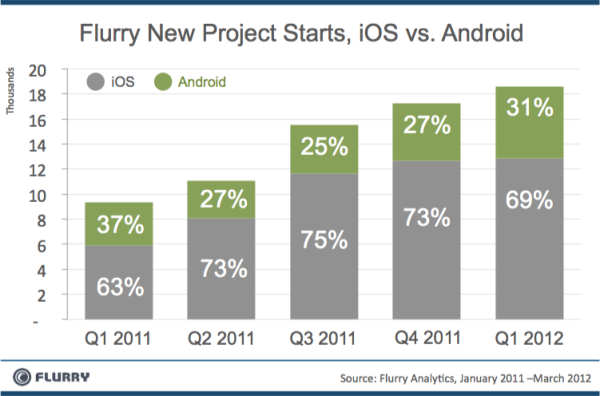
The study compared developer support for iOS versus Android by examining data collected from more than 70,000 companies across more than 185,000 mobile apps. The bar graph below illustrates developers’ loyalty to Apple: For every 10 apps that developers build, seven are for the iOS operating system.
“While Google made some gains in Q1 2012, edging up to over 30% for the first time in a year, we believe this is largely due to seasonality, as Apple traditionally experiences a spike in developer support leading up to the holiday season. Apple’s business has more observable seasonality,” explained Flurry in a blog post.
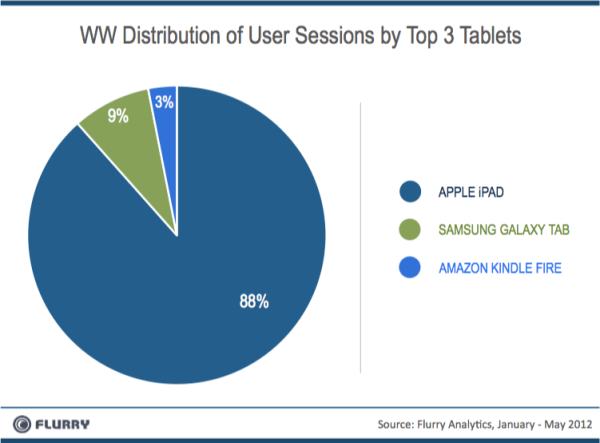
Flurry further cited iOS as the more attractive platform to developers due to its stronghold on the tablet market share. The pie chart below represents a sample size exceeding 5 billion total user sessions. It reveals the Galaxy Tab and Amazon Kindle Fire “hold very distant second and third places in terms of consumer usage.”
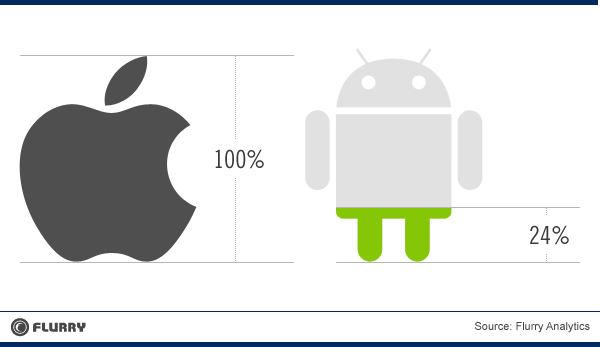
Another comparison on revenue generated by top apps for both Android and iOS uncovered the difference in revenue generated per active user is four times greater on iOS than Android. Flurry noted that for every $1 earned on iOS, a developer could expect to earn about 24-cents on Android.
Apple’s Worldwide Developer Conference is June 11 to June 15 in San Francisco, while Google’s I/O conference is June 27 to June 29 in the same California tech-hub city.
Samsung officially appointed a new CEO today to replace Choi Gee-Sung, who will now take up a position as head of corporate strategy overseeing Samsung Group’s roughly 80 companies. Choi, who was CEO for over three decades, will be replaced by Kwon Oh-hyun, who Reutersexplained is currently head of Samsung’s components business and has deep relationships with Apple. Samsung made a statement claiming there will be no major changes in the way the company operates, because Kwon will continue to run the components business that “became the sole supplier of the mobile processors” for iPhone and iPad under his leadership:
The South Korean group named Kwon Oh-hyun as its new CEO. Currently head of Samsung’s components business, which oversees chips and display, Kwon cemented Samsung’s position in memory chips, where it has almost 50 percent global market share, and expanded into non-memory, or logic chips, which now account for 40 percent of Samsung’s overall semiconductor revenue… Under Kwon, Samsung became the sole supplier of the mobile processors that power Apple’s iPhone and iPad – rival products to Samsung’s own Galaxy and Note. The 59-year-old former engineer, who studied electrical engineering at Seoul National University and Stanford, has also led a restructuring of Samsung’s LCD flat-screen business.
Apple removed Rogue Amoeba’s Airfoil from the App Store last month shortly after it began offering the ability to AirPlay music from one iOS device to another, effectively making your old iPod touch an AirPlay speaker. Some thought the app removal was due to use of private APIs. Apple gave a statement on the matter:
The feature in question permits any iOS device running the app to play back audio beamed from a variety of sources using Apple’s AirPlay wireless streaming protocol. Apple presently only allows designated products to act in this capacity — such as the Apple TV and (often expensive) AirPlay-enabled third-party hardware
From a post today, it seems pretty clear that Apple just did not want that functionality in the app and that third-party hardware vendors were to “blame.”
You may be asking why Apple would want to prevent users from having this functionality. Only Apple can provide a full answer here. We do know that Airfoil Speakers Touch’s ability to receive audio directly from iTunes and iOS enabled some users to forgo purchasing expensive AirPlay hardware, hardware which Apple licenses. It seems Apple has chosen to use their gatekeeper powers to simply prevent competition.
Perhaps as part of its costly AirPlay licensing, Apple gives speaker manufacturers exclusive rights to the AirPlay protocol. Maybe some of these makers cried foul when Airfoil allowed other iOS devices to sling audio to each other. Apple was then forced to remove it, otherwise breaking their exclusivity agreement. That does not seem too outlandish to me.
Apple put forward a second California litigation against South Korea-based Samsung earlier this week when it sought the court’s consent to add the Android-powered Galaxy S III smartphone to its motion for a preliminary injunction against the Galaxy Nexus.
Apple made this move approximately 20 hours after I wrote about the Galaxy S III being “the obvious next target”. In my blog post I speculated that Apple might bring a preliminary injunction motion against it, possibly after awaiting tomorrow’s preliminary injunction hearing. Apple decided to forge ahead now. Apple is on the offensive against Android. Earlier this week it filed an ITC complaint requesting an immediate import ban of 29 allegedly-infringing HTC devices. There’s an important overlap: the “data tapping” patent that Apple is seeking to enforce against HTC’s current generation of products is one of two patents Apple is using against the S III.
Apple purchased the S III in the United Kingdom, where Samsung launched it on May 29. The U.S. launch date is June 21 — precisely two weeks after the preliminary injunction hearing.
Apple’s motion notes that “[a]ccording to press reports, Samsung has already sold over nine million preorders of the Galaxy S III; indeed, the Galaxy S III has been reported to be the most extensively preordered piece of consumer electronics in history.”
Apple filed the first preliminary injunction motion against the Galaxy Nexus in February over four disputed patents. The Cupertino, Calif.-based Company’s requested in its latest motion that Samsung withhold the launch of the device’s successor in the United States until the court rules on the preliminary injunction request.
Samsung replied to the motion this afternoon, contending Apple cannot continue to add to its record for the Galaxy Nexus:
“If Apple wishes to seek an injunction against the Galaxy S III, the Court should require Apple to file a new motion and allow the parties to develop a full factual record on all four factors. Accordingly, the Court should reject Apple’s motion to amend its current notice of motion for a preliminary injunction.”
We told you about Mac OS X apps AirParrot and Reflection in the past. Developed by app makers Squirrels, AirParrot allows you to mirror your Mac’s screen on an Apple TV-connected TV, while Reflection provides mirroring of iOS devices to any Mac display. The developers have since followed up with updates to both of the apps bringing many requested features such as audio and Mountain Lion support, but they released PC versions of both apps today that allow you to mirror your iOS device to a Windows machine or a PC’s screen to an Apple TV.
As for the Windows version of Reflection, it will release with all the same features as the OS X client, including: screen recording, audio support, frame colors, full screen mode, multiple device mirroring, and more. The first release of the AirParrot PC app will just provide basic screen mirroring features initially due to roadblocks during development. Head developer David Stanfill, who is also the founder of Napkin Studio, told us about the difficulties of bringing the AirPlay mirroring functionality to PCs and provided us with screenshots of the apps below:
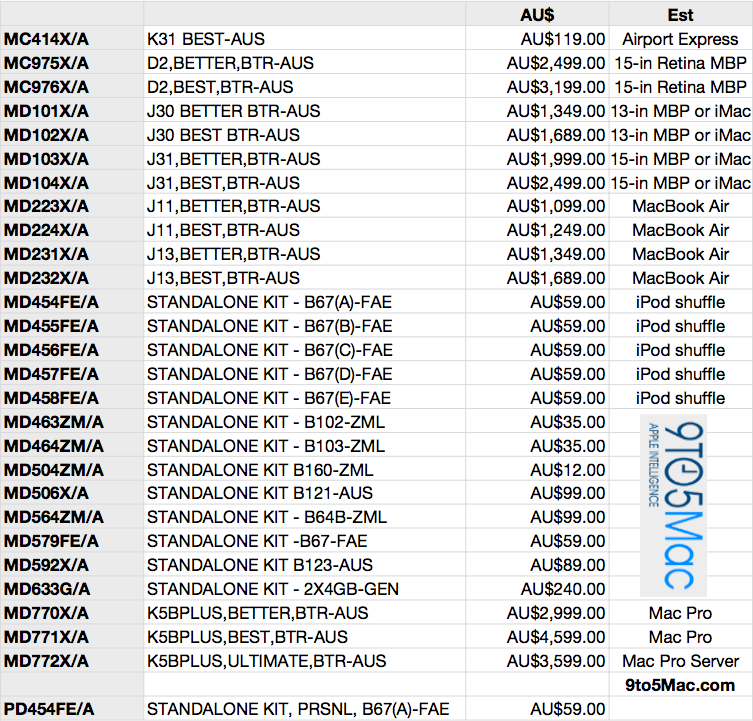
The image above represents the full pricing matrix for new devices expected to unveil in a few days at the Worldwide Developers Conference. You will notice the Mac Pros, Retina MacBook Pros, MacBook Airs, and iMacs that we discussed before at length.
We have more notes on the unlabeled parts below—including the newly identified RAM update: Expand Expanding Close
MacUpdate has one of the better bundles we’ve seen on a wide-ranging set of Mac software. If you are like us and getting a new MacBook next week, you can load it up with software: You are getting a solid deal with the Parallels 7 headliner ($30 off retail), but then you get some great apps up and down the lineup basically for free including:
1) Parallels Desktop 7 ($79.99)
2) BusyCal ($49.99) (first 10,000 bundles)
3) ScreenFlow 3 ($99.00)
4) Civilization V ($39.99) Gods & Kings expansion pack for just $20
5) Jaksta ($49.95)
6) Espionage 3 ($19.99)
7) Attachment Tamer 3 ($14.99)
8) Speed Download 5 ($25.00)
9) KeyCue 6 ($28)
10) A Better Finder Rename 9 ($19.95)
11) My Living Desktop 5 ($29.95)
Yesterday, we reported that Apple has an incredible WWDC surprise: major updates to four of its Mac lines. We were able to affirm that three of these updates would cover the redesigned MacBook Pro with a Retina Display, refreshed 11-inch and 13-inch MacBook Airs, and new iMacs in two screen sizes. Besides those three Mac lines updates, we were unsure if the either the Mac mini or the Mac Pro would make it as the fourth update. We speculated that it could be the Mac mini due to the newly available Ivy Bridge processors, but now, reliable sources are reporting that Apple will, in fact, unveil a new Mac Pro at WWDC next week.
Sources have also been able to provide some part numbers and prices to prove this:
MD770LL/A – K5BPLUS,BETTER, BTR-USA
MD771LL/A – K5BPLUS,BEST,BTR-USA
MD772LL/A – K5BPLUS,ULTIMATE,BTR-USA
The pricing is similar to current Mac Pro models. What’s interesting here is that we’ve seen updates to every other line of Macs that Apple carries….except one…The Mac Mini.
Our sources are currently unsure of the feature-set coming with the new Mac Pro, but these sources say that there will likely now be three configurations. Two standard versions of the Mac Pro and a third version with OS X Server capabilities. In early 2011, we reported on some of the work that Apple engineers had been prototyping up for a future version of Apple’s Pro desktop line. For that report, sources said that Apple had been experimenting with a new Mac Pro design that is rackable and stackable. These prototype machines also included space for more storage drives, an important feature now that the Xserve has been long discontinued. With a year having passed since we heard about these prototype Mac Pros and the ability of Thunderbolt to offload a lot of the expandability, the final new Mac Pro designs could be different than the current designs but we haven’t yet heard definitively either way.
MacRumors reported that Apple has begun pulling Mac Pro stock from some of its retail stores. We’ve heard the same from tipsters, left.
With Apple adding the super-fast USB 3.0 technology to its next-generation MacBook Pro, and with Apple’s latest Macs including the even faster Thunderbolt I/O technology, Apple will likely add these faster connection ports to their latest Pro desktop. Since the Mac Pro is Apple’s most high-end machine for professional workers of all types, the most important features are the internals. Earlier this year, Intel released a series of Xeon E5 chips that would seem like a lock for a new Mac Pro. These new Mac Pros will likely also likely feature the latest graphics chips.
Apple last updated the Mac Pro in July 2010, making this upcoming update significant. It is unclear why Apple had left the Mac Pro in its 2010 form for so long, but a reader email from 2011 might explain that. According to the Apple executive who replied to a 9to5Mac reader inquiring about the Mac Pro’s status, Apple had been “investing heavily” in the professional desktop computer. We are unsure what investing heavily will mean for the final product, but it should surely be an incredible update over the nearly two year old model.
Texas-based shell company Lodsys has often been accused of being a patent troll for its various attempts to take legal action against app developers and companies that it claims uses its technologies. Most notably, the company last year attempted to get iOS and Android developers to pay royalties over in-app purchasing before Apple’s legal team eventually intervened on behalf of developers. Now, after recent threats from Lodsys to Oracle customers such as Walgreens over a web-chat technology, Oracle is suing Lodsys in an attempt to invalidate its patents. GigaOMreported:
Oracle has decided to weigh in because Lodsys “has repeatedly threatened numerous Oracle customers” such as Walgreens over the use of a web-chat feature Lodsys claims to own. Oracle is asking the court to declare that the four patents Lodsys is using to bully its customers are not new inventions. The patents, including US Patent 5,999,908 (“customer based design module”), came to prominence last year when Lodsys used them to sue Best Buy, Adidas and others.
According to two separate reports today, Apple is once again facing roadblocks in its attempt to win sales bans in a patent-related litigation with Samsung and Motorola.
The first report comes from Bloomberg about a court in Dusseldorf, Germany, which said Apple would likely lose its bid for an injunction on Motorola’s Xoom tablet in the country:
The German court that banned Samsung Electronics Co.’s Galaxy 10.1 tablet sales last year is unlikely to grant Apple the same victory against Motorola Mobility’s device, Presiding Judge Johanna Brueckner-Hofmann said at a Dusseldorf hearing. The assessment is preliminary and may change after today’s arguments are reviewed. A ruling is scheduled for July 17… “We don’t think someone sits in a coffee house using the Xoom and hopes other people will think he owns an iPad,” Brueckner-Hofmann said.
The second report is related to the ongoing United States Samsung/Apple patent case. Today, CIO claimed Apple’s request to ban Samsung’s Galaxy Tab 10.1 was delayed due to a judge in California telling the court it will hold off on a ruling:
Apple’s bid to get a ban on sales in the U.S. of Samsung’s Galaxy Tab 10.1 tablet has been delayed after a federal court in California said on Monday it could not rule right away on Apple’s request for a preliminary injunction, while the matter is before an appeals court… The judge said Apple can renew its request for a preliminary injunction once the appeal court issues its ruling.
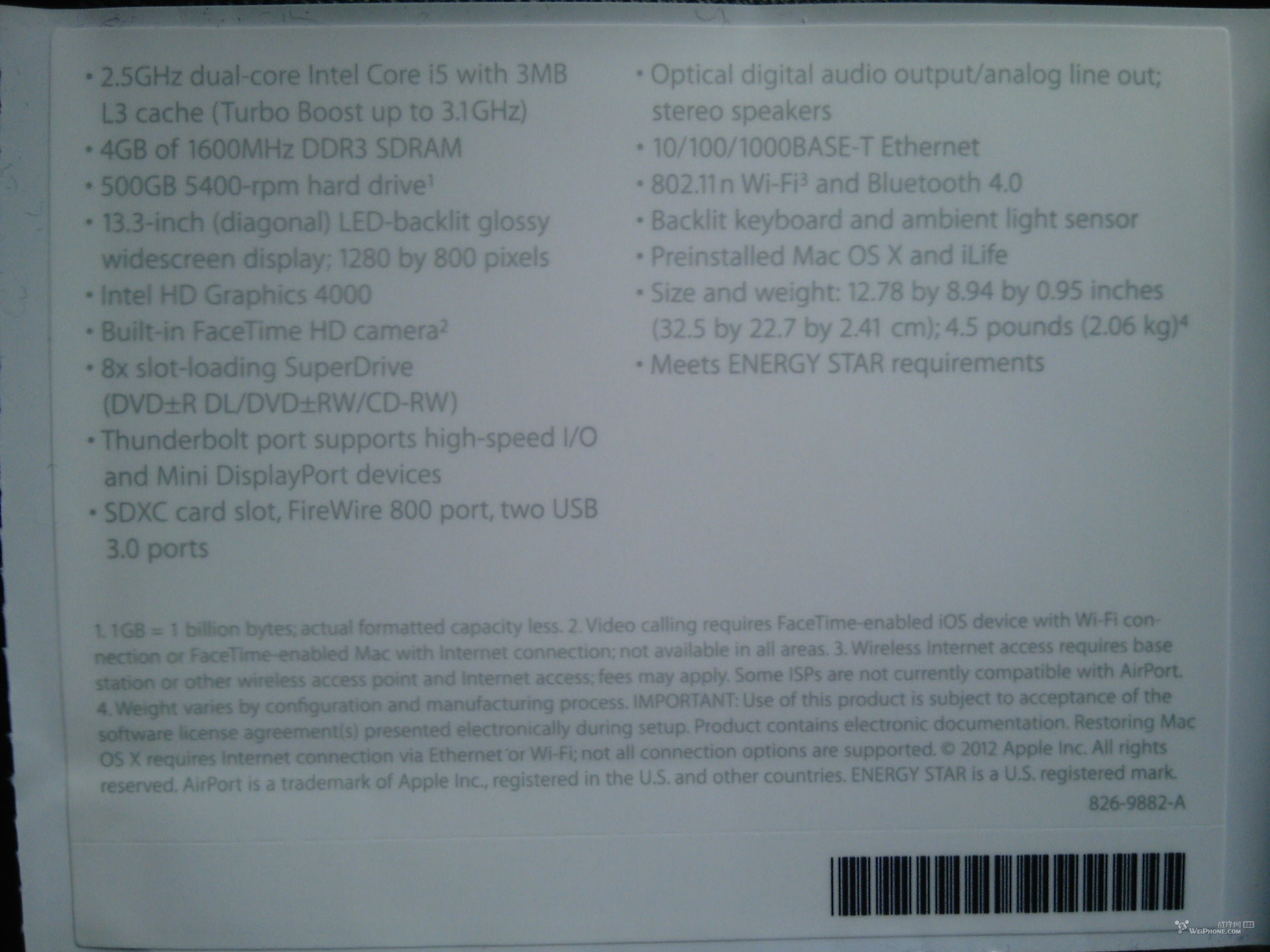
A Weiphone forum member shows a purported new MacBook Pro spec sheet ripped right from a unit. The notables are Intel HD 4000 video, USB 3.0, and a faster 1600MHz DDR3 RAM.
Perhaps more notable is the same .95-inch thickness (in fact it has the exact same dimensions as the current 13-inch MacBook Pro), optical drive, and sad 1,280-by-800 display that is not even as dense as the 2010 13-inch MacBook Air’s display.
This base model (if this is indeed real) is not going to be on our shopping list. Do you know what is?
Most of you know what is coming in iOS 6 Maps. However, in a long post this evening, which unfortunately does not include much that we haven’t seen or heard, the Wall Street Journal chronicles the last five years that have saw Google and Apple going from best of corporate friends by sharing board members and agreeing to no-poach agreements to sworn enemies spending a great deal of time disparaging each other in and out of courts. The latest breakup in the relationship, and probably the biggest holdout, is Maps. Apple has used Google’s Maps since the launch of the iPhone in 2007 when Google’s CEO Eric Schmidt went on stage to introduce the new software (above).
Later this year, Apple is planning to oust Google Maps as the preloaded, default maps app from the iPhone and iPad and release a new mapping app that runs Apple’s own technology, according to current and former Apple employees. Apple could preview the new software, which will be part of its next mobile-operating system, as soon as next week at its annual developer conference in San Francisco, one person familiar with the plans says. Apple plans to encourage app developers to embed its maps inside their applications like social-networking and search services. Technology blog 9to5Mac earlier reportedthat Apple will launch its own maps app in its next mobile-operating system.
Apple purchased Placebase, C3 Technologies, and Poly9 over the past three years to ramp up its mapping capabilities faster. In a rare description of something we have not heard, a use case is explained for the new calendar-integrated mapping system:
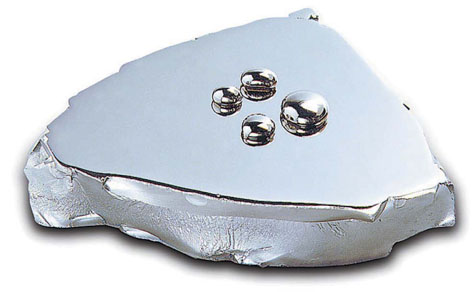
Apple has been said to use the oh-so shiny Liquidmetal technology ever since the Cupertino, Calif.-based Company obtained a patent to use Liquidmetal in its products in 2o1o. Apple ran a test using Liquidmetal in its SIM card ejector tool, and it is further rumored to be investigating uses in batteries. Some even said that Liquidmetal would be used in the next iPhone. However, it is unlikely that the casing will be made of the material.
In what looks to be a video aimed toward potential investors, Liquidmetal Technologies’ CEO Tom Steipp confirmed his company’s involvement by announcing it is supplying Liquidmetal to Apple. In the video seen below, the CEO said (55 seconds): “Our technology has been commercialized in a number of accounts,most recently by Apple computer, which took a license on the product in August of 2010. [Apple] along with us are commercializing [Liquidmetal] in the consumer electronic space.”
We do not believe Steipp is confirming Liquidmetal as a feature in the next iPhone, iPad, or computer on a large-scale. Although, it appears he is confirming that Apple will/has used Liquidmetal for more expensive parts—perhaps dealing with dense batteries. It makes sense for Apple to use the best materials out there.
This is not the first time we have heard from Steipp:
Microsoft just wrapped up its presentation at this year’s E3 event. While we did not hear anything about iOS support for its new cross-platform Xbox Music service, the company did confirm Xbox SmartGlass would come to Apple devices. SmartGlass incorporates at least some AirPlay-like features that enable users to send video from their mobile devices to Xbox Live and Windows 8. It would also allow phones and tablets to be used as a second screen for providing content related to video or games on Xbox.
Microsoft demoed the feature with Madden on Xbox. It allowed players to use their tablet’s touchscreen to draw plays. Unfortunately, Microsoft only mentioned support for Windows 8 mobile devices for the Xbox gaming features:
Microsoft announced ahead of the E3 conference a new software application called “SmartGlass,” which can be downloaded on Windows phones and Windows 8 tablets, as well as devices powered by rivals such as Apple Inc’s iOS and Google Inc’s Android operating systems… For TV, someone watching “Game of Thrones” on the “HBO GO” streaming service via Xbox could simultaneously browse websites about the show’s cast.
Corning Inc., the manufacturer behind Gorilla Glass, Gorilla Glass 2, and other display products, just announced a new ultra-slim, flexible glass called “Willow Glass“.
The Corning, N.Y.-based Company introduced its technology at the Society for Information Display’s Display Week tradeshow in Boston this morning. The main highlight is its ability to “wrap” around a device or structure. Willow Glass is specifically formulated to couple with touch sensors, and Corning is exploring further use in “lighting and flexible solar cells.” The company’s fusion process helps to make the product just 100 microns thick, which is akin to a sheet of printer paper. Willow Glass samples are shipping to customers now, but The Verge expects full production to begin later this year.
Apple released a report in March on U.S. jobs that revealed Corning employees in Kentucky and New York create “the majority of the glass for iPhone.”
Corning’s Gorilla Glass 2 is a much stronger, resilient version of the Gorilla Glass featured on Apple’s current iPhones. It’s possible that the next-generation iPhone will sport this new glass, so take a look at the video above.
While the media is quick to jump on any hint that Apple might be working on an HDTV—and many analysts even pinpoint a late 2012 launch—CEO of video cloud company Brightcove Jeremy Allaire said Apple’s approach to cable TV will not focus on a traditional TV monitor product (via AllThingsD). Instead, he makes the case for beaming content from iOS devices through dedicated cable TV apps using AirPlay. This follows reports late last month that claimed Apple is set to introduce a new Apple TV OS at WWDC this month. Allaire explained:
I believe Apple will seek partnerships with the top cable companies for them to open up their APIs for their EPG, VOD libraries and Network DVR infrastructure so that Apple can offer a superior user experience on top of those services… In such a model, you’d purchase and use an Apple TV device (more on what the devices will actually be below) and use it in concert with an existing subscription from a TV operator, and access the TV functionality as an App. Yes, cable TV will just be an app among what will be tens and then hundreds of thousands of apps on your Apple TV.
As for new devices and software, Allaire claimed Apple’s main focus would be to enhance its current TV platform and integration with iOS devices, while possibly entering the TV monitor business. He further claimed Apple will release a completely redesigned Apple TV set-top box as a “thin black bar,” a “TV monitor” device that includes the same features as the set-top box, and updates to iOS APIs and AirPlay to include “new camera and microphone, motion detection and speech recognition” capabilities:
First, Apple will release a new Apple TV add-on product, though I expect that rather than using the current “puck” design it will instead be a thin black bar, perhaps 1 inch tall and 3 inches wide, that can easily mount to the top of almost any existing HD capable TV set. Like the existing Apple TV, it will have HDMI and power jacks on the back, but it will also include a high-def camera built into it’s face, as well as an embedded iOS environment that provides motion-sensing and speech processing.
Second, Apple will also release a TV monitor product as well with identical capabilities as the updated Apple TV add-on device, but in a design and form factor that presents the Apple brand effectively. Why would they do this when it is such an established market with such long replacement cycles? In short, because they can, and it will be gorgeous and include the latest innovations in display technology, and will sell at a premium price that ensures a reasonable gross margin for Apple.
Third, Apple will provide updates to iOS that include significantly enhanced and improved AirPlay functionality, and where AirPlay capabilities become a more front and center aspect of the iOS experience. Additionally, they will release new iOS APIs for dealing with second screen device capabilities such as the new camera and microphone, motion detection and speech recognition. Developers will be encouraged to build iOS apps that are Apple TV ready, using dual-screen features and motion user interaction, among other things.