Apple

See All Stories

Apple News and Brief History

Before you can properly understand Apple News, it’s important to know its history. Apple was founded by Steve Jobs and Steve Wozniak in 1976. In 1977, Apple’s sales were growing with the success of its early computers. Within a few years, Jobs and Wozniak hired designers and a production line crew. Apple went public in 1980 and was an instant success. Over the next few years, Apple shipped new computers featuring new graphical user interfaces, such as the original Macintosh in 1984. As the market for personal computers expanded through the 1990s, Apple lost market share to the cheaper Microsoft Windows on PC clones. Eventually, Wozniak and Jobs both left Apple. Jobs would go on to found NeXT and would return to Apple when NeXT was acquired in the late 90s. Apple then began a journey to the great second act in the history of the business world.

Since the release of the iPod in 2001, Apple has become a major player once again in the technology industry. After releasing the iPhone in 2007, the iPad in 2010, and the Apple Watch in 2015, Apple is now one of the largest companies in the world. Apple’s worldwide annual revenue totaled $274.5 billion for its 2020 fiscal year.

Today, Apple operates retail stores all across the world, has a growing services division, and an ever-expanding hardware lineup. The technology industry follows Apple news to see where the company is headed in the future.

Keep reading for the latest Apple news
Site default logo image

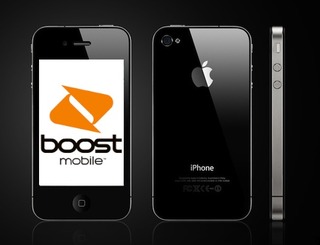
Source: No iPhone 4S on Boost Mobile in September

There is a rumor floating around today that surfaced conspicuously/immediately after the Cricket pre-paid phone was announced. If Cricket got the iPhone, it would make sense that Boost could also get the iPhone. Even we said:

Sprint, which carries the iPhone, and owns two big prepaid networks in Virgin and Boost Mobile, will likely have an iPhone prepaid offering in the coming months too.

Both Boost and Virgin use the same CDMA as Cricket, so it is not a technology barrier by any means.

However, according to our sources, Boost getting the iPhone this September is purely fiction.

We’re not sure if Boost isn’t getting it at all, or perhaps the timing is off, or perhaps Sprint’s more premium Pre-Paid service, Virgin, is getting the iPhone.

Update: Looks like it is Virgin.
Expand
Expanding
Close

Site default logo image

ChipWorks dives into the Samsung Galaxy SIII, discovers the Sony iPhone 4S camera

ChipWorks and iFixit are hardcore when it comes to breaking open our favorite devices to see what is inside. The two websites decided to take it up a notch today by joining forces to publish a live teardown of the non-LTE Samsung Galaxy SIII. ChipWorks looked at the—you guessed—chips, while iFixit focused on repair aspects.

This is what the ChipWorks dissection unearthed: 

Yep, that is Samsung’s Exynos 4412, 32 nm CMOS, 1.4 GHz quad core ARM processor.

“The Exynos is in a standard PoP (Package-on-Package) assembly with a Samsung LP DDR2 Green Memory K3PE7E700M-XGC2,” explained ChipWorks. “It is notable that this is the same process generation as we documented in the Apple A5 rev 2, APL2498, also fabricated by Samsung and for which you can see the general structure.”

The device also features the Sony IMX145 is an 8-megapixel, 1.4 um pixel pitch, back illuminated CMOS image sensor. Sony designs and manufactures this image sensor, which the Apple iPhone 4S also boasts. Samsung provides its own storage, however, with the KMVTU000LM. According to ChipWorks, it is a multi-chip Samsung MOVI N and memory module.

Go to 9to5Google for more information. 


Expand
Expanding
Close

Site default logo image

Netflix took top spot from Apple in US online movie revenue last year

Looking at data just released by IHS iSuppli, Netflix was able to take the top spot from Apple for online movie marketshare during 2011. With Apple experiencing a huge decline from 60.8-percent of the market the year before to 32.3-percent during 2011, Netflix came out on top for United States marketshare by revenue with 44 percent of the market last year. That is an incredible nearly 44 percent increase for Netflix, which had just 0.5-percent of the market in 2010.

What Netflix and iTunes have in common is that both services are focused on the hardware side of the business… Netflix is available on a very wide range of connected devices, while iTunes can take advantage of Apple’s soaring device sales growth… Nevertheless, comparisons between the two services have their limits… “Effectively the market has split,” Cryan said. “Netflix and Apple are competing for some of the same consumer time and money. However, the core value proposition of the two services is actually very different.”

While Netflix rules the SVOD market, its closest competitor—Hulu—is less than 10 percent of its size. Apple’s iTunes continues to dominate the transactional segment, accounting for 63.0 percent of revenue in this area, which was only down slightly from 64.6 percent in 2010. At the same time, the big growth story of 2011 was Walmart’s Vudu, which captured 8.2 percent of the growing transactional market, up from 2.8 percent last year. Most of this growth has been achieved by using a Netflix-like device strategy and has come at the expense of other providers, not Apple.

Apple to include Facebook integration in iOS 6

Site default logo image

Apple’s CEO Tim Cook hinted this past week during his interview at D10 that we could expect closer ties with Facebook and to “stay tuned” when asked about Twitter-like integration in iOS. Now, according to a report from TechCrunch, the much-anticipated integration of Facebook will happen in “the latest version of iOS.” There are not many details provided by the report, but it did note Apple is still trying to decide “exactly how sharing will work” and that things could change before iOS 6 is unveiled:

Expand
Expanding
Close

Twitter to host WWDC session, tickets available now (Update: sold out/rescheduled)

Site default logo image

Update: Tickets are now sold out, but the website noted: “Pending tickets are currently with other customers. They may become available, so check back soon”

Update 2: Looks like they might be looking for a bigger venue – it says now lists ‘rescheduled’

With Apple’s WWDC just around the corner, and many TBA sessions still on the latest schedule, you can at least now get tickets for Twitter’s WWDC Open House set to include “tech talks, food and beer with our iOS and native applications engineering team!” There is only 50 or so tickets still available at the time of this writing for the session that—among others—will include talks on “Patterns for Mobile-Friendly API Design,” and “how the Twitter for iPhone team ships code.”

@TwitterMobile and @TwitterEng invite you to an evening of tech talks, food and beer with our iOS and native applications engineering team! Register as soon as you can as we anticipate hitting our capacity very quickly. If you’re planning to bring a +1, please see below (#questions) so you can get in touch with us to let us know their name and info.

Twitter’s session is set to take place the opening day of WWDC on June 11 at 6:30 p.m. to 9:30 p.m.

Expand
Expanding
Close

Site default logo image

Hackintosh Ivy Bridge vs. Sandy Bridge benchmarked, small speed gains but significant power efficiency detailed [Video]

[youtube=http://www.youtube.com/watch?feature=player_embedded&v=oHzLPrXB8Wg#!]

With Apple’s upcoming Mac lineup to include the much-rumored Ivy Bridge upgrade, we get a look today at what the new CPUs might be cable of, courtesy of a comparison to Sandy Bridge, running on a Hackintosh. According to Insanely Great Mac:

How the new Ivy Bridge CPUs look to match up to Intel’s previous generation Sandy Bridge platform. Benchmarks include both stock and over clocked Core i7 3770K and Core i7 2600K. Plus a look at how the new chips may affect the next round of Mac upgrades.

Site default logo image

Author Ken Segall details fight between Jobs and Ive, reveals the iPhone’s surprising first name

Ken Segall, a former Apple consultant and subsequent author, recently revealed a couple of anecdotes on the late CEO Steve Jobs while speaking at an event for his tell-all book.

Segall remembered a quarrel between Jobs and Apple’s design guru Jonathan Ive. He said the pair was “inseparable” and as “close as lovers,” but he also noted they had their disagreements: According to PC Advisor:

Segall was shocked at one of these rare arguments between Steve and Jony – he even worried that Ive might quit Apple over the row.

After 1998’s Bondi Blue iMac Apple decided to push the boat out and release a whole rainbow of the coloured computers the next year. Many models in various hues were collected together for Jobs, Ive, Segall and a few others to select from.

But Ive was “driven crazy” by Steve’s choices, and eventually stormed out of the room to his holiday, shouting that Steve could choose any of the colours he liked but he was taking no more part in the discussion.

Walter Issacson’s “Steve Jobs” biography provides a little more background information on the iMac feud:

Ive soon came up with four new juicy-looking colors, in addition to bondi blue, for the iMacs. Offering the same computer in five colors would of course create huge challenges for manufacturing, inventory, and distribution. At most companies, including even the old Apple, there would have been studies and meetings to look at the costs and benefits. But when Jobs looked at the new colors, he got totally psyched and summoned other executives over to the design studio. “We’re going to do all sorts of colors!” he told them excitedly. When they left,Ive looked at his team in amazement. “In most places that decision would have taken months,” Ive recalled. “Steve did it in a half hour.”

The author of “Insanely Simple: The Obsession That Drives Apple’s Success” further remembered one of the first names considered for the iPhone. So, what is the ingenious smartphone name that fell to the wayside in lieu of the “iPhone” moniker?

The “iPad.”

The book is $15.


Expand
Expanding
Close

ETSI selects Apple’s nano-SIM design for new 4FF standard?

Site default logo image

We already knew that Apple is pushing hard to have the European Telecommunications Standards Institute select its nano-SIM card design over competitors like Nokia and Motorola, who proposed their own alternative design with RIM. While it was rumored that Apple had support from the majority of European operators, the ETSI confirmed today that it has selected a form factor for the new 4FF SIM Card:

The fourth form factor (4FF) card will be 40% smaller than the current smallest SIM card design, at 12.3mm wide by 8.8mm high, and 0.67mm thick. It can be packaged and distributed in a way that is backwards compatible with existing SIM card designs. The new design will offer the same functionality as all current SIM cards.

The announcement from the ESTI does not flat-out confirm Apple’s design was chosen, but we are able to confirm that the new form factor does match up nicely with measurements of Apple’s proposed design thanks to a little bit of investigative work courtesy of The Verge. Unfortunately, Nokia and Motorola’s proposed design had almost identical dimensions. We will have to wait for more official information on the new standard from ESTI before we know for sure that Apple’s design was selected.

The ESTI explained the standard would be published in its TS 102 221 specification:


Expand
Expanding
Close

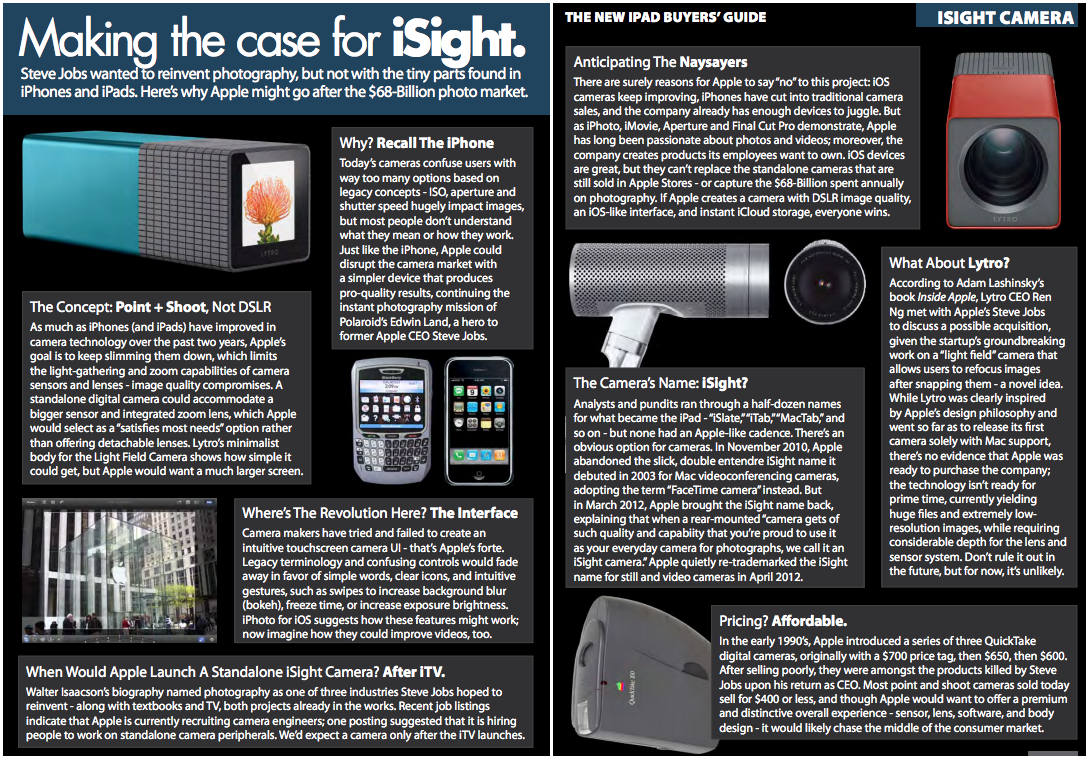
Rumor: Apple working on standalone iSight camera?

Site default logo image

The New iPad Buyers’ Guide published by iLounge this week included a piece that speculated Apple might be working on a standalone camera product. While the story discussed the possibility of Apple working on a point-and-shoot iSight camera, iLounge clearly labeled it as speculation and simultaneously noted it received a tip claiming Apple is working on the project.

Take special note of pages 152 and 153—“Making the case for a standalone iSight Camera.” I’ll share more on this topic shortly, but for now, I’ll say that this two-page spread very nearly had a different title. We were tipped that this project is actually happening at Apple right now, but we didn’t feel confident enough in our source to call it a certainty; it’s therefore billed as speculation. Still, there’s enough smoke to make us think there’s a fire.

It did not feel strongly enough in the source to run the story, but Jeremy Horwitz of iLounge sent out a tweet today noting once again that Apple is working on a standalone camera:

[tweet https://twitter.com/horwitz/status/208273241540792320]

Expand
Expanding
Close

Site default logo image

Apps and updates: Little Things Forever, Diet Coda, Sparrow, Netflix, Angry Birds Space, and more

[slideshow]

A few of the most noteworthy apps in the iOS ecosystem either landed on the App Store recently or received much-welcomed updates, such as the launch of Little Things Forever—the long-awaited sequel to the “iPad App of the Week” Little Things. Performance enhancements and new feature additions also arrived to Little Things,  as well as Diet Coda, Sparrow for iPhone, Netflix, Etsy, Pinterest, Angry Birds Space and Angry Birds Space HD, Flixster with Rotten Tomatoes, Google Shopper, and Djay and Djay Free.

Check out the full slate of notables below.


Expand
Expanding
Close

Site default logo image

Atari founder on Steve Jobs: Apple culture came from Atari

TUAW interviewed one of only a few people to ever hire Steve Jobs, the founder of Atari Nolan Bushnell. As you might expect, he is working on a few iOS projects, and he is particularly interested in augmented reality. These paragraphs stand out:

“He basically lived just below me in Woodside for many, many years, before he moved down to Palo Alto, and he’d just walk up the hill to my house and we’d go on and bullshit about stuff. We kept in contact — I’m writing a book right now called ‘Finding the Next Steve Jobs,’ because I was one of the few people that ever gave him a job.”

Bushnell says even at that early point in his career, Steve stood out. “The thing that people miss about Steve is that Steve was very, very driven and very passionate. He was an enthusiastic individual about everything. He had one speed and it was full blast,” says Bushnell. Some of the qualities Jobs is now known for were some of the reasons he first was able to join on at Atari back in the early ’70s. “We looked at what people did in their spare time, how diverse they were. We never looked at grades, college degrees. One of the best engineers at Atari never graduated from high school, and he was one of the prime architects for the 2600.”

Bushnell says that attitude at Atari definitely shaped Apple as a company later on. “We were focused on merit. And the fact that we can go to work in tennis shoes and a t-shirt started at Atari and it was taken to Apple. Because we said this is a meritocracy, we don’t care where you go to school, when you come to work, we don’t care if you come to work, we don’t care where you are we you are at work. You get the job done, we’re happy.”

Interesting to think that some of Apple’s culture is derived from Jobs’ days at Atari. The book should be interesting.

Amazon Trade-In program conveniently now lists MacBook lineup, other laptops

Site default logo image

Amazon’s Trade-In program now accepts laptops and netbooks, which means Mac users are eligible to swap their MacBook Pro, MacBook Air, or MacBook before the upcoming refresh. How convenient—especially with the new MacBooks likely just weeks away from launch!

Starting today, those who are interested can visit www.amazon.com/tradein to search for electronics worth trading-in. After finding the item, click the Trade in button. After the trade-in submission is accepted, Amazon offers free shipping through UPS Ground or U.S. Postal Service to eliminate the headache and cost of the trade-in process. All items have to ship within seven days of submitting the transaction.

The online retailer deposits a Gift Card into the seller’s account after the deal finalizes. Unaccepted trade-ins either will receive a lower Gift Card amount or simply be returned. The return method adheres to the seller’s preference, which is selected upon completing the initial transaction online.

A quick glance through the MacBook price tags reveal an Apple MacBook Pro MD322LL/A 15.4-Inch Laptop (NEWEST VERSION) for a trade-in value up to $1,230, while an Apple MacBook MC516LL/A 13.3-Inch Laptop (OLD VERSION) fetches a trade-in value up to $360. An Apple MacBook Air MC966LL/A 13.3-Inch Laptop (NEWEST VERSION) earns a trade-in value up to $74o. The amount offered per trade-in varies depending on the model and condition.

9to5Mac first reported earlier this month that Apple is prepping a new 15-inch MacBook Pro for this summer that features an ultra-thin design, a “jaw-dropping” Retina Display, and super-fast USB 3. Our sources also indicated the MacBook Retina Display will début at the Worldwide Developers Conference next month, but it will not stay exclusive to Apple’s Pro notebook. The first-class, high-resolution display is also coming to the MacBook Air family.
Expand
Expanding
Close

Site default logo image

Report: Microsoft Office for iPad launching on Nov. 10

Reports claimed last week that an iPad version of Microsoft Office would launch in November, following several reports from The Daily, which claimed Microsoft is readying the app and posted the alleged spy shots above. Today, The Daily weighed in again by offering an exact launch date of Nov. 10:

Microsoft will launch Office for iPad on Nov. 10, The Daily has learned. This follows reports earlier this month that a late fall release was likely… We’ve learned that the development team within Office Mobile finished its work on the project last month, and the efforts of the design group wrapped soon after. The app is  now in the hands of a usability team that appraises software that utilizes the Metro design language for “Metro compliance” and suggests changes as needed. When approved by the team, the app likely will go to Apple for app store approval, which could take a couple of weeks.

Site default logo image

Foxconn workers, activists claim no change at Apple plants following FLA audits

We reported earlier this month that Foxconn announced it would share the initial costs of improving iPhone and iPad assembly plants with Apple following an agreement to improve working conditions based on recommendations from the Fair Labor Association. Today, according to a report from Reuters, labor watchdog Student & Scholars Against Corporate Misbehaviour released a report claiming Foxconn factories have not changed much since the FLA’s audits:

A fresh report released on Thursday by labor watchdog Student & Scholars Against Corporate Misbehaviour (SACOM), based on visits to several Foxconn factories and 170 worker interviews, found rights violations “remain the norm” including high production targets, inhumane treatment and signs of overall salary cuts.

“The frontline management continue to impose humiliating disciplinary measures on workers,” it said.

“The above findings demonstrate that Apple and Foxconn have not turned over a new leaf,” the report added.

Even after recently raising wages of some workers by 16 to 25 percent, Reuters’ report claimed average overall salaries decreased and some “had to work unpaid overtime after pay hikes.” A Foxconn worker in Guanlan told Reuters: “The work pressure is still great… There hasn’t been much change. We are still being pushed very hard.”

Foxconn responded to the SACOM report in a statement to Reuters:

“The welfare of our employees is without a doubt our top priority and we are working hard to give our more than one million employees in China a safe and positive working environment,”

iPhone goes prepaid in the US on Cricket starting June 22

Site default logo image

Update: Apple commented on the move:

“By making iPhone available on pre-paid plans through Cricket Wireless, we are making the best smartphone more accessible to an even broader market in the US,” Apple representative Natalie Harrison said.

Apple took a big step today in the United States by aligning with Cricket prepaid Wireless. While you can buy an iPhone off-contract (for significantly more than the above Cricket prices), and then go on AT&T, T-Mobile, or any GSM carriers’ network, this is the first time Apple has let the iPhone play in the prepaid market.

Cricket’s monthly fee for unlimited anything (data throttled after 2.3GB) is $55 per month, which is very low for all things considered. You can also quit at any time, take months off, or trade phones. However, you need to buy the iPhone at an “unsubsidized rate.” But is it really unsubsidized?

What is interesting is that Cricket offers the iPhone 4 for $399 and iPhone 4S for $499. Look at Apple’s prices for unlocked iPhone 4S (iPhone 4 costs $549):

.

There is a $150 gap somewhere. Perhaps Cricket is subsidizing some of the cost by thinking buyers will eventually make up that $150 difference in service fees. Apple may also offer Cricket a discount as it buys large quantities of iPhones, because Apple is hoping to spread its customer base.

We are not sure how many prepaid customers will shell out $400 to $500 up front for an iPhone. However, there are probably some jailbreaker/unlockers or otherwise who would like to take a Cricket iPhone and use it off-network (or without a network).

Sprint, which carries the iPhone, and owns two big prepaid networks in Virgin and Boost Mobile, will likely have an iPhone prepaid offering in the coming months too.

The press release follows:
Expand
Expanding
Close

Site default logo image

Gruber: TBA sessions on WWDC schedule could point to apps for Apple TV

In a post where he admittedly overanalyzed the recently released schedule for WWDC 2012, Daring Fireball’s John Gruber speculated that the high amount of “To Be Announced” sessions could indicate the launch of a new developer platform. His bet? Apps for Apple TV:

To me, this is what a preliminary WWDC conference schedule would look like if Apple were set to announce a new developer platform, like, say, apps for Apple TV. Apps for Apple TV is just a guess — I’ve heard not a single whisper about such a thing from any Cupertino area little birdies. (Cf. the aforementioned Tim Cook quote about Apple doubling down on secrecy.) But it’s one of the few things I can imagine would that would be big, new, and different enough to warrant that much attention at WWDC.

This tidbit follows reports from this morning that claimed Apple is set to introduce a new Apple TV OS and APIs, which could work with the unconfirmed Apple HDTV. We noted this morning that a new Apple TV OS raised questions, especially because Apple introduced a revamped Apple TV UI in March. We will have to wait a couple weeks to find out for sure, but we are expecting to see at least thinner, redesigned MacBook Pros, iOS 6, and Mountain Lion. Some of the TBA sessions could be for Retina Mac apps.

Apple will kick off WWDC with its keynote presentation at 10 a.m. PST on June 11.

Site default logo image

New original iPad 3G 64GB: $350 (Collector’s item?)

From 9to5Toys.com:

.

MacConnection offers a New-in-box original iPad in its maxed out configuration for just $350.  That’s much less than half its original $829 price tag but at about the same price you can pick up a refurbished base model iPad 2. This could be used in the car, for kids/grandparents or even as a collector’s item.

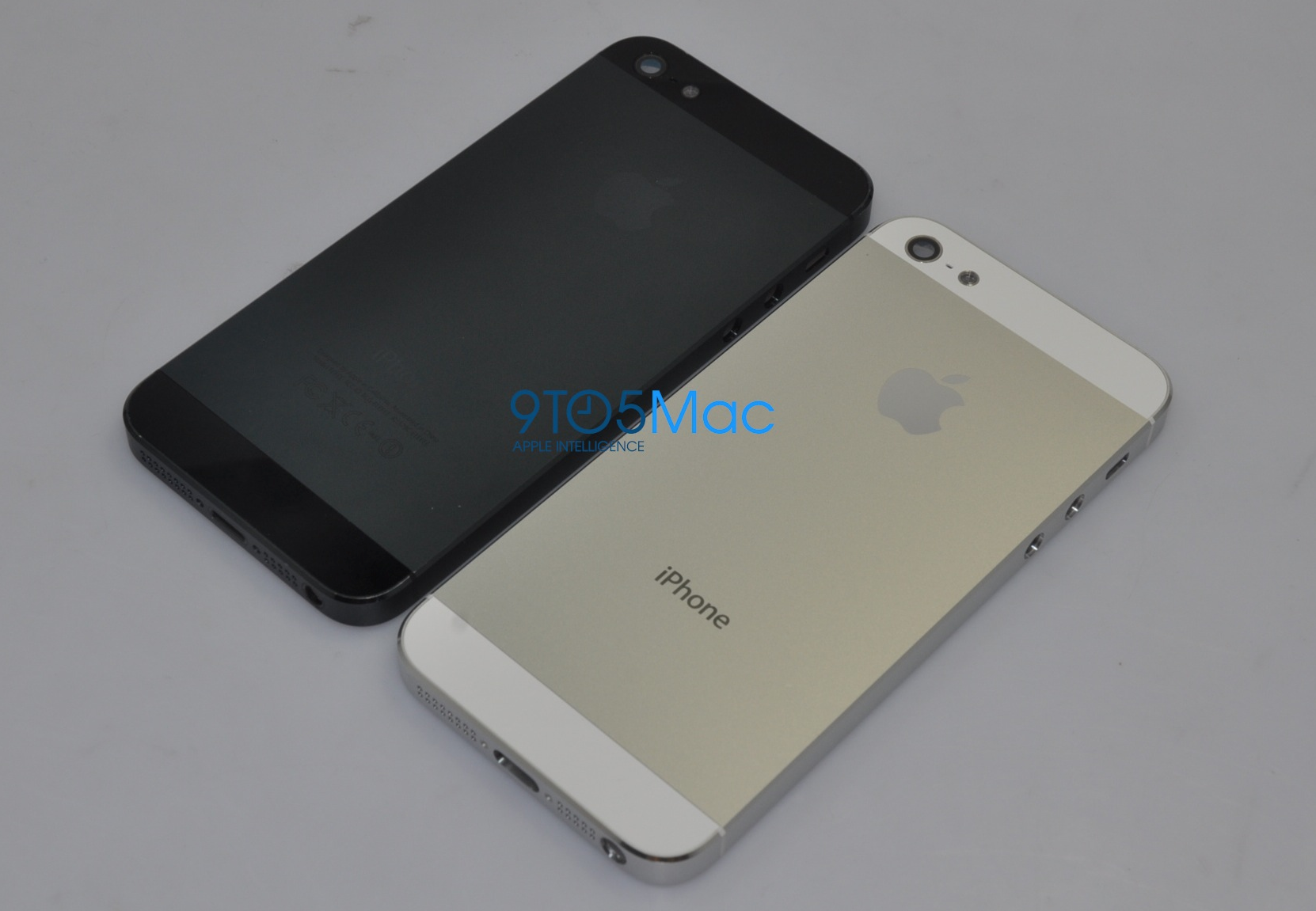
Next-gen iPhone schematic shows 4-inch display, repositioned FaceTime camera

Site default logo image

We posted high-resolution images of both the black and white versions of the next-generation iPhone back plate yesterday. Although we could determine many new features of the device, such as the redesigned speaker grills, repositioned earphone jack, and FaceTime camera, the exact display dimensions are still unknown. We noted one of our images depicted what appears to be the next-generation iPhone front glass with enough room for the much-rumored, roughly 4-inch display, but new schematics surfaced today (via Cydia Blog) that show a diagonal opening of just slightly over 4-inches. The designs also shows the repositioned FaceTime camera above the earpiece.

Although calculations of the display show an opening less than 0.1-inch over 4-inches, the display could likely measure a flat 4-inches diagonally as the front panel is typically slightly larger than the display. We noted yesterday that our sources informed us that the next-generation iPhone front glass images we posted feature the same width of the current iPhones, which would comfortably allow for an approximate 16:9 aspect ratio. We cannot confirm the schematic is 100 percent legit, or not just a past prototype, but also all the recent evidence points to a 4-inch next-generation iPhone that we expect to see this October.


Expand
Expanding
Close

Report: Apple to unveil new Apple TV OS at WWDC, will run on future HDTV

Site default logo image

According to a report from BGR, which cited a “trusted source,” Apple is preparing to demo a refreshed version of its Apple TV OS at WWDC next week. The report also claimed it is the same OS that runs on the much-rumored Apple HDTV that many reports indicate the company is working on. BGR also said Apple is testing a new “control out” API. The report explained:


Expand
Expanding
Close

Tim Cook on Steve Jobs as flip-flopper, tablets & PC legacy, and ‘Pain in the ass’ patent wars [Video]

Site default logo image

[youtube=http://www.youtube.com/watch?v=Z2tkxWfDOaM]

AllThingsD just posted clips of almost the entire Apple CEO Tim Cook interview from D10. Our live blog of the event is here. The first video (above) is Cook’s comments on former CEO Steve Jobs as a “flip-flopper,” followed by a second video (below) where he discussed tablets and the PC legacy.

[youtube=http://www.youtube.com/watch?v=r33DGQL35wQ&]

Links to the rest of the videos are below, where Cook talks about doubling down on privacy, the “Pain in the ass” patent wars, etc.


Expand
Expanding
Close

Site default logo image

Cook: Apple is considering killing off Ping, admits it has to be more social

While agreeing that Apple has to do more social network-type features, CEO Tim Cook noted at the D10 conference in California tonight that the company will consider killing the Ping social network feature baked into iTunes due to a lack of interest among users. He did mention that social has to be a focus despite Apple not necessarily having to own a social network, and he noted upcoming Twitter, Game Center, and iMessage integration in Mountain Lion bring new social elements:

What happened to Ping?

Cook: Apple doesn’t have to own a social network, but does Apple have to be social? Yes…You’ll see us integrate Twitter into the Mac OS as we introduce Mountain Lion. Game Center and iMessage could be thought of as social… We tried Ping and I think the customer voted and said this isn’t something that I want to put a lot of energy into… Will we kill it? I don’t know. We’ll look at that.

Site default logo image

Tim Cook hints at improvements to Siri in coming months, says ‘We have a lot that Siri can do’

Some more noteworthy comments from Apple’s CEO Tim Cook coming out of tonight’s interview with Walt Mossberg and Kara Swisher at D10 in California. We just heard Cook’s thoughts on deeper Facebook integration and Apple TV sales, and a few moments ago he hinted improvements to Siri will arrive “over the coming months.” He also noted that there is “a lot that Siri can do,” and he said they are doubling down on the tech with “a lot of people working on it.”

“I think you are going to be really pleased with where we take Siri.”

Cook’s comments via The Verge:

Customers love it. It’s one of the most popular features of the 4S. But there’s more that it can do, and we have a lot of people working on it. And I think you’ll be really pleased with some of the things coming over the coming months. The breadth of it. We have a lot that Siri can do… That’s what I’m talking about. People have dreamed of this for years, and it’s here. Yes it could be broader, but Siri as a feature has moved into the mainstream. So I think you’re going to be really happy with where it’s going. We’re doubling down on it.

Site default logo image

Tim Cook: We’ve sold 2.7M Apple TVs this year

Live from the D10 conference in California, Apple’s CEO Tim Cook just noted onstage that the company sold 2.7 million Apple TVs in just the first few months of this year. The last time we received official numbers from Apple, it reported 1.4 million units for Q1 and sales of just 2.8 million for the entire previous year, which means Apple is on track to double its Apple TV sales this year. Cook’s comments, as reported by The Verge:

Tim: You know, very uncharacteristic of us, we’ve stayed in the Apple TV product. We’re not a hobby kind of company as you know. Our tendency is to do very few things. And, if something creeps in and isn’t a big success, we get it out of the way and put our energies on something else. Apple TV though, you see what we’ve done. We’ve stuck in this. It’s not a fifth leg of the stool. It’s not the same size as the phone or Mac or tablet business. But last year we sold a little less tan 3m Apple TVs… This year, just in a first few months, we’ve sold 2.7m… This is an area of intense interest for us…