Siri

See All Stories

Siri does more than ever. Even before you ask.

Siri is Apple’s personal assistant technology that debuted in 2011 with the iPhone 4S. Apple purchased Siri in 2010. At the time, it was a dedicated app on the iPhone. When it became built into the iPhone, it could do basic things like play music and make phone calls.

Now, it can do things like integrate with third-party messaging apps. payments, ride-sharing service, calling app, set timers, get directions, add reminders, start TV shows on the Apple TV, make language translations, search for photos, open documents, interact with your smart home though HomeKit, and a lot more.

In iOS 12, it became integrated into more third-party apps through Shortcuts. Companies can build their own interactions for the service to work with.

Compatible Devices

iPhone

iPad

Siri Remote for Apple TV

AirPods

HomePod

Apple Watch

Car Play

Site default logo image

Will your iOS device get all of the new iOS 6 features? Here’s the official word

As iOS 6 officially unveiled yesterday, we noted a few of the features—such as Siri and FaceTime—would only be available on certain iOS devices. Ars Technica noticed the 3D flyover feature of Apple’s new Maps app would only be available to A5-powered iOS devices. In case you were wondering exactly which iOS 6 features will be compatible with your iOS device, Apple published a list (below) on its iOS 6 preview page that details all of the limitations for specific features:

-Flyover and turn-by-turn navigation will be available only on iPhone 4S and iPad 2 or later. Cellular data charges may apply.

-Siri will be available only on iPhone 4S and iPad (3rd generation) and requires Internet access. Siri may not be available in all languages or all areas, and features may vary by area. Cellular data charges may apply.

-Shared Photo Streams requires iOS 6 on iPhone 4 or later or iPad 2 or later, or a Mac computer with OS X Mountain Lion. An up-to-date browser is required for accessing shared photo streams on the web.

-FaceTime over a cellular network requires iPhone 4S or iPad (3rd generation) with cellular data capability. Carrier data charges may apply. FaceTime is not available in all countries.

-VIP list and VIP and Flagged smart mailboxes will be available on iPhone 4 or later and iPad 2 or later.

-Offline Reading List will be available on iPhone 4 or later and iPad 2 or later.

-Made for iPhone hearing aids require iPhone 4S.

-Find My Friends and Find My iPhone enable you to locate iOS devices only when they are on and connected to a registered Wi-Fi network or have an active data plan. Not available in all areas.

Two new Apple iOS apps to be announced today: Organize.app and…

Site default logo image

Fox News’ Clayton Morris tweeted today that he got word there will be two new iOS apps revealed today:

[tweet https://twitter.com/ClaytonMorris/statuses/212195055782469632]

We detailed one called Organize.app:

Get Organized… with an all-new app from Apple?

iOS 6 will likely feature everything we’ve reported thus far (above: Siri on iPad, a 3D Apple-based Maps application, and features from OS X Mountain Lion), but there has been one possible feature that we’ve been hearing whispers about, but not full, concrete details like we heard for other features. Apple is working on a new in-house application for iOS called “Organize,” but we’re not sure if Organize will be announced with iOS 6 at WWDC, or if it is a future App Store app from Apple, a future iOS enhancement, or something scrapped all together. The application is said to be a virtual pocket, and the app’s purpose is to be able to replicate a person’s pocket and store things such as coupons, travel information, credit card info and more. We speculate that Apple will be using the neat camera-based scanning software that we reported to be in development for the scanning in of business cards, receipts, and using that to provide virtual items that get used when shopping and travelling. We can’t help but think that this application will eventually tie into the rumored Apple wallet/NFC service at some point in the future.

So, what is the other app?
Expand
Expanding
Close

iPhone goes prepaid in the US on Cricket starting June 22

Site default logo image

Update: Apple commented on the move:

“By making iPhone available on pre-paid plans through Cricket Wireless, we are making the best smartphone more accessible to an even broader market in the US,” Apple representative Natalie Harrison said.

Apple took a big step today in the United States by aligning with Cricket prepaid Wireless. While you can buy an iPhone off-contract (for significantly more than the above Cricket prices), and then go on AT&T, T-Mobile, or any GSM carriers’ network, this is the first time Apple has let the iPhone play in the prepaid market.

Cricket’s monthly fee for unlimited anything (data throttled after 2.3GB) is $55 per month, which is very low for all things considered. You can also quit at any time, take months off, or trade phones. However, you need to buy the iPhone at an “unsubsidized rate.” But is it really unsubsidized?

What is interesting is that Cricket offers the iPhone 4 for $399 and iPhone 4S for $499. Look at Apple’s prices for unlocked iPhone 4S (iPhone 4 costs $549):

.

There is a $150 gap somewhere. Perhaps Cricket is subsidizing some of the cost by thinking buyers will eventually make up that $150 difference in service fees. Apple may also offer Cricket a discount as it buys large quantities of iPhones, because Apple is hoping to spread its customer base.

We are not sure how many prepaid customers will shell out $400 to $500 up front for an iPhone. However, there are probably some jailbreaker/unlockers or otherwise who would like to take a Cricket iPhone and use it off-network (or without a network).

Sprint, which carries the iPhone, and owns two big prepaid networks in Virgin and Boost Mobile, will likely have an iPhone prepaid offering in the coming months too.

The press release follows:
Expand
Expanding
Close

Site default logo image

Tim Cook hints at improvements to Siri in coming months, says ‘We have a lot that Siri can do’

Some more noteworthy comments from Apple’s CEO Tim Cook coming out of tonight’s interview with Walt Mossberg and Kara Swisher at D10 in California. We just heard Cook’s thoughts on deeper Facebook integration and Apple TV sales, and a few moments ago he hinted improvements to Siri will arrive “over the coming months.” He also noted that there is “a lot that Siri can do,” and he said they are doubling down on the tech with “a lot of people working on it.”

“I think you are going to be really pleased with where we take Siri.”

Cook’s comments via The Verge:

Customers love it. It’s one of the most popular features of the 4S. But there’s more that it can do, and we have a lot of people working on it. And I think you’ll be really pleased with some of the things coming over the coming months. The breadth of it. We have a lot that Siri can do… That’s what I’m talking about. People have dreamed of this for years, and it’s here. Yes it could be broader, but Siri as a feature has moved into the mainstream. So I think you’re going to be really happy with where it’s going. We’re doubling down on it.

Siri vs S-Voice on Samsung’s Galaxy S III

Site default logo image

[youtube=http://www.youtube.com/watch?feature=player_embedded&v=X9YbwtVN8Sk]

The Verge recently went hands on with Samsung’s new flagship Galaxy S III launched earlier this month and during its review put the device’s new Vlingo-powered “S-Voice” feature up against Siri on the iPhone 4S. Other than the striking resemblance to Siri’s UI and canned responses, the first thing we notice is Siri appears to be much quicker than S-Voice running on the Galaxy S III.

When asked “Who is the president of France”, Siri quickly asks to search the web, while S-Voice takes a little longer but comes up with the correct answer. However, in most scenarios, both Siri and S-Voice request to search the web for the majority of the same queries. You’ll also notice S-Voice has no problem keeping up with Siri when scheduling appointments, but both have some of the same issues understanding The Verge’s commands.

S Voice consistently chews up my words when I try asking it questions, although it works better when instructed to schedule an appointment or set an alarm. It can also be used as an unlocking mechanism once you pre-record a pass phrase. That adds to the face unlocking option that’s native to Android 4.0 in being frustratingly unwieldy and planted firmly within gimmick territory — more than once I was stuck repeating “hello” without any recognition from the phone.

While we don’t have all of the info on S-Voice, we know it is using voice recognition technology from Vlingo, the same as the previous Voice Commander feature for the Galaxy S II. Last December Nuance acquired Vlingo. It’s no secret Apple is currently using Nuance to power speech in Siri, and Siri co-founder Norman Winarsky told us in October that Siri originally used Vlingo, but that Nuance has by far the most “IP in speech synthesis technologies”. However, he also noted Apple could likely easily replace Nuance if something better was available.

Expand
Expanding
Close

Is Siri a success for Apple? [Poll]

Site default logo image

Oh, Siri. Apple’s little voice-activated personal assistant in iOS can handle questions, give recommendations, and delegate requests, but does it really live up to expectations?

The folks in Cupertino like to roll out advertisements that show Siri capable of compiling individual preferences with personalized results, and even completing basic tasks like finding a nearby restaurant, but the software met very mixed reactions after it Beta-débuted on the iPhone 4S in October. Those who felt misled by Siri’s functionality depicted in commercials eventually sought reimbursement by filing a class action lawsuit against Apple earlier this year.

Fortune’s Adam Lashinsky wrote about how chief executive Tim Cook is changing Apple in an interesting piece this morning, but he also touched upon the contention surrounding Siri. He noted Apple’s future relies on the quality of its products, which holds true for any company, but then he pointed to the iOS-maker’s knowledge navigator:

“Those looking for deficiencies have found them in Siri, a less-than-perfect product that Apple released with the rare beta label in late 2011, a signal that the service shouldn’t be viewed as fully baked. Siri’s response time has been slow, meaning the servers and software powering it are inadequate. ‘People are embarrassed by Siri,’ says one former insider. ‘Steve would have lost his mind over Siri.'”

It is interesting that an unnamed insider claimed Jobs would “lose his mind” over Siri, especially because it is well-known the late CEO worked with former Siri founder and subsequent Apple Engineering Director Dag Kittlaus on the project. Kittlaus admitted last March at Network World that Jobs felt they “cracked it” in regards to Siri, which alludes to the chief’s satisfaction with the voice assistant and contrasts with the insider’s opinion.

The poll is after the break.


Expand
Expanding
Close

Site default logo image

Analyst gives some good reasons why the rumored ‘iTV’ isn’t a given

Rumors of Apple’s “iTV” set have spiraled ever since former CEO Steve Jobs told biographer Walter Isaacson that he finally “cracked the television.” Since then, many analysts and publications reported on the iTV—sometimes very inaccurately—claiming it will feature Siri and a Facetime camera for video calls built-in to a larger panel that looks like Apple’s current Thunderbolt displays (at least that’s the consensus). Analysts said Apple will announce the TV set later this year, but one analyst points out why this is not likely.

Pacific Crest analyst Andy Hargreaves released (via Fortune) a note to clients on Monday making some very good points. First off, he said the iTV does not make much sense if Apple cannot get content providers in line to stream content to the TV. This type of situation is one of the reasons that the Google TV out of Mountain View has not been off to a great start, because content providers are not in line to stream content for those who want to ditch cable. Moreover, those who tried to get access to online streaming of content from websites like NBC and ABC were quickly blocked. So, then comes the realization: why would Apple release a TV set if they do not have the right content providers? If it is going to use Internet streaming services like Netflix or Hulu, why not just stick with the current Apple TV solution?

Then comes the second point regarding Apple’s famous retail stores, which rank among the top retail spaces in the world. As Hargreaves pointed out, a TV would be a terrible use of space, compared to Apple’s smaller offerings like the iPhone, iPad, and Mac. If Apple’s TV were in fact to be the rumored 46-inches, it would likely generate less than a mere 1/200th of the gross profit per cubic that the iPhone drives in retail. If money could generate from content, or from in-store sales, what would be the point?

Of course, Apple could have something very different up its sleeve, but the totally revamped Apple TV just does not seem likely this year. What seems more in-line is the rumored 7.85-inch “iPad Mini” that Apple is said to release later this year, and even then, I am skeptical.


Expand
Expanding
Close

Site default logo image

Wolfram Mathematica coming to the iPad

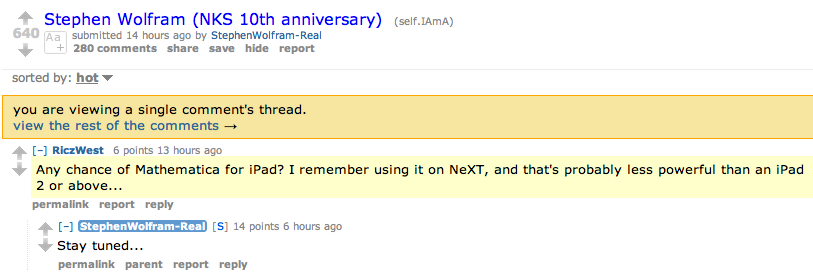
It would appear that Wolfram, the company behind the Siri search engine, is bringing its original product, Mathematica, to the iPad. In response to a comment on Reddit, when asked if there was an iPad version of Wolfram for iPad in the works, Stephen Wolfram said, “stay tuned.”

What Is Mathematica?

Almost any workflow involves computing results, and that’s what Mathematica does—from building a hedge fund trading website or publishing interactive engineering textbooks to developing embedded image recognition algorithms or teaching calculus.

Mathematica is renowned as the world’s ultimate application for computations. But it’s much more—it’s the only development platform fully integrating computation into complete workflows, moving you seamlessly from initial ideas all the way to deployed individual or enterprise solutions.

Mathematica is huge in science/engineering education and application—a few of the many areas where the iPad is making huge inroads in personal computing.

Cheers Rudy!

Site default logo image

Rumor: Foxconn exec says ‘iTV’ preparations are underway

A Foxconn executive allegedly claimed that his company is “making preparations” for an Apple television, but development and manufacturing has not begun. English-language daily newspaper China Daily (via How To Arena) quoted, well, summarized Foxconn Chairman Terry Gou on Friday:

Gou said Foxconn is making preparations for iTV, Apple Inc’s rumored upcoming high-definition television, although development or manufacturing has yet to begin.

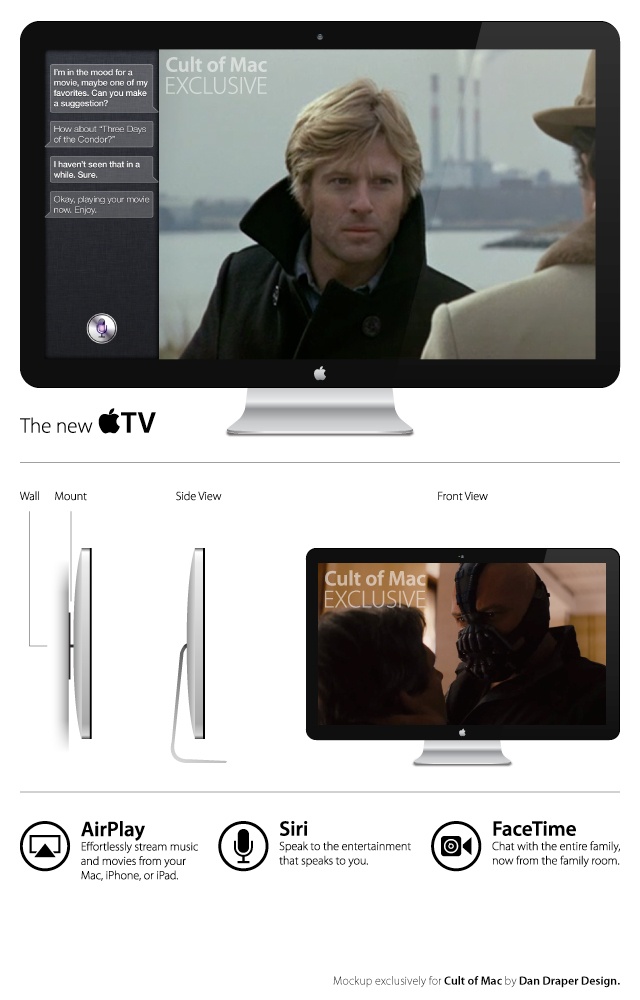
iTV reportedly features an aluminum construction, Siri, and FaceTime video calling […]

Foxconn’s recent 50-50 joint venture factory with Sharp in Japan is one of the preparations made for the new device, Gou added.

The report refers to the device as “iTV,” which is a common name circulating for the Apple television set. Despite no official confirmation from Apple, rumors persist that the product is edging closer and could feature a host of appealing characteristics, such as the ones mentioned in the excerpt above.


Expand
Expanding
Close

Site default logo image

Rumor: Apple HDTV looks like a Cinema Display with iSight and Siri says anon source

Continuing a long string of recent exclusives that quote un-named sources, CultofMac today claims that someone who saw the Apple HDTV says it looks like a bigger Cinema Display with an iSight camera and Siri, according to the post.

We are filing this one somewhere between the infamous Steve Jobs eating rice pudding post and….

Samsung announces Galaxy S III with S Voice and a bunch of other iOS features

Site default logo image

[youtube http://www.youtube.com/watch?v=2lpLGb1WW8E&hd=1]

Samsung announced the Galaxy S III today at the Unpacked event in London. Apple’s biggest competitor in the smartphone space, and the only other manufacture making any significant profit, showed off the upgraded 4.8-inch 720P SuperAMOLED display device that now weighs 133 grams among other minor spec improvements.

A few of the features shown off were S-Voice, which is like Siri, Scan and Match for Music (iTunes Match), and Airplay-like “AllShare Cast” for streaming content to your HDTV through the AppleTV-like AllShare Cast Dongle.  Samsung also named its iPod nano-like music player “Pebble,” which bears a resemblance to the iOS Kickstarter watch that goes by the same name.

One cool new thing is a face recognition photo app. It lets you instantly send pictures to your friends that it recognizes in your pictures. The S III also has a pop-up player, which is sort of an app version of picture-in-picture that allows you to watch a movie while you switch around to other applications.

Initial reviews seem a little luke-warm on the device. Most call it an incremental update from the S II with new features that also brought some new flaws.

Oh, and Phil Schiller will not like this news: Flipboard for Android is debuting on the S III.


Expand
Expanding
Close

Site default logo image

iMac Touch concept incorporates a touchscreen, iOS, and Siri

[vodpod id=Video.16427916&w=650&h=350&fv=]

“You can converge a toaster and refrigerator, but these things are probably not going to be pleasing to the user”- Tim Cook on Windows 8 and touch-friendly PCs at Q2 earnings.

Disregarding Cook’s statement for a second, here is an iMac touch concept sent by 9to5Mac reader and 3D animation student Joakim Ulseth. The mockup shows how he thought a redesigned iMac could incorporate a touchscreen and iOS-like features. The overall concept is based on an Apple patent published in 2010 that detailed an iMac with adjustable “Flex base.” This is what Ulseth imagined would be inside the next-gen device:

Apple iMac Touch with Flex Base running both OSX 10.8 Mountain Lion and iOS5– ”Power at your fingertips”

Specs:

Retina-Display: The 27-inch iMac Touch features 4096-by-2304 HD resolution. The resulting pixel density — 174 pixels per inch — makes text and graphics look smooth and continuous at any size.
Siri: The intelligent assistant that helps you get things done.
Ivy Bridge: Intels new Ivy Bridge i5 and i7 processors.
Thunderbolt: Two Thunderbolt ports for high speed data transfer.

And, before you unleash the hate:

[tweet https://twitter.com/chronic/status/195163119788634114]

Site default logo image

16GB iPhone 4S (New, no contract) for $619

Go4Computers has the 16GB iPhone 4S in black or white for $619 with free United States shipping— and tax in Florida only. They also ship internationally. That’s $30 off of Apple’s no contract price.

Tip: Bring Siri’s voice to your Mac with Samantha downloadable Voice for Lion

Site default logo image

[youtube=http://www.youtube.com/watch?v=UOCA-nqIzz4&feature=player_embedded]

Since the introduction of Nuance speech technology in OS X Lion, which provides several new voice options in system preferences for the System Voice, many have compared the voice of Nuance-powered Siri on iPhone 4S to the improved text-to-speech included as free downloads within Lion. As noted by Reddit user Moosehadley, what you might not have realized is the downloadable “Samantha” voice for Lion is the same as Siri’s in the United States. Here is how to download it:

Open System Preferences> Speech> Text to Speech>System Voice> Customize> and select “Samantha” from the list. Apple will ask you to confirm the 469MB install.


Expand
Expanding
Close

Apple rejected this app because it is too much like Siri

Site default logo image

[youtube=http://www.youtube.com/watch?v=s_xpeAXCfLc]

The last we heard, Apple was working with developers of Siri alternatives such as True Knowledge, the developers behind “Evi,” to iron out similarities between the app and the iPhone 4S‘s flagship feature. Apple is quick to warn developers who are submitting Siri-like apps not to mimic native features of the OS. Apple wants an app’s features to remain “distinctly different from the iOS behaviors and interfaces to avoid causing user confusion.” Developer Sparkling Apps reached out to let us know Apple rejected its latest app submission called “Voice Answer,” with Apple telling the developer the Wolfram Alpha-powered alternative is “too similar to Siri.”

Apple is not flat-out rejecting all Siri alternatives/competitors. Sparkling Apps already has an app called “Voice Ask” on the App Store that sits in the top charts of the Reference category. Evi remains on the App Store as well. However, the Voice Ask app employs the same True Knowledge database as Evi. While Apple did not offer a specific reason for why the app was rejected, it is possible that Apple is more inclined to reject Siri-like apps using Siri’s Wolfram Alpha knowledge base. Unsurprisingly, the developers decided to release Voice Answer as an Android-only app on Google Play. So why would you want a third-party Siri alternative anyway? There are a few features an app like Voice Answer, if Apple were to allow it, would provide that Siri does not.

First off, the app would run on all devices with iOS 4.2 and up. It also provides spoken answers, optional keyboard input, and configurable items stored in the app’s memory. According to the developer, Voice Answer’s “speech recognition works better than that of Siri, especially with foreign accents,” and the app includes a chatbot called “Eve” that you can teach answers. While most of these features are also baked into Evi, it is unclear exactly why Apple is working with some developers to coexist peacefully with Siri, and then flat-out rejecting others without discussion. It is clear that iOS users are interested in these apps. With the 99-cent-Evi sitting around 200,000 downloads shortly after release, and Siri currently limited to only the iPhone 4S, there is definitely a market for voice-powered assistants if Apple allows it. However, Apple’s reasoning is vague for allowing some Siri competitors and rejecting others. An excerpt from Apple’s rejection to Sparkling Apps and screenshots of the unreleased Voice Answer iOS app are below. Unfortunately, if you want to try the app, you will have to on an Android device for the time being:


Expand
Expanding
Close

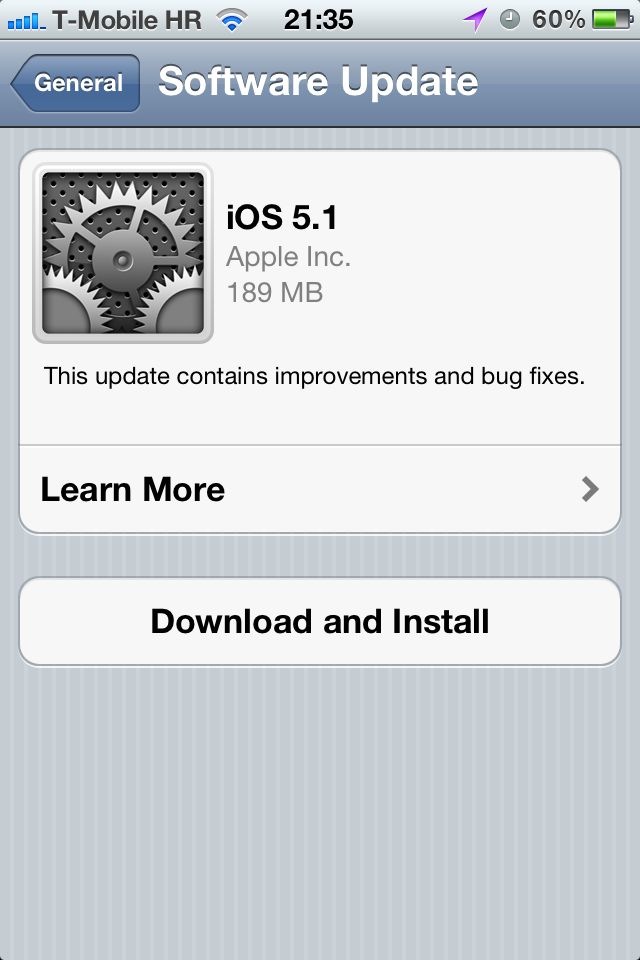
iOS 5.1 is out: Redesigned Camera app, battery optimizations, delete Photo Stream images

Site default logo image

Apple said today at the new iPad unveiling that the device runs iOS 5.1, which is an unreleased version of its mobile operating system featuring Siri in Japanese, several camera app tweaks, and other little nice-to-haves. Interesting, this update also “addresses bugs affecting battery life.” Other features include new podcast controls for playback speed on iPad, the redesigned camera app on iPads, the always-visible camera shortcut on the lock screen, updated AT&T network indicator, Genius Mixes and Genius playlist for iTunes Match subscribers and more. We are guessing iCloud users will appreciate that they can finally remove photos from their Photo Stream directly on the device without having to go to iCloud.com on their computer.

Depending on your location, the update might not have hit iTunes, but you can always download the right firmware for your device using direct links here. Of course, you can also bring your device up to date over-the-air by hitting Software Update under the General section of the Settings app.


Expand
Expanding
Close

Motorola takes jab at Apple with Android Voice Actions vs. Siri comparison

Site default logo image

[youtube=http://www.youtube.com/watch?v=FBYMDs_RFeI]

Handset maker Motorola Mobility may have found itself in an uneasy place as both Microsoft and Apple are attempting to block its $12.billion sale to Google, but the company’s marketing department is as vigorous as ever. With this week’s spotlight on the latest mobile developments showcased at Mobile World Congress 2012 in Barcelona, Spain, the Razr-maker published three provocative clips on its YouTube channel.

The videos pit the iPhone 4S-exclusive Siri feature against Android Voice Actions running on three different handsets: The Atrix 2, Photon 4G and Electrify. In each instance, Siri runs notably slower (and therefore less useful) than Android Voice Actions on Motorola’s devices.

Both Android Voice Actions and Siri need a network connection to upload audio samples of spoken queries. The cloud does the rest–speech recognition, parsing your query and beaming down the results.

Two more clips are right below.


Expand
Expanding
Close

Apple threatens to pull Evi due to similarities with Siri, but what about competition? (Updated: statement)

Site default logo image

True Knowledge, the brains behind a popular Siri alternative for iOS devices, received a note from Apple that the company will shoot down the popular 99-cent download from its mobile bazaar. According to TechCrunch, True Knowledge had a call from an Apple representative on Friday evening who informed them the company was “going to pull Evi from the App Store,” citing similarities with Siri.

However, pundits point out that Evi, which couples Nuance-licensed speech recognition engine with its own core semantic search technology dubbed the “True Knowledge Answer Engine,” may pose a threat to the otherwise stellar iPhone 4S sales due to folks running Evi on iPhone 4 being uncompelled to upgrade to an iPhone 4S.

If Apple’s real motivation is similarities and not competition, then perhaps the company should take a closer look at Japan carrier NTT DoCoMo’s new project that is a Siri alternative for non-iPhones.

Evi landed last month as a Siri alternative for owners of iOS devices. The program costs 99-cents and has already raked in 200,000 downloads, proving there is a practical market for search assistants on mobile devices. It is also available on the Android Market, so the App Store removal will not affect its availability on the rival Android platform. Siri owes much of its success to Apple’s top-notch marketing and an advanced artificial intelligence engine Apple scored by acquiring SRI. Shortly upon the iPhone 4S introduction last October, Siri spanned various projects aiming to port her to older iOS devices. She has also inspired similar programs on both Android and Windows Phone platforms.

Update: The Verge chimes in:

Despite what True Knowledge told TechCrunch, the app remains in the App Store, and according to sources familiar with the matter[translation: Apple off the record], Apple is attempting to work with the developers on bumping out those similarities, rather than just pulling the product. It’s apparently standard practice these days for Apple to flag something that could be confusing to end users and then try to work with developers to alter the appearance and / or functionality of the app, and we’re told that’s taking place with True Knowledge right now.


Expand
Expanding
Close

Siri leaks her own upcoming ability to speak Japanese

Site default logo image

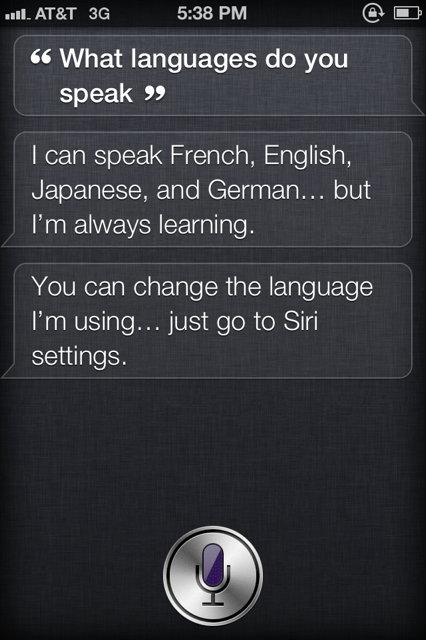
Siri is many things, but it seems she is not a good secret keeper. A few tipsters reached out and told us that Siri now speaks Japanese. Rumors earlier this month said Apple’s AI speech recognition interface would gain Mandarin Chinese, Japanese, and possibly Russian. It now appears that Japanese is about to be announced, perhaps at the iPad 3 announcement next month. There is no word yet on Chinese or Russian, but those are also likely coming soon.

When Siri was announced in October, Apple said that that additional languages would follow this year.  Apple’s Siri FAQ says that she will support Japanese, Chinese, Korean, Italian, and Spanish in 2012:

Language Support and Availability

Siri works exclusively on iPhone 4S. Siri understands and can speak the following languages:

  • English (United States, United Kingdom, Australia)
  • French (France)
  • German (Germany)

In 2012, Siri will support additional languages, including Japanese, Chinese, Korean, Italian, and Spanish.

Can I use Siri in any of these languages in other countries?

Yes. Siri can be enabled in any country, and you can choose to speak to it in English, French, or German. However, Siri is designed to recognize the specific accents and dialects of the supported countries listed above. Since every language has its own accents and dialects, the accuracy rate will be higher for native speakers.

Thanks Alex, AR and D.


Expand
Expanding
Close

Apple seems to be disabling Siri on unsupported devices, Spire

Site default logo image

Apple usually disables jailbreaks in new software releases. That is part of the reason why it took so long for Absinthe to debut for the iPhone 4S. It appears that Apple is also trying to break Siri running on unsupported devices, such as the iPhone 4. Many people who use Spire, the popular Siri port for the iPhone 4, have reported Siri is now disabled on their unsupported device. Has another cat and mouse game begun?

Historically, to get Siri working on an older device, you only need a server host and an iPhone 4S certificate. However, Apple apparently added a “SetActivationToken” that breaks services like Spire.

Just as quick, hackers have found a temporary workaround to get Spire working again. The fix is simply to delete “com.apple.assistant.plist” and the service should work again.

A demo of the issue, video after the break:


Expand
Expanding
Close

Rumor: Siri should speak Russian, Japanese and Mandarin Chinese next month

Site default logo image

Siri is an AI-driven virtual assistant that launched last October as an iPhone 4S exclusive, and it currently speaks English (United States, United Kingdom, and Australia), French, and German languages. The official Siri FAQ from the onset made it clear that in 2012: “Siri will support additional languages, including Japanese, Chinese, Korean, Italian, and Spanish.”

9to5Mac discovered job openings last December indicating possible Siri enhancements, including a prettier interface and a Siri API to extend the functionality to third-party iOS programs. We also uncovered this LinkedIn profile belonging to Apple’s language technologies engineer Chen Zhang that proves Apple’s been at work completing Siri support for the Chinese market. According to today’s article by Tech Asia, Mandarin-only support for the Chinese language could be released as early as next month…


Expand
Expanding
Close

Siri represents nearly 25 percent of Wolfram Alpha queries after four months

Site default logo image

Apple’s digital secretary named Siri, an iPhone 4S exclusive, is now responsible for nearly 25 percent of all searches conducted on Wolfram Alpha, an answer-engine developed by Wolfram Research.

As you know, Apple collaborated with Wolfram Alpha on Siri (Microsoft is another licensee), and took advantage of algorithms powering Mathematica, another Wolfram Research product. It lets users type in complex factual queries, and then Wolfram Alpha computes accurate answers from its structured data containing hundreds of datasets.

The Cupertino, Calif.-based Company fancies Wolfram Alpha’s curated knowledge database, which is a nice fit for the iPhone 4S’s factual question answering feature. According to the New York Times’ Steve Lohr, Siri accounts for a quarter of all Wolfram Alpha queries after four months:

Siri accounts for about a quarter of the queries fielded by Wolfram Alpha, whose staff has grown to 200.

Google should be worried, as this could be another sign of Siri users becoming accustomed to retrieving factual answers from Wolfram Alpha and not Google. For example: Telling Siri to “Google the iPhone” launches Safari with Google search results accompanied by text-based adverts, but just asking “How many days are there until Easter” produces a formatted answer from Wolfram Alpha with no advertising whatsoever. This is also important knowing that a quarter of all searches on mobile devices are conducted through voice commands.


Expand
Expanding
Close

For iOS users without Siri, there is Evi

Site default logo image

[youtube=http://www.youtube.com/watch?feature=player_embedded&v=TrCK0ya097Q]

We have seen Siri clones in the Android Market trying to pass themselves off as the real thing, and some Siri alternatives making their way to the Windows Phone Marketplace. Evi, on the other hand, might actually be the first true Siri competitor/alternative for Android and non-iPhone 4S iOS users.

Available on the App Store for 99 cents and free to Android users on the Android Market, Evi is the work of True Knowledge and its “core semantic search technology” better known as The True Knowledge Answer Engine. The 99-cent price tag on iOS is apparently to cover the cost of using Nuance voice recognition (the same voice recognition tech as Siri), which is not used in the Android version.

The app’s iTunes page explained Evi is capable of returning local data for the United Kingdom (along with the United States), which has been a complaint from U.K. Siri users since the iPhone 4S launch. According to TechCrunch, the app uses “an ontology of tens of thousands of classes into which” every possible user command can be recognized. True Knowledge said the app contains “almost a billion ‘facts’ (machine understandable bits of knowledge)” with the ability to infer trillions if necessary. It also reportedly uses all the expected sources, such as local results from Yelp, third-party websites, traditional web searches, and APIs.

While as of yet Evi is incapable of integrating with Calendar and Reminders like Siri, TechCrunch pointed out it sometimes provides more accurate and useful results for certain types of questions. Siri requests to search the web for an answer when users ask certain questions, such as “How do I make apple pie?” Evi, however, would provide a list of recipes with relevant links to that specific question. TechCrunch highlighted another example where Evi excels:


Expand
Expanding
Close

Does Siri infringe old Excite patents?

Site default logo image

Shawn Carolan of Menlo Ventures, an investor in Siri Inc., prior to Apple acquiring the company, recently sat down on Bloomberg to discuss the technology. Apart from talking about the initial demo that attracted him to the investment and meeting Siri Co-Founder Norman Winarsky, Bloomberg host Cory Johnson pressed him on exactly how Siri is able to take voice-recognition data and determine intent.

Around the 3:20 mark, Carolan discussed Siri’s unique approach of taking all words as “one big block” and mapping “those strings of words across” a group of 10 domains of expertise. This approach sounds familiar to at least one technology journalist who claimed the method is similar to patents owned by search portal Excite in 1994. Robert Cringely explained:


Expand
Expanding
Close