Jordan manages the internal Partner Program for sponsorships and partnerships across the 9to5 network’s media brands including 9to5Mac, 9to5Google, 9to5Toys, Electrek.co, SpaceExplored and DroneDJ.com.
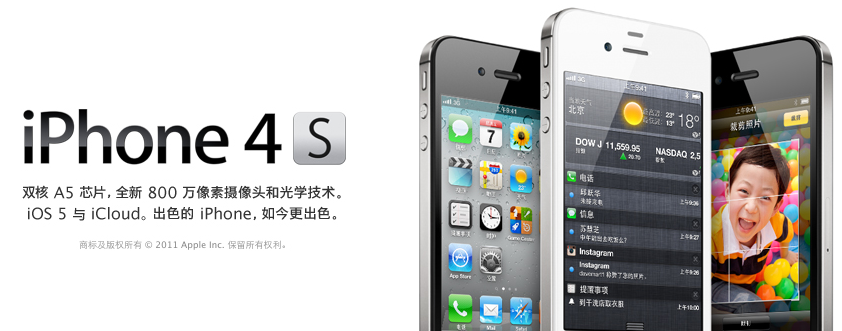
Apple is set to launch the iPhone in China and 21 other markets this Friday, Jan. 13. As of yet, the device is only confirmed to launch on China Unicom, the nation’s second-largest wireless carrier and currently the sole provider of the iPhone in the country. However, a new report from a Chinese agency website (via The Wall Street Journal) claimed the iPhone received necessary approval from the China Radio Management agency for use on China’s third largest mobile operator by subscribers, China Telecom.
The report listed the device only as model number A1387, but also it listed network compatibility as “CDMA-2000,” the same technology used by China Telecom, and not China Unicom. The listing also said the new model supports “WCDMA,” which might indicate Apple will release a device that works on both China Unicom’s and China Telecom’s networks. The Wall Street Journal claimed that Apple could finish the necessary approval process within weeks: Expand Expanding Close
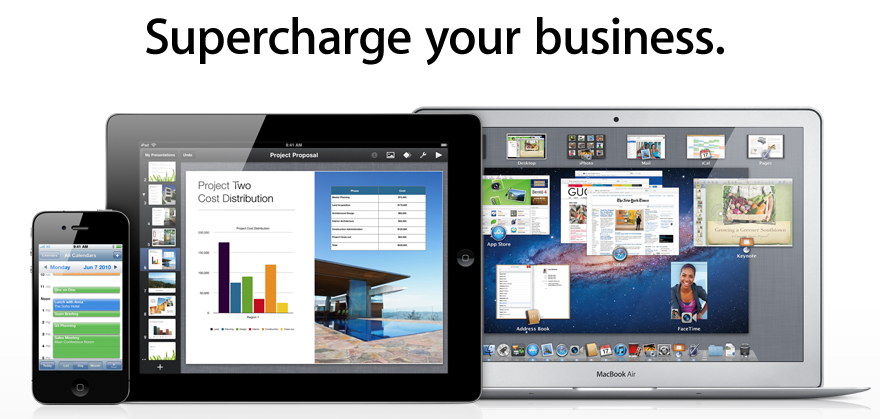
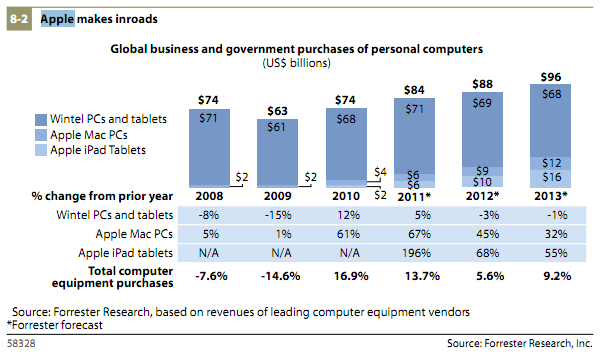
Forrester just published its Global Tech Market Outlook for 2012 and 2013 where the research company argued that Apple —not cloud computing as a whole— will “reshape the computing equipment market.” The study cited the adoption of iPad and Macs among professionals as proof that Apple is “dramatically disrupting” the corporate market traditionally dominated by Microsoft, Dell, Lenovo, and HP. In 2012, estimates showed Apple could potentially sell $9 billion worth of Macs and $10 billion worth of iPads to the corporate market alone.
Analysts have been predicting that cloud computing — specifically, infrastructure-as a service (IaaS) — will reshape the server and storage market… Actual adoption of IaaS remains limited…The biggest disruptive force in the computer equipment market thus is not IaaS, but Apple. This is a surprise, because Apple has not and does not directly address the corporate market, while turning a wide variety of consumer technology markets upside-down. But its rapid growth in the corporate market has been the big surprise of 2011, and it will be even more of a factor in 2012.
By measuring the number of Apple OS-powered devices and supported tablets for 2010 and 2011, Forrester estimated Apple will sell $6 billion worth of Macs and $6 billion worth of iPads to the corporate market in 2011. The research company expects that number to more than double by 2013 to $12 billion worth of Macs and $16 billion worth of iPads.
As part of the report, Forrester outlined some of the areas where Apple is excelling in capturing the corporate market. While reminding us that the research includes iPads in the PC category, Forrester attributes Apple’s penetration into IT departments with orders for tens of thousands of iPads from Fortune 500 companies. The report also noted that professionals are increasingly urging their employers to fund and support Apple products with a growing number of iPads and MacBooks used by company executives. Forrester explained:
We reported yesterday that Apple was requesting Chinese manufacturer In Icon to cease production of what is probably the most realistic Steve Jobs figurine to date. While we already knew CEO Tandy Cheung’s stance on Apple having the copyright to Steve’s likeness, a new report from Paid Content claimed the doll is in fact legal in most states and “Apple’s legal claim is largely bogus.”
The report explained that people do own the rights to their likeness, but most American states do not recognize these rights after death. In fact, according to Paid Content, only a dozen states currently recognize “personality rights” after death.
What this means is that Apple’s warning about the doll is an empty threat in most places. It may not even be able to stop others from using the name Steve Jobs as, surprisingly, the term does not appear on the company’s long list of registered trademarks.
In light of that news, several of the figurines appear to have made their way to different eBay stores globally. One —on the United States eBay store— is listed with a ‘Buy It Now’ price of US $138.88 and ships straight from Hong Kong. The figurines have also landed on the Australian eBay here. You can still preorder from In Icons’ official website for $109.99 with shipping expected to start in February. However, the website noted it is a ‘first-come, first-served’ policy with refunds being issued when initial limited stock runs out.
Paid Content cited the following list of states where the doll could potentially run into an issue, according to a recent paper on Dignitarian Posthumous Personality Rights:
China Unicom, the second-largest wireless carrier in China and currently Apple’s sole carrier of the iPhone in country, announced a new promotion that would provide customers with a free iPhone 4S when signing up for a multiyear commitment. The carrier announced on its website (via Bloomberg) that a 16GB iPhone 4S will be available free on a two-year contract starting Jan. 13, while the 32GB model will be free on a three-year agreement.
Plans for the promotion appear to commence at 286 Yuan (approximately $46 USD) per month for the 32GB model on a three-year agreement. However, the 16GB model seems to be available for 386 Yuan on a shorter two-year commitment. According to Alen Lin at BNP Paribas Securities, who closely follows China Unicom and spoke with Bloomberg, the carrier lost money on the previous 286-yuan plan available with two-year agreements and changed it to the three-year agreement in order to have “one additional year to recover the expense.”
China Unicom is the second largest carrier behind China Mobile. The third largest carrier in the country, China Telecom, is also rumored to begin offering the iPhone to over 100 million subscribers soon. China Mobile has yet to sign a deal to offer the iPhone, but reports from October claimed around 10 million iPhone users already use the network. The iPhone 4S just recently received necessary China compulsory certification by the Ministry of Industry and Information Technology of China late last month.
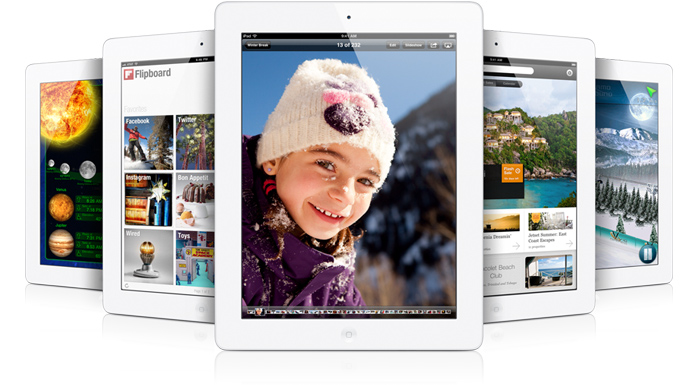
A new report today claimed Apple is gearing up to release a next-generation “iPad 3” with a “full HD display” in March, followed by an “iPad 4” in October. The report came from Asian supply chain watcher DigiTimes who cited Taiwanese industry sources again. Digitimes’ record has been more than a little shaky, especially of late, so approach with caution…
According to the report, iPad 3 will sport a QXGA display (1,536 x 2,048 pixel) and improved battery life, but otherwise hardware specifications will remain largely unchanged. The launch of iPad 3 in March will apparently see the current generation iPad 2 receive a price cut to $399:
The iPad 3 will come with a QXGA (1,536×2,048 pixels) display and longer battery life although its other hardware specifications may not be so amazing as expected, said the sources. But Apple will take the advantage of the iPad 3 launch to slash the price of its iPad 2 to US$399, the sources claimed.
DigiTimes claimed that Apple will drop another 9.7-inch iPad dubbed “iPad 4” by October. The device is expected to have “killer applications,” all-around upgraded hardware specifications, and “integrated applications so as to compete with an array of Android-, Wintel- or WoA (Windows on ARM)-based tablet PCs.” Previously the publication claimed Apple had a 7.85-inch iPad in the works for a late 2012 launch, which their sources later claimed would no longer be happening… Expand Expanding Close
ADR Studio’s Antonio De Rosa, the designer behind many unofficial Apple concept products in the past, just published his latest design— the iPhone SJ. According to ADR, the concept would include a “Totally glass capacitive screen on a polycarbonate lightweight body” and a moniker inspired by Steve Jobs.
Other specifications imagined by De Rosa as part of the concept include a new 10-megapixel camera and an A6 dual core processor; although, those specifications are obviously just a wish list at this point. As you can see from the mockups, the concept has a much slimmer design and a slightly rounded edge from the back and front panels to the bezel. Otherwise, the concept borrows much of its design from the current iPhone 4 and 4S.
Epic Games and Chair Entertainment, developers of the popular on-rails, hack-and-slash iOS franchise called “Infinity Blade,” just announced the two titles have earned over $30 million since the first game launched in the App Store in December 2010. Assuming “earnings” accounts for total earnings, Apple’s 30 percent cut would be $9 million.
Epic Games, Inc. and its award-winning Salt Lake City-based development studio, ChAIR Entertainment, today announced that earnings from ChAIR’s blockbuster Infinity Blade video game franchise have eclipsed $30 million in just one year since the introduction of the original game. One of the most popular gaming franchises to be launched on the App Store, the award-winning series has also created significant licensing interest in the underlying Unreal Engine 3 technology from developers worldwide.
In the announcement (via Joystiq), the developers also noted that Infinity Blade II reached over $5 million in net earnings since its release last month on Dec. 1, 2011. In comparison, it took the first Infinity Blade title three months to achieve that milestone. The first game now accounts for more than $23 million of the franchise’s earnings.
A recent report from Le Figaro claimed Apple authorized reseller eBizcuss was suing Apple regarding claims it gives preferential treatment to its own Apple retail stores when shipping products. Now, following that news, a European Apple Premium Reseller reached out to ChannelWeb to clarify Apple’s retail tactics in a 4,400-word letter.
Speaking anonymously, the APR mirrored many of the complaints of product shortages from eBizcuss’ original lawsuit, but goes even beyond by claiming stores are experiencing cash-flow shortages due to Apple cutting credit lines. It also said Apple’s partners are entering premium reseller’s territory and driving down margins by “targeting SMB and education deals.”
The letter touches on the new v2 redesign for retail stores that costs approximately $400,000 (£258,000) per store. According to the APR, who wrote the letter, APRs are required to update to the v2 store design by the end of the year or face losing their APR status. According to the European APR, the v2 redesign is meant to prevent APRs from selling whatever third-party products they would like. The source claimed with Apple’s current retail tactics, it might not be worth it for resellers like eBizcuss:
“According to our calculation, if eBizcuss has 15 shops, the investment required to remain in the business as an APR v2 would be $6m to $8m… one must concede that without product to place in their shops, with unfair competition from Apple’s own pricing and regulation, with no access to iPhone, with no guarantee from Apple on any of the previous topics, it may be a very dangerous game to play.”
Another APR from the U.K., who reached out to Channel Web, also weighed in on the situation:
“The general consensus is good luck to them [eBizcuss].” APRs on the continent are definitely feeling the pain more than us, but there are instances where Apple has given preferential treatment to its own stores and website and even the high street retailers like DSG. We totally feel eBizcuss’s pain and hope that something positive comes out of it. Apple is not giving us the tools to do the job it wants us to do.”
A series of patents published by the United States Patent and Trademark Office today (via PatentlyApple) suggested Apple is attempting to own as many Thunderbolt related trademarks and patents as possible. This is despite most being under the impression the technology is an open collaboration between Intel and Apple.
Perhaps the most noteworthy aspect of today’s patents is the possibility Apple might bring Thunderbolt to iOS devices. According to one of the patents published today, “a connection may be provided between a portable media player and a display, a computer and a portable media player, or between other types of devices.”
The benefit of supporting Thunderbolt connections on iOS devices, at least initially, would be to provide faster recharging and data transfer. It is unclear from the patents whether an iOS device would act as a Thunderbolt host machine, like a MacBook, or simply as a supported peripheral. As PatentlyApple pointed out, Apple would have to reengineer the Thunderbolt “connector to be flat enough to fit a USB-type of device slot.”
Apple is already experimenting with next-generation 30-pin connectors that would potentially support high-speed Thunderbolt-like connections. A patent originally filed in 2009, and reported byPatentlyApple in April 2011, showed that Apple is working on a new hybrid connector for iOS devices to support dual-lane Display Port technology (same as Thunderbolt).
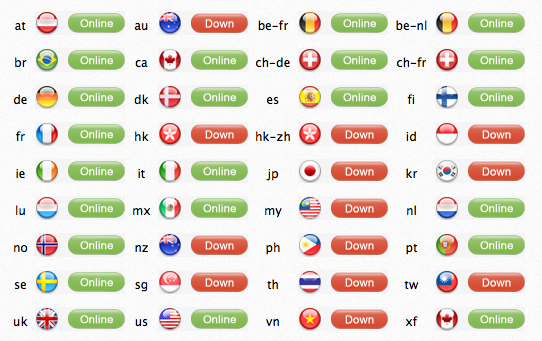
Update: The stores appear to be back online now, and while the China/Hong Kong, Taiwan, Singapore, Malaysia, Philippines, and Thailand stores have access to Red Friday deals, the others don’t. As for discounts, most products, including iPads, MacBooks, and iMacs appear to be on sale for in between 5% and 10% off. For everyone else, 9to5 readers can still get some of the best prices on Macs in the U.S. through our discount code at MacMall.
While we have not confirmed the exact reason, it looks like around 13 Apple online stores worldwide are currently down. Among them: China, Australia, Japan, Korea, Taiwan, New Zealand, Hong Kong, Singapore, Malaysia, Philippines, Thailand, and Vietnam.
There is a good possibility Apple is updating these websites to reflect the ‘Year of the Dragon’ Jan. 6 Red Friday shopping event that is expected to land in China/Hong Kong, Taiwan, Singapore, Malaysia, Philippines, Thailand, and possibly the other countries with online stores currently down. We will keep you posted if we notice any changes when they come back online.
We had a feeling it would not be long before Apple stepped in and shut down Chinese manufacturer In Icon’s plans to create an extremely realistic Steve Jobs figurine, and today The Telegraph reports the 12-inch doll originally slated for release in February is now facing legal threats from Apple if the company doesn’t cease production plans.
According to the report, Apple claimed it owns the rights to Steve Jobs’ likeness and in a letter to the company claims toys using the Apple logo, a person’s name, or likeness of Jobs is considered a criminal offense.
The 12-inch figurine, which comes complete with Jobs’s trademark blue jeans, sneakers and black turtleneck sweater, was created by Chinese company In Icons and was set for release in February. But ‘their efforts have reportedly met with’ a legal challenge with Apple allegedly threatening to sue the toy maker unless they cease trading.
In Icon’s Tandy Cheung originally told ABC News the company would not stop production in lieu of Apple’s requests, and said the technology company cannot copyright Jobs’ appearance:
“Apple can do anything they like. I will not stop, we already started production…Steve Jobs is not an actor, he’s just a celebrity… There is no copyright protection for a normal person… Steve Jobs is not a product… so I don’t think Apple has the copyright of him.”
Apple agreed to pay a $5 million settlement to Taiwanese touch chip and module maker Elan Microelectronics Corp that will provide both companies with access to each other’s patents and end ongoing patent infringement cases, according to a report from Reuters.
Elan Microelectronics Corp, a Taiwanese touch design company, said on Thursday that Apple Inc will pay $5 million as part of a settlement in a patent infringement case. The statement said the two companies would also exchange authorizations to use each other’s patents.
Taiwan-based Elan Microelectronics Corp originally sued Apple in 2009 claiming Apple infringed on their multitouch patents with the iPhone, iPad, iPod touch, MacBook, and Magic Mouse. Elan was originally seeking bans on the products in the United States. According to a Cnet report from 2010, the patent covered “touch-sensitive input devices with the ability to detect the simultaneous presence of two or more fingers.”
Reuters reported that Apple counter-sued Elan in 2009, and in June of last year, the U.S. International Trade Commission ruled Apple “had not violated U.S. trade law.” Following that decision, Elan made a post on their website claiming they would seek review of the decision after USITC Chief ALJ recommended to the ITC that Elan “failed to show that Apple products infringe the asserted claims.” The Chief ALJ also, claimed “Elan has not shown significant licensing activities of the 5,825,352 patent (the 352 patent) within the U.S. sufficient to satisfy the domestic industry requirement.” However, at the time of that review, the USITC also claimed Apple had not proven Elan’s patent claims were invalid.
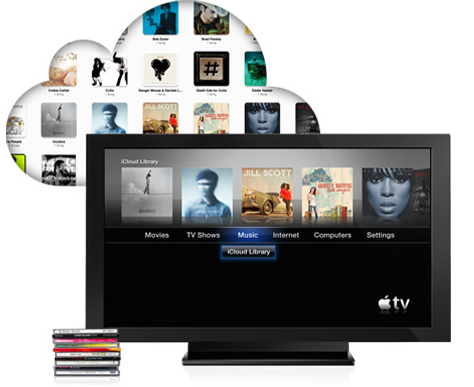
According to a report fromUSA Today, a source that worked at Apple said a 42-inch “or larger” LCD TV is being worked on and locked down in Apple design guru Jonathan Ive’s workspace. The source claimed Ive’s studio is currently home to “a slick 50-inch TV”.
Apple is said to be looking at a 42-inch or larger LCD TV with built-in Wi-Fi. Inside the locked-down studio of Jonathan Ive, senior vice president of industrial design at Apple, there’s a slick 50-inch TV, according to the source who worked at Apple.
This goes against most recent reports from Asian supply chain watcher DigiTimes who claimed 32- and 37-inch variants were being prepared for a summer 2012 launch. Reports from the New York Times in October claimed Apple was in the process of prototyping an Apple television after large parts suitable for an HDTV were discovered moving around Apple’s supply chains.
Apple is continuing having problems securing licensing deals for content with major cable companies and content providers preventing them from creating an “à la carte iTunes TV service”. The report cited an interview with an unidentified person close to the “Apple TV group” and two “television industry sources”. In November, CBS’s Les Moonves commented at the company’s earnings call that they had turned down a streaming deal with Apple for the Apple TV.
A major roadblock for Apple along the way has been securing content needed to make an iTV succeed. The problems Apple is having securing content deals were described in an interview with a person who worked in the Apple TV group and verified by two television industry sources. All declined to be identified because of the confidential nature of the talks.
According to the report, anticipation of an Apple smart TV is getting “big buzz” leading up to the International Consumer Electronics Show slated to kick off Jan. 10. Apple Cofounder Steve Wozniak weighed in and said he too expects Apple to enter the living room with an Apple branded HDTV: Expand Expanding Close
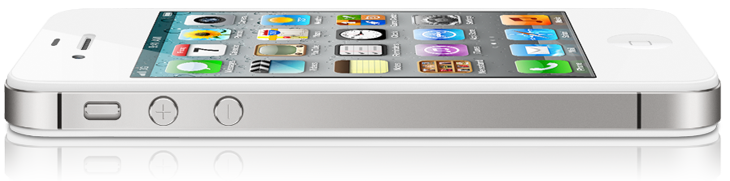
Apple just issued a press release confirming the availability of iPhone 4S in China and 21 other markets starting Friday, Jan. 13. This comes just over a week after the device received necessary certifications from the Ministry of Industry and Information and Technnology of China.
Apple CEO Tim Cook said this about the announcement in a statement earlier today:
“Customer response to our products in China has been off the charts. With the launch in China next week, iPhone 4S will be available in over 90 countries making this our fastest iPhone rollout ever.”
All other markets gaining access to the iPhone 4S beginning Jan. 13 include: Anguilla, Antigua and Barbuda, Bolivia, Botswana, British Virgin Islands, Cameroon, Cayman Islands, Central African Republic, China, Dominica, Dominican Republic, Ecuador, Grenada, Guam, Guinea Conakry, Ivory Coast, Jamaica, Kenya, Madagascar, Mali, Mauritius, Niger, Senegal, St. Vincent and The Grenadines, Trinidad and Tobago, Turks and Caicos and Uganda.
Although there is no indication of carriers in the press release, the country’s third-largest carrier China Unicom is currently the sole provider of the iPhone in China. Apple has not confirmed whether they plan on expanding carriers to reach an untapped market outside China Unicom of approximately 1.33 billion people. As of their latest earnings call, CEO Tim Cook announced $3.8 billion of sales in China for the June quarter, which is a six-fold increase from the year-ago quarter and it is 13.3-percent of Apple’s entire business by revenue. Apple is expected to announce its 2012 first-quarter financial results on Tuesday, Jan, 24.
The full press release is available after the break.
Apple subsidiary FileMaker Inc., just announced they shipped over 1 million units of Bento, their personal database tool currently available for iPhone, iPad and Mac. Originally released in 2008, Bento is now available in seven languages with dedicated clients for iPhone and iPad ($4.99) that sync with Bento for Mac currently available on the Mac App Store for $49.99.
Vice President of Marketing and Services for FileMaker, Inc., Ryan Rosenberg said the following in a statement:
“Bento’s elegance has led to sales of more than a million units, meeting the needs of customers ranging from ranchers and mobile dentists to personal trainers and rock bands. With Bento on your iPad, iPhone, or Mac it’s easy to organize your contacts, track projects, plan events and manage just about anything.”
The full press release is available after the break.
We showed you some Siri clones available in the Android Market last week that use official Apple icons, and they are even promoted as “Real Siri for Android” and “Siri for Android.” Now, the first round of Windows Phone Siri alternatives seem to be popping up in the WP Marketplace.
If you are craving Siri like functionality for Windows Phone and more, look no further. Ask Ziggy is your Personal Assistant that goes beyond Siri functionality.
The first app is called “Ask Ziggy” from developer Shai Leib and it is not exactly a rip-off like the Android Siri alternatives. As you can see in the video above from WP Central, the app takes inspiration from the Siri UI and seems to work rather smoothly in comparison to Windows Phone’s built-in TellMe voice control features. It does not borrow Apple’s icons, but has an overall similar feel to Siri. The app apparently utilizes Nuance voice-recognition (same as Siri), but the developers handled everything else themselves. It is available for free now, and the updated version seen in the video should be landing soon.
Another Siri alternative for Windows Phone currently available in the Marketplace isn’t really a functioning voice control app, but it is marketed as “Siri for Windows Phone”. The name “iSiri Faker” also seems to be associated with the app. This app will allow you to “fake Siri conversations on your Windows Phone.” We are not sure exactly what that means, but according to the app’s description you can “program custom responses” using speech recognition, text to speech, data compression, and voice effects. The app is available for $0.99 in the Marketplace. Screenshots are available after the break. Expand Expanding Close
359gsm (via My Nokia Blog) recently pitted the iOS 4.3-based iPhone 4 and the iOS 5-based iPhone 4S against a Windows Phone 7.5 Mango-based Nokia Lumia 800 smartphone in various benchmark tests. In every test, both the iPhone 4 and iPhone 4S significantly outperform one of the best Windows Phone options on the market. This is in contrast to reports in April, prior to Mango’s release, that claimed Window Phone’s IE 9 on Mango devices beat mobile Safari in similar browser benchmark tests.
You can view the results in the video above or get the full results below (via 359gsm). As you can see, the iPhone 4S significantly passes the Lumia 800 in all tests, including: Browsermark tests, Speed Reading test, Sunspider, Acid3, and HTML5. The iPhone 4 also outperforms the Lumia in most tests, although by a narrower margin.
Update: Apple has now pulled the GameStore app from iTunes and the App Store.
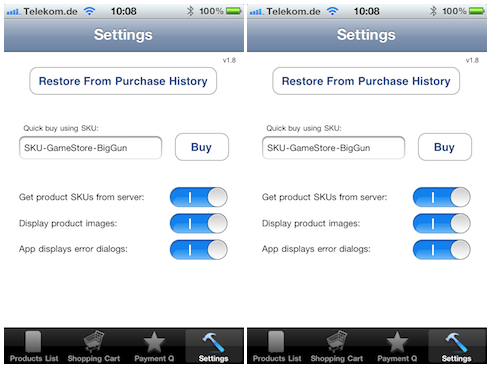
Spotted by Flo’s Weblog at Schimake.com, an application called GameStore, published by Apple, made its way onto iTunes Dec. 31. What exactly GameStore is used for -at this point- is still unknown. At first glance, it appears to be some type of internal test app for in-app purchases and payments.
The official description for the app through its iTunes page is as follows: “This application allows you to buy different things from within the app.” Inside the app, there appears to be in-app purchase content for racing games under the “Products List” tab. Tapping one prompts you to buy the content, but the content itself does not seem to be functional. Other tabs within the app, include: “Shopping Cart,” “Payment Q,” and “Settings.”
While the app is listed as published on Dec. 31, 2011, viewing it from within the App Store on an iOS device shows a post date of June 9, 2009. It is likely this is simply an internal tool used for testing in-app purchase functionality that was published accidentally on iTunes. The app is currently still available through iTunes for $0.99.
The design of the iPad itself does not appear to be the only Apple product Samsung intends on “slavishly” copying. Samsung’s latest ad released last week came under scrutiny for its obvious inspiration taken from Apple commercials that came before it. However, it is not just the overall look and feel that was copied. Samsung now removed the ad after Google+ user Cheryl Lindo Jones (via TNW) discovered the ad uses the same actress as an iPhone 4S ad.
Both ads feature the same girl throughout testing the features of each device in a similar manner. The Samsung ad is above, and the Apple iPhone 4S ad is below for comparison. Samsung has not commented on whether this is the official reason why the video was removed from their YouTube channel.
Apple is not slowing down when it comes to opening more iconic brick-and-mortar retail locations. Three new retail locations all received recent approval: one located in a century theatre in Germany, and a second in London, Ontario, Canada, and the third in a historic 1860-era building in Madrid, Spain. The approvals continue Apple’s aggressive retail push after the opening of their new Grand Central store, and after meeting its goal of 30 new locations opened worldwide in the fourth-quarter of 2011.
Following over a year’s worth of discussions, TeleCinco (via ifoAppleStore) confirmed plans for an Apple Store in a 65,293 square-foot building in Madrid, Spain have finally been approved by city officials. The rendering above was released by the city and, despite not showing any Apple logos, it shows a classic Apple retail design meshed with the 1860-era building facade. The building was previously Hotel Paris, and according to ifoAppleStore, it will retain the massive, iconic “Tio Pepe” electric sign. The sign, not shown in the rendering, was removed for the construction process.
Located on the The Kurfürstendamm in Berlin, Germany, we already told you about rumors concerning Apple’s next store that will be located in a 5,000 square foot theatre originally built in 1912 or 1913. Berlin.de gave a break down of the building’s history. Until now, it was not exactly confirmed, but iFun confirmed that employment applications for the location have surfaced. It also seems as though construction is underway due to the front windows being covered (pictured right).
Another store set to open in 2012 is located in London, Ontario, Canada in Masonville Place shopping mall. Although it’s been rumored for years, we’re receiving several tips that it is set to open next year and the typically reliably ifoAppleStore has confirmed. The store will apparently take over the 6,176 square-foot space previously occupied by Eddie Bauer on the upper level. This would continue Apple’s steady retail expansion in Canada, currently sitting at just 22 stores across the country, nine of which are located in Ontario.
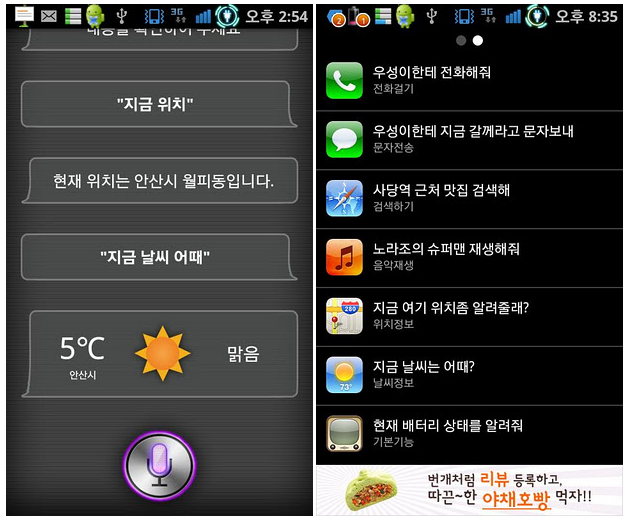
Google’s Android Market is now home to a couple not-so convincing Siri clones, both of which use Apple’s official Siri icon and one that attempts to mimic the UI. Developer Viewide is even marketing one of the applications called “Speerit” as “REAL Siri for Android”.
Speerit (pictured above), is for now only available in Korean, but the developers plan to support English in a future update. As Electronista pointed out: “Differing results on the weather widget suggest it’s not actually asking Apple’s servers.” The app is available on the Android Market for free.
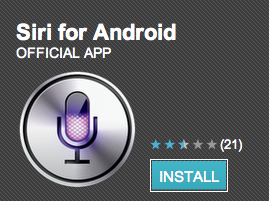
Another app, called Siri for Android, as picked up by The Next Web, made a point of clarifying it is simply a Siri icon that acts as a shortcut to Google’s Voice Actions. Although, like Speerit, it too boldly uses what appears to be Apple’s official Siri icon.
Also, the app’s name, “Siri for Android,” beside the developer’s name, “Official App,” could give users who don’t know any better the impression it is some type of official Siri port. The app is also available for free in the Android Market.
No word on whether Google or Apple plans to take action. Controversial or knockoff apps being removed from the Android Market and the App Store is not uncommon, but it is clearly a bigger concern for the Android Market’s easygoing review policies.
Apple plans to appeal a decision by Autorità Garante della Concorrenza e del Mercato to impose $1.2 million USD fine for not providing consumers with a two-year warranty mandatory under European Union law and the Italian Consumer Code. An Apple PR representative apparently confirmed the decision to appeal the fines to The Register.
We reported earlier this week that Italian antitrust authorities were fining Apple Inc., Apple Sales International, and Apple Retail Italy $1.2 million USD related to “bad commercial practices that harmed consumers.” The Autorità Garante della Concorrenza e del Mercato claimed Apple has not implemented a two-year product guarantee available to all consumers through EU law. Instead, Apple continues to push their own AppleCare warranties to consumers without indication of the consumer’s rights to the free two-year guarantee.
The Autorità Garante della Concorrenza e del Mercato asked Apple “cease practice” of their current warranty policies, and “notify the Authority” of a new course of action. They also want Apple to publish clarification of the new policy on Apple.com to notify consumers. It is unclear if other authorities throughout the EU will take similar action.
Apple is also accused by the European Antitrust Commission of engaging in “illegal agreements or practices that would have the object or the effect of restricting competition in the EU or in the EEA” related to their iBooks business.
Much like the somewhat controversial face unlock feature built-in to Google’s Galaxy Nexus smartphone, a new patent application reveals Apple too is working on similar, but more advanced user detection solutions. As PatentlyApplepointed out, Apple noted these recognition systems could land in a future iPhone, iPad, iPod touch, or MacBook.
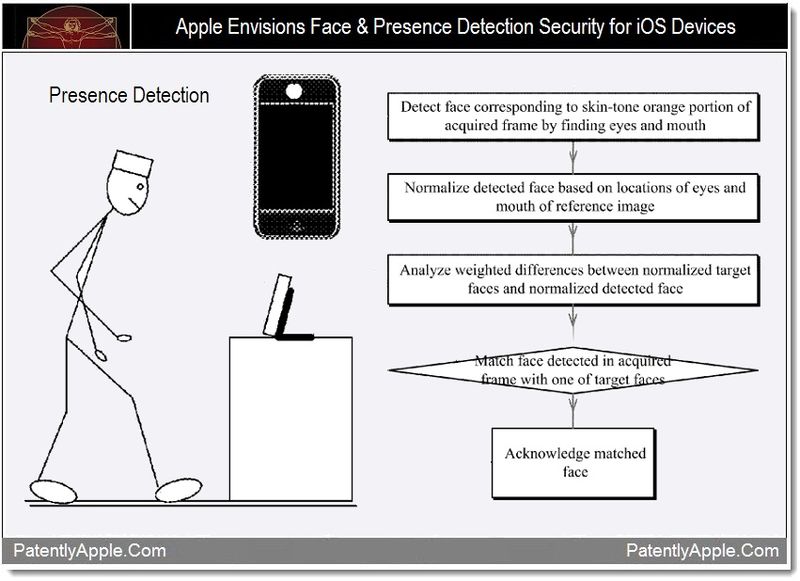
The basics of the patent entitled “Low Threshold Face Recognition,” is to allow a user to unlock a device—such an iPhone or iPad—using facial recognition. Apple’s solution could allow the device’s camera to recognize the user even when the device is in sleep mode. In other words, the device’s camera would remain active when sleeping, detect the user, and unlock the device without having to press the sleep/wake button. This could, in theory, allow a user to bypass the current Slide to Unlock feature.
Perhaps the most interesting aspect of the system would be the ability for the device’s settings to be customized depending on the user. For example, when detecting a specific user, iOS could set personalized wallpapers, notification settings, and custom configurations for apps. This would provide multiple user logins, allowing iOS users to easily share a device among family or coworkers.
Apple’s system would differ from other face recognition systems by ignoring face biometrics. As PatentlyApple explained, “The face recognition techniques are based on a simple, weighted difference map, rather than traditional (and computationally expensive) correlation matching.” Apple’s system could detect “high information portions” of a face such as the eyes, mouth, or the tip of a nose. In addition, an “orange-distance filter” could be applied to determine variations in skin tone and detect the “likely presence” of a user. This could detect the distance between the device and the user’s face, as well as the user’s “level of attentiveness.”
In 2010, before the iPad launch, The Wall Street Journal reported Apple was experimenting with the ability to recognize individual users with the device’s camera. Today’s patent was originally filed in 2009.
Stanford University’s Silicon Valley Archives currently holds “the largest assembly of Apple historical materials” stored within hundreds of boxes taking up over 600 feet of shelf space in an undisclosed facility outside San Fran.
The Associated Presspublished a story today detailing their recent visit to Stanford’s Apple Collection, which contains in-house video Apple recorded in the 80s, blueprints for early Macs, user manuals, company shirts, and drafts of Steve Jobs’ speeches.
Stanford historian Leslie Berlin had this to say about the collection:
“Through this one collection you can trace out the evolution of the personal computer. These sorts of documents are as close as you get to the unmediated story of what really happened.”
While you may have heard versions of how the name Apple came to be, an interview recorded with Wozniak and Jobs in the 80s (originally meant to be an in-house video for employees) has the two men recalling the exact moment:
Woz: “I remember driving down Highway 85. We’re on the freeway, and Steve mentions, `I’ve got a name: Apple Computer.’ We kept thinking of other alternatives to that name, and we couldn’t think of anything better.”
Jobs: “And also remember that I worked at Atari, and it got us ahead of Atari in the phonebook.”
That video and others were donated to Stanford in 1997 after Jobs returned to the company and plans for an in-house Apple museum were cancelled. Also included in the collection is this “Blue Busters” Ghostbusters-style internal ad featuring Apple executives, embedded below. The ad was originally shown in October 1984 at an international sales meeting in Hawaii. Blue Busters is obviously a not so subtle reference to their biggest competitor at the time, IBM.