Following yesterday’s story by the usually accurate Japanese blog Macotakara on Apple’s Japan arm rolling out iTunes in the Cloud for music, Japanese music journal AV Watchreported this morning that the California-based iPod maker has its sights set high on the 130 million people market. According to the report, customers in Japan are now finally able to purchase and download music on iOS devices through 3G cellular networks rather than just wireless hotspots, as before. The story also quoted Apple’s Senior iTunes Director for the Asia, Pacific, and Canada region Peter Lowe, who confirmed that iTunes Match would roll out to iTunes Japan in the second half of this year.
“We are keeping good relationship with Japanese music publishers,” said Lowe as he highlighted that iTunes Japan’s catalog now includes Sony Music’s Western artists, such as Beyonce, Michael Jackson, Celine Dion, and Sade. Interestingly, Apple did not allow the music journal to publish Lowe’s mug shot. In case you were wondering, iTunes in the Cloud files as the first-ever music re-downloading service in Japan. The iTunes Store launched in Japan in 2005…
Apple’s Chief Executive Officer Tim Cook was invited to take part in a roundtable discussion at the National Comprehensive Cancer Network’s annual conference on clinical practice guidelines and quality cancer care. This year’s agenda centers around the topic of “Cancer and Corporate America: Business as Usual?” The five-day discussion begins March 15 in Hollywood, Fla., and ABC News anchor Sam Donaldson will moderate it. The NCNN website listed Cook as an invitee, but there is no guarantee that Apple’s CEO will participate. The fact that a reputable organization invited him means Cook was informed of the conference in advance. A history of late Steve Jobs’ illness gives some hope that Cook will contribute to the discussion. Other invites include doctors, cancer survivors, and other corporate figures, including IBM’s Senior Vice President of Human Resources J. Randall MacDonald.
Whether Cook will take part as a private person or as the CEO of Apple remains unknown, though it is possible he will discuss how Apple can give to medical research. The executive revealed at a recent internal meeting with employees that Apple donated $50 million to Stanford University hospitals, split into $25 million for a new main building and $25 million for a new children’s hospital.
An important update as a Shanghai court hearing this morning confronted Shenzhen, China-based LCD display maker Proview and Apple of California, the maker of the widely popular iPad tablet. The high-profile hearing drew more than a hundred reporters. As you know, Proview is dreaming of a multi-billion dollar settlement for rights to the iPad name in China where Apple pushes aggressively with claims it acquired the iPad trademark in 2009 from Proview’s Taiwanese affiliate for about $55,000. Associated Press this morning described a heated exchange between cash-strapped Proview, which recently filed for bankruptcy, and the Silicon Valley giant. At stake: A countrywide import and export ban on the iPad that enjoys a 76 percent share in China.
If enforced, the ban could easily disrupt worldwide iPad availability, because the world’s largest contract manufacturer Foxconn at its plants in the Chinese province of Shenzhen manufactures the tablet. Worse, it could disrupt a future iPad 3 launch allegedly scheduled for March 7 unveiling. So yeah, it is all about money.
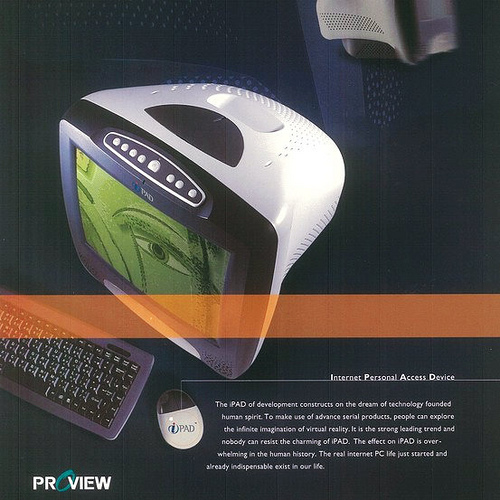
Proview representatives presented as court evidence the company’s 2000 iMac-lookalike named IPAD (pictured on the right). The lawyers came down with all guns blazing on Apple, and said: “Apple has no right to sell iPads under that name.” The company’s CEO told reporters “both sides have willingness to negotiate,” and asserted, “both sides will submit their plans before the talks,” because an out-of-court settlement “is quite possible.”
To this, Apple responded:
They have no market, no sales, no customers. They have nothing. The iPad is so popular that it is in short supply. We have to consider the public good.
Reutersfollowed up with another quote attributed to Apple’s legal team:
Apple has huge sales in China. Its fans line up to buy Apple products. The ban, if executed, would not only hurt Apple sales but it would also hurt China’s national interest.
Explaining Proview has not sold or marketed its IPAD computer system in years while Apple only began selling the iPad tablet in 2010, the company said the fact essentially invalidates Proview’s trademark. Lawyers for Proview cried foul, and claimed any public good achieved through the creation of iPad manufacturing jobs in China and tax revenues should not be confused with trademark infringement:
Twitter updated its iOS app with long overdue usability enhancements and a host of little improvements and bug fixes. Twitter for iOS version 4.1, a free download from the App Store, brought back the handy swipe shortcut. Just swipe a tweet in your home timeline to reply, retweet, favorite or share it, or view the Twitter user’s profile without leaving your timeline. You can also copy and paste tweets and profiles, press and hold links to get more options, including opening the link in Safari, tweet, copy or mail that link, or read it later.
When checking someone’s profile, the app will finally tell you whether that person is following you and people search results has gained verified badges. The Direct Message feature now lets you mark all DMs as read by tapping the check mark in the lower right corner. Other nice-to-haves: Font size settings, confirmation alert for Find Friends, and improved image quality in tweet detail.
Sadly, the app still does not support sending long tweets, and all these new features and improvements are for iPhone only. Release notes are after the break.
Today only, MacConnection has the Mac Mini base configuration for $529.95 with free shipping. That’s $70 off retail and the lowest price we’ve seen (refurb is $519 at Apple).
UPDATE: Qualcomm at Mobile World Congress in Barcelona, Spain took the wraps off three next-generation modem chipsets, first to support 84MBps HSPA+ Release 10 and LTE-Advanced with carrier aggregation technology.
Chipmaker Qualcomm today issued a press release highlighting a fifth iteration of its Gobi reference platform that had actually been introduced back in February 2011. That said, these chips include in a comprehensive support for TD-SCDMA, TD-LTE, LTE on FDD and TDD networks worldwide, in addition to embedded GPS capability.
Of course, the platform also supports the usual HSPA+ and EV-DO for backwards compatibility and (unlike current 6000 series chips) voice. Such a powerful combo in theory allows Gobi products to connect to the faster LTE network locally and stay connected to the Internet globally on 3G networks worldwide.
Now, Qualcomm noted in the release included after the break that both the MDM9615 and MDM9215 work with Windows 8 and Android devices plus x86 and Qualcomm’s own dual- and quad-core Snapdragon system-on-a-chip solutions. For all we know, this could be the chip inside the iPhone 5. The yet-to-be-announced iPhone 5 running this new Gobi chip would theoretically enable Apple to tap a single hardware in targeting a variety of carriers that often use different and incompatible radio technologies.
This includes the world’s biggest carrier China Mobile whose infrastructure revolves around TD-LTE radio technology. Put simply: These Gobi chips allow for true world-phone compatibility. It is worth noting that almost every 3G iOS device since the Verizon iPhone uses Qualcomm’s Gobi platform. The only exception is the AT&T iPad that still runs an older Infineon chip. Whichever way you look at it, one thing is certain: Apple will soon ship its first 4G LTE mobile device.
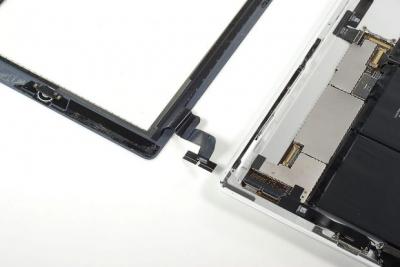
The iPad 3 is going to look a lot like iPad 2—until you turn it on, that is. If the purported iPad 3 front glass spy shot on the right is an indication, the third-generation iPad (rumored for the March 7 unveiling) will sport almost identical appearance to its predecessor. Discovered byApple.pro, a usually reliable source for Apple hardware rumors, the front glass part shows literally the same 9.7-inch size and shape as the iPad 2, even down to the home button and the round bezel. Compared to the iPad 2 digitizer assembly seen below, iPad 3 clearly has a longer ribbon cable going all the way to the side of the display. Apart from this aspect, the iPad 3’s front is mostly indistinguishable from iPad 2. It is widely assumed the iPad 3 will rock a 2,048-by-1, 536 pixel resolution display, and a set of manufacturing spy shots suggest that—surprisingly—Samsung is manufacturing those high-resolution displays and not Sharp or LG Display, as previously thought.
As Apple does not keep all its eggs in the same basket, the company could (and probably will) source iPad 3 panels from multiple suppliers. Interestingly, Samsung’s board of directors approved plans today to spin the company’s LCD display business into a new entity. The wholly owned subsidiary of Samsung Electronics, the new company is now called Samsung Display Company and it will merge with Samsung Mobile Display and S-LCD to improve competitiveness. The South Korean consumer electronics conglomerate said in a statement: “The display market is undergoing rapid chances with OLED panels expected to fast replace LCD panels to become the mainstream.”
Now, some media outlets speculate Apple will make a mistake by advertising iPad 3 as Retina-capable, arguing a 2,048-by-1, 536 display does not meet Apple’s Retina specifications. We deconstruct this myth right after the break.
If you are fond of handy little helper apps for your Mac like MenuTab for Facebook, Tab for Google+ or MailTab for Gmail, you will definitely want to consider adding Rasmus Porsager and Anders Myrup’s QuickMailer to your daily productivity arsenal. Do you hate having to launch a full-blown email client just to fire off a quick email message? Worry not; QuickMailer comes to the rescue (viaCult of Mac). All this little Mac app does is sit at your menu bar and wait for a keystroke combination.
As seen above: An elegant, clean compose window will pop up with the To, Subject, and Body fields, and an option to attach a file, access preferences and send your message. The program works through your primary Mail.app account and looks up previous recipients to provide auto-completion. Also handy: QuickMailer can remember fields for your next message. A 99-cent download from the App Store, QuickMailer is a real lifesaver. One more screenshot is right below the fold.
The App Store is the home to many VNC apps that let you run a desktop using your iOS device. Some are quite good, but most are too clunky, slow, and cumbersome. Edovia’s Screens app for the Mac and iOS released more than two years ago and just received a major overhaul with new features that leapfrog rival offerings. Coupled with the new Screens Connect service at screensconnect.com, Screens 2.0 is by far the most elegant solution to connect to a Mac or PC box through your iPhone, iPod touch or iPad through a local network or the web.
Upon installing the Mac client, simply enable screen sharing under System Preferences -> Sharing and registering your computer with Screens Connect (which takes care of network changes and configuring your router for UPnP and NAT-PMP) and that is all it takes for the iOS app to auto-configure itself. Screens 2.0 also sports iCloud integration for seamless experience across devices. It is the kind of app that will truly shine on Retina Display iPad 3…
Update: Whooooaaaaa…hold your horses. Microsoft says it ain’t so:
A Microsoft spokeswoman issued this statement: “The Daily story is based on inaccurate rumors and speculation. We have no further comment.”
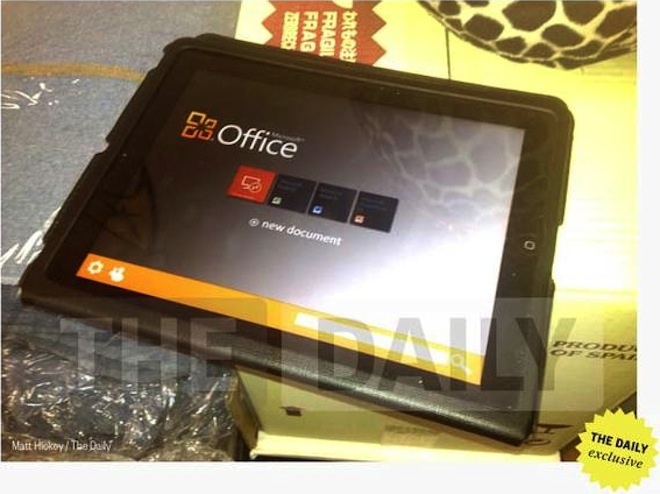
Corroborating earlier reports, Rupert Murdoch’s tablet-only magazine The Dailyapparently saw a work-in-progress version of Microsoft’s native Office app for iPad, and the publication posted the above screenshot to prove it exists. The Daily’s first impressions?
The app’s user interface is similar to the current OneNote app, but it has hints of Metro, the new design language that can be seen in Windows Phone and in the as-yet-released Windows 8 desktop operating system. Word, Excel and PowerPoint files can be created and edited locally and online.
According to unnamed sources, the team wrapped up the project and will soon submit the app for approval. An Android version of Office is not in the works, “sources familiar with the matter” said, but the Windows maker is putting the finishing touches on the new OneNote iOS app said to sport the Metro user-interface overhaul. When Office for iPad finally arrives, it will compete with the likes of Documents to Go, Quickoffice and Apple’s own Pages, Keynote and Numbers apps, which at $9.99 each might be hard to beat.
Cash-strapped display maker Proview that sued Apple over the iPad moniker in China feels it has the Cupertino, Calif.-headquartered gadget giant right where it wants them, cornered against the wall. Just as the Intermediate People’s Court in Huizhou ruled last Friday that local distributors should stop selling iPads in China, Proview now toldThe Times of India it us ready to sit at the negotiating table, apparently telling Apple it has “peaceful intentions.”
The company wants money, is hoping for an out of court settlement, and it is shooting for as high as $2 billion for the I-PAD trademark in China. Legal representatives for the debt-laden company told the paper Tuesday:
We are now preparing for negotiations. The court cases will continue until we reach an agreement.
A court in Shanghai will begin hearings tomorrow on whether Proview’s claims have any merit and the ruling could take months, Reutersreported. Whether or not Proview’s strategy works, that is anyone’s guess at this point. Apple is even threatening to sue Proview over “defamatory statements.” This highlights Apple’s unwillingness to engage in trademark licensing talks with the Chinese firm that recently filed for bankruptcy…
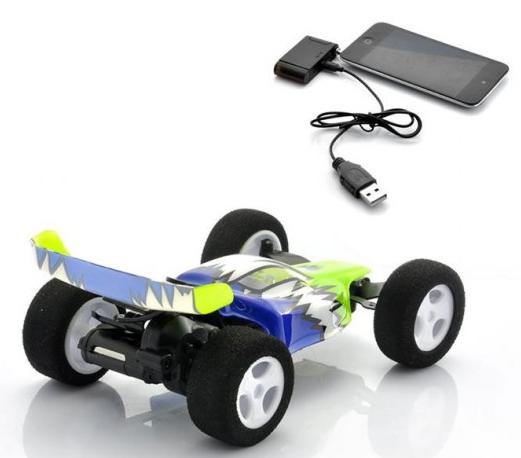
From the makers of iOS-controlled iHelicopter (and its souped up cousin aptly named the Cobra) comes a new iOS-friendly toy that will have you revved up for some cool stunts. Tapping the accelerometer sensor, the Stunt Car Racer uses your iPhone, iPad or iPod Touch as the steering wheel. A free app works with the RF transmitter dongle (plugs in the headphone jack) that uses radio waves to communicate with your race car at up to 20 meters, and up to three people can race each other in the same area because it supports three different frequency bands. The vendor boasts the robust structure that lets you make “crazy stunts.”
We will not take it for granted until we get our hands on the Stunt Car Racer, of course. If the iHelicopter thing is anything to go by, the Stunt Car Racer will not disappointconstruction quality-wise. Interested? The Stunt Car Racer is available now in exchange for $49.95, and the company is spoiling buyers with free shipping to any destination in the world. Spec sheet follows the break.
Pictured above: Proview’s iMac-like computer named iPAD, released 12 years ago.
The latest in an ongoing iPad trademark dispute in China comes as Shenzhen-based Proview claims a small victory in its pursue of a $2 billion compensation from Apple over the iPad moniker in China. According to a report filed by The Associated Press, Proview’s lawyer Xie Xianghui told the media Monday that the Intermediate People’s Court in Huizhou ruled last Friday that local distributors should stop selling iPads in the country.
Previous reports declared that commercial authorities in more than 40 Chinese cities were removing the device from store shelves. Apple appealed to Guangdong’s High Court against an earlier ruling in Proview’s favor, stressing in today’s statement its case is still pending in mainland China. It should be noted that Hong Kong’s and Mainland China’s legal systems are not very much alike.
PCWorld followed up with an update and said Apple will sue Proview’s lawyers and bosses for “defamatory statements.” Folks familiar with Apple’s letter to Proview claim it reads: “It is inappropriate to release information contrary to the facts to the media, especially when such disclosures have the effect of wrongfully causing damage to Apple’s reputation.” The document is embedded below.
So, who is the biggest beneficiary of this brouhaha? Samsung— its Galaxy Tab family of tablets is after the same high-end of the market. Per IDC, Apple in the third quarter of 2011 moved 1.3 million iPads in China versus 58,000 Galaxy Tabs.
Once a well-known display maker, Proview is now strapped for cash and recently filed for bankruptcy. The company maintains it first used the iPAD moniker, which stands for “Internet Personal Access Device,” for its iMac-like computer dated back to 2000.
[vodpod id=Video.16115602&w=650&h=420&fv=allowFullScreen%3Dtrue%26bgcolor%3D%23000000%26autoPlay%3Dfalse%26screensLayer.startScreenOverId%3DstartScreen%26screensLayer.startScreenId%3DstartScreen%26] Note: A YouTube version should be up soon
As promised, ABC aired its documentary about Foxconn factories producing Apple products. In an unprecedented move, Apple decided to grant the network’s “Nightline” program full access to its Chinese supply chain, so correspondent Bill Weir traveled to Shenzhen, China to look at “iFactories,” as ABC dubbed them.
Full disclosure: Disney Corporation owns the ABC News network. The fact that the Steve Jobs Trust is Disney’s largest individual shareholder, coupled with Disney CEO Bob Iger now having a seat on Apple’s board of directors, certainly helped win the official approval from Apple. It also raises questions on a possible conflict of interest with this report.
The full “iFactory: Inside Apple” report is scheduled to air on a special edition of “Nightline” due tomorrow, Feb. 21, at 11:35pm ET/PT. A preview will air on “Good Morning America” and “World News with Diane Sawyer.” A long article that accompanies a video teaser, included above for your convenience, offers a grim description of working conditions inside Foxconn plants:
Staples has 2x$25 iTunes gift cards for $40 with free shipping. At 20% off, that matches the lowest price we’ve seen. The promo lasts until Feb. 25th. iTunes gift cards can be used on Music, Videos, iBooks, iOS Apps and Mac Apps (including Mountain Lion).
Apple started a countdown to its 25 billionth app download on the App Store. A promotional page at the company’s website reads:
As of today, nearly 25 billion apps have been downloaded worldwide. Which is almost as amazing as the apps themselves. So we want to say thanks. Download the 25 billionth app, and you could win a US$10,000 App Store Gift Card. Just visit the App Store and download your best app yet.
A special section on the App Store, and the official rules, state that a person lucky enough to download the 25 billionth app will take home a $10,000 App Store Gift Card. You can also fill out an entry form here to take part in the contest.
Chinese vendor Proview apparently owns rights to the iPad trademark in China, and it has two billion reasons not to honor its prior agreement with Apple as the Wall Street Journalcited a representative of Proview creditors who suggested compensation from Apple “could range as high as $2 billion,”which is up from the previous sum of $1.5 billion. Cash-strapped Proview recently filed for bankruptcy, so courts could interpret this as banks’ last-ditch effort to recoup their loans to Proview.
A Hong Kong court ruled last year that Apple’s agreement with Proview was valid, but that case is still pending on the Chinese mainland. Court documents uncovered by Dow Jones suggest on Dec. 23, 2009, Apple of California bought the rights to the iPad trademark from Proview in South Korea, Thailand, Singapore, and China for a paltry sum of about $55,494 in today’s dollars. Proview waived its right to sue for past infringements and passing off.
Proview said it still owns the trademark and maintains the deal did n0t include the China market. Another court in Mainland China sided with Proview, thus paving the way for a potential injunction on both the import and export of iPads. The world’s largest contract manufacturer, Foxconn, is exclusively manufacturing Apple’s tablet in China.
Proview chairperson Yang Rongshan said today: “If we are not compensated properly, then Apple doesn’t use the iPad trademark in mainland China.” Shenzhen-based Proview, once a well-known monitor vendor, claimed it started developing a product called the iPAD in 2000. iPAD stands for “Internet Personal Access Device.” So, what does Proview’s iPAD look like? Images are right after the break.
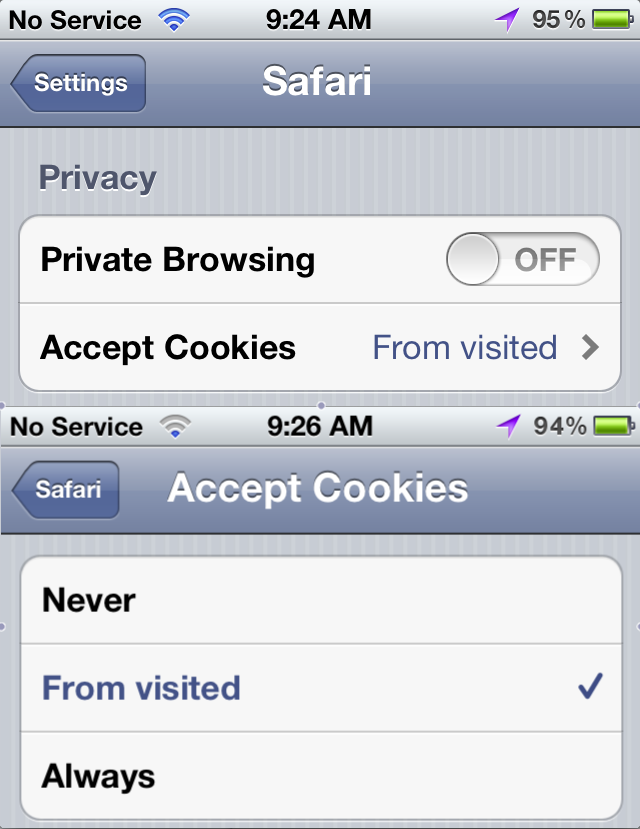
Internet giant Google found itself in a middle of a potential public relations nightmare following a Wall Street Journalarticle this morning. Tentatively titled “Google’s iPhone Tracking,” the article asserts that “Google Inc. and other advertising companies have been bypassing the privacy settings of millions of people using Apple Inc.’s Web browser on their iPhones and computers” to follow iPhone users even after they explicitly set Safari’s privacy controls to disable such tracking. According to authors Julia Angwin and Jennifer Valentino-Devries, Google used “special computer code that tricks Apple’s Safari Web-browsing software into letting them monitor many users.” Google apparently disabled the problematic code after the newspaper contacted the Mountain View, Calif.-based Company.
Stanford researcher Jonathan Mayer discovered that although mobile Safari’s default setting blocks cookies from third parties and advertisers, Google and advertising companies Media Innovation Group, Vibrant Media, and Gannett PointRoll fooled mobile Safari into thinking “a person was submitting an invisible form to Google,” letting them in turn install a tracking cookie on users’ iPhones and PCs without consent.
Once a cookie installed, a Safari glitch allowed subsequent cookies to attach. Both Google and Apple issued statements following this morning’s report…
As part of today’s Mountain Lion Preview roll out, Apple seeded its registered developers with new versions of the Xcode development environment and the Safari browser. Safari 5.2 for Lion, now available for download through the Dev Center, welcomes new features that cannot be found in the most recent Safari 5.1.3 version for end-users or the recently seeded Safari 5.1.4 for developers.
Apple took a page from Google’s book by integrating the search bar into the address bar (finally, some would say) in Safari 5.2. Other enhancements include visual tweaks that highlight the domain section of the URL in the address bar and a rehashed Reader icon. Features from both Safari 5.1.4 and 5.2 are likely to be included in this summer’s release of Mountain Lion.
A developer preview version of Xcode 4.4 is required to code and test applications for Mountain Lion that will become available to the public this summer. Among the new features:
If you plan to install Mountain Lion on an older Mac, you might be out of luck. The new operating system release raises the ladder in terms of graphics performance required for its new features like AirPlay Mirroring. As a result, a couple years old Mac might not cut it anymore. According to French-language website MacGeneration, any Mac sporting Intel’s sluggish GMA x3100 or 950 chip will not be able to run Mountain Lion. While we have come a long way since the GMA graphics, you probably have somewhere under your table or in the basement a legacy Mac that does not have enough oomph for Mountain Lion. Anything older than the mid-2007 iMacs, early-2008 Mac Pros, early-2009 Mac minis and Xserves are left behind. The same goes for MacBooks based on any Intel Core 2 Duo processor and the original 2008 MacBook Air. Sorry folks, that is the price of progression. In addition, the following platform changes may interest you…
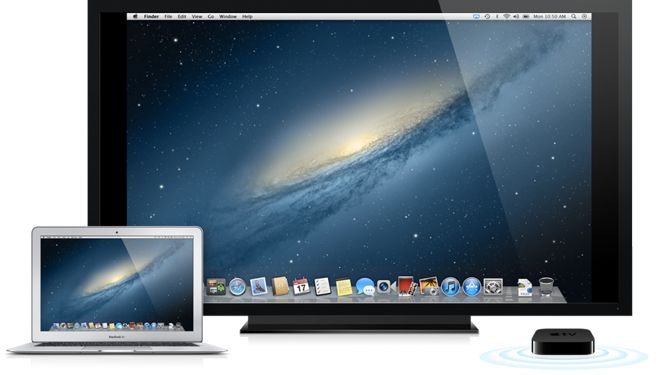
Yes, there are a few apps for that, though, I have yet to find one that works as seamlessly and effortlessly as AirPlay implementation on iOS devices. Eagle-eyed readers could point out that AirPlay support was long-planned for Lion until it was abruptly pulled last-minute without an explanation. Sure enough, it took longer than expected, so we are excited with full AirPlay Mirroring now a possibility on Macs running Mountain Lion.
Just as you would expect, AirPlay Mirroring in Mountain Lion lets you tunnel whatever is on your Mac wirelessly to your television through the Apple TV set-top box. Think web pages in Safari, kitten clips on YouTube, movies from iMovies, Keynote presentations or any other content displayed on your Mac, including your desktop. Yes, just like on the iPad.
Better yet, using AirPlay Mirroring on 2011 Mac notebooks does not need a local wireless network, because the machine can create an ad hoc wireless network to pair with the Apple TV. This is gold for road warriors and educators who only need a MacBook and an Apple TV to present their portfolio or teaching material on the big screen.
There are people—yours truly included—who felt genuinely dumbfounded having read both the authorized “Steve Jobs” biography by Walter Isaacson and Adam Lashinsky’s “Inside Apple.” Do not get me wrong, Isaacson and Lashinsky are among the best contemporary wordsmiths, and their work enlightened us with some previously unknown details about the inner-workings of Apple and the man who cofounded it. Nonetheless, the authors dedicated way too many pages to the stuff we already knew, and their writing style may not appeal to the Technorati accustomed to fast-paced news reporting and sensationalist headlines. Hoping to fill this gap and tell the untold story about Apple of California from a different angle, writer Ken Segall committed to a project tentatively named “Insanely Simple – The Obsession That Drives Apple’s Success” (viaDaring Fireball).
Few would dare argue that Apple’s agonizing over the tiniest and seemingly unimportant details is what makes the products so pleasurable to use. Segall should know what makes Apple tick: He coined the iMac moniker during his 12-year tenure at TBWA\Chiat\Day, Apple’s and NeXT’s advertising agency, and he now runs an Apple parody website you are probably familiar with called Scoopertino. The author explained the reasoning behind his ambitious undertaking on his personal blog:
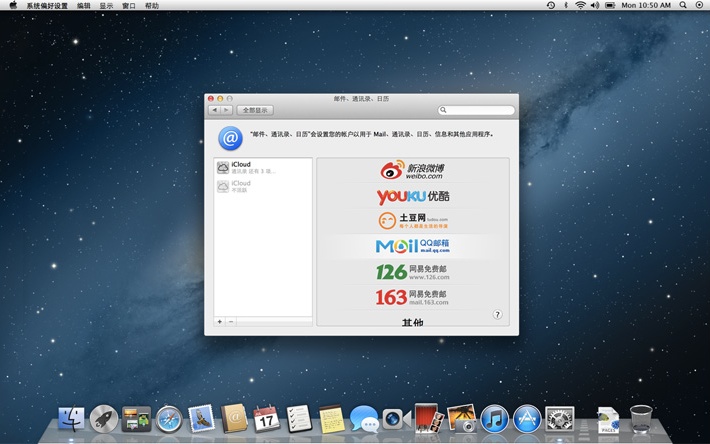
Mountain Lion will cater to Chinese users more than any other OS X version. CEO Tim Cook once more underscored the importance of China by highlighting Mac sales in today’s interview with the Wall Street Journal. Sales doubled in the 1.33 billion-people market during 2011 to the tune of $13 billion in revenue.
“They know about Apple and what Apple stands for. Then they search out and look for the Mac”, he told the paper. Apple’s promotional material said Mountain Lion makes it easy to “set up Mail, Contacts, Calendar, video sharing, web searching, and blogging on your Mac using many popular services in China.”
For starters, Chinese input method in Mountain Lion has “significant enhancements.” Secondly, Apple worked hard to make sure customers in China get a localized experience by providing the ability to select Baidu search in Safari. Baidu is the dominant search engine in China, ranked No. 6 in Alexa’s global rankings and No. 1 in China with an estimated 56.6-percent share of the country’s 4.02 billion search queries as of June 2011…