Tech Industry

See All Stories
Site default logo image

Congress considers forbidding sales bans related to essential patents

Reuters reported today that Congress is set to discuss whether companies that hold patents considered essential to an industry standard, “such as a digital movie format,” should be allowed to request bans on infringing devices. A hearing will take place this Wednesday with the Senate Judiciary Committee, and Federal Trade Commission officials are expected to testify:

“If they (smartphone makers) had taken the conservatively $15 to $20 billion dollars they’ve spent on this fight, imagine how much better a place the world would be,” said Lemley.

Site default logo image

Casting for Jony Ive role, others announced for indie Steve Jobs biopic

We previously told you about the “jOBS” biopic staring Ashton Kutcher as Steve Jobs that is currently in production, and we brought you some early images of Kutcher on set. The film was previously confirmed to star Josh Gad as Steve Wozniak and Matthew Modine as John Sculley, but a new report from HollywoodReporter announced more additions to the cast including Giles Matthey (pictured right) as Jony Ive:

Kevin Dunn and J.K. Simmons have joined the cast of Jobs, the biopic about the late Apple co-founder Steve Jobs, starring Ashton Kutcher. Also rounding out the cast are Elden Henson, Lenny Jacobson, Giles Matthey, Ahna O’Reilly and Victor Rasuk… Dunn, who recently co-starred in HBO’s Luck, will play Apple chairman Gil Amelio. Simmons, known from his nine seasons on Law & Order, will appear as venture capitalist and Apple investor Arthur Rock. Among the other additions to the cast, Henson plays computer scientist and Macintosh developer Andy Hertzfeld; Jacobson portrays Apple engineer Burrell Smith; Matthey is iPod designer Jonathan Ive; O’Reilly plays Jobs’ girlfriend Chris-Ann; and Rasuk is Apple’s first employee and user interface architect Bill Fernandez.

The biopic is now shooting in Los Altos and Los Angeles, and it is expected to release later this year. Other cast members previously confirmed include James Woods, Ron Eldard, John Getz, Lukas Haas, Dermot Mulroney, and Lesley Ann Warren.

Site default logo image

Google to pay $22.5M settlement in FTC’s iOS Safari privacy investigation

The last time we updated you on the Federal Trade Commission’s investigation into Google’s method of bypassing the default Safari browser settings on iOS devices, reports claimed the company was facing possible fines that could reach tens of millions. Today, The Wall Street Journal said Google is close to reaching a $22.5 million settlement with the FTC, according to people close to the negotiations:

The fine is expected to be the largest penalty ever levied on a single company by the U.S. Federal Trade Commission. It offers the latest sign of the FTC’s stepped-up approach to policing online privacy violations, coming just six months after The Wall Street Journal reported on Google’s practices.

While the fine likely will represent only a tiny portion of Google’s revenues—last year, the Internet giant raked in that much cash roughly every five hours or so—it counts among a series of negative reports about Google’s privacy practices that could undermine users’ trust in its services.

iOS 6 code points to integration of Apple Maps on Intel-based Macs

Site default logo image

Since Apple unveiled its new in-house Maps app for iOS 6, we have discovered bits and pieces of what it has planned for the final release this fall. Apple already showed off Yelp integration, turn-by-turn navigation, and the 3D flyover mode, and it appears to be utilizing a new Avenir typeface. Today, Techpp posted a code dump from the iOS 6 maps app courtesy of developer Cody Cooper who found some interesting evidence of potential Maps integration with OS X:

Our developer friend, Cody Cooper has now stumbled upon an interesting code dump in iOS 6 maps application which hints at the possibility of Apple Maps coming to Macs in the near future.

During his routine investigation of Maps app, Cody found some interesting bits in the file altitude_manifest.xml

In this XML file, there is a reference to a set of Intel based graphics chipsets for which certain features like Shading are disabled.

While this is not solid proof that Apple is working on a full-blown Maps app for Mac, it could hint at possible integration between core apps and features in Mountain Lion and Maps on iOS. For example, location features in iPhoto could integrate with iOS Maps. As noted in the report, the code refers to shading being disabled for older Intel chipsets, which Cooper guessed could likely not support the app’s shading features. We will do some digging, and then update you if we discover anything new. The public release of Mountain Lion is scheduled for this month.
Expand
Expanding
Close

Amazon is building a phone to compete with iOS and Android

Site default logo image

According to Bloomberg, Amazon is developing a smartphone to go head-to-head with the iOS and Android handsets. Amazon is reportedly working with Foxconn to build the device, the same manufacture for many of Apple’s mobile devices including the iPhone and iPad.

In order to prepare for the launch of their phone, Amazon plans to build up a wireless-related patent portfolio, according to the report. Amazon already sells the successful Kindle Fire with a 7-inch display, a device that demonstrates the firm’s aptitude for building a high-quality, customized mobile operating system (based on Android).

Amazon has its own series of content and distribution channels, including cloud services for downloading media like movies and books, making their Amazon phone an obvious competitor to Apple’s iPhone and its portfolio of media content stores like the iTunes Store and iBookstore…


Expand
Expanding
Close

Site default logo image

Avid sells off its consumer M-Audio brand and video editing apps

Avid is best known for its Pro Tools software, the music industry’s leading DAW used by pros worldwide, and it is the biggest competitor to Apple’s Logic Pro, but perhaps just as popular among Mac musicians is Avid’s consumer M-Audio brand. It offers midi controllers, keyboards, audio interfaces, speakers, and DJ gear.

Today, Avid announced that it will sell off its consumer audio and video product lines to focus on “Media Enterprise and Post & Professional customers and to drive improved operating performance.”

Avid will sell M-Audio to inMusic, the parent company of well-known gear makers Akai, Alesis, and Numark. Its video editing apps, such as the recently launched Avid Studio for iPad, will be sold to Corel Corporation:
Expand
Expanding
Close

Site default logo image

Former Mac OS X chief Bertrand Serlet working on cloud startup with ex-Apple colleagues

In March 2011, Apple officially announced that Mac OS X chief Bertrand Serlet would leave Apple after 22 years with Steve Jobs at NeXT and Apple. At the time of the announcement, Serlet said he wanted “to focus less on products and more on science,” but we did not have any other information on what was in the cards for the man Apple credited with the “definition, development and creation of Mac OS X.”

Today, BusinessInsider reported on what Serlet has in the works:

Business Insider has learned that Serlet has spent much of the time since his departure from Apple working with at least two other former Apple employees to launch a cloud computing startup in downtown Palo Alto called Upthere

Some of these job postings also allude to the fact that the startup was founded by high-profile ex-Apple employees.

We have since learned that this is a reference to Serlet (the brains behind Mac OS X) and Roger Bodamer, a former VP of product operations and development at Apple who previously worked at Oracle.

Based on the job postings we’ve seen, it’s clear the startup is looking to rethink the way people store files in the cloud, though just how this service will compare to options like Dropbox or Apple’s own iCloud feature remains unclear.

Site default logo image

T-Mobile signs AWS spectrum agreement with Verizon

T-Mobile just announced plans to exchange and purchase spectrum from Verizon Wireless in a deal the carrier claimed would improve its “spectrum position in 15 of the top 25 markets” that covers 60 million people. T-Mobile said the spectrum would help enhance its 4G network and advance the rollout of its LTE service. The agreement includes spectrum that Verizon planned to acquire from several cable companies, so T-Mobile will first have to wait for the Federal Communications Commission and U.S. Department of Justice to approve the deal:

“This agreement will provide T-Mobile with critical AWS spectrum, enhancing both network capacity and performance and allowing us to meet the growing consumer demand for 4G mobile broadband,” T-Mobile CEO and President Philipp Humm said. “This is good for T-Mobile and good for consumers because it will enable T-Mobile to compete even more vigorously with other wireless carriers. We anticipate FCC approval later this summer, in time for us to incorporate this new spectrum into our network modernization and the rollout of LTE services next year.”

We recently updated you on the rollout of T-Mobile’s $4 billion 4G-network plan, including its plan to rollout 4G HSPA+ in the 1900 MHz spectrum to iPhone users “in a large number of markets later this year.” T-Mobile mentioned a few of the cities that would benefit if the agreement goes through:

T-Mobile will gain spectrum covering 60 million people — notably in Philadelphia; Washington, D.C.; Detroit; Minneapolis; Seattle; Cleveland; Columbus, Ohio; Milwaukee; Charlotte, N.C.; Raleigh-Durham, N.C.; Greensboro, N.C.; Memphis, Tenn.; and Rochester, N.Y

Site default logo image

RIM to be split into handset and services, sold off piecemeal?

TheVerge reads behind the Sunday Times’ firewall:

The Sunday Times reports today that RIM is considering a plan to split its handset division and messaging network into two separate companies, and will sell off the struggling BlackBerry hardware business. The British paper doesn’t cite any sources in the report, but it says that Facebook and Amazon are both “potential buyers.” As part of this plan, RIM could keep its enterprise-friendly messaging and data network (including BBM and BIS) in-house and license them out.

BBM and BES only run on Blackberry now, and that platform will have a market share heading toward zero by the time RIM gets all of this organizational structure sorted. So keeping that a separate business makes little sense.

The other option is selling out piecemeal to Microsoft for parts and people. I imagine that by then, the price of RIM will get so low, even Apple and Google would be interested in picking up the parts (patents, people, and tech). Microsoft is probably already lining up some cash to buy the remnants of Nokia as well, so it is less likely to pick up RIM (although it made several attempts to pick up RIM in the past).

Moreover, RIM’s QNX/Blackberry 10 might have some value for companies like Dell, HP (which recently fumbled WebOS), Lenovo, Toshiba, Acer, or ASUS due to Microsoft now building its own tablets and scaring OEMs.

That split could also see Cisco or Oracle taking the backend stuff.

Any way you look at it, on the fifth anniversary of iPhone, Blackberry —as we knew it— is almost over.

Site default logo image

Microsoft unveils Windows Phone 8

Microsoft’s Windows Phone Summit is happening now in San Francisco with Microsoft Vice President Joe Belfiore giving a demo on eight of the big new features to be included in Windows Phone 8. Some of the notables, as highlighted in the images above, include: a new SIM-based NFC wallet experience that will initially launch on Orange (and it appears to include iOS 6 Passbook-like features for third-party cards, etc.); Nokia Map technology for offline maps and turn-by-turn; and, an updated customizable home screen. During the presentation, Belfiore also showed the slide above (via CNET) of SunSpider benchmark results showing IE 10 on Windows 8 beating out the iPhone 4S (running iOS 6 beta—Developer NDA be damned) and Android devices.

Perhaps the most interesting thing about Microsoft’s strategy is that it is—yet again—totally refreshing. That means no single Windows Phone 7 device will upgrade to Windows 8; all current devices are orphaned. For consumers, the company did this same thing with Windows Mobile. The only difference is that Windows Phone 7 looks like Windows 8. It is a completely new ballgame underneath, and the device is actually running an entirely new OS that gets its roots in Windows NT. For developers, things are easier due to the shared libraries.

Chevy Sonic, Spark to be the first cars out of GM to sport Siri’s ‘Eyes Free’ feature

Site default logo image

During its opening keynote at the Worldwide Developers Conference, Apple announced Siri would gain an all-new “Eyes Free” feature as part of iOS 6. Eyes Free lets automakers include a button on their automobiles that allows drivers to initiate Siri for sending messages, making calls, setting reminders, launching apps, and accessing a slew of information from inside of the car without picking up the device. Apple revealed nine automakers will adopt Eyes Free, but it gave no more information. This evening, GM Authority reported that GM would be one of the first to include the technology in its automobiles. The company is starting with its Chevy Spark and Sonic, which are two compacts with a budget in mind. The publication could not provide an exact date of arrival for the technology in GM’s vehicles, but it should be available within the next year.

The Spark and Sonic now feature Chevy’s MyLink that allows drivers to connect their car with any smartphone. It has roughly 60 commands, which is not that much, but Siri could definitely add a long-list of commands for those who have an iOS device.

Eyes Free should resemble how other hands-free packages work on automobiles. An Eyes Free button will be included on the steering wheel, so users can activate and speak to any iPhone or iPad that is connected over Bluetooth. Siri will do all the processing work.

The other nine automakers announced as partners include BMW, Mercedes, Land Rover, Jaguar, Audi, Toyota, Chrysler, and Honda. We will look out for when more information becomes available over the next year. (via CNET)


Expand
Expanding
Close

Site default logo image

Google accelerating development of Siri competitor for Android

The Wall Street Journal reported that Google is accelerating its plans to launch a competitor to Siri. 9to5Google has the full story:

We have heard several reports in the past that Google was working on various evolutions of its Voice Actions platform for Android. Back in December we heard of “Project Majel”, which according to reports is the codename for a new voice-controlled assistant app similar to Siri. In March TechCrunch reported on a similar project dubbed Google Assistant. According to a new report from the Wall Street Journal, Google is accelerating its plans to launch a competitor to Apple’s Siri…

Site default logo image

Verizon announces ultra-high speed FiOS ‘Quantum’ service, up to 300 Mbps for $210 a month

Verizon announced tiers for its new high-speed Internet FiOS “Quantum” service today. It ranges from $65 to $210 a month, and it is available in double or triple-play bundles and stand-alone plans. Verizon will continue offering its entry-level $65 15/5 Mbps service, but it will introduce new plans including: 50/25 Mbps, 75/35 Mbps, 150/65 Mbps, and 300/65 Mbps. The company noted they are “by a wide margin the nation’s fastest, mass scale residential Internet speeds.”

Three of those speeds ¬¬ 75/35, 150/65 and 300/65 — are twice as fast as those previously offered.1 In addition, Verizon will continue to offer its entry-level speed of 15/5 Mbps… The two highest downstream speed offers – 150 and 300 Mbps – and the new 65 Mbps upstream speed are by a wide margin the nation’s fastest, mass scale residential Internet speeds available. By contrast, the fastest Internet speeds offered by cable-company challengers top out at 105 Mbps downstream and 20 Mbps upstream. (This FiOS Internet speed grid shows specific examples of the benefits of faster downstream and upstream speeds.)

Verizon noted existing customers can upgrade free, but they will on-average pay $10 to $15 more per month. The company also outlined the different pricing options for new customers:

For new customers, prices of triple-play bundles of 15/5 Mbps FiOS Internet, FiOS TV and FiOS Digital Voice unlimited calling will range from $99.99 to $144.99 per month, depending upon which FiOS TV package is ordered. The packages are: Prime, with more than 200 channels and more than 50 HD channels; Extreme, with more than 290 channels and more than 70 HD channels; and Ultimate, with more than 380 channels plus premium movie channels, and more than 110 HD channels).

Double-play bundles of the 15/5 Mbps FiOS Internet and FiOS TV range from $84.99 to $129.99 per month. Stand-alone 15/5 Mbps service costs $69.99 per month on a month-to-month basis, and $64.99 per month with a two-year contract.

Triple-play bundles of the 50/25 Mbps speed range from $109.99 to $149.99 per month for new customers. Double-play bundles with FiOS TV range from $94.99 to $134.99 per month. The stand-alone version costs $79.99 per month on a month-to-month basis, and $74.99 with a two-year contract.

Triple-play bundles of the new 75/35 Mbps speed range from $114.99 to $154.99 per month for new subscribers. Double-play bundles with FiOS TV range from $99.99 to $139.99 per month. The stand-alone costs $89.99 per month on a month-to-month basis, and $84.99 with a two-year contract.

Triple-play bundles of 150/65 Mbps speed range from $169.99 to $174.99 per month for new FiOS customers. Double-play bundles with FiOS TV range from $154.99 to $159.99 per month. The stand-alone costs $99.99 per month on a month-to-month basis, and $94.99 with a two-year contract.

The new 300/65 Mbps tier, offered as a stand-alone only, costs $209.99 per month on a month-to-month basis, and $204.99 with a two-year contract.3
Will Microsoft try to take on Apple by manufacturing its own tablet?

Site default logo image

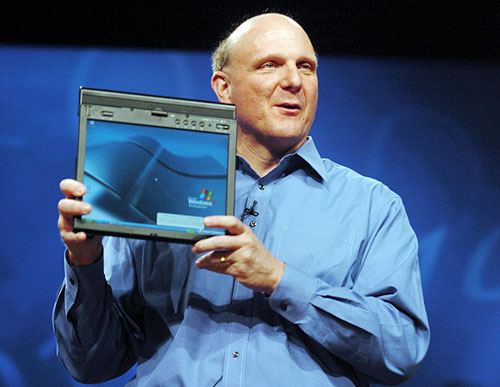
Microsoft is allegedly prepping to directly compete with Apple in the tablet market

The Redmond, Wash.-based Company scheduled an event in Los Angeles on Monday to make a “major announcement.” AllThingsD reported earlier this week that the event would unveil Microsoft’s tablet plans:

  • After signaling for months that it would attack the market only through its traditional hardware partners, Microsoft has decided to enter the tablet business more directly. […]
  • Sources say that Microsoft concluded that it needs its own tablet, with the company designing both the hardware and software in an effort to better compete against Apple’s strengths. Microsoft’s tablets may include machines running ARM-based processors as well as models running on traditional PC processors, sources said.

Perhaps more interesting: The Wrap claimed Microsoft will self-manufacture the device, which is an assertion that AllThingsD supports. The move is certainly plausible, because Microsoft snatched a 17.6-percent stake in Barnes and Noble’s Nook eReader business last month for $300 million. One could speculate that Apple and Amazon’s dominating presence in the market causes companies like Microsoft and Barnes and Noble to join forces.

[tweet https://twitter.com/harrymccracken/status/213653354117738497]


Expand
Expanding
Close

Apple patent details replaceable back panels for adding lenses and advanced camera features

Site default logo image

According to an Apple patent application published by the U.S. Patent and Trademark Office and detailed by PatentlyApple, Apple is at the very least conceptualizing a device that sports a removable back panel for easily replaceable components such as lenses or optical solutions.

While it is unclear whether the invention would be used in a standalone camera, next-generation iPod or iPhone, or a different device entirely, the patent detailed several methods of upgrading a device with supplementary optics:

The digital imaging subsystem is typically enclosed within the case of the device to protect the digital imaging subsystem. The enclosure generally prevents direct access to the lens of the digital imaging subsystem for the purpose of providing any sort of supplementary optics, especially if the supplementary optics must be precisely aligned with the image sensor… It would be desirable to provide a structure for a compact device that allows the end user to reconfigure the optical arrangement of the device while retaining the benefits of assembling the device using a pre-assembled digital imaging subsystem.

Apple detailed several features that could be added through the easily swappable supplementary optics, including: improved zoom capabilities, better shutter control, removable close-up lenses, and the addition of motion sensors, flashes, or a lens baffle. As an example, the report explained a removable IR cut-off filter that would allow “capturing black and white images at very low light levels. Without the IR-cut filter the camera’s light sensitivity may extend to 0.001 lux or lower.” The report also broke down how the removable back panels could be implemented:


Expand
Expanding
Close

Site default logo image

T-Mobile details progress of 4G network rollout, continues testing iPhone compatible 1900MHz HSPA+

Following a keynote from T-Mobile’s Chief Technology Officer Neville Ray at the NGMN conference this morning, Senior Vice President of Technology Dave Mayo provided an update today regarding the company’s $4 billion 4G-network plan.

We already knew T-Mobile would be make its 4G HSPA+ in the 1900 MHz band available to iPhone users later this year as its new network equipment gets installed. It recently confirmed that it began testing the network on a small scale. Today, we get an update on the progress of the carrier’s 4G rollout with Mayo confirming installations of new equipment at the first 400 modernized GSM / HSPA+ sites, which will be complete by the end of June, with the number growing to 2,500 sites a month after. He also noted the carrier was approved for 19,500 additional sites. This indicates the LTE network is on track for its 2013 rollout.

Expand
Expanding
Close

Verizon to introduce shared data plans June 28, reflects reality of multiple device users

Site default logo image

According to a report from AllThingsD, Verizon Wireless will soon change the way it charges customers for cellular/data plans in a major way. Rather than charging customers for phones calls or messages sent, the report claimed Verizon would charge “almost exclusively based on how much data” is consumed. The new “Share Everything” plans will also be the first in the United States that allows users to share their data with up to 10 devices through a single account:

The plans, known as “Share Everything,” allow users an unlimited number of calls and texts and also allow data usage to be pooled among up to 10 devices on one account. With the move, Verizon becomes the first U.S. carrier to offer the ability for customers to share a bucket of data across multiple devices.

AllThingsD noted that AT&T also has plans for shared data options, but it did not provide more details. As for Verizon’s new plans, which will apparently kick-in June 28, the report explained the cost of the data plan and pricing metrics based on a per-device fee. In other words, you will have to pay roughly $40 per smartphone ($10 per tablet), and then opt for either a $50 1GB data plan or a $100 10GB plan. While the report claimed the new pricing should not impact the cost of plans for users who continue consuming the same amount of data, it is clear that those signing a new plan for a single smartphone are getting a bit less for their money:


Expand
Expanding
Close

Site default logo image

Photos allegedly show logic board of new MacBook Pro, sporting NVIDIA GT 650M graphics

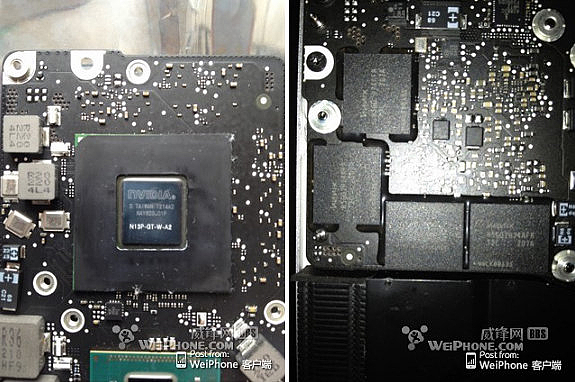
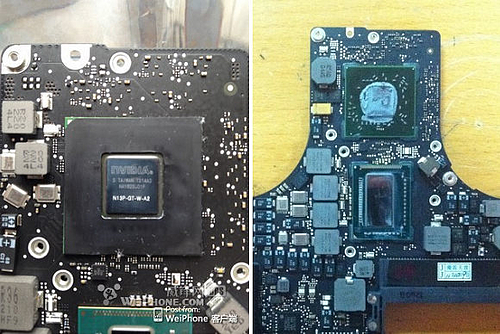
A user on Chinese forum WeiPhone posted (via MacRumors) photos that allegedly show off the logic board placed in the new MacBook Pro, which is to be announced tomorrow during Apple’s keynote opening at this year’s Worldwide Developers Conference. According to the leak, the MacBook Pro is set to feature a NVIDIA GT 650M graphics chip with 1GB GDDR5 graphics memory.

Another forum user analyzed the new logic board and put it side-by-side with the logic board on the current 15-inch MacBook Pro. As you can see, both logic boards have very similar layouts. The position of the GPU is also the same on both units.

We were the first to report last week that Apple is set to announce a refresh to most of the Mac line tomorrow, including the Mac Pro. Our sources indicated that Apple will release two configurations of the redesigned 15-inch MacBook Pro; although, what Apple plans to do with the other screen sizes is unclear. The new MacBook Pro will sport Retina graphics, an ultra-slim design, and USB 3.0. Our source said the Retina display is “jaw dropping.”

Tonight’s leak does not indicate what type of processor speed the new MacBook Pro will have, but it is somewhere in the neighborhood of 2.3 GHz, 2.5 GHz, or 2.7 GHz chip variants. You can bank on the processor being Intel’s new Ivy Bridge chip that supports Retina graphics, but pricing is still up in the air.

All of our questions will be answered tomorrow when Apple’s CEO Tim Cook and his company take the stage to make things official. You can read our full wrap-up of what we expect to be announced and follow our liveblog kicking off at 1 p.m. EST/10 a.m. PST tomorrow!

Update: this morning we reported Apple will be announcing both next-generation MacBook Pros with a thinner design and Retina Display AND spec-bumped MacBook Pros with the current design.


Expand
Expanding
Close

Site default logo image

Project Magenta is Linux-based mobile OS that aims to replicate iOS on generic hardware

.

Without getting into too many details, here is what little is known about this Open Source Magenta Project:

Magenta is an implementation of Darwin/BSD on top of the Linux kernel. It is made up of a number of kernel and userland components that work together. It is fully binary compatible with iPhone OS 5.0 (as in, it uses the same binary format).

It runs on ARM 7 Hardware currently, but what is the goal?

The final goal is probably recreating the iPhone OS 1.0 stack. I think this is a pretty feasible goal, considering the fact that there are so many open source libs that can be used to replace the proprietary libs used by Apple. Just as an example:
* CoreGraphics -> Cairo
-> FreeType
-> libpng/jpg
* Celestial -> Various open source media decoding libs.
* UIKit -> Chamelleon

The project does not wish to build a platform that can run Apple’s App Store apps; it appears to just aim at running iOS.

It will be interesting to see where this goes.

[tweet https://twitter.com/chronic/status/211315542026493953]
Expand
Expanding
Close

Site default logo image

UN’s ITU wants to tax biggest US websites including Google and Apple

The United Nations is considering a new Internet tax for U.S. websites and content providers including Google and Apple, according to leaked proposals from the European Telecommunications Network Operators Association:

The United Nations is considering a new Internet tax targeting the largest Web content providers, including Google, Facebook, Apple, and Netflix, that could cripple their ability to reach users in developing nations…The European proposal, offered for debate at a December meeting of a U.N. agency called the International Telecommunication Union, would amend an existing telecommunications treaty by imposing heavy costs on popular Web sites and their network providers for the privilege of serving non-U.S. users, according to newly leaked documents.

Site default logo image

Oracle sues Lodsys, attempts to invalidate patents

Texas-based shell company Lodsys has often been accused of being a patent troll for its various attempts to take legal action against app developers and companies that it claims uses its technologies. Most notably, the company last year attempted to get iOS and Android developers to pay royalties over in-app purchasing before Apple’s legal team eventually intervened on behalf of developers. Now, after recent threats from Lodsys to Oracle customers such as Walgreens over a web-chat technology, Oracle is suing Lodsys in an attempt to invalidate its patents. GigaOM reported:

Oracle has decided to weigh in because Lodsys “has repeatedly threatened numerous Oracle customers” such as Walgreens over the use of a web-chat feature Lodsys claims to own. Oracle is asking the court to declare that the four patents Lodsys is using to bully its customers are not new inventions. The patents, including US Patent  5,999,908 (“customer based design module”), came to prominence last year when Lodsys used them to sue Best Buy, Adidas and others.