Before you can properly understand Apple News, it’s important to know its history. Apple was founded by Steve Jobs and Steve Wozniak in 1976. In 1977, Apple’s sales were growing with the success of its early computers. Within a few years, Jobs and Wozniak hired designers and a production line crew. Apple went public in 1980 and was an instant success. Over the next few years, Apple shipped new computers featuring new graphical user interfaces, such as the original Macintosh in 1984. As the market for personal computers expanded through the 1990s, Apple lost market share to the cheaper Microsoft Windows on PC clones. Eventually, Wozniak and Jobs both left Apple. Jobs would go on to found NeXT and would return to Apple when NeXT was acquired in the late 90s. Apple then began a journey to the great second act in the history of the business world.
Since the release of the iPod in 2001, Apple has become a major player once again in the technology industry. After releasing the iPhone in 2007, the iPad in 2010, and the Apple Watch in 2015, Apple is now one of the largest companies in the world. Apple’s worldwide annual revenue totaled $274.5 billion for its 2020 fiscal year.
Today, Apple operates retail stores all across the world, has a growing services division, and an ever-expanding hardware lineup. The technology industry follows Apple news to see where the company is headed in the future.
There are times when an iPad can act as a handy sidekick to your Mac, but with a typical iPad stand you end up looking a little like a nodding dog as you look up at your monitor and down at your iPad. The TwelveSouth HoverBar 3 is designed to solve that, positioning your iPad display right next to your iMac or Apple Thunderbolt/Cinema Display.
The HoverBar can also be used on its own to position an iPad more comfortably, especially when using it to watch movies … Expand Expanding Close
Whether you’re blown away by all the new features, disappointed by things you wanted but didn’t get, or just a bit underwhelmed, here’s your chance to let us know.
We’ve summarized the features Apple has chosen to highlight, and there are separate polls for each platform … Expand Expanding Close
With so many new iOS and OS X features being introduced in yesterday’s WWDC keynote, the numbers that kicked off the show perhaps didn’t get the attention they otherwise might have done.
While the Wall Street line is that the smartphone market is saturated and iPhone and iPad growth is done, Tim Cook clearly thinks otherwise. Business Insider highlighted Cook’s comment on the migration Apple is seeing from Android phones.
“Over 130 million customers who bought an iOS device in the past 12 months were buying their first Apple device,” said Cook before introducing iOS 8, the new software for the iPhone and iPad. “Many of these customers were switchers from Android. They had bought an Android phone — by mistake. Then had sought a better experience … And a better life. And decided to check out iPhone and iOS.”
He added, “Nearly half of our customers in China in the past six months switch from Android to iPhone. This is incredible.”
Two of the great updated features in OS X Yosemite are improved versions of both Notification Center and Spotlight, both of which have become staples on OS X. Both of these features have received substantial updates, dropping their old user interfaces entirely, and gaining quite a few new features.
In this video, we’ll take you on a little tour of the new interfaces and their features.
It’s been a long time coming, but Apple has finally implemented useful notification features in iOS 8. Interactive notifications are essentially Apple’s version of quick reply (or quick actions) that will be available for a wide variety of apps when iOS 8 is released. We’ve had some time to explore the beta version today and put together a quick video to show off iOS 8’s new notification features.
One big change for Apple with the unveiling of OS X Yosemite today is Bing web searches in the completely revamped Spotlight feature. Spotlight, which allows users to look up anything locally on their Mac as well as perform web searches, received a redesigned user experience in Yosemite, but it might have also received a switch to Bing from Google search.
To be fair, the “web search” feature of spotlight prior to Yosemite actually just defaults to the default search engine in your browser of choice. If that happens to be Safari or Chrome like it is for most users, that meant Spotlight would typically send users to a Google search results page if they hadn’t changed their default preference. Now, Apple is listing Bing searches– but not Google– as a feature of Spotlight regardless of the default option (pictured above). We’ve yet to confirm that Bing is the only web search option for Spotlight in OS X Yosemite, as we’ve not yet been able to get the new Spotlight web search feature to work properly in the first beta.
While Spotlight is going to use Bing, Apple’s revamped search bar in Safari still uses Google as does iOS 8. Its easy to imagine Apple is only continuing to use Google search in Safari due to contractual agreements, but it’s harder to imagine it just decided to use Bing for Spotlight with no plans to possibly use it in its other products down the road. Expand Expanding Close
Earlier today we pointed out that Apple quietly announced WiFi calling would arrive in iOS 8 despite not actually talking about the feature on stage. Now, T-Mobile has confirmed that it will soon enable the experience for iPhone users on its network when iOS 8 is released later this year: Expand Expanding Close
Alongside the brand new iOS 8, Apple today unveiled OS X 10.10 Yosemite today at WWDC 2014. OS X Yosemite is by far the biggest change to OS X since its introduction itself, well over a decade ago. Of course, the biggest news here is the all new, iOS 7-inspired UI.
Above you’ll find a hands-on with the new software, taking a look at the new UI, feature set, and more. Stay tuned to 9to5Mac for more coverage of both OS X Yosemite and iOS 8 today and in the coming days.
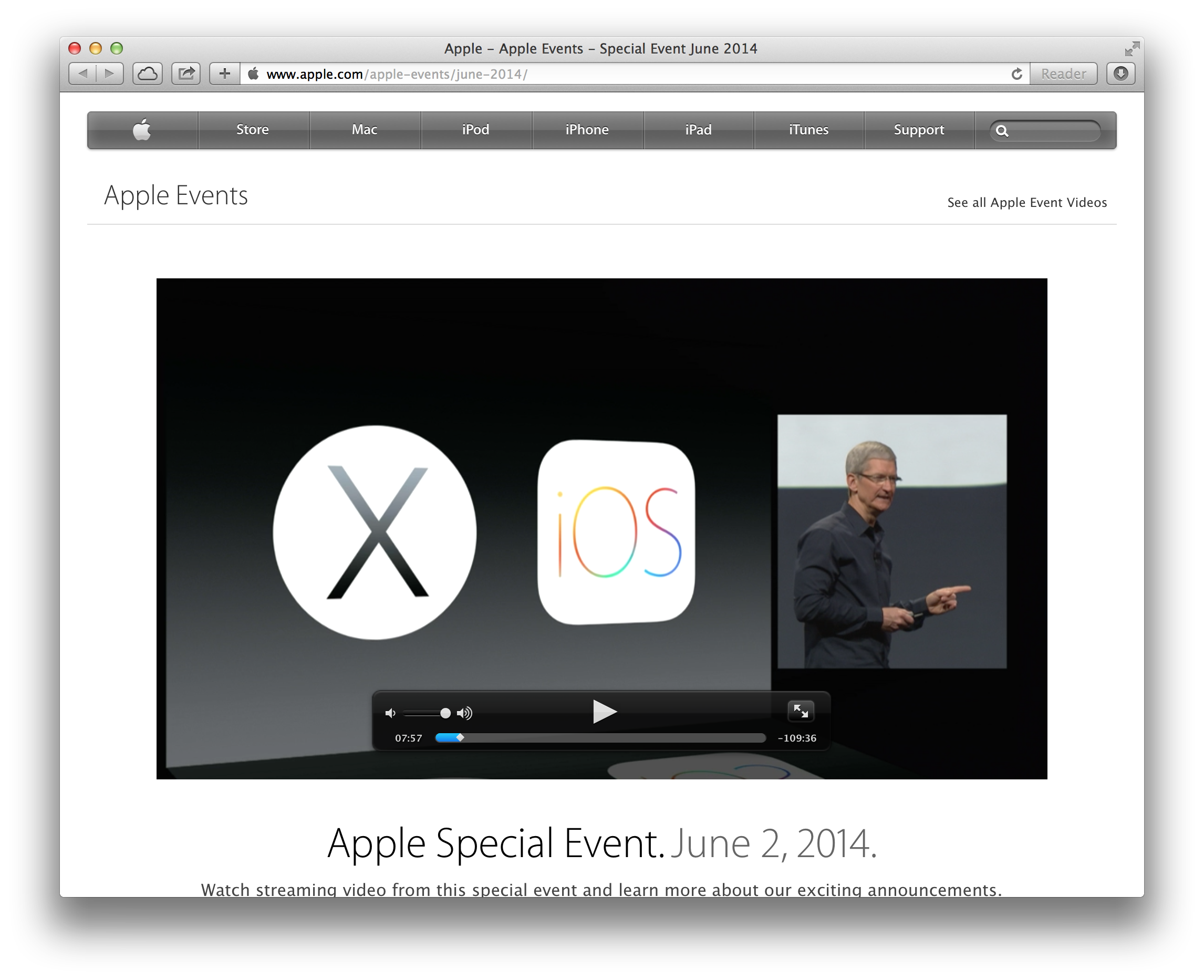
Following today’s WWDC 2014 keynote, Apple has just refreshed their website with tons of new information on iOS 8, OS X Yosemite, and all of the new developer announcements unveiled at the keynote. (Now let’s just hope they update that navigation bar soon!)
Apple has also refreshed the Dev Center with new betas for registered developers.
Stay tuned to 9to5Mac for more news coverage from WWDC 2014.
During the WWDC 2014 keynote, Apple wrapped up its overview of iOS 8 and has officially announced device compatibility. This release is available for developers today and schedules for a public launch in fall.
iOS 8 will be compatible with iPhone 4s, iPhone 5, iPhone 5c, iPhone 5s, iPod touch 5th generation, iPad 2, iPad with Retina display, iPad Air, iPad mini, and iPad mini with Retina display. So it looks like the iPhone 4 is officially dead to Apple.
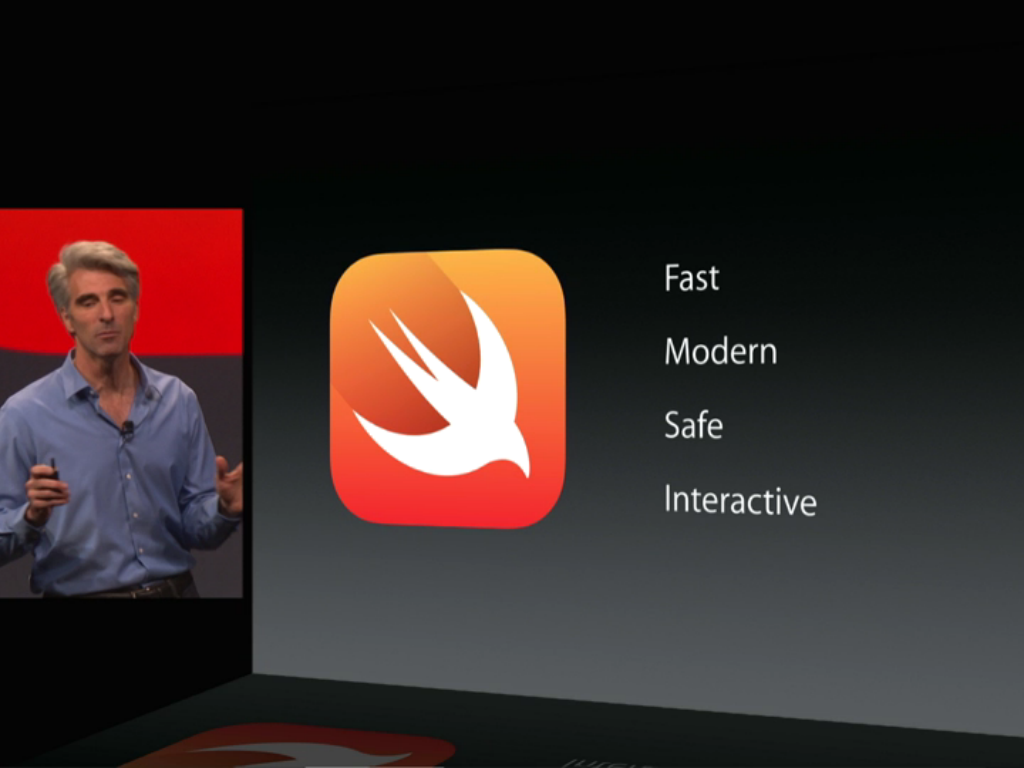
Apple has introduced a brand new programming language alongside a brand new version of Xcode.
Swift is a big deal for developers. The language includes loads of features third-party developers have been asking for. It sits alongside Objective-C and C, meaning developers can interchange between languages in the same project.
Along with several other new APIs for developers, Apple has announced HomeKit which allows all home automation accessories/devices to work together. The new API will allow home automation developers to centralize all home automation in iOS without needing separate apps to access each device’s specific features. These devices include locks, lights, cameras, doors, thermostats, plugs, switches, and more.
Apple has announced CloudKit, a new way for developers to create cloud apps. Apple takes responsibility for the server-side elements of apps. This leaves developers with a greatly simplified client-side development experience.
Alongside a whole of other changes to the App Store, Apple is integrating TestFlight. This allows developers to do seamless beta-testing for free. There are also a whole host of ‘extensions’ apps can access, enabling integration into share sheets, Notification Center widgets and more.
Apple is heavily stressing that this is the biggest developer release since the App Store was announced.
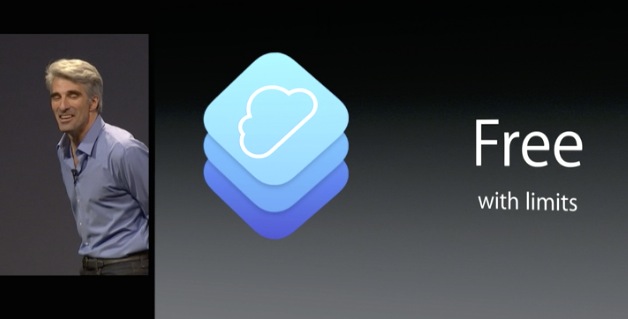
The new pricing starts with the same free 5GB for all users and introduces a new 20GB for $1/month tier as well as a 200GB for $4/month tier. Currently Apple offers 5GB for free and charges $20.00 for an extra 10GB, $40 for an extra 20GB, or $100 for 50GB per month.
Apple didn’t say exactly when it would be flipping the switch on the new prices, but it did confirm that tiers up to 1TB will be available under its new pricing scheme.
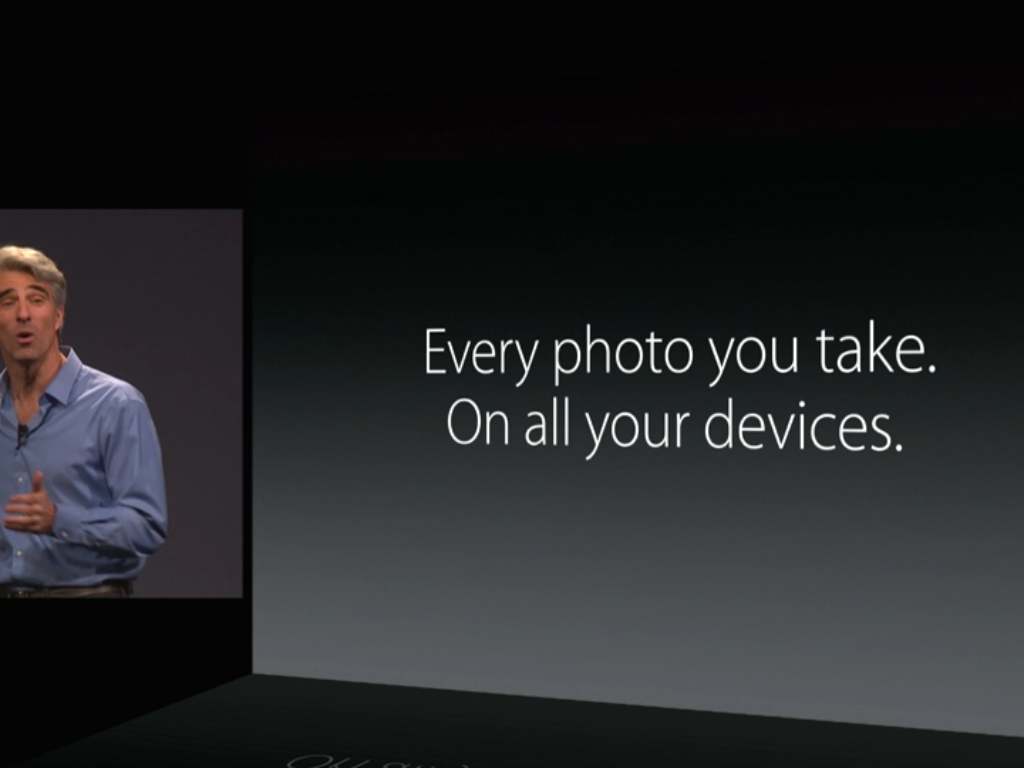
With iOS 8, Apple will now backup of all your photos. The limitations of Photo Stream seem to have gone away. Apple will now store all of your photos in iCloud, regardless of what device you take them on. iPhones and iPads can view these entire libraries, without having to download them to local storage. The photos stream in as you scroll.
Storage is only limited by your iCloud Storage. Apple has announced new cheaper storage plans to go along with the new philosophy.
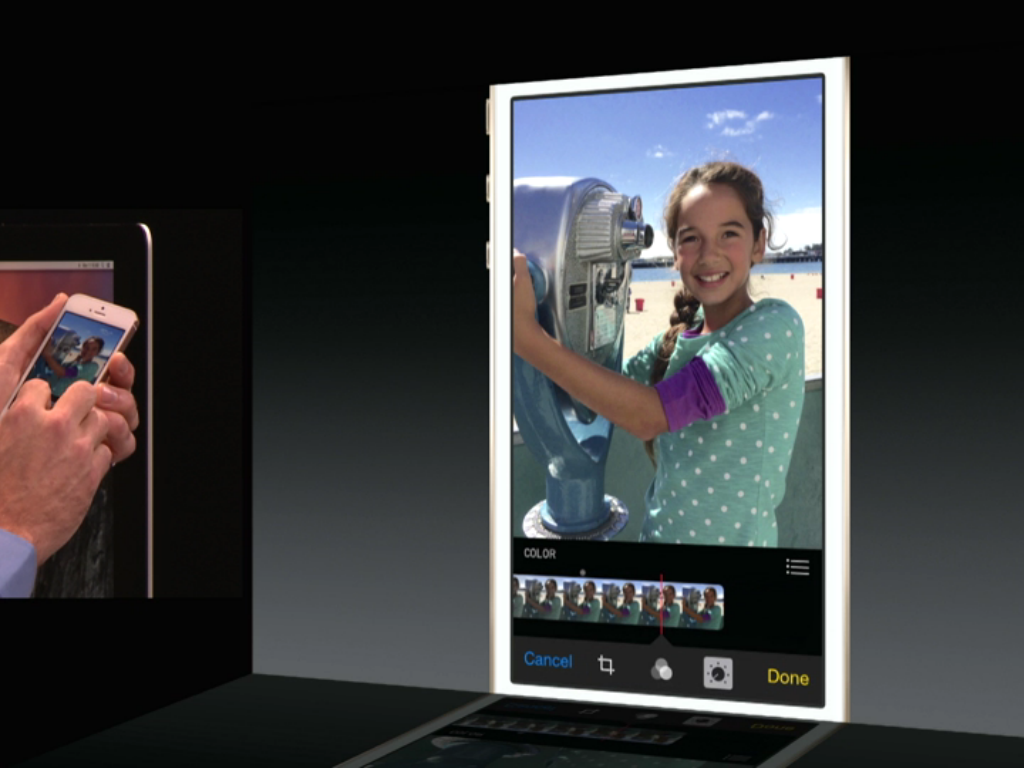
Apple is also adding a whole host of color and other editing features into the Photos app. This includes things like color correction, brightness, cropping and more. These edits automatically sync across devices.
Apple wants users to be able to smoothly move between their Macs and iOS devices. AirDrop now interoperates between Mac and iOS devices. However, it goes further. Handoff allows you to send a document from your Mac to your iOS device, just by being in close proximity to each other.
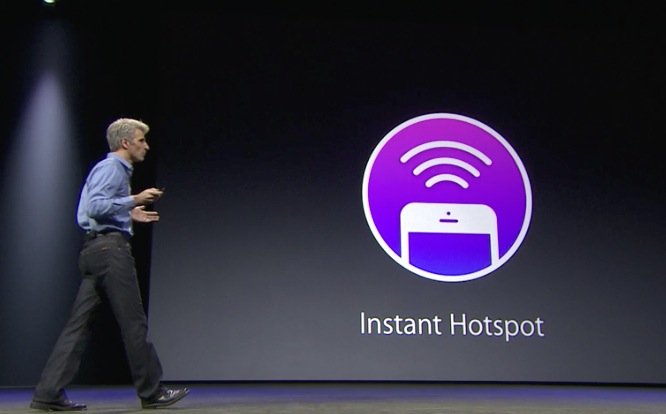
The Mac also notices when an iOS device is nearby for Personal Hotspot. The phone appears in the WiFi menu, shown above, and with one-click the phone connects to the Mac and the devices start tethering.
The code shows that this is a new addition for OS X 10.10 and iOS 8.
Slightly ahead of the keynote later today, Apple has pushed some of its new APIs for developers into the open-source channels. The class in question is a new view that appears to replace the current iOS and OS X WebKit implementations, which enables apps to show webpages and other content inline.
The new framework seems to indicate a focus on cross-platform API compatibility, between iOS and OS X. The leaked framework seems to be fully feature-compatible across platforms. This differs to the situation today, where developers must use the ‘WebView’ class for OS X and ‘UIWebView’ for iOS. This should help developers write more reusable code.
Seth Weintraub|8:33Apple Store still up….what does it all mean? Head South to the comments to discuss.
Someone forgot to take the AppleStore down…unless Apple got some new 1990’s technology that doesn’t require the store to go down for updates—
Seth Weintraub (@llsethj) June 02, 2014
Mark Gurman|8:07We are just under two hours away from the kickoff WWDC keynote, and here’s the latest news: there are cars situated inside Moscone West. This likely indicates that some significant CarPlay announcements are in-store for today. Also, some OS X 10.10 and iOS 8 APIs for developers are already appearing on some open source WebKit files.
We’re approximately two hours away from Apple’s major WWDC 2014 keynote address, and we’ll be providing live blogging and analysis of the event as it proceeds. We’re expecting Apple to discuss updates to iOS and OS X 10.10, with the former seeing enhancements across the system and the latter receiving a complete redesign to bring the software in line with the iOS 7 design aesthetic. You can catch our full analysis and live updates from the conference below:
Apple’s gross revenues of $170B were enough for the world’s most valuable company by market cap to climb one place in the Fortune 500 ranking, from 6th to 5th place.
Apple was placed behind Walmart, Exxon, Chevron and conglomerate holding company Berkshire Hathaway (which owns large chunks of such well-known brands as Heinz, Coca-Cola, Mars and American Express). Phillips 66, General Motors, Ford Motor, General Electric and Valero Energy make up the rest of the top 10.
While Apple ranks fifth in terms of revenues, its huge cash reserves mean that it has tended to alternate with Exxon as the world’s most valuable company when measured by market capitalization, and is arguably significantly undervalued by most measures … Expand Expanding Close
Update: A spokesperson for Beats Music confirmed to us that “Trent Reznor is still with Beats Music.”
Jimmy Iovine has long credited Nine Inch Nails frontman and Beats Music Chief Creative Officer Trent Reznor as a driving force behind the success of the service. Reznor, however, is now rumored to have left the company as it finalizes its $3B sell to Apple. The news comes from a line in a USA Today report over the weekend that curiously doesn’t mention a source of the information:
(Curiously, Beats’ chief creative officer, Trent Reznor, the singer-songwriter and producer of Nine Inch Nails fame responsible for Beats’ tastemaking, has reportedly left the company. Also, one of Beats’ principal technology executives, Fredric Vinna, has recently gone to Spotify, and its co-founder, Ola Sars, to a Spotify-backed venture.)
Beats Music didn’t respond to a request for comment on this story, but Billboard reports that a spokesperson for Beats and for Reznor claim the report is inaccurate: Expand Expanding Close
A few weeks before initial reports that Apple was planning to acquire Beats Electronics, I started AT&T’s three month trial of the Beats Music subscription streaming service.. Given that generous window of time, I felt more comfortable investing my time than I would with a one or two week trial. When news broke that Apple was in final talks to purchase Beats, I was caught off guard and immediately concerned that the subscription service that I was starting to really like would change under Apple’s watch. Since the deal has been made official, Apple has said that Beats Music will continue as it is (across multiple platforms even) as will the headphones line (Beats branded, not Apple branded) for now.
In an SEC filing today, Apple announced that Luca Maestri has officially transitioned into the Chief Financial Officer and Senior Vice President role. His first official day on the job was yesterday, May 29th. Maestri is not yet on Apple’s executive biographies page, but an official profile will likely go live in the coming days. Apple says that Maestri’s previous job as Principle Accounting Officer will be folded into his CFO role.
Maestri, previously Corporate Controller and a Vice President at Apple, replaces long-time CFO Peter Oppenehimer. The transition was announced by Apple earlier this year. Oppenheimer will shift his remaining responsibilities to Maestri over the course of the next few months and completely retire from Apple at the end of September of this year. As part of his promotion, Maestri will now receive an annual salary of $1 million and new stock-based payment packages: