MacBook Pro: The biggest and baddest Mac laptops

See All Stories

Apple's premium laptop comes in 13- and 16-inch screen sizes. Each model includes 2-4 USB-C ports for charging, accessories, and data transfer. Higher-end models also include the Touch Bar.
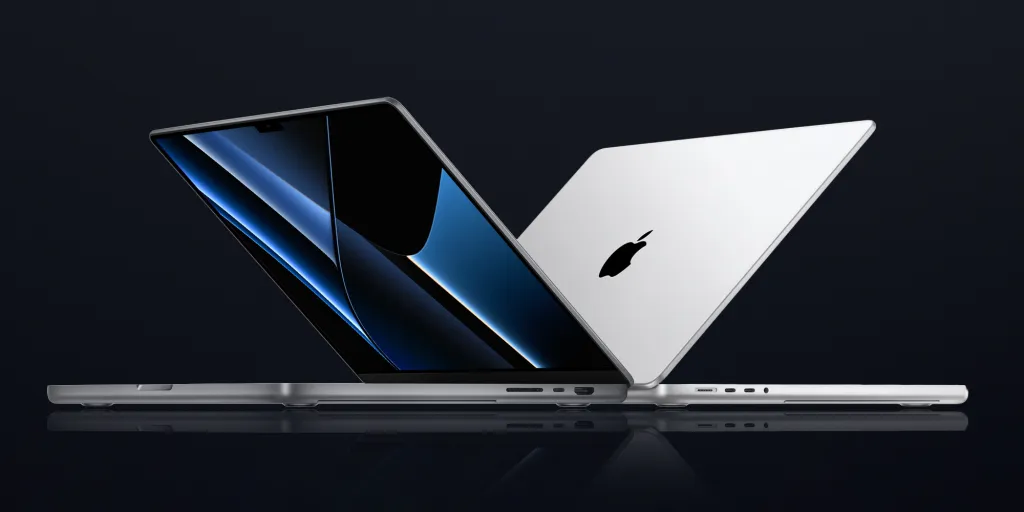
2021 MacBook Pro

MacBook Pro has been the product name for Apple’s high-end laptop since early 2006 when the transition to Intel processors began. Now, that Pro naming has carried forth as Apple has moved to its own silicon. The latest fourth and fifth-generation Pro Apple notebooks bring dramatically more power with lower heat generation and better battery life thanks to the ARM-based Apple silicon. Keep reading for a brief history of the line and a breakdown of the current lineup.

MacBook Pro history

The first generation MacBook Pro followed in the style of the PowerBook G4 that came before it, but used Intel processors rather than PowerPC chips.

The second generation of the MacBook Pro was the first to really separate itself from the products before, with a unibody enclosure. The third-generation MacBook Pro introduced the retina display as well as MagSafe 2.

Perhaps the most controversial version of the MacBook Pro is the fourth generation. While the third generation received some backlash for the removal of ethernet and the optical drive, the fourth generation was a complete rethinking of the device peripherals. No more MagSafe, no more USB-A ports, and only the 13-inch model kept the function keys. Instead, this redesigned MacBook Pro opted for all Thunderbolt 3 ports and headphone jack. In place of function keys, the MacBook Pro gained an OLED Touch Bar. In late-2020, Apple introduced the M1 chip and updated the 13-inch MacBook Pro. The ARM-based processor brought down power consumption and increased performance.

In October of 2021, Apple introduced the fifth-generation MacBook Pro with not one but two updated versions of the M1 chip, the M1 Pro and M1 Max. The move walked back some of the decisions from the previous generation, adding back an HDMI Port, MagSafe charger, and SD card reader while removing the Touch Bar.

The 2020 13-Inch MacBook Pro

In late 2020, Apple introduced the 13-inch M1 MacBook Pro as the latest update to the fourth-generation MacBook. The MacBook features the same look as previous MacBooks, but like the MacBook Air and Mac Mini, switched to Apple silicon.

Apple’s M1 chip brought ARM architecture to the MacBook line, and this was the first MacBook without an Intel processor.

The M1 chip is a unified design with an 8-core CPU and an 8-core CPU. The processor integrated memory on board, limiting the device to either 8GB or 16GB of unified memory. The 13-inch M1 MacBook Pro is configurable with between 256GB and 2TB of storage and features a Magic Keyboard, rather than the problematic butterfly keyboard.

13-inch MacBook Pro specs

Base Configuration$1,299.00

  • Apple M1 chip with 8‑core CPU, 8‑core GPU, and 16‑core Neural Engine
  • 8GB unified memory
  • 256GB SSD storage
  • 13-inch Retina display with True Tone
  • Backlit Magic Keyboard – US English
  • Touch Bar and Touch ID
  • Two Thunderbolt / USB 4 ports

Max Configuration$2,299.00

  • Apple M1 chip with 8‑core CPU, 8‑core GPU, and 16‑core Neural Engine
  • 16GB unified memory
  • 2TB SSD storage
  • 13-inch Retina display with True Tone
  • Backlit Magic Keyboard – US English
  • Touch Bar and Touch ID
  • Two Thunderbolt / USB 4 ports

13-inch MacBook Pro pricing

The price for the 13-inch M1 MacBook Pro starts at $1,299. Upgrading this base configuration to 16GB of memory adds $200 to the price. Likewise, each step above 256GB of storage – 512GB, 1TB, and 2TB – will add $200 to the price. A fully specced out 13-inch MacBook Pro will run you $2,299.

You can configure your own 13-inch MacBook Pro on Apple’s website.

Current 14-inch and 16-inch MacBook Pro

In October 2021, Apple brought a brand new design to the MacBook Pro line. Apple increased the screen size on the 13-inch, making it a 14-inch, and shrunk the bezels on the 16-inch. This fifth-generation notebook addressed many complaints of the last generation. MagSafe returned, in the form of an improved MagSafe 3, while the MacBook also regained an HDMI port and an SD-card slot.

Also gone is the Touch Bar. Instead, the standard row of function keys return. The latest MacBooks also bring a ProMotion display that was first introduced on the iPad Pro, with a variable refresh rate and mini-LED backlight.

The 2021 MacBooks aren’t without a controversial feature, as while the display has been made larger there is now a large notch for the 1080P FaceTime camera. While FaceID would have been a nice addition in exchange for this small chunk of the screen, there are some reasons this is not totally practical.

14-inch MacBook Pro specs

Base Configuration$1,999.00

  • Apple M1 Pro with 8-core CPU, 14-core GPU, 16-core Neural Engine
  • 16GB unified memory
  • 512GB SSD storage
  • 67W USB-C Power Adapter
  • 14-inch Liquid Retina XDR display
  • Three Thunderbolt 4 ports, HDMI port, SDXC card slot, MagSafe 3 port
  • Backlit Magic Keyboard with Touch ID – US English

Maximum Configuration$5,899.00

  • Apple M1 Max with 10-core CPU, 32-core GPU, 16-core Neural Engine
  • 64GB unified memory
  • 8TB SSD storage
  • 96W USB-C Power Adapter
  • 14-inch Liquid Retina XDR display
  • Three Thunderbolt 4 ports, HDMI port, SDXC card slot, MagSafe 3 port
  • Backlit Magic Keyboard with Touch ID – US English

14-inch MacBook Pro pricing

The 14-inch MacBook Pro starts at $1,999. The base model includes 16GB of memory, 512GB of storage, and an M1 Pro processor with an 8-core CPU and 14-core GPU. There are multiple versions of the M1 Pro processor available, while jumping to an M1 Max processor will cost $500 more, and requires you to jump up to 32GB of memory – a $400 upgrade. Going with the M1 Max processor means you can configure up to the full 64GB of memory, an $800 upgrade.

You can configure up to 8TB of storage in the 2021 14-inch MacBook Pro. Upgrade costs are as follows:

  • 1TB SSD Storage – $200
  • 2TB SSD Storage – $600
  • 4TB SSD Storage – $1,200
  • 8TB SSD Storage – $2,400

You can configure your own 14-inch MacBook Pro on Apple’s website.

16-inch MacBook Pro specs

Base Configuration$2,499.00

  • Apple M1 Pro with 10-core CPU, 16-core GPU, 16-core Neural Engine
  • 16GB unified memory
  • 512GB SSD storage
  • 16-inch Liquid Retina XDR display
  • Three Thunderbolt 4 ports, HDMI port, SDXC card slot, MagSafe 3 port
  • 140W USB-C Power Adapter
  • Backlit Magic Keyboard with Touch ID – US English

Maximum Configuration$6,099.00

  • Apple M1 Max with 10-core CPU, 32-core GPU, 16-core Neural Engine
  • 64GB unified memory
  • 8TB SSD storage
  • 16-inch Liquid Retina XDR display
  • Three Thunderbolt 4 ports, HDMI port, SDXC card slot, MagSafe 3 port
  • 140W USB-C Power Adapter
  • Backlit Magic Keyboard with Touch ID – US English

16-inch MacBook Pro pricing

The 16-inch MacBook Pro starts at $2,499. There is only one M1 Pro processor available on the 16-inch MacBook, and that’s the highest version 10-core CPU, 16-core GPU version of the M1 Pro processor that is a $300 upgrade on the 14-inch MacBook Pro. Of course, you can also step up to the M1 Max processor with either a 24-core or 32-core GPU, a $200 and $400 upgrade respectively (which also requires the $400 upgrade to 32GB of memory). The memory and storage options are all the same as the 14-inch MacBook Pro.

You can configure your own 16-inch MacBook Pro on Apple’s website.

Differences between 13-inch,14-inch, and 16-inch models

The 2021 MacBook Pro lineup is a refreshing change. The return of ports and physical keys make the laptops more versatile, while additions like an XDR display and hardware acceleration for ProRes improves the experience but is harder to quantify for the average user.

13-inch14-inch16-inch
ProcessorM1M1 Pro / M1 MaxM1 Pro / M1 Max
Memory8GB / 16GB16GB / 32GB / 64GB16GB / 32GB / 64GB
Storage512GB, 1TB, 2TB512GB, 1TB, 2TB, 4TB, 8TB512GB, 1TB, 2TB, 4TB, 8TB
Screen2560×1600 pixels 3024×1964 pixels; ProMotion3456×2234 pixels; ProMotion
Weight3.0 pounds (1.4 kg)3.5 pounds (1.6 kg)M1 Pro: 4.7 pounds (2.1 kg)
M1 Max: 4.8 pounds (2.2 kg)
Size (Width x Depth)11.97 x 8.36 inches (30.41 x 21.24 cm)12.31 x 8.71 inches (31.26 x 22.12 cm)14.01 x 9.77 inches (35.57 x 24.81 cm)
Height0.61 inch (1.56 cm)0.61 inch (1.55 cm)0.66 inch (1.68 cm)
Base Price$1,299.00$1,999.00$2,499.00

The $1,999 starting price for Apple latest computer is a harder pill to swallow than the $1,300 13-inch Pro from last year. For an average user, the superb M1 MacBook Air will likely suffice (and that sub-$1,000 price is hard to pass up).

But the 2021 14-inch and 16-inch MacBook Pro are exactly what they need to be, a return to function-over-form that will truly meet the needs of professional users.

New MacBook Pros appear to be selling well as supply chain report says Apple is raising components orders

Apple’s latest line of MacBook Pros appear to have been received well by the market, although the most interesting models with Touch Bar are yet to ship to customers. Digitimes reports that Apple is upping component orders for the new MacBook Pros, expected to continue at least until the end of 2016. Apple is apparently “optimistic” about fourth quarter sales.

The new 13-inch MacBook Pro and 15-inch MacBook Pro feature high-speed Thunderbolt 3 USB-C ports, faster SSDs, Skylake processors, better GPU options, larger trackpad and an OLED display ‘Touch Bar’ touchscreen panel to replace the physical row of function keys.


Expand
Expanding
Close

After new Pro launch, Apple immediately sells out of refurbished 15” last-gen MacBook Pros…

Apple has sold out of refurbished last-generation 15-inch MacBook Pros from its online store as the company introduces new models expected to ship to customers in the coming weeks.

As noted by customers on Reddit, Apple previously had several models of refurbished last-generation MacBook Pro models available at discounted prices, but that supply is now dwindling as customers pick up remaining stock.


Expand
Expanding
Close

Best USB-C cables and dongles for the new 2016 MacBook Pro — how annoying will all the adaptors really be?

The new MacBook Pros have certainly caused an uprising of controversy, with perhaps the lack of any traditional USB ports causing the most public outcry. Following in the footsteps of the one-port Retina MacBook, the new 2016 MacBook Pro lacks traditional USB-A ports, instead featuring up to four USB-C ports. Although the ports are highly more capable, offering Thunderbolt 3 speeds on a reversible small connector, it effectively means that all current Mac accessories and peripherals are incompatible without some kind of adaptor.

In preparation for my new MacBook Pro arriving, I’ve ordered what I think I will need in terms of dongles for my uses. After seeing it all laid out on the table, I generally feel like the negative criticism is overblown …


Expand
Expanding
Close

Apple drops USB-C adapter prices after pushback from introducing MacBook Pros without USB-A ports, but not for long

Site default logo image

The Apple community has had a hard time being content with the Mac lately. First it was the feeling that the Mac line including MacBook Pros weren’t being updated as often as, say, iPhones. A redesigned MacBook Pro helps resolve that with at least one member of the Mac family.

But the new MacBook Pro goes all in on USB-C and drops legacy ports like standard USB-A, and many Mac users believe this move is too aggressive considering the cost attached to this transition. The good news is that Apple is listening and lowering the price of its USB-C adapters in an effort to ease the USB-A to USB-C transition, but you have to act fast…


Expand
Expanding
Close

How Apple’s stock apps will use the Touch Bar on the new MacBook Pro [Gallery]

The Touch Bar in the new MacBook Pro replaces the physical function keys on the keyboard with a touchscreen panel, allowing apps to display custom, unique and contextual interfaces like buttons, sliders, tabs and other controls. We’ve already covered some general details about how the Touch Bar works and what developers can do with the API, but it will take some time for third-party developers to add integration.

Apple is leading the charge, however, adding extensive Touch Bar support to many macOS apps with 10.12.1. Using the Xcode developer tools, we’ve gathered screenshots from all of Apple’s apps that already include Touch Bar features. See our roundup of the 23 compatible apps after the jump …


Expand
Expanding
Close

9to5Mac readers narrowly in favor of all-USB-C ports on new MacBook Pro

With much heated debate on Apple’s decision to go all-out on USB-C ports on the new MacBook Pro, removing everything else bar the headphone socket, we thought it was time to get some hard data on whether there was a consensus view on the issue.

Our poll, attracting more than 25,000 votes, showed that there isn’t. There was close to an even split, though those who consider it a positive development did narrowly outweigh those who think it a bad move …


Expand
Expanding
Close

Comment: How the 12-inch MacBook prepared us for new MacBook Pros

Site default logo image

It’s no secret that I’ve been a huge fan of Apple’s 12-inch MacBook. Last year, I wrote that it was the product that excited me the most about Apple’s future, noting of its design, new trackpad and keyboard technology, and overall daily impact on my workflow. A year and a half after the device was announced, we’re now seeing Apple take much of what made the 12-inch MacBook so great and apply it to the MacBook Pro lineup.

While there has been some skepticism surrounding the new MacBook Pros, I am incredibly excited for mine to arrive. And that’s partly because of my love for the 12-inch model.


Expand
Expanding
Close

Site default logo image

2016 MacBook Pros may not be compatible with currently available Thunderbolt 3 devices

After a battery of tests with their current lineup of USB-C and Thunderbolt products, Plugable learned that Apple’s newest MacBook Pros may not be compatible with currently available Thunderbolt 3 devices. This issue seems to specifically stem from the use of Texas Instruments controller chips in the Thunderbolt 3 devices. If true, this means that has Apple potentially shut out early adopters of the new technology.


Expand
Expanding
Close

Site default logo image

Kickstarter: Snapnator brings a low-profile MagSafe-like connection to all USB-C MacBook Pros

Future owners of the 2016 MacBook Pro may be feeling the pain of Apple removing MagSafe from the notebooks, but a new project on Kickstarter is hoping to help ease that feeling. We’ve written about Griffin’s BreakSafe before, but customer’s hoping to use that same adapter on the new MacBook Pros may be disappointed over its limitations. The new MagSafe alternative on Kickstarter, Snapnator, not only brings MagSafe back to the MacBook Pros, but also to a slew of other devices thanks to the increasingly ubiquitous USB-C port.


Expand
Expanding
Close

OWC announces Thunderbolt 3 dock, adds 13 ports of legacy I/O to the new MacBook Pros over a single cable

In the wake of the new Thunderbolt 3 USB-C only MacBook Pro, OWC has announced its first Thunderbolt 3 Dock. The dock features a total of 13 additional ports, including 5 USB-A ports, two additional Thunderbolt 3 ports (which could drive a pair of 4K displays), Ethernet and an SD card reader.

Thanks to the high bandwidth of Thunderbolt 3, all of this expandability can be enabled by connecting a single Thunderbolt 3 USB-C cable to your new MacBook Pro (or any other computer with a Thunderbolt 3 USB-C port). In comparison, the Thunderbolt 2 version of this dock can only drive 5 concurrent accessories, so it’s easy to see the benefits of the additional throughput.


Expand
Expanding
Close

Poll: What is your view of the all-USB-C ports on the new MacBook Pro?

We’ve run three opinion pieces recently addressing Apple’s decision to remove all but USB-C ports from the new MacBook Pro – and each has attracted literally hundreds of comments.

I started the ball rolling by arguing that while I do fully appreciate the pain involved in the transition, it’s a trade-off. Buying a few new cables or adapters today versus ending up with too few USB-C ports when the new standard has taken over a year or so down the line. That one generated more than 700 comments, many of them arguing that I was wrong and that Apple should have offered a mix of USB-A and -C ports, as well as retaining the SD slot …


Expand
Expanding
Close

PSA: Griffin BreakSafe brings MagSafe to the new MacBook Pros, but with limitations

Site default logo image

A lot of noise has been made about Apple’s move away from MagSafe with the all-new MacBook Pros. Instead of MagSafe, the new machines feature four USB-C ports, all of which are capable of charging the machine. As Zac noted this afternoon, the ability to charge from either side of the machine with USB-C has its perks, but some users are still rightfully missing the safety and security of the MagSafe adapter.

That’s where Griffin’s BreakSafe comes in. It brings MagSafe-like tech to USB-C connections, but there are a few things you should note before running out and purchasing one…


Expand
Expanding
Close

Comment: People are complaining about the wrong things with the new MacBook Pro

Site default logo image

I am really excited about the new MacBook Pro with Touch Bar. I placed my order for a 15-inch model with storage upgraded to 1TB SSD on day one which puts me in the initial 2-3 week shipping range between November 17 and November 25. I seriously cannot wait to unbox this Mac.

The time between the unveiling and deliveries, however, has been filled with mass criticism targeted at nearly every change Apple has made between the last MacBook Pro design and the new one. This is a change MacBook Pro and we’ve been through these before. We’ll be fine. But in the meantime, I believe people are complaining about the wrong things.


Expand
Expanding
Close

MacBook Pro Touch Bar support for Logic Pro X coming early next year

Site default logo image

Apple impressed me with the apps it had ready for the new MacBook Pro’s Touch Bar at launch. It’s not just limited to button replacements or system functions, which you can customize, but will also support Final Cut Pro, Terminal, GarageBand, Maps, iTunes, Calendar, Djay Pro, Photoshop, and lot of other Apple and third-party apps when customers start receiving the first orders in the weeks to come.

But as a daily Logic Pro X user, I noted the lack of mention for Apple’s pro audio suite at the unveiling of its new Pro notebook. The good news: we’ve learned from a source familiar with the company’s plans that the Logic Pro team is currently targeting early next year for Touch Bar support.


Expand
Expanding
Close

Opinion: No SD Card slot? It’s the camera companies you should be upset with, not Apple

Site default logo image

When I first learned that the new MacBook Pro had no SD Card slot, like many creators, I was a little perturbed. The reason is that SD Cards have long been the fastest way to transfer media from cameras to our computers.

But now that the new MacBook Pros have no built-in SD Card reader, it means that creators will have to rely on an external USB-C to SD Card dongle, like this one. These dongles are cheap, small, and easy to carry around, so at the end of the day it’s not an outright dealbreaker, but the fact that I have to remember to always carry one with me presents somewhat of an inconvenience.

That said, we shouldn’t be mad at Apple for this. Camera companies have had years to innovate in this area, and have simply failed to do so. It’s the camera companies that we should be upset with, not Apple.
Expand
Expanding
Close

Phil Schiller addresses new MacBook Pro controversy, explains why Apple dropped the SD card reader but kept the headphone jack

In an interview with The Independent, Apple marketing exec Phil Schiller discusses the development and public response to the new MacBook Pros. He says that “many things” have impressed people and “some” have caused some controversy, referring to the ongoing debates about Apple’s design goals versus the needs of pro users. Rebutting critics, Schiller announces that orders for the new MacBook Pro have set a new online sales record, beating previous sales for ‘pro Apple notebooks’.

The interview also focuses in on a few specific complaints, such as the decision to remove the SD card slot but keep the 3.5mm headphone jack which it classed obsolete for the iPhone 7. Schiller has interesting answers for these questions …


Expand
Expanding
Close

New 15-inch MacBook Pro appears to offer fastest SSD performance on the market

iFixit uncovers the SSD in the 13-inch non-Touch Bar MacBook Pro as we await the Touch Bar models

ComputerWorld notes that if the latest 15-inch MacBook Pro benchmarks anywhere close to its claimed SSD performance, it will offer the fastest drive read and write speeds of any stock computer available – and that Apple is around two years ahead of most of its competition.

Computerworld‘s own benchmark tests with Blackmagic software on a 2015 13-in. MacBook Pro with Retina display revealed it could pin the needle at more than 1.4Gbps for writes and more than 1.3Gbps for reads. The new MacBook Pro’s specs smoke its predecessor.

The 2016 13-in. MacBook Pro‘s specs claim it has sequential read/write speeds of 3.1Gbps and 2.1Gbps per second, respectively. The new 15-in MacBook Pro ups the write speeds to 2.2Gbps, while the reads remain the same as the 13-in [which would make it] the highest performing stock system on the market …


Expand
Expanding
Close

Touch Bar reportedly made by Samsung, as Apple tests OLED for main MacBook screens

A report from Korea’s ETNews says that the OLED Touch Bar panel in the new MacBook Pro was made by Samsung, and that Apple is currently testing OLED panels suitable for use in MacBooks.

According to an industry [source], Apple installed Samsung Display’s OLED panel for touch screen bar for its new MacBook Pro. This panel is rigid-type OLED that is produced from Samsung Display’s A2 Line […]

“Apple is currently looking into ways of using OLED panels for MacBooks and testing their performance.” said a different representative.

It’s of course a no-brainer that Apple would be looking at a switch to OLED for future MacBook displays given the benefits these offer …


Expand
Expanding
Close