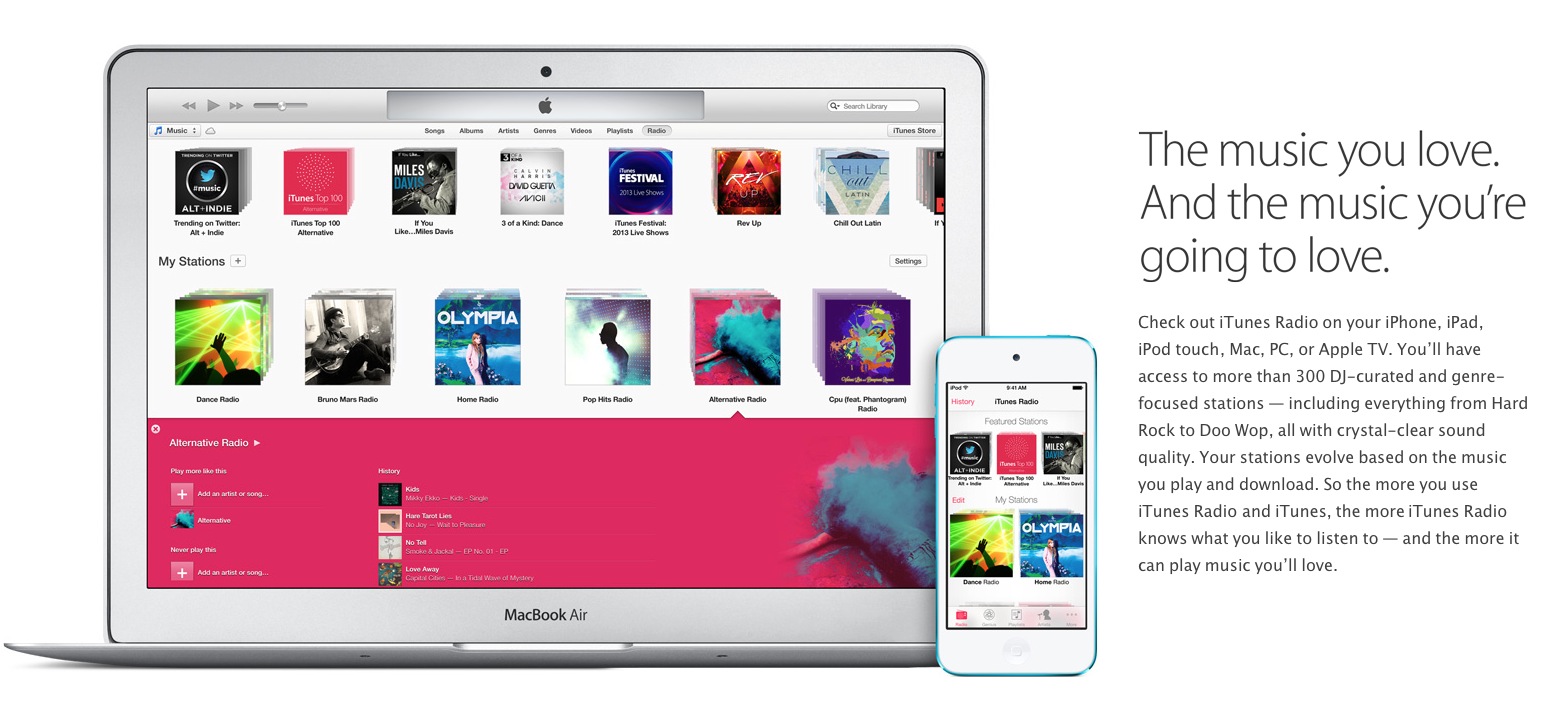
With only days remaining until iOS 7 is released into the hands of consumers worldwide, Apple has finally managed to bring The Beatles to iTunes Radio.
Since its initial introduction at WWDC in June, users of iTunes Radio would be greeted with an absence of Beatles music, even when creating a specific “Beatles Radio” station. No explanation was given from Apple. Perhaps what’s most interesting here is that from the launch of the iTunes Music Store in 2003 until late 2010, Apple struggled to reach an agreement with Apple Corps to get The Beatles onto the store. This was due to a long series of legal battles with Apple Corps and Apple Inc, stretching back multiple decades. Until this past weekend, it appeared that The Beatles wouldn’t make it onto iTunes Radio either.
Sprint is readying its own program that allows customers to roll in the cost of phone hardware in their monthly bill, according to CNET. Sprint’s program is reportedly called One Up, and it works in a similar fashion to the recently launched AT&T Next, T-Mobile Jump, and Verizon Edge initiatives.
All of the carrier programs principally work the same, with a few nuanced differences. Sprint’s One Up lets customers pick up a phone with no money down and pay for the device in 24 monthly installments. A phone that costs $649.99, for instance, will cost $27 a month (with the difference tacked on to the 24th payment). If a customer leaves the service early, that person is on the hook for the balance of the device cost, due the following month.
Unlike with a typical U.S. carrier contract, Sprint’s new program (like those from the other U.S. carriers) will allow customers to upgrade to a new device every year. The (subsidized) cost of the phone will be divided up into 24 installments and added to the customer’s monthly bill. A customer can trade-in that current hardware towards the new phone that they would like to upgrade to.
Notably, the new Sprint One Up program is claimed to launch on September 20th, which just so happens to be the launch date of the new iPhone 5s and iPhone 5c.
As the success stories keep piling up, so do the number of projects filling up crowdfunding websites with, among other things, neat hardware- and software-related products. Some projects, like Pebble, gain thousands of supporters as well as millions of dollars in funding (and end up at Best Buy’s retail stores). Other projects flop and don’t reach their necessary funding amount.
Rather than make you sift through all of these projects, we’re rounding up the best or most notable projects from around the web and delivering them to you in a simple roundup.
If there’s a project that you’ve backed – or even a project that you founded – be sure to leave a link below so it can be considered for the next roundup.
The Tastiest Cord Solution: Cord Taco, Cordito, Cordlupa (Kickstarter project) – It’s probably not the best idea to actually eat these cord organizers. However, the unique designs allow you to beautifully wrap up your headphones, USB cords, and Mac charging block in style. Just three days into it, this campaign is half way to meeting its $15,000 goal. Expand Expanding Close
As for the Surface, the tablet has essentially been a flop, leading the company to take a $900 million write-off on the device. Nonetheless, the company will be upgrading the more-than-year-old tablet later this month. Apple, for its part, is expected to unleash its new iPads about a month later.
Inlfight internet service Gogo announced today that it plans to bring new technology to partner airlines in the US that will provide more than 60 Mbps starting with Virgin America flights in the second half of next year. Dubbed “Gogo GTO” or “Ground to Orbit,” the new service offers a 20-fold increase in speeds up from the peak 9.8Mbps delivered through Gogo’s current network.
“Because we are a Silicon Valley-based airline, Virgin America guests expect a fully connected in–flight experience that enables them to remain productive even at 35,000 feet,” said President and CEO of Virgin America David Cush. “We were proud to be the first to offer Gogo’s ATG-4 product last year and we are pleased to be the launch partner for GTO, which will be another leap forward in terms of speed and performance of in–flight Wi-Fi for our guests.”
Gogo will first have to get FAA approval before rolling out next year. But when it does, this is how it will work:
Gogo will be utilizing a Ku antenna developed specifically for receive only functionality. The advantages of using satellite for reception only and Gogo’s ATG Network for the return link are unprecedented. Existing two-way satellite antennas in the commercial aviation market have limited power for transmissions so they don’t interfere with other satellites. This dynamic makes the connection from the aircraft to the ground using two-way satellite an inefficient and expensive return link compared to Gogo’s ATG Network. Gogo’s receive only antenna will be two times more spectrally efficient and half the height of other antennas in the commercial aviation market. The low profile of the antenna will result in much less drag and therefore fuel burn on the aircraft and, ultimately, greater operational efficiencies for airlines.
Ahead of the iPhone media event taking place at 10AM PST, the Apple Store is down for updates. The expectation is that Apple will announce two new phones at the event, a first for the company, dubbed the iPhone 5S and the iPhone 5C, with both models being available in new colour variations. As always, the Store will return after the event is over, with new pages featuring the newly announced hardware.
As the success stories keep piling up, so do the number of projects filling up crowdfunding websites with, among other things, neat hardware- and software-related products. Some projects, like Pebble, gain thousands of supporters as well as millions of dollars in funding (and end up at Best Buy’s retail stores). Other projects flop and don’t reach their necessary funding amount.
Rather than make you sift through all of these projects, we’re rounding up the best or most notable projects from around the web and delivering them to you in a simple roundup.
If there’s a project that you’ve backed – or even a project that you founded – be sure to leave a link below so it can be considered for the next roundup.
Nova: the slim, wireless flash for better iPhone photos (Kickstarter project) – Just a few weeks ago, we featured the iblazr LED flash, which closed with over $150k in funding. The Nova, on the other hand, is wireless, meaning you have more control over the location and angle of the flash. The project has already met its funding goal, so if all goes well, you’ll see your Nova in February. Expand Expanding Close
Thinkspace, an organization created by sixteen-year-old James Anderson, seeks to “inspire the next generation of app developers” through dedicated coding zones in high schools across the globe. Anderson formally launched Thinkspace this month with campuses in Plymouth and Northern Ireland.
Anderson first came up with the idea for Thinkspace when he became disappointed with the UK educational system’s approach to computer information and related topics. Rather than attempt to change the curriculum, Anderson sought to work around it by creating “Thinkspaces” within schools.
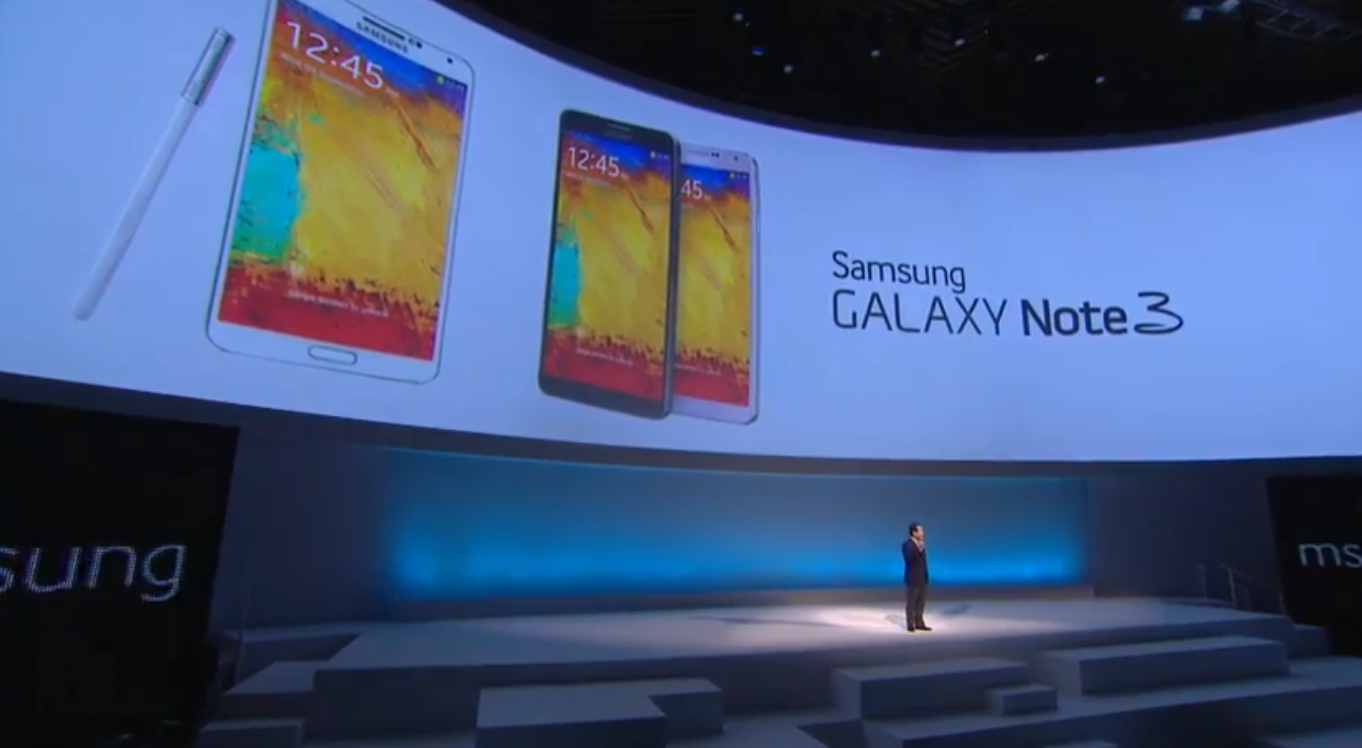
Samsung unveiled several new additions to their consumer electronics family today, less than a week before Apple is expected to announce their next-generation iPhone. Samsung started today’s announcements with the Galaxy Note 3. The new phone includes improved cellular radios, a larger 5.7″ 1080p display, 3 GB of RAM, a 13MP camera, better support for enterprise customers, and general improvements to battery life. The Note 3 is available in both 32 GB and 64 GB models.
For devices with NFC, a simple tap hooks up the camera/lens and makes it ready to share or save files right on the spot:
For added convenience, the app can be activated using NFC one-touch with compatible devices. Once pictures are taken, they are saved directly on both the phone and the camera*, and can be shared instantly via social media or other common mobile applications.
The device will take advantage of the PlayMemories Mobile app available for iOS and Android devices. The device will come with a piece to attach to a phone, however, it is also detachable as seen in the video.
The QX100 and QX10 will be available some time later this month for $500 and $250, respectively.
Microsoft has just announced that they are purchasing Nokia’s devices and services divisions. Nokia has been the main manufacturer of Windows Phone 8 devices, and it looks like Microsoft will be using this acquisition to further merge their software and hardware engineering and design.
This is not a complete takeover, as Nokia will still be its own entity with its own patent portfolio. However, Microsoft will be granted a “10-year license” to Nokia’s patents.
The purchase is expected to close the first quarter of 2014 and will net Nokia EUR 5.44 billion (~$7.1 billion).
Some interesting tidbits from the announcement:
“At closing, approximately 32,000 people are expected to transfer to Microsoft, including 4,700 people in Finland and 18,300 employees directly involved in manufacturing, assembly and packaging of products worldwide.”
“Microsoft is acquiring Nokia’s Smart Devices business unit, including the Lumia brand and products.”
As the success stories keep piling up, so do the number of projects filling up crowdfunding websites with, among other things, neat hardware- and software-related products. Some projects, like Pebble, gain thousands of supporters as well as millions of dollars in funding (and end up at Best Buy’s retail stores). Other projects flop and don’t reach their necessary funding amount.
Rather than make you sift through all of these projects, we’re rounding up the best or most notable projects from around the web and delivering them to you in a simple roundup.
If there’s a project that you’ve backed – or even a project that you founded – be sure to leave a link below so it can be considered for the next roundup.
Qooqi for your cables (Kickstarter project) – All of my cables like to fall off my desk and into oblivion. I’ve tried small, adhesive cord holders in the past, but usually the cords tug on the holder so much that peel off. Qooqi, on the other hand, uses what they call “nano pad tad technology” which sounds a lot like the microsuction of my favorite NanoTek Stand dock.I personally backed this project and it has already exceeded its $10k goal. Expect the Qooqi to ship out in December. Expand Expanding Close
Verizon Wireless and Vodafone have announced that Verizon has acquired Vodafone’s 45% stake in Verizon. This means that Verizon now owns 100% of its Wireless company. The cash and stock deal is worth $130 billion, and the deal is expected to close in Q1 2014.
Verizon says that it feels 100% ownership of Verizon Wireless will make them “better equipped to take advantage of the changing competitive dynamics in the market and capitalize on the continuing evolution of consumer demand for wireless, video and broadband services.”
Both Verizon Wireless and Vodafone carry Apple’s wireless products, like the iPhone and iPad. Perhaps now that Verizon is no longer in a material partnership with Vodafone, this could open up the door to enhanced international roaming capabilities for Verizon-optimized iPhones and iPads.
We’ve previously covered the recent rumors of the 20 Megapixel Sony Wifi ‘smart lens’ which will attach to Android and iOS smartphones and connect to the phone via Wifi. Theoretically, you’ll be able to take much better pictures with the bigger CMOS sensor and Zeiss glass.
But is that black lens going to look good on your new gold iPhone? No, it is not.
Logitech is announcing a line of new super slim, touch enabled Bluetooth mice today that might finally give Mac users a great alternative to Apple’s own multi-touch Magic Mouse. While both mouses feature the same specs and multi-touch enabled surface, Logitech is marketing the black version for Windows Ultrabook users, while the white version has been made specifically for OS X users to match the all-aluminum body of MacBooks.
“Whether it’s a computer, tablet, smartphone or touch-navigation device, people are looking for thin, modern design that works fluidly,” said Charlotte Johs, Logitech global vice president of brand development. “We created the Logitech Ultrathin Touch Mouse to give people an ultraportable mouse that complements today’s MacBook and Ultrabook computers.”
The Logitech Ultrathin Touch Mouse T631 for Mac (as well as the T630 for Ultrabooks) features a brushed metallic body, “feather-light” design at 70g, and comes in at 85 mm x 59mm x 18 mm. It also includes USB charging, Logitech’s Easy-Switch Bluetooth technology for switching between devices, and optimizations for OS X touch gestures. The company says you can expect to get around 1 hour of use from 1 minute of charge time. Logitech clarified that the mouse gets around 10 hours max battery life on a full charge:
the Logitech Ultrathin Touch Mouse is much longer than one hour — it can last up to 10 days on a full charge, based on typical user experiences. It charges very quickly, and just one minute of charge time will give you up to one hour of power.
The Logitech Ultrathin Touch Mouse T631 for Mac in white will be available in the US and Europe in November, while the Ultrathin Touch Mouse T630 in black will be available in both markets starting in next month. Both will sell for $69.99 and are available to preorder now through Logitech’s website starting today.
As the success stories keep piling up, so do the number of projects filling up crowdfunding websites with, among other things, neat hardware- and software-related products. Some projects, like Pebble, gain thousands of supporters as well as millions of dollars in funding (and end up at Best Buy’s retail stores). Other projects flop and don’t reach their necessary funding amount.
Rather than make you sift through all of these projects, we’re rounding up the best or most notable projects from around the web and delivering them to you in a simple roundup.
If there’s a project that you’ve backed – or even a project that you founded – be sure to leave a link below so it can be considered for the next roundup.
eleMount: Premium Car & Camera Mount for iPhone & iPad (Kickstarter project) – These aluminum mounts with polyurethane pads are sleek and versatile. The project exceeded its goal extremely quickly and expects to have these shipped out in December. Expand Expanding Close
Just two short months ago, Nook manufacturer Barnes & Noble was telling the world that it was moving out of the tablet business and focusing on content. Now it appears the company is scrapping that new strategy and going full-speed ahead with their original plans (memories of Netflix’s Qwikster plans are brought to mind).
Although the Nook business has been hurting Barnes & Noble’s bottom line since its inception – and the revenue continues to decline – CNET is reporting that B&N president today stated the company “intends to continue to design and develop cutting-edge Nook black and white and color devices” and one new Nook will be launched before the end of the year.
With the company losing nearly $87 million in the last quarter and lack of CEO (former CEO William Lynch resigned back in June and the company isn’t currently looking for a successor) paints a sad picture for the ailing company.
As the success stories keep piling up, so do the number of projects filling up crowdfunding websites with, among other things, neat hardware- and software-related products. Some projects, like Pebble, gain thousands of supporters as well as millions of dollars in funding (and end up at Best Buy’s retail stores). Other projects flop and don’t reach their necessary funding amount.
Rather than make you sift through all of these projects, we’re rounding up the best or most notable projects from around the web and delivering them to you in a simple roundup.
If there’s a project that you’ve backed – or even a project that you founded – be sure to leave a link below so it can be considered for the next roundup.
Blazar Aluminum Bluetooth Speaker (Kickstarter project) – With a really small footprint and sleek aluminum shell, this is sure to fit in with your Mac’s setup. All of the early bird pledges are taken, but you can grab this device for $124. Expand Expanding Close
U.S. President Barack Obama met with Apple CEO Tim Cook and other technology company executives today to discuss government surveillance, according to a report from Politico. Earlier this week, according to the report, the President and his staff began holding confidential meetings about surveillance tactics and topics such as the recent NSA-related controversies with company executives and other members of pertinent organizations.
Those invited were mostly senior executives, including Cook, Stephenson and Cerf, as well as representatives of groups like the Center for Democracy and Technology and Gigi Sohn, the leader of Public Knowledge, according to three sources familiar with the meeting. Each declined comment for this story.
The report names AT&T CEO Randall Stephenson and former Google Vice President Vint Serf as the other technology community members involved in the meetings. Serf recently was appointed by President Obama to the National Science Board, and Serf is also known as a pioneer of the internet…
comScore has released their June 2013 stats for the US smartphone market showing Apple remaining at the top of the OEM list with 39.9% market share, up from 39.0% in March. The stats pertain to current US mobile subscribers rather than sales or shipments.
Samsung, at #2, grew from 21.7% to 23.7%. HTC, Motorola and LG all lost market share during the period. Expand Expanding Close
As the success stories keep piling up, so do the number of projects filling up crowdfunding websites with, among other things, neat hardware- and software-related products. Some projects, like Pebble, gain thousands of supporters as well as millions of dollars in funding (and end up at Best Buy’s retail stores). Other projects flop and don’t reach their necessary funding amount.
Rather than make you sift through all of these projects, we’re rounding up the best or most notable projects from around the web and delivering them to you in a simple roundup.
If there’s a project that you’ve backed – or even a project that you founded – be sure to leave a link below so it can be considered for the next roundup.
Hot Watch: Smart watch with revolutionary private calls (Kickstarter Project) – This is yet another project that seems to be nearly too good to be true. Using the smart watch, you can raise your hand and answer a phone call that’s amplified by the shape of your hand. In addition, you can send/receive texts and perform many other functions. Expand Expanding Close
Nokia has released a new ad for its Lumia 925 today comparing the device’s camera to the iPhone 5 and simultaneously parodying Apple’s recent “Photos Every Day” TV spot. It’s not surprising that Nokia would choose to focus on the Lumia 925’s camera, as it made a big deal of the device’s 8.7 megapixel camera, dual LED flash, Carl Zeiss lens, and enhanced software camera features when it was unveiled. The dual LED flash is a feature that happens to be rumored for the next-gen iPhone. This also isn’t the first time that Nokia has compared the iPhone 5’s camera to its own smartphones, but it’s certainly the first time it has done a parody of an Apple commercial. Some scenes, like 50 seconds into Nokia’s ad, are taken directly from Apple’s commercial.
DigiTimes is reporting today that Pegatron may be picking up contracts for production of upcoming iMacs with “upstream supply chain players revealing they sent iMac components to Pegatron recently.” Both Pegatron and Apple’s current partner for Mac production, Quanta, aren’t commenting on the rumor, but perhaps Apple could be looking to add additional partners to produce its next round of iMacs after experiencing significant delays following the launch of its latest iMac refresh.
While Quanta produces the majority of Apples Mac lineups, Pegatron is already an Apple manufacturing partner for iOS devices. However, last month the company came under fire when a report from China Labor Watch alleged poor working conditions at several Pegatron facilities in China.
Motorola today launched its new flagship “Moto X” smartphone, the first device Google has launched under the brand after acquiring the company and taking it in a new direction. We already knew a lot about the device leading up to today’s event, but now we have all the details on specs and the many customization options that Motorola is hoping will help differentiate the device. With all the rumors of a next-gen iPhone possibly landing in multiple colors, it will be interesting to see if Google has any success with the Moto X customization strategy– Motorola is providing up to 32 color combinations (2 on the front, and 16 on the back) and around 2000 total customization options through a new online tool called “Moto Maker.” Moto X also includes some pretty respectable hardware for the $199 price point, but that of course puts it in direct competition with the iPhone. Get all the details on the device over on our sister site 9to5Google.com: