Before you can properly understand Apple News, it’s important to know its history. Apple was founded by Steve Jobs and Steve Wozniak in 1976. In 1977, Apple’s sales were growing with the success of its early computers. Within a few years, Jobs and Wozniak hired designers and a production line crew. Apple went public in 1980 and was an instant success. Over the next few years, Apple shipped new computers featuring new graphical user interfaces, such as the original Macintosh in 1984. As the market for personal computers expanded through the 1990s, Apple lost market share to the cheaper Microsoft Windows on PC clones. Eventually, Wozniak and Jobs both left Apple. Jobs would go on to found NeXT and would return to Apple when NeXT was acquired in the late 90s. Apple then began a journey to the great second act in the history of the business world.
Since the release of the iPod in 2001, Apple has become a major player once again in the technology industry. After releasing the iPhone in 2007, the iPad in 2010, and the Apple Watch in 2015, Apple is now one of the largest companies in the world. Apple’s worldwide annual revenue totaled $274.5 billion for its 2020 fiscal year.
Today, Apple operates retail stores all across the world, has a growing services division, and an ever-expanding hardware lineup. The technology industry follows Apple news to see where the company is headed in the future.
Corning, the company that currently supplies glass for Apple’s iOS devices, yesterday introduced its second generation glass substrate with the commercial launch of Corning Lotus XT Glass. While we initially expected Corning’s recently announced Gorilla Glass 3 might end up in an iOS device, the second generation Lotus XT Glass could be a prime candidate for LCD and OLED displays on future Apple devices.
The end result for consumers, according to Corning, is an easier method of manufacturing “faster, thinner, brighter, and higher resolution” displays.
The Corning Lotus Glass platform enables organic light-emitting diode (OLED) displays and liquid crystal displays (LCD) that use either low-temperature poly-silicon (LTPS) or oxide thin-film transistor (TFT) backplanes. The result is an energy-efficient, immersive display device that features high resolution, fast response times, and bright picture quality.
Corning Lotus XT Glass also offers the advantages of Corning’s proprietary fusion process while meeting the stringent cost requirements of the mobile device and IT display market. Its superb surface quality supports the backplane characteristics required for the vibrant colors and clarity OLED and LCD transmissions are known for.
Apple is widely believed to use Corning’s Gorilla Glass in its iOS devices, although the company has never specifically confirmed as much.
Lotus XT Glass features best-in-class total pitch variation, which is integral to efficient panel manufacturing. Essentially, total pitch – usually measured in microns or parts per million (ppm) – is the distance features move during panel processing.
“If you can predict the amount the glass shifts, then you can account for this movement. Deviation – or variation – from this predictable movement can ultimately result in yield loss,” said John P. Bayne, vice president and general manager, Corning High Performance Displays. “Lotus XT Glass is designed to have improved thermal and dimensional stability over higher temperatures, generating higher yields for our customers.”
The Corning Lotus Glass platform enables organic light-emitting diode (OLED) displays and liquid crystal displays (LCD) that use either low-temperature poly-silicon (LTPS) or oxide thin-film transistor (TFT) backplanes. The result is an energy-efficient, immersive display device that features high resolution, fast response times, and bright picture quality.
In addition to Lotus XT Glass, the Corning booth will feature each of its advanced glass technologies, including: Corning EAGLE XG® Slim for a-Si displays; Corning® Willow™ Glass, the company’s ultra-slim, flexible glass; and Corning® Gorilla® Glass 3 with Native Damage Resistance™. Corning experts will provide daily demonstrations of Gorilla Glass 3, the industry-leading, damage-resistant cover glass. Attendees should consult booth staff for exact times.
Display Week attendees will also have the opportunity to hear several of Corning’s technology experts deliver presentations at the conference.
“Display Week is a time to take stock of the industry and its future,” Bayne noted. “The industry is changing, and Corning believes each of its innovative glasses helps solve tough technological challenges – advancing displays even further.”
For additional information about Corning’s presence at SID Display Week 2013, please visit www.corning.com/SID2013.
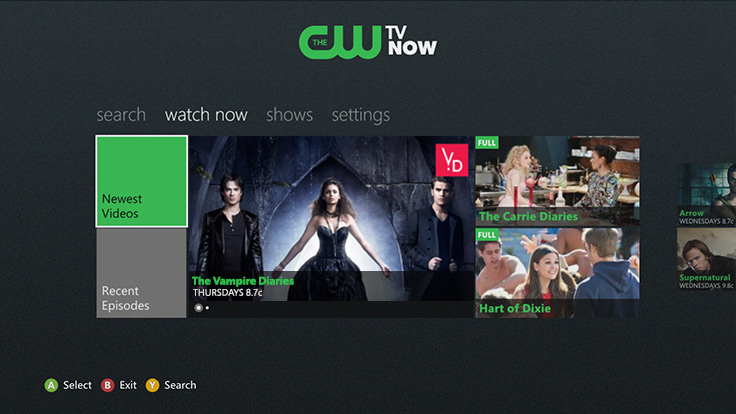
During a presentation with advertisers, CW Network president Mark Pedowitz announced that the network would be expanding its content offerings to new multimedia devices. This strategy will include a spot as an app on the Apple TV set-top-box’s home screen.
It’s a dedicated CW app that will work like our Xbox and mobile and tablet apps – no cable authentication required, full episodes of our shows available next day after air, ad-supported.
Notably, as noted in the above quote, the CW content will be ad-supported.
CW currently streams its content to software on Microsoft Windows devices such as the Xbox. Apple recently added Hulu Plus and sports content to the Apple TV, and the current generation Apple set-top-box has sported YouTube and Netflix integration since launch.
Interesting exit interview with Intel CEO Paul Otellini wherein he says (duh) he regrets not trying harder not to get his chips inside the iPhone (and subsequently iPod touch and iPads).
But, oh, what could have been! Even Otellini betrayed a profound sense of disappointment over a decision he made about a then-unreleased product that became the iPhone. Shortly after winning Apple’s Mac business, he decided against doing what it took to be the chip in Apple’s paradigm-shifting product.
“We ended up not winning it or passing on it, depending on how you want to view it. And the world would have been a lot different if we’d done it,” Otellini told me in a two-hour conversation during his last month at Intel. “The thing you have to remember is that this was before the iPhone was introduced and no one knew what the iPhone would do… At the end of the day, there was a chip that they were interested in that they wanted to pay a certain price for and not a nickel more and that price was below our forecasted cost. I couldn’t see it. It wasn’t one of these things you can make up on volume. And in hindsight, the forecasted cost was wrong and the volume was 100x what anyone thought.”
While there seems to be some sentiment that if Otellini had tried, Intel would have won Apple’s iOS device business. But, it clearly isn’t that simple. ARM chips use an order of magnitude less power than Intel chips, even to this day.
Also, if Intel is so great at powering mobile device chips, why wouldn’t Android devices (And Windows 8 devices!) have used them as an advantage?
Steve Jobs and Apple prioritized efficiency over raw power which may have proved to be one of the winning advantages of the feature-rich iPhone and iPad over a decade plus of Windows machines.
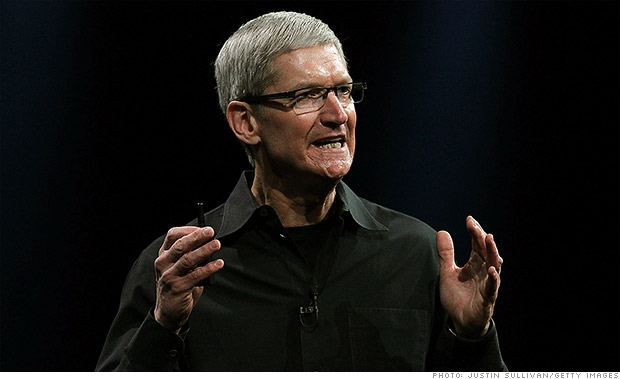
Tim Cook and Apple tend to avoid any public discussion aside from comments during quarterly earnings calls, but it seems the company is on a PR offense leading up to next week’s public hearings.
“We don’t have a large presence in Washington, as you probably know, but we care deeply about public policy and believe creative policy can be a huge catalyst for a better society and a stronger economy.”
Cook went on to defend Apple against any accusations that may come its way next week.
“I can tell you unequivocally Apple does not funnel its domestic profits overseas. We don’t do that. We pay taxes on all the products we sell in the U.S., and we pay every dollar that we owe. And so I’d like to be really clear on that.”
The Apple CEO also noted the company’s $100 million project to produce a Mac line in the United States this year, which the company says will add jobs to the economy. Expand Expanding Close
UPS announced today that it is finally rolling out a native iPad app that brings the ability to track and schedule deliveries as well as access to features of UPS My Choice® and enhanced mapping features. These features were previously available to users in the free UPS Mobile app for iPhone, but today they come to iPads through the UPS for iPad app available on the App Store now.
Some of the features below will require enrollment in the UPS My Choice program:
Without logging in, you can: – Track packages and freight shipments – Save up to 5 tracking numbers in your tracking list – See the current location of your package on a map – Find UPS service locations via GPS
When you log in, you can also: – Sync your recent tracks from ups.com – Nickname tracked shipments – Enroll in UPS My Choice – Use UPS My Choice to take action on your incoming deliveries – Set your delivery preferences
BGR claims to have gotten their hands on some iPhone 5S parts. At this stage they could be anything and the parts listed conveniently don’t detail any huge changes. The nano-SIM trays above are reportedly thinner and the different color shown could add weight to the multiple color options claims.
Other parts include the vibrating motor and Wifi chip assemblies that differ slightly from the iPhone 5 design.
These leaks are similar to a previous cache of random parts shown by Nowhereelse.fr. in March (below) and it is hard to know if they are valid parts.
Update: AllThingsD got its hands on some better images (above) and a statement from Apple on the new store (below):
“We’re thrilled to be working with the city of San Francisco on a new Apple retail store at Union Square…. Our store on Stockton Street has welcomed over 13 million customers since it opened nine years ago, and we look forward to serving them in an amazing new location when this project is complete.”
San Francisco Chronicle reports today that Apple has now submitted plans to open a new store in San Francisco’s Union Square. The new location would apparently replace Apple’s old retail location just a few streets away at Stockton and Ellis.
The new building is said to give Apple around 45% more space than its old San Fran retail location and will apparently occupy a building formerly home to Levi’s in Union Square at Stockton and Post Streets.
Apple thinks it will add about 50 jobs on top of the 350 it employees at its current Stockton street location: Expand Expanding Close
Research firm IDC is out with its latest numbers for Q1 2013 today tracking worldwide smartphone shipments by OS and OEM noting Android and iOS combined accounted for 92.3% of all shipments during the quarter.
IDC noted that Apple and Android shipments combined increased year over year approximately 59.1% with a total of 199.5 million units shipped worldwide during Q1. That’s up from just 125.4 million a year ago. Apple is clearly a large driver of the growth with the report pointing out that iPhone had its “largest ever first quarter volume.” However, despite that, Apple also saw a decline among usage of iOS compared to growth of the industry as a whole, allowing Android to keep its top spot by OS and Samsung to remain number 1 by OEM.
How far is iOS behind Android? According to IDC it accounted for 17.3% of the market in Q1 compared to 75% for Android. Of course this is likely taking shipments (not sales) into account and also doesn’t represent tablet usage that we know iOS continues to dominate. Expand Expanding Close
That auction for coffee with Tim Cook we showed you last month wrapped up today, and it looks like the Apple CEO severely underestimated his value.
Tim Cook and Charitybuzz hoped to raise $50,000 for the Robert F. Kennedy Center for Justice and Human Rights, but the final price for an hour long cup of coffee with Mr. Cook ultimately reached $610,000 just before bids closed today.
Nearly three years after the device first launched, GigaOm points us to a recently filed class action lawsuit that claims Apple’s iPhone 4 has a defective power button. The lawsuit claims that a defective flex cable typically causes the on/off switch to fail shortly after the device’s one year warranty has expired. It also claimsApple is aware of the problem, which is costing users around $149 to fix off of warranty.
Apple of course still sells the iPhone 4 through a number of carrier partners as its low end, $0 down iPhone option.
According to the lawsuit, “thousands of iPhone 4 users have suffered” from the issue that Apple allegedly knew existed before manufacturing and selling the device. The problem has never received a lot of mainstream media coverage or a response from Apple, but the lawsuit notes that a support forum on Apple’s website boasts over 800K views since first popping up in January 2011. Expand Expanding Close
In its ongoing second major patent trial against Samsung, Apple yesterday filed a statement with the US District Court in California claiming that after examining the recently released Galaxy S4 it has “concluded that it is an infringing device and accordingly intends to move for leave to add the Galaxy S4” to its long list of 22 infringing products. Apple is hoping Judge Lucy Koh allows the S4 to be added, but in line with the court’s request to reduce the number of infringing devices ahead of a trial scheduled for spring 2014, Apple has also agreed to remove without prejudice one of the other 22 infringing devices from Samsung it currently has listed.
Apple’s current list of infringing Samsung products include Admire, Captivate Glide, Conquer 4G, Dart, Exhibit II 4G, Galaxy Nexus, Galaxy Note, Galaxy Note 10.1, Galaxy Note II, Galaxy Player 4.0, Galaxy Player 5.0, Galaxy Rugby Pro, Galaxy SII, Galaxy SII Epic 4G Touch, Galaxy SII Skyrocket, Galaxy S III, Galaxy Tab 7.0 Plus, Galaxy Tab 8.9, Galaxy Tab 2 10, Illusion, and Stratosphere.
The filing also highlights a disagreement in which Samsung believes each carrier variant of a specific device should be counted separately. For example, “the Galaxy Nexus activated on Sprint must be counted separately from the Galaxy Nexus activated on Verizon; and the Galaxy Nexus operating on Sprint running Android version 4.0 must be counted separately from the Galaxy Nexus operating on Sprint, but running Android version 4.1.” Apple, however, claims that Samsung has not itself applied this logic: Expand Expanding Close
9to5Toys scours the net each day to bring our US readers the best deals in consumer electronics. Below are the absolute hottest deals going on right now. Most of these promotions are only available for a limited time, so be sure to lock in these savings if you see something you like. Check back often as we are constantly posting new deals.
Also bookmark 9to5Toys.com/Daily-deals for 35+ of the top daily deals across most of the biggest shopping sites in the US including Amazon, Best Buy, Walmart, Target, and many more.
Amazon has stepped up and is offering a staggering $150 off three out of four standard configuration iMacs (21″ & 27″). This discount is yielding the lowest prices we have ever seen on these super-skinny iMacs. Don’t wait too long to pull the trigger, this is an unadvertised sale that Amazon could pull the plug on at any moment.
Amazon today released an iPhone version of its Amazon Cloud Drive Photos mobile app that it originally launched on Android only back in November. Amazon;’s Cloud Drive Photos app for iPhone, like the Android version, will allow users to back up and view photos to their Amazon Cloud Drive accounts. Up until today, iOS device users have only had access to Amazon’s Cloud Player app for streaming music stored in an Amazon cloud account.
The app provides everything a user might need to ditch Apple’s less than perfect iCloud Photostream feature, including the ability to automatically save photos taken on your iPhone to Cloud Drive, access your entire Cloud Drive photo collection from any device, and easily share through social networks.
“It’s like giving a glass of ice water to somebody in hell”
That’s what Steve Jobs said of iTunes for Windows when asked why Apple made its software for competing Microsoft users in 2007.
But times have changed. Apple continues to make/support iTunes for Windows desktop computing environments, but it doesn’t need Microsoft’s outlier tablet users who now represent the third largest share of tablet OS behind iOS and Android (by the way, don’t expect iTunes for Android any time soon either).
In fact, the iTunes ecosystem is a competitive advantage as Apple sells its iOS tablets, smartphones and TVs against Android and now Windows 8 devices. Where Windows dominated the userbase in the early 2000s, Apple now is the leader in the current ecosystem race.
That’s why it comes as no surprise that Microsoft’s Windows division CFO Tami Reller is telling folks not to expect a Windows 8 ‘Metro’ iTunes app:
“You shouldn’t expect an iTunes app on Windows 8 any time soon,” said Tami Reller, chief financial officer of Microsoft’s Windows division. “ITunes is in high demand. The welcome mat has been laid out. It’s not for lack of trying.”
It should be noted that Microsoft has been dragging its feet in delivering the once ubiquitous Office Suite of applications for iOS which is now letting competitors (Like Pages/Numbers/Keynote and Google Apps) thrive on the now dominant iOS and Android touch platforms. Expand Expanding Close
Research firm Canalys is out today with its latest report tracking worldwide smart mobile device shipments for Q1 with Android accounting for almost 60% of smart mobile devices shipped by OS. That’s compared to a 19.3% share for Apple and approximately 18.1% for Microsoft. Keep in mind Canalys’s report also includes notebooks, in addition to tablets and smartphones, which account for the majority of Microsoft’s share. When looking at tablets alone, Apple continued its lead with 46.4% share in the quarter, although Canalys warned Apple “lost share to its Android-based rivals for the third consecutive quarter.”
Though Apple continues to lead in the tablet space with a 46.4% share, it lost share to its Android-based rivals for the third consecutive quarter. ‘Spearheaded by Google and Amazon, the commoditization of the tablet market has happened far quicker than that of the wider PC market,’ said Canalys Senior Analyst, Tim Coulling. ‘Profit margins are being squeezed and vendors without a low cost structure will find it hard to compete. A solid range of must-have accessories and a software and services strategy are vital as vendors will increasingly need to make revenue around their devices.’
When it comes to smartphones, the report has Android at roughly 75.6% of shipments with around 32% of those shipments coming from Samsung. We know Apple sold around 37 million iPhones in the quarter but, as always, we warn that the stats from Canalys don’t include shipped vs sold data. Expand Expanding Close
As we reported last week, AT&T today launched its new pre-paid wireless MVNO called Aio Wireless with the iPhone 5 on offer, front and center. Currently, the service is only available in Houston, Orlando and Tampa but it is expected to roll out nationally over the coming months.
The company will offer 4 plans: Aio Basic, Smart and Pro phone plans at $35-40 for 250MB, $55 for 2GB and $70/month for 7GB data respectively. Each plan will shift to lower speed data after data is used up and also offers unlimited calls and text on AT&T’s network. They will also offer a tablet plan that starts at $15/month for 250MB.
The MVNO will carry Android, Windows and Apple smartphones including iPhone 4S for $499 and iPhone 5 for $649 without subsidy. They also cap 4G data at 4Mb/s so LTE speeds shouldn’t be expected.
Yesterday we decided not to run with a story published by Bloomberg that Pegatron’s forecasted 25 percent to 30 percent drop for second-quarter revenue was due to “falling iPad mini demand.” It seemed a little far fetched that an Apple supplier would be giving up specific information on product demand, something we know suppliers in Apple’s circle typically remain tight-lipped on. Today CEO of Pegatron Jason Cheng has confirmed our suspicions in an email to Fortune claiming that Bloomberg reporter Tim Culpan made the iPad mini angle up.
While quoting an analyst’s expectations for iPad mini demand in Q2, Bloomberg’s Tim Culpan offered the following quote from Pegatron Chief Executive Officer Jason Cheng as proof:
A decline in revenue from the iPad Mini “is more on demand, while price has been stable. Not just tablets, also e-books and games consoles, almost every item is moving in a negative direction.”
Pegatron chief Jason Cheng says he wasn’t referring to iPad mini specifically, but rather all of its products including all tablets and game consoles, while noting that “clearly refused” to answer Culpan’s questions related to specific products. Here’s what he had to say about the Bloomberg piece: Expand Expanding Close
Best Buy is also offering a $100 iTunes gift cad for $85. (Free Money!) That is a total savings of 15% off future purchases of Apps Music, Movies and any other content on the the App Store, iTunes, Mac App Store and iBook Store. This is the first iTunes deal we’ve seen in nearly 2 months and a perfect opportunity to surprise Mom on Mother’s Day.
Those interested in an iPhone 4S can pick one up for $50 (half off) with contract.
Best Buy also offers probably the best looking keyboard case out there, Targus – Versavu Keyboard Case for Apple® iPad – Bone White half off for $50.
Belanger is the man behind some of Apple’s most iconic product images, a San Francisco-based product photographer at the top of his field. Apple is but one of his clients — he’s done work for everyone from eBay and Nike to Pixar and Square — and we sat down with Peter to talk about his work, his background, and some very, very expensive gear.
The New York Post reports that the flagship Fifth Avenue Apple Store in Manhattan was flooded following heavy rain in the city this morning due to a leak in the retail store’s roof. The flood apparently began shortly after opening at approximately 8 a.m while around 15 customers were shopping in the store. According to reports from NY Post, employees blamed construction completed on the location last year for the leak: Expand Expanding Close
Update: Bloomberg reports Apple has now won an order granting its request for Google to provide more information about its process of turning over documents in an ongoing lawsuit with Samsung:
U.S. Magistrate Judge Paul S. Grewal in San Jose, California, ordered Google within two days to disclose what terms it’s using to find documents Apple has requested in pretrial information sharing, and to tell Apple which Google employees those documents came from. Google had argued the collection of information would be too burdensome.
“The court cannot help but note the irony that Google, a pioneer in searching the Internet, is arguing that it would be unduly burdened by producing a list of how it searched its own files,” Grewal wrote in his order.
Bloomberg reports that Apple has requested Google turn over documents related to Android’s source code in an ongoing patent-infringement lawsuit with Samsung in California. According to the report, Apple took issue with Google’s process of turning over requested pretrial documents claiming Google is “improperly withholding information” and that Android “provides much of the accused functionality” in the infringement claims related to several of Samsung’s Galaxy products: Expand Expanding Close
Despite having access to a pretty powerful voice-enabled, predictive search engine with Google Now, Samsung is still pushing ahead with its own ‘S Voice’ app to try and provide a unique Siri-like experience on its devices. We’ve seen many comparisons of how Samsung might have borrowed from Apple for its own voice-controlled assistant, but today a post from AndroidCentral got us curious about how S Voice reacts when asked about Siri.
The screenshot we grabbed above speaks for itself with the Galaxy S4 returning snappy answers when asked about the iPhone and Siri. When asked, “Have you ever used an iPhone?,” S Voice responded, simply, “No, I have standards.” Another question, “Are you Siri?,” returns the answer, “I think that I am, but I’m a little biased.”
Results appear to vary for users, but it’s certainly an easter egg that Samsung has intentionally included in the app at some point. Siri isn’t free of its own clever responses with users finding several easter eggs and controversial remarks since the app first launched on iPhone 4S. Asking Siri about Samsung or its devices, however, usually just provides a vague response or directs users to Apple’s website or the web.
Some answers Siri gives are amusing, such as responding to marriage questions with “My End User License Agreement does not cover marriage”. People are more amused by the silly stuff, like when you say “call me an ambulance” and she responds by acknowledging “From now on, I’ll call you ‘an ambulance’”.



 .
.