Security

See All Stories

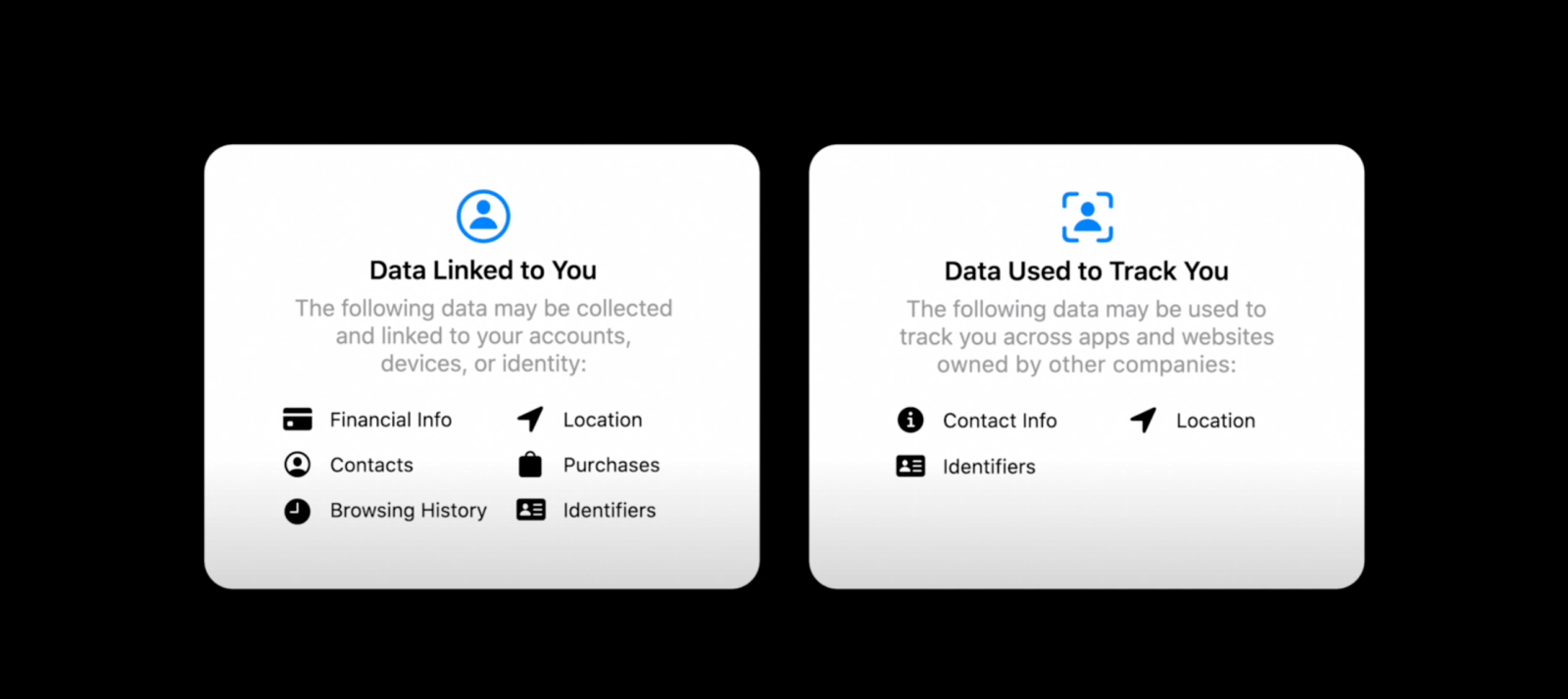
iOS 14 introduces privacy ‘nutrition labels’ for apps, here’s how developers can prepare

Apple app privacy details nutrition labels developer support document

After announcing new iOS privacy requirements back at WWDC in June, Apple has shared a new detailed document for developers as they prepare to create privacy “nutrition labels” for apps. The new iOS 14 feature will apply for all apps that are available in Apple’s App Stores with the goal to better inform consumers with a clear overview of an app’s privacy practices.

Expand Expanding Close

Apple battles Mac malware disguised as Adobe Flash after accidental notarization

While Apple’s devices are typically more secure than the competition, that doesn’t mean they’re immune to flaws. In the case of the Mac, a new report highlights how Apple accidentally approved one of the most common malware threats to run on recent versions of macOS. While the original flaw was quickly fixed, another similar one has popped up.

Read more

Can police demand you unlock your phone? NJ court says yes.

Can police demand you unlock your phone

Can police demand you unlock your phone if they want to examine it for evidence? Courts in different states have given different answers to this question, but New Jersey’s Supreme Court has ruled that the answer is yes. The court decided that a suspect can be forced to use his passcode to unlock his phone.

Despite the ruling coming from the state’s Supreme Court, however, that may not be the final, definitive answer …

Expand Expanding Close

New ‘unpatchable’ exploit allegedly found on Apple’s Secure Enclave chip, here’s what it could mean

One of the major security enhancements Apple has brought to its devices over the years is the Secure Enclave chip, which encrypts and protects all sensitive data stored on the devices. Last month, however, hackers claimed they found a permanent vulnerability in the Secure Enclave, which could put data from iPhone, iPad, and even Mac users at risk.

Expand Expanding Close

Twitter hack: Suspect identified; why Trump’s account wasn’t hacked; more

Twitter hack latest

There have been significant developments in the Twitter hack which saw the takeover of many high-profile accounts, among them Apple, Joe Biden, Elon Musk, Jeff Bezos, Bill Gates, Mike Bloomberg, Kayne West, Uber, Floyd Mayweather, Warren Buffett, and Barack Obama.

Twitter said yesterday that passwords were not compromised, but it subsequently locked all accounts where there was an attempted password change within the past 30 days …


Expand
Expanding
Close

US AG Barr alleges Apple and other tech companies are collaborating with China

AG Barr

In the latest accusation from the US Attorney General against Apple and other major tech companies, today William Barr alleged a number of American companies are “all too willing to collaborate” with China. In particular, Barr accused Apple of making it easier for China to crack iPhone encryption to be able to keep doing business there.


Expand
Expanding
Close

Apple and Google asked to warn users about ‘national security risks’ of apps

Apple should warn app users about potential national security risks

Apple and Google should warn users about the ‘national security risks’ of apps developed by foreign entities, says the chairman of the congressional Subcommittee on National Security, Rep. Stephen Lynch.

Lynch has written to both tech giants arguing that apps by ‘our adversaries’ could be used to gather sensitive information on American citizens …


Expand
Expanding
Close

Is TikTok a national security threat? In an abstract way, say experts …

Is TikTok a national security threat

Earlier this week, the White House suggested that it might declare TikTok a national security threat, with Secretary of State Mike Pompeo stating that the administration was ‘looking at’ the possibility of banning the video sharing app from the US.

Experts have now weighed in on the question, concluding that it’s not a direct threat, but might be an indirect one …


Expand
Expanding
Close

Dropbox password manager

[Now open to all] Dropbox password manager here, but invite-only; uses zero-knowledge encryption

Update: The app is now available to all. The company also announced two additional new features for home users, and two others for work users, described at the end of the piece.

A Dropbox password manager has been quietly added to the App Store, but it is currently listed as ‘by invite.’ This means that you can download it, but can’t yet activate it. An Android version is also available on the Play store, subject to the same restriction …


Expand
Expanding
Close

Anonymous Camera for iPhone launches with face, full-body, and voice anonymizing via on-device processing

Anonymous Camera iPhone app

Anonymizing photos and videos can be a time-consuming task sometimes including multiple steps, especially if you want to strip metadata. Developers Playground.AI decided to tackle that problem and came up with a valuable new iPhone app called Anonymous Camera that handles all of the processing on device in real-time. Playground.AI is also donating all of its proceeds from the app to Black Visions Collective and Unicorn Riot for the first month.


Expand
Expanding
Close

Some iPhones, iPads, Macs, vulnerable to short-range attacks via Bluetooth

Attacks via Bluetooth possible on some Apple devices

Some iPhones, iPads, and Macs are vulnerable to short-range attacks via Bluetooth which could fool them into thinking they are connected to a trusted device. That would then enable an attacker to both send and request data via Bluetooth.

The same security vulnerability is found in a wide range of chips from Intel, Qualcomm, and Samsung, meaning that a large number of non-Apple devices are also affected …


Expand
Expanding
Close

[Update: Apple responds] FBI links Pensacola shooter to Al-Qaeda with cracked iPhones with ‘no thanks to Apple’

FBI pressure on iCloud backups story questioned

It looks like the most recent contention between the FBI and Apple over device encryption has come to an end as the agency has unlocked the two iPhones belonging to the Pensacola shooter with “no thanks to Apple.” Going further, AG William Barr has again called for the government to force Apple and others to create backdoors into their devices.

Update: We’ve got an official response from Apple on the matter that highlights all the ways it helped the FBI and that it’s precisely because it takes security and privacy so seriously that it doesn’t believe in creating a backdoor:

The terrorist attack on members of the US armed services at the Naval Air Station in Pensacola, Florida was a devastating and heinous act. Apple responded to the FBI’s first requests for information just hours after the attack on December 6, 2019 and continued to support law enforcement during their investigation. We provided every piece of information available to us, including iCloud backups, account information and transactional data for multiple accounts, and we lent continuous and ongoing technical and investigative support to FBI offices in Jacksonville, Pensacola and New York over the months since.

On this and many thousands of other cases, we continue to work around-the-clock with the FBI and other investigators who keep Americans safe and bring criminals to justice. As a proud American company, we consider supporting law enforcement’s important work our responsibility. The false claims made about our company are an excuse to weaken encryption and other security measures that protect millions of users and our national security.

It is because we take our responsibility to national security so seriously that we do not believe in the creation of a backdoor — one which will make every device vulnerable to bad actors who threaten our national security and the data security of our customers. There is no such thing as a backdoor just for the good guys, and the American people do not have to choose between weakening encryption and effective investigations.

Customers count on Apple to keep their information secure and one of the ways in which we do so is by using strong encryption across our devices and servers. We sell the same iPhone everywhere, we don’t store customers’ passcodes and we don’t have the capacity to unlock passcode-protected devices. In data centers, we deploy strong hardware and software security protections to keep information safe and to ensure there are no backdoors into our systems. All of these practices apply equally to our operations in every country in the world.


Expand
Expanding
Close