China

See All Stories
China

China has been fundamental to Apple’s historical success, but is also arguably the greatest risk to the company’s future.

Why are most Apple products made in China?

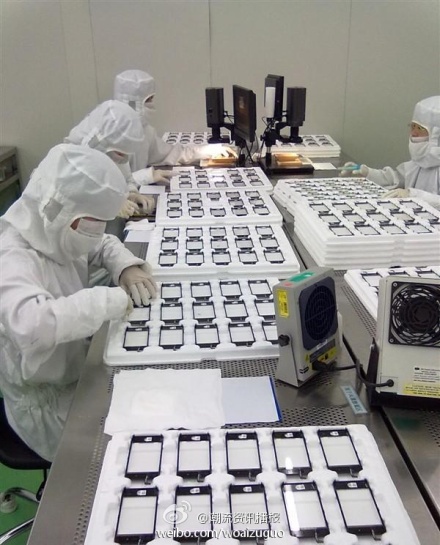
Although everyone assumes Apple products are made in China because labor is cheap there, that’s only part of the story – and an increasingly small part, as the company’s assembly partners move toward more and more automated operations.

Steve Jobs originally transferred most Apple manufacturing to China because it was the only country in the world with a huge ready-made supply-chain network, and the ability to scale up production almost overnight. There are three main reasons China – and specifically the Shenzhen area – is such a powerful manufacturing center.

First, the city is strategically placed, serving as the gateway between mainland China and Hong Kong. It is one of the largest shipping centers in the world, with a massive container port.

Second, the Chinese government established Shenzhen as the first Special Economic Zone (SEZ) in the country. SEZs are designed to encourage enterprise through relaxed planning regulations and generous tax incentives – and crucially, to facilitate foreign investment in local companies. It is this, as much as its geographical advantages, which has enabled it to grow at such a pace.

Third, that SEZ was established way back in 1980, meaning that the city has had over 40 years to grow into the manufacturing center of the tech world. Apple relies on a huge network of suppliers and sub-contractors, some of which may make just a single tiny component. The majority of them are based in Shenzhen and its immediate surrounds, so the logistics of bringing everything together in one place for assembly are straightforward.

What are the risk factors with China?

Being over-dependent on China carries a number of risks.

First, there is the generic one: Being overly dependent on any one country is a strategic risk. For example, the COVID-19 pandemic originated there, and had a massive impact on manufacturing capacity. Anything from a natural disaster to political upheaval could disrupt operations within a single country, so it is always wise to have a diverse range of manufacturing centers around the world.

Second, the relationship between the US and China has often been fraught. The trade war started by the previous US administration was a particularly low point, but continued tensions mean that there is always a risk of disruptions to trade between the two countries.

Third, it is increasingly damaging to Apple’s reputation to be so closely associated with a country that has a worsening human rights record – especially when the iPhone maker has no choice but to comply with local laws, however much they may conflict with the company’s own values. Apple has been required to remove VPN and a variety of other apps from the Chinese App Store, allow the iCloud data of Chinese customers to be stored on government-controlled servers, and more. Additionally, there have been growing reports of forced labor in China, including within many different areas of Apple’s supply chain.

What is Apple doing about it?

Apple has been working for a long time on diversifying its manufacturing operations, and has in recent years accelerated the pace at which it is doing so.

As explained above, this is far from an easy undertaking, but Apple now has major manufacturing operations in India, Thailand, Malaysia, and the Philippines, among other countries.

In India in particular, we are seeing the very early stages of a complete supply-chain infrastructure as the government uses a mix of carrot and stick to encourage companies to manufacture more of their components within the country – namely, tariffs on imports of components and tax breaks for local production. COVID-19 lockdowns in China also saw Apple move some iPad production to Vietnam for the first time, but it’s clear that the risks of over-dependence on China have never been greater.


Toshiba Mobile Displays outed on Apple’s production suppliers list, factories open doors to labor group inspectors

Site default logo image


Apple just posted its 2012 Supplier Responsibility Report highlighting its efforts to audit and improve working conditions within its supply chain. As part of the report, Apple also posted a list of 156 companies currently supplying components for Apple products that make up over 97 percent of all “procurement expenditures for materials, manufacturing, and assembly” of its entire product line globally.

The list includes Toshiba Mobile display, which is —as far as we know—currently not supplying displays for Apple. There were rumors in May that claimed Toshiba was working on a 4-inch retina display and rumors last month that Apple and Toshiba are building a plant for display production, which were later debunked by the increasingly unreliable DigiTimes. It also includes Sharp, who was recently rumored to be ruled out of iPad 3-panel production due to quality concerns but also supplies other components to Apple. The full list is available after the break.

In 2011, we conducted 229 audits throughout our supply chain — an 80 percent increase over 2010 — including more than 100 first-time audits. We continue to expand our program to reach deeper into our supply base, and this year we added more detailed and specialized audits that focus on safety and the environment.

Every year Apple audits suppliers in eight areas including: Anti-discrimination, Fair treatment, Prevention of involuntary labor, Prevention of underage labor, Juvenile worker protections, Working hours, Wages and benefits, and Freedom of association. The overall results can be seen in the graphic below. We also learned than Apple found 42 facilities delayed wages, 68 facilities did not provide proper benefits, and 67 facilities held back payments as punishment.

There were also 108 facilities failing to pay legal requirements for overtime and holiday pay, and 5 facilities with 6 active cases of underage labor, to which Apple is requiring the suppliers “support the young workers’ return to school and to improve its management systems.”

In the audits, Apple found 93 facilities currently have more than 50 percent of its staff exceeding the maximum 60 hour workweek (with one day of rest per 7 days) set by Apple’s Code of Conduct for suppliers:

Expand
Expanding
Close

No more iPhones in Beijing and Shanghai ‘for the time being’, Apple warns as analysts criticize China launch delays

Site default logo image

Yesterday’s eagerly awaited iPhone 4S launch in China quickly turned into chaos as an ugly brawl between gangs of professional scalpers grew out of control. Beijing SWAT teams intervened to calm down hundreds of angry customers and tame the rowdy lines. The New York Times explained that scalpers hired migrant workers to stand in the line and buy the phone. As Apple said it would not open the store, those individuals, identifiable by matching armbands or hats, got angry because they were not going to be paid.

An Apple spokeswoman issued the  following statement following the incident (via Reuters):

Unfortunately, we were unable to open our store at Sanlitun due to the large crowd. And to ensure the safety of our customers and our employees, iPhones will not be available in our retails stores in Beijing and Shanghai for the time being.

Instead, Apple noted, customers could order the iPhone 4S on the online Apple store or through one of the many China Unicom retail outlets, the country’s exclusive iPhone carrier. However, the iconic smartphone was out of stock on the Chinese online Apple Store at the time of this writing.

As you know, Apple rarely goes on the record unless absolutely necessary, so the statement is an indication of how the launch spiraled out of control. Moreover, the egg-throwing incident inspired funny remarks on Twitter. Really, who goes to buy a new iPhone with a pocket full of eggs? Let’s just hope this situation won’t snowball into a public relations nightmare and become a theme for another anti-Apple advert by Samsung.

In the meantime, one analyst pointed out that Apple must learn from this turmoil and consider launching its products in China and United States simultaneously. Another incredible riot clip, egg throwing video and additional tidbits are displayed after the break.

[vodpod id=Video.15951524&w=425&h=350&fv=]

Expand
Expanding
Close

Huge lines form at Apple Stores in China for iPhone 4S launch

Site default logo image

[slideshow]

     The gallery above via Flickr user Liz Phung shows more shots from the launch in Beijing. There are also two images of  employees receiving their first shipments at China Unicom in Wuxi, east China’s Jiangsu Province (via xinhuanet). 

It is just over 8 hours before the iPhone 4S officially lands in China and huge lines already starting to form outside of Apple Stores in Beijing and Shanghai. The image below is from Instagram user Sanverde who noted he snapped the shot outside an Apple Store in Sanlitun Village, Beijing less than an hour ago. As you can see from the daytime image in the slideshow above (posted by Twitter user Alexander Galimberti on Jan. 10), Beijing line sitters started showing up for tonight’s launch days in advance. To the right is an image from Instagram user sainasilverman who says 400,000 units of the iPhone 4S have now arrived in Beijing.

China Unicom, the only carrier currently offering the iPhone 4S, does not currently accept pre-orders, but it will be offering the 16GB and 32GB models free on two- and three-year agreements. China Telecom, the nation’s third largest mobile carrier, is also expected to offer the iPhone in the future. The device recently received necessary approval from the China Radio Management agency for use on its CDMA network.

Check out the most recent shot of the lines outside the Sanlitun Village, Beijing Apple Store after the break and some more shots of gray market line sitters wearing red hats. According to MIC Gadget, those wearing a red cap have been paid 100 yuan ($16) to line up for the 12+ hour wait. We will be updating with more shots, so email your photographs of the lines to us at tips@9to5mac.com
Expand
Expanding
Close

Apple online stores down in China, Australia, and 11 other Pacific countries

Site default logo image

Update: The stores appear to be back online now, and while the China/Hong Kong, Taiwan, Singapore, Malaysia, Philippines, and Thailand stores have access to Red Friday deals, the others don’t. As for discounts, most products, including iPads, MacBooks, and iMacs appear to be on sale for in between 5% and 10% off. For everyone else, 9to5 readers can still get some of the best prices on Macs in the U.S. through our discount code at MacMall.

While we have not confirmed the exact reason, it looks like around 13 Apple online stores worldwide are currently down. Among them: China, Australia, Japan, Korea, Taiwan, New Zealand, Hong Kong, Singapore, Malaysia, Philippines, Thailand, and Vietnam.

There is a good possibility Apple is updating these websites to reflect the ‘Year of the Dragon’ Jan. 6 Red Friday shopping event that is expected to land in China/Hong Kong, Taiwan, Singapore, Malaysia, Philippines, Thailand, and possibly the other countries with online stores currently down. We will keep you posted if we notice any changes when they come back online.


Expand
Expanding
Close

iPhone 4S gains necessary China certification; January launch expected for mainland

Site default logo image

People Daily reported that Apple received the certification it needs by the China Compulsory Certification to launch the iPhone 4S in mainland China. The certification was awarded on Dec. 22, shortly after Apple also received certification from the Ministry of Industry and Information Technology of China. With the necessary certifications, Apple has now met all of its requirements to launch the iPhone 4S in China. People Daily said the iPhone 4S-model number A1431- will hit in early January.

To model how well the iPhone 4S could potentially do in China, in this year’s June quarter earnings, Apple’s sales in China topped $3.8 billion. Thus, obviously, the launch of the iPhone 4S in China would boost sales.

China Unicom is the third-largest carrier in China, and it remains the sole carrier for the iPhone. While Apple is able to reach a large market, only being available on one carrier leaves about 1.33 billion people in the market untapped. If Apple were to also sell the iPhone 4S on China Mobile, sales could grow substantially. At any rate, the iPhone 4S is at least on its way to China Unicom by January.


Expand
Expanding
Close

Distimo: Drastic increases for Chinese App Store downloads and in-app purchases in 2011

Site default logo image

Apple’s App Store is currently taking approximately four times more revenue generated by the 200 highest grossing apps in comparison to the Android Market. According to research firm Distimo’s recently published 2011 report, a significantly increasing portion of app downloads are originating in China.

Likely further increased by Apple’s recent announcement to begin accepting App Store payments in Chinese Yuan, Distimo said when comparing the United States and China, 30 percent of downloads are coming from China. This is up from approximately 18 percent reported by Distimo in January 2011.

Growth in China is even more impressive when looking at just iPad numbers with China now accounting for 44 percent of all downloads from the two countries. Distimo reported late last month that App Store downloads for the top 100 paid apps in China nearly doubled just days following Apple’s decision to accept Yuan.

During Apple’s fourth quarter earnings call, CEO Tim Cook called the progress in Chinaamazing” and said the country represents “enormous opportunity.” As of that time, revenues from China accounted for 16 percent of Apple’s revenue for the September quarter – approximately $4.52 billion.

Some of the other interesting numbers reported by Distimo, include: 50 percent of App Store revenue for iPhone is now generated by freemium apps and in-app purchases for the 200 highest grossing apps; there are currently 79,077 games for iPhone, 28,683 for iPad, and 46,045 for the Android Market.

While the report noted App Store downloads have been on the decline for the year, downloads peaked following the release of the iPad 2 and iPhone 4S. Distimo attributed the increase to what they call the “anticipation effect” for Apple’s new devices.

Distimo put together their App of the Year Award based on total downloads worldwide across all platforms. Not surprisingly, Angry Birds took the top spot, followed by Facebook, Skype, Google Maps, and iBooks. Check out the full top 10 below.


Expand
Expanding
Close

Apple is turning out millions of iPhone 3GS and iPhone 4 CDMAs ahead of the holidays

Site default logo image

Digitimes’ latest report puts some numbers on the low end iPhones coming out of China.  The 2.5 year old iPhone 3GS has continued to sell briskly with the volume likely to reach two million units in the fourth quarter of 2011 and 1.4-1.6 million units in the first quarter of 2012, according to “industry sources”.

Think about that for a second.  In a world where a new, free Android flagship phone comes out every week or so and dying out a few months later, Apple is selling 2 million/quarter of a device that was introduced two and a half years ago.  This is the phone the original Droid went up against — in fact.

Verizon and conceivably other CDMA carriers in the world have also continued to sell the iPhone 4 CDMA version at an impressive clip.

Meanwhile, the production of the CDMA version of iPhone 4 is expected to top 800,000 to one million units in the fourth quarter of 2011 and 500,000-600,000 units in the following quarter, estimated the sources.

Proview sues retailers in Southern China seeking ban on iPad sales

Site default logo image

Yesterday we told you that Apple’s lawsuit against Proview regarding the “iPad” trademark was rejected by a court in Shenzhen, which would make Proview the rightful owner until Apple decides to appeal the decision or settle with the company outside of court.

At the time we weren’t sure what exactly would be the next course of action for either company, but according to a new report from Financial Times, it appears Proview is attempting to block iPad sales by suing resellers in Southern China. Starting with the cities of Huizhou and Shenzhen, if the company is successful at blocking sales of the iPad there, they will then go after other Apple resellers throughout China.

Xie Xianghui, a lawyer presenting Proview, discussed the company’s new course of action:

We are starting with these two cities, and if we are successful in getting iPad sales stopped, we will consider going after Apple resellers elsewhere in China.

The Shenzhen Futian District Court will begin hearing one case on December 30, with another slated for January 7. There’s always the possibility that Apple will settle outside of the courts before then, as Proview’s financial troubles are clearly a motivating factor.

Expand
Expanding
Close

Apple addresses environmental concerns with audits of 15 suppliers, could impact future components and contracts

Site default logo image

Apple has been no stranger to environmental concerns regarding their manufacturing and supply chain abroad, most recently a report from five independent environmental organizations in China in August accused the company of taking “advantage of the loopholes in developing countries environmental management systems” and awarding contracts to known polluters. Yesterday Apple responded to the accusations in a three-hour meeting with five Chinese environmental NGOs, admitting fifteen of their current manufacturing partners are contributing to pollution in surrounding areas by agreeing to perform audits of the companies. This followed several meetings with Apple following the group’s report in August, including one with Apple execs in Cupertino.

According to a report from WSJ, Ma Jun, of the Institute of Public & Environmental Affairs in Beijing, had this to say following the meeting:

“This is a major step forward… They asked these companies to take corrective plans and give a timeline, and Apple will verify whether all these issues have been resolved.”

As a result of the meeting, Apple is apparently vowing to improve its environmental standards within its supply chain, a move that could not only alter the manufacturing process of components, but also impact contracts awarded to manufacturers and suppliers in the future. According to the report, to avoid issues like massive amounts of waste water, Apple will encourage alternative manufacturing processes for components such as printed circuit boards. Apple also confirmed that this and other environmental concerns will play a role when awarding future contracts to suppliers.

Expand
Expanding
Close

Jobs to Obama: “You’re headed for a one-term presidency” because the US can’t build factories

Site default logo image

The Huffington Post pulls some words that Steve Jobs had for president Obama from Isaacson’s Steve Jobs bio.  On the meeting, Jobs insisted that Obama himself ask for a personal invitation.  They met in the Westin Airport hotel in San Francisco. It sounds like like Jobs is more of a Conservative than “hippy Liberal” in his incredibly blunt words to President Obama:

“You’re headed for a one-term presidency,” he told Obama at the start of their meeting, insisting that the administration needed to be more business-friendly. As an example, Jobs described the ease with which companies can build factories in China compared to the United States, where “regulations and unnecessary costs” make it difficult for them.

Jobs also criticized America’s education system, saying it was “crippled by union work rules,” noted Isaacson. “Until the teachers’ unions were broken, there was almost no hope for education reform.” Jobs proposed allowing principals to hire and fire teachers based on merit, that schools stay open until 6 p.m. and that they be open 11 months a year.

That said, Jobs was still willing to help Obama’s re-election campaign…

Expand
Expanding
Close

Nearly one in six dollars of Apple’s revenue coming from China

Site default logo image

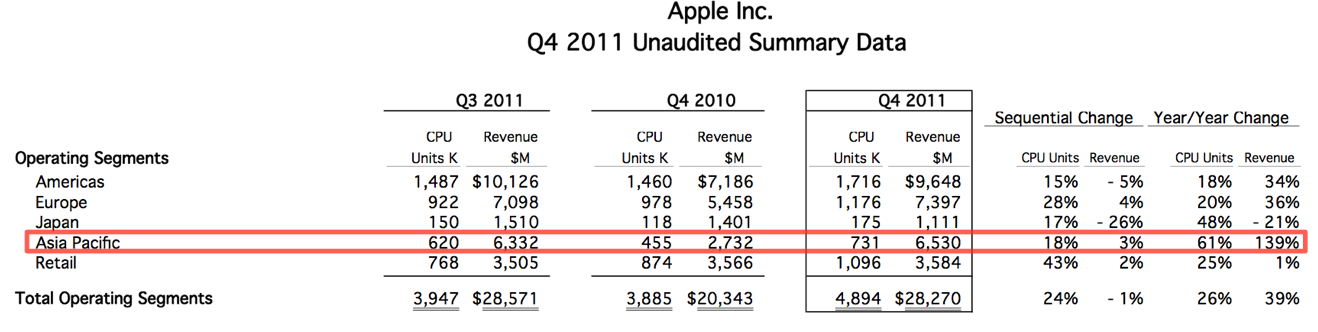
There have been signs and indications of China’s growing importance to Apple’s bottom line before. In the June quarter the company grew China revenues sixfold, to an astounding $3.8 billion, or nearly eight percent of its total revenue for the quarter. Just three months later, however, the business in China has ballooned to $4.52 billion, an impressive sixteen percent of Apple’s total $28.27 billion revenue for the September quarter. China contributed with twelve percent in the more than $108 billion of fiscal 2011 revenue, or about fifteen billion dollars. Last year revenue from China was just three billion dollars and in 2009 only two percent of Apple’s total revenue.

In other words, one in six dollars of Apple’s quarterly revenue came from China (almost one-in-eight looking at fiscal 2011). The 1.33 billion people country is now Apple’s second-best revenue market. Moreover, revenue for the entire Asia Pacific region grew by 139 percent year over year to $6.53 billion, with CPU units climbing by 61 percent (three percent revenue and eighteen percent CPU units sequential growth). Compared to a 34 percent annual revenue growth in the Americas ($9.64 billion) or a 36 percent growth in Europe ($7.39 billion).

It’s clear now that the Asia Pacific region is Apple’s fastest-growing market, outpacing Europe and the Americas by nearly four times. In fact, Asia Pacific raked in nearly two-thirds of the Americas’ revenue, Apple’s top revenue market. And at four times larger growth, the Asia Pacific region could become Apple’s #1 revenue generator by this time next year.


Click for larger

CEO Tim Cook said in a conference call with Wall Street analysts that “the China progress has been amazing”, calling it an “enormous opportunity” for Apple. It’s bound to grow even bigger as Apple builds more stores to increase its distribution footprint there. Apple operates five flagship retail stores in China which combined had the most traffic in the quarter. The company has managed to build an impressive thirty retail stores worldwide during the quarter, including massive outlets in Hong Kong and Shanghai, the latter being pictured below.

There were as of this writing more than seven thousand points of sale for the iPhone in Greater China. In total, iPhone has 120,000 points of sale around the world and iPad and iPod are now carried in 40,000 and 50,000 points of sale, respectively. They should open at least 25 new stores in China within the next few years and 40 outlets around the world in the next quarter, with 30 outside the United States.

Other markets to watch? More after the break…


Apple’s Nanjing East Road store in Shanghai


Expand
Expanding
Close

How the teardrop iPhone design wound up in the hands of every case maker in China

Site default logo image

The idea of a next-generation iPhone shaped like a teardrop dates back to a report published by This is my next in late-April, describing a 3.7-inch iPhone with edge-to-edge glass and striking new design shape akin to the late-2010 MacBook Air, meaning thicker to thinner from top to bottom. Piggy-backing on the story, agile Asian vendors followed up with teardrop-shaped cases. Or so we thought.

While we will ‘talk iPhone’ next Tuesday, M.I.C. Gadget reveals that an iPhone 5 prototype had recently gone missing from the Shenzhen district. “This should explain why we are seeing a whole lot of iPhone 5 cases in China today”, the publication concludes.

Much like the widely publicized iPhone 4 prototype that had gone missing at a German beer bar in California, the missing handset was camouflaged in an iPhone 4-like case (strange because the teardrop phone is wider and taller). Inside: A test model with a finalized iPhone 5 chassis sporting the teardrop design. The publication then builds on this tip by speculating that the device houses “slightly modified iPhone 4 electronics” plus the A4 chip “and even the same amount of memory”.

If this is true, then the tear drop iPhone may be the low end device, and the one inside the iPhone 4 case might be the high end.

[youtube=http://www.youtube.com/watch?v=TU7iCNIumpc]


Expand
Expanding
Close

WSJ: Apple bringing 3G iPad 2 to China on Wednesday

Site default logo image

An Apple spokesperson has confirmed to WSJ they will begin selling the 3G version of their iPad 2 in China through Apple Retail Stores, the Apple online store, and authorized resellers starting Wednesday. This will add to China’s growing tablet market, roughly 75% of which is already dominated by the iPad.

The Wi-Fi-only iPad 2 is already available in mainland China. Up until now, only Hong Kong has officially had access to the 3G iPad 2 model, but as the report notes, some 3G iPads have made their way into the region on the grey market. Of course China Unicom would be the obvious choice of carriers, but at this point they’ve declined to comment.

Apple has once again been on a retail blitz in China opening up a number of grandiose retail spaces in recent months and a couple due this week.

Foxconn is already producing 150,000 iPhone 5s/day, 2nd supplier Pegatron won’t begin until 2012?

Site default logo image

Somewhere in China there are stacks of millions of completed iPhone 5s.

Digitimes is reporting that iPhone 5 production is at full swing with 150,000 of the devices being produced per day. That isn’t quite the “volume” production level that Apple expects as it gets ready to release its phone for the holiday shopping season, however.

Lens maker Largan Precision, touch panel maker TPK Holding, reinforced glass supplier G-Tech Optoelectronics and battery vendors Simplo and Dynapack are all operating at full swing currently, the sources indicated.

We’ve also heard recently that these iPhones aren’t being boxed up just yet as Apple is finalizing the iOS 5 build that will eventually go on these iPhones.

Shipments of iPhone 5 from the supply chain are expected to reach 5-6 million in September but will then ramp up to over 22 million units in the fourth quarter as suppliers will ship fewer iPhone 4 and CDMA-version iPhones during the final quarter of the year, noted the sources.

Apple’s other manufacturing partner, Pegatron, is said to be holding off on production until 2012 and is expected to only build 15% of the devices overall.

Expand
Expanding
Close

Union president Jim Hoffa accuses Apple of being unpatriotic [Video]

Site default logo image

In a recent TV interview on State of the Union, International Brotherhood of Teamsters Union President Jim Hoffa claimed Apple is unpatriotic for outsourcing manufacturing overseas.

“Look at Apple, they have $76 billion dollars in their checking account, and they’re not spending it… instead of investing here, everything they do is in China, or in Asia somewhere… There’s something wrong with that.”

Hoffa, in the video embedded below, urged President Obama to “challenge the patriotism” of American companies for investing outside the U.S. in his upcoming jobs speech and also proposes a tax initiative to “start spending some of that money here in America and put Americans back to work”.

Expand
Expanding
Close

Apple accuses Chinese food company of copying logo

Site default logo image

The image on the left (above) is the logo of Sichuan China-based food company Sichuan Fangguo Food Co., Ltd. It’s also the logo that Apple claims infringes on trademarks related to it’s own iconic Apple logo, according to a report from go chengdoo. (We cant help but feel that it looks more like an Apple logo merged with elements of LG’s logo)

CEO of Fangguo, Zhao Yi’s intial response:

“There’s a leaf so you can tell it’s an apple, but it also contains two Chinese characters. … The orientation is also different, and ours is a totally different shape … .” Besides, he added, “When I started Fangguo, I had never even heard of Apple.”

The company claims to have received a letter on July 19 from Beijing Zhucheng Law on behalf of Apple that gave the company until August 6th to respond to complaints regarding the resemblance of their logo to Apple’s. This was two days before Fangguo’s logo registration application was to be extended. The trademark registration license currently extends to August 19, 2017.
Expand
Expanding
Close

Chinese maker pulls the glowing Apple logo trick with the iSD Card Reader

Site default logo image

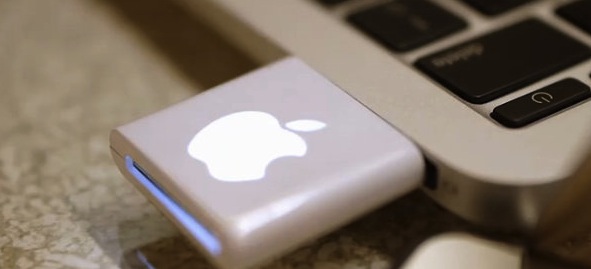
Remember the iHub, a four-port USB port that set itself apart with the cool-looking, glowing Apple logo – until Cupertino outlawed them? Apparently someone in China was inspired enough with the iHub and walked away concluding this must be the way to roll with everything. Check out a Chinese SD card reader in the below clip. We actually love its miniaturized all-white design with round corners and the advert certainly looks business, if we disregard the too obvious focus on the many close-ups of the glowing Apple logo. The iSD Card Reader is interesting because it lets the 11-inch MacBook Air owners accept SD and SDHC memory cards via USB as the notebook lacks an SD card slot. It can be yours for $9.90 over at the K.O. Gadget store. And while you’re there, make sure to check out their obnoxious white iPhone 4 air cooler. And what’s with the “Apple and 7 Pioneers” article (mark 00:13)

[youtube=http://www.youtube.com/watch?v=Df8VCRrPuGU]

another video below


Expand
Expanding
Close

China Mobile had secret iPhone meetings with Steve Jobs

Site default logo image

Reuters reported this morning that top brass from China Mobile, the world’s largest carrier by both subscribers and market valuation, and Apple’s head honcho Steve Jobs met “several times on introducing an iPhone based on its network standard”. Did Jobs travel incognito or was he accompanying Apple’s operations wizard Tim Cook during his China tour (snapped paparazzi-style in the shot below)?

More likely, Jobs probably hosted China Mobile reps in Cupertino.

Interestingly, China Mobile counts a cool 7.44 million iPhone users on its network, although it doesn’t carry the handset yet and iPhone users cannot tap 3G speeds on their TD-SCDMA 3G network.

Apple’s been alleged previously as wanting to release an iPhone optimized for China Mobile’s fourth-generation TD-LTE network. The Wall Street Journal chimed in with sources saying the gadget maker and China Mobile are close to cutting a deal set to open up the carrier’s 600+ million subscribers to Apple’s phone. The highest-level meeting isn’t surprising considering that Apple is only “scratching surface” in China, having reported in the June quarter a sixfold growth in the country for a total of $3.8B in revenues from operations in the country.


Expand
Expanding
Close

UK Apple Stores remove their inventory in the face of continuing riots

Site default logo image

We’re getting images in from around the UK of Apple Stores having removed their inventory after closing of business. The concern is the ongoing riots that have plagued London and now the greater UK for the past 3 days.

Above: Due To The Riots In England, The Apple Store In Liverpool One have moved all stock up stairs from the show floor.

Even resellers are getting into the action. Canterbury, Kent, below:

.

More on the way, unfortunately.
Expand
Expanding
Close

China moves to close some of its knockoff Apple Stores

Site default logo image

[youtube=http://www.youtube.com/watch?v=FaL90WROdTI]

Since the original breaking of the Chinese fake Apple Stores news last week, there has been a flurry of activity.  Chinese authorities began investigating the stores over the weekend.  Chinese customers demanded refunds even though they products were real.

Today, Bloomberg is reporting that two of the five stores investigated have been shut down.

Chinese authorities shut two stores in Kunming that used Apple Inc.’s logo without the company’s permission because they lacked the proper business licenses, a newspaper run by the southwestern city’s government reported.

Three separate unauthorized Apple stores, which were also investigated, had operating licenses, according to the Dushi Shibao newspaper report, which was posted on the Kunming city government’s website. Officials inspected more than 300 vendors of electronic products in the city, Dushi reported.

Apple currently has four stores in China.  While that number will increase greatly over the next year, it isn’t surprising to see local businesses trying to fill the void in the interim.
Expand
Expanding
Close

Apple Store Grand Central Terminal expected to be approved “as early as next week”

Site default logo image

The New York Times reports that Apple is close to approval on the Grand Central Station Apple Store that has been rumored over the past year:

When Apple proposed opening a store on the balcony overlooking the main hall, it submitted its bid in linen-lined boxes, as if it were a wedding present to transit officials, a source familiar with the application process said. The board is expected to approve the deal as early as next week, at its monthly board meeting.

Class.

(view from proposed store below – thanks Ken!)
Expand
Expanding
Close

China not only fakes iPhones… but Apple Stores, too!

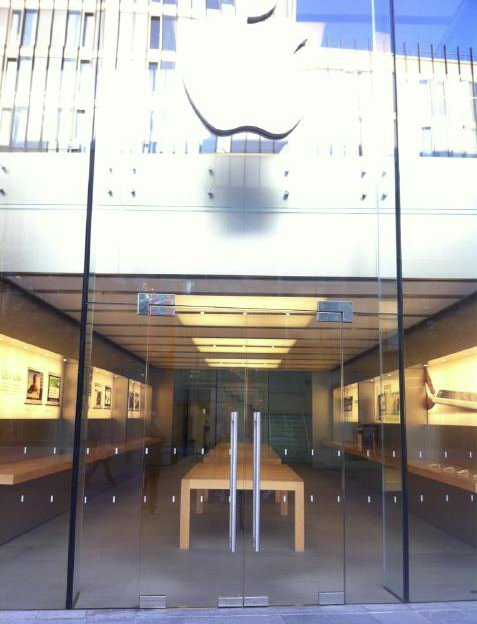
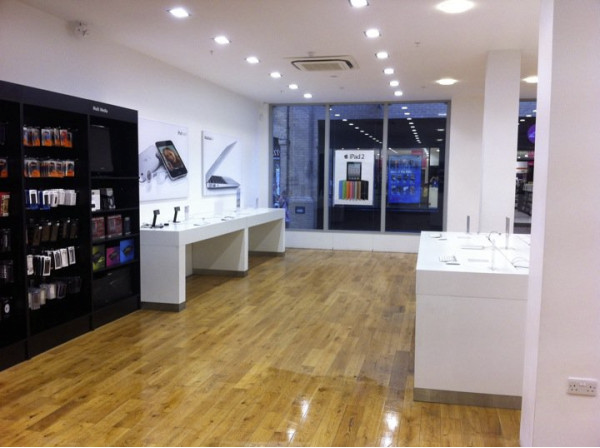
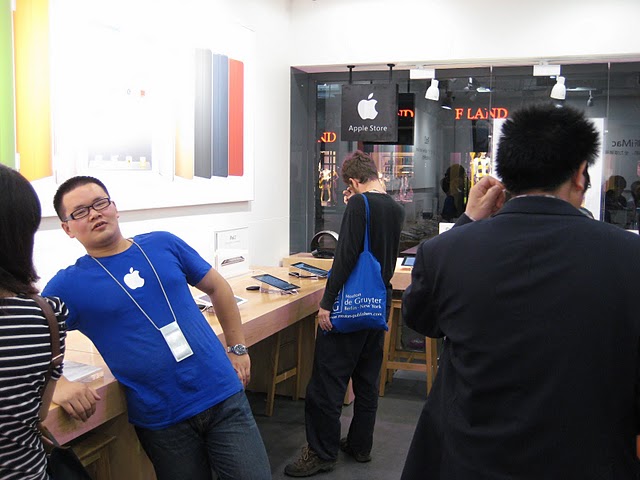
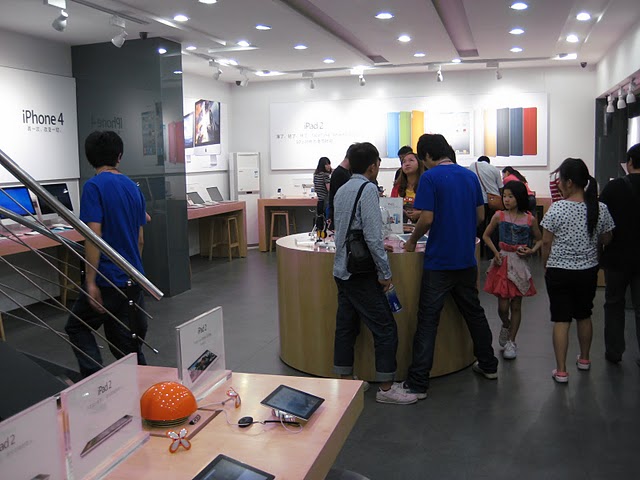
China might be known as the home of the fake iPhone, but what about whole stores? Surprising almost no one, China is indeed home to the fake Apple Store. These pictures from BirdAbroad (via IFOAppleStore), show a fake Apple Store complete with everything that a real Apple Store offers. Right down to the blue shirts with Apple logos and name labels for the employees. Starting from the top, this ‘Apple Store’ features a shiny exterior with a big glowing, white Apple front and center.

When you walk into the store, you will be stepping on wood or grey stone floors, depending on the section of the store, and will be surrounded by a showroom filled with iPads, Macs, and more… all on wooden tables. These tables are even equipped with the Apple (patented!) product holders. In fact, these tables are nearly identical, if not identical, to the tables used in Apple’s official stores. These stores went as far as to completely rip off Apple’s official press images – as you can see with the iPad 2 and iPod shuffle banners. Also notice the extremely outdated pink iPod posters.

Making this sound even more unbelievable are the twisted stair cases, accessory and software walls (which are nearly identical to the official ones), an area for children with cushy and fun chairs, and of course what appears to be a mini Genius Bar or a section of the store to take product lessons from employees. The most amazing part is what these employees think of their jobs:

Being the curious types that we are, we struck up some conversation with these salespeople who, hand to God, all genuinely think they work for Apple.

The “bosses” of this fake Apple Store, in Kunming, knowing that they are up to no good, informed their multiple plain clothed security guards to ban all picture taking. The best part is that there are three of these stores all within walking distance of each other. Check out some more pictures after the break that are courtesy of BirdAbroad.


Expand
Expanding
Close

WSJ: China Mobile “getting closer” to deal that will make iPhone available to 600 million subscribers

Site default logo image

[vodpod id=Video.13339040&w=650&h=400&fv=videoGUID%3D%7B2606B2B4-E5C1-41E6-A7FF-191E5D010FA3%7D%26amp%3Bplayerid%3D1000%26amp%3BplyMediaEnabled%3D1%26amp%3BconfigURL%3Dhttp%3A%2F%2Fwsj.vo.llnwd.net%2Fo28%2Fplayers%2F%26amp%3BautoStart%3Dfalse]

Without revealing too many new details, The Wall Street Journal reports that Apple and China Mobile are “getting closer” to the seemingly elusive China Mobile iPhone deal. China Mobile is the mainland’s largest carrier with over 600 million subscribers (that’s about the equiv. of the US+European populations). The report also confirms that it was, in fact, Tim Cook who was spotted at China Mobile‘s headquarters in mid-June.

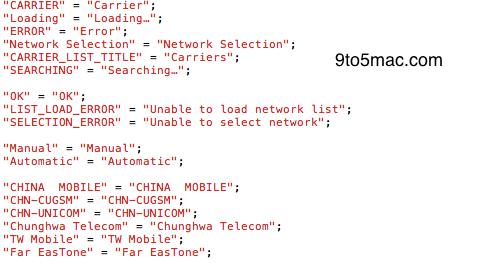
China Mobile references in the iOS SDK – Thanks, Sonny Dickson!

The WSJ also discusses the price of the current iPhone models in context with the average salaries for China households:

The iPhone, which currently sells for between 3,999 and 5,999 yuan without contract, would be a luxury for many Chinese consumers. The average household income in the first half of 2011 was 12,076 yuan, according to China’s national statistics bureau.

With this fact in mind, it makes sense for Apple to build and sell a more economical iPhone. The report is not specific about when this China Mobile iPhone will launch and China Mobile has already confirmed that talks with Apple over carrying the iPhone are ongoing. Be sure to check out the WSJ’s explanation of the “exclusive” in the video above.


Expand
Expanding
Close