Before you can properly understand Apple News, it’s important to know its history. Apple was founded by Steve Jobs and Steve Wozniak in 1976. In 1977, Apple’s sales were growing with the success of its early computers. Within a few years, Jobs and Wozniak hired designers and a production line crew. Apple went public in 1980 and was an instant success. Over the next few years, Apple shipped new computers featuring new graphical user interfaces, such as the original Macintosh in 1984. As the market for personal computers expanded through the 1990s, Apple lost market share to the cheaper Microsoft Windows on PC clones. Eventually, Wozniak and Jobs both left Apple. Jobs would go on to found NeXT and would return to Apple when NeXT was acquired in the late 90s. Apple then began a journey to the great second act in the history of the business world.
Since the release of the iPod in 2001, Apple has become a major player once again in the technology industry. After releasing the iPhone in 2007, the iPad in 2010, and the Apple Watch in 2015, Apple is now one of the largest companies in the world. Apple’s worldwide annual revenue totaled $274.5 billion for its 2020 fiscal year.
Today, Apple operates retail stores all across the world, has a growing services division, and an ever-expanding hardware lineup. The technology industry follows Apple news to see where the company is headed in the future.
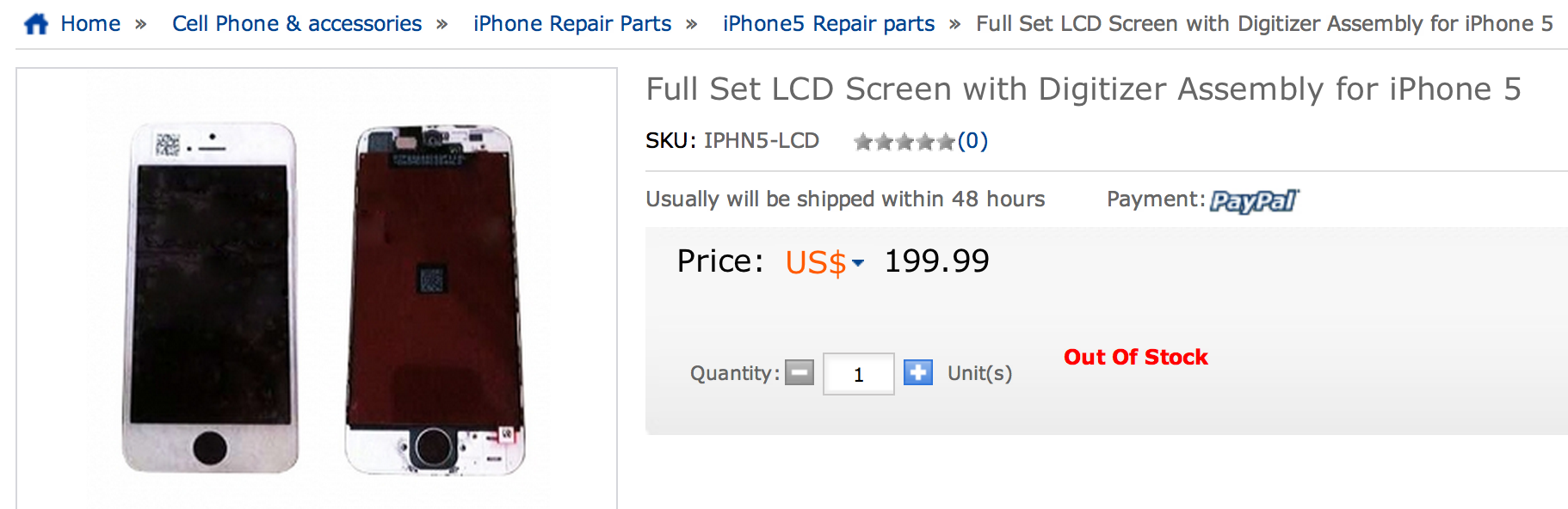
I think it is safe to say we are seeing an unprecedented number of upcoming iPhone parts from the supply chain this time around and one of the few remaining parts yet pictured not only started showing up over the weekend…it is also on sale. For $199, you can pick up (update: out of stock) the “iPhone 5” LCD Screen complete with digitizer assembly. The part looks to be a taller 1,136-by-640-pixel display but obviously, “buyers beware.”
UbreakIfix relayed by MacRumors posted the first images of the new iPhone display over the weekend. Perhaps it purchased the display from ChinaGadgetLand—the parts look very similar.
We are all familiar with various retailers offering discounted iTunes cards by now. We told you just yesterday that Walmart is offering downloadable $100 iTunes/App Store gift cards for just $80. The redeem code associated with these cards is usually good for the purchase of all content from the stores including songs, movies, TV shows, apps, games, books, etc. However, according to a report from German website ifun.de, Apple is no longer allowing discounted iTunes cards to be used toward the purchase of books in the country due to pressure from a German bookseller association:
Apple says, discounted iTunes gift cards are not valid for ebooks anymore in Germany…Background is a law, that forces retailers to offer books at same price in Germany. This is to protect small book shops. Booksellers association sent Apple a c&d letter last week, to end selling ebooks for discounted iTunes credit… Announcing an actual gift card discount, German supermarket REWE notices, that discounted iTunes cards can’t be used to buy books at the iTunes Store.
Apple has bigger things to worry about at home with a trial in the U.S. Department of Justice’s ongoing eBook antitrust suit currently scheduled for June 2013. Most recently, Apple claimed previous settlements with three book publishers involved in the case were unlawful and requested the settlements be rejected or delayed until after trial. It is possible Apple’s decision to stop allowing discounted iTunes cards to be used for book purchases will eventually extend to other markets.
For a limited time, Walmart.com is offering a $100 downloadable Apple iTunes/App Store gift card for just $80. These popular gift cards can be used on iBooks, iTunes Movies, Videos, music, Mac and iOS Apps. We’ve heard these do work internationally if paid for with a US source and used in the US iTunes/App Stores.
You are basically getting 20% off every Apple media purchase you make. Also makes a great gift…we imagine.
John Bergmayer, Senior Staff Attorney at advocacy group Public Knowledge has this to say:
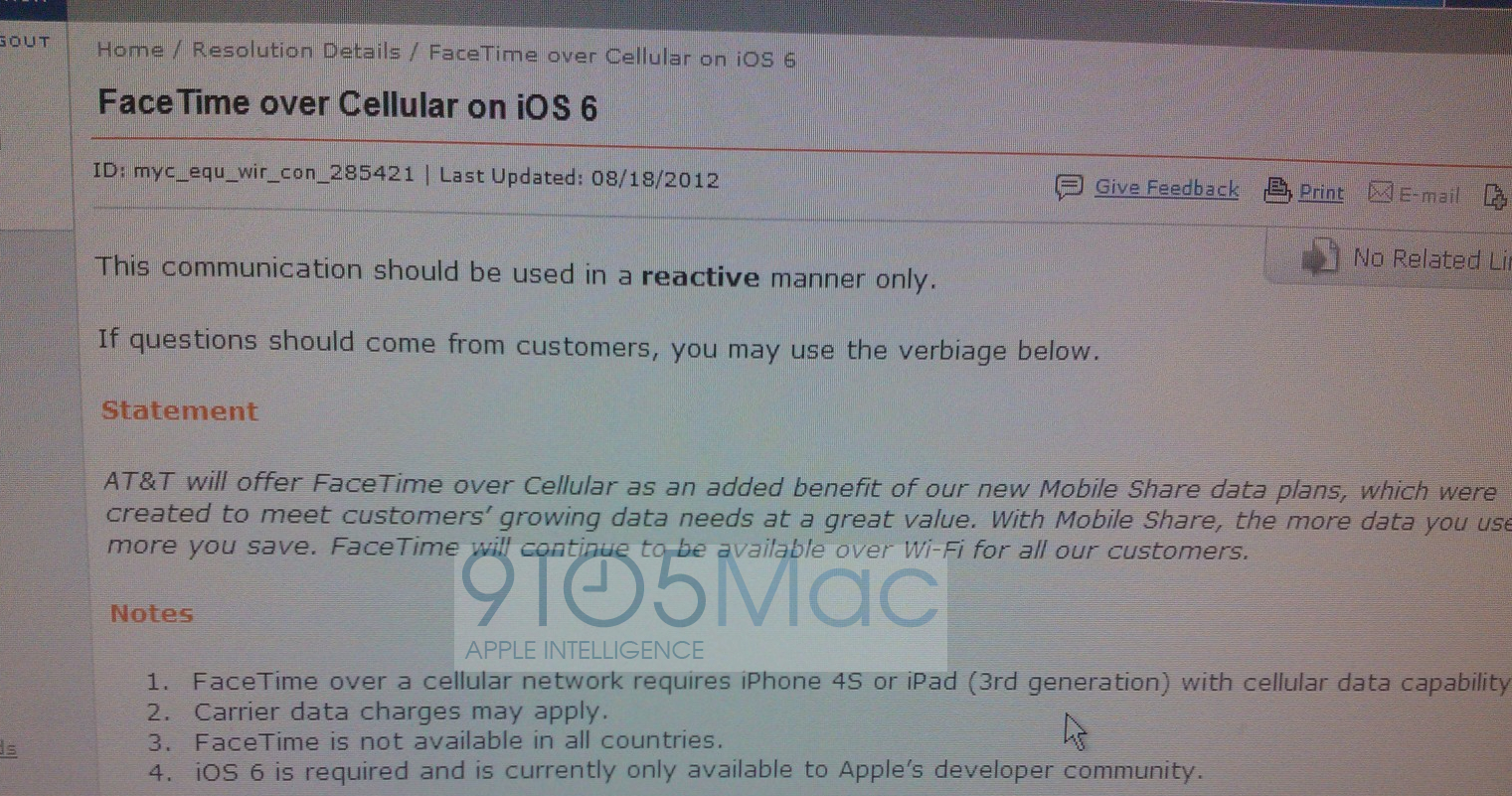
“By blocking FaceTime for many of its customers, AT&T is violating the FCC’s Open Internet rules. These rules state that mobile providers shall not ‘block applications that compete with the provider’s voice or video telephony services.’ Although carriers are permitted to engage in ‘reasonable network management,’ there is no technical reason why one data plan should be able to access FaceTime, and another not.
“‘Over-the-top’ communications services like FaceTime are a threat to carriers’ revenue, but they should respond by competing with these services and not by engaging in discriminatory behavior.”
Sure, FaceTime over cellular is a “new feature” of iOS 6, but so is Apple’s new Maps Turn-by-turn navigation. So is the PassBook Application and Photo Streams. They all will use more data. What is stopping AT&T from blocking those too?
What justification can AT&T give for such a move when it allows competing video chat apps to be available over its network? The most popular video chatting app, Microsoft’s Skype, has been available on the iPhone over 3G since AT&T allowed it –with some significant coaxing – from the FCC in 2009.
But with the FCC not only investigating AT&T and Apple’s Google Voice ban — but wireless industry competition overall — AT&T has miraculously had a change of heart and will now allow iPhone Skype traffic over 3G:
Previously, VoIP applications on iPhone were enabled for Wi-Fi connectivity…AT&T this afternoon informed Apple Inc. and the FCC of its decision. In late summer, AT&T said it was taking a fresh look at VoIP capabilities on iPhone for use on AT&T’s 3G network, consistent with its regular review of device features and capabilities to ensure attractive options for consumers.
AT&T can’t claim network usage penalties for a couple of reasons:
1. As mentioned above, Skype and other Video chatting applications aren’t blocked by AT&T and they use just as much data.
2. AT&T has moved just about all of its customers over to tiered data plans and even those who are left on “Unlimited Plans” are still subject to throttling that would eliminate the ability to use video chatting applications. Users are paying for data that they use.
3. FaceTime over Wifi uses about 3 Megabytes per minute of talk. For someone to use up a 3GB monthly allotment of data, they would need to FaceTime video chat for almost 17 hours (and the data usage over 3G would likely be less taxing). Netflix, Hulu, Crackle, Amazon Video all use roughly this amount of data without regulation from AT&T.
As for the competition, Sprint already announced that it will not hinder FaceTime over cellular, and Verizon is being forced not to mess with it because of a Net Neutrality agreement.
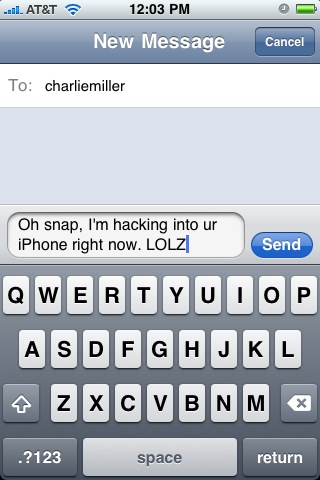
Apple takes security very seriously. When using iMessage instead of SMS, addresses are verified which protects against these kinds of spoofing attacks. One of the limitations of SMS is that it allows messages to be sent with spoofed addresses to any phone, so we urge customers to be extremely careful if they’re directed to an unknown website or address over SMS.
Interesting statement from Apple that seems to throw the blame for the SMS vulnerability over to the SMS protocol. That actually might be the case, but Pod2G’s assessment is that Apple could fix it in an upcoming release.
It must be a cold day in Hell. Apple is consorting with Google, Samsung, LG Electronics, and various ventures and firms to bid as a group on Kodak’s intellectual property.
Kodak filed for bankruptcy protection in January, according to The Wall Street Journal, and it is looking to auction its patents to raise money for surviving a Chapter 11 court protection. Kodak could barter all 1,100 digital photography-based patents or end the auction without a deal, as the company announced it would name the winning bidders on Monday but eventually pushed the deadline upon talking with creditors.
Negotiations and the bidding group’s composition are fluid, the people said. If the consortium reaches a deal to buy some or all of Kodak’s patents, they would essentially be kept out of any one company’s hands and could prevent consortium members from using them in litigation against each other. A deal, however, could also attract attention from federal antitrust regulators.
A deal for the entire portfolio—one of many options under discussion— could fetch more than $500 million based on recent negotiations, people familiar with the process said. That is well above opening bids when the auction started last week, but far below the $2.2 billion to $2.6 billion Kodak at one point said the patents could be worth.
In a statement Thursday, Kodak said discussions with buyers are active and that it isn’t ready to announce a result. The company added that it might decline to sell some or all of the patents, depending on how the auction progresses.
Photography and cameras are obviously a main feature of mobile devices. Competitors in the tech arena have joined forces in the past to snatch up attractive patents, but The Wall Street Journal noted it is “unusual for them all to join the same camp.”
Patent law whiz Michael Carrier, of Rutgers University in Camden, said the companies would not suffer antitrust issues if the tech giants commit to licensing on reasonable rates. Otherwise, an action such as dividing the patents without sharing the rights to use them could likely meet legal trouble down the road.
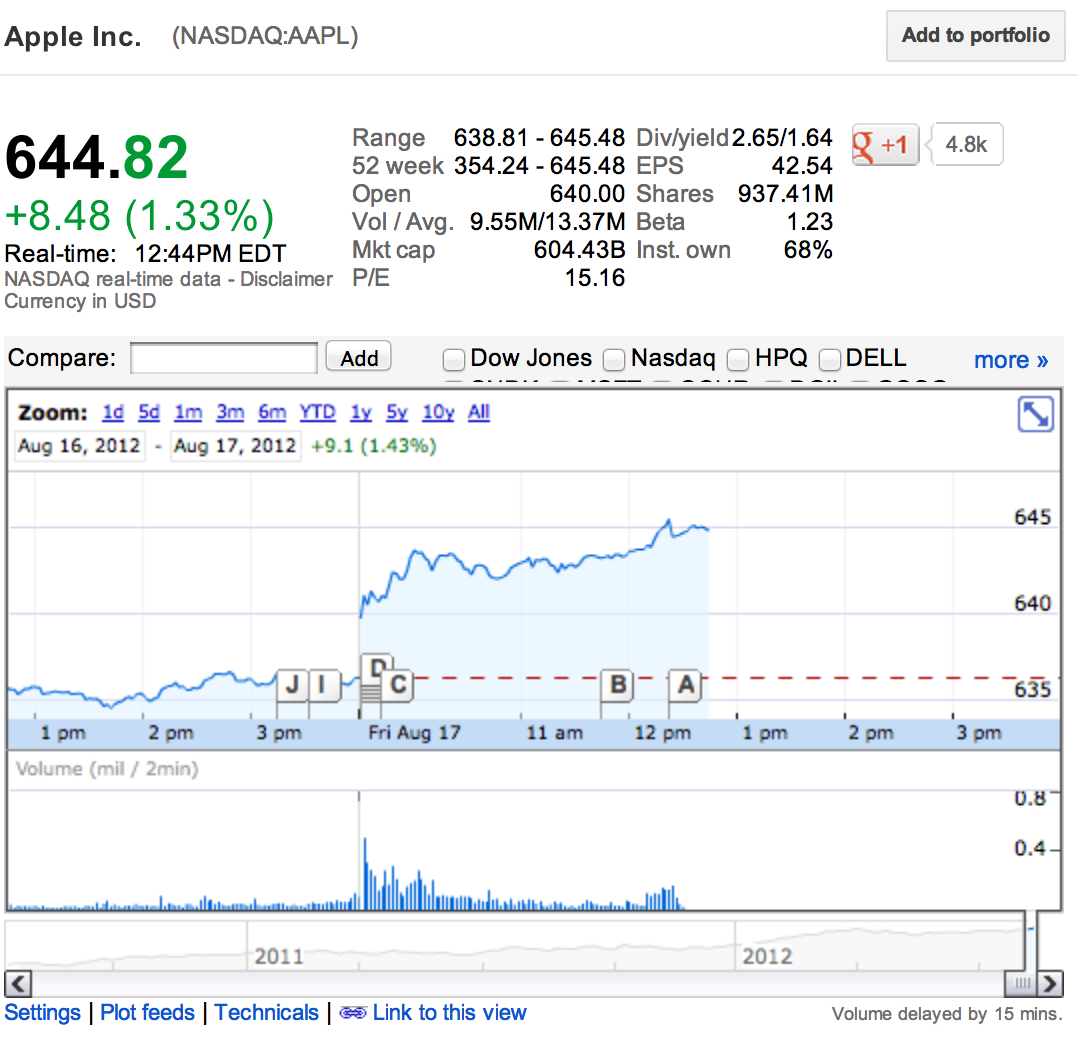
Apple passed its all-time high of 644 and its market cap is once again over $600 billion. Apple last hit both milestones on April 10. The news follows yesterday’s first dividend disbursement in 17 years that paid $2.65 per share of the company’s common stock. The stock price closed over 648.
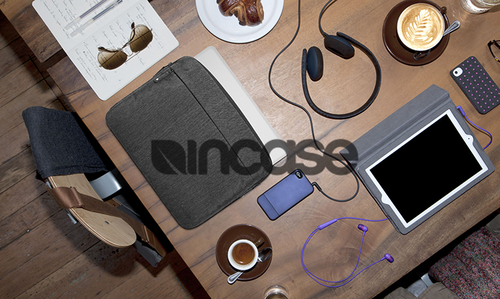
StackSocial today offers $50 worth of InCase credit for $25 with free shipping on orders. The credit expires December 20 (deal ends August 18) so you can use the credit to buy products for upcoming iOS devices and/or gifts for the holidays.
Have you been searching for unique iPhone & iPad accessories that will get people looking?
Who are we kidding, you can never have enough Apple accessories that’s why we’ve worked day and night to bring you $50 worth of Incase accessories for ONLY $25! That includes shipping to contiguous USA customers only.
Who is Incase?
Incase creates products to protect and enhance the technology that is essential to our lives. Their designs meet the needs of individuals across all interests, professions, and passions – so there is a product for you.
As you browse around Incase’s online shop you’ll notice their products promote design simplicity and offer intuitive functionality keeping you connected and protected anywhere you go.
You can spend your $50 on InCase products which include:
As noted by Twitter user @shahruz_, Apple does not seem to want to show any other Podcast apps besides its own when you search for “Podcasts”. Twelve hours after it was first reported, iTunes still appears to only show Apple’s Podcast app.
We are fairly certain that Apple is not doing this on purpose, but it does not seem to be jumping to fix the error either.
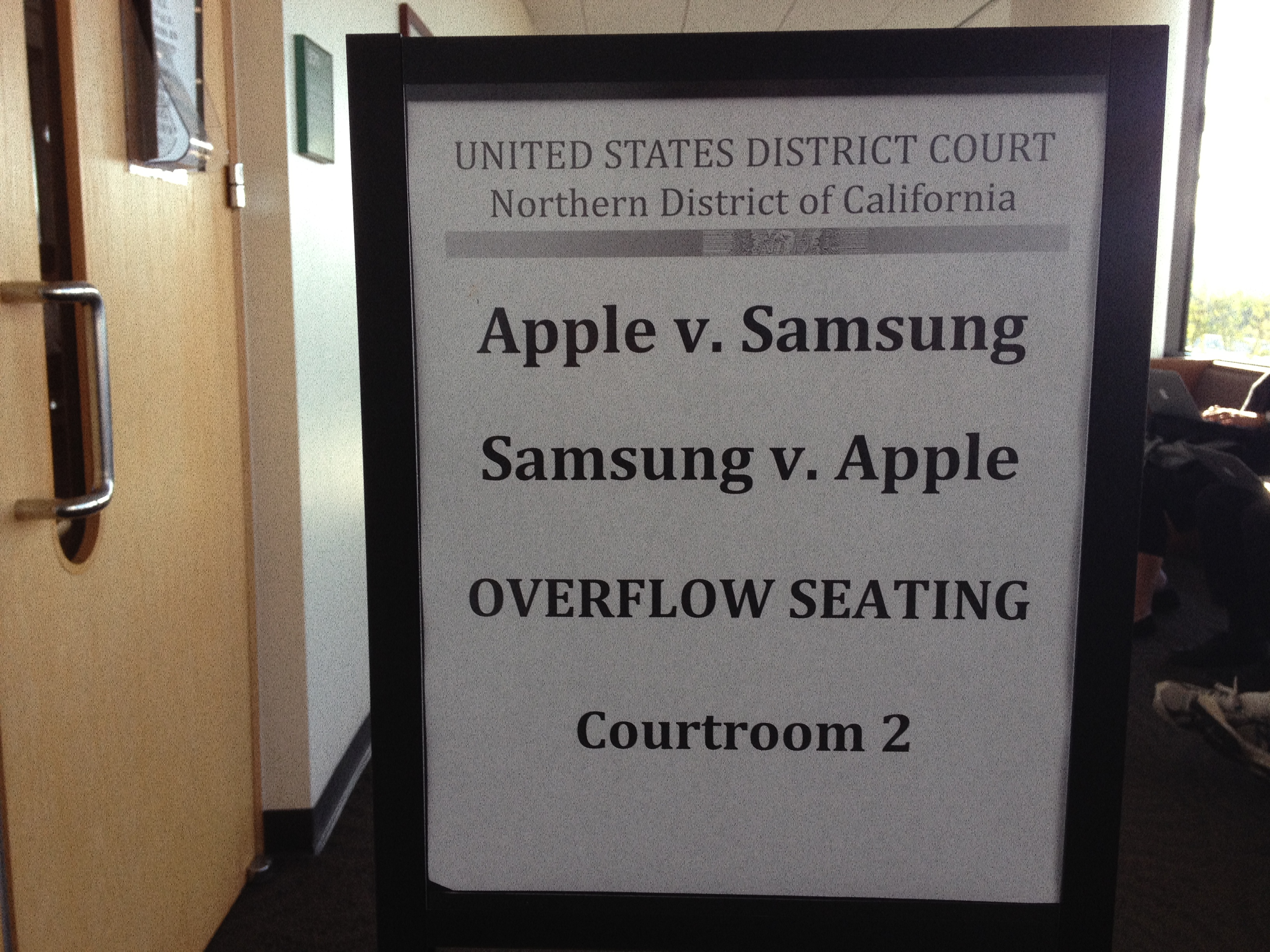
The U.S. Department of Justice announced a settlement in April with three of the publishers involved in the eBook price-fixing antitrust suit against Apple. Hachette, HarperCollins, and Simon & Schuster were part of the settlement, which would allow Amazon to return to its previous wholesale model and the publishers to set and reduce prices for eBook titles freely. PaidContent provided an update today on the case by reporting Apple has filed a document with the Southern District of New York. It called the proposed settlements with the three publishers “fundamentally unfair, unlawful, and unprecedented.” Apple argued that since it is not settling, the settlement would unlawfully end contracts those publishers have with Apple.
The proposed settlement would require the three settling publishers — HarperCollins, Hachette and Simon & Schuster — to terminate their existing agency pricing contracts with Apple. Apple says that isn’t fair: “The Government is seeking to impose a remedy on Apple before there has been any finding of an antitrust violation.” This case, the company states, revolves around “an alleged conspiracy to force Amazon to adopt agency.” So a settlement “enjoining collusion or precluding publishers from forcing agency on Amazon would be appropriate,” but Apple is entitled to defend its contracts in court.
Apple is hoping the courts decide to reject the settlements or delay a ruling until after the June 2013 trial. Apple also discussed Amazon’ role in the case. It claimed the government has “unwittingly placed a thumb on the scales in favor of Amazon”: Expand Expanding Close
When Microsoft updated Office 2011 for Mac for Mountain Lion late last month, Retina display users quickly noticed Outlook was the only app to receive updated Retina graphics. One user described the remaining Office apps as “very blurry and tough on the eyes” on the new Retina MacBook Pro. Unfortunately, it does not look like Microsoft plans a fix anytime soon. A response from the Office for Mac Team explained Word, Excel, and PowerPoint would continue to run in the same resolution as on non-Retina Macs:
Outlook for Mac 2011 already supports Retina Display and the remaining apps will have the same viewing quality as on any non-Retina device. Unfortunately at this time, we cannot comment on any future updates regarding supporting Retina on Word, Excel or PowerPoint… Hope that helps!
While most are expecting Apple to include the rumored LTE connectivity in the upcoming next-gen iPhone, we get word from Korea Times today that Korean carriers SK Telecom and KT have revealed they are currently in talks with Apple to carry a new iPhone on their LTE networks:
SK Telecom and KT are in talks to offer long-term evolution (LTE) connectivity on Apple’s next handset, tentatively named the iPhone 5, officials from the companies said Wednesday…The two local telecom companies are authorized Korean partners to sell the American firm’s i-branded devices here. The smallest carrier LG Uplus is unable to sell Apple’s products as it doesn’t own a suitable frequency.
According to an official at KT, which is home to roughly 1.4 million users compared to SK Telecom’s 4 million LTE subscribers, the carrier is in talks “with Apple to persuade the latter to support KT’s 1.8-gigahertz frequency in Korea for the upcoming iPhone.” Although it’s unclear exactly what type of negotiations might be taking place, we know the current third-gen LTE iPad supports only AT&T, Verizon, and a few Canadian carriers on 700 MHz and 2100 MHz frequency bands. If the talks are indeed to discuss launching an LTE iPhone with support for the 800 MHz and 1800 MHz bands, it’s importnat to note that many other markets also operate over those bands including Australia and parts of Europe. Expand Expanding Close
Wearing work gloves, McFarlin set down lawn furniture cushions outside the perimeter of the home in order to safely toss his take including: two iMacs, three iPads, one Apple TV, a Sodastream soda maker and various Tiffany jewels before fleeing away in his car.
The jewelry McFarlin lifted was the bulk of the heist’s value, totaling nearly all of the $60,000 in value. Jobs’ wallet, including credit cards and $1 (his famous yearly salary), was also part of the heist. Laurene Powell Jobs was staying nearby while the renovations were being done.
The suspect, McFarlin, did not seem to realize he was in Jobs’ home. McFarlin said he was in dire straits with money and “he was desperate.”
McFarlin told cops that he had been living in his car and had chanced upon the abandoned Jobs home while sleeping on the street there. He decided it would be the target of his first burglary. Before the heat was on, the novice McFarlin quickly Googled how to fence the jewelry.
He was caught when trying to plug in the Apple equipment and the devices “called home” for software updates. Expand Expanding Close
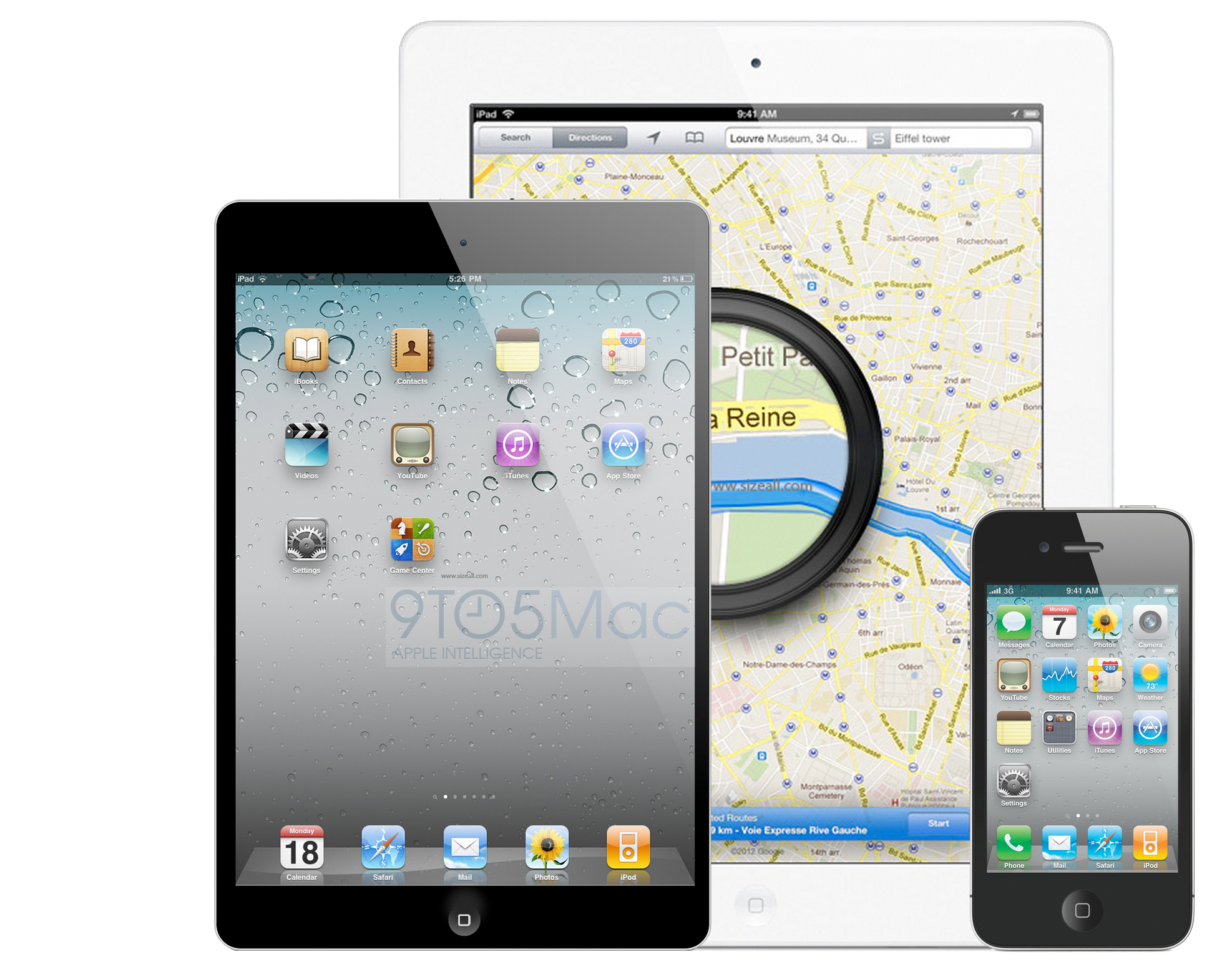
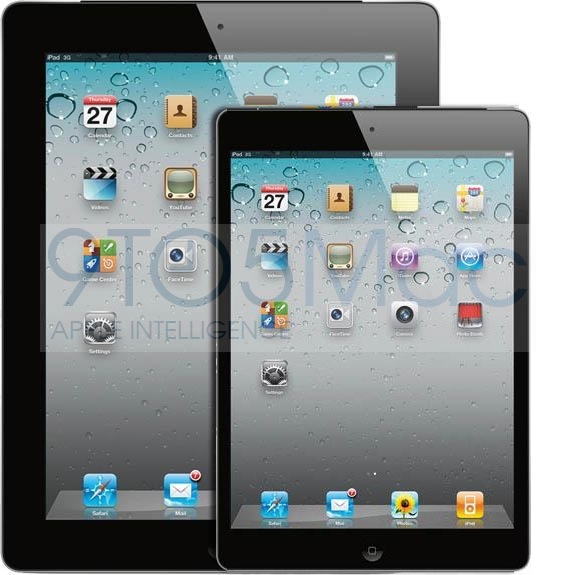
We received a number of tips over the last few weeks from sources that we have reason to believe hold knowledge about Apple’s plans on the upcoming iPad mini. A recurring theme of late is that the iPad mini will “look like a big iPod touch” with smaller bezels along the sides in portrait mode and separate volume buttons and not a “rocker” and a mic on the back.
We were not confident enough to post the above information alone (but did make the atop mockup), but the very reliable John Gruber chimes in today with many of the same bits of information.
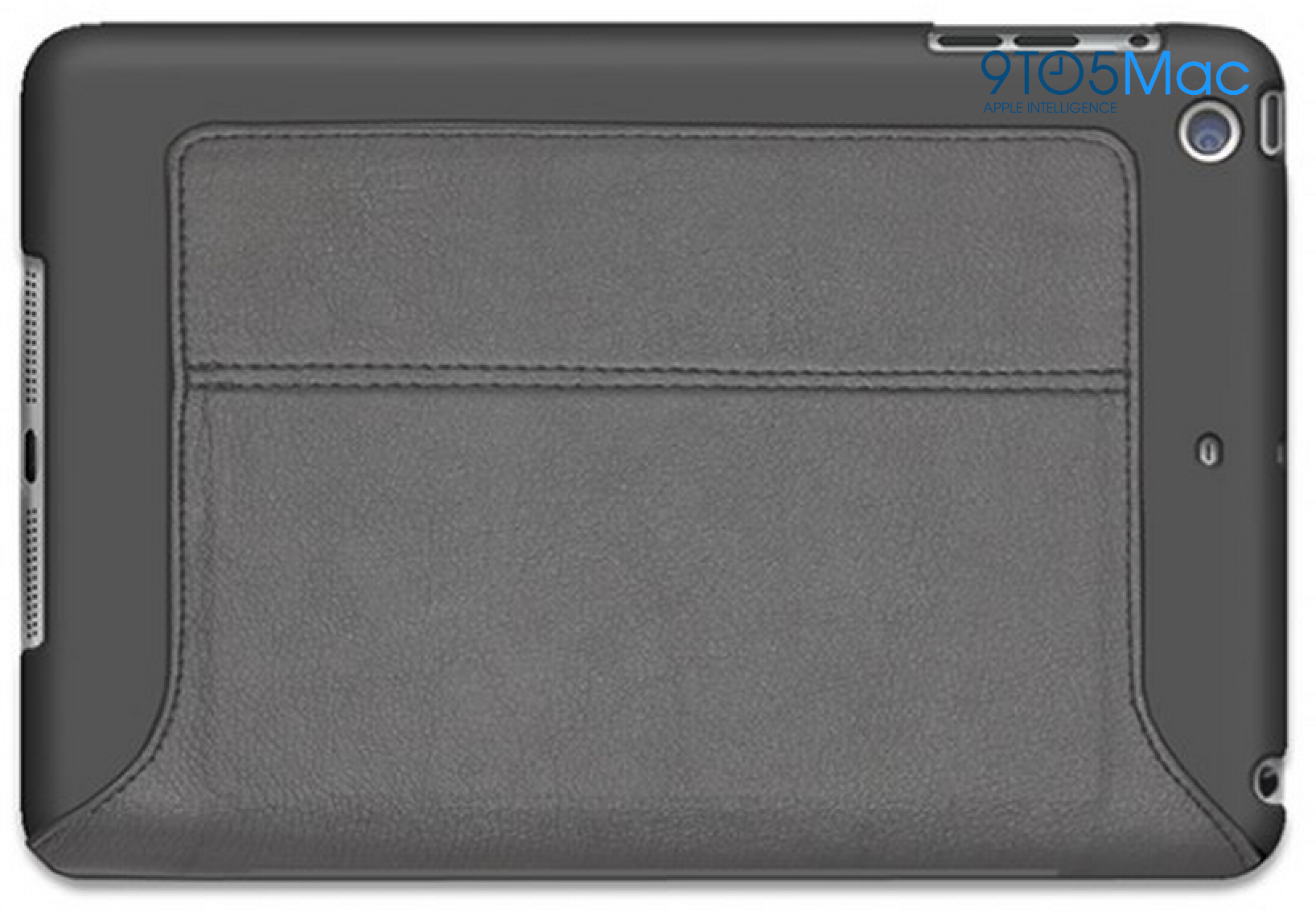
Here is a gallery of all the iPad mini images and mockups we have obtained to date: Expand Expanding Close
The majority of American teens prefer YouTube to iTunes, radio, online radio, and CDs when it comes to finding and listening to music.
Approximately two-thirds of 18-and-younger U.S. teenagers, according to a “Music 360” survey from research firm Nielsen (via The Wall Street Journal), claimed they sidestepped other music-listening mediums for Google’s video-sharing platform.
YouTube snagged 64 percent of 13-to-17 year olds, while radio came in second at 56 percent. iTunes held 54 percent, with CDs and Pandora rounding the top five at 50- and- 35 percent respectively.
The Wall Street Journal noted young folks regard YouTube as a “de facto free music service,” but adults do not take full advantage of the site’s complimentary content.
Go to 9to5Google for more information on adults’ favorite mediums.
The Loop pointed us to this iOS support matrix (Autumn 2012 edition) posted by app developer Empirical Magic. Definitely a useful resource for developers, the chart shows the number of devices running certain versions of iOS, and makes recommendations for dropping support in future updates.
Amazon offers the Logitech Wireless Solar Keyboard K760 for Mac/iPad/iPhone (920-003884) for just $59.99 with free shipping (Amazon Store link). That’s the first time we’ve seen this keyboard marked down from its $80 retail price. The Logitech Wireless Solar Keyboard K760 keyboard charges by sunlight/lamplight and can run for 3 months in total darkness. Users can also immediately switch between iPhone, iPad and Mac (or any 3 devices) with dedicated function keys.
According to a report from MercuryNews, suspects are now in custody for the recent burglary of the Silicon Valley home of Steve Jobs that contained more than $60,000 worth of computers and personal items:
The deceased Apple co-founder’s home on the 2100 block of Waverley Street in Palo Alto was burglarized July 17, said Santa Clara County Deputy District Attorney Tom Flattery, a member of the high-technology crimes unit…More than $60,000 worth of “computers and personal items” were allegedly stolen, but Flattery declined to say whether they belonged to Jobs, who died last year at the age of 56, or another family member.
Weeks after the burglary on July 17, police arrested Kariem McFarlin, 35, who is currently in jail on $500,000 bail, but other specific details regarding the crime are not available. We know that Laurene Powell Jobs and family were likely not living in the home at the time of the robbery, as during July the property was undergoing renovations with construction barricades and scaffolding surrounding the house. Forbes snapped photos of the property under construction (below) on July 4:
Much like in the weeks leading up to the iPhone 4S launch in early October 2011, European carriers are preparing for the expected Sept. 12 introduction of the new iPhone with pre-order tickets now available through various carriers. As noted by reports from German website iPhone-ticker.de, Deutsche Telekom will offer pre-order tickets to interested customers through its distribution partners starting today. The tickets will offer a first-come, first-serve basis for the new iPhone with express delivery of the device to ticket holders on the first available day. Carriers are clearly preparing for the launch of Apple’s next-gen iPhone. Not that we need additional verification, as the most recent reports once again confirm a Sept. 12 unveiling and add the device could actually be available for pre-order on the same day. Last year, Vodafone and other carriers quickly followed Deutsche Telekom by offering iPhone pre-order tickets.
According to a new report from Rene Ritchie of iMore, who has been correct in the past, Apple is set to begin pre-orders of the next-generation iPhone on Sept. 12, which is the same day the device is expected to be announced. The device is then expected to be released Sept. 21, as several publications reported (and subsequently confirmed each other) a few weeks ago. At the same event, Apple is expected to introduce its new 7.85-inch iPad Mini. It is believed to compete directly with Google’s Nexus 7 and Amazon’s Kindle Fire. iMore further added in its report this morning that the international launch of the next iPhone will take place in early October, with Oct. 5 being the most likely day. Apple has been known to delay the launch of its devices internationally to ramp up sales. For example, the launch of the iPhone 4S internationally was two weeks after the U.S. launch. Read on for more details: Expand Expanding Close
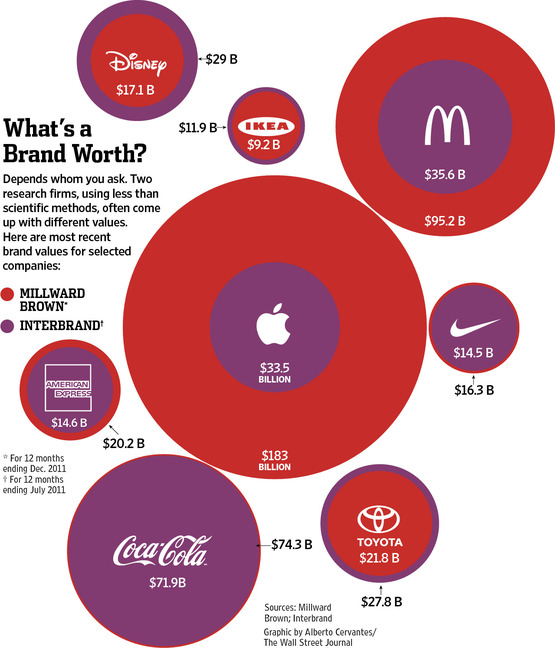
The Wall Street Journal today shows that the value of Apple’s brand varies greatly depending on who is taking the survey. Apple’s brand may be worth as much as $183 billion, according to an earlier Millward Brown study. The study’s results greatly vary from a separate Interbrand study, which valued the company at less than a fifth of that value and half of the value of Microsoft’s brand.
The most valuable brand in the world, according to WPP PLC’s Millward Brown, is Apple Inc., worth $183 billion—nearly a third of the company’s market capitalization of $581 billion.
Omnicom Group Inc.’s Interbrand, however, judges Apple’s brand as worth only $33.5 billion, or eighth, behind such names as MicrosoftCorp. (ranked third at $59 billion), International Business MachinesCorp. and Coca-Cola Co. (first at $71.9 billion). Interbrand notes its estimate of Apple’s brand value has risen.
Why such a big difference?
“The value of brand is both art and science,” says Allen Adamson, a managing director of Landor Associates, a branding firm owned by WPP. “It’s simple in theory but hard to pin down in reality. It’s really about how much would a consumer pay for a caramel colored soda versus how much they would pay for a Coke.”
If you think about PCs, how much would someone pay for a similarly spec’d Microsoft PC Ultrabook vs. a MacBook Air? Usually much less. The same goes for tablets—even though Apple’s prices and margins are smaller than phones or PCs. Apple’s reputation is what allows it to grab such huge margins in its hardware.
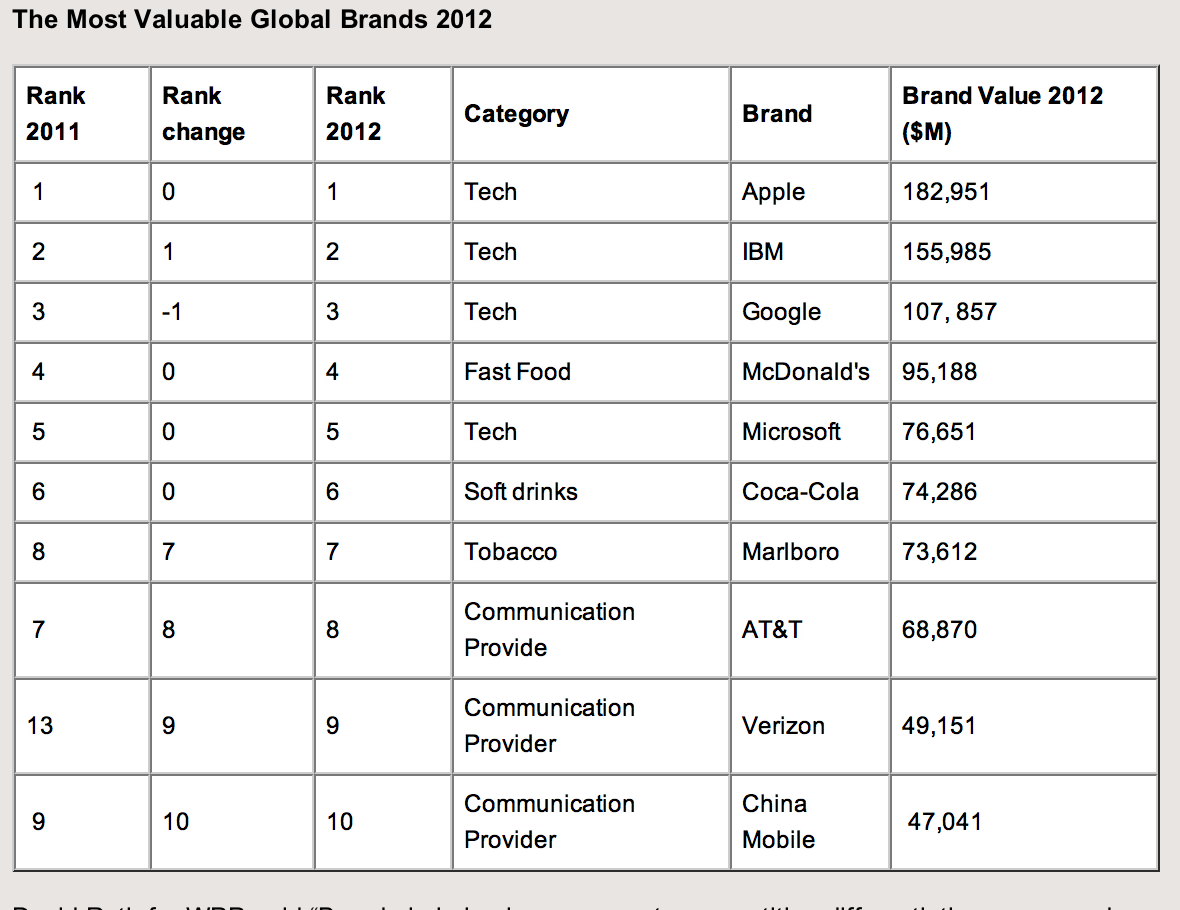
Yet, Interbrand ranks Microsoft at double of Apple’s brand. I would re-run the numbers if I were Interbrand. Millward Brown’s numbers are below:
Update: The original source, Nowherelse, posted an update with new information regarding the leaked dock connector images claiming the connector has 16 pins, eight on each side, with eight likely being reserved for future uses:
We have obtained new information about this connector. We have indeed learned that it is not equipped with 8 to 16 pins but distinct functions or 8 on each side thereof to note that one of them would have no basis of record and would be for possible future use.
There has been a ton of alleged next-gen iPhone leaks in recent weeks including images of the device’s thinner, higher capacity 1440 mAh battery, SIM card tray, and other internal components. Today, we get a look at parts related to the smaller, redesigned dock connector, as well as what French site Nowherelse.fr claimed could possibly be the first images of the connector itself. In our own image above, we see an insert component for the new iPhone on the right showing the outline of the new iPhone’s dock connector. The unconfirmed images from Nowherelse below show what appears to be an 8-pin dock connector next to the USB end for context. We recently discovered possible references to a 9-pin dock connector in iOS 6, while previous reports claimed a 19-pin or 8-pin design was in the works. While our leak of the next-gen iPhone backs in May gave us a good look at the port for the redesigned dock connector, the pin layout for the connector itself is still unconfirmed.
Update: iFixit told MacRumors that the metal frame counts as its own pin even though there are eight gold pins. This adds up to nine pins, as we reported the other day based on iOS 6 source code, and this may mean these above photos are legitimate.
Also: We cannot help but notice that these connectors seem to have similar pins and size to MicroSD cards (image via).
Today, in a post on his Google+ page, Google software engineer and original Macintosh co-creator Andy Hertzfeld pointed us to a rare commercial created for the first Macintosh in the fall of 1983 by ad agency Chiat-Day. Hertzfeld noted Apple ultimately decided not to air the commercial that featured interviews with members of the Macintosh design team, because “Apple deemed it too self-congratulatory.” It did, however, make its way to dealers as a promotional video at the time. Featured in the video are snippets of interviews with Andy Hertzfeld, George Crow, Bill Atkinson, Mike Murray, and Burrell Smith.