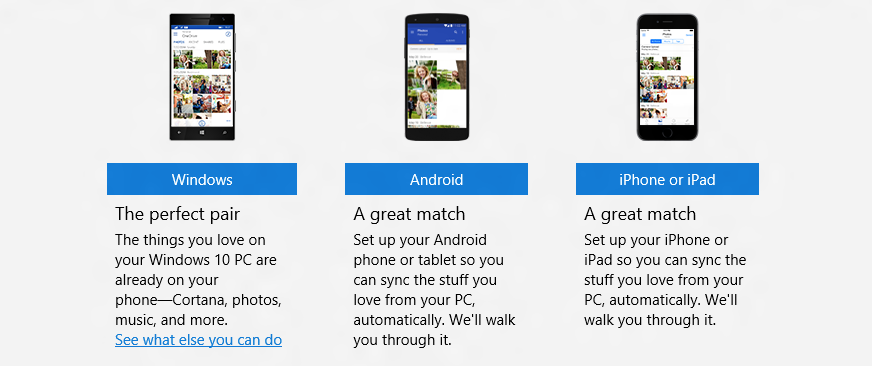
Microsoft is admitting smartphone defeat and is now officially urging any remaining Windows 10 Mobile users to switch to an iOS or Android device instead.
In an End of Support document spotted by Thurrott, Microsoft notifies users that Windows 10 Mobile will cease to receive new security updates after December 10, 2019.
The writing has been on the wall for Windows Phone for a very long time. It had long struggled to achieve more than one or two percentage points of market share; Microsoft wrote-off its Nokia hardware business in 2015; the company exited the consumer market in May; and even Bill Gates recently admitted he’d switched to an Android phone …
Ten months after Microsoft wrote-off its Nokia acquisition, the company has now announced that it is effectively out of the consumer phone business. It is cutting 1,850 jobs, and setting aside almost a billion dollars to cover the costs of exiting the business.
Microsoft on Wednesday announced plans to streamline the company’s smartphone hardware business, which will impact up to 1,850 jobs. As a result, the company will record an impairment and restructuring charge of approximately $950 million […]
“We are focusing our phone efforts where we have differentiation — with enterprises that value security, manageability and our Continuum capability, and consumers who value the same,” said Satya Nadella, chief executive officer of Microsoft.
The company recently saw its market share fall below 1%. While Microsoft is – for now – insistent that it has a future in the corporate smartphone business, the reality seems doubtful …
Microsoft is bringing its predictive Windows Phone keyboard, called Word Flow, to the iPhone. The third-party keyboard is now available for free in the US App Store. The keyboard features traditional keycap input as well as the popular swiping-between-letters gesture input method popularized by Swype.
BlackBerry phones were once the default choice for enterprise, the combination of physical keyboard and secure messaging facility the two key selling-points. Those days are long gone.
The company dismissed the iPhone when it was launched in 2007, claiming that touchscreen phones could never compete with physical keyboards – before doing a U-turn by launching its own touchscreen phone less than a year later. A series of major service outages and a failure to deliver the promised BlackBerry 10 in 2011 sealed the company’s fate as a major player, and it today appears set to completely cede the secure messaging space to Apple.
BlackBerry CEO John Chen effectively admitted in December that the company had a ‘backdoor’ into its supposedly secure messaging system, and the company has now stated that it will this year make only Android phones – a platform not noted for its security credentials. This shortly after Microsoft’s Windows Phone looked even more irrelevant, the company reporting that revenues had halved year-on-year …
It’s not the first time that a ‘Twitter for iPhone’ tag has given away the fact that someone is not using the device you might expect them to. Latest casualty of the telltale tag is Joe Belfiore, the Microsoft VP who fronts the Windows Phone project.
When The Verge ran a piece on it, Business Insider noticed that Belfiore used the comments section to share the reasons he is using an iPhone whilst on a 9-month sabbatical.
It’s very important for me to understand products like the iPhone and Android phones, which […] represent the competition for Windows Phone […] On a 9-month leave-of-absence, I have a HUGE AND UNUSUAL opportunity to get to know these products deeply. To understand the benefits and drawbacks of a full ecosystem like Windows, Android, iOS — you have to LIVE IN IT. You have to feel its strengths and weaknesses, be let down, be delighted. And you can’t do that just “playing around” with a device for a couple of days. You have to learn the UI, upload your photos, use cross-device apps and tools… all of it.
Given all this, he says, “it would be crazy not to” use an iPhone while he’s away.
His arguments of course make sense, and we have no doubt that many Apple execs also spend time playing with competitor devices for the very same reasons. But given the PR considerations, we imagine they take rather more care not to be seen doing so …
Just over a year ago Microsoft shipped a completely redesigned version of Skype for iPhone, iPad, and Android in version 5.0 that looked a lot more like a Windows Phone app than previous versions, adding back old features and introducing new features in updates that followed. Now with version 6.0, Skype is taking strides to move its iOS and Android apps away from the Windows Phone look with redesigned versions for both platforms that should feel a lot more familiar for users. Skype 6 for iOS also introduces an enhanced search feature, brings the iPad version up to parity with the iPhone version, and more. Expand Expanding Close
Windows Phone has not been the greatest success story in the world, and Microsoft’s purchase of Nokia to produce its own handsets looks to have been an even bigger flop. The company today announced that it is writing off $7.6B against the Nokia business – more than it paid for the company in the first place.
Microsoft has also revealed that it will be laying-off 7,800 staff – more than 6% of its workforce – over the next few months, mostly from the Phones business … Expand Expanding Close
Reuters reported back in March that Microsoft planned to bring its Siri competitor Cortana to iOS, and Microsoft has now officially confirmed this in a blog post.
Today, we’re announcing a Cortana application for Android phones and for iPhones which works as a companion to Cortana on your Windows 10 PC. The ‘Phone Companion’ app on the PC will help you install the Cortana app from the Google Play or Apple App Store onto your phone so you’ll be able to take the intelligence of Cortana with you, wherever you go […]
The Cortana companion will be available for Android phones at the end of June and for iPhones later this year.
While Microsoft is pitching the app as a companion to a Windows PC, it appears that most of the functionality will work in the iPhone app without the need for a Windows device, Microsoft saying that you can “make the same queries, ask the same questions” in the standalone app … Expand Expanding Close
Microsoft is bringing its OneNote scanner app calledOffice Lens to the iPhone after first launching on Windows Phone a year ago. Office Lens is similar to other on-the-go scanner apps letting you use your iPhone camera to capture information from receipts, documents, and other information around you. Office Lens is different, however, because it’s connected directly with OneNote, Microsoft’s cloud-syncing notebook service.
Microsoft is planning on making the next generation of its Siri competitor, Cortana, available on iOS and Android devices sometime after the fall, reports Reuters. The focus, says the company, will be on an intelligent assistant that predicts the help you need, rather than simply responding to user requests.
Cortana could tell a mobile phone user when to leave for the airport, days after it read an email and realized the user was planning a flight. It would automatically check flight status, determine where the phone is located using GPS, and checking traffic conditions.
Google has majored on this kind of proactive approach through its Google Now service, which aims to work out what you will want to know when, and Apple began implementing similar functionality into the Today view in Notification Center in iOS 7, but Microsoft believes that integrating everything into the digital assistant is the future … Expand Expanding Close
While an increasing number of retailers are adopting smartphones and tablets as mobile payment terminals, the deployment process can often prove to be expensive and time consuming as the sizes and form factors of devices continue to change. Leading NFC terminal maker Verifone aims to solve that problem, announcing today a new mPOS terminal that supports all mobile payment platforms and devices.
Verifone’s upcoming PAYware Mobile e355 should be an extremely valuable option for retailers looking to deploy a mobile POS system without being locked into a single ecosystem. PAYware Mobile e355 is designed to work with multiple device sizes and form factors, meaning that retailers won’t have to constantly upgrade their hardware when next-generation iPhones or Android-based smartphones are released. Expand Expanding Close
HP’s annual two-day Mobile Pwn2Own competition came to a close this afternoon, with a group of veteran security researchers and other competitors able to compromise several flagship smartphones across the top-three mobile operating systems: Android, iOS and Windows Phone. The devices that were exploited include the iPhone 5s, Samsung Galaxy S5, Nexus 5, Amazon Fire Phone and Nokia Lumia 1520. Expand Expanding Close
The latest numbers from Strategy Analytics reveal that iOS and Android combined to capture 96% global market share in the third quarter. iOS and Android accounted for 12.3% market share and 83.6% global market share respectively for the three-month period ending September. Those figures arrive just one day after the research firm reported that Chinese company Xiaomi has become the third-largest smartphone maker in the world.
Android continued to be a dominant player in global smartphone operating system market share, increasing its lead over iOS by three percentage points compared to the year-ago quarter. Apple’s mobile operating system held 12.3% market share during the third quarter, trailed by Windows Phone (3.3%) and BlackBerry (0.7%). Other mobile platforms accounted for less than 0.1% market share. Expand Expanding Close
Microsoft has just joined the ranks of companies looking to capitalize on the success of ephemeral messaging apps like Snapchat. Through its Skype division, the company has launched a new cross-platform app for iOS, Android, and (of course) Windows Phone called Skype Qik. The premise of the application, as can be seen in the video above and screenshots below, is simple: you can record a quick video, and then share it to either one person in your address book or multiple groups of people.
Differentiating itself from some of the other players, the Skype-based solution is video-focused, and Skype is positioning it as a communication tool for in between full-scale Skype video chats. Notably, the whole service is connected to your phone number and existing contacts list, so it doesn’t require signing up with a standard Skype account. If you send a message via Qik to a user without the Qik app, the other person will be sent an SMS text message with instructions for downloading the Qik app to view the video message. This app is based on the technology from startup Qik, which Skype acquired a few years ago.
By default, videos will expire after two weeks, and you can also un-send messages at any time. A cool feature of Skype Qik is the ability to pre-record various 5 second GIFs that you can send as instant replies. So, if you don’t have the ability to send a live video reply, you can just choose one of your pre-record defaults. The app is free today on the aforementioned platforms, and Microsoft says that updates, such as one for blocking iPhone contacts (that feature is available today on Android and Windows Phone), will come often to enhance the feature-set.
You can view some screenshots of the iPhone app in action below:
Nokia, like the rest of the smartphone industry, is no stranger to mocking its biggest competitor in ads. Today we get two new spots posted to the company’s YouTube account that highlight the Windows Phone Cortana assistant feature while mocking Apple’s Siri feature in the process.
The first ad called “Lost” highlights Cortana’s ability to automatically remind users when to leave for appointments based of calendar and traffic data. The second spot, titled “Remind Me”, shows Cortana sending reminder notifications associated with texts and calls they are receiving.
We’re 2 short weeks away from Apple’s iPhone 6 announcement and that of course means it is almost time to trade in your current but now outdated tiny iPhone 3/4/5/s/c. Giving your non-sapphire 4-incher to a friend or relative? That’s nice of you but for those in the US who prefer cold hard cash, there are lots of great options out there.
In years past, we’ve put together roundups (2013, 2012) that include 12 different options but things change pretty quickly so we wait right until launch week to update ours. This year, Statistacompared the major US trade in options out there two weeks ahead of time to find the best pricing.
The TL;DR is that Amazon gives you the most credit for an iPhone across all carriers and models and we’ve had good success here using Amazon. Additionally, Amazon credit for most of us is almost as good as cash (compared to say Best Buy where we might not be making another electronics purchase in the near future). That said, Amazon doesn’t offer the iPhone directly as a purchase and many folks will prefer to use the credit to directly buy their next iPhone.
As for cash money options, Glyde and NextWorth seem to be the winners with Gazelle bringing up the rear in most cases (Gazelle is offering a price lock which might be driving down their current offer).
Stay tuned for our launch day guide and see results for all carriers as of yesterday below: Expand Expanding Close
The latest enterprise market share data from Good Technology shows that iOS holds two-thirds of the market, at 67 percent, but has dropped five points to Android – which increased its share to 32 percent. Windows Phone remains flat (and irrelevant) at just 1 percent. (BlackBerry data is not included as the company uses its own servers and activations are invisible to Good Technology.) Expand Expanding Close
Microsoft ads seem to make a habit of bashing Apple, even using Siri’s voice to do so – and without the company concerning itself too much about accuracy. Microsoft has now released the 30-second commercial it first showed at its developer’s conference back in April … Expand Expanding Close
At the time, Ek was reserved in saying too much about the proposition. “I don’t like speculating about things that haven’t happened,” Ek stated. He did, however, say that he always believed Apple would enter the streaming music space and doubled down saying Spotify is focused on “building the best possible product” while noting the service’s 40 million users with 10 million paid customers.
The Spotify CEO was interviewed last week at Fortune’s Brainstorm Tech conference and once again asked about the Apple-Beats deal, this time with the acquisition being official: Expand Expanding Close
A Nielsen study (via TechCrunch) reveals that while we all spend much longer using mobile apps than we did two years ago, and we may have many more apps installed on our phones, the average number of apps we actually interact with in any given month hasn’t changed nearly as much.
While time spent using mobile apps climbed from 18h 18m in 2011 to 30h 15m by the end of last year, the total number of apps actually used only increased from 23.3 to 26.8. So we’re spending more time using pretty much the same number of apps … Expand Expanding Close
A few years ago, Skype was the rockstar of the messaging world, but now with smartphones and mobile messaging apps like WhatsApp, Facebook Messenger, and iMessage, Skype’s iPhone feature-set and application have begun to stagnate. However, the Skype development team has not been standing still. The Microsoft-owned company is revealing today that it is nearing the launch of a completely revamped Skype application for the iPhone and iPod touch. I met with lead Skype designer Guilherme Schneider last week for an exclusive preview and an interview regarding the new software, and the application certainly seems impressive…
At its BUILD conference, Microsoft officially unveiled its personal assistant for Windows Phone named Cortana. The similarities to Siri are rather uncanny (and three years late) but in some areas, Siri could definitely learn from Cortana’s feature set.
Cortana certainly does a good job of cloning Siri’s appearance and functionality. However, it goes further by allowing third-party applications to do tasks and answer questions as well. For instance, you can ask Cortana to add a film to your Hulu watch list with natural language.
Now that we’ve had our first look at at least an early take on iOS 8, what stands out most to me is how little the basic appearance of the iOS homescreen has changed over the years. On the left is iOS 1, on the right the recently-leaked iOS 8 homescreen.
Seven years apart, yet still essentially identical in form: a grid of static icons. Looked at in one way, that’s incredibly impressive: that a user-interface that worked in 2007 still works today. But it does make me wonder at what point the iOS homescreen will move beyond this format? Expand Expanding Close