Google Drive goes live [Video]
After all of this time, Google has now unveiled the Google Drive. Mac Client downloadable here. (Bonus: Gmail bumped to 10GB.)
Reuters reported that a judge rejected Apple and Google’s bid last night to have an antitrust lawsuit dismissed. The lawsuit claimed the companies illegally entered “no-poach” agreements in an effort to stop competitors from stealing talent:
District Judge Lucy Koh in San Jose, California, rejected the companies’ bid to dismiss claims brought under the Sherman Act and California state law, in a decision released Wednesday night. […] The proposed class action lawsuit was brought by five software engineers, who accused the companies of conspiring to depress employee pay by eliminating competition for skilled labor.
Other defendants in the case included Intel, Adobe Systems, Intuit Walt Disney Co’s Pixar, and Lucasfilm.
This Aside is cross-posted at 9to5Google.
(Image via Zoknowsgaming)
A recent interview with Google’s cofounder Sergey Brin received a lot of attention due to his view that Apple and Facebook are the biggest threats to the open Internet. Today, Brin took some time to clarify his thoughts about the coverage of his interview, which he feels has been “particularly distorted.” In a Google+ post, Brin noted he has “always admired Apple’s products,” and he currently uses an iMac (Imac?):
Moreover, I have much admiration for two of the companies we discussed — Apple and Facebook. I have always admired Apple’s products. In fact, I am writing this post on an Imac and using an Apple keyboard I have cherished for the past seven years.
9to5Google has the full story.
In an interview with the Guardian over the weekend, Google cofounder Sergey Brin said:
[…]he was most concerned by the efforts of countries such as China, Saudi Arabia and Iran to censor and restrict use of the internet, but warned that the rise of Facebook and Apple, which have their own proprietary platforms and control access to their users, risked stifling innovation and balkanizing the web.” There’s a lot to be lost,” he said. “For example, all the information in apps – that data is not crawlable by web crawlers. You can’t search it.”
It is interesting that “lost” is defined above as “not crawlable by Google’s search engine.” Framing the argument—as “what is in the best interests of users” versus what Google wants—would probably have helped his case. We are supposed to think that it is just a coincidence the two biggest corporate threats to Google are also the two biggest threats to humanity/the Internet. (via Slashdot)
TL;DR: By popular demand, we are rolling out 9to5Forums.com built on the Vanilla platform. As part of this new structure, we are moving our comments going forward to Vanilla, as well. Single sign up for both is quick and easy (including login with Twitter/Facebook/Open ID, etc.). Oh, and there will be prizes!
Long version:
Expand
Expanding
Close
Yesterday, as part of a wider interview with Larry Page, Bloomberg quoted Google’s CEO as saying:
I think the Android differences were actually for show. I had a relationship with Steve. I wouldn’t say I spent a lot of time with him over the years, but I saw him periodically. Curiously enough, actually, he requested that meeting. He sent me an e-mail and said: “Hey, you want to get together and chat?” I said, “Sure, I’ll come over.” And we had a very nice talk. We always did when we had a discussion generally….I think that [Anger at Android] served their interests. For a lot of companies, it’s useful for them to feel like they have an obvious competitor and to rally around that. I personally believe that it’s better to shoot higher. You don’t want to be looking at your competitors. You want to be looking at what’s possible and how to make the world better.
However, Page likely was not present for the behind-the-scenes remarks from the former Apple CEO. Jobs probably put on a more distinguished game face, especially in the last meeting the two had when Jobs was very ill. In addition, Jobs’ anger was more than likely focused on former Apple board member and then previous Google CEO Eric Schmidt.
Biographer Walter Isaacson was present behind-the-scenes with Jobs, and last night he disputed Page’s assertion that Jobs’ anger was “for show”:
Isaacson continued: “It’s almost copied verbatim by Android. And then they licence it around promiscuously. And then Android starts surpassing Apple in market share, and this totally infuriated him. It wasn’t a matter of money. He said: ‘You can’t pay me off, I’m here to destroy you’.”
As for what will happen now that Jobs isn’t around to go ‘thermonuclear’ on Google, Isaacson thinks that Apple CEO Tim Cook will handle things differently. “Tim Cook will settle that lawsuit”, Isaacson added.
In the book, Isaacson quoted Jobs as saying:
Expand
Expanding
Close

In a recent interview with Bloomberg Businessweek, Google’s Chief Executive Officer Larry Page talked at length about his new role as chief and his plans for the future of Android, Motorola, and the rest of the company. Much the interview revolved around Android and Google’s relationship with other companies, and Page was asked about his relationship with Steve Jobs toward the end. He was also asked about the state of Android tablets and his thoughts on Apple’s recently announced dividend.
When the interviewer mentioned Google and Jobs had their “differences” about Android, presumably referring to Jobs’ claims that Android is a “stolen product,” Page claimed Jobs’ anger toward Android/Google was “actually for show”:
I think the Android differences were actually for show. I had a relationship with Steve. I wouldn’t say I spent a lot of time with him over the years, but I saw him periodically. Curiously enough, actually, he requested that meeting. He sent me an e-mail and said: “Hey, you want to get together and chat?” I said, “Sure, I’ll come over.” And we had a very nice talk. We always did when we had a discussion generally… He was quite sick. I took it as an honor that he wanted to spend some time with me. I figured he wanted to spend time with his family at that point. He had a lot of interesting insights about how to run a company and that was pretty much what we discussed.
He continued when encouraged to elaborate on his “for show” comment:
Expand
Expanding
Close
From 9to5Google, which scooped this story months ago (here and here):
[youtube=http://www.youtube.com/watch?feature=player_embedded&v=9c6W4CCU9M4]
There are a lot of interesting announcements this Sunday morning. Here is a rundown, but make sure to hit us with anything else you find in the comments below.
iFixit offers a special tool for opening the new iPad, which is reinforced with extra glue:
From the makers of Doxie comes Shreddie, the portable document shredder.
ThinkGeek —whose previous entry, the iCade, became a real product— introduced us to Hungry Hungry Hippos for iPad:

O2 has a phone that will last for 1,000 hours of talk time:
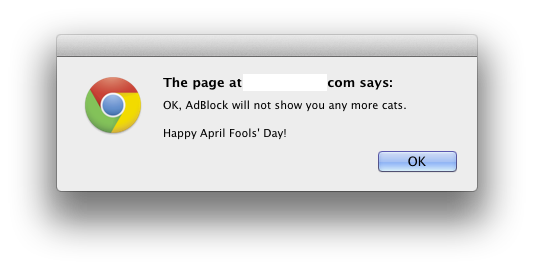
Adblock is showing LOLcats today:
Google, which seems to give every department a mission for today, has a bunch of great stuff:
Google gave a testimony to Congress last year claiming it earned two-thirds of its mobile revenue from iOS devices, but now it seems as though the company’s estimate might have been low.
Google made less than $550 million in revenues for Android between 2008 and 2011, while making four times as much revenue during the same period with Apple products that employ Google services like Search and Maps.
According to The Guardian, the settlement offer provided yesterday by Google to Oracle depicted Android’s revenue streams. Settlement discussions ordered by Judge William Alsup were derailed when Oracle rejected Google’s low offer to pay royalties on Android if alleged patent infringements deem true in court.
Reuters reported yesterday that the settlement stems from a 2010 lawsuit where Oracle claimed its Java-related patents were infringed by Android. Oracle acquired the intellectual property in question when it purchased Sun Microsystems in 2010.
Reports are surfacing in China that claim Apple plans to integrate Baidu into iOS next month as the country’s possible default search function.
According to Chinese news website Sina Tech (machine-translation):
Sina Technology News on March 26 morning news, according to informed sources, Apple iOS operating system next month will be formally introduced Baidu search, Baidu and Apple between cooperation component in the China region.
Google’s Susan Creighton revealed last fall that two-thirds of the Mountain View, Calif.-based Company’s mobile search comes from Apple iOS devices.
Meanwhile, recent speculation claims Apple is moving to an in-house Mapping solution that would replace Google Maps. The firm also recently removed its publish to YouTube option in QuickTime for Mountain lion. If these latest rumors deem true, Apple’s move to Baidu would further indicate a significant effort to reduce Google’s presence in iOS.
With that said, the move to Baidu might be more than a snub to Google. As SearchEngineLand noted, Baidu holds 80 percent of the search market in China, and it would make sense for the Chinese to carry the same search on their mobile devices as they have on their desktop.

As we reported earlier this month, Apple was set to appeal a $1.2 million fine imposed by Italian anti-trust authorities Autorità Garante della Concorrenza e del Mercato. The authorities argued Apple is misleading consumers by selling its one-year AppleCare warranties without informing customers of a two-year warranty mandatory by European Union law. Apple officially lost the appeal in court this week, which forced the company to pay the €900,00 fine and alter its AppleCare policies to properly inform consumers going forward. Apple can still appeal the decision, but consumer groups from 10 other countries are also requesting Apple change its policies—indicating this could soon be EU-wide. (via Repubblica.it)
Following the Path incident, a letter sent from lawmakers to Apple in February requested information on how the company collects personal data. The two congressional representatives behind the letter, Henry A. Waxman and G. K. Butterfield, sent letters to 34 app developers requesting similar information. One of the letters was sent to Tim Cook and Apple about the “Find My Friends” app. The letters are requesting that developers answer questions about their privacy policies and how they handle user data. In response to Path, Apple already confirmed, “Any app wishing to access contact data will require explicit user approval in a future software release.”
Earlier this month, we reported that U.S. Circuit Judge Richard A. Posner ruled in favor of Apple’s request to view documents related to the development of Android and the Google/Motorola acquisition. Apple claimed, “The Android/Motorola acquisition discovery is highly relevant to Apple’s claims and defenses.” According to Bloomberg, Apple told the courts last week that Motorola has yet to fulfill the original request, but Judge Posner denied Apple’s request this week and said, “Motorola’s objections are persuasive.” Two patent infringement-related trials between Apple and Motorola are set for June, and Posner warns Apple will have to “narrow its request to a manageable and particularized set of documents” for any future production of data requests.
Expand
Expanding
Close
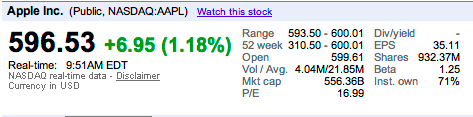
For a couple of seconds this morning Apple’s stock hit 600. It is currently dropping slightly, but we imagine some of you aren’t about to sell your yachts.
Expand
Expanding
Close

According to a report from Bloomberg (via AllThingsD), the U.S. Federal Trade Commission subpoenaed Apple as part of its antitrust investigation of Google. There are not many details currently, but the report claims the FTC is interested in Apple’s agreement with the company to use Google as its primary default search engine on iOS devices.
The agency’s request for documents includes the agreements that made Google the preferred search engine on Apple’s mobile devices, said the people, who weren’t authorized to speak publicly and declined to be identified. Google rivals such as Microsoft Corp. (MSFT) have criticized these agreements as anticompetitive.

Apple’s latest cunning move in its Holy Crusade against Android involves getting a court order to force Google, the maker of Android software, to produce documents detailing the Android roadmap and its proposed $12.5 billion acquisition of handset maker Motorola Mobility. It was not immediately clear what data Apple was exactly seeking to uncover. This is notable, because Apple is actually going after Google with this request. It is the first direct in the ongoing legal war considering Apple fought Google by proxy in the past.
According to Bloomberg, U.S. Circuit Judge Richard A. Posner ruled yesterday based on a patent lawsuit Apple filed in 2010 against Motorola that both Motorola and Google must spill relevant information to Apple, as “the Android/Motorola acquisition discovery is highly relevant to Apple’s claims and defenses.” Motorola, of course, opposed the request, offering the following argument.
[youtube=http://www.youtube.com/watch?v=FBYMDs_RFeI]
Handset maker Motorola Mobility may have found itself in an uneasy place as both Microsoft and Apple are attempting to block its $12.billion sale to Google, but the company’s marketing department is as vigorous as ever. With this week’s spotlight on the latest mobile developments showcased at Mobile World Congress 2012 in Barcelona, Spain, the Razr-maker published three provocative clips on its YouTube channel.
The videos pit the iPhone 4S-exclusive Siri feature against Android Voice Actions running on three different handsets: The Atrix 2, Photon 4G and Electrify. In each instance, Siri runs notably slower (and therefore less useful) than Android Voice Actions on Motorola’s devices.
Both Android Voice Actions and Siri need a network connection to upload audio samples of spoken queries. The cloud does the rest–speech recognition, parsing your query and beaming down the results.
Two more clips are right below.
[youtube=http://www.youtube.com/watch?v=Z07MnBf9QNY]
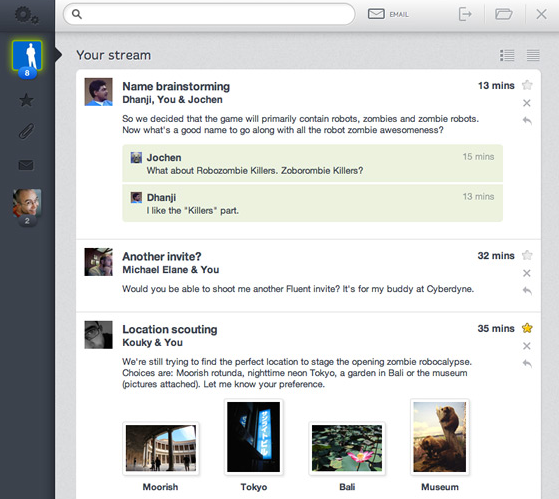
Fluent is a web-based workflow stream that works with existing Gmail accounts to bring a Sparrow-like user interface to email.
Users can stream email threads and replies, preview aggregated attachments in a tab, quickly reply or compose inline, archive messages, and even add a to-do list with the new design concept that claims to run on any web browser.
Sparrow is a great success as a Mac-only application, and now Fluent hopes to balance the playing field and snag users whom are in dire need of a new Gmail look and functionality. Fluent’s website specifically praises its workflow ability, multiple accounts options, and “blazing” fast search-as-you-type filter.
The streaming email UI is the work of three former Googlers who quit the Mountain View, Calif.-based Company. BusinessInsider said Cameron Adams, Dhanji Prasanna, and Jochen Bekmann left because designers were “less valuable” than engineers at Google, and they felt disconnected from Google’s culture while operating from across the world in Sydney, Australia…
Internet giant Google found itself in a middle of a potential public relations nightmare following a Wall Street Journal article this morning. Tentatively titled “Google’s iPhone Tracking,” the article asserts that “Google Inc. and other advertising companies have been bypassing the privacy settings of millions of people using Apple Inc.’s Web browser on their iPhones and computers” to follow iPhone users even after they explicitly set Safari’s privacy controls to disable such tracking. According to authors Julia Angwin and Jennifer Valentino-Devries, Google used “special computer code that tricks Apple’s Safari Web-browsing software into letting them monitor many users.” Google apparently disabled the problematic code after the newspaper contacted the Mountain View, Calif.-based Company.
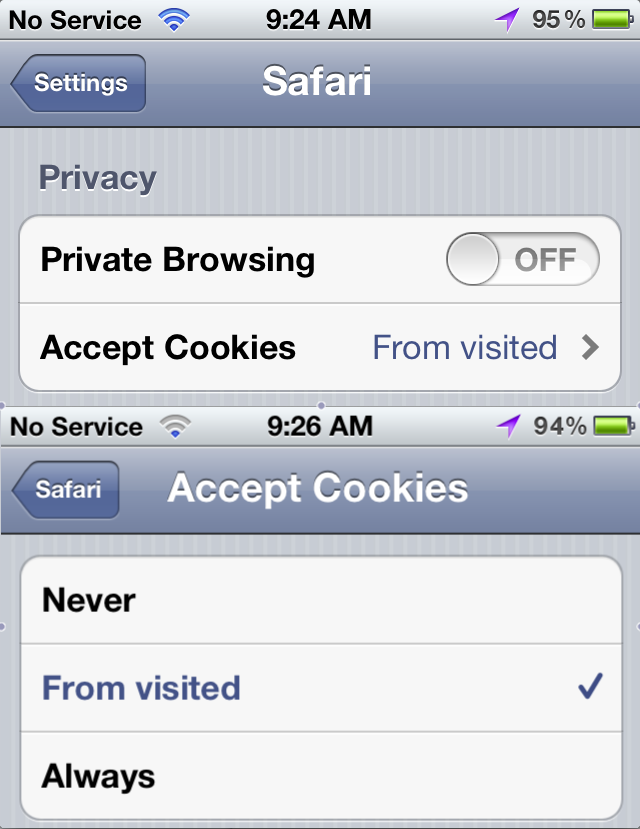
Stanford researcher Jonathan Mayer discovered that although mobile Safari’s default setting blocks cookies from third parties and advertisers, Google and advertising companies Media Innovation Group, Vibrant Media, and Gannett PointRoll fooled mobile Safari into thinking “a person was submitting an invisible form to Google,” letting them in turn install a tracking cookie on users’ iPhones and PCs without consent.
Once a cookie installed, a Safari glitch allowed subsequent cookies to attach. Both Google and Apple issued statements following this morning’s report…
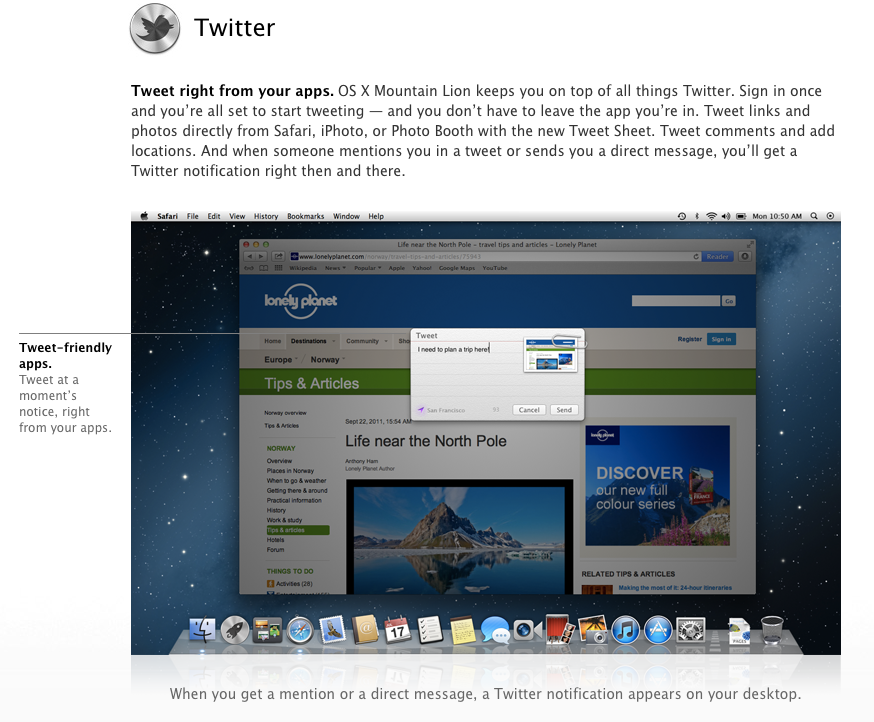
As of today, Twitter is baked into both iOS and MacOS X on a relatively low-level. Apple’s own social network Ping has yet to gather any steam in the marketplace. Facebook and Google are both growing their social networks like crazy while they are increasing in value.
Apple has $100 billion in its pocket, and CEO Tim Cook said at a recent Goldman Sachs event that he is looking for innovative ways to spend the money.
Do you think Apple will buy Twitter? If so, when?

Apple earned the top spot in a new corporate reputation study by Harris Poll (via TechCrunch). It awarded Apple with a corporate reputation quotient of 85.63, which is enough to displace a second-ranked Google with a score of 82.82. Only eight companies earned an RQ score of 80 or above that denotes “excellent reputation.” Apple’s achievement is even more noteworthy knowing Google ranked as last year’s most reputable corporation. Facebook and Intel did not appear on the list this year at all. As for Apple’s rise:
Apple’s current dominance is built on strong investments in its brand, predominantly through its products and services. This one-dimensional approach to building reputation has ultimately yielded high associations with all six reputational dimensions. Conversely, Hewlett Packard, which once out-ranked Apple, has headed in the reverse direction. Hewlett Packard’s slowly eroding reputation has been injured by negative perceptions on Ethics and Vision & Leadership dimensions, and its brand is beginning to feel the damage.
Beverages giant Coca-Cola (No. 3), online retailer Amazon (No. 4) and multinational confectionery, food and beverage conglomerate Kraft Foods (No. 5) round out the top five. Apple ranked the highest in Financial Performance, Products & Services, Vision & Leadership and Workplace Environment—four out of the six key dimensions in reputation. Interestingly, Amazon.com rules the Emotional Appeal category, even though it lacks brick-and-mortar stores and has a limited human interaction with its customers…

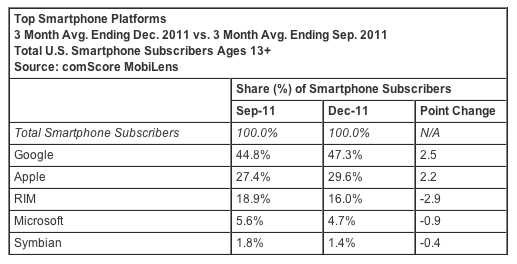
Research firm comScore is out with its latest numbers for the month of December, giving us a glimpse at the current United States mobile market. The report indicates that mobile sales are up-and-rising for the holiday month. comScore found that Google’s Android is leading with a 47.3-percent OS market share (rising 2.5 points) and Apple’s iOS is in second with a 29.6-percent market share (rising 2.2 points).
When it comes to device market share for both smartphones and non-smartphones on the OEM side, Samsung tops the charts with a 25.3-percent market share, which did not change from the previous month. LG and Motorola place second and third, both losing a small amount of market share during December. Apple comes in fourth in market share, and now boasts 12.4-percent of total mobile subscribers (rising 2.2 points).
The U.S. still ranks in as one of the world’s most important places for smartphones, with 97.9 million people owning smartphones during Q4 2011. When it comes to worldwide sales, Research Firm IDC yesterday released its estimates for December. They found that Apple passed LG to become the third-largest smartphone manufacturer worldwide, with an 8.7-percent market share in Q4 2011, and a 6 percent market share in 2011 as a whole. Nokia remains in the top spot with 26.6-percent, followed by Samsung who has 22.8-percent. You can check out the graphs after the break for the full run-down:
iPhone NFC by moneto
We had some time to talk to a well-connected developer at Macworld who was building an app that— among other capabilities— includes NFC reading for the purpose of mobile transactions. We were obviously curious why they would do that, noting that third party NFC readers for iPhone were not popular (aside from the recently announced Moneto, above). The developer told us that he had no hardware knowledge, but he had spoken to Apple iOS engineers on multiple occasions, and they are “heavy into NFC.”
I asked how confident he was, and he said, “Enough to bet the app development on.”
This is not the first we have heard that iPhone 5 would have NFC, however. Besides the deluge of ideas Apple has patented with NFC, the New York Times said pre-iPhone 4S that an upcoming iPhone would have NFC. While it did not turn out to be the iPhone 4S, it could be the one coming up.
(Moneto again)
The question is now: Who will Apple partner with for its payment systems? Over the weekend we received some hints…
Expand
Expanding
Close

Late last week we told you that the U.S. Justice Department apparently had evidence that Apple, along along with Google, Adobe, Intuit, Pixar, Intel, and Lucasfilms, entered “no-poach” agreements as part of an antitrust investigation from 2010. U.S. District Judge Lucy H Koh made a statement yesterday at the U.S. District Court in San Jose, Calif., confirming the companies must face a lawsuit. According to the report from Bloomberg, Koh said she would allow plaintiffs to re-file their complaint even if an initial request by the defendants to dismiss the claims is granted.
Judge Koh’s decision yesterday will result in Google and the other companies having to provide a detailed account of the agreements made with other companies. They must also allow lawyers to take depositions. One lawyer representing the plaintiffs, Joseph Saveri, said, “We get to see what really happened,” claiming the case could result in hundreds of millions of dollars in damages. Google provided statements to Bloomberg claiming they have “always actively and aggressively recruited top talent,” while the others have declined to comment.
Expand
Expanding
Close

Apple’s iPad maintained its market lead throughout fourth quarter of last year even though it lost some ground compared to the previous quarter due to an influx of Android-based tablets. In fact, Amazon’s dirt-cheap Kindle Fire device that costs just $199 saved the day for Android slates, really. This is the gist of the latest survey by research firm Strategy Analytics that was released this morning.
Global tablet shipments reached 26.8 million units in the fourth quarter of 2011— up 150 percent from 10.7 million from the year-ago quarter. Global tablet shipments hit 66.9 million units throughout 2011— a 260 percent increase from just 18.6 million units in 2010. Looking at how tablet vendors performed throughout Q4 2011, the survey recorded a 39.1 percent share for tablets powered by Android. Even though it is a record for tablets driven by Google’s software, Apple sold 15.43 million iPads during the holiday quarter for a healthy 57.6 percent share. This left the remaining 3 percent for tablets outside the Android/iOS tablet duopoly, with Microsoft-driven devices holding onto 1 percent share of the market.
This compares to a Strategy Analytics’ survey for the September 2011 quarter that depicted a 27 percent share for Android tablets in Q3 2011 (up from 2.3 percent in Q3 2010) and 67 percent for iPad (down from 96 percent in Q3 2010). Android tablets are clearly picking up steam, largely based on the success of Amazon’s device that launched Oct. 15, 2011. Still, the iPad is expected to remain king of the hill as analysts expect its lead to maintain throughout 2012.
Strategy Analytics Research Director Peter King opined: