Before you can properly understand Apple News, it’s important to know its history. Apple was founded by Steve Jobs and Steve Wozniak in 1976. In 1977, Apple’s sales were growing with the success of its early computers. Within a few years, Jobs and Wozniak hired designers and a production line crew. Apple went public in 1980 and was an instant success. Over the next few years, Apple shipped new computers featuring new graphical user interfaces, such as the original Macintosh in 1984. As the market for personal computers expanded through the 1990s, Apple lost market share to the cheaper Microsoft Windows on PC clones. Eventually, Wozniak and Jobs both left Apple. Jobs would go on to found NeXT and would return to Apple when NeXT was acquired in the late 90s. Apple then began a journey to the great second act in the history of the business world.
Since the release of the iPod in 2001, Apple has become a major player once again in the technology industry. After releasing the iPhone in 2007, the iPad in 2010, and the Apple Watch in 2015, Apple is now one of the largest companies in the world. Apple’s worldwide annual revenue totaled $274.5 billion for its 2020 fiscal year.
Today, Apple operates retail stores all across the world, has a growing services division, and an ever-expanding hardware lineup. The technology industry follows Apple news to see where the company is headed in the future.
Realmac Software is on the brink of launching its fun new camera app Analog Camera for iPhone, but it has one more major task to mark off its list before we all get our hands on it. With its latest update to Clear, that item can now be swiped right off the list.
Clear on the iPhone and Mac both were updated today receiving a frequently requested feature: list sharing over email.
In case you needed some proof that the rumors of Apple switching from Corning glass to sapphire crystal are unlikely, Corning has posted a video on its website showing how its current Gorilla Glass is superior to sapphire for mobile devices.
Recently, speculation has arisen that manufactured sapphire crystal might become an alternative to Corning’s Gorilla Glass. “Sapphire’s performance as a cover for high-end watches probably leads to the current speculation. But those covers are much smaller than a mobile phone and are two to three times thicker than Gorilla Glass. In one of our commonly accepted strength tests, sapphire breaks more easily than Gorilla Glass after the same simulated use. Additionally, sapphire’s cost and environmental hit are huge issues,” Steiner said.
There have been a couple rumors floating around that smartphone makers are looking into using sapphire crystal as a replacement for other cover glass solutions. With Apple using the material as a cover for its camera lenses on iPhone 5 and the latest iPod touch, some have speculated it could use sapphire for other parts of its devices, such as the display’s cover glass or home button. However, that’s not likely, according to Corning, Gorilla Glass is “about half the weight”, requires 99 percent less energy in manufacturing, provides brighter displays, and “costs less than a tenth” of sapphire. Expand Expanding Close
Simply put. iPad 2 is the best gadget I have ever used. Welcome to the post-PC era.
— Michael Gartenberg ✡️🇮🇱🎗️ (@Gartenberg) March 10, 2011
I may abandon my quest for a proper CA home, just buy a really good car and park in other people’s driveways at night
— Michael Gartenberg ✡️🇮🇱🎗️ (@Gartenberg) May 22, 2013
According to Forbes, long time technology analyst Michael Gartenberg has joined Apple. According to the report he is now officially working under the marketing team led by Phil Schiller. Gartenberg has always been Apple-focused/leaning in his coverage and a contributor to Macworld magazine among other endeavors.
We already knew back in December that Pearson, along with a handful of other publishers had decided to settle with the U.S. Department of Justice in the high-profile Apple ebook price-fixing case. Today a statement from Peason’s Penguin unit confirms that it has now also reached an agreement that will see the publisher pay $75 million in consumer damages to the US State Attorneys General on behalf of people that were overcharged due to the alleged price fixing:
Penguin has reached a comprehensive agreement with the US State Attorneys General and private class plaintiffs to pay $75 million in consumer damages plus costs and fees to resolve all antitrust claims relating to eBook pricing. Penguin has also committed to the State Attorneys General to abide by the same injunctive relief as previously agreed in a separate settlement with the Department of Justice.
In anticipation of reaching this agreement, Pearson had made a $40m provision for settlement in its 2012 accounts. An incremental charge will be expensed in Pearson’s 2013 statutory accounts as part of the accounting for the Penguin Random House joint-venture.
Earlier this month we noted that Apple was asking courts to add the Galaxy S4 as an infringing device in its ongoing patent dispute with Samsung in California. Now, Apple has officially filed a motion (via FossPatents) outlining five patents infringed by the Galaxy S4 and another two Siri related patents infringed by the device’s Google Now voice controlled search feature.
Apple had previously claimed that the Android Google search box feature on Samsung devices infringed the same patents, but is now moving to have Google Now included alongside the S4. Excerpt from Apple’s filing below: Expand Expanding Close
As first spotted by our friends over at German language publication Macerkopf.de, Apple appears to be rolling out an option to make purchases on the Apple Online Store using PayPal. The feature appears to be limited to Germany currently, but it could mark the start of a broader roll out to other users.
Apple has never been opposed to offering the option to use PayPal for some services. Users in the U.S. have long been able to setup PayPal as a payment option for their Apple ID on the desktop, allowing them to purchase iTunes content with PayPal on iTunes & the Mac App Store. Apple does, however, already support PayPal payments for its online store in China.
It also allows its education customers to use PayPal for volume purchases of iOS apps, but the privilege didn’t extend to making purchases from the online store at Apple.com.
Apple’s help page for payments and tax information in Germany now explains how users can opt for PayPal at checkout, but we’ve yet to find the feature live in other countries that we’ve tested.
Users will not have to setup their PayPal as their payment option for their Apple ID, instead they will be redirected to log in using their PayPal username and password at the time of purchase: Expand Expanding Close
When Jony Ive took over the role of leadership for Apple’s Human Interface in October of last year, many speculated that the style of Apple’s design language across iOS and Mac OS X would also shift towards a flatter, more clean style. This speculation was fueled mainly by Ive’s feelings towards skeuomorphism and his minimalist design aesthetic.
In the upcoming overhaul of its iPhone, iPad, and iPod touch operating system, iOS 7, Apple plans to include an increased presence of third-party social networks, including Flickr and Vimeo, according to a person familiar with the software. Since the new software is yet to be even officially announced, there is a very real possibility that any feature in testing could be removed prior to the announcement, this person said (much like Facebook integration was removed from iOS 4). More details below:
During this morning’s Senate hearing regarding Apple’s tax strategies, Apple CEO Tim Cook provided opening statements regarding Apple’s perspective on the issues. Notably, during a time in which Cook was discussing Apple’s United States-based operations and strategies, the Apple CEO said that Apple’s upcoming Made-in-the-USA Mac line will be assembled in Texas…
Before either Apple CEO Tim Cook or Apple CFO Peter Oppenheimer took the stand to testify on behalf of Apple to defend the company’s tax practices, Senator Rand Paul of Kentucky lashed out on Senator John McCain and Senator Carl Levin for the “spectacle of dragging in here executives from Apple using the brute force of government to bully a great success story.”
Senator Paul, a notable Tea Party leader and son of Representative Ron Paul, is often outspoken on issues of tax reform and made no effort to align for his Republican colleague Senator John McCain.
Chairman Levin didn’t hesitate to bring the narrative against Apple and its tax practices back to the center stage soon after Senator Paul’s comments.
The denial was made to Yahoo! Finance reporter Conor Humphries:
According to the congressional report, Ireland had also agreed a special 2 percent rate for Apple’s Irish taxable profits instead of the normal 12.5 percent, but a spokesman for Ireland’s finance department, when asked how and why this had come about, said: “Ireland’s tax system is statute based, so there is no possibility of individual special tax rate deals for companies.”
This appears to flatly contradict a statement by the Senate subcommittee that accused Apple of … Expand Expanding Close
Here’s what the other side has to say via Michigan’s Carl Levin (Democrat) on the senator’s view of Apple’s tax avoidance strategy:
“Apple wasn’t satisfied with shifting its profits to a low-tax offshore tax haven. Apple sought the Holy Grail of tax avoidance. It has created offshore entities holding tens of billions of dollars, while claiming to be tax resident nowhere. We intend to highlight that gimmick and other Apple offshore tax avoidance tactics so that American working families who pay their share of taxes understand how offshore tax loopholes raise their tax burden, add to the federal deficit and ought to be closed.”
Republican Senator John McCain adds:
“Apple claims to be the largest U.S. corporate taxpayer, but by sheer size and scale, it is also among America’s largest tax avoiders. A company that found remarkable success by harnessing American ingenuity and the opportunities afforded by the U.S. economy should not be shifting its profits overseas to avoid the payment of U.S. tax, purposefully depriving the American people of revenue. It is important to understand Apple’s byzantine tax structure so that we can effectively close the loopholes utilized by many U.S. multinational companies, particularly in this era of sequestration.I have long advocated for modernizing our broken and uncompetitive tax code, but that cannot and must not be an excuse for turning a blind eye to the highly questionable tax strategies that corporations like Apple use to avoid paying taxes in America. The proper place for the bulk of Apple’s creative energy ought to go into its innovative products and services, not in its tax department.”
Apple Chief Executive Officer Tim Cook, Chief Financial Officer Peter Oppenheimer, and Tax Operations Head Phillip Bullock will be on hand giving testimony. Check back tomorrow for the blow by blow. Expand Expanding Close
In the testimony, Apple proposed what it called comprehensive corporate tax reform that should: Be revenue neutral, eliminate all corporate tax expenditures, lower corporate income tax rates; and implement a reasonable tax on foreign earnings that allows free movement of capital back to the US.
While some Subcommittee members may have differing views on these tax policy matters, Apple hopes the Subcommittee will see that these recommendations aim to create meaningful change and go well beyond what most US companies propose. As both a pioneer and participant in the American innovation economy, Apple looks forward to working with the Subcommittee on its efforts to encourage comprehensive reform of the US corporate tax system. Apple appreciates the opportunity to appear before the Subcommittee to contribute constructively to this important debate.
Apple also detailed the company’s current tax practices and noted it “made income tax payments to the US Treasury totaling nearly $6 billion – or $16 million per day.” Apple points out that, at a rate of 30.5%, that accounts for around “$1 out of every $40 of corporate income taxes collected by the US Treasury last year.”
Apple continued by commenting on its recent decision to borrow $17 billion in debt instead of repatriating offshore funds to help fund its shareholder return: Expand Expanding Close
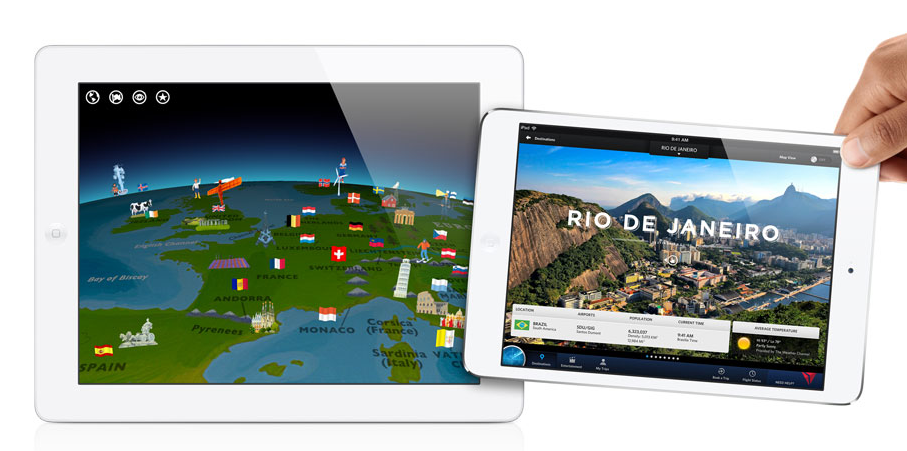
We expect the next 9.7″ iPad to resemble the design of the 7.9″ iPad mini, but dropping a third of its weight is certainly a tall order as it would bring it just under a pound.
Current iPads without cellular connectivity weigh in at 1.44 pounds while the iPad mini is much lighter at 0.66 pounds, but the iPad mini doesn’t require as much LED backlighting as the larger, Retina display full-sized iPad, though the report claims the next full-sized iPad will use a single LED backlight rather than two.
Turkish Prime Minister Recep Erdoğan has visited Apple, Google and Microsoft in the run-up to a tender for 10.6 million tablets for use in Turkish schools as part of a major modernization program in which textbooks will be replaced by tablets and chalkboards by electronic whiteboards … Expand Expanding Close
Just as the Defense Department granted iOS devices approval for use on military networks, TheStreet reports that the U.S. Air Force plans on saving around $50 million through its purchase of iPads. The savings will mainly be due to the ability to cut weight on flights by replacing traditional flight bags and come over a ten year period:
“We’re saving about 90 pounds of paper per aircraft and limiting the need for each crew member to carry a 30 to 40 pound paper pile [of flight manuals],” said Major Brian Moritz, EFB program manager, in a phone interview. “It adds up to quite a lot of weight in paper.”
Removing the need to print and distribute thousands of flight manuals, however, equates to an even greater cost saving. “It comes out to just over $5 million a year,” noted Moritz. “With fuel savings, it comes out to $5.7 million annually in pure cost. When you look at $5.7 million a year, over 10 years, that’s well over $50 million.”
According to the report, the Air Force’s Air Mobility Command now currently has around 16,000 iPads in use with another 2,000 spread across other Air Force members. Expand Expanding Close
“With iPhone and iPad being tested or deployed in almost every Fortune 500 company, Apple continues to scale across enterprise with nearly 30,000 companies globally developing and distributing iOS apps for corporate use by their employees,” Apple spokeswoman Trudy Muller told AllThingsD. “The FIPS 140-2 certification and STIG approval demonstrate our ongoing commitment to deliver a secure platform to our enterprise and government customers around the world who deploy iOS devices on their networks.”
Following reports earlier this month that the Defense Department was in the process of approving iOS 6 for nonclassified communications and widespread use by government agencies, Bloomberg reports today that Apple has officially been granted approval for use on U.S. military networks.
The Pentagon already approved Samsung devices powered by the company’s Knox security software and BB10 ahead of today’s approval of iOS 6.
In February the US Defense Department confirmed plans to open its networks to 100,000 new devices from Apple and Google by February of next year. At that time the Pentagon said its networks had about 470,000 BlackBerrys, 41,000 Apple products, and 8,700 Android devices.
A number of U.S. agencies switched from BlackBerry to iPhones over the last year, while earlier reports indicate Samsung is attempting to attract more government and corporate customers with a new team of security experts and former RIM employees as well as a water and dust proof variant of its flagship S4 dubbed the Galaxy S4 Active. Today’s security approval will increase the number of agencies allowed to deploy iPhone and iPads on government networks for nonclassified communications.
Corning, the company that currently supplies glass for Apple’s iOS devices, yesterday introduced its second generation glass substrate with the commercial launch of Corning Lotus XT Glass. While we initially expected Corning’s recently announced Gorilla Glass 3 might end up in an iOS device, the second generation Lotus XT Glass could be a prime candidate for LCD and OLED displays on future Apple devices.
The end result for consumers, according to Corning, is an easier method of manufacturing “faster, thinner, brighter, and higher resolution” displays.
The Corning Lotus Glass platform enables organic light-emitting diode (OLED) displays and liquid crystal displays (LCD) that use either low-temperature poly-silicon (LTPS) or oxide thin-film transistor (TFT) backplanes. The result is an energy-efficient, immersive display device that features high resolution, fast response times, and bright picture quality.
Corning Lotus XT Glass also offers the advantages of Corning’s proprietary fusion process while meeting the stringent cost requirements of the mobile device and IT display market. Its superb surface quality supports the backplane characteristics required for the vibrant colors and clarity OLED and LCD transmissions are known for.
Apple is widely believed to use Corning’s Gorilla Glass in its iOS devices, although the company has never specifically confirmed as much.
Lotus XT Glass features best-in-class total pitch variation, which is integral to efficient panel manufacturing. Essentially, total pitch – usually measured in microns or parts per million (ppm) – is the distance features move during panel processing.
“If you can predict the amount the glass shifts, then you can account for this movement. Deviation – or variation – from this predictable movement can ultimately result in yield loss,” said John P. Bayne, vice president and general manager, Corning High Performance Displays. “Lotus XT Glass is designed to have improved thermal and dimensional stability over higher temperatures, generating higher yields for our customers.”
The Corning Lotus Glass platform enables organic light-emitting diode (OLED) displays and liquid crystal displays (LCD) that use either low-temperature poly-silicon (LTPS) or oxide thin-film transistor (TFT) backplanes. The result is an energy-efficient, immersive display device that features high resolution, fast response times, and bright picture quality.
In addition to Lotus XT Glass, the Corning booth will feature each of its advanced glass technologies, including: Corning EAGLE XG® Slim for a-Si displays; Corning® Willow™ Glass, the company’s ultra-slim, flexible glass; and Corning® Gorilla® Glass 3 with Native Damage Resistance™. Corning experts will provide daily demonstrations of Gorilla Glass 3, the industry-leading, damage-resistant cover glass. Attendees should consult booth staff for exact times.
Display Week attendees will also have the opportunity to hear several of Corning’s technology experts deliver presentations at the conference.
“Display Week is a time to take stock of the industry and its future,” Bayne noted. “The industry is changing, and Corning believes each of its innovative glasses helps solve tough technological challenges – advancing displays even further.”
For additional information about Corning’s presence at SID Display Week 2013, please visit www.corning.com/SID2013.
During a presentation with advertisers, CW Network president Mark Pedowitz announced that the network would be expanding its content offerings to new multimedia devices. This strategy will include a spot as an app on the Apple TV set-top-box’s home screen.
It’s a dedicated CW app that will work like our Xbox and mobile and tablet apps – no cable authentication required, full episodes of our shows available next day after air, ad-supported.
Notably, as noted in the above quote, the CW content will be ad-supported.
CW currently streams its content to software on Microsoft Windows devices such as the Xbox. Apple recently added Hulu Plus and sports content to the Apple TV, and the current generation Apple set-top-box has sported YouTube and Netflix integration since launch.
Interesting exit interview with Intel CEO Paul Otellini wherein he says (duh) he regrets not trying harder not to get his chips inside the iPhone (and subsequently iPod touch and iPads).
But, oh, what could have been! Even Otellini betrayed a profound sense of disappointment over a decision he made about a then-unreleased product that became the iPhone. Shortly after winning Apple’s Mac business, he decided against doing what it took to be the chip in Apple’s paradigm-shifting product.
“We ended up not winning it or passing on it, depending on how you want to view it. And the world would have been a lot different if we’d done it,” Otellini told me in a two-hour conversation during his last month at Intel. “The thing you have to remember is that this was before the iPhone was introduced and no one knew what the iPhone would do… At the end of the day, there was a chip that they were interested in that they wanted to pay a certain price for and not a nickel more and that price was below our forecasted cost. I couldn’t see it. It wasn’t one of these things you can make up on volume. And in hindsight, the forecasted cost was wrong and the volume was 100x what anyone thought.”
While there seems to be some sentiment that if Otellini had tried, Intel would have won Apple’s iOS device business. But, it clearly isn’t that simple. ARM chips use an order of magnitude less power than Intel chips, even to this day.
Also, if Intel is so great at powering mobile device chips, why wouldn’t Android devices (And Windows 8 devices!) have used them as an advantage?
Steve Jobs and Apple prioritized efficiency over raw power which may have proved to be one of the winning advantages of the feature-rich iPhone and iPad over a decade plus of Windows machines.
Tim Cook and Apple tend to avoid any public discussion aside from comments during quarterly earnings calls, but it seems the company is on a PR offense leading up to next week’s public hearings.
“We don’t have a large presence in Washington, as you probably know, but we care deeply about public policy and believe creative policy can be a huge catalyst for a better society and a stronger economy.”
Cook went on to defend Apple against any accusations that may come its way next week.
“I can tell you unequivocally Apple does not funnel its domestic profits overseas. We don’t do that. We pay taxes on all the products we sell in the U.S., and we pay every dollar that we owe. And so I’d like to be really clear on that.”
The Apple CEO also noted the company’s $100 million project to produce a Mac line in the United States this year, which the company says will add jobs to the economy. Expand Expanding Close
UPS announced today that it is finally rolling out a native iPad app that brings the ability to track and schedule deliveries as well as access to features of UPS My Choice® and enhanced mapping features. These features were previously available to users in the free UPS Mobile app for iPhone, but today they come to iPads through the UPS for iPad app available on the App Store now.
Some of the features below will require enrollment in the UPS My Choice program:
Without logging in, you can: – Track packages and freight shipments – Save up to 5 tracking numbers in your tracking list – See the current location of your package on a map – Find UPS service locations via GPS
When you log in, you can also: – Sync your recent tracks from ups.com – Nickname tracked shipments – Enroll in UPS My Choice – Use UPS My Choice to take action on your incoming deliveries – Set your delivery preferences