China

See All Stories
China

China has been fundamental to Apple’s historical success, but is also arguably the greatest risk to the company’s future.

Why are most Apple products made in China?

Although everyone assumes Apple products are made in China because labor is cheap there, that’s only part of the story – and an increasingly small part, as the company’s assembly partners move toward more and more automated operations.

Steve Jobs originally transferred most Apple manufacturing to China because it was the only country in the world with a huge ready-made supply-chain network, and the ability to scale up production almost overnight. There are three main reasons China – and specifically the Shenzhen area – is such a powerful manufacturing center.

First, the city is strategically placed, serving as the gateway between mainland China and Hong Kong. It is one of the largest shipping centers in the world, with a massive container port.

Second, the Chinese government established Shenzhen as the first Special Economic Zone (SEZ) in the country. SEZs are designed to encourage enterprise through relaxed planning regulations and generous tax incentives – and crucially, to facilitate foreign investment in local companies. It is this, as much as its geographical advantages, which has enabled it to grow at such a pace.

Third, that SEZ was established way back in 1980, meaning that the city has had over 40 years to grow into the manufacturing center of the tech world. Apple relies on a huge network of suppliers and sub-contractors, some of which may make just a single tiny component. The majority of them are based in Shenzhen and its immediate surrounds, so the logistics of bringing everything together in one place for assembly are straightforward.

What are the risk factors with China?

Being over-dependent on China carries a number of risks.

First, there is the generic one: Being overly dependent on any one country is a strategic risk. For example, the COVID-19 pandemic originated there, and had a massive impact on manufacturing capacity. Anything from a natural disaster to political upheaval could disrupt operations within a single country, so it is always wise to have a diverse range of manufacturing centers around the world.

Second, the relationship between the US and China has often been fraught. The trade war started by the previous US administration was a particularly low point, but continued tensions mean that there is always a risk of disruptions to trade between the two countries.

Third, it is increasingly damaging to Apple’s reputation to be so closely associated with a country that has a worsening human rights record – especially when the iPhone maker has no choice but to comply with local laws, however much they may conflict with the company’s own values. Apple has been required to remove VPN and a variety of other apps from the Chinese App Store, allow the iCloud data of Chinese customers to be stored on government-controlled servers, and more. Additionally, there have been growing reports of forced labor in China, including within many different areas of Apple’s supply chain.

What is Apple doing about it?

Apple has been working for a long time on diversifying its manufacturing operations, and has in recent years accelerated the pace at which it is doing so.

As explained above, this is far from an easy undertaking, but Apple now has major manufacturing operations in India, Thailand, Malaysia, and the Philippines, among other countries.

In India in particular, we are seeing the very early stages of a complete supply-chain infrastructure as the government uses a mix of carrot and stick to encourage companies to manufacture more of their components within the country – namely, tariffs on imports of components and tax breaks for local production. COVID-19 lockdowns in China also saw Apple move some iPad production to Vietnam for the first time, but it’s clear that the risks of over-dependence on China have never been greater.


Foxconn hoping to make future iPhone screens, get more of the Apple pie

Site default logo image

iPhone assembler Foxconn is apparently hoping to move beyond its relatively low-margin work into more profitable high-end component manufacturing in order to take a bigger slice of revenue from Apple, reports the WSJ.

Apple Inc.’s major assembler Foxconn is in preliminary discussions with a provincial government in northern China for an investment in a new factory that would make high-end screens for iPhones and other mobile devices, people familiar with the talks say.

Foxconn already manufactures some iPhone components, but currently only low-margin ones like metal casings and cables … 
Expand
Expanding
Close

Apple to grow retail stores in China from 15 to 40 within two years, says Cook

Site default logo image

Tim Cook noted during Monday’s earnings call that Apple was “investing like crazy” in China, but he took the opportunity of his current visit to the country to put a specific number on the company’s retail expansion plans: it will open 25 new Apple Stores in Greater China within the next two years. Greater China includes both Hong Kong and Taiwan.

Speaking to local media, Cook also said that China would in time become Apple’s biggest market, reports the WSJ … 
Expand
Expanding
Close

Tim Cook meets with Chinese vice premier in Beijing following iCloud phishing attack

Site default logo image

Two days after evidence emerged of a phishing attack on iCloud, allegedly due to the Chinese government firewall redirecting traffic to a fake login page, the Chinese state news agency Xinhuanet is reporting a meeting in Beijing between Tim Cook and Chinese vice premier Ma Kai.

Chinese Vice Premier Ma Kai and Apple Inc. CEO Tim Cook on Wednesday exchanged views on protection of users’ information during their meeting in Zhongnanhai, the central authority’s seat. They also exchanged views on strengthening cooperation in information and communication fields.

The Chinese government censors access to the Internet by deploying a country-wide firewall which blocks certain sites and which can redirect traffic from sites the government dislikes to officially-sanctioned ones …

Expand
Expanding
Close

“iPad has a great future,” said Cook: long-term more important than “90-day clicks”

Site default logo image

While yesterday’s iPad numbers don’t look great – down 12.5% year-on-year, the third successive quarter in which sales have fallen – Tim Cook remains upbeat about the product, stating that it “has a great future” and that its long-term prospects are more important than “individual 90-day clicks.”

Quartz‘s Dan Frommer pulled together some of the things Cook has to say about the device, and while you’d clearly expect Apple’s CEO to put the best possible spin on things, he makes some reasonable arguments … 
Expand
Expanding
Close

AAPL will announce record quarter, predict analysts, with earnings up 11.9%

Site default logo image

Analysts are predicting that Apple (AAPL) will announce record sales and earnings in today’s fiscal Q4 (calendar Q3) earnings call, reports Fortune.

I’ve got the collected fiscal Q4 estimates of 33 Apple analysts — 21 professionals and 12 amateurs. They are all to a man (and one woman) predicting record Q4 sales and earnings (up 7.1% and 11.9%, respectively).

The analysts also expect earnings per share to be up 12% year-on-year, to $1.32 … 
Expand
Expanding
Close

Apple rolls out iPhone 6/Plus to 36 more countries this month

Site default logo image

Apple has announced that it will be rolling out the iPhone 6 and 6 Plus to an additional 36 countries this month, bringing the total number of markets to 69. The latest rollout will begin with India and Monaco alongside China on Friday.

Apple today announced that iPhone 6 and iPhone 6 Plus, the biggest advancements in iPhone history, will arrive in 36 additional countries and territories across Europe, Asia, the Middle East, Latin America and Africa by the end of October. iPhone 6 and iPhone 6 Plus will be available in a total of 69 countries and territories by the end of the month and are on track to be available in more than 115 countries by the end of the year, making this the fastest iPhone rollout ever … 


Expand
Expanding
Close

Apple Watch set to appear on the cover of Vogue China’s November issue

Site default logo image

Apple’s upcoming wearable will appear on the cover of Vogue China’s November issue according to Business of Fashion. Several styles of the device will be worn by supermodel Liu Wen. This comes just a few weeks after Apple’s one-day-only special showing of the Apple Watch during Paris Fashion Week, proving that the company is taking a much more direct approach to the fashion world.

Vogue China EiC Angelica Cheung reportedly met with Tim Cook and Jony Ive prior to the official reveal of the watch to learn about the process behind its design. When asked about why Vogue China was chosen as the first magazine to feature the device, she responded in part by stating:


Expand
Expanding
Close

Site default logo image

2 million reservations in 6 hours: China shows strong early demand for iPhone 6 and iPhone 6 Plus


According to AppleInsider, Chinese carriers have recorded more than 2 million reservations of the iPhone 6 and iPhone 6 Plus in the first six hours of opening. Although official preorders start on October 10th, carriers are already offering presale signups.

By contrast, Apple announced preorders of 5 million units across a 24 hour period for nine countries, including the United States and the United Kingdom. Although reservations don’t translate directly into formal orders, it is still a good showing and a great indicator that Chinese iPhone sales will continue to boost Apple’s bottom line.


Expand
Expanding
Close

iPhone 6 finally approved for sale in China following regulatory hangups (U: Pre-orders start Oct. 10, available Oct. 17)

Site default logo image

Earlier this month it was discovered that the iPhone 6 and 6 Plus would be delayed in China due to regulatory hold ups when Chinese authorities decided that they were not pleased with the current state of security on iOS. According to Bloomberg, Apple has cleared the last hurdle and received the licenses necessary to run the device on Chinese cellular networks.

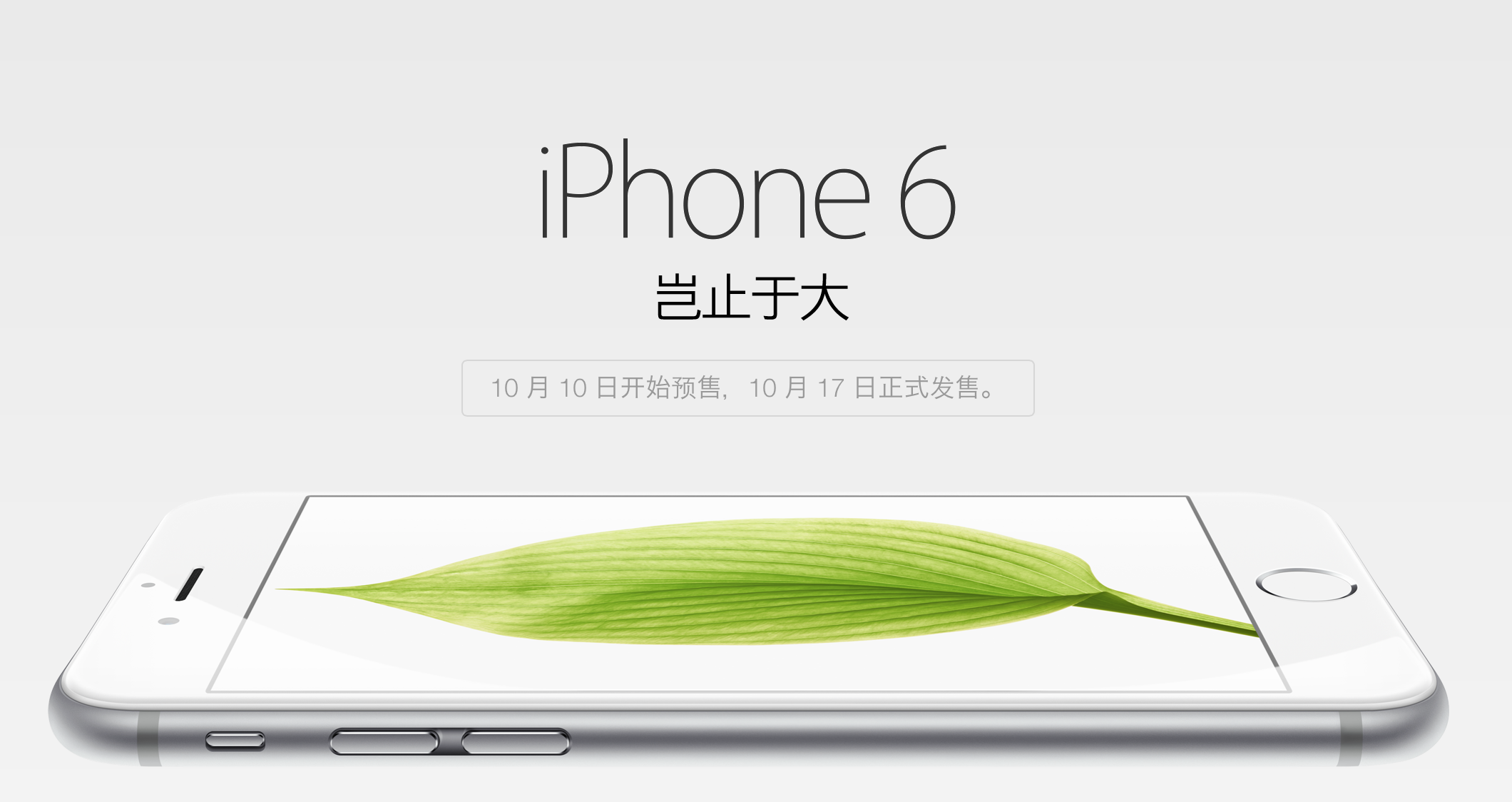
Apple reportedly agreed to make undisclosed changes to the privacy settings on the device to appease the regulators. Yesterday we reported that Apple was apparently preparing for a Chinese launch on October 10th, but that date has not yet been confirmed. Update: Apple has announced through a press release that the phones will be available for sale in China on October 17th with pre-orders starting on the 10th.

Apple also released a beta version of iOS 8.1 today, which may or may not include the updated privacy settings necessary to get approval from the Chinese government.


Expand
Expanding
Close

Apple seemingly preparing for China iPhone 6 launch on October 10th

Site default logo image

A supposed screenshot of a notice (via TechWeb) sent to Apple retail employees suggests that Apple is readying a China iPhone 6 (and 6 Plus) launch for October 10th. As stated on the Chinese site (translated):

It is important that the person broke new iPhone prototype store shelves will be put on Oct. 7, and should be officially on sale in October 10. A few days ago the Ministry of Industry Minister Miao Wei once said in an interview, iPhone 6 and iPhone 6 Plus has entered the final stage of the audit, which means the phones will soon be landing in mainland China.

This is shortly after China’s national week-long holiday. Independently, the Chinese press have also reported the same October 10th date for the iPhone 6 debut. Last week, regulators stated that the phone was nearing final approval, causing black market iPhone 6 prices to plummet.


Expand
Expanding
Close

Black market iPhone 6 prices fall as Chinese regulators say final approvals are coming soon

Site default logo image

iPhone smuggling into China is nothing new, but this year it has perhaps been even more of a problem as Apple awaits regulatory approvals to begin selling its new iPhone models in the country. The good news is that a report from CNBC notes that regulators in the country said today that final reviews of licenses for the new iPhones would be “completed soon”. 
Expand
Expanding
Close

The seamy underbelly of Apple Store lines in New York City on iPhone launch days [video]

Site default logo image

[youtube=https://www.youtube.com/watch?v=Ef_BznBwktw]

Casey Neistat’s latest video isn’t really news to anyone nor does it appear that Apple can or will do anything about the problem but perhaps this years delayed launch in China has exacerbated it even more.  What can Apple do in this situation?

Another video of the 5th Avenue line below:


Expand
Expanding
Close

Apple halfway to solving regulatory holdup delaying iPhone 6 launch in China

Site default logo image

Reuters is reporting that Apple has now received one of the two licences needed to allow it to sell the iPhone 6 in China. There is no word yet on the second licence required before the iPhone 6 and 6 Plus can be launched in this hugely important market.

Apple Inc’s iPhone 6 received regulatory approval for use on domestic frequencies but still requires one more critical licence before it may be sold in the country, the official Xinhua news agency reported on Thursday […]

Apple still needs to obtain a critical network access licence for the iPhone, after which sales may begin, Xinhua said …


Expand
Expanding
Close

Major Chinese business paper claims iPhone 6 won’t go on sale in China this year – reliability unclear

Site default logo image

Bloomberg is quoting a report from the major Chinese business paper 21st Century Business Herald that the iPhone 6 may not go on sale in China this year due to regulatory delays. Apple was unable to confirm a launch date in the country.

Apple may have to wait until next year to get approval for new iPhones in China after failing to reach agreement with the Ministry of Industry and Information Technology this month, the 21st Century Business Herald reported today, citing an unidentified person close to Apple.

Carolyn Wu, a Beijing-based spokeswoman for Apple, said she couldn’t provide a date for the China release. “China is a key market for us and we will get here as soon as possible,” Wu said in an e-mail today …


Expand
Expanding
Close

Apple Pay headed to China with UnionPay partnership, references found in iOS code

Site default logo image


Apple is set to bring Apple Pay, its mobile wallet service, to China using a partnership with China UnionPay. @KhaosT on Twitter found references to the credit card type in iOS 8 code and now MarketWatch is corroborating with sources that a deal is in the works.

Apple announced Apple Pay as a US only service, coming to iPhone 6 and iPhone 6 Plus in October with a software update. A deal with UnionPay would obviously mean Apple wants to bring the feature to Chinese iOS customers soon.


Expand
Expanding
Close

Site default logo image

Sketchy supply-chain report says production gearing-up for 80M iPhone 6 sales this year

DigiTimes is citing supply-chain sources as stating that Apple is gearing-up its iPhone 6 production plans for an anticipated 80 million sales by year-end. If achieved, it would represent 33 percent year-on-year growth.

Makers in the iPhone supply chain are preparing parts and components for production of up to 80 million units of iPhone 6 and iPhone 6 Plus before year-end 2014, according to sources at Taiwan-based iPhone supply chain.

As ever with DigiTimes, the number should be taken with a large dose of salt: while manufacturers will be aware of their own order-books from Apple, and thus have some degree of insight into the company’s expectations for early sales, it’s a stretch to extrapolate from that to sales targets up to the end of the year.

We won’t have too long to wait for a good indication of how well the new models are selling. They go on sale on Friday 19th, and Apple is expected to issue its usual announcement of opening weekend sales on Monday 22nd September. Last year, Apple announced a record 9M iPhone sales in the first three days.

This year’s opening weekend numbers may take a hit, however, with the New York Times reporting that regulatory problems may mean the new models won’t go on sale in China – a massive market – on 19th September.

Via Business Insider

Apple reportedly pushes back iPhone 6 rollout in China due to regulatory problems

Site default logo image

According to a report from The New York Times, Apple is facing issues in China that have led the California tech giant to delay the launch of its latest devices in that country. While many countries will be getting the iPhone 6 and 6 Plus on September 19th, Chinese carriers have been told not to expect it on that date.

Last year’s iPhone 5s and 5c were the first iPhones to hit China the same day as the United States, whereas previous devices had been made available several months after their initial launches. The Times notes that all three of the country’s major carriers were already preparing staff to begin sales on the 19th, and the companies had already bought advertising campaigns for the phones with the expectation that they would have it on day one.


Expand
Expanding
Close

Competitors expected to miss deadlines as Apple floods Chinese shipping channels with iPhone 6

Site default logo image

Earlier this year we reported that Apple had ordered a record number of iPhone 6 units for the upcoming launch of the next-gen device. According to TechCrunch, the number of devices being shipped from China is so high that Apple is actually causing shipping delays for other companies.

Just how bad are the delays? According to a source from one unnamed electronics manufacturer, some companies have been told they’ll miss their shipping deadlines because a certain high-priority customer has essentially taken over the shipping channels.


Expand
Expanding
Close

Report details labor violations left unresolved at Apple supplier in China

Site default logo image

A new report published today by non-profit organization Green America and industry watchdog China Labor Watch accuses Apple of various violations of Chinese labor laws at one of its suppliers in the country (via NYTimes). The investigation focused on Apple supplier Catcher Technology in Suqian, China and claims to have found violations similar to those found during an audit of the same supplier last year:
Expand
Expanding
Close

China Telecom advertises intent to sell iPhone 6 supporting all networks with curious set of renders

Site default logo image

If you thought things were messy with U.S. networks, Verizon and Sprint using CMDA and AT&T and T-Mobile using GSM, things are even worse in China – with WCDMA, CDMA2000, CDMA1X, GSM, TDD-LTE and FDD-LTE all in use by different carriers in different combinations.

The iPhone 6 may be about to make life a whole lot easier, though, with Sina (via ZDNet) reporting that the model sold by China Telecom at least will support all of the wireless networks in use in the country, based on a Weibo post by the carrier. Admittedly the image used in the Weibo above looks a little different than the general consensus we’ve seen before – they were created by Tomas Moyano and Nicolàs Aichino, and China Telecom likely downloaded them from Bēhance.

That aside, the message they are sending might be more interesting…


Expand
Expanding
Close

Xiaomi, the Chinese company behind the Mi Pad, announces iOS-like Android skin

Site default logo image

Not content with a blatant copy of the iPad mini and a smartphone called the Mi Phone, Xiaomi’s latest Android overlay – MIUI 6 – bears more than a passing resemblance to iOS 7. The flat icons, the icon screens scrolling above the fixed app tray at the bottom, the calendar, calculator, compass … 
Expand
Expanding
Close

Apple starts using China Telecom’s data centers to store iCloud data for China users, rather than US locations

Site default logo image

Update: Apple confirmed the use of China Telecom servers in a statement to the Wall Street Journal.

But the company said Friday in a statement to The Wall Street Journal that all data stored is encrypted, meaning China Telecom won’t have access to its content.

“Apple takes user security and privacy very seriously. We have added China Telecom to our list of data center providers to increase bandwidth and improve performance for our customers in mainland China,” it said.

Apple has begun using Chinese data centers to store iCloud data for local Apple customers, the first time Apple has used mainland China for iCloud account and information storage. On a municipal government website, Fuzhuo City Telecom said that ‘Apple China has completed the iCloud data dump into China Telecom’s cloud services’. The post has since been taken down from the government site, however.


Expand
Expanding
Close

Tim Cook shares ‘deepest sympathies’ and makes $1.6m donation following Yunnan, China earthquake

Site default logo image

In an email to employees, Apple CEO Tim Cook shared his “deepest sympathies” to the people of Yunnan, China after the region was struck by a disastrous earthquake this past weekend. The earthquake took the lives of 589 people and caused the relocation of over 200,000 people, according to reports. Here’s Cook’s internal memo to employees, which was provided by a source:

Team,

Our deepest sympathies go out to the people of China’s Yunnan Province, which was struck by a devastating 6.5-magnitude earthquake over the weekend. Nearly 600 people died and over 2400 were injured in the worst earthquake to hit the region in 100 years. Rescuers have evacuated 230,000 people who are now displaced from their homes. The road to Longtoushan Township, the epicenter of the quake, has been blocked by landslides, making the rescue effort there even more challenging. Apple is eager to help. We are making a financial donation in support of the work of Mercy Corps and CFPA (China Foundation for Poverty Alleviation) to get supplies and relief to those affected by the earthquake and to help them through the process of healing and recovery. The tragedy in Yunnan Province is on the minds of many in the Apple community. Apple has over 6500 employees in China and Hong Kong as well as a growing developer community and deep ties to the workers in our supply chain who make Apple products. In this time of tragedy, our thoughts are with the victims and their families.

Tim

Cook says that Apple will be making a monetary donation to groups that provide relief efforts for those hurt by the earthquake and its ramifications. Reports indicate that the donation is worth 10 million Yuan, which converts to just over $1.6 million. Cook also notes that Apple has deep ties to the area as Apple has over 6500 employees in China, many third-party developers, and family members of supply chain personnel. Apple has also posted a message on its China homepage:


Expand
Expanding
Close