China

See All Stories
China

China has been fundamental to Apple’s historical success, but is also arguably the greatest risk to the company’s future.

Why are most Apple products made in China?

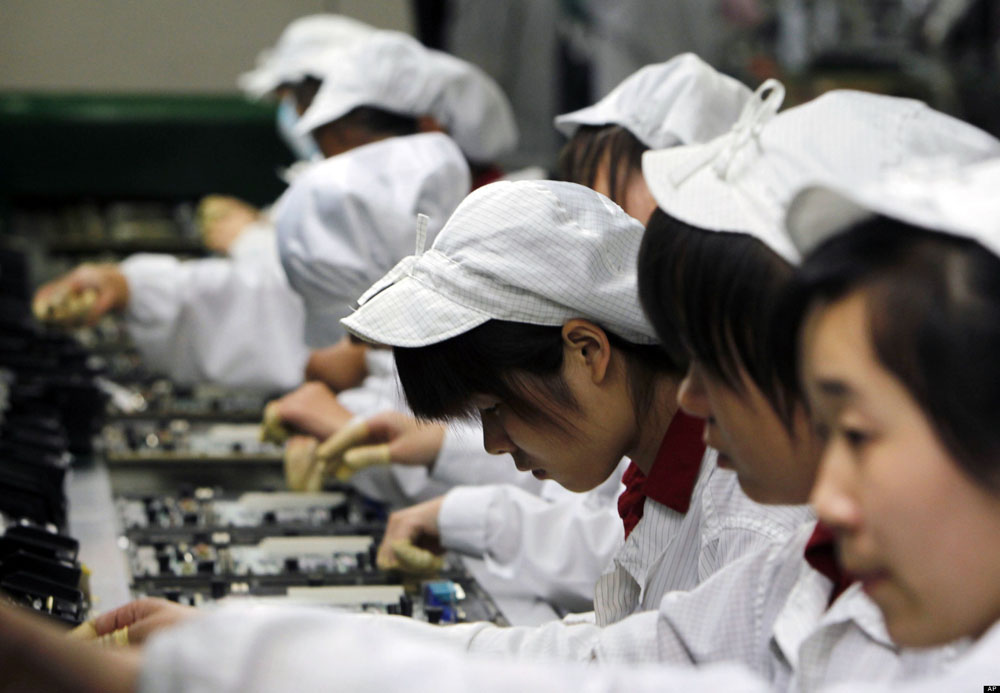
Although everyone assumes Apple products are made in China because labor is cheap there, that’s only part of the story – and an increasingly small part, as the company’s assembly partners move toward more and more automated operations.

Steve Jobs originally transferred most Apple manufacturing to China because it was the only country in the world with a huge ready-made supply-chain network, and the ability to scale up production almost overnight. There are three main reasons China – and specifically the Shenzhen area – is such a powerful manufacturing center.

First, the city is strategically placed, serving as the gateway between mainland China and Hong Kong. It is one of the largest shipping centers in the world, with a massive container port.

Second, the Chinese government established Shenzhen as the first Special Economic Zone (SEZ) in the country. SEZs are designed to encourage enterprise through relaxed planning regulations and generous tax incentives – and crucially, to facilitate foreign investment in local companies. It is this, as much as its geographical advantages, which has enabled it to grow at such a pace.

Third, that SEZ was established way back in 1980, meaning that the city has had over 40 years to grow into the manufacturing center of the tech world. Apple relies on a huge network of suppliers and sub-contractors, some of which may make just a single tiny component. The majority of them are based in Shenzhen and its immediate surrounds, so the logistics of bringing everything together in one place for assembly are straightforward.

What are the risk factors with China?

Being over-dependent on China carries a number of risks.

First, there is the generic one: Being overly dependent on any one country is a strategic risk. For example, the COVID-19 pandemic originated there, and had a massive impact on manufacturing capacity. Anything from a natural disaster to political upheaval could disrupt operations within a single country, so it is always wise to have a diverse range of manufacturing centers around the world.

Second, the relationship between the US and China has often been fraught. The trade war started by the previous US administration was a particularly low point, but continued tensions mean that there is always a risk of disruptions to trade between the two countries.

Third, it is increasingly damaging to Apple’s reputation to be so closely associated with a country that has a worsening human rights record – especially when the iPhone maker has no choice but to comply with local laws, however much they may conflict with the company’s own values. Apple has been required to remove VPN and a variety of other apps from the Chinese App Store, allow the iCloud data of Chinese customers to be stored on government-controlled servers, and more. Additionally, there have been growing reports of forced labor in China, including within many different areas of Apple’s supply chain.

What is Apple doing about it?

Apple has been working for a long time on diversifying its manufacturing operations, and has in recent years accelerated the pace at which it is doing so.

As explained above, this is far from an easy undertaking, but Apple now has major manufacturing operations in India, Thailand, Malaysia, and the Philippines, among other countries.

In India in particular, we are seeing the very early stages of a complete supply-chain infrastructure as the government uses a mix of carrot and stick to encourage companies to manufacture more of their components within the country – namely, tariffs on imports of components and tax breaks for local production. COVID-19 lockdowns in China also saw Apple move some iPad production to Vietnam for the first time, but it’s clear that the risks of over-dependence on China have never been greater.

Site default logo image

‘Apple of China’ brand Xiaomi pips iPhone in latest Chinese app usage stats

Android may have the raw numbers, but iPhone users have always been the ones to make the most use of their phones – from web browsing through enterprise to paid apps. Mobile analytics company Flurry reports that one Android brand has finally caught up – but only in China.

Over the past 6 years, the average Apple iPhone consumer has spent more time in apps than consumers of every Android device we track- by a wide margin. This year, it looks like the story is about to change. In an analysis we conducted on a random sample of 23,000 devices in China throughout January 2014, we found that Xiaomi is now in the lead as far as time-spent in apps is concerned.

It’s no coincidence that the brand is Xiaomi. The company, and its CEO, has blatantly copied Apple’s marketing approach in every way from product launches right the way down to the Steve Jobs style clothing of the company’s founder. The company even recently announced an iPad mini clone known as the Mi Pad.

Xiaomi’s antics have so far been ignored by Apple, which has been focusing on developing good relationships with China, but given the company’s ambitious international expansion plans, there may come a time when Apple has to take a harder line.

(via TNW)

Fourth Swiss Apple Store coming to Basel on July 12th

Site default logo image

Apple will be opening up its fourth official retail store in Switzerland this weekend. A new store in the city of Basel will see its grand opening on Saturday, July 12th, according to a notice on Apple’s Retail Store website. Job listings for the store first appeared earlier this year on Apple’s jobs website. Apple has already surrounded the store with a black banner promoting the store’s website. Apple is also planning several new stores in China, Italy, and the United States under the guide of recently appointed retail head Angela Ahrendts.


Expand
Expanding
Close

Apple begins hiring for another 3 new retail stores in China

Site default logo image

Photo: mshcdn.com

We previously reported that Apple had new retail stores planned for the Chongqing region as well as upcoming locations for Shenyang and Central Hangzhou coming later this year. Today three more stores in China get added to the mix with a job listing on the company’s website hiring for positions in Tianjin, Wuxi, and Zhengzhou in addition to the three stores mentioned above that we already knew about (via Bloomberg). 
Expand
Expanding
Close

Apple’s Ahrendts to oversee slew of new China, Italy, U.S. stores as organizational restructuring planned

Site default logo image

Seeking to enhance Apple’s retail store divison and bring the customer experience to higher levels, new Apple Senior Vice President of Retail and Online Stores Angela Ahrendts is planning a fundamental restructuring of Apple’s retail stores as she prepares a series of new store openings across the globe for the second half of 2014 and first half of 2015…


Expand
Expanding
Close

Site default logo image

Smartphone maker Xiaomi continues to grow, outsells Apple in China during Q1 2014

A new video out of Bloomberg details  just exactly how a once unknown Chinese phone company has able to leapfrog the household names in technology and become the sixth largest mobile handset company in the world, and the third largest in China. Xiaomi was founded back in 2010 and went the total opposite direction in terms of strategy from Apple and Samsung. Making Android powered devices, Xiaomi has focused devices with high build quality and excellent performance.


Expand
Expanding
Close

Android migration means there’s more iPhone growth to come, suggests Cook

Site default logo image

With so many new iOS and OS X features being introduced in yesterday’s WWDC keynote, the numbers that kicked off the show perhaps didn’t get the attention they otherwise might have done.

While the Wall Street line is that the smartphone market is saturated and iPhone and iPad growth is done, Tim Cook clearly thinks otherwise. Business Insider highlighted Cook’s comment on the migration Apple is seeing from Android phones.

“Over 130 million customers who bought an iOS device in the past 12 months were buying their first Apple device,” said Cook before introducing iOS 8, the new software for the iPhone and iPad. “Many of these customers were switchers from Android. They had bought an Android phone — by mistake. Then had sought a better experience … And a better life. And decided to check out iPhone and iOS.”

He added, “Nearly half of our customers in China in the past six months switch from Android to iPhone. This is incredible.”


Expand
Expanding
Close

WWDC ’14: Women in Technology and Apps for China events as most labs remain secret

Site default logo image

Besides a slew of events focused squarely on the technical side of developing and designing applications for iOS 8 and OS X 10.10, Apple, this year, will be holding a pair of interesting events over the course of the first week of June at WWDC.

On Wednesday June 4th from 4:30 to 5:30 PM Pacific Time, an event called Women in Technology Get Together will take place. This important event will discuss “the increased participation of women in technology,” the schedule in the updated WWDC app reads. Apple is making a point to further involve women in the conference this year, even announcing that the National Center for Women & Information Technology (NCWIT) will provide scholarships for women to attend WWDC:


Expand
Expanding
Close

Site default logo image

How blatant? Xiaomi announces ‘Mi Pad’ iPad mini clone [Video]

[youtube=https://www.youtube.com/watch?v=lVp34KQbAqk]

Chinese smartphone maker Xiaomi, the company which specialises in imitating Apple’s marketing for its Android handsets, has launched its first tablet, reports Reuters – and it’s an iPad mini clone. The company has even named it the Mi Pad.

The Mi Pad is essentially a colorful plastic version of the iPad mini with Retina display design, and even has an identical screen resolution of 2048×1536. The tablet has a 2.2GHz Nvidia K1 processor, 2GB RAM and a choice of 16GB or 64GB storage. A heavily-forked version of Android attempts to complete the iPad emulation with an iOS-like look to it.

Xiaomi started life making low-cost, low-spec Android handsets for the Chinese market, but has gradually upped its game to higher-end phones. Last August, Google’s former VP of Hugo Barra joined the company in August of last year (amidst a certain amount of gossip).

Xiaomi has long blatantly copied Apple’s marketing approach, down to its CEO Lei Jun copying Steve Jobs’ trademark blue jeans and black turtleneck shirt at Apple-like product launches.

The $240 Mi Pad will initially be sold only in China, but it’s believed the company plans to expand later into other developing markets, with India, Brazil and Mexico among those suggested. The Mi Pad is said to begin “public testing” in June. No date has yet been given for it to go on public sale.

Analyst: Apple has reached deal with China UnionPay, could include NFC in iPhone 6

Site default logo image

According to Shanghai Mobile analyst Frank Hill, Apple has reached a deal with mobile payment provider China UnionPay that would enable the next iPhone to make purchases at millions of supported Chinese point-of-sale devices. This would work in conjunction with NFC hardware said to be included in the next iPhone model.

UnionPay works with many of China’s major banks, and is the only domestic mobile payment company operating in the country. Several banks have reportedly been invited by UnionPay to participate in the development of a new system that is compatible with iOS devices.

While rumors of NFC in the iPhone have been relatively rare compared to some previous upgrade cycles, this isn’t the first time this year we’ve seen mentions of the technology finally making its way into Apple’s smartphone. Last month a report from analyst Ming-Chi Kuo indicated that we’d see near-field communication in the upcoming device.


Expand
Expanding
Close

Strong iPhone 5s sales sees Apple gain market share in Japan, Australia, UK, France & Spain

Site default logo image

Kantar data showed that Apple saw its smartphone market share rise in five out of nine countries surveyed “primarily due to the strong performance of the iPhone 5s.”

The iPhone gained market share in Japan, Australia, UK, France and Spain, with its strongest growth in Japan, where first quarter market share grew by 8.6 percent, from 49 percent in 2013 ro 57.6 percent in 2014. Apple’s success in the country followed a deal with Japan’s largest wireless carrier, DoCoMo.

Japan’s love affair with Apple shows no sign of fading. Even though the iPhone has now been available on Japan’s largest carrier, NTT DoCoMo, for a number of months Apple still accounts for more than 40% of sales on the network. The success of the iPhone is also filtering through to the iPad, with almost a quarter of Japanese iPhone owners also owning an iPad. With smartphone penetration in Japan lagging well behind Europe and the US, Japan will remain a key growth market for Apple …


Expand
Expanding
Close

Analysts respond to AAPL earnings, rating the stock a strong buy

Site default logo image

Photo: USA Today

Early overnight reports collated by Fortune unsurprisingly show analysts pleased by the higher-than-expected iPhone numbers, with five out of five rating the stock a buy, their price targets ranging from $75 to $252 above yesterday’s closing value. Apple reported iPhone sales of 43.7B against expectations of 38B, and revenue of $45.6B against the consensus estimate of $43.5B.

  • Katy Huberty, Morgen Stanley: Price target $630

  • Gene Munster, Piper Jaffray: Price target $640

  • Brian Marshall, ISI: Price target $600

  • Brian White, Cantor Fitzgerald: Price target $777

  • Peter Misek, Jefferies: Price target $625  …


Expand
Expanding
Close

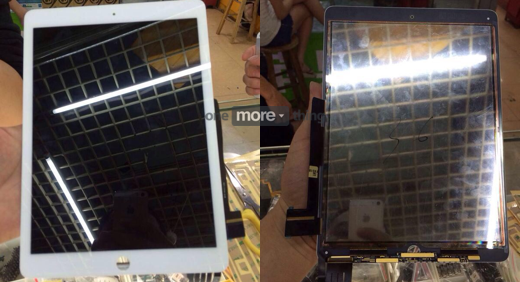
Next-gen iPad Air front panel with integrated display reportedly shown in leaked photos

New photos that reportedly show the front panel of a next-generation iPad Air have surfaced. Originally shared by One More Thing, the front panel appears to have an integrated display. This notable change could result in an even thinner iPad Air, or leave room for Apple to rework the hardware and add additional components.


Expand
Expanding
Close

Site default logo image

Chinese smartphone vendors disappointed by 5s but eagerly awaiting iPhone 6, says analyst

Cantor Fitzgerald analyst Brian White, quoted in Business Insider, had both bad news and good for Apple in his talks with smartphone vendors during a tour of China and Taiwan, claiming disappointment with sales of the iPhone 5s but big hopes for the iPhone 6.

In the near term, we sensed disappointment around demand for the iPhone 5s.

That said, we heard great enthusiasm around the potential for Apple to introduce a larger iPhone form factor in China this year with the iPhone 6. In our view, the iPhone 6 with a larger screen (e.g., 4.7-inch, 5.5-inch) has the potential to meaningfully accelerate Apple’s growth trajectory in China during 2H:14. We have not heard this type of excitement in China around the iPhone in at least two years and thus we believe this could be a very special iPhone launch for Apple.

White doesn’t have the greatest record of reliability (he’s the guy who told us the Apple television set was launching last year, with an iRing controller), but lower than anticipated iPhone 5s sales does seem consistent with the rather muted comments made by China Mobile chairman Xi Guohua last month.

China Mobile sold over 1M iPhones last month, chairman non-committal about the numbers

Site default logo image

Photo: readwrite.com

China Mobile announced that it sold 1.34M 4G handsets in February and that “most of them” were iPhones. China Mobile chairman Xi Guohua was relatively non-committal on the numbers.

It’s just been getting started for one or two months. So far it’s hard to tell how that will affect our business […]

We are happy with the progress as we are still building our 4G network and the coverage is only available in some major cities.

Analyst estimates of likely sales had varied widely. Most had predicted at least 15-17M sales a year in China as a whole, however, suggesting that 1M in a month on what is by far the country’s largest carrier may be somewhat lower than anticipated … 
Expand
Expanding
Close

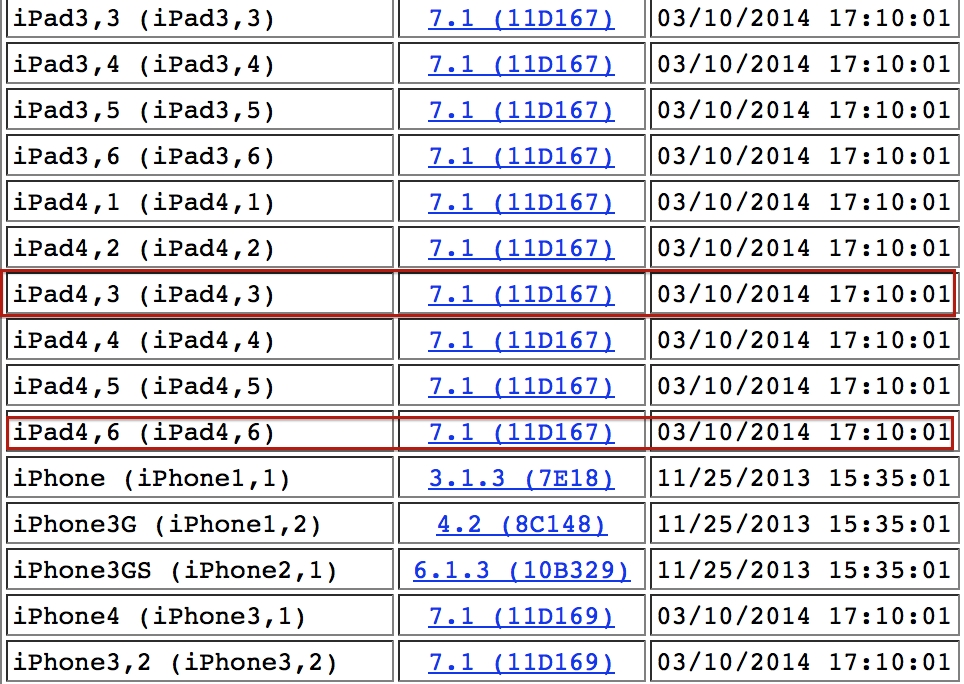
iOS 7.1 builds for two new iPads 4,3 and 4,6 released, likely minor hardware revisions

Site default logo image

<a href="http://ios.e-lite.org">Downloads on iOS-Elite</a>

Besides supporting all iOS 7 devices, iOS 7.1 brings support for a pair of new iPad models: iPad 4,3 (download link) and iPad 4,6 (download link). These models have not been announced by Apple, but they likely represent minor hardware revisions…


Expand
Expanding
Close

Site default logo image

Apple adding hundreds of new engineers and operations staff in China to speed development of larger iPhones

Apple is on a mass hiring spree for Asian staff, beginning in the middle of last year, as noted by the Wall Street Journal. The Journal says that Apple is trying to speed up product development in China and Taiwan to help launch a larger lineup of devices. Apparently, the company is aggressively hiring away from HTC and other firms to form strong product teams in Asia.


Expand
Expanding
Close

Site default logo image

Apple suing China’s patent office & Zhizhen Network Technology over Siri

Tim Cook during the China Mobile launch earlier this year

Amid Apple’s push to expand its presence in China with its new deal with China Mobile, AFP reports Apple is suing the State Intellectual Property Office in China as well as Zhizhen Network Technology.

The dispute is not a new one as Zhizhen Network Technology previously sued Apple over disputes with Siri and its Xiao i Robot product, but this time the roles are reversed. Furthermore, Apple is filing suit against the patent office responsible for protecting patent rights after the agency declined to invalidate Zhizhen’s patent, according to the report.

The case will be heard on Thursday by the Beijing Number one Intermediate People’s Court, but no ruling has been announced for the case heard last July yet, so we it may be some time before this concludes.

Site default logo image

Apple’s market share in China started climbing even before China Mobile deal; Russian sales double

Photo: readwrite.com

While smartphone growth is slowing in China, Apple managed to increase its market share from 6 to 7 percent in the final quarter of 2013, even before the China Mobile deal was struck. IDC figures reported by the WSJ show that Apple is now the fifth largest smartphone seller in the country, behind Samsung, Lenovo, Coolpad and Huawei. Xiaomi sits just behind Apple at 6 percent.

Apple’s share is likely to increase significantly in the current quarter, thanks to finally being sold through China’s largest carrier, China Mobile. The carrier has more than 760M subscribers, and analysts have estimated that the deal will generate between 15M and 30M additional iPhone sales in the course of 2014.

iPhone sales in Russia, meantime, doubled to 1.57M units with a total value of $1B, reports Bloomberg. Apple had struggled to persuade Russian carriers to sell the iPhone due to its high price and laws that forbid carriers from discounting up-front prices in return for signing up to lengthy contracts. After selling through electronics stores, however, three Russian carriers resumed selling iPhones within the past few months.

The so-called BRIC markets – Brazil, Russia, India and China – are of huge importance to Apple now that the U.S. and Europe have reached saturation point. While Apple will never compete in market share with the low-end Android handsets available in these markets, there is still significant growth potential at the high end. In an earlier WSJ interview, Tim Cook said:

I look at the mobile phone market as having three kinds of phones: feature phones, smartphones that function as or are used as feature phones, and real smartphones. I do care about the market share of the last category and you want to be relevant.

The importance of the BRIC markets was illustrated when it was revealed that Apple’s Asian sales had outstripped those of Europe even by Q1 of last year. Next quarter’s China numbers are going to make very interesting reading.

Site default logo image

How big a thing could Touch ID mobile payment be? China alone hit $1.6 trillion last year

With Tim Cook having as good as confirmed that mobile payment via Touch ID is on the way, numbers released by the People’s Bank of China and reported in TechNode provide an insight into just how big the mobile payment market could be. Total mobile payments in China last year hit 9.64 trillion yuan – equivalent to $1.59 trillion.

Mobile transactions on just one of China’s mobile payment services reached 25,000 per minute. While China has a population of 1.3B, contrasted with around 317M in the USA, and many of those in China use a mobile device as their primary Internet connection, it still illustrates what a huge opportunity iPhone-based payments could represent for Apple.

It’s been suggested that Apple’s approach may be to allow payment to be made via iTunes accounts, effectively turning Apple into a bank – a prediction I made last September. Using iTunes as a payment method would mean that customers would not have to hand over card details to retail stores. In the light of recent large scale card compromises at Neiman Marcus (1.1M cards) and Target (2M cards), this may well prove a strong reason for iPhone owners to use the service.

Via TNW

Site default logo image

The changing world map of Apple’s customers in two charts

Apple’s efforts to secure the China Mobile deal were long, drawn out and likely involved rather more negotiation than the company is used to. But if you ever had any doubts as to the importance of those efforts in China, Japan and elsewhere in the Asia-Pacific region, the above two charts, compiled by Fortune, make the reason very clear.

The bad news for Apple is that revenue from its two biggest segments — Europe and the Americas — have begun to contract, not just as a percentage of total revenue, but in dollar terms as well. The good news is that Japan, Asia Pacific and Greater China have so far more than taken up the slack. In Q1 2014, Apple’s combined Asian sales were $17.4 billion, more than Europe ($13 billion) and closing in on the Americas ($20 billion).

Site default logo image

A billion smartphones were sold last year, says IDC

Image: theguardian.com

A billion smartphones were sold in 2013, according to IDC data, the first time the milestone has been hit. The number represents one smartphone sale for every seventh man, woman and child on the planet.

IDC says that price has been the main driver for growth, putting yesterday’s market share stats into perspective.

Markets like China and India are quickly moving toward a point where sub-$150 smartphones are the majority of shipments

iPhone market share continues to fall, but it’s Samsung feeling the pressure

Site default logo image

While Android reaching almost 70 percent of smartphone sales across 12 key markets is the headline, with iOS falling to just under 24 percent, it is Samsung feeling the pressure, says Kantar, reporting sales figures for the final quarter of 2013.

After years of accelerated growth, Samsung is now coming under real pressure in most regions, with European share down by 2.2 percentage points to 40.3% and in China its share ended the year flat at 23.7% […]

Apple has lost share in most countries compared with this time last year, but importantly it has held strong shares in key markets including 43.9% in USA, 29.9% in Great Britain and 19.0% in China … 
Expand
Expanding
Close

China Mobile iPhone launch could lead to subsidy wars, say analysts

Site default logo image

Image: thenextweb.com

Analysts say that the official launch of the iPhone on China Mobile could lead to subsidy wars as Chinese carriers compete to attract buyers. The predictions, quoted by Business Insider, follow price cuts by rival carriers China Unicom and China Telecom as China Mobile reports 1.2 million pre-orders.

China Mobile is currently offering the iPhone 5s free with a 24-month contract costing the equivalent of $98 a month. A 30-month contract on China Unicom costs $63 a month.

I do think you’re going to see a subsidy war coming,” said Michael Clendenin, managing director of Shanghai-based RedTech Advisors. “China Mobile, if they’re not making their targets on sales for these phones, they’re going to increase the subsidies […] It’s like airlines: the other guys will fall like dominoes, so China Unicom will do it and China Telecom will do it” … 
Expand
Expanding
Close