MacBook Pro: The biggest and baddest Mac laptops

See All Stories

Apple's premium laptop comes in 13- and 16-inch screen sizes. Each model includes 2-4 USB-C ports for charging, accessories, and data transfer. Higher-end models also include the Touch Bar.
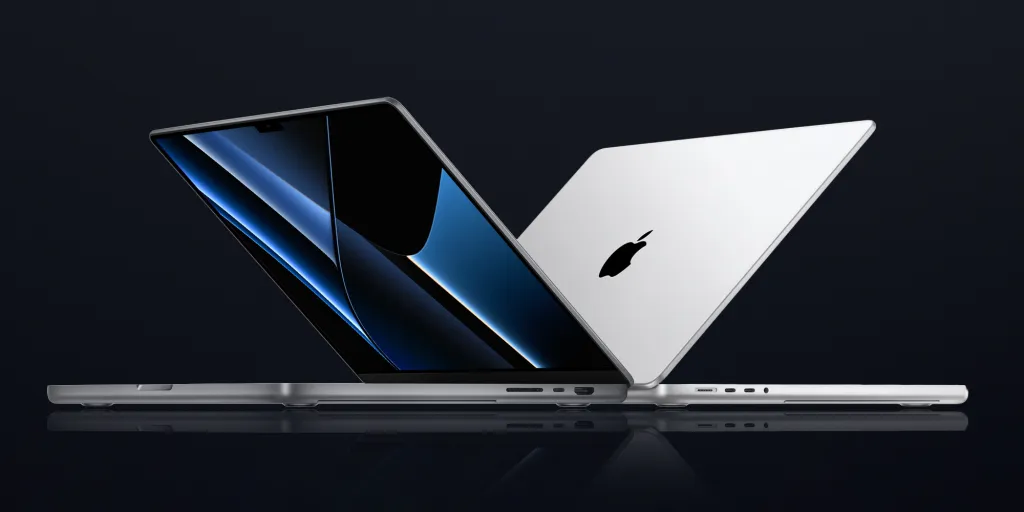
2021 MacBook Pro

MacBook Pro has been the product name for Apple’s high-end laptop since early 2006 when the transition to Intel processors began. Now, that Pro naming has carried forth as Apple has moved to its own silicon. The latest fourth and fifth-generation Pro Apple notebooks bring dramatically more power with lower heat generation and better battery life thanks to the ARM-based Apple silicon. Keep reading for a brief history of the line and a breakdown of the current lineup.

MacBook Pro history

The first generation MacBook Pro followed in the style of the PowerBook G4 that came before it, but used Intel processors rather than PowerPC chips.

The second generation of the MacBook Pro was the first to really separate itself from the products before, with a unibody enclosure. The third-generation MacBook Pro introduced the retina display as well as MagSafe 2.

Perhaps the most controversial version of the MacBook Pro is the fourth generation. While the third generation received some backlash for the removal of ethernet and the optical drive, the fourth generation was a complete rethinking of the device peripherals. No more MagSafe, no more USB-A ports, and only the 13-inch model kept the function keys. Instead, this redesigned MacBook Pro opted for all Thunderbolt 3 ports and headphone jack. In place of function keys, the MacBook Pro gained an OLED Touch Bar. In late-2020, Apple introduced the M1 chip and updated the 13-inch MacBook Pro. The ARM-based processor brought down power consumption and increased performance.

In October of 2021, Apple introduced the fifth-generation MacBook Pro with not one but two updated versions of the M1 chip, the M1 Pro and M1 Max. The move walked back some of the decisions from the previous generation, adding back an HDMI Port, MagSafe charger, and SD card reader while removing the Touch Bar.

The 2020 13-Inch MacBook Pro

In late 2020, Apple introduced the 13-inch M1 MacBook Pro as the latest update to the fourth-generation MacBook. The MacBook features the same look as previous MacBooks, but like the MacBook Air and Mac Mini, switched to Apple silicon.

Apple’s M1 chip brought ARM architecture to the MacBook line, and this was the first MacBook without an Intel processor.

The M1 chip is a unified design with an 8-core CPU and an 8-core CPU. The processor integrated memory on board, limiting the device to either 8GB or 16GB of unified memory. The 13-inch M1 MacBook Pro is configurable with between 256GB and 2TB of storage and features a Magic Keyboard, rather than the problematic butterfly keyboard.

13-inch MacBook Pro specs

Base Configuration$1,299.00

  • Apple M1 chip with 8‑core CPU, 8‑core GPU, and 16‑core Neural Engine
  • 8GB unified memory
  • 256GB SSD storage
  • 13-inch Retina display with True Tone
  • Backlit Magic Keyboard – US English
  • Touch Bar and Touch ID
  • Two Thunderbolt / USB 4 ports

Max Configuration$2,299.00

  • Apple M1 chip with 8‑core CPU, 8‑core GPU, and 16‑core Neural Engine
  • 16GB unified memory
  • 2TB SSD storage
  • 13-inch Retina display with True Tone
  • Backlit Magic Keyboard – US English
  • Touch Bar and Touch ID
  • Two Thunderbolt / USB 4 ports

13-inch MacBook Pro pricing

The price for the 13-inch M1 MacBook Pro starts at $1,299. Upgrading this base configuration to 16GB of memory adds $200 to the price. Likewise, each step above 256GB of storage – 512GB, 1TB, and 2TB – will add $200 to the price. A fully specced out 13-inch MacBook Pro will run you $2,299.

You can configure your own 13-inch MacBook Pro on Apple’s website.

Current 14-inch and 16-inch MacBook Pro

In October 2021, Apple brought a brand new design to the MacBook Pro line. Apple increased the screen size on the 13-inch, making it a 14-inch, and shrunk the bezels on the 16-inch. This fifth-generation notebook addressed many complaints of the last generation. MagSafe returned, in the form of an improved MagSafe 3, while the MacBook also regained an HDMI port and an SD-card slot.

Also gone is the Touch Bar. Instead, the standard row of function keys return. The latest MacBooks also bring a ProMotion display that was first introduced on the iPad Pro, with a variable refresh rate and mini-LED backlight.

The 2021 MacBooks aren’t without a controversial feature, as while the display has been made larger there is now a large notch for the 1080P FaceTime camera. While FaceID would have been a nice addition in exchange for this small chunk of the screen, there are some reasons this is not totally practical.

14-inch MacBook Pro specs

Base Configuration$1,999.00

  • Apple M1 Pro with 8-core CPU, 14-core GPU, 16-core Neural Engine
  • 16GB unified memory
  • 512GB SSD storage
  • 67W USB-C Power Adapter
  • 14-inch Liquid Retina XDR display
  • Three Thunderbolt 4 ports, HDMI port, SDXC card slot, MagSafe 3 port
  • Backlit Magic Keyboard with Touch ID – US English

Maximum Configuration$5,899.00

  • Apple M1 Max with 10-core CPU, 32-core GPU, 16-core Neural Engine
  • 64GB unified memory
  • 8TB SSD storage
  • 96W USB-C Power Adapter
  • 14-inch Liquid Retina XDR display
  • Three Thunderbolt 4 ports, HDMI port, SDXC card slot, MagSafe 3 port
  • Backlit Magic Keyboard with Touch ID – US English

14-inch MacBook Pro pricing

The 14-inch MacBook Pro starts at $1,999. The base model includes 16GB of memory, 512GB of storage, and an M1 Pro processor with an 8-core CPU and 14-core GPU. There are multiple versions of the M1 Pro processor available, while jumping to an M1 Max processor will cost $500 more, and requires you to jump up to 32GB of memory – a $400 upgrade. Going with the M1 Max processor means you can configure up to the full 64GB of memory, an $800 upgrade.

You can configure up to 8TB of storage in the 2021 14-inch MacBook Pro. Upgrade costs are as follows:

  • 1TB SSD Storage – $200
  • 2TB SSD Storage – $600
  • 4TB SSD Storage – $1,200
  • 8TB SSD Storage – $2,400

You can configure your own 14-inch MacBook Pro on Apple’s website.

16-inch MacBook Pro specs

Base Configuration$2,499.00

  • Apple M1 Pro with 10-core CPU, 16-core GPU, 16-core Neural Engine
  • 16GB unified memory
  • 512GB SSD storage
  • 16-inch Liquid Retina XDR display
  • Three Thunderbolt 4 ports, HDMI port, SDXC card slot, MagSafe 3 port
  • 140W USB-C Power Adapter
  • Backlit Magic Keyboard with Touch ID – US English

Maximum Configuration$6,099.00

  • Apple M1 Max with 10-core CPU, 32-core GPU, 16-core Neural Engine
  • 64GB unified memory
  • 8TB SSD storage
  • 16-inch Liquid Retina XDR display
  • Three Thunderbolt 4 ports, HDMI port, SDXC card slot, MagSafe 3 port
  • 140W USB-C Power Adapter
  • Backlit Magic Keyboard with Touch ID – US English

16-inch MacBook Pro pricing

The 16-inch MacBook Pro starts at $2,499. There is only one M1 Pro processor available on the 16-inch MacBook, and that’s the highest version 10-core CPU, 16-core GPU version of the M1 Pro processor that is a $300 upgrade on the 14-inch MacBook Pro. Of course, you can also step up to the M1 Max processor with either a 24-core or 32-core GPU, a $200 and $400 upgrade respectively (which also requires the $400 upgrade to 32GB of memory). The memory and storage options are all the same as the 14-inch MacBook Pro.

You can configure your own 16-inch MacBook Pro on Apple’s website.

Differences between 13-inch,14-inch, and 16-inch models

The 2021 MacBook Pro lineup is a refreshing change. The return of ports and physical keys make the laptops more versatile, while additions like an XDR display and hardware acceleration for ProRes improves the experience but is harder to quantify for the average user.

13-inch14-inch16-inch
ProcessorM1M1 Pro / M1 MaxM1 Pro / M1 Max
Memory8GB / 16GB16GB / 32GB / 64GB16GB / 32GB / 64GB
Storage512GB, 1TB, 2TB512GB, 1TB, 2TB, 4TB, 8TB512GB, 1TB, 2TB, 4TB, 8TB
Screen2560×1600 pixels 3024×1964 pixels; ProMotion3456×2234 pixels; ProMotion
Weight3.0 pounds (1.4 kg)3.5 pounds (1.6 kg)M1 Pro: 4.7 pounds (2.1 kg)
M1 Max: 4.8 pounds (2.2 kg)
Size (Width x Depth)11.97 x 8.36 inches (30.41 x 21.24 cm)12.31 x 8.71 inches (31.26 x 22.12 cm)14.01 x 9.77 inches (35.57 x 24.81 cm)
Height0.61 inch (1.56 cm)0.61 inch (1.55 cm)0.66 inch (1.68 cm)
Base Price$1,299.00$1,999.00$2,499.00

The $1,999 starting price for Apple latest computer is a harder pill to swallow than the $1,300 13-inch Pro from last year. For an average user, the superb M1 MacBook Air will likely suffice (and that sub-$1,000 price is hard to pass up).

But the 2021 14-inch and 16-inch MacBook Pro are exactly what they need to be, a return to function-over-form that will truly meet the needs of professional users.


Satechi launches ‘Type-C 75W Multiport Travel Charger’ for MacBook, iPhone, and iPad

At CES 2018, Satechi has announced another new USB-C accessory on the heels of unveiling its Smart Dual Charging Station for iPhone and Apple Watch yesterday. The “Type-C 75W Multiport Travel Charger” offers 2 – 2.4A USB-A ports, 1 – QC 3.0 USB-A port, and 1 – USB C port at a fair price.


Expand
Expanding
Close

Hands-on: Akitio Node Pro – a more refined external graphics box for Mac [Video]

The original Akitio Node was the first external graphics box that came with a Mac-compatible Thunderbolt 3 chipset. Hence, it was recognized by macOS without needing to rely on hacks like previous eGPU boxes. Needless to say, the Akitio Node was and continues to be popular among Mac enthusiasts looking to drive external graphics.

Recently, Akitio launched the latest product in its external graphics Node line — the Akitio Node Pro (currently sold out on Amazon). The result is a more refined external graphics box with a built-in DisplayPort connection, and a second Thunderbolt 3 port for daisy-chaining to other Thunderbolt 3-enabled devices. Watch our hands-on video for a first look the at $360 Node Pro.
Expand
Expanding
Close

Apple takes fourth place in global laptop shipments in Q3, thanks to new MacBook Pro models

According to TrendForce, Apple managed to secure the fourth spot in global shipments of laptops in the third quarter. Apple notebook sales beat the market in quarterly growth; MacBook sales increased 11% whilst the market rose 7% overall.

The analysts believe Apple shipped 4.43 million Mac laptops in total across July, August, and September. Apple benefited from the launch of the 2017 MacBook Pro refresh ahead of the busy back-to-school season.


Expand
Expanding
Close

Three Macs declared obsolete/vintage as free ‘Staingate’ coverage ends for 2012 Retina MacBook Pro

Apple has declared that three Macs are now obsolete or vintage, and that the company will no longer offer repair services or replacement parts for them. For legal reasons, the situation is different in Turkey and California, where some of the computers are instead labeled ‘vintage’ and will continue to be supported for a further two years …


Expand
Expanding
Close

Review: CalDigit AV Pro 2 – an external storage solution with a built-in USB 3.0 hub [Video]

CalDigit is no stranger when it comes to producing peripherals for the Mac. In particular, the California-based company has concentrated on Apple’s laptops with USB-C and Thunderbolt. The CalDigit AV Pro 2 is its latest such product: an external storage solution wrapped in a high-grade aluminum enclosure.

CalDigit has merged external storage with a USB 3.0 hub to create a product capable of providing three things of interest to MacBook owners — access to more storage, additional USB ports, and charging up to 30W. Have a look at our video walkthrough as we unbox and go hands-on with the CalDigit AV Pro 2.
Expand
Expanding
Close

Review: OWC Thunderbolt 3 Dock adds 12 I/O ports and charging to MacBook Pro with a single cable at your desk

The promise of Apple’s USB-C laptop future is expandability, versatility and flexibility. Plugging in single-device dongles for USB and HDMI is a stop-gap, but is wasting the potential of the port.

The OWC Thunderbolt 3 Dock ($299) better fulfills the idea: one port, one cable, provides power and a multitude of inputs and outputs like normal USB, a 3.5mm jack, SD card, mini DisplayPort, Ethernet and more. It isn’t perfect, but I’ve been using it for months now with my MacBook Pro and it adds so much convenience and utility. Read on for my full review …


Expand
Expanding
Close

Latest Transcend SSDs for DIY Mac upgrades support high-speed PCIe 3.0

Transcend, which has long offered Mac owners the chance to upgrade their SSDs to higher-capacity ones, has announced a new range of drives that support PCIe Gen 3.0. These cards, which use the latest 3D NAND flash chips, offer read/write speeds of up to 950MB/s.

The new JetDrive 820 drives are available in capacities of up to 960GB, and are compatible with a wide range of Macs …


Expand
Expanding
Close

This Thunderbolt 3 hard drive/SSD enclosure looks like a mini cheese-grater Mac Pro

I always loved the design of the old ‘cheese-grater‘ Mac Pro, and computer storage company Akitio has used it as the inspiration for its new Thunderbolt 3 drive enclosure.

The company says that the Akitio Thunder3 Quad X was designed for use with the MacBook Pro. The previous version – which had a more generic design – did not support Macs …


Expand
Expanding
Close

MacBook shipments grew by 17% in Q2, with more double-digit growth ahead – TrendForce

TrendForce’s latest global laptop shipment report, seen by us, says that MacBook shipments grew by a healthy 17.1% in Q2, helped in large part by sales of the updated 12-inch MacBook.

The growth boosted Apple’s market share from 9.3% to 10%, bringing it very close to challenging ASUS for the #4 slot behind HP, Lenovo and Dell …


Expand
Expanding
Close

Review: TwelveSouth’s new BookBook Vol 2 case for the latest MacBook Pro models

I have a bit of a love-hate relationship with cases for iDevices. My general view is that we pay a lot of money for a beautifully-designed device, so it seems a great shame to hide them away inside a case.

On the other hand, there are some cases that are beautiful in themselves. For example, my iPhone 6 lived in a Mujjo Leather Wallet Case most of the time. That was mostly, though, for the convenience of being able to carry a couple of cards with me when I wanted to go out without my wallet. My iPhone SE travels naked.

My iPad spends a lot of its time attached to a Brydge keyboard, which also protects the screen, but doesn’t sit inside a case. My MacBook Air does still live inside a Burkley hardshell leather case because I’m a big fan of leather and think that looks just as good as the machine itself.

But the portability of my 2016 MacBook Pro means that this, not the Air, is the machine I carry with me when I need more than an iPad. That meant I did need to think about protecting it …


Expand
Expanding
Close

Hands-on: Akitio’s portable 4-Bay Thunderbolt 3 external storage solution turbo-charges your Mac [Video]

Last year I went hands-on with a few Akitio Thunderbolt 3-enabled drive enclosures for 9to5Mac, but none of the previous enclosures came with out-of-the-box support for macOS. Instead, users had to rely on a hack in order to enable support for these enclosures, due to the fact that macOS wasn’t compatible with the Thunderbolt 3 chipsets being used.

In today’s world, things are a bit different. Much of the Thunderbolt 3 hardware shipping today is no longer “Windows only”, which is a great thing for recent MacBook Pro and Mid-2017 iMac hardware with Thunderbolt 3 I/O capabilities.

Akitio’s Thunder3 Quad Mini is one such example of Thunderbolt 3-enabled hardware made with the Mac in mind. This four-bay enclosure comes with two Thunderbolt 3 ports in a small aluminum enclosure that supports passive cooling for noiseless operation. In other words, it’s a quiet enclosure that’s perfect for RAID 0 SSD setups for maximum speed. Have a look at our hands-on video walkthrough for more details.
Expand
Expanding
Close

Mini-review: Compulocks Ledge brings back security locks to thinner Macs

One of the many slots in MacBooks that has disappeared over the years is the security slot. For anyone who doesn’t remember these from the pre-Retina machines, this was a small horizontal slot into which you could insert a T-shaped security lock attached to a cable.

You ran the cable around something solid like a desk leg, fed it back through a loop and then inserted the lock into the slot on your Mac. Locking it would twist the T-shaped element 90 degrees, securing it in place.

It wasn’t the highest security in the world – cable locks can be easily snipped with hand croppers – but it protected against opportunist snatch thieves in places like libraries and coffee shops. As of the Retina MacBook Pro, however, Apple removed the slot …


Expand
Expanding
Close

iFixit launches battery replacement kits for MacBook Pro with Retina Display [Video]

Recent MacBooks aren’t exactly noted for their repairability, a change that started in 2012 with the 15-inch MacBook Pro with Retina display. Among the many changes introduced was a battery very firmly glued to the chassis, making it next to impossible to replace.

But iFixit likes a challenge, and has now come up with a DIY battery replacement kit which it reckons allows the job to be tackled by mere mortals …


Expand
Expanding
Close

Hands-on: CalDigit’s TS3 is a compact dock with full speed MacBook Pro power delivery [Video]

CalDigit’s TS3 is a Thunderbolt 3-enabled dock in a very compact form factor. The dock omits the flat landscape design that has been the hallmark of most Thunderbolt 3 docks thus far, and instead comes with a compact design that can be placed on a desk vertically or horizontally.

Most notably, the CalDigit TS3 affords full-speed 15-inch MacBook Pro charging thanks to its 85W of power delivery. This is a feature that many of the previous Thunderbolt 3 docks, including CalDigit’s own TS3 Lite, weren’t capable of.

Yet, as someone who just recently traded a 2016 MacBook Pro for a Thunderbolt 3-enabled 2017 iMac, I was also anxious to see how the dock would integrate with my desktop setup. Have a look at our hands-on video walkthrough inside for the details.
Expand
Expanding
Close