Steve Jobs

See All Stories

The foundation of Apple

Steve Jobs was the co-founder and CEO of Apple. He also founded NeXT and was the majority shareholder of Pixar, both of which he was also CEO. Jobs is known as an icon of creativity and entrepreneurship. The prolific author Walter Isaacson released Jobs’ biography in October of 2011. Isaacson describes his major accomplishment as being a “creative entrepreneur whose passion for perfection and ferocious drive revolutionized six industries: personal computers, animated movies, music, phones, tablet computing, and digital publishing.”

Jobs attended Reed College for a short period of time before dropping out in 1972. However, he continued to dabble with classes unofficially and came across a calligraphy course instructed by Robert Palladino. This course ended up being highly influential for Jobs as he attributed it to bringing multiple typefaces to the Mac.

Steve Jobs founded Apple with Steve Wozniak and Ronald Wayne in 1976. After a drawn out power struggle Jobs was pushed out of Apple in 1985. He then founded NeXT in 1985 and also funded the move of Lucasfilm’s Graphics Group to become its own corporation, which became Pixar in 1986. Just over a decade later in 1997, Jobs returned to Apple as they acquired NeXT. His return marked the beginning of a new era of success. He took over as CEO in July of 1997 and continued on until handing the position to Tim Cook on August 24, 2011 after increasing health problems. Jobs passed away on October 5, 2011.

Isaacson describes his major accomplishment as being a “creative entrepreneur whose passion for perfection and ferocious drive revolutionized six industries: personal computers, animated movies, music, phones, tablet computing, and digital publishing.”
Steve Jobs named #1 in CNBC’s list of the most influential leaders in the past 25 years

Site default logo image

Steve Jobs has been ranked #1 in CNBC’s First 25: Rebels, Icons & Leaders, described as “a definitive list of people who have had the greatest influence, sparked the biggest changes and created the most disruption in business over the past quarter century.”

Steve Jobs earned the top spot for both transforming the way we think about technology and redefining the style in which we live […]

More than any other member of our group of extraordinary entrepreneurs and executives—all outstanding leaders—his vision spurred changes far beyond his industry and put an indelible stamp on the wider culture … 


Expand
Expanding
Close

Site default logo image

Mossberg: Apple is a movie studio and its next blockbuster is coming later this year

Recode’s Walt Mossberg is out with an interesting piece today taking a look at Apple after Steve Jobs and revisiting Tim Cook’s promise of new product categories across 2014. While comparing Apple and its product releases to movie studios— big blockbuster hits followed by sequels that often make more money— Walt says Apple execs have told him “impressive new products” are indeed on the way.

But I think the most useful way of thinking about Apple is to see it as a movie studio. Studios release blockbuster franchise movies every few years, and then try to live off a series of sequels until the next big, successful franchise. We are in the early stages of one such project right now: On May 2, Columbia Pictures will release “The Amazing Spider-Man 2,” the first of what may be several sequels to the original 2012 film, that was itself a reboot of an earlier series.

Just because these things are sequels doesn’t mean they’re bad, or even worse than the originals. Sometimes, as with “The Godfather Part II,” the sequel is considered by many to be even better than the original. (Of course, sometimes — as with “The Godfather Part III,” a sequel may be reviled as so bad that it’s unworthy of the series.)… And sequels can make more money — sometimes much, much more — than the originals.

While Mossberg has had relative success with Apple’s sequel products in recent years— despite a few hiccups with Maps and iOS 7— he claims “Apple executives have assured me that the second half of 2014 will have impressive new products.” Whether that includes a new game-changing product or “franchise” category remains to be seen.

Sony eyes Danny Boyle as Steve Jobs biopic director, Leonardo DiCaprio to star

Site default logo image

DiCaprio and Boyle on the set of the 2000 film “The Beach”

With David Fincher recently rejected to direct the upcoming Steve Jobs biopic written by Aaron Sorkin, Sony may have found its replacement in Slumdog Millionaire director Danny Boyle, according to The Hollywood Reporter. And with the lead role still not cast, Sony is reportedly considering tapping Leonardo DiCaprio to play Steve Jobs.

The film was first announced by Sony in mid-2012. Screenwriter Sorkin later revealed that the movie would focus on Jobs’ preparations in the thirty minutes leading up to three key Apple keynotes—a much different approach last year’s Jobs, which starred Ashton Kutcher. There have not been many updates on the project’s progress until recently, with the announcement that Fincher (and his choice for lead actor, Christian Bale) would not be part of the production going forward.


Expand
Expanding
Close

Death of Steve Jobs prompted Samsung’s U-turn on Apple attack ads

Site default logo image

We learned yesterday from patent trial evidence that Samsung was worried about running ads that directly attacked Apple, wanting Google to do it for them. We now know that it was the death of Steve Jobs which prompted Samsung’s change of mind, running the Next Big Thing ads which directly mocked Apple customers.

An email trail shows that Samsung America’s VP of U.S. sales Mike Pennington cynically described the death of Jobs as “the best opportunity” to run the campaign, as consumers might be worried about Apple’s future product innovations following the death of its famous co-founder.

Sorry to continue to push this issue, but I have seen this far too long and I know this is our best opportunity to attack iPhone …


Expand
Expanding
Close

Jony Ive shakes up Apple’s software design group, iPhone interface creator Greg Christie departing

Site default logo image

Following friction between top Apple Human Interface Vice President Greg Christie and Senior Vice President Jony Ive, Apple’s hardware and software design is being dramatically shaken up, according to sources familiar with the matter. After adding human interface design direction to his responsibilities in 2012, Ive will soon completely subsume Apple’s software design group, wresting control away from long-time human interface design chief Christie, according to sources briefed on the matter. Previous to this shakeup, all Apple software design has been led by Christie, who has reported to Craig Federighi, and Ive has been attending interface design meetings and providing instruction…


Expand
Expanding
Close

Steve Jobs in 2010 on Apple TV’s future: Magic Wand, apps, Web browser

Site default logo image

<a href="http://9to5mac.com/write-a-community-article/apple-tv-concept-03/">Apple TV Concept</a>

An interesting email chain between Steve Jobs and various Apple executives has surfaced via court records for the latest spat between Apple and Samsung. Our earlier article on the matter detailed some parts of the email in which Jobs revealed roadmap plans for 2011 and some of 2012. The discussions were a preview of what was to be discussed at an off-site for Apple’s “Top 100” employees. Presentations regarding the yet-to-be-announced iPad 2, iPad 3, iPhone 4s, iPhone 5, Verizon iPhone 4, Apple Campus 2, and iCloud took place, but the talking points regarding Apple TV deserve a closer look in light of recent rumors of an imminent update


Expand
Expanding
Close

New Steve Jobs email a treasure trove of information about Apple TV, Google ‘holy war,’ and behind-the-scenes strategy

Site default logo image

A new email from Steve Jobs that was published during today’s Samsung lawsuit (via The Verge) has revealed a lot about Apple’s plans for its products in 2011 and beyond. As we’ve previously noted, Jobs referred to 2011 as a year of “holy war” against Google, but this document goes above that and describes how exactly Apple planned to wage this war.

A few choice bits are below, followed by the complete email.


Expand
Expanding
Close

This is the room where the iPhone was born

Site default logo image

Ahead of the latest Apple-Samsung trial, Apple is sharing some of the details regarding the creation of the iPhone with the WSJ. As an aside, Apple also shared a shot of the secret windowless room where the original iPhone meetings took place. The nondescript room is where most of the design decisions for the original iPhone’s software were made and is called “hallowed ground” to Greg Christie, who designs the software interface for products and one of the first members recruited to work on the device in 2004.

It doesn’t mean that the windowless room, lit by fluorescent lights hanging from the ceiling, looked like anything special. Christie recalled the walls had signs of water damage from a flood in an adjacent bathroom. A few images covered the walls including one of Apple’s “Think Different” posters of famous graphic designer Paul Rand and another of a large chicken running around without its head.

Inspiration comes in many forms.

Apple may be sharing this information to drum up public support before the trial. Or, perhaps more likely, Apple knows this information will come out in the trial and wants to “own” the story beforehand.


Expand
Expanding
Close

Apple engineer Greg Christie discusses the process of creating the original iPhone

Site default logo image


Apple made Greg Christie, one of its original iPhone engineers, available before yet another round of patent fights with Samsung, allowing Christie to further expand on the stories of the iPhone’s secretive development under then-CEO Steve Jobs in a report by the Wall Street Journal. While some of what Christie said isn’t new information, there are some interesting anecdotes near the end of his interview.

For example, in 2005—two years before the Apple went public with the iPhone—Christie’s team was responsible for planning how the device would look and work. When the team found itself floundering and unable to settle on how the phone should work, Christie was told that his team could either figure it out over the next two weeks or be moved to another project so someone else could solve the problems.


Expand
Expanding
Close

‘Jobs’ biopic starring Ashton Kutcher now available on Netflix

Site default logo image

Update: Not so fast. Despite Netflix promoting the movie on Twitter and it being available earlier, it’s currently no longer available. We’ve reached out to Netflix for more information.

Update 2: Netflix tells me that Jobs “will be back on soon.”

Update 3: Netflix tells me an issue with subtitles led to it being pulled and it should be resolved now.

If you haven’t seen Ashton Kutcher’s portrayal of the late Apple co-founder Steve Jobs yet or just want to catch the film again, Netflix now features ‘Jobs’ in its catalog of streaming movies and TV shows for subscribers. Netflix of course offers streaming to iPhone, iPad, and iPod touch users in addition to Apple and Mac users for $7.99 a month.

The biopic featuring Kutcher was released to mixed reviews, and our own Michael Steeber shared his thoughts on the film in 9to5Mac‘s review of Jobs.


Expand
Expanding
Close

Non-poaching emails show Jobs was warring with Google long before iPhone was launched

Site default logo image

If you’ve paid attention to the ongoing feud between Apple and Google in recent years, you might think that the conflict is the result of Google’s decision to create a competitor to the iPhone after working in tandem with Apple to create the iconic device. And you’d be forgiven for thinking that.

But according to some emails sent by Google’s Sergey Brin back in 2005 that recently surfaced during a class-action lawsuit over the do-not-hire policies of the two companies (among others), that may not be the case. This “thermonuclear war,” as Steve Jobs put it, was a long time coming. Android was just the last straw.


Expand
Expanding
Close

Report: Apple considering iTunes Store for Android & on-demand streaming service

Site default logo image

According to a new report from Billboard, Apple is considering launching an iTunes Store app on the Android platform to combat declining music sales on the digital platform. The report also says that Apple execs are in talks with high level label executives to discuss debuting an on-demand streaming service.

Apple has opened exploratory talks with senior label executives about the possibility of launching an on-demand streaming service that would rival Spotify and Beats Music, according to three people familiar with the talks. Apple is also thinking about adding an iTunes App for Android phones, the Google rival that has been growing faster than the iPhone, these sources said.

The move to an on-demand streaming service could transform iTunes Radio from the Pandora-like radio model to the more robust on-demand model used by Spotify, Rdio, Beats Music, and others.
Expand
Expanding
Close

Eddy Cue throws a pen at Haunted Empire/Yukari Kane’s accuracy, says story isn’t true

Tim Cook may have called the Haunted Empire book ‘nonsense’, but the derisive comments about the book from Apple executives do not end there. Personally, I found the pen-throwing anecdote too funny and decided to ask Cue whether it was true or not. I wasn’t really expecting a reply, but to my surprise he actually did.

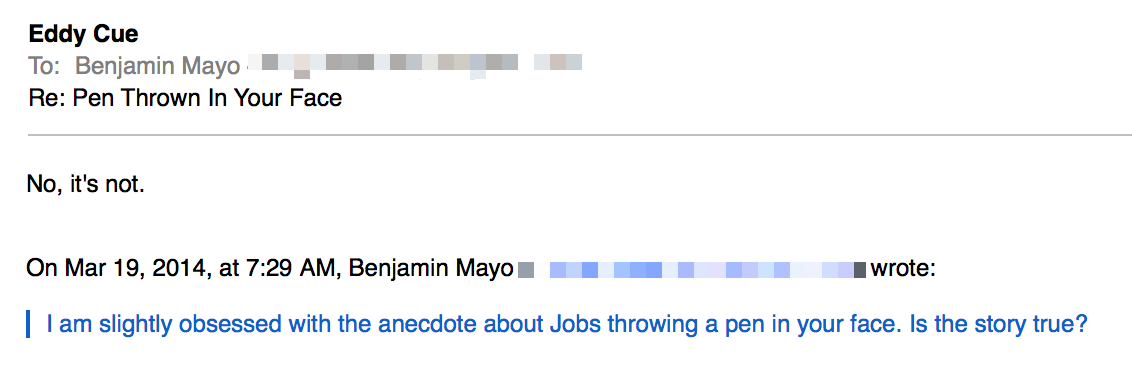
I asked about the story’s truthfulness:

I am slightly obsessed with the anecdote about Jobs throwing a pen in your face. Is the story true?

Cue replied rather curtly:

No it’s not.

Hard to argue with a direct reply from Cue himself. The full extract from Haunted Empire can be seen below. You can find 9to5Mac‘s full review of Kane’s controversial book here.


Expand
Expanding
Close

Tim Cook calls Yukari Kane book Haunted Empire “nonsense”, says it fails to capture Apple or Jobs

Site default logo image

Today marked the debut of former WSJ Apple reporter Yukari Iwatani Kane’s book “Haunted Empire: Apple After Steve Jobs” (review from this morning) and Tim Cook is not pleased.

The Apple CEO told CNBC the following:

This nonsense belongs with some of the other books I’ve read about Apple. It fails to capture Apple, Steve, or anyone else in the company. Apple has over 85,000 employees that come to work each day to do their best work, to create the world’s best products, to put their mark in the universe and leave it better than they found it. This has been the heart of Apple from day one and will remain at the heart for decades to come. I am very confident about our future.

Update: Re/Code’s telling of the email sent by Apple has an additional sentence:

“We’ve always had many doubters in our history,” he said in the e-mail. “They only make us stronger.”

Yukari Kane also responded to Re/Code:

“For Tim Cook to have such strong feelings about the book, it must have touched a nerve,” Kane said. “Even I was surprised by my conclusions, so I understand the sentiment. I’m happy to speak with him or anyone at Apple in public or private. My hope in writing this book was to be thought-provoking and to start a conversation which I’m glad it has.”
Expand
Expanding
Close

Site default logo image

Yukari Kane on Apple leadership styles: Jobs demanding, Cook inclusive, both intense

The NY Times has a brief interview with Yukari Kane, author of Haunted Empire, in which she contrasts the leadership styles of Steve Jobs and Tim Cook. Interestingly, while many see Cook as laid-back in contrast to the driven nature of the company’s co-founder, Kane says that both share an intensity.

I don’t think of Tim as laid back. In fact, he’s extremely intense. His intensity is just more quiet and dogged than Steve’s.

There is, of course, the obligatory anecdote to illustrate the obsession with detail and demands Jobs would make on his team.

Jobs routinely made a habit of calling people back mid-vacation […] for example, people had to work on Christmas Day because he decided he wanted a different color iPod shuffle at the last minute.

Despite her book’s contention that Apple is lost without Steve, she does acknowledge the strengths that Cook brings to the role.

Cook is also a better internal communicator. He sends out more all-staff emails and holds more town hall meetings. He also understands that people need to take vacations and have down time […]

Cook brings more efficiency and organization to Apple, which is good because the company’s increased size and scale requires a professional, consistent leadership style that is more inclusive than Steve Jobs’s was.

But doesn’t waste any time in returning to her theme.

In terms of profits and revenues, there is no question that Apple continues to be a successful company. But Apple’s own definition of success is much more. Its promise is to be exceptional – to make insanely great products that change the world. The latter is difficult to do without Steve Jobs’s reality distortion field. […]  If Apple stays on the current trajectory, I think the danger is that it could turn into Sony.

Former VP of marketing at Apple talks iPhone, Steve Jobs, and more at the 99U conference

Site default logo image

Apple’s former Vice President of Marketing Allison Johnson talked about her time at Apple during the 99U conference, as reported by Cult of Mac. Johnson now works with companies like Jawbone and Anki.

In the video, Johnson discusses her time working with Steve Jobs, including his response to the iPhone 4 “antenna-gate” issue. Johnson describe’s Jobs as being “so sad and so angry” about the problem, declaring that Apple would not be the kind of company that people regarded negatively.

She also talks about her role (and Jobs’) in marketing the original iPhone and other key events in the six years she was in charge of the company’s marketing.

The full twenty-five minute interview is included below:


Expand
Expanding
Close

iOS 8: Apple polishes Maps data, adds public transit directions service

Site default logo image

Apple is readying an upgraded version of its iPhone, iPad, and iPod touch Maps application for the next major release of iOS in an effort to battle Google for mobile maps supremacy, according to sources briefed on the plans. Apple CEO Tim Cook, Senior Vice Presidents Eddy Cue and Craig Federighi, and Maps head Patrice Gautier are using the new app to move toward fulfilling a promise to users that the iOS Maps application will eventually live up to the “incredibly high standard” of Apple’s customers…


Expand
Expanding
Close

iTunes Radio beats Spotify to take 3rd place in U.S. music streaming, eyes up #2 spot

Site default logo image

iTunes Radio, launched alongside iOS 7 six months ago, has now overtaken Spotify to become the third most popular music streaming service in America – and looks set to take second place within the next quarter or two.

Reporting on listening data compiled by Edison ResearchElectronista estimates that iTunes Radio’s 8 percent market share gives it around 20M listeners, and says that it is the fastest-growing of the top three services … 
Expand
Expanding
Close

Apple Campus 2 site’s demolition progress shown almost complete in latest aerial photos

Site default logo image

The folks over at Apple Toolbox have shared a number of aerial photos capturing the demolition progress of the future site of Apple’s Campus 2 ‘spaceship’. As you can see above, the former site of Hewlett-Packard that Apple purchased in 2010 is leveling out ahead of the expected 2016 completion date. Campus 2 designer Norman Foster discussed the project’s evolution and Steve Jobs’ involvement earlier this week, and late last month we saw a less clear shot of the plot undergoing demolition. Check below for more detailed photos.


Expand
Expanding
Close

Apple CFO Peter Oppenheimer to retire in September, Luca Maestri to take over

Apple has announced that its CFO Peter Oppenheimer is leaving Apple for retirement in September this year. Luca Maestri, vice president of finance, will take over as CFO. The transition will begin in June to smooth the changeover from Oppenheimer to Maestri.

Oppenheimer has been at Apple since before Jobs returned in 1997, as a senior director. He became Senior Vice President and CFO in 2004. Yesterday, it was announced that Oppenheimer would join Goldman Sachs as a board member. Oppenheimer was the lead of the Apple Campus 2 project; whether Maestri will take over this responsibility is currently unclear.


Expand
Expanding
Close

Apple’s ‘Spaceship’ designer discusses Steve Jobs’ involvement and Stanford campus influence

Site default logo image

Image via Cupertino.org

As Apple’s Campus 2 site steadily progresses closer toward someday being complete, Architectural Record (via Mac Rumors) has shared a recent Q&A with architect Norman Foster, the designer responsible for the structure and appearance of the future campus. In the interview, Foster describes the evolution of the project and working with Steve Jobs on Apple’s Campus 2, which is currently in the midst of construction after being approved by the city of Cupertino just last fall


Expand
Expanding
Close

Site default logo image

Tim Cook profiled in “Haunted Empire: Apple After Steve Jobs” [Video]

There wasn’t a whole lot new in this chunk of the Haunted Empire: Apple After Steve Jobs, which Yukari Kane mostly focuses on Apple CEO Tim Cook and his characteristics that are often the opposite of Steve Jobs. Cook is a character but not the same character that brought Apple to its current success.

From the WSJ excerpt:

As tough as Cook was reputed to be, he was also generous. He gave away the frequent-flier miles that he racked up as Christmas gifts, and he volunteered at a soup kitchen during the Thanksgiving holidays. He had also participated in an annual two-day cycling event across Georgia to raise money for multiple sclerosis; Cook had been a supporter since being misdiagnosed with the disease years before. “The doctor said, ‘Mr. Cook, you’ve either had a stroke, or you have MS,’ ” Cook told the Auburn alumni magazine. He didn’t have either. His symptoms had been produced from “lugging a lot of incredibly heavy luggage around.”

An earlier piece in the New Yorker online edition painted a dreary picture of Apple post Steve Jobs and the video above does delve into that viewpoint a bit.

Apple’s latest version of its mobile operating system, iOS 7, looks pretty but is full of bugs and flaws. As for innovation, the last time Apple created something that was truly great was the original iPad, when Jobs was still alive. Although the company’s C.E.O., Tim Cook, insists otherwise, Apple seems more eager to talk about the past than about the future.

From the video:

[Has Apple lost its touch? Are they still King of the Hill?]

KANE: I think the answer is obvious to me. The answer has got to be yes. This is a company who had revolved around Steve Jobs for so long, I mean that was something that Jobs himself went out of his way to make sure of. And the people there are conditioned to operate, to play off of his strengths and weaknesses. And so now you’ve got this completely opposite guy in Tim Cook, who is I think brilliant in many ways, but in different ways. But so they’re going through some growing pains in that.

Meanwhile, Publishers Weekly has the following review of the book:

Jan 27, 2014 – The globe-bestriding computer-maker loses its soul in this lively business history. Former Wall Street Journal technology reporter Kane follows Apple after the 2011 death of founder Steve Jobs as the company’s knack for conjuring breakthrough i-gadgets lapsed into a series of ho-hum upgrades, misfires like the befuddled artificial intelligence app Siri, and interminable patent lawsuits, while market share, profits, and stock price eroded. Kane makes the story a study in CEO leadership styles, contrasting Jobs’s visionary bluster with his successor Tim Cook’s icy bean-counting and the histrionics of Samsung’s “wise emperor” Lee Kun-hee, whose quality crusade involved burning an entire factory’s inventory in front of its weeping employees. Kane unearths plenty of colorful material here, including lawyerly jousting, hilariously lame new-product unveilings, and conference-room psychodramas between bullying execs and groveling underlings. The author’s great-man theory of Jobs’s “unfiltered” leadership as the indispensable motor of Apple’s innovation doesn’t explain much; her unusually rich dissection of Apple’s ugly dealings with its FoxConn manufacturing partner suggests that Cook’s merciless wringing of profits out of exploited Chinese labor is as much the soul of Apple as Jobs’s oft-hyped intuition for design. Still, this well-paced, vividly detailed narrative reveals the machine surrounding the Jobsian ghost at Apple and brings the company’s high-flying mythology down to earth.© Publishers Weekly

We’re getting an advanced copy this week which we don’t expect to be as pessimistic and the publicity-generating excerpts above.  Interesting bits will be posted here.

Haunted Empire: Apple After Steve Jobs is available March 18th from Harper Collins ($12.74 Amazon/$14.99 iBookstore)

Site default logo image

Ever wondered why your mouse pointer is angled, not straight?

Here’s the reason, courtesy of a concept drawing from Xerox Palo Alto Research Center, where the graphical user interface was invented, and where Steve Jobs was introduced to the concept that was to lead to the Macintosh8BitFuture writes:

When the graphical user interface was later developed by Xerox, however, the team found that the vertical pointer was almost impossible to see due to the low resolution displays in use at the time.

Rather than make the pointer larger, the decision was made to turn it 45 degrees, making it easy to see. Despite the high resolution displays we have today, the concept has managed to stick for 33 years.