iOS devices refer to any of Apple’s hardware that runs the iOS mobile operating system which include iPhones, iPads, and iPods. Historically, Apple releases a new iOS version once a year, the current version is iOS 10. Here is the complete list of iOS 10 compatible devices.
Apple’s talks with networks for its upcoming streaming TV cable service are well underway, according to the New York Post. The four main broadcast networks are involved: ABC, CBS, NBC and Fox. Apple’s 30% revenue share of the subscription fee remains a point of contention, but the report claims that negotiations are rapidly gaining momentum with Apple targeting a late fall launch of its new TV product.
Disney or CBS will apparently be the first companies to sign up with Apple and get the skinny TV package deal rolling. Apple wants to have channels like Disney’s ESPN and Discovery in the mix too. Apple is also interested in getting local live TV as part of the package, as has been previously reported. According to the report, Apple has worked out a way to speed up the process so it doesn’t have to negotiate with every local affiliate network across the country itself.
Pixelmator for iPhone and iPad has today been updated to version 2.0.2 bringing even more features to the popular image editor for iOS and Mac. This update adds a new kind of brush stroke called Dynamic Touch, which simulates pressure sensitivity by examining the size of the finger input that touches the screen. Larger surface area produces thicker strokes on the canvas. Similarly, using just the tip of a finger results in fine lines in the app.
Apple Pay has gone live in the UK today with over 250,000 officially blessed locations (although Apple Pay will work at any standard NFC terminal) and seven banks. In the runup to the launch, the main holdout has been Barclays bank who instead promoted their alternative ‘bPay’ service.
Now, though, they have changed their tune. Over Twitter, Barclays announced that it is actually ‘really excited’ about Apple Pay and will add support for the service to Barclaycard debit and credit cards in future.
Your digital photos were never intended to remain trapped on your computer’s hard drive. Apple’s original 2002 version of iPhoto proudly included physical book and photo printing services, adding new books and various types of cards every 2-3 years. Since early digital cameras took low-resolution photos, Apple’s services focused primarily on small prints. But over the past decade, cameras have really evolved: there are now 36-Megapixel Nikons, 42-Megapixel Sonys, and 50-Megapixel Canons. Unfortunately, Apple didn’t update iPhoto or its later Aperture and Photos apps with additional large-format printing options to keep up with the higher-resolution cameras many people are using.
Even if you don’t have a high-end DSLR, there are ways to turn more typical 20-Megapixel images into large pieces of wall art — if you’re willing to look outside Apple’s photo apps for printing services. And amazingly, even recent iPhones and iPads can create 43-Megapixel ultra-wide panoramas that will look stunning on one or more large canvases, as shown in the photo above.
What’s the best large format to choose for your photos? That depends on the type of images you have, and the results you’re looking for. To illustrate the options, I reached out to a number of popular photo printing services to see how digital photos would look on metal, glass, and canvas — large-format alternatives Apple doesn’t offer. Part 1 of this How-To guide looked at metal prints that apply dyes and gloss directly onto aluminum surfaces. Today, Part 2 looks at large-format canvas and glass prints. And the last part, coming next week, will look at several additional options that provide unique twists on these options. Inside, you’ll see how each process has its own unique appeal…
The always-doubted sometimes-accurate Digitimes is reporting that Apple will release the long-rumored iPad Pro in mid November this year. The ‘iPad Pro’ is expected to feature a large 12.9 inch screen with stereo speakers and targeted at business and education uses. Digitimes says that Apple has asked suppliers to ramp up in late September which should mean a November debut, with manufacturing by Foxconn.
Android may have the market share, but it’s an entirely different story when it comes to profit share: the latest estimates from Canaccord Genuity indicate that Apple takes 92% of the profits for the entire smartphone industry despite accounting for only 20% of sales.
Roughly 1,000 companies make smartphones. Just one reaps nearly all the profits.
Samsung took a further 15% of the profits – and if you were wondering how that rather odd math works, it’s because most of the other players make a loss, so the two companies make more profit between them than the smartphone industry as whole … Expand Expanding Close
HSBC appears to have let slip the release date of Apple Pay in the UK over Twitter. In a tweet that has since been deleted, a support representative from the bank said ‘Yes! It’s due to launch this Tuesday! We are excited too’. 9to5Mac previously reported the 14th July date for the expansion of Apple Pay into the UK a couple of weeks ago.
UK retailers also seem to think that the Apple Pay launch is imminent as signs showing support for the contactless technology have started appearing across the country, as noted by 9to5Mac readers and Matt Brian on Twitter.
The US antitrust regulators are reportedly looking into Apple’s subscription service rules for the App Store are anticompetitive and illegal under US law, according to Reuters. The main issue of contention is that the standard streaming music price of $9.99 per month is not attainable for Apple Music competitors as App Store rules enforce a 30% cut of all revenues made from within apps.
This means that streaming companies either have to take on significant profit cuts to stay at the $9.99 mark or charge more in the App Store to account for the 30% margin. The argument is that consumers will not want to pay $12.99 (approximately $9.99 with a 30% increase) per month for a streaming music service when they can readily buy Apple Music for $9.99.
Just yesterday I was speculating about the future of the iPod, and it appears we may not have long to wait until we learn a little more about it. French site iGen, which has a good track-record, says that the iPod line-up will see a refresh on or around 14th July.
It appears to have little hard information beyond internal model numbers, but based on those speculates that the Shuffle and Nano will see only the color changes spotted in iTunes 12.2, while the Touch may receive a more substantive update … Expand Expanding Close
Samsung is planning to bring forward the launch of the Galaxy Note 5 from September to August, according to the WSJ. It’s believed the change in schedule is designed to get the device on sale ahead of Apple’s anticipated September launch of the iPhone 6S and 6S Plus, which is likely to dominate tech media coverage that month.
Samsung has always previously launched its Note models on the eve of the IFA conference, which takes place in Berlin in September. The WSJ cites only a single source for the claim, but it’s not the first time we’ve heard suggestions that the company may bring forward the launch this year.
A Korean report back in May suggested that the Note 5 would be launched in late July, also citing a desire to get ahead of Apple’s launch. A second reason was said to be to align with the anticipated launch of the company’s mobile payment platform, named (yep) Samsung Pay – but this is now expected to be be pushed back to September.
Samsung was hit hard by Apple’s move into larger-screened phones, the iPhone 6 Plus in particular providing the first Cupertino competition for its Galaxy Note phablet. Apple is reportedly expecting big things of its launch of the iPhone 6S this September, aiming to produce 90M units by the end of the year.
Apple today uploaded a pair of new ads to YouTube. The first ad, entitled “Hardware & Software,” showcases the fact that Apple is responsible for both major aspects of the iPhone, making for a more seamless and stable experience. The obvious goal here is to advertise the fact that with an Android device, you get hardware made by a manufacturer and software made by Google.
T-Mobile’s mission to change the entire U.S. wireless industry took another step forward this morning. In an Uncarrier Amped move dubbed ‘Mobile without Borders‘, T-Mobile announced that it will offer its American customers free telephone call roaming to and from Mexico and Canada. For the first time, it will also include free 4G LTE data. Postpaid, prepaid and business customers will be able to make use of it from Wednesday, July 15th. It’s a killer move, and effectively erases the virtual borders between the U.S. and its neighboring countries.
Unlike the current Simple Global feature, when a T-Mo subscriber crosses the Mexican or Canadian borders, they won’t be reduced down to EDGE speeds. They retain 4G LTE connectivity seamlessly, providing there is LTE coverage in that area. T-Mo partnered with carriers in those two countries to pull this move off. There’s only one small asterisk — the feature is being offered in specific cities within Canada and Mexico — as discussed below…
Apple alerted developers to some App Store price adjustments earlier in the week and the alternative price tier details have now been posted. Apple has added other alternative price tiers in the past, but what’s interesting with these changes in particular is is that they are specifically targeted at offering really low price options for apps in a select few countries.
The new tiers enable developers to set prices for their apps way below the usual $0.99 price floor in India, Russia, Indonesia, Mexico, South Africa and Turkey. (Special pricing for China has existed for some time.)
For example, using the ‘Alternative Price Tier A’ means that apps are priced at 10 Indian Rupees. This is equivalent to about 16 cents in USD. Before the addition, the lowest price developers could charge in India was 60 rupees, which is about 96 cents.
Following reports that said Apple had begun manufacturing the next-generation iPhone in late June, a new report by the Wall Street Journal is oloorroborating the story. It says that Apple is asking suppliers to produce a record number of ‘iPhone 6S’ units for the upcoming fall launch, topping 90 million units by the end of the year. Apple sold 74.5 million iPhones in the equivalent quarter in 2014, spurred by the success of the iPhone 6 and iPhone 6 Plus.
The report also matches previous rumors that the new iPhone will feature Force Touch, which 9to5Mac extensively covered back in May. The iPhone 6S is expected to look almost identical to the iPhone 6 with improvements focusing on the camera, new pressure sensitivity screens and internal component improvements.
Update: eBay told 9to5Mac via email that it recently started removing listings for gun-shaped iPhone cases due to their violation of the company’s replica gun policy. eBay also noted that the cases pose a safety threat to consumers.
The New York Times reports that police officials around the United States are speaking out against a wave of gun-shaped iPhone cases that are gaining popularity. The cases, which are available in black, white, and pink, are mostly imported from Asia and are causing concern for police departments. Officials are urging users not to purchase the accessory, citing the confusion it causes for police officials.
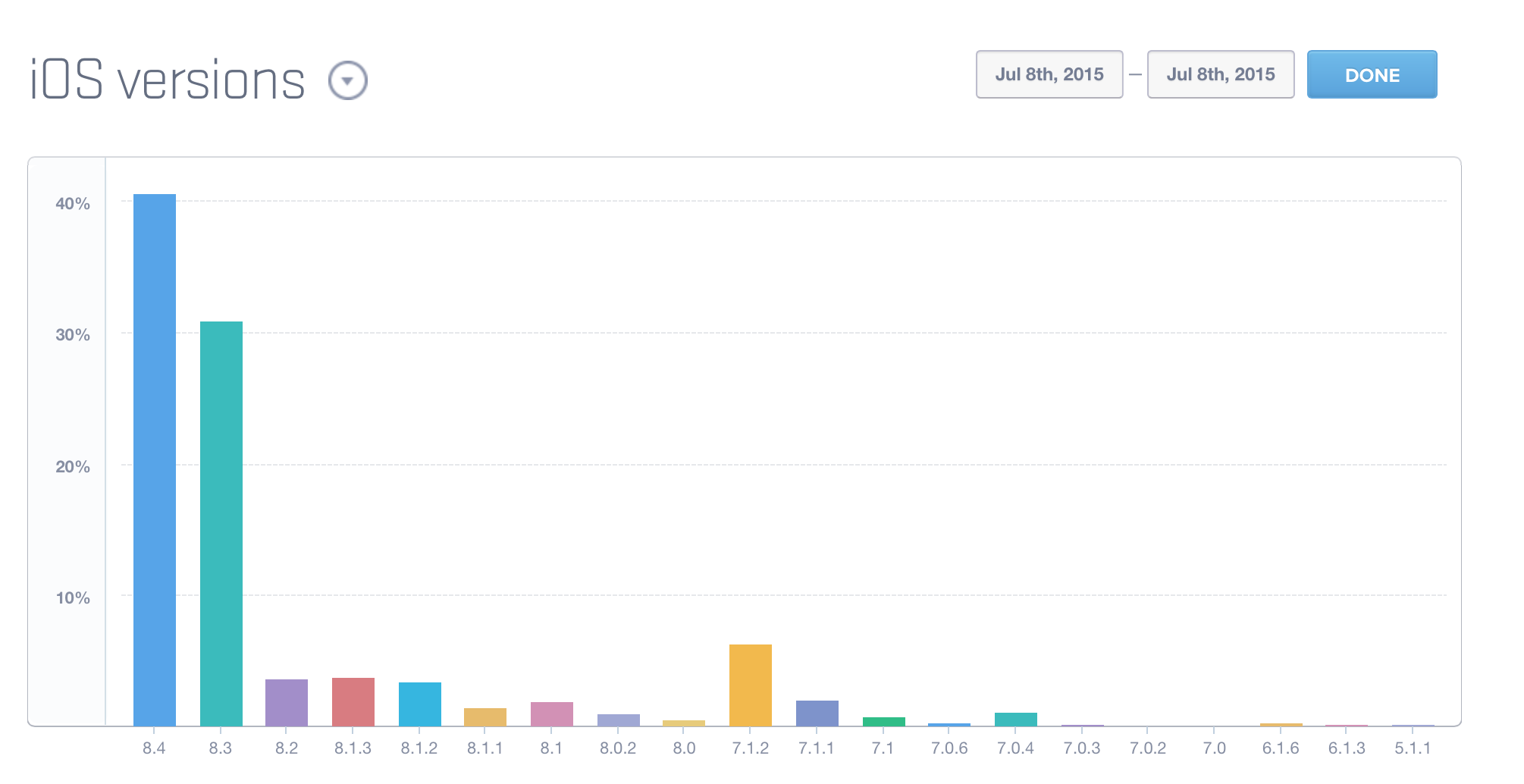
Using data by Mixpanel, Apple Music seems to be quickly driving adoption of Apple’s latest iteration of its operating system, iOS 8.4. The chart shows that, in just one week, iOS 8.4 usage now makes up more than 40% of all iOS device usage. This is a rather staggering rate of uptake for a point-release. Clearly, the interest and advertisement around Apple Music is having an effect on update rates. Obviously, this only tracks OS adoption and says nothing about how well Apple Music itself is being received.
Yesterday we revealed that Apple was revamping the third-party accessory selection in its retail locations with new boxes designed by Apple itself. Apple has recently launched a new webpage that showcases the testing that all iPhone, iPad, and iPod touch cases are required to go through before they are sold in an Apple Store.
Bryan Jones has taken close up images of the Apple Watch screen, magnified such it is possible to discern the individual pixels and sub-pixels. The images show the arrangements of red, green and blue light that make up the images users see on the Apple Watch Retina Display.
Jones compares the screen technology with that of iPhone screens (shown below). They look quite different likely due to the fact that Apple Watch uses an AMOLED display rather than a LCD. iPhone pixels are tightly packed together with the red, green and blue aligned vertically. With the Apple Watch, the blue sub-pixels act as spacers for the stacked red and green sub-pixels. Jones also notes that the imaging specs are a lot smaller than compared with an iPhone which seems to be in aid of maximising battery life. When zoomed in to this level, it means you can see a lot more black space. Jones says this contributes to the Apple Watch’s excellent contrast ratios.
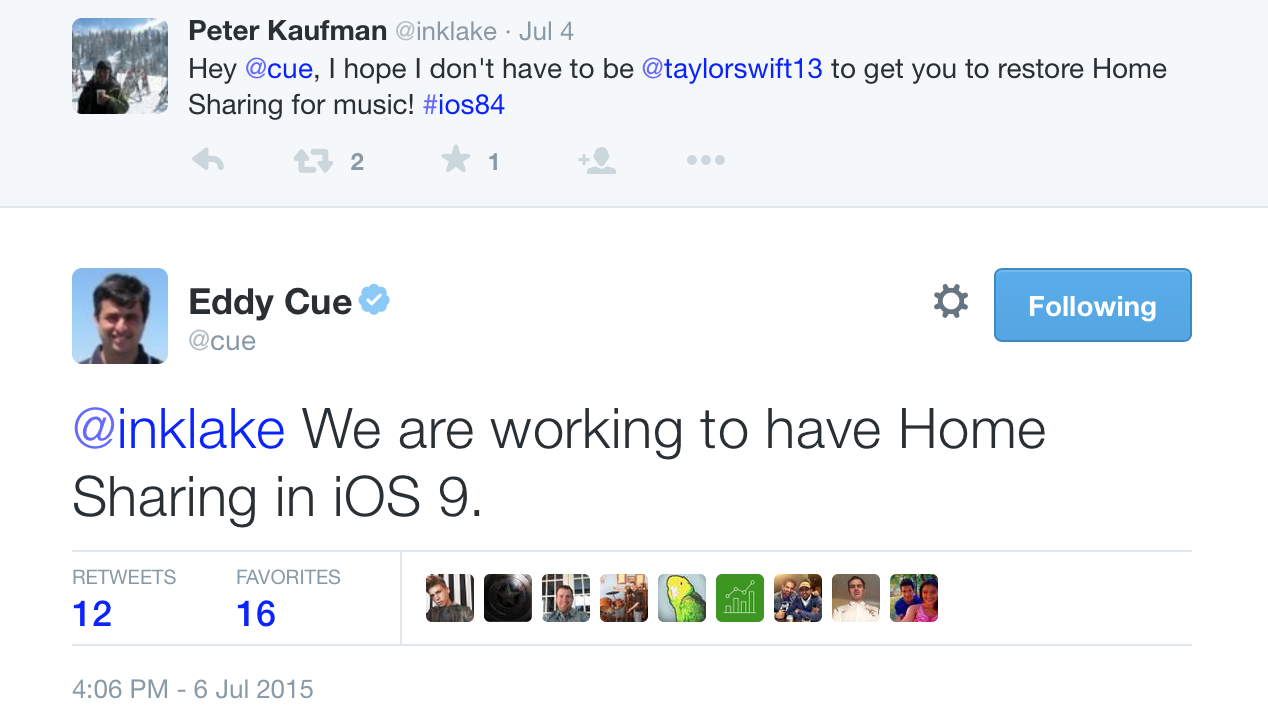
Last week, we noted that Apple’s latest iOS 8.4 release with Apple Music removes support for the long-existing Music Home Sharing feature. This function allows an iOS device user to stream music from a computer running iTunes on their own WiFi network. Today, Apple Senior Vice President of Internet Software and Services noted on Twitter that Apple is “working” to restore Home Sharing functionality in iOS 9. It is likely that Home Sharing was removed in iOS 8.4 due to changes necessary with the record labels to launch the new streaming music service. Cook previously revealed details on this week’s iOS 9 beta, streaming bit rates, and more via Twitter.
There isn’t any question that Apple’s working on a larger-screened iPad: early details leaked in 2013 and have been followed by dimensional drawings and prototype shells over the past year. All of the leaks suggest that the “iPad Pro” or “iPad Plus” will be nearly identical to the iPad Air 2, except with an almost 13″ screen and four (rather than two) speaker grilles. Few of the leaks have suggested major new design elements, such as an extra connector port, an integrated stand, or a stylus; no one believes Apple will even rotate the rear logo to signify a preferred horizontal orientation. In short, the “iPad Pro” will likely be a bigger-screened iPad Air, much as the iPad Air was just a bigger version of the iPad mini that preceded it.
Despite once-credible reports of an early 2015 release, the big iPad was apparently pushed back at least twice so Apple could focus on making more iPhones. Since it’s supposedly been rescheduled for a fall release, I wanted to pose a question: given what we (think we) know about it, do you believe a bigger-screened iPad without other major design changes will be compelling enough to succeed?…
There have been a wide range of both complaints and praises regarding the larger screened iPhones Apple introduced last fall, but this one is new. Matt Bonner, longtime member of the San Antonio Spurs, gave an interview recently in which he blamed a season-changing injury on Apple’s larger screened iPhone (via Yahoo).
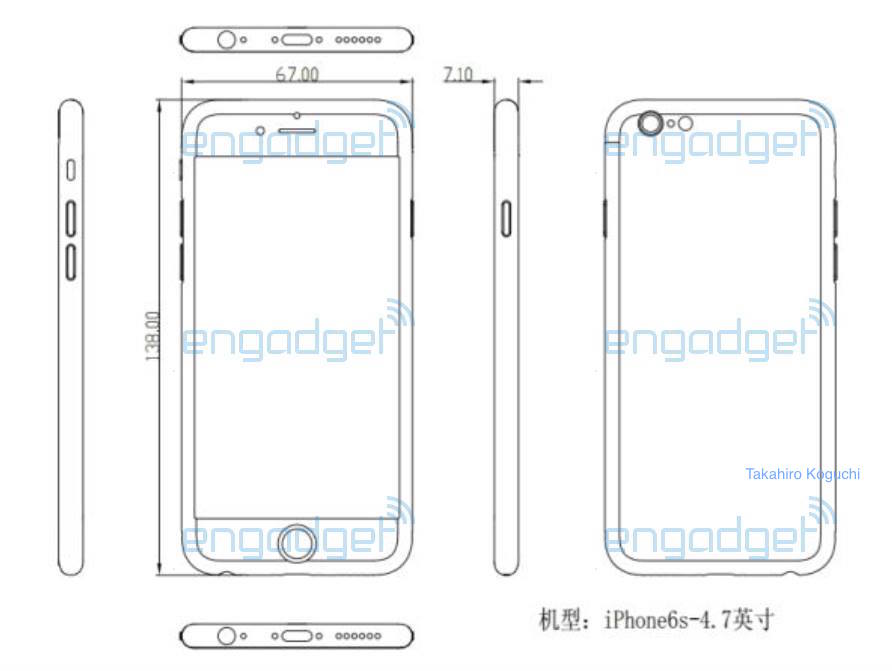
Engadget Japan has shown a purported schematic of the iPhone 6S which it attributes to a reliable source in the Chinese supply chain. While the diagram does not appear to have originated from Apple, the design and marked dimensions are consistent with casing photos we obtained from a proven source.
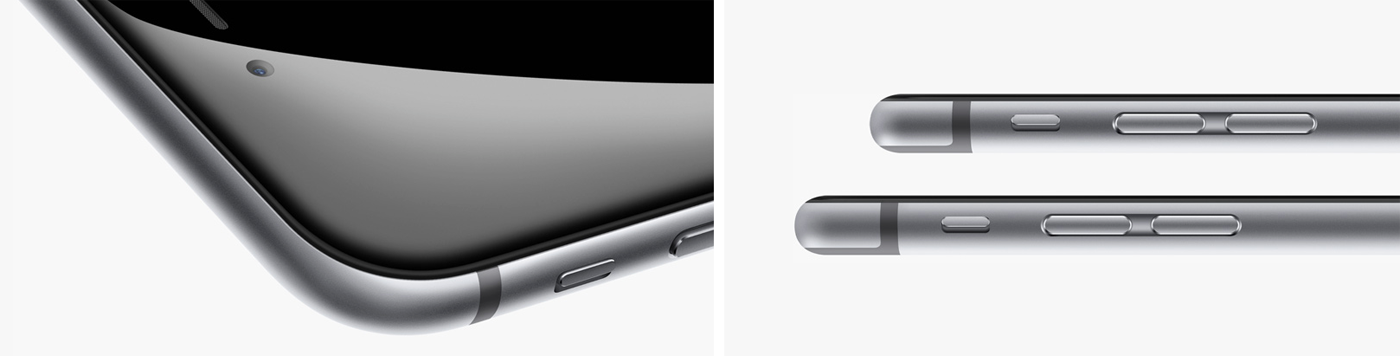
We noted that any change in thickness was imperceptible, and the thickness marked on the schematic is 7.1mm – just 0.2mm thicker than the iPhone 6, and the exact same thickness as the iPhone 6 Plus. This also matches (within 0.03mm) that shown in a drawing we reported earlier … Expand Expanding Close
A Chinese blog report that claims to reveal the date of the keynote announcing the iPhone 6S and 6S Plus is being picked up by some media outlets. According to the blog, sources inside the Foxconn supply chain have stated that the keynote will take place on Friday 11th September, with the phones going on sale a week later on the 18th. Expand Expanding Close
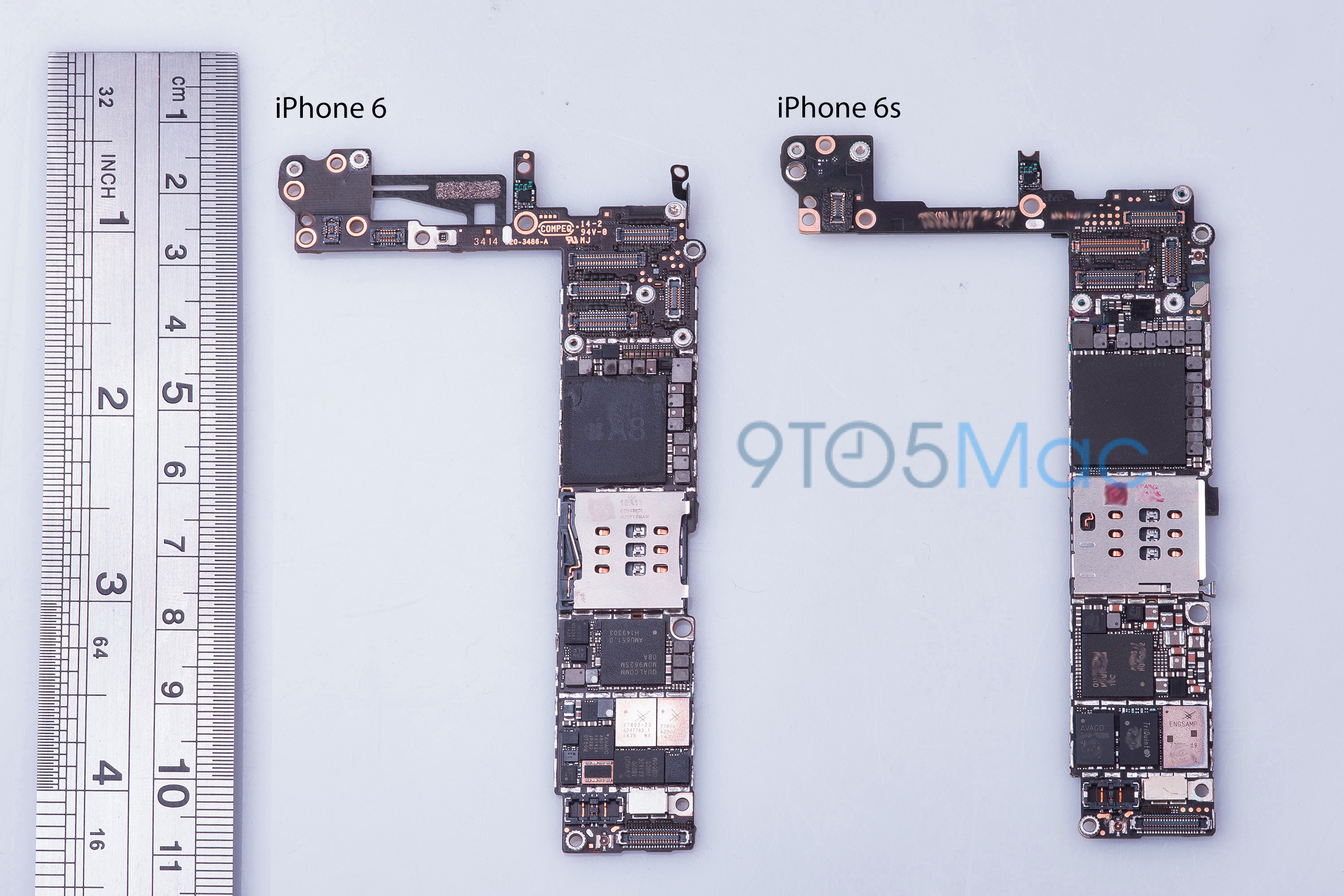
Our look at the upcoming “iPhone 6S” continues today with a discussion of new internal components that are expected to be inside Apple’s latest smartphone. In addition to expected changes such as a Force Touch display, upgraded camera system, and new Qualcomm LTE chip for up to twice-as-fast data speeds, the next iPhone will likely include updated NFC hardware, fewer and more efficient chips, and new flash memory that may nonetheless remain at a 16GB minimum capacity.