Apple Maps

See All Stories

When the iPhone first launched, it was preloaded with Google Maps. In 2012, Apple replaced it with its own mapping application known as Apple Maps. It launched in beta in the iOS 6 beta, and was released to the public that fall.

After its launched, it was clear that it was no on the same level of quality as Google Maps. The poor launch led to a public apology from Tim Cook and ultimately led to the firing of Scott Forstall.

Apple Maps Features

Over the years, Apple has continued to adds features to Apple Maps. iOS 11 brought lane guidance and a speed limit widget on the navigation, and indoor location mapping.

Apple has also added proactive location suggestions (time to get home when you are leaving work, etc), integration with public transit, Yelp integration, and integration with ride sharing services like Lyft and Uber.

With iOS 12, Apple has proclaimed they are rebuilding Maps from the ground up.

Maps is being rebuilt from the ground up to better reflect the world around you. The new underlying map uses Apple data and features enhanced geographic context like pedestrian paths and parks, more detailed building outlines and parking lots, better road network coverage, and more. You’ll also be able to get where you’re going with improved routes, whether you’re on the road or on foot. The new Maps is now available in Northern California and is coming soon to the rest of the United States.

While the general consensus is that Google Maps offers more accurate data and navigation, Apple Maps is widely considered to be the most used mapping application in the world since it’s built into every iPhone, iPad, and Mac.

Apple wins patent for Maps feature that could help you avoid routes w/ weak cellular signal

Site default logo image

Apple applies for and gets awarded patents for everything under the sun, and patents don’t always translate to shipped features. Disclaimer aside, the iPhone maker was recently awarded a patent for a potentially useful feature that could help you avoid areas with weak cellular coverage when planning your trip with navigation in Maps.

The USPTO awarded Apple with a patent (via Gigaom) to analyze routes between two locations and “employ an algorithm that considers wireless network signal strengths along those routes.”

In other words, because your iPhone can collect and measure cellular signal data and many iPhone users anonymously share travel data with Apple, there’s potential for Maps to know which routes problematically contain dead zones and suggest lengthier routes with better signal.
Expand
Expanding
Close

Apple Maps adds animated 3D imagery starting w/ UK’s London Eye & Big Ben (Videos)

Site default logo image

Apple has added some nice new touches to Apple Maps with animated 3D imagery for iconic landmarks starting with the UK. Apple Maps now shows the correct time on Big Ben and a rotating London Eye when users viewing the landmarks access the app’s 3D Flyover feature.

Videos showing off the animated London Eye and Big Ben in Apple Maps are below:
Expand
Expanding
Close

Site default logo image

Apple adding 9 new 3D Flyover locations to Maps

Apple today added nine new cities to its Flyover feature offering high resolution 3D imagery of select locations in its Maps app.

The full list of new locations rolling out is below:

Baton Rouge, LA
Boise, ID
Edinburgh, Scotland
Cáceres, Spain
Guadalajara, Mexico
Ponce, Puerto Rico
Venice, Italy
Linz, Austria
Rennes, France

The new additions follow Apple’s latest update last month that added another 11 cities from locations around the world.

As always, Apple has a full list of supported locations for iOS features including Flyover on its website.

Site default logo image

Apple Maps Connect gains new languages as it expands to Canada, France & Germany

The Apple Maps Connect service, which allows small businesses to add their listings to the Apple Maps database, has been expanded to Canada, France and Germany. The service has also gained two new language options, French and German, to correspond with the regional expansion.

Apple first launched Maps Connect in the U.S. last October, enabling businesses to edit or add listings, as well as set up indoor mapping within selected areas. Entries made by businesses typically show up in Apple Maps around a week later. The international rollout began last month with the UK, Australia, New Zealand, Ireland and Singapore.

Apple switched from Google Maps to its own mapping service on iCloud.com in December. Apple-leased camera cars have been spotted recently, with some suggesting that they are being used to add Street View style images to Apple Maps, while others believe they are part of the Apple Car project.

Site default logo image

Apple Maps Connect for small businesses expands beyond the U.S.

Apple has notified Apple Maps Connect for Small Businesses users that the service has expanded beyond the United States into the U.K., Australia, New Zealand, Ireland, and Singapore. As we detailed in October of last year, Apple Maps Connect is a web-based tool for businesses to either add or edit their listings to the Apple Maps database. The site is also used to bolster Apple’s indoor mapping data for future iOS Maps features. Thanks, Matt!


Expand
Expanding
Close

Site default logo image

Dutch city of Rotterdam gets the 3D Apple Maps imagery and Flyover [Update: Strasbourg & Malmö too]

[youtube=https://www.youtube.com/watch?v=m1OHRoEjL6Q]

Apple Maps has brought 3D imagery and a Flyover tour to the Netherlands for the first time, with Rotterdam leading the way. The second-largest city in the country, and home to one of the largest ports in the world, Rotterdam may have been selected for the proliferation of funky architecture.

Dutch site iculture put together the above video of the Flyover tour, which highlights among other places the Euromast tower – a popular tourist attraction – the Erasmusbrug single-sided suspension bridge and the famous (and very cute) Kubuswoningen cube houses.

Update: Strasbourg in France and Malmö in Sweden just got added too (via iGen).

Apple recently added nine other Flyover locations around the world, and switched from Google Maps to Apple Maps for the Find My iPhone service on iCloud.

Did Apple drop Google Maps for good? Apple Maps now rolling out on iCloud.com

Site default logo image

Apple appears to have finally dropped Google Maps from iCloud.com, replacing it with its own in-house maps almost two years after removing Google Maps from iOS and most of its other products. Apple started slowly rolling out the feature to its iCloud beta site for select users earlier this year before pulling it, but it now seems to have replaced Google for all users of iCloud.com’s Find My iPhone feature (pictured above).
Expand
Expanding
Close

Apple launches new service allowing local businesses to get listed on Apple Maps, solicits indoor mapping partners

Site default logo image

Apple has launched a new web service called Maps Connect that allows small business owners to manage their listings on Apple Maps along with a tool for setting up indoor positioning in select areas. Companies can enter their own listings and verify via a phone call or email address.

The iBeacon-powered indoor mapping tool allows businesses to setup interior views of their businesses on Apple Maps to help guide users through their venues. This tool is currently limited only to locations that meet specific criteria, such as Wi-Fi throughout the building and at least 1 million visitors per year.


Expand
Expanding
Close

Apple hints at Maps data-collection project taking place in New York

Site default logo image

Apple has for a long time hired engineers around the globe to contribute to making its Maps experience better. While positions for its team outside Cupertino usually consist of Maps Quality Analysts and Ground Truth managers that submit region specific corrections for Maps, a new job listing on Apple’s website hints at a “data-collection project” planned for New York.
Expand
Expanding
Close

UK carrier reports increased Apple Maps usage as ComScore numbers show downward trend

Site default logo image

Apple’s Maps app, introduced as part of iOS 6 in 2012, has had its fair share of technical issues and was the source of a PR crisis and the ejection of multiple long-time Apple executives. But two years later, if data from UK carrier EE is any indication, Apple Maps usage appears to be on an upward trend. Here’s the latest usage data for Apple Maps from the network:


Expand
Expanding
Close

More on why public transit directions got lost in iOS 8 Apple Maps

Site default logo image

TechCrunch is out with a story today with details on why some of the mapping features originally scheduled for iOS 8 didn’t make the cut at Apple’s WWDC keynote last week. The report quotes a few sources close to the mapping teams that say most of the improvements originally planned for iOS 8 weren’t finished on time due to talent departures and internal politics:

Why didn’t they appear? One tipster says it was a personnel issue: “Many developers left the company, no map improvements planned for iOS 8 release were finished in time. Mostly it was failure of project managers and engineering project managers, tasks were very badly planned, developers had to switch multiple times from project to project.”… It’s a take that is both contested and corroborated by our other source. “I would say that planning, project management and internal politics issues were a much more significant contributor to the failure to complete projects than developers leaving the group,” the source said.

We reported leading up to WWDC that the transit directions in iOS 8 might be pushed back to instead focus on other priorities.

While the TechCrunch report doesn’t mention any names, we do know that the mapping team has lost a few key people recently. Back in March, reports popped up that Cathy Edwards, who happened to be in charge of Maps Quality after joining Apple through the company’s acquisition of Chomp, was leaving the company. The reason behind Cathy’s departure was unknown at the time, but we’ve learned from sources that disagreements with employees on the Maps team working under Edwards and an opposition to her management style lead to problems on the Maps team and ultimately her leaving in April. Apple also lost key Maps team member Jared Waldman from Placebase who worked as Head of Geo at Apple Maps until late last year. In addition, we’ve heard from former employees of the mapping team that recently left the company due to issues with Edwards and management of the Maps team. 
Expand
Expanding
Close

Site default logo image

Apple hires CEO of indoor positioning firm Wifarer as it continues testing indoor mapping features

TechCrunch reports today that the CEO and founder of Wifarer, a company working on innovative indoor positioning technology, has has left for a leadership role at Apple.

If a CEO and co-founder quits his indoor positioning startup to work for Apple, should his staff and customers be concerned? Wifarer, a startup which offers tools to help consumers navigate malls, museums and other venues, was notacquired by Apple, we learned, while following up on some tips pointing in that direction. However, its CEO and founder Philip Stanger now works there in a “leadership role.”

While Philip Stanger confirmed on his LinkedIn that he’s been at Apple since February, the report notes that the company claims it is still in business and has not been acquired by Apple:

And finally, it’s odd because despite new CEO Murphy’s claims, Wifarer could be seen as being in decline. The company got rid of its sales staff in 2012, and today there are roughly a half dozen employees still at the company, according to what we’ve heard, as well as public searches on LinkedIn. Murphy says its numbers are higher than that, but admits they’re less than Wifarer’s previous peak.

We’ve reported several times in the past that Apple is working on new Maps features that would rely on indoor positioning technologies. Ahead of  iOS 8, Apple is currently testing unique ways of integrating indoor mapping views into its Maps app, but those features aren’t confirmed for the next iOS release.

Last year, Apple picked up another company working on indoor positioning technologies called WiFiSLAM.

Site default logo image

Apple Maps adds ancient Stonehenge monument to 3D Flyover

Nobody is quite sure why or how Stongehenge was constructed, but the stone circle constructed sometime between four and five thousand years ago has long fascinated visitors.

As a Scheduled Ancient Monument and a UNESCO World Heritage Site, the closest most visitors can get to it these days is a pathway around the outside. (I probably shouldn’t admit this, but as a young child who lived nearby before all the restrictions were put in place, I used to climb on the stones …)

But thanks to Apple adding the site to its 3D Flyover library of Apple Maps, you can now take a tour around the site from the comfort of your sofa. Just enter Stonehenge into the search box.

Apple added 3D Flyover coverage of Perth, Saint-Tropez and Cordoba last month. This followed Cape Town, Helsinki and Marseille back in January. After a less than stellar start, Apple is working hard on an upgraded version of the Maps app ready for iOS 8.

Will CarPlay impact your next car purchase? [Poll]

Site default logo image

After Mark uncovered it last April and Apple announced it last June, this week we’ve seen a steady stream of details about Apple’s iOS and car integration following Apple’s marketing push. There’s plenty more coverage on the way as we continue to explore what CarPlay means for Apple and its users, but now we want to hear from you. What effect will CarPlay have on your next car purchase?

Cars certainly aren’t purchases you make impulsively (or often), and CarPlay seems to address that by relying on the iPhone (something we may purchase impulsively and often) for much of the functionality. Among other things, will CarPlay be on the list of things you look for in your next car purchase?
Expand
Expanding
Close

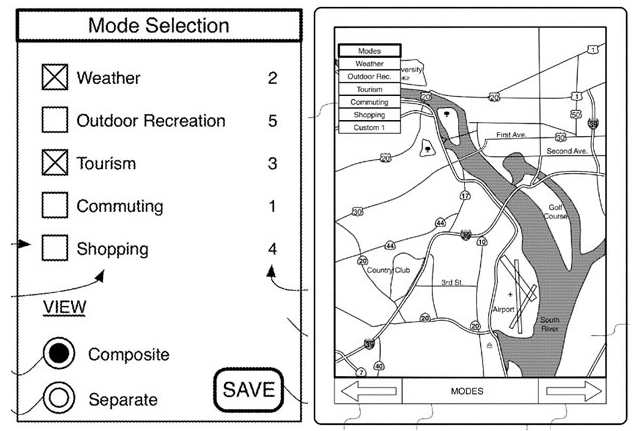
Apple explores customizable layers for future Apple Maps app – new patent application

Site default logo image

We’re pretty selective in the Apple patent applications we cover here, simply because Apple patents all kinds of things for all kinds of reasons, and for every one of them that makes it into an Apple product, there are hundreds of others that never will. But this is one we think might.

The core concept is nothing new: layered maps. The existing Apple Maps app already allows us to choose between standard mapping, satellite view or both, and Google Maps on the web allows us to switch on or off layers like traffic, weather, public transit lines and so on. But what the Apple patent application describes would, if you’ll excuse the pun, take this idea to a whole new level … 
Expand
Expanding
Close

Site default logo image

Google Maps iOS app gets some Google Now functionality, showing reservation info

The latest version of the Google Maps iOS app has been given some Google Now functionality: when you click on an airport, hotel or restaurant, the app will display any reservation information it can find in your linked gmail account. This functionality was previously only available in the desktop app.

Although Google has added a succession of features to the app, data last month showed that most iPhone users were using the pre-installed Apple Maps. Adding Google Now functionality is an attractive feature for gmail users, but Google faces the same problem as ever since Apple replaced Google Maps with its own offering: most iPhone users will use what Apple gives them.

Google Maps is a free download from iTunes.

How-To: Start using Maps in OS X Mavericks

Site default logo image

Apple has finally implemented a maps app in the OS X platform, and it seems to have been worth the wait. After being noticeably missing from the system, Maps (and iBooks) are helping achieve a greater consistency between the iOS and OS X platforms. After running the free Mavericks update, the Maps app icon will automatically be added to your dock.

In this guide, we’ll show you how to use the new app for everything from searching for locations to getting turn-by-turn directions set directly to your iPhone.


Expand
Expanding
Close

Google Maps left out in the cold as most iPhone users stick with Apple Maps

Site default logo image

Photo: bgr.com

Apple Maps may not have had the best of starts, but data from ComScore shows that most iPhone users have stuck with the app rather than reinstalling Google Maps. Google Maps lost 23M iPhone users in the US alone in the last year, with similar numbers expected elsewhere.

The figures show that in September this year, 35M iPhone owners used Apple Maps, against just 6M for Google Maps – the latter including around 2M who were using older versions of iOS unable to run Apple Maps.

The story is essentially a simple one: while techier iOS users may choose their own apps, the majority of iPhone owners use the apps that Apple provides. And if you apply that to other services, that may not bode well for technologies like Pandora … 
Expand
Expanding
Close

Maps roundup: Early Placebase founder leaves for startup, Alaska airport directions disabled, & secret project job listing

Site default logo image

A few Apple map related stories have popped up today starting with the departure of early Placebase founder– the mapping company Apple bought back in 2009–  Jaron Waldman. After Apple bought Placebase, Waldman started and lead the Apple Geo team behind the Apple Maps infrastructure and location services on iOS and Mac like MapKit and CoreLocation. He was at Apple up until last month and even filed for numerous Apple mapping patents, but recently left to work at a “new startup” according sources and verified by his LinkedIn page.

As Waldman is on his way out, the Apple Maps team today posted a job listing (via Macrumors) seeking a web UI designer to “design, develop, and maintain complex front-end code for a new secret project.” Unfortunately we don’t get many hints at what the project would consist of, but the job listing adds that the successful applicant would join “a small team working on an advanced web platform upon which many of Apple’s future services will be based.” It is almost like Apple knows the listing will get lots of publicity if it adds ‘secret project’ therefore attracting a wider audience of potential candidates.

Finally, over a year into Apple’s Maps launch, Apple is still getting press for some hiccups it is yet to work out. A couple days ago news broke that Apple’s Maps app was directing drivers in Alaska down a dangerous route across a Fairbanks International Airport runway and taxiway. It’s certainly not the first time that Apple’s Maps app has given dangerous directions to drivers (those lacking common sense anyway) since its controversial launch, and today airport officials confirmed that Apple has disabled directions to the airport until it fixes the directions:
Expand
Expanding
Close

Site default logo image

Tim Cook probably won’t be retweeting Conan O’Brien’s Siri fail

[youtube=http://www.youtube.com/watch?v=VW1UDKyxJJ4]

Tim Cook’s may be on Twitter now, but he’s probably not going to be retweeting a poor showing from Siri on the late night program last night.

.

Actress Jane Lynch’s tweeted a recent experience with Siri in which it apparently responded to her request for directions to Le Pain Quotidien with “I have no listing for Let Pam Cookie Ian.” She recounted the story in an interview on Conan, in which two further live Siri attempts also failed.

The first, Lynch’s voice on O’Brien’s phone, wasn’t really a fair test: Siri keeps personalised voice files for each user on its servers. But the second, in which O’Brien used his own phone, resulted in the infamous “I’m really sorry about this, but I can’t take any requests right now” message.

With some iPhone fails, though, you have to look more to the human factor than the phone. Sure, it’s a bit of an oops moment when Apple Maps directs local drivers onto an airport taxiway, but as with many other GPS fails, you’d kind of think drivers might notice that they were crossing a runway – or that an international airport might, you know, make sure the gate was closed or something …

iPhone’s M7 motion processor to integrate with Maps as Apple develops indoor mapping, public transit

Site default logo image

Besides the main 64-bit A7 processor in the new iPhone 5s, Apple has included a dedicated motion co-processor called the M7. The chip powers many of the sensor technologies in the iPhone, such as the accelerometer, compass, and gyroscope in order to move the weight off of those technologies from the phone’s main chip. This, in turn, will make the new iPhone more efficient for both performance and battery life for the user.

Apple briefly explained some of the consumer-facing abilities of the M7 motion chip, highlighting that the chip could greatly enhance fitness apps such as those from Nike. But, just like with the new iPhone’s Touch ID fingerprint scanner, Apple’s ambitions for the M7 are greater than those discussed earlier this week. According to a source with knowledge of the chip’s development, Apple plans to tightly integrate the chip with its own Maps service in the coming years.

On its official website, Apple presents a brief teaser of what the M7 can do, highlighting a feature in the iPhone 5s (which was not discussed during the keynote presentation):


Expand
Expanding
Close

Apple acquires yet another transit app company: ‘Embark’

Site default logo image

Apple continues its maps buying spree with the acquisition of Embark, the development firm with 10 transit-related apps in the App Store, according to Jessica Lessin. Back in November, the company received an investment boost from BMW, but now it looks like Apple will be integrating the information directly into the Apple Maps application:

We don’t know how much Apple paid for the several-person team it acquired very recently. But we heard from people knowledgeable about the deal that the company plans to directly integrate Embark’s technology into Apple Maps.

Apple has confirmed the deal to Jessica Lessin.
Expand
Expanding
Close