HomeKit

See All Stories

HomeKit is Apple's home automation framework that lets you control connected accessories from your iPhone, iPad, Apple Watch, HomePod, and Siri.
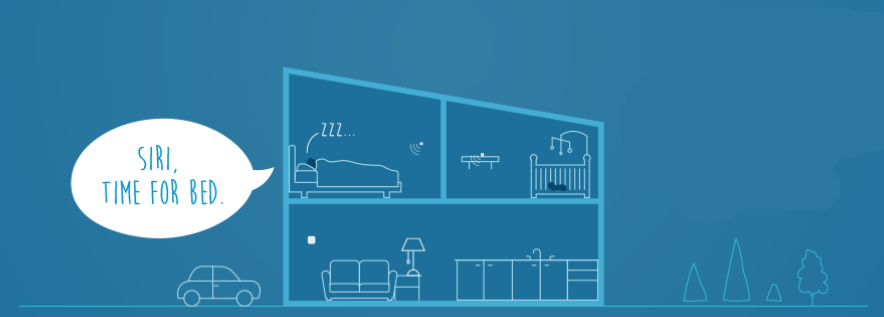
Your home at your command.

What is HomeKit / Apple Home?

Along with several other new APIs for developers, Apple announced HomeKit in June 2014, which allows all home automation accessories/devices to work together in harmony with iOS. The API allows home automation developers to centralize all home automation without needing separate apps to access each device’s specific features. These devices include locks, lights, cameras, doors, thermostats, plugs, switches, and more.

HomeKit allows for secure pairing with devices and the ability to control individual devices. It also makes it possible to group several home automation devices into scenes that allow for easier control of any automation device in specific situations. One of the coolest features available with HomeKit is the ability to control any home automation accessory with Siri based on certain commands or scenes previously configured with these devices.

In 2016, Apple introduced a new Home app that came with a modern look, relatively easy-to-use controls, and access to accessories and scenes from anywhere on iOS 10. Apple’s new built-in Home app arrived on the iPhone’s Home screen, plus you can access a ton of functions from the Lock screen or anywhere on iOS from the new Control Center once you have a HomeKit accessory set up.

In 2018, Apple released the HomePod. It was a way to interact with your connected home devices through Siri using a standalone device.

In 2020, Apple announced that tvOS 14 would gain access to the Home app. iOS 14 is also bringing improvement to the Home app UI.

HomeKit Secure Video
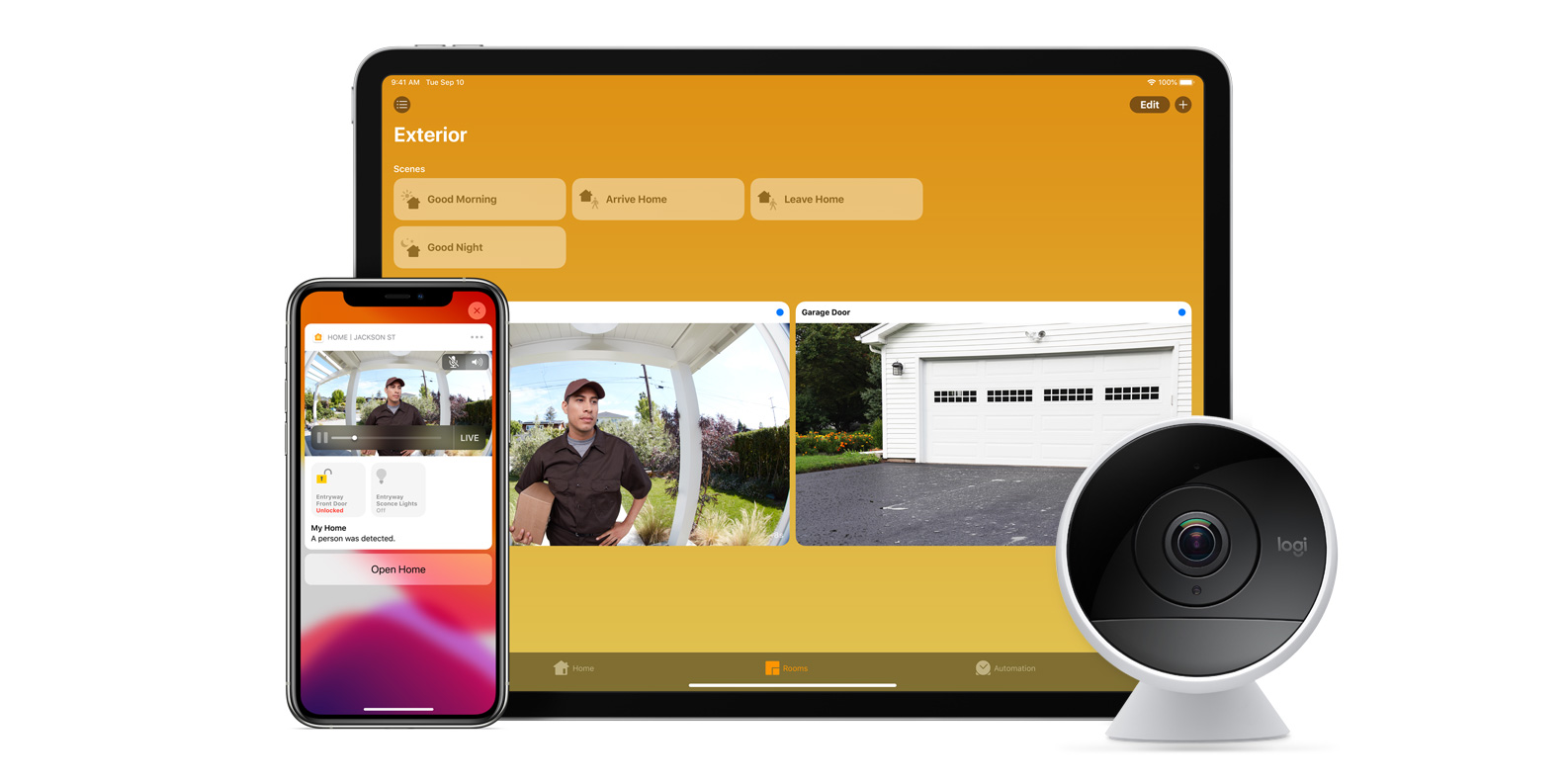
With iOS 13, Apple announced HomeKit Secure Video.

Footage from home security cameras contains your most personal and sensitive data. With HomeKit Secure Video, activity detected by supported cameras is privately analyzed by your home hub using on‑device intelligence to determine if people, pets, or cars are present. When important activity is detected, you and anyone you share your Home app with will receive a rich notification that lets you view the clip right from the Lock Screen. Recorded video is available to view for ten days from the Home app. It’s securely stored for free in supported iCloud accounts and doesn’t count against your storage limit.

While the rollout has been slow, Logitech, Arlo, Netatmo, and Eufy are among the early standouts. With recent privacy issues with Ring, HomeKit Secure Video is likely to continue to grow in popularity. One key benefit with Secure Video is that it works with your existing iCloud storage (200GB and up plan), so you don’t have an extra monthly fee for storage.

HomeKit Router
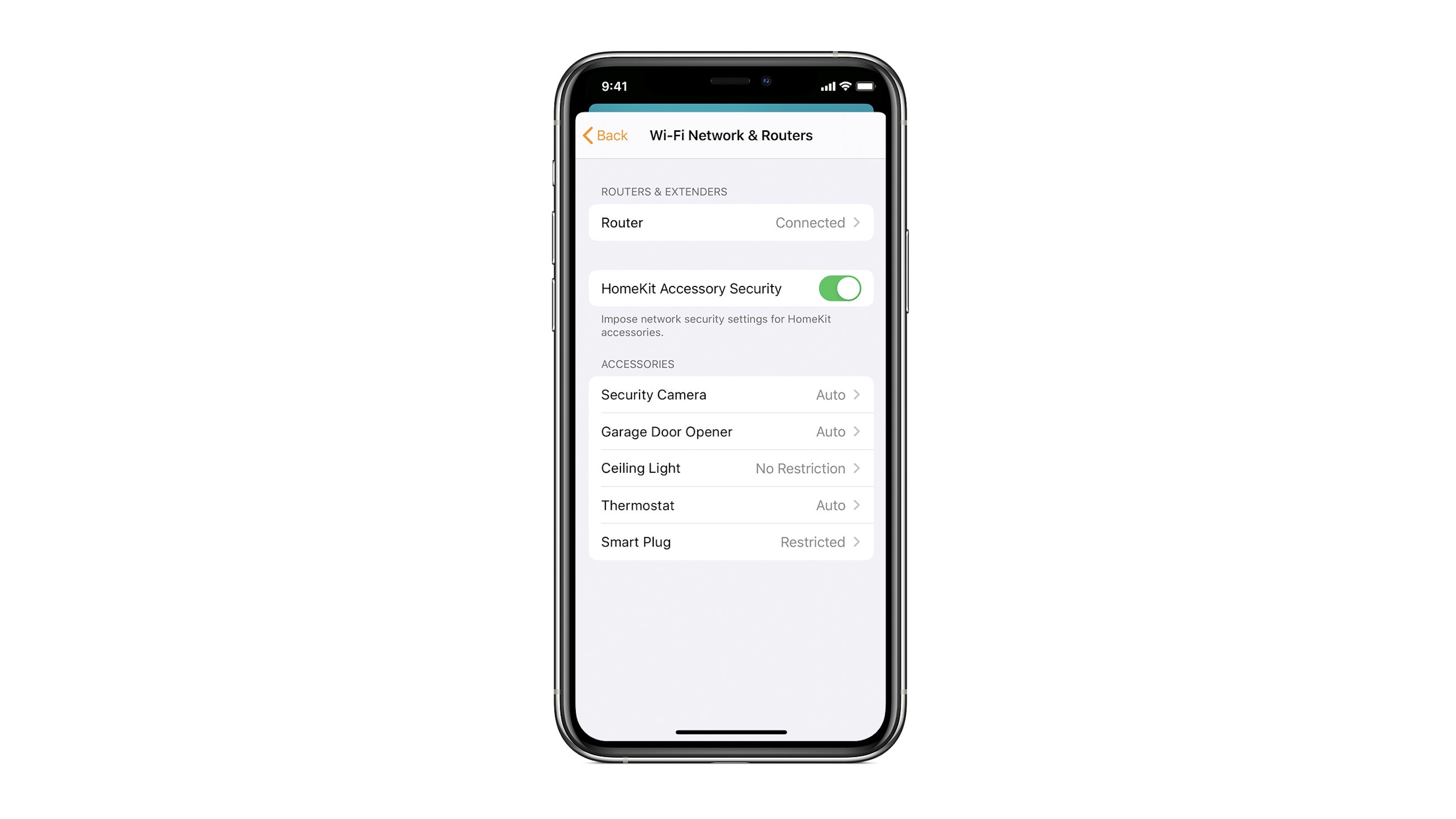
HomeKit Router was also announced with iOS 13, but it wasn’t released until early 2020. The idea behind the feature is you can give granular control to smart home enabled devices to control where on the internet they can reach.

eero was the first company to roll out support in for HomeKit Router.

With Apple HomeKit, eero gives you even more protection of your HomeKit accessories and an easy way to manage what they are allowed to communicate with in your home and through the internet.

There are three levels of security Apple offers for accessories paired with HomeKit routers:

  • Restrict to Home: Most secure. Your accessory can interact only with HomeKit through your Apple devices. The accessory won’t connect to the Internet or any local devices, so any third-party services, like firmware updates, might be blocked.
  • Automatic: Default security. Your accessory can communicate with HomeKit and connections recommended by its manufacturer.
  • No Restriction: Least secure. This setting bypasses the secure router and allows your accessory to interact with any device in your network or Internet-based service.

How Do You Use HomeKit?
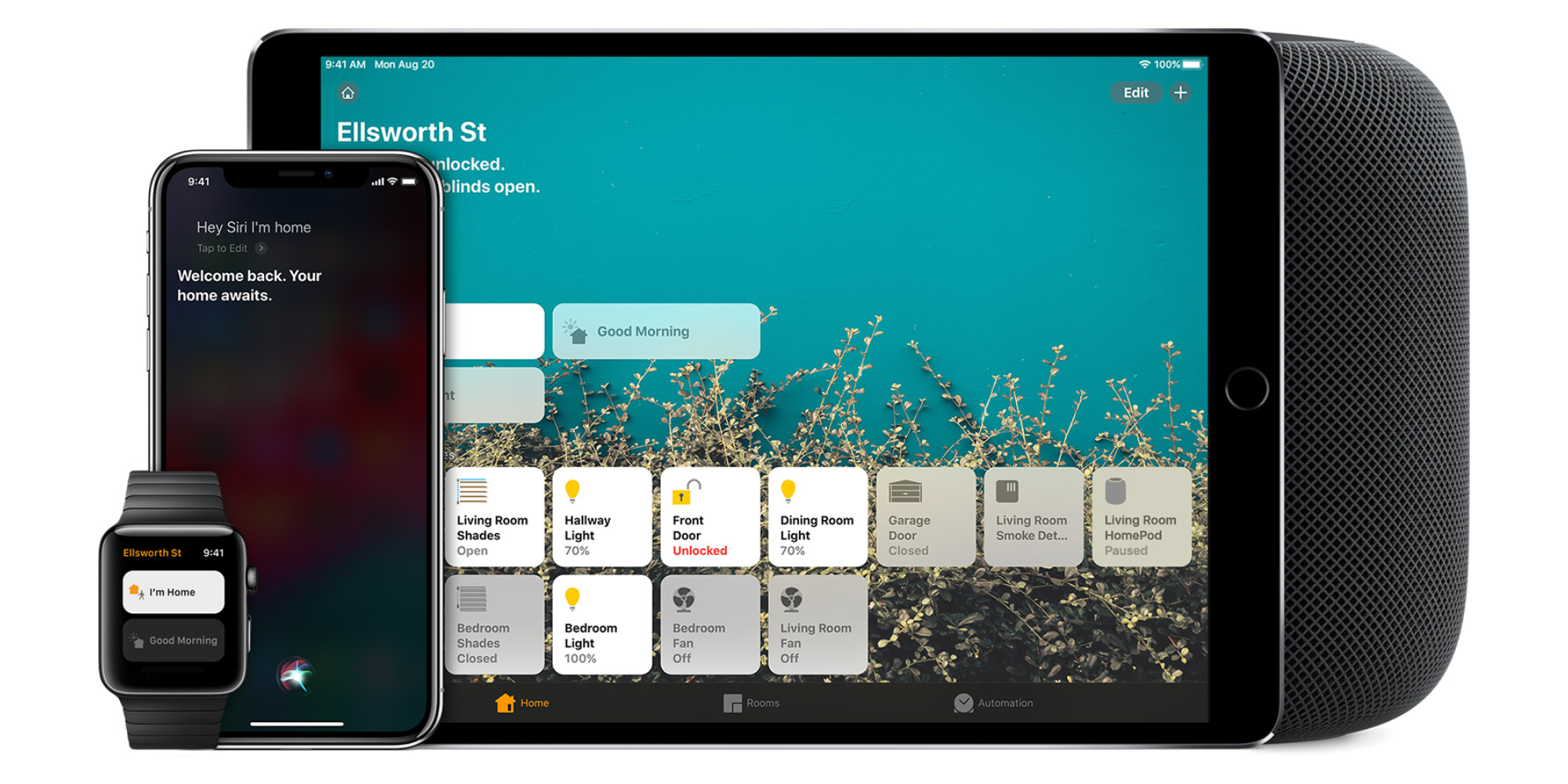
Homekit app

HomeKit devices can be controlled from iPad, iPhone, Mac, Apple Watch, and HomePod. A 4th generation Apple TV (or newer) is an essential Apple smart home device as it acts as a bridge over iCloud to allow access to your devices when away from home.

9to5Mac’s Bradley Chambers does a regular column about the “Apple Home” lifestyle in his HomeKit Weekly column.

MediaTek outs two new SDKs for building HomeKit accessories with its chips

MediaTek is today launching support for Apple’s new HomeKit platform for iPhone-connected home automation accessories with new SDKs for two of the company’s systems-on-a-chip (SoC) products. That means that manufacturers using the MediaTek chips can now easily support HomeKit for controlling products from iOS apps and Siri.

MediaTek, a pioneering fabless semiconductor company and a market leader in cutting-edge systems-on-chip (SoC), today announced it has released two software development kits (SDKs) that support Apple HomeKit. Apple HomeKit is a framework built into iOS that enables secure home control from iPhone, iPad, iPod touch or Apple Watch and lets home accessories work together in smart ways.

The two new SDKs support MediaTek’s MT7688 product, a chip that manufacturers are using for high performance home accessories like webcams and wireless speakers, and the MT7687, a chip being used for lower power Wi-Fi devices like garage doors, power outlets, and thermostats.

Apple officially launched the HomeKit platform back in June with the first batch of products going up for preorder. Since then, other companies have announced incoming support for the platform including hardware bridges that will allow popular existing home automation platforms like Philips’ Hue lights connect to Apple’s framework. Yesterday, 9to5Mac exclusively reported Philips’ HomeKit bridge is planned for release early next month. 

To get a feel for HomeKit in the wild, check out our review of one of the first products to hit the market with HomeKit support, iHome’s $40 SmartPlug.

Sources: Philips Hue to release HomeKit support in October via bridge box, new 800 lumen lights with better colors

Update: We’re hearing the date for the new HomeKit bridge is October 6th … In addition, Philips has officially confirmed that the old box will not be getting HomeKit compatibility in any form. However, it will continue to receive other software updates. You can buy the new HomeKit bridge from here.

Philips is finally ready to join the HomeKit ecosystem with a new box that will act as a bridge between the Apple HomeKit standard and its range of smart internet-connected lightbulbs. As shown in the images above, provided by sources, the new box looks very much like an Apple TV — a rounded rectangle ‘puck’ with indicator lights showing connectivity status.

The new HomeKit box will be available in October and connect existing Philips Hue accessories to the Apple platform. The bridge box will be sold standalone as an official ‘Works with Apple HomeKit’ compatible accessory as well as in new combo sets, also depicted above. These sets include new bulbs with a few improvements over the current models …


Expand
Expanding
Close

Netflix unveils its DIY ‘Netflix and Chill’ button

Netflix has shown off a one-touch ‘move time’ button that switches on Netflix, dims the lights and puts your iPhone into Do Not Disturb mode. The button was introduced at the 2015 World Maker Faire, and the company has released the plans to enable you to build your own. It is also inviting idea for further one-touch buttons.

It was done as a PR stunt, of course, but the button does have a serious side – showing the kind of intelligence we can look forward to when Apple’s HomeKit starts integrating control of our smart home products. Being able to use Siri to control lights is nice, but homes will really be smart when we can say things like ‘Romantic dinner’ and have it set the lights, play the right music and keep the kids occupied upstairs by unlocking their favourite games.

[youtube=https://www.youtube.com/watch?t=2&v=TTlIGdlbTy4]

Via Engadget

Tado, Europe’s Nest competitor, adds multi-room temperature control and IFTTT support

Tado, Europe’s main Nest competitor in the smart thermostat field, has announced two new enhancements to its system. First, multi-room temperature control, allowing different temperatures to be set in different rooms. Second, support for IFTTT recipes to automatically trigger other actions based on Tado detecting people arriving or leaving the home.

For homes that already have different heating devices in different rooms, such as underfloor heating, adding a second thermostat is all you need for the multi-room control. Most of us, though, will need a new smart radiator valve that won’t be available until next fall.

IFTTT support – first promised back in March – has been added from today. This can do things like automatically switch on your alarm when the last person leaves your home, and turn on lights when someone returns. The company has also confirmed that it plans to add HomeKit support further down the line, enabling Siri control and more.

If you’re considering Tado, you may want to check out my review.

Samsung launches next-gen SmartThings Hub with 10-hour backup battery, new iPhone app

SmartThings, Samsung’s answer to Apple’s HomeKit, got some valuable stage time at IFA in Berlin this morning, with the announcement of a brand new SmartThings Hub.

The hardware has been revamped, and no longer needs a connection to the cloud in order to work. What’s more, it’s got a built in backup battery capable of giving you 10 hours use in the event that you have a power cut.  The new Hub is available to order today and was launched alongside a handful of complimentary sensors for tracking water leaks and motion among other things.

Whether you have two smart devices or 200, all you need is one Hub to create a smart home. Like a live-in translator, the Hub communicates with all of your different connected products—regardless of their wireless protocol—so that you can easily monitor and control them from the SmartThings app.

Samsung’s new SmartThings hub has a more powerful processor enabling it to handle video streaming and sensor monitoring tasks without the cloud. With this feature in mind, Sammy also introduced its new Smart Home Monitor which lets users access a continuous vide live-stream and can trigger video recording when something unexpected happens. Only important video is saved for viewing, and early detection enables it to capture the footage before the event.

[vimeo 138101882 w=500 h=281]

As well as new hardware, Samsung has released a new app for iPhone today, with an Apple Watch app expected in the near future. You can organize and control your connected devices by room, view live streaming from cameras and manage the routines right from the app. It’s probably worth noting that although the hub itself has a built-in battery capable of keeping it active during power outages, there’s little point to that feature if all the connected products also require power from the mains.

SmartThings is compatible with nearly 200 products, including the Amazon Echo, and devices from manufacturers like Bose, D-Link and Honeywell. It’s unlikely that many Apple owners will be tempted, but just in case there are, the SmartThings hub is available to buy from today for $99 from SmartThings.com or Amazon, with sensors priced between $30-$55.

Apple TV 4 hardware revealed: A8 chip, black remote, 8/16GB storage, same ports, no 4K

The fourth-generation Apple TV, set to be unveiled at an event on September 9th and released in October, will feature a mix of new and familiar hardware, according to reliable sources. While the new device will sport a much faster processor than the current Apple TV, a color-matched remote control, and a somewhat larger body, it will lack support for 4K video streaming and have the same basic ports as the third-generation model…


Expand
Expanding
Close

Apple TV 4 coming in October for under $200, Apple TV 3 stays & gets new streaming service

Rough mockup of fourth Apple TV vs. third Apple TV by Michael Steeber

With the official debut of the next-generation Apple TV less than two weeks away, sources have provided additional details on Apple’s pricing, availability, and product lineup plans for its set-top devices. According to sources, the fourth-generation Apple TV will be priced below $200, and is on track to become available in October. Apple executives are apparently still finalizing the price of the revamped living room device, but the latest options call for a starting price point of either $149 or $199, both higher than the third-generation Apple TV


Expand
Expanding
Close

Review: Are Belkin’s latest Wemo lights worth the investment before HomeKit support?

Belkin’s three latest products in its Wemo line of Wi-Fi connected, smartphone-controlled products for the home include a white bulb starter kit, a versatile strip light, and garden lights for outdoor use. The last two are both tunable to thousands of colors and all three connect to Belkin’s Wemo ecosystem and companion app for remote control from your iPhone. All three of the products are through a partnership with OSRAM SYLVANIA, who provided the lightning products that Belkin has integrated into its Wemo platform. We took the three new starter kits for a test drive to get a second look at the growing Wemo platform and see if they are worth the investment before support for Apple’s HomeKit…

Expand
Expanding
Close

Philips adds improved HomeKit-compatible dimmer for Hue lighting, wall-mount or use as remote

While the iPhone app is a great way to control your Philips Hue lighting, there are times when a good old-fashioned button is more convenient – especially for the less techy members of your household. Philips already offers the Hue Tap, but that’s a little clunky and designed for wall-mounting only. Its new Philips Hue Wireless Dimming Kit is much sleeker, and is designed so that you can wall-mount it or use it as a handheld remote.

The dimmer can control up to 10 Hue bulbs at once, with Philips promising that the dimming will be smooth, flicker-free and buzz-free. The company also says the firmware can be upgraded for HomeKit compatibility when Philips adds its hub device in the fall … 
Expand
Expanding
Close

Review: iHome’s Siri-controlled SmartPlug lets you try Apple’s HomeKit platform for under $40

Smart plugs aren’t exactly new. Belkin has its WeMo platform of connected home devices including its Wi-Fi-enabled ‘Insight Switch’, an iPhone app-controlled outlet, and others have similar competing products. But iHome’s new SmartPlug is one of the first arriving for Apple’s recently launched Siri-controlled HomeKit platform. I’ve been testing out the product in recent weeks to see exactly what HomeKit adds to the experience and to get a real world taste of Apple’s home automation platform in general for the first time with an actual product. Now that it’s officially available for purchase, here’s what you need to know…
Expand
Expanding
Close

What will September’s new iOS 9-based Apple TV bring to the living room?

Site default logo image

Apple plans to hold one of its annual fall media events on Wednesday, September 9th to introduce the new iPhone 6S and iPhone 6S Plus with Force Touch, and after many fits and starts, it appears that the long-awaited next-generation Apple TV will also be unveiled. We’ve been reporting on this upcoming model since 2014, as Apple has been planning to update its set-top-box with support for an App Store for quite some time.

Earlier this year, Apple had locked in a June WWDC debut for both the new Apple TV hardware and software upgrades, but the company ultimately decided to delay the introduction until the fall. While some had speculated that the announcement was pushed back due to a lack of content deals, we are told that the delay was internally attributed to a concern over compromising iOS 9 engineering resources, as the latest OS release is focused at least as much on polish as on new features.

Why would the new Apple TV potentially take away resources from iOS 9? According to sources, this new Apple TV model, codenamed J34, will be the first model to run a full-blown iOS core. Specifically, the new Apple TV operating system will be a TV-optimized version of iOS 9. In addition to the new hardware inside, running iOS 9 will give the new Apple TV a series of benefits over the current model. Below, we explore what users can expect from Apple’s next-generation living room product.


Expand
Expanding
Close

iHome releases HomeKit-ready iSP5 SmartPlug, first iHome Control product

Announced at CES in January, the iSP5 SmartPlug ($40) — iHome’s first smart home accessory, and first Apple HomeKit accessory — is now officially available for purchase. The SmartPlug installs easily in an existing wall outlet, enabling users to enjoy iOS-based remote control of a connected lamp, fan, air conditioner or other electronic device. Two SmartPlugs can be stacked atop one another on a standard wall plate, and multiple SmartPlugs can be grouped as “scenes” for simultaneous iOS control within a home. Interestingly, the new accessory’s compatibility isn’t limited to iOS and HomeKit…


Expand
Expanding
Close

Apple stops selling Nest’s smart thermostat following launch of HomeKit-compatible Ecobee 3

Site default logo image

Apple has removed Google’s Nest smart thermostat from both its online store and physical retail locations following the launch of some of the first HomeKit devices. As reported by Mashable, Google’s smart thermostat is not available from Apple and searching for the product on Apple’s online store now reveals HomeKit-compatible smart devices instead.


Expand
Expanding
Close

Site default logo image

Apple patents TV remote with Touch ID, references both television and HomeKit applications

While Apple reportedly dropped its plans to make a complete TV, its adoption of the Apple TV box as the gateway device for HomeKit may be behind a patent for a TV remote with Touch ID.

As is often the case, the patent is expressed in extremely broad terms, referring to a “sensor configured to detect a biometric characteristic of a user” and mentioning everything from iris detection to voice sensing, but a fingerprint is included and appears to be what is shown in the main drawing.

Apple suggests that biometric authorization could be used both for things like selecting an individual’s preferred channels on a TV, and for home automation applications like changing a thermostat temperature or opening a garage door.

As ever, the fact that Apple patents something is no indication that it will ever make it into a product.

Via Patently Apple

Apple’s tough security requirements for Bluetooth LE are delaying HomeKit roll-out, say manufacturers

Site default logo image

If you were wondering why manufacturers seemed to be rather slow in launching HomeKit-compatible devices, it may all be down to Apple’s stringent security requirements. Forbes reports that manufacturers are finding it hard to incorporate the extremely secure encryption standards demanded by Apple in order to achieve MFi certification for their products.

Apple is requiring device makers using both WiFi and Bluetooth LE to use complicated encryption with 3072-bit keys, as well as the super secure Curve25519, which is an elliptic curve used for digital signatures and exchanging encrypted keys.

While mains-powered WiFi kit is coping, the processing workload in battery-powered Bluetooth LE devices is leading to extremely slow response times, say manufacturers … 
Expand
Expanding
Close

Site default logo image

HomeKit-compatible version of Ecobee 3 smart thermostat goes on sale in Apple Stores today

The HomeKit-compatible version of the Ecobee 3 smart thermostat, officially announced last month, goes on sale in U.S. Apple Stores today, reports The Verge. Apple has sold the original version since November of last year. The HomeKit-enabled model allows the thermostat to be controlled by Siri.

While Apple’s online store listing has not yet been updated to mention HomeKit-compatibility, it’s likely that the new version will ship from there too.

HomeKit was officially documented by Apple last month, the company confirming our report that the Apple TV would act as the gateway device. The support page has since been updated with a full list of Siri commands.

You can read the full press release below.

Via The Verge
Expand
Expanding
Close

Site default logo image

Twist debuts as an AirPlay-connected lightbulb and speaker system combo

[vimeo 129033413 w=700 h=350]

Yet another smart home accessory is hitting the marketplace, but this one relies on WiFi and AirPlay rather than HomeKit. Twist is a lightbulb accessory that does not require any external power or a hub, rather it works by being installed into your standard lamp or light fixture. Using AirPlay as its wireless technology allows users to stream audio to individual Twist lightbulbs via an iOS device or iTunes on the Mac. We saw a demo of the speaker system, and standalone sound quality was fairly good, but it is unclear how it will be affected when installed in a lamp, ceiling, or wall. The multi-color lighting system can be controlled via an iPhone app or a standalone piece of dimmer hardware. The system will ship next year for $249, including one speaker bulb, two standard Twist light bulbs, and the dimmer control.


Expand
Expanding
Close

Site default logo image

Philips says HomeKit coming to Hue in the fall, existing lights will be compatible

Philips has confirmed on Facebook that it will be adding HomeKit support to its iPhone-controlled Hue lighting system – and that existing lights will be compatible.

The post gives no specific details, but in response to a customer question about whether existing Hue lights will work with HomeKit, Philips confirmed that they will.

Yes, the solution we are working on will work with all your existing and new Hue lights. To get details about how your existing Philips Hue products will work with HomeKit, please follow us on Twitter or Facebook

The most likely approach is that Philips will offer a hub to act as a bridge between HomeKit and existing Hue products. The company says that it will reveal full details in September.

An Apple support document recently confirmed expectations that the Apple TV will act as a HomeKit gateway for controlling devices from outside the home.

[youtube https://www.youtube.com/watch?v=BHvgtAcZl6g&feature=youtu.be]

HomeKit documented officially by Apple, as Apple TV confirmed as gateway device

Site default logo image


A new Apple support document for HomeKit has now officially confirmed our earlier report that the Apple TV would serve as a hub for HomeKit devices. The document confirms an Apple TV is needed if you want to control HomeKit accessories while away from home.

If you have an Apple TV (3rd generation or later) with software version 7.0 or later, you can control your HomeKit-enabled accessories when you’re away from home using your iOS device.

Sign in with the same Apple ID on your iOS device and Apple TV, and you’ll be able to use Siri commands to remotely control your accessories.

Apple has also created a page listing the HomeKit devices launched so far, and which we’d expect to be regularly updated as new products are announced … 
Expand
Expanding
Close

Here comes Apple’s HomeKit, first products start shipping starting w/ Insteon, Lutron, iHome, Elgato and Ecobee

Site default logo image

Insteon, Lutron, iHome, Elgato and Ecobee have all just announced that their HomeKit products are now officially available and/or shipping to customers.

The announcements come on the heels of our report that Apple partners planned this week to launch the first products using the company’s new Siri-controlled HomeKit home automation platform, first introduced alongside iOS 8 last year. 
Expand
Expanding
Close

Elgato’s smart home devices now available for pre-order as HomeKit officially starts shipping

Site default logo image

Elgato has announced pricing for its range of HomeKit-compatible smart home devices, and made them available for pre-order. Sources told us last week that the first HomeKit devices would go on sale this week, but with no indication of delivery times, Elgato doesn’t appear to be one of the roughly five companies expected to begin shipping later today.

Elgato first announced last September that it would be making HomeKit devices, and has now revealed pricing on four products, ranging from door/window sensors for $39.95 to a room sensor – measuring temperature, humidity and air quality – for $79.95 … 
Expand
Expanding
Close