China

See All Stories
China

China has been fundamental to Apple’s historical success, but is also arguably the greatest risk to the company’s future.

Why are most Apple products made in China?

Although everyone assumes Apple products are made in China because labor is cheap there, that’s only part of the story – and an increasingly small part, as the company’s assembly partners move toward more and more automated operations.

Steve Jobs originally transferred most Apple manufacturing to China because it was the only country in the world with a huge ready-made supply-chain network, and the ability to scale up production almost overnight. There are three main reasons China – and specifically the Shenzhen area – is such a powerful manufacturing center.

First, the city is strategically placed, serving as the gateway between mainland China and Hong Kong. It is one of the largest shipping centers in the world, with a massive container port.

Second, the Chinese government established Shenzhen as the first Special Economic Zone (SEZ) in the country. SEZs are designed to encourage enterprise through relaxed planning regulations and generous tax incentives – and crucially, to facilitate foreign investment in local companies. It is this, as much as its geographical advantages, which has enabled it to grow at such a pace.

Third, that SEZ was established way back in 1980, meaning that the city has had over 40 years to grow into the manufacturing center of the tech world. Apple relies on a huge network of suppliers and sub-contractors, some of which may make just a single tiny component. The majority of them are based in Shenzhen and its immediate surrounds, so the logistics of bringing everything together in one place for assembly are straightforward.

What are the risk factors with China?

Being over-dependent on China carries a number of risks.

First, there is the generic one: Being overly dependent on any one country is a strategic risk. For example, the COVID-19 pandemic originated there, and had a massive impact on manufacturing capacity. Anything from a natural disaster to political upheaval could disrupt operations within a single country, so it is always wise to have a diverse range of manufacturing centers around the world.

Second, the relationship between the US and China has often been fraught. The trade war started by the previous US administration was a particularly low point, but continued tensions mean that there is always a risk of disruptions to trade between the two countries.

Third, it is increasingly damaging to Apple’s reputation to be so closely associated with a country that has a worsening human rights record – especially when the iPhone maker has no choice but to comply with local laws, however much they may conflict with the company’s own values. Apple has been required to remove VPN and a variety of other apps from the Chinese App Store, allow the iCloud data of Chinese customers to be stored on government-controlled servers, and more. Additionally, there have been growing reports of forced labor in China, including within many different areas of Apple’s supply chain.

What is Apple doing about it?

Apple has been working for a long time on diversifying its manufacturing operations, and has in recent years accelerated the pace at which it is doing so.

As explained above, this is far from an easy undertaking, but Apple now has major manufacturing operations in India, Thailand, Malaysia, and the Philippines, among other countries.

In India in particular, we are seeing the very early stages of a complete supply-chain infrastructure as the government uses a mix of carrot and stick to encourage companies to manufacture more of their components within the country – namely, tariffs on imports of components and tax breaks for local production. COVID-19 lockdowns in China also saw Apple move some iPad production to Vietnam for the first time, but it’s clear that the risks of over-dependence on China have never been greater.


Apple commissions another artistic mural for upcoming Chongqing, China retail store

Site default logo image

Last week Apple posted a video showing how the calligraphy mural painted at one of its upcoming Chinese retail outlets was created just days before that store opened to the public.

Today the company has posted a new video of a second mural, this time at its new Chongqing location. The store features a unique cylindrical entrance, and Apple commissioned two artists—a China-based painter and US-based photographer—to collaborate on the artwork.


Expand
Expanding
Close

Angela Ahrendts recruiting U.S. employees for China as new stores & initiatives revealed

Site default logo image

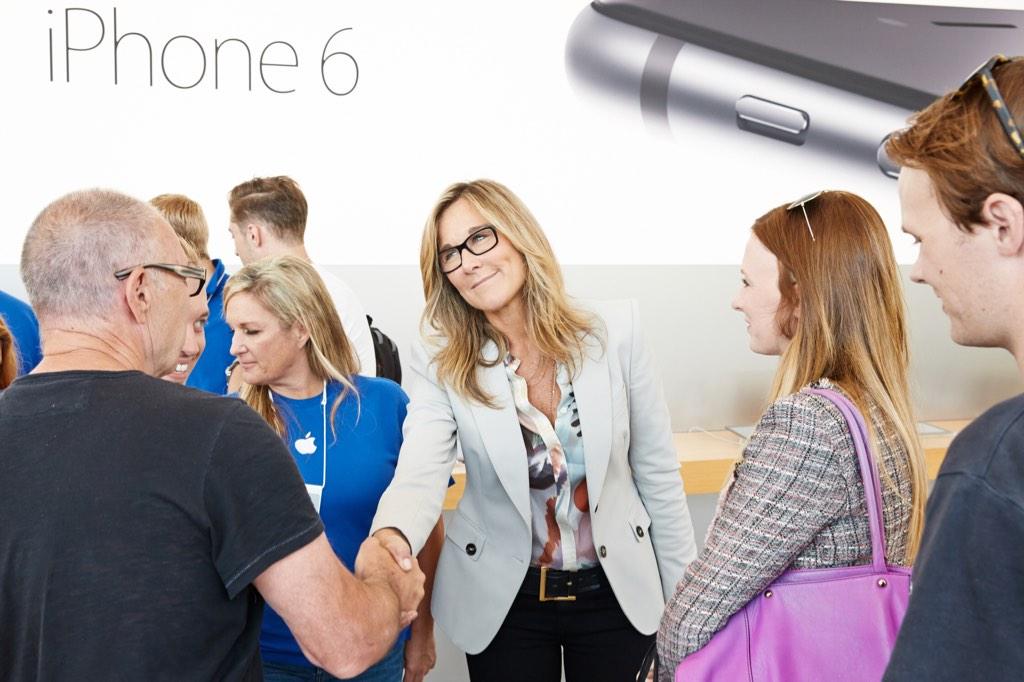
Apple Senior Vice President of Retail Angela Ahrendts is continuing to go all in on growth in China. In video messages to employees in recent days and weeks, Ahrendts has been recruiting employees from United States-based Apple Retail stores to relocate to China to help build up Apple’s retail efforts in the region. In a note to employees late last week, sources say that Ahrendts reported that approximately 200 Apple retail workers from the U.S. have already offered to make the move. Ahrendts added that the offer to move to China “has no expiration date because as the business grows, our needs will only become greater, so as your personal and professional life changes, just always keep China at the top of your mind, because we’re going to need you…”


Expand
Expanding
Close

Apple now selling more iPhones in China than in US, say analysts

Site default logo image

Tim Cook said in October that it was “just a matter of time” before China overtook the USA as its biggest market, and it seems that time may be arriving sooner than expected – at least as far as the iPhone is concerned. The Financial Times reports that analysts expect tomorrow’s Q1 earnings call to confirm that Apple sold more iPhones in China than in the US.

Analysts at UBS estimate that China accounted for 36 per cent of iPhone shipments in the most recent quarter, compared with 24 per cent for the US. During the same period last year, 29 per cent of units were sold in the US and 22 per cent were in China, UBS said.

The view was supported by Creative Strategies, which forecast that Apple has sold around 2M more iPhones in China than in the US in the final calendar quarter of 2014 (Apple’s financial Q1) … 
Expand
Expanding
Close

Westlake Apple Store officially opens its doors in Hangzhou, China (Photos)

Site default logo image

Apple CEO Tim Cook shared the grand opening photo via Twitter

Apple’s latest massive retail store—the Westlake Apple Store in Hangzhou, China—had its opening to the public today as officially scheduled. Naturally, much attention has been paid to what is now the largest Apple Store in Asia with Apple teasing the store’s grand opening earlier this month with a magnificent mural by artist Wang Dongling. You can see more shots from the scene around the new Westlake Apple Store below:
Expand
Expanding
Close

Tim Cook agreed to allow Chinese government to conduct security audits on Apple devices – local media

Site default logo image

Beijing News reports that Tim Cook has agreed to allow China’s State Internet Information Office to carry out security audits of Apple products sold in the country. Cook reportedly made the offer during his meeting with China’s Cyberspace Administration minister Lu Wei in December.

China has long expressed suspicion over the security of Apple products, seemingly resulting from frosty relations with the U.S. Government. A state-run TV station in China described the iPhone as a “national security concern” last July due to its location-tracking capabilities. Apple responded by pointing out that location data is stored on the phone, not on Apple’s servers, and is encrypted … 
Expand
Expanding
Close

Apple teases soon-to-open Apple Store in Hangzhou, China, with stunning mural

Site default logo image

[youtube https://www.youtube.com/watch?v=8MAsPtCNMTI]

Update: Apple has posted a version of the video with English subtitles on YouTube (embedded above).

Apple is certainly not thinking small when it comes to China, with 25 new retail stores promised within a two-year period, and its latest soon-to-open store in Hangzhou features a massive mural covering the entire front of the store. The store is due to open on Saturday, January 24th, the second of five new stores Angela Ahrendts said would be opening by the Chinese New Year on February 19th.

Featuring a poem written around 2000 years ago celebrating the importance of the city—a provincial capital—the stunning calligraphy was hand-painted by Wang Dongling, a famous modern calligrapher. Apple has released a video of its creation … 
Expand
Expanding
Close

Apple planning 5 new Chinese retail store openings by Feb, hiring for 15 new locations

Site default logo image

Apple is committed to its promise of expanding its retail presence in China from 15 to 40 stores within two years. Apple retail chief Angela Ahrendts told Chinese website Xinhua on Thursday that the iPhone maker is gearing up to open five new stores in roughly five weeks.

“We are opening five new stores before the Chinese New Year this year. Four of the stores are in brand new cities for us,” said Ahrendts in a telephone interview with Xinhua. The new locations will be opened in time for China‘s Spring Festival, a popular shopping season that commemorates the Chinese New Year, on February 19.
Expand
Expanding
Close

Site default logo image

Westlake Apple Store set to open in Hangzhou, China next weekend

The Apple Store in Hangzhou, China that was initially believed to be opening late last year finally has an official date.

The Westlake store, as it’s being called by Apple, will open on Saturday, January 24th at 9 AM local time. While many Apple Stores are named after the city or street where they’re located, the Westlake store is named after a popular lake located in the city.

In recent months, Apple’s new retail chief has expressed her desire to push further into the Chinese market along with expanding the company’s global retail footprint.

Site default logo image

Chinese iPhone smuggler caught with 94 iPhones strapped to his body

One Chinese man seemingly couldn’t wait for an official Apple wearable, and tried to smuggle an amazing 94 iPhones from Hong Kong – where they are cheaper – into mainland China by wearing them inside his clothes.

Huffington Post reports that the man was pulled aside by customs officials as a result of his “weird walking posture, joint stiffness, muscle tension.”

We don’t know the mix of models involved, but the total value of the iPhones would likely exceed $50,000, making his saran-wrapped iPhone suit one of the most expensive suits in the world.

Black market iPhone 6 Plus prices had reached over $3000 during the period when they were not officially available in China. Apple’s more official retail outlets are growing rapidly in the country, with Tim Cook pledging to boost the number of Apple Stores in the country from 15 to 40 within two years.

Apple creating a smaller version of iconic Shanghai store as promised Chinese retail expansion continues

Site default logo image

Pudong, Shanghai, store left; latest Chongqing store right

Apple is creating in Chongqing, China, what appears to be a smaller version of its iconic glass cylinder Apple Store in Shanghai. ifo Apple Store shared a series of photos as the wraps came off what is set to be Apple’s third retail store in the Chongqing region, which has a total population of more than 28 million people.

Workers dismantled the huge steel structure that has been covering the entrance for nearly the past year, revealing a 30-foot tall glass structure that will lead to the underground store. The entrance is set in a plaza and surrounded by tall buildings, a setting similar to the [Shanghai] store, but on a smaller scale.

The first Apple Store in Chongqing opened in July of last year, and a second one is under construction. More photos of the latest store can be seen below … 
Expand
Expanding
Close

Watch the full BBC documentary on iPhone factory working conditions while you can

Site default logo image

A screengrab from the documentary showing workers sleeping on the production-line

The full BBC documentary on working conditions in iPhone factories has been unofficially uploaded to YouTube. It probably won’t be too long before it gets pulled, so if you want to see it, watch it while you can – we’ve embedded the full video below … 
Expand
Expanding
Close

Tim Cook “deeply offended” by BBC allegations of poor working conditions in iPhone factories

Site default logo image

In a letter to UK staff, Tim Cook is said to have been “deeply offended” by allegations made in a BBC undercover documentary that Apple had broken promises over the working conditions in Pegatron’s iPhone factories in China, reports the Telegraph.

In an email to around 5,000 staff across the UK, Apple senior vice president of operations Jeff Williams said both himself and the chief executive were “deeply offended by the suggestion that Apple would break a promise to the workers in our supply chain or mislead our customers in any way”.

“Panorama’s report implied that Apple isn’t improving working conditions,” he continued. “Let me tell you, nothing could be further from the truth.”

Williams said that Apple had provided both “facts and perspective” on the allegations, but the BBC had chosen not to include these in the program … 
Expand
Expanding
Close

Tim Cook demoed Apple Watch for Chinese officials on recent US visit

Site default logo image

Tim Cook shows China’s top internet regulator Lu Wei the Apple Watch

Apple CEO Tim Cook alongside Facebook’s Mark Zuckerberg, Amazon’s Jeff Bezos and other tech executives recently met with China’s Cyberspace Administration ministerLu Wei while the government official was in the US, according to a report from China’s government-run china.com.cn (via Bloomberg).
Expand
Expanding
Close

Apple planning to support 500 Apple resellers in India, focusing on iOS devices – report

Site default logo image

An Apple Premium Reseller store in India

Times of India has put numbers on its earlier claim that Apple was planning to open a collection of iOS-centric stores in India. It now says that Apple plans to support 500 new resellers in the country as part of a major expansion program into smaller towns and cities, where Samsung currently dominates.

Apple reportedly sold a million iPhones in India in the 12 months to September 2014, helped in part by a cheaper 8GB version of the iPhone 5c, and is said to expect sales to treble in the following 12 months following the rollout of the iPhone 6 in October … 
Expand
Expanding
Close

Chinese smartphone maker claims Apple copied iPhone 6 design

Site default logo image

Chinese smartphone maker Digione is claiming Apple’s iPhone 6 and 6 Plus copy the design of its own smartphone line.

Macworld reports that the company published a letter online yesterday that was originally sent to Apple back in September in order to make them aware that the latest iPhones might infringe on a patent it was granted in July by China’s State Intellectual Property Office.
Expand
Expanding
Close

Apple will soon let third-party products use its Lightning port, opening up new possibilities for accessories

Site default logo image

Last week at Apple’s yearly briefing for accessory makers in its Made-for-iPhone/iPad (MFi) licensing program, the company unveiled new Lightning connectors and specs for Lightning receptacles that will soon be available for implementation in MFi accessories. The new Lightning receptacle, scheduled to start shipping next year, will allow accessory makers to build new types of accessories that include a port for Apple’s proprietary Lightning connector previously reserved for its own iOS devices (pictured above).
Expand
Expanding
Close

China UnionPay debit and credit cards now accepted as payment method for Apple’s Chinese App Store

Site default logo image

China UnionPay is the largest bank card provider in the region, but the App Store has not supported the payment method up to now. Apple has announced that this inconvenience has now been resolved with customers in China now able to link their Apple ID with debit or credit cards from UnionPay.

The addition should help expand the reach of the App Store to even more customers, allowing Apple to bolster its number credit cards on file ahead of an Apple Pay launch in the country. Code references have already been found that show the iPhone 6 NFC element is ready to support China UnionPay purchases.


Expand
Expanding
Close

US-China trade deal set to reduce manufacturing costs for Apple, aims to cut prices for consumers

Site default logo image

President Obama and President Xi Jinping in Beijing (photo: Agence France-Presse/Getty Images)

A trade agreement reached between the U.S. and China looks set to reduce Apple’s manufacturing costs by removing import tariffs on components imported into the country.

Apple uses components from a number of countries around the world, notably Korea and Japan, which are imported into China for the assembly of iPhones, iPads and Macs. China currently imposes import tariffs on these components. The new deal would allow companies like Apple, Microsoft and HP to bring components into China free from these charges … 
Expand
Expanding
Close

Possible Apple-Alibaba partnership could lead to greatly accelerated rollout of Apple Pay in China

Site default logo image

The potential partnership between Apple and Chinese ecommerce giant Alibaba could facilitate a far more rapid rollout of Apple Pay in the country than if Apple goes it alone, suggests a piece in the WSJ. Tim Cook first revealed that he was in talks with the company at the WSJ Digital conference last month.

One possible scenario is for Alibaba’s financial affiliate, which owns the Alipay electronic-payment business in China, to provide back-end services for Apple’s Apple Pay payment system, allowing iPhone users to pay with Apple Pay using the money from their Alipay accounts, Mr. Tsai said.

Such an arrangement would be significant for two reasons … 
Expand
Expanding
Close

Apple blocks WireLurker malware apps from opening, but needs to do more, argues security researcher

Site default logo image

Apple has now blocked the launching of Mac apps infected with WireLurker malware, after earlier revoking security certificates to prevent them being installed on new devices. WireLurker was capable of infecting non-jailbroken iOS devices when connected to a Mac running one of the compromised apps. Over 400 Mac apps in a third-party Chinese app store were affected.

In a written statement, an Apple spokesperson said:

We are aware of malicious software available from a download site aimed at users in China, and we’ve blocked the identified apps to prevent them from launching. As always, we recommend that users download and install software from trusted sources.

However, a security researcher says that it would be easy for other attackers to exploit the exact same weakness … 
Expand
Expanding
Close

Apple plans Apple University in China, bringing Jobs’ vision to Asia

Site default logo image

Tim Cook speaking at a conference in China

Apple is seeking to cement its business position in China for the long-term with an expansion of its Cupertino-based Apple University program to the region, according to a person with knowledge of the plans. Apple Vice President and Dean of Apple University Joel Podolny is currently interviewing candidates for a new Dean of Apple University position for China, according to the source.

Started in 2008, Apple University is an extensive and growing program within corporate Apple that trains mid-level employees and managers on the decisions made by Steve Jobs and other key executives throughout the company’s resurgence. Jobs created the program alongside former Yale School of Business Dean Podolny in order to keep the culture of Apple alive well beyond the lifetime of executives key to Apple’s early success.

The expansion of Apple University to China will mark a key step in Apple’s history as a global company. It will be the first time Apple has fully expanded the exclusive program to another region, indicating that it wants to extend its presence in China beyond mostly just sales and operations, like it has done in the United States. Apple has previously offered a minimal amount of courses in other regions and has flown-in professors. With many Apple suppliers headquartered in China, it is likely that a notable portion of the Apple University classes in China will be geared toward product engineering and manufacturing matters…


Expand
Expanding
Close

Tim Cook talks Apple Pay, Apple Watch and security on final day in China

Site default logo image

On the final day of Tim Cook’s four-day visit to China, he told state news agency Xinhuanet that Apple Pay was top of the list of things the company wanted to take to China.

“China is a really key market for us,” said the CEO. “Everything we do, we are going to work it here. Apple Pay is on the top of the list.”

Cook said that Apple would be working to understand the steps needed to bring the new service to China before meeting with local carriers, banks and merchants …

Expand
Expanding
Close