Mac

See All Stories

Apple’s Mac lineup consists of MacBook, MacBook Air, MacBook Pro, iMac, Mac Pro, and Mac Mini. The Mac runs macOS for its operating system.
Mac lineup

History

The Mac is Apple’s lineup of computers, and it can be considered the company’s oldest product. The name “Mac” comes from the original Macintosh, which was introduced in 1984 and is also considered the first personal computer for the masses to have a graphical user interface. The first Macintosh hit the stores on January 24, 1984, costing $2,945.

Among all these years, Apple has introduced many different Mac models, ranging from desktops to laptops to professional tower machines. The current lineup consists of the MacBook Air, MacBook Pro, Mac mini, iMac, and Mac Pro. However, there have been other Mac models were discontinued, such as the eMac, MacBook, and iMac Pro.

The history of modern Macs began in 1998, a year after Steve Jobs returned to Apple. Apple had dozens of Macintosh computers at that time, but Steve decided to rethink the entire lineup. In 1998, Apple announced the iMac G3, which ditched the floppy disk and serial ports in favor of USB connectors.
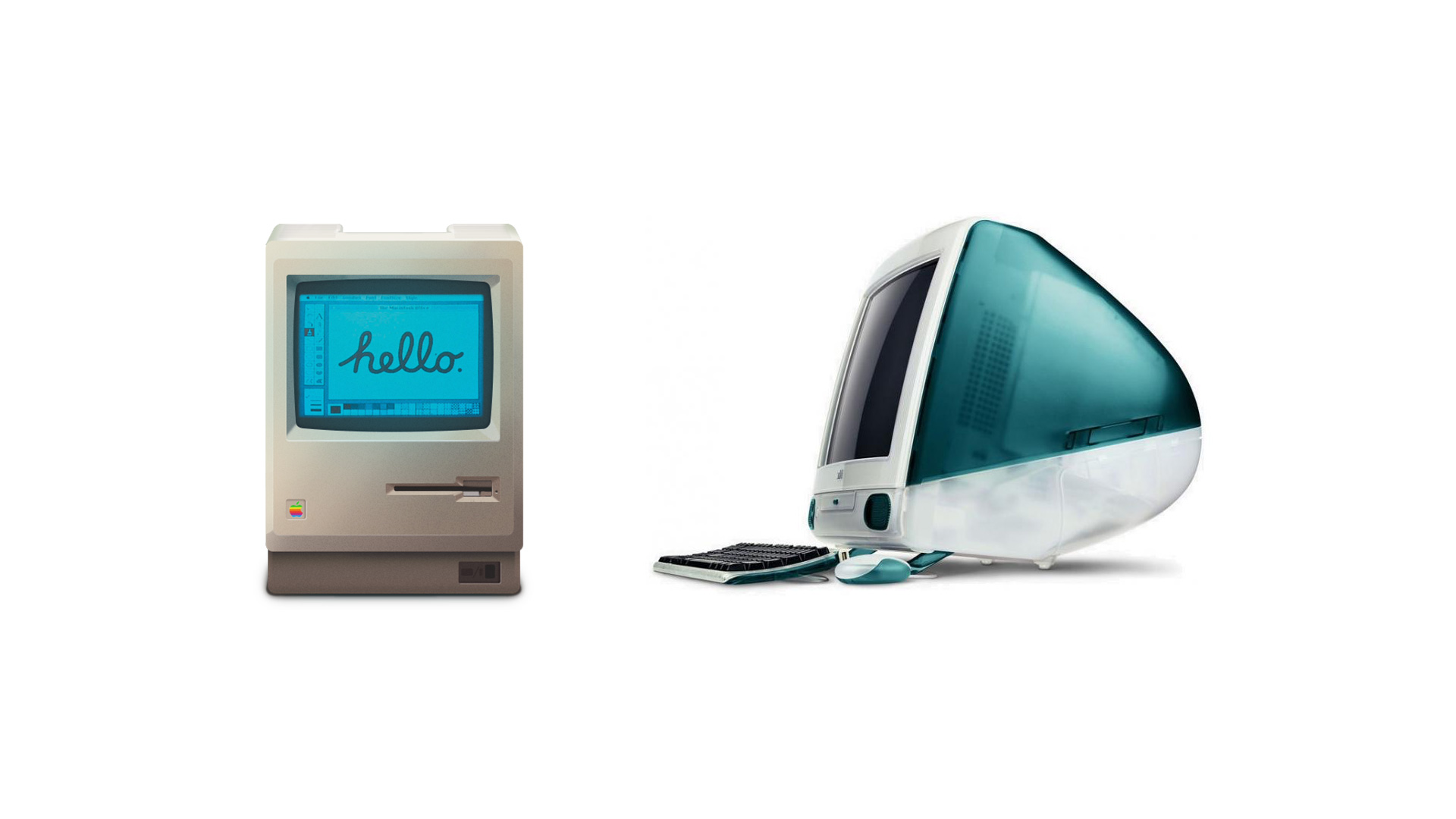
Macintosh and iMac G3.

Unlike the Macintosh, the first iMac was considered a huge success — not only for its technology, but also for its unique design with colorful translucent plastic. Apple quickly expanded the Mac lineup with other models, which included the iBook and PowerBook (which became the MacBook and MacBook Pro) and the PowerMac, which is now the Mac Pro.

macOS

What makes a Mac the Mac is the macOS operating system, which has also had a long history since the introduction of the first Macintosh. Initially called Mac OS, the operating system was rebuilt when Steve Jobs returned to Apple.

The first version of Mac OS X was released on March 24, 2001 with a new interface that is still present in some ways in current versions of macOS. Apple’s desktop operating system comes with many free applications such as Pages, Keynote, Numbers, iMovie, and GarageBand.

With macOS, users also have access to deep integrations with other Apple devices. For instance, you can answer calls and send SMS from your iPhone using your Mac. Handoff lets you switch from one device to the other and pick up where you left off. Apple Watch users can unlock their computer without entering a password, and you can even copy and paste between devices.
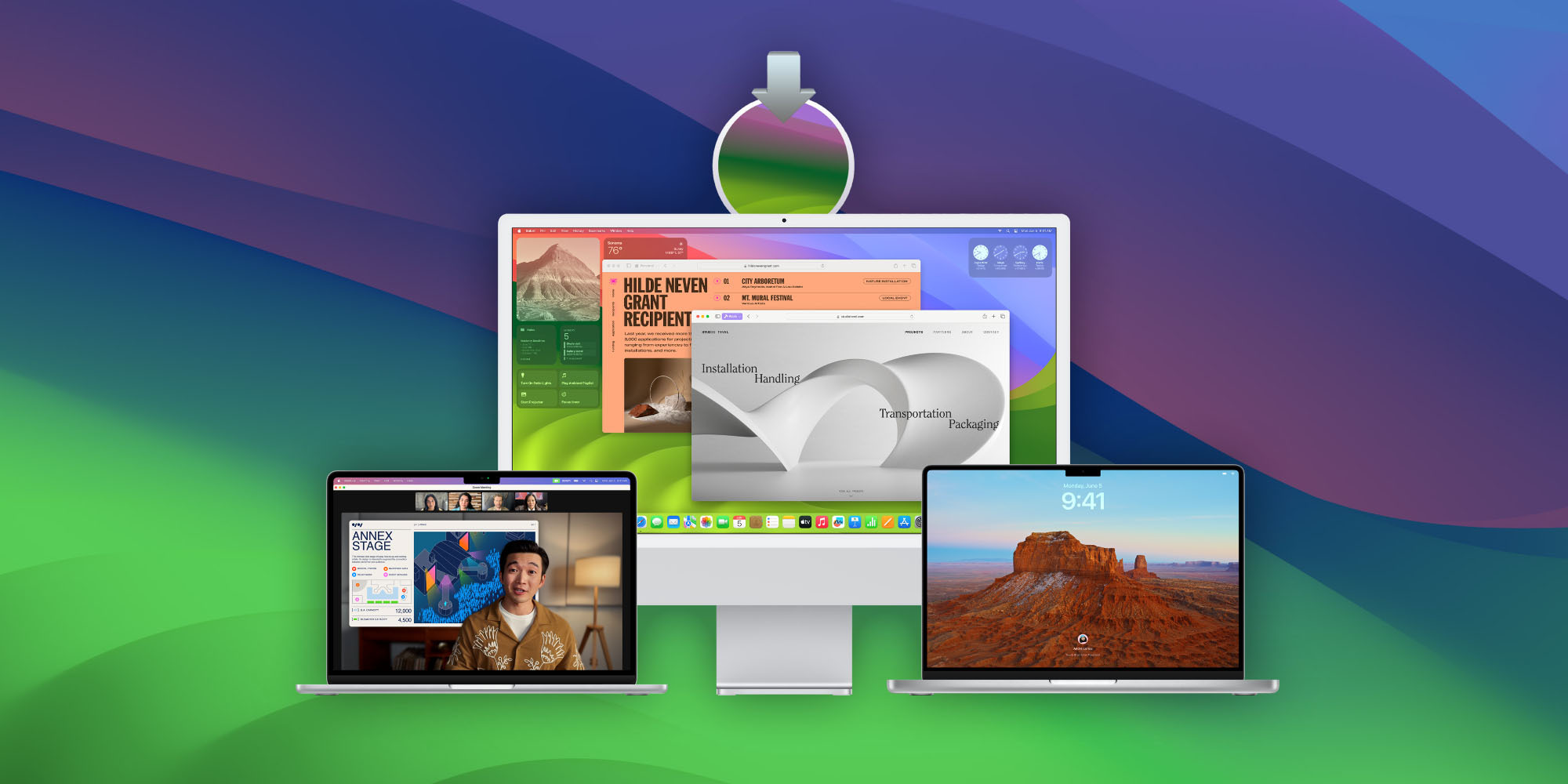
macOS Sonoma

Apple’s desktop operating system is also integrated with services offered by the company, such as iCloud, Apple Music, and Apple TV+.

The current version of macOS is Sonoma (version 14), which features new slow-motion screen savers, widgets on desktop, camera effects on FaceTime and other apps, web apps, passkey sharing, improved PDF support, and Game Mode. The update also comes with a new API that lets developers easily port Windows games to macOS.

Architecture Transitions

The Mac has had three major architecture transitions in its history. Apple’s first computers ran on Motorola processors, but the company decided to migrate to the new PowerPC platform in 1994. While this brought benefits at the time, the PowerPC processors were not delivering what Apple expected.

It was in 2005 that Apple confirmed the transition from PowerPC to Intel. Intel processors had become faster and more efficient than PowerPC, which enabled the development of new Mac computers that were more powerful and also more compact. Developers have been given access to a Developer Transition Kit running Mac OS X Tiger with Intel Pentium 4 to update their apps before the transition begins.
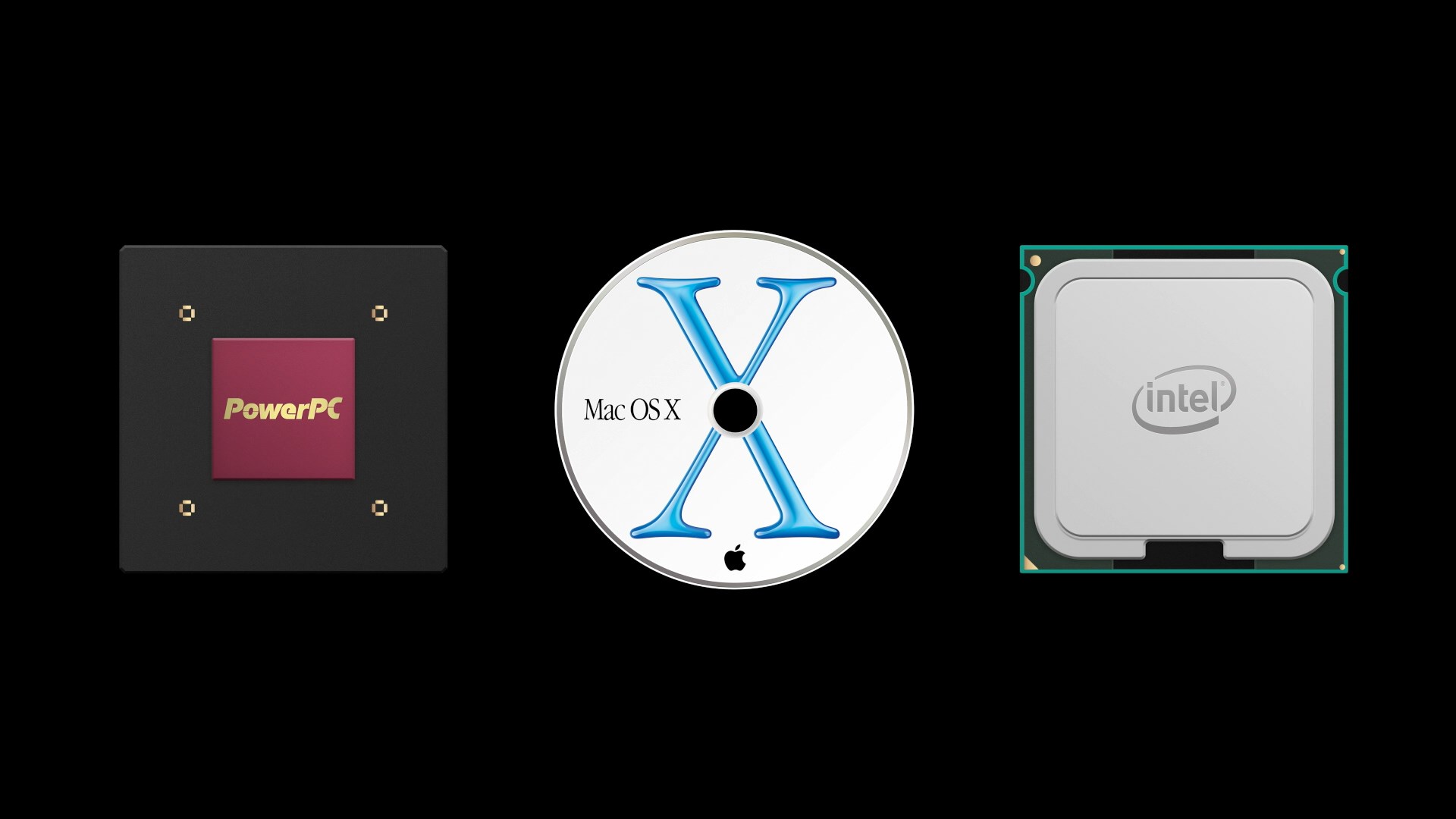
Power PC, Mac OS X, and Intel processor.

Apple said that the transition would begin in June 2006 and be finished by the end of 2007. However, the transition to Intel was fully completed in August 2006 when the company replaced the PowerMac with the new Intel Mac Pro.

As the years went by, Apple once again felt the need to have more powerful and efficient processors for its computers. This time, the company was already working on its own chips for the iPhone and iPad. In June 2020, Apple confirmed that it was changing the architecture of the Mac, now from Intel to ARM chips, which are called Apple Silicon.

Apple offered a Mac mini DTK running on the same A12Z Bionic chip as the 2020 iPad Pro. This way developers could once again update their apps ahead of the transition. In addition to being more powerful and energy efficient, the ARM architecture of Apple Silicon chips has enabled Macs to run iOS apps for the first time.
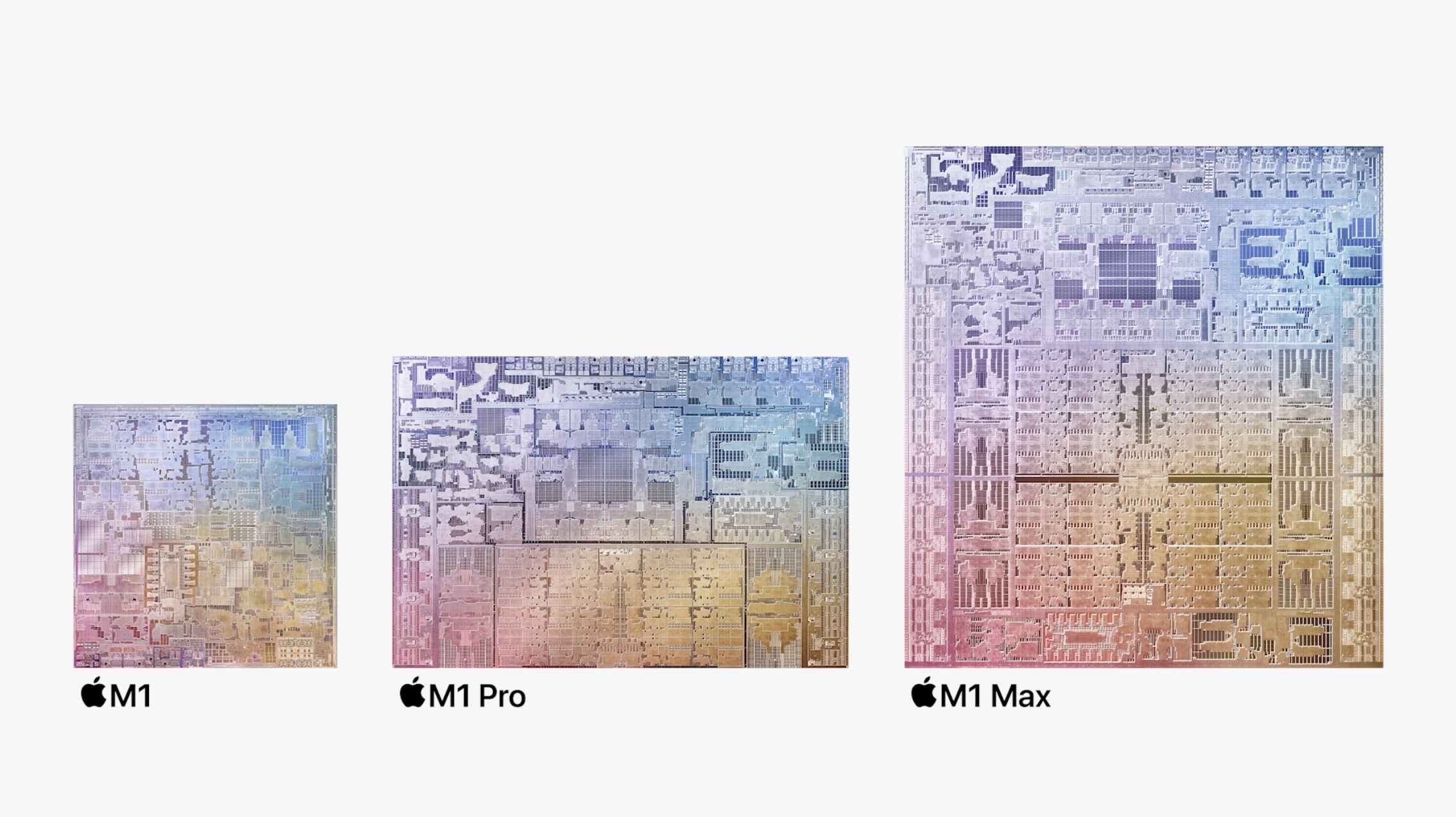
Apple M1 chip | Mac

The first Apple Silicon Macs were released in November 2020 with the M1 chip. The company later introduced more powerful variants of the M1 chip, called M1 Pro, M1 Max, and M1 Ultra. Macs with Apple Silicon have become known for being more powerful while consuming much less power, which has resulted in MacBooks with extended battery life.

In June 2022, Apple introduced the M2 chip, which is around 20% faster than the M1 and also supports more RAM. M2 also has more powerful variants: M2 Pro, M2 Max, and M2 Ultra.

Apple unveiled the M3, M3 Pro, and M3 Max chips in October 2023. The main highlight of this generation is the 3 nanometer technology, the same as the A17 Pro chip. The M3 family also features better GPUs with support for hardware-accelerated ray-tracing.

Current Mac lineup

Apple currently sells a variety of Mac computers, which includes MacBooks, Mac mini, iMac, and Mac Pro. While some of the Macs have already been updated with an Apple Silicon chip, others remain with Intel processors.

MacBook Air

The MacBook Air is Apple’s most affordable laptop and it has become popular for its light, compact design. The 2022 version is powered by the M2 chip and is offered with 8GB, 16GB, or 24GB of RAM. Plus, it has a new, edge-to edge 13.6-inch Retina display.

The laptop features Touch ID and has two Thunderbolt 3 compatible USB-C ports, a MagSafe connector for charging, and a headphone jack. Prices start at $1099 in the US. It’s offered in silver, space gray, starlight, and midnight.
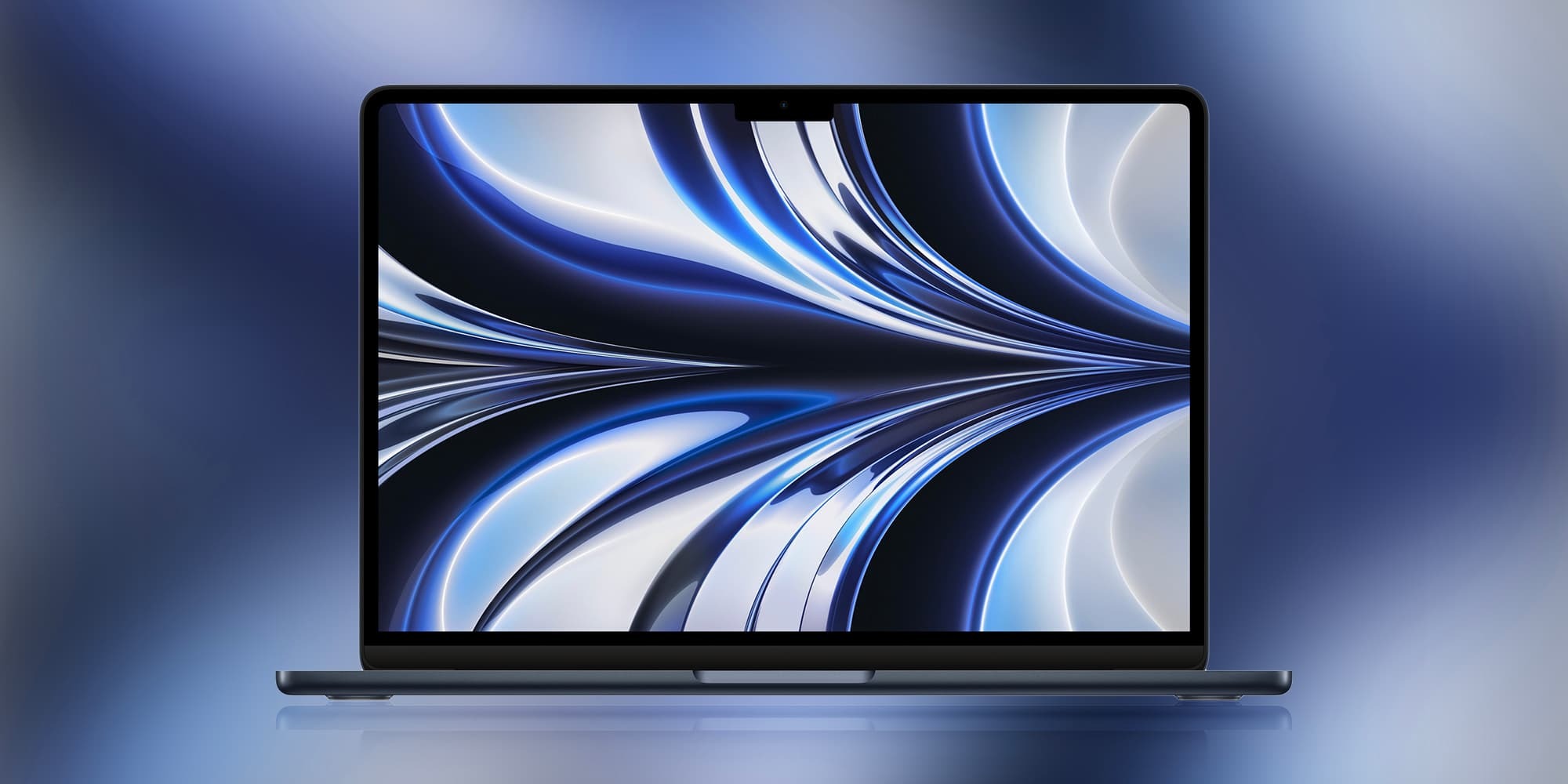
M2 MacBook Air.

A year later, Apple introduced the first 15-inch MacBook Air. It has essentially the same hardware as the smaller version with a similar design, but with a larger display. Prices start at $1299 in the US.Apple is still selling the M1 MacBook Air for prices starting at $999.

MacBook Pro

The 2023 MacBook Pro is available in multiple versions, and customers can choose between 14-inch and 16-inch screen sizes. For the first time, Apple has introduced a less expensive version of the 14-inch MacBook Pro with the base M3 chip. This version has the same design and display as the high-end versions, except that it only has two USB-C ports instead of three.
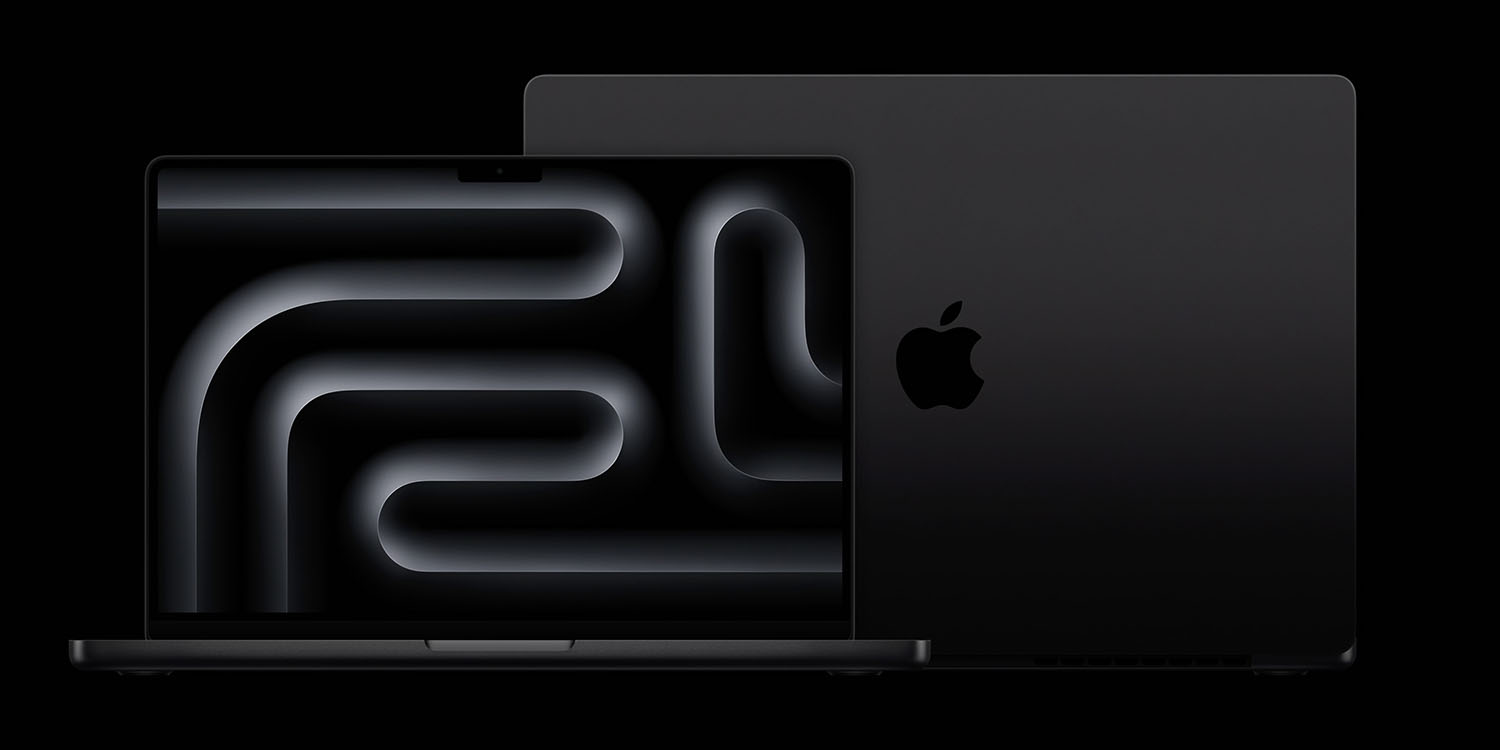
M3 MacBook Pro

The most expensive versions of the MacBook Pro are equipped with the more powerful M3 Pro and M3 Max chips. The laptop can be configured with up to 128GB of RAM and 8TB SSD. These versions also come in a new Space Black color.

Unlike the MacBook Air, the MacBook Pro comes with an HDMI port and an SD card reader. It also features MagSafe and Touch ID on the keyboard. Apple no longer sells MacBooks with the Touch Bar. Prices start at $1,599 in the US.

Mac mini

Mac mini is the cheapest Mac currently available since it’s basically a desktop without a built-in display or other peripherals. The base model with the M2 chip features one Ethernet port, two USB-C/Thunderbolt 4 ports, HDMI 2.0, two USB-A ports, and a headphone jack.

Apple sells a more powerful version of the Mac mini with the M2 Pro chip, which also comes with four USB-C ports instead of two. Mac mini can be configured with up to 32GB of RAM and up to 8TB of storage. Customers can also opt for a 10 Gigabit Ethernet port. The Apple Silicon Mac mini is only available in silver, while the now discontinued Intel model was available in space gray.
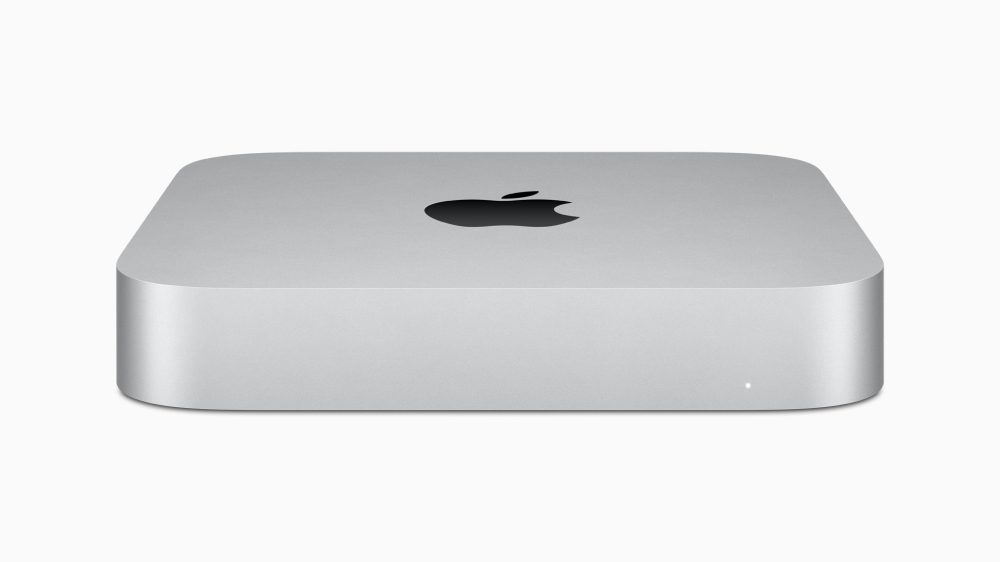
Apple Silicon Mac mini.

Prices for the Mac mini start at $599 in the US. Again, it’s worth noting that it doesn’t come with a keyboard or mouse in the box – you need to buy them separately or use your current ones.

Mac Studio

Mac Studio represents a new category between Mac mini and Mac Pro. It features a design based on the Mac mini, but with a taller body to support the more powerful hardware and also a better cooling system.

The new Mac Studio is targeted at professional users who work with demanding tasks such as video editing, 3D rendering, and machine learning. 

Embraced by creative pros everywhere, Mac Studio now delivers next-generation power in the form of the lightning-fast M2 Max and the boundary-breaking M2 Ultra. It packs outrageous performance and extensive connectivity in an unbelievably compact form, putting everything you need within easy reach and transforming any space into a studio.

By default, Mac Studio already comes with the M2 Max chip, 32GB of RAM, and 512GB SSD storage. A more expensive option lets users customize Mac Studio with M2 Ultra. While M2 Max has a 12-core CPU and a 30-core GPU, M2 Ultra doubles all of those specs. The new chip has a 24-core CPU and a 60-core GPU.

Mac Studio can also be configured with up to 192GB of RAM and 8TB of SSD storage. The machine offers up to six Thunderbolt ports, 10 Gigabit Ethernet, headphone jack, two USB-A ports, and one HDMI port.
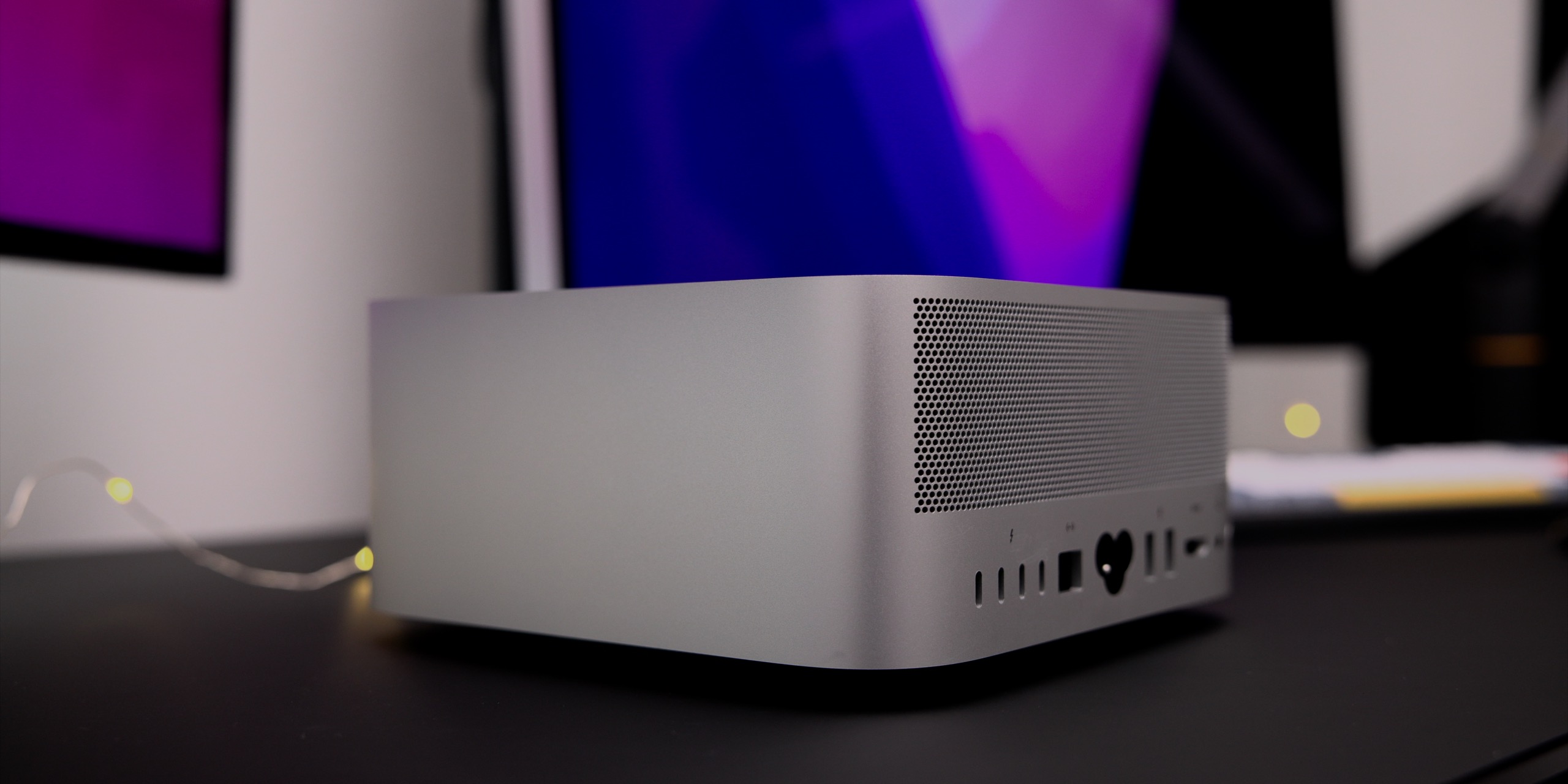
Mac Studio

Apple has been rumored to be working on new versions of this machine with the M3 Max and M3 Ultra chips. However, these versions may not be ready until 2025. Bloomberg’s Mark Gurman said in November last year that the M3 Ultra chip “hasn’t yet gone into broad testing” inside Apple.

In the US, prices for the Mac Studio with M2 Max chip start at $1999. The M2 Ultra chip version starts at $3999. Just like the Mac mini, Mac Studio doesn’t come with a keyboard and mouse in the box. You can find accessories for your Mac Studio here.

iMac

iMac is Apple’s most popular desktop computer with an all-in-one construction. It features a 4.5K display in its 24-inch version and a 5K display in the 27-inch version. At the same time, Apple still sells an entry-level iMac with a regular 1080p display.

The 24-inch iMac is the first to feature the M1 chip, the same as in the Mac mini, MacBook Air, and MacBook Pro. This allowed Apple to introduce a completely redesigned model with a slimmer design, which is also offered in seven new colors. Customers can customize the new 24-inch iMac with up to 16GB of RAM and 2TB of storage.
Site default logo image

The company ships the 24-inch iMac with Magic Mouse and Magic Keyboard, plus a Lightning cable for recharging accessories. Prices in the US start at $1299. Apple has discontinued its old 21.5-inch iMac and the 27-inch iMac 5K.

Mac Pro

Mac Pro is a computer built for professional users who depend on extremely powerful hardware. Available in tower and rack versions, it has a completely modular design. That means users can replace RAM, SSD, GPU, and other internal components.

By default, it features four USB-C/Thunderbolt 3 ports, two USB-A ports, and two 10Gb Ethernet ports. However, the ports can be expanded using the PCI Express slots. Apple also ships the computer with a Magic Mouse and Magic Keyboard, but it does not come with an external monitor included.

All models feature Intel Xeon W processors, which are the most powerful processors offered by Intel. Consumers can configure Mac Pro with up to 28-core processor, 1.5TB RAM, and 8TB of SSD storage. In addition to supporting multiple dedicated GPUs, Apple also offers the Afterburner card — which accelerates the decoding of ProRes videos.

The company recently updated the Mac Pro with new graphics card modules, which include Radeon Pro W6800X and Radeon Pro W6900X.

Site default logo image

Mac Pro prices start at $5999 in the US.

Rumors about upcoming Macs

Top stories about the Mac

Site default logo image

Civilization: Beyond Earth arrives today for Mac users

Following an announcement last month that the latest entry in the popular Civilization strategy game series would hit Mac sometime this holiday season, today Civilization: Beyond Earth has officially arrived for Mac users. The game, developed by Firaxis and brought to Mac users by Aspyr, first hit PC on October 24th.

Beyond Earth offers a fresh take on the traditional strategy gameplay of previous entries with a new sci-fi theme that lets users explore deep space and other futuristic settings. 

As part of an expedition sent to find a home beyond Earth, you will write the next chapter for humanity as you lead your people into a new frontier and create a new civilization in space. Explore and colonize an alien planet, research new technologies, amass mighty armies, build incredible Wonders and shape the face of your new world. As you embark on your journey you must make critical decisions. From your choice of sponsor and the make-up of your colony, to the ultimate path you choose for your civilization, every decision opens up new possibilities.

The Mac version arrives today with all of the features included in the PC counterpart including cross platform multiplayer and save syncing between all platforms. 

The game is available today through all of the usual suspects including Steam, the Mac App Store, and developer Aspyr’s own GameAgent store. It cost $49.99, but the $41 preorder deal is still live through Cyber Monday.

Features:

  • Seed the Adventure: Establish your cultural identity by choosing one of eight different expedition sponsors, each with its own leader and unique gameplay benefits. Assemble your spacecraft, cargo & colonists through a series of choices that directly seed the starting conditions when arriving at the new planet.
  • Colonize an Alien World: Explore the dangers and benefits of a new planet filled with dangerous terrain, mystical resources, and hostile life forms unlike those of Earth. Build outposts, unearth ancient alien relics, tame new forms of life, develop flourishing cities and establish trade routes to create prosperity for your people.
  • Technology Web: To reflect progress forward into an uncertain future, technology advancement occurs through a series of nonlinear choices that affect the development of mankind. The technology web is organized around three broad themes, each with a distinct victory condition.
  • Orbital Layer: Build and deploy advanced military, economic and scientific satellites that provide strategic offensive, defensive and support capabilities from orbit.
  • Unit Customization: Unlock different upgrades through the tech web and customize your units to reflect your play style.
  • Multiplayer: Up to 8 players can compete for dominance of a new alien world.

Gameplay trailer below:

[youtube=https://www.youtube.com/watch?v=sfQyG885arY]

Site default logo image

Some of the best audio interfaces for your Mac, iPad and iPhone get deep discounts for Black Friday

Apogee, well known for its studio quality audio interfaces and converters, has kicked of its Black Friday 2014 sale today. Running from now through December 2nd, you’ll find as much 60% off its factory refurbished iOS/Mac interfaces and multi-channel flagship options.

Due to how rare it is for these interfaces to go on sale from any retailer, all of the deals are quite notable. Some standout options are the JAM studio quality guitar input interface for iPad, Mac and iPhone is available for $69 (Reg. $99), and the Duet USB interface for Mac and iPad for $475 (Reg. $595). Both are matching or beating the previous Apogee sale, between $30 and $100 under Amazon and other retailers and are the lowest prices available.

You can see more of what Apogee’s Black Friday sale has to offer below, and be sure to head over to Amazon’s pre-Black Friday Musical Instruments Store for ongoing discounts/lightning deals from now through Black Friday.

Apogee is offering incredible, limited-time deals on their award-winning products for recording and listening to music on iPad, iPhone and Mac. Starting on Wednesday, November 2014, save up to 60% on select products exclusively through Apogee’s US webstore. The sale continues through Black Friday and Cyber Monday, ending on Tuesday December 2. Supplies are limited so act fast!

Twitterrific 5 for Mac may become the first casualty in Twitter’s war on developers, but it won’t be the last

Site default logo image

If you open the Mac App Store right now and do a search for “twitter,” you’ll find results just like the ones in the image above. You may recognize the official Twitter app along with some of the most popular and prolific third-party clients. Right below Twitter for Mac you’ll find Twitterrific.

Twitterrific has been around for quite a while now, and was the very first native Twitter application ever built for Mac. It was also the first app to use the word “tweet” to refer to the posts on the network, and introduced many modern staples like conversations and replies. To this day it remains a popular choice among users and has seen many major updates and redesigns. It’s currently on its fourth major version.

In December 2012, Twitterrific 5 was released for iOS devices. The Iconfactory, Twitterrific’s developers, promised that a Mac version of the updated app was in development and would include support for the new iCloud syncing feature and an all-new design. Three days shy of a year after releasing the iPhone update, however, users were given what is currently the app’s most recent update. It included only two bug fixes. The developers have noted that the 5.0 update for Mac is facing big delays.

So what’s going on here? Why has it taken two years for any more news of the update? When will the new version finally be available?

The unfortunate truth? Not even the developers know.


Expand
Expanding
Close

GarageBand, Star Walk, Threes and more apps go (RED) until December 7th, all proceeds going to charity

Site default logo image

A range of apps have been updated today with limited-time promotions, in aid of the (RED) charity. Apple has participated in the event with an update to GarageBand, offering a limited-edition In-App Purchase that makes over 300 new drum, guitar, synth and bass loops available as an In-App Purchase. All proceeds from the sale of this expansion pack go directly to the (RED) charity, which sends the money to the Global Fund to fight AIDS, Tuberculosis and Malaria. The In-App Purchase, which is priced at $0.99, will be available until December 7th.

Other notable developers are also participating, many of which including exclusive additional content. For example, Threes has been updated, with a fresh red theme and updated icon. Monument Valley has added one special (RED) level, Star Walk has added exploration of Mars, The Red Planet. The popular drawing app, Paper, has also participated with a red application theme and icon. The ‘Over’ app has made special edition font and artwork packs available for purchase. djay and Heads Up! are also taking part in the event. Like GarageBand, 100% of proceeds of app and IAP sales go to the (RED) fund.


Expand
Expanding
Close

AirParrot 2 brings Mac & Windows screen mirroring to Chromecast, drag and drop media streaming

Site default logo image

AirParrot, the app that lets you send your desktop display to an Apple TV-connected TV, is today releasing version 2 with Chromecast support and number of other new features. Sure, you can mirror your Mac’s display to an Apple TV using Apple’s built-in AirPlay feature, but AirParrot provides features beyond what Apple offers and also support for screen mirroring from Chromebooks and Windows. Today’s release makes it the first to enable full screen mirroring support to Chromecast with audio support and more. 


Expand
Expanding
Close

Apple pushes Flash Player update to address security issues

Site default logo image

Apple has issued a new update for Adobe’s Flash Player browser plugin. The update fixes “a recently-identified Adobe Flash Player web plug-in vulnerability,” according to Apple’s website. Users will be automatically prompted to install the update when visiting a page that uses Flash Player.

The prompt in Safari will take users to the Flash Player download page on Adobe’s website. Users who haven’t yet seen the prompt can also go there to download the update now.

Evernote for OS X updated w/ Yosemite design, performance improvements, more

Site default logo image

Evernote this afternoon has released a major update to its OS X desktop app, making both major design enhancements for Yosemite and under-the-hood performance improvements. The update, which the company says is a total rewrite of the app, adds an entirely redesigned interface with a new, lighter color scheme, as well as new icons.

At Evernote, we believe that speed and stability are essential for productivity. That’s why we’ve completely rewritten Evernote for Mac. Everenote is significantly faster, more reliable and consumes less energy than ever before. We’ve also added a number of new features!

In addition to the design improvements, Evernote also touts a variety of new features.


Expand
Expanding
Close

Site default logo image

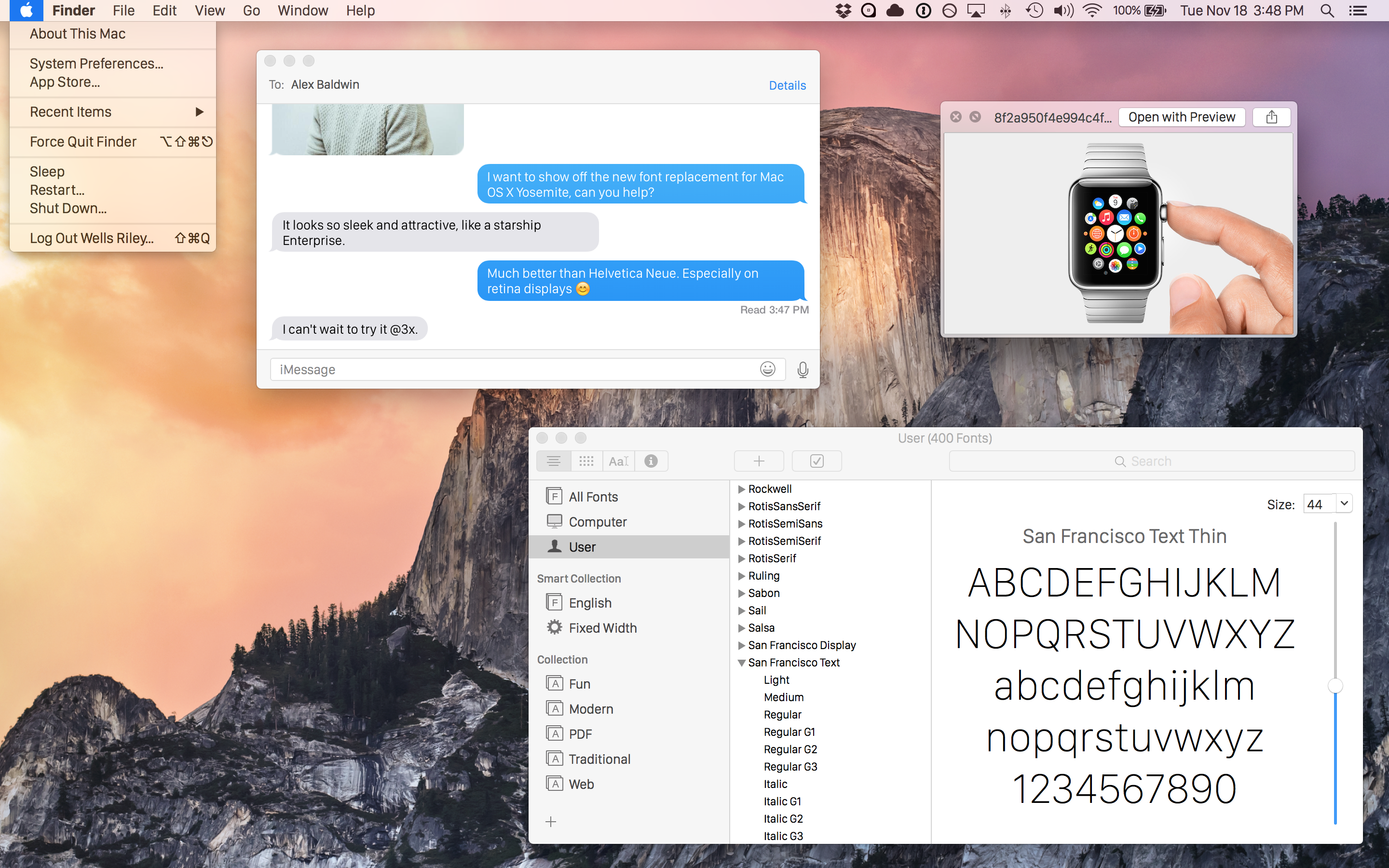
How to use the Apple Watch font as the system font on OS X Yosemite

As part of the WatchKit resources, which can be freely downloaded by anyone at Apple’s website, the company released the font it uses on Apple Watch, called San Francisco.

With Yosemite, Apple changed the system font from Lucida Grande to Helvetica, the font used on iOS. This caused some backlash amongst the designer community who detested the change of typeface. The Apple Watch font has been widely praised, leading some people to speculate whether it will become the default on iOS or OS X anytime soon. A user on GitHub has posted instructions on how to try out San Francisco on your Mac today, with some basic changes.


Expand
Expanding
Close

OS X Yosemite 10.10.1 failing to cure WiFi problems for some users – support forums

Site default logo image

Yesterday’s dot-release of OS X 10.10.1 has seemingly failed to address the WiFi problems some users have been experiencing since upgrading to Yosemite, according to continuing posts on the Apple Support Communities.

Despite the first bullet-point in the release notes for 10.10.1 reading ‘Improves WiFi reliability,’ many of those who had reported connection failures, dropped connections and slow speeds said that nothing had changed since upgrading to 10.10.1 … 
Expand
Expanding
Close

Site default logo image

Chinese authorities arrest three suspects behind ‘WireLurker’ Mac and iOS malware

Earlier this month, a new type of Mac- and iOS-based malware called “WireLurker” appeared online. Apple responded by blocking affected apps from launching on OS X, but another development was made in the case today.

According to ZDNet, Chinese authorities have arrested three suspects in connection with the malware and taken down the website that was found to be distributing it. The suspects are believed to be the creators of the software.


Expand
Expanding
Close

Apple releases OS X Yosemite 10.10.1 w/ bug fixes & WiFi improvements

Site default logo image

In addition to releasing iOS 8.1.1 for iPhone and iPad users, Apple has released OS X Yosemite 10.10.1 with bug fixes and performance improvements for Macs running the latest version of the desktop operating system. Mac users that have experienced WiFi performance issues running Yosemite should expect improvements with this bug fix release. The update is available for Macs running OS X Yosemite through the Updates tab of the Mac App Store.


Expand
Expanding
Close

Site default logo image

First ACEs Conference for Apple consultants scheduled for May 2015 in New Orleans

A new Apple-focused meetup for consultants is kicking off its inaugural conference in New Orleans, Louisiana, this coming up May. The event is called the ACEs Conference and it’s put on by two members of the Apple community, Justin Esgar and Luis Giraldo, both of whom run Apple consultant businesses in Manhattan and Canada, respectively. The two describe the event as being for Apple consultants by Apple consultants:

The Aces Conference is the first of its kind. Apple consultants teaching Apple consultants not only tips and tricks of tech, but of business too. Learn how to be a better consultant, a better technician, a better everything at Aces Conf.


Expand
Expanding
Close

Site default logo image

Microsoft continues MacBook bashing in latest Surface Pro 3 ad for the holidays

[youtube=https://www.youtube.com/watch?v=H5_CrXh227Q&feature=youtu.be]
Same old story, but with a Christmas theme this time around in the latest Apple-bashing Surface ad from Microsoft. Touchscreen, kickstand, USB, etc, Microsoft has given up on comparing its tablets with the iPad and instead wants you to believe Surface Pro 3 is an acceptable substitute for a MacBook Air.

It certainly isn’t the first time Microsoft has put the Surface Pro 3 head to head with MacBooks in its advertisements. The company has been aggressively running the comparison ads poking fun at the MacBook’s lack of tablet-like features since it first compared the devices side-by-side live on stage at the introduction of its 12-inch Surface Pro 3 back in May.

Perhaps Microsoft will get back to comparing apples to apples when we get a 12-inch iPad Pro next year?
Expand
Expanding
Close

Microsoft begins inviting users to Skype for Web beta

Site default logo image

We told you Microsoft released a redesigned version of Skype for the Mac earlier last month, and today Microsoft says the communication software is starting to roll out as a service on the Web. Skype for Web will allow users to chat, video call, and manage contacts from a web browser without having to download the Skype app. Microsoft is currently offering Skype for Web as a beta to select users.
Expand
Expanding
Close

Last chance to get a Retina iMac for the holiday nears as ship times hit 2-3 weeks

Site default logo image

When Apple announced the first 27-inch Retina 5K iMac at its special event last month, its new super high resolution desktop computer became available for purchase online that same day. Ship times for the Retina 5K iMac have since steadily slipped from 3-5 days to 7-10 days. With Black Friday and the holidays quickly approaching, though, the shipment promise for the Retina 4K iMac has stretched out to 2-3 weeks when ordering directly from Apple…
Expand
Expanding
Close

Samsung’s not done with its ‘me too’ act yet: announces Continuity clone, Flow

Site default logo image

Not content with being a ‘fast follower’ of HealthKit and HomeKit with its Digital Health and Smart Home platforms, and iBeacon with its Proximity Service, Samsung has just announced a Continuity clone, Flow.

People today use multiple devices in their daily activities: phones, tablets, laptops, smart watches, TVs, and more. But the way we work is still device-centric. We still use one application, within one device, with data that is tied to that application and device.

Samsung Flow is a platform that enables developers to create seamless transitions across devices, so that people can change devices in the midst of an activity and continue right from where they left off.

Flow is compatible with anything that works with Android’s Share feature: if content can be shared with other apps, Flow can be used to to hand it off to other devices … 
Expand
Expanding
Close

Staples turns on Apple Pay support at its retail stores ahead of Black Friday

Site default logo image

Staples shared in an announcement today that it is now accepting Apple Pay transactions at its “over 1,200 stores” in the United States for iPhone 6 and iPhone 6 Plus users. Apple Pay, of course, will also be available for iPhone 5, iPhone 5c, and iPhone 5s users starting next year when paired with the upcoming Apple Watch. Apple included Staples in its list of retail partners when announcing its secure mobile payment service, although Apple noted that support would be “coming later this year” from the retailer as it was available in time for last month’s launch.
Expand
Expanding
Close

US-China trade deal set to reduce manufacturing costs for Apple, aims to cut prices for consumers

Site default logo image

President Obama and President Xi Jinping in Beijing (photo: Agence France-Presse/Getty Images)

A trade agreement reached between the U.S. and China looks set to reduce Apple’s manufacturing costs by removing import tariffs on components imported into the country.

Apple uses components from a number of countries around the world, notably Korea and Japan, which are imported into China for the assembly of iPhones, iPads and Macs. China currently imposes import tariffs on these components. The new deal would allow companies like Apple, Microsoft and HP to bring components into China free from these charges … 
Expand
Expanding
Close

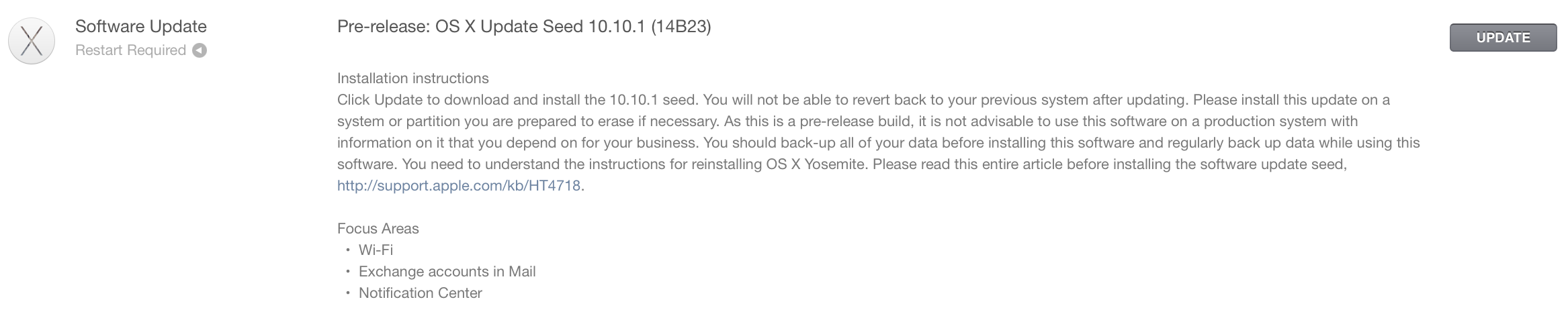
OS X Yosemite 10.10.1 build 14B23 seeded to developers

Site default logo image

Apple today seeded the second beta of the upcoming OS X Yosemite 10.10.1 update to registered developers and participants in the AppleSeed program. The update is available for these users in the Software Update tab of the Mac App Store.

As with the first beta, Apple asks developers to focus their testing on WiFi-connectvitiy, Exchange accounts in the Mail app, and Notification Center. Apple has not indicated when OS X 10.10.1 will be released to the public, but the first point updates to OS X typically arrive within a month of the original version.


Expand
Expanding
Close

Apple blocks WireLurker malware apps from opening, but needs to do more, argues security researcher

Site default logo image

Apple has now blocked the launching of Mac apps infected with WireLurker malware, after earlier revoking security certificates to prevent them being installed on new devices. WireLurker was capable of infecting non-jailbroken iOS devices when connected to a Mac running one of the compromised apps. Over 400 Mac apps in a third-party Chinese app store were affected.

In a written statement, an Apple spokesperson said:

We are aware of malicious software available from a download site aimed at users in China, and we’ve blocked the identified apps to prevent them from launching. As always, we recommend that users download and install software from trusted sources.

However, a security researcher says that it would be easy for other attackers to exploit the exact same weakness … 
Expand
Expanding
Close